Touting Your Credentials (& Humility)

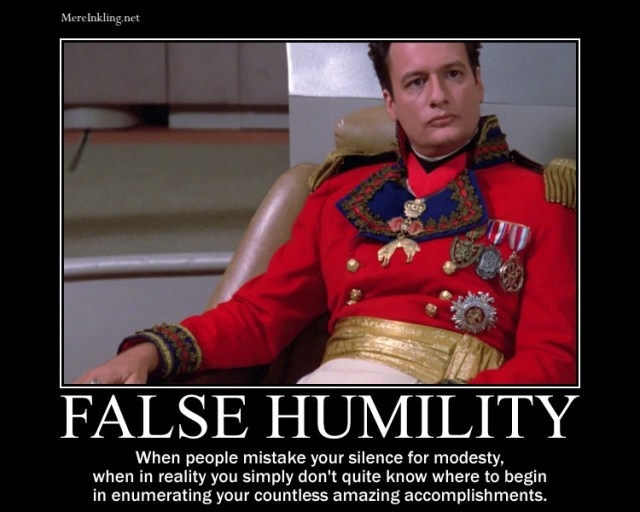
false humility

Normally, whenever writers approach a publisher (or an agent) with a book suggestion, the authors have to prepare a formal book proposal. A key element of the document—especially for nonfiction—is often called “about the author.”

This element is not “biographical;” it is a description of your particular experience or credentials that qualify you to write this book. This is also where you typically share your “platform,” media outlets, etc. where you can promote your literary endeavor.

Publishers don’t expect us to have credentials like those of C.S. Lewis. After all, not everyone becomes a professor at a prominent university.

But what potential publishers do hope, is that we know what we’re writing about, and that we can help them sell it, assuming they opt to invest in the project.

This is a logical consideration for publishing houses, who have more publishing “failures” than bestsellers. That’s not the problem.

The problem is that we are all conditioned not to brag about our accomplishments. In general, that’s a wonderful thing. (Who loves a braggart?) The difficulty is that this natural modesty becomes a terrible handicap when we are in situations where we are required to promote ourselves.

C.S. Lewis builds on the Christian witness that we must avoid pride at all costs.

According to Christian teachers, the essential vice, the utmost evil, is Pride. Unchastity, anger, greed, drunkenness, and all that, are mere fleabites in comparison: it was through Pride that the devil became the devil: Pride leads to every other vice: it is the complete anti-God state of mind. (Mere Christianity)

So, we may feel ourselves between the proverbial rock and a hard place. We genuinely desire to be modest, but certain circumstances (job interviews, anyone?) demand that we “toot our own horn.” There is, of course, one thing worse than bragging . . . pretending false humility.

A Real-Life Dilemma

A fair number of Mere Inkling’s readers also blog. Most blogging software sets up sites with a default page built in to share something about the website and its author(s). On my About page, I’ve remained anonymous. It simply describes the reason for the site’s name. The only “personal” note in the original version came in the final sentence.

Accordingly, many of the posts in Mere Inkling will be about writing and Christianity. History and humor are also keen interests of the writer of this column, so they will most certainly be encountered with regularity as well.

Now, however, I’ve discovered that we who’ve used this less personal tack have undermined the visibility of our posts.

I just learned something important on the blog of a Lutheran theologian I respect. He writes as part of the Patheos web community. They boast eleven faith channels, two of which are Nonreligious and Pagan. My friend, of course, blogs on the Evangelical channel.  I want to pass on the opening of yesterday’s column.

Google has some new algorithms, so Patheos told its writers to bolster the E.A.T. factor (“Expertise. Authoritativeness, and Trustworthiness”) for our posts. One way to do that is to beef up our biographies on the “About” section of our blogs.

Professor Veith changed his biographical page accordingly. And after reflecting on the matter, I’ve decided to do the same.

Thus, I have added a section on my About page that lists some of my credentials. I am doing this not because of personal vanity, but due to my desire to reach the widest possible audience with a message that not only points to the preeminent Inkling, but also beyond Lewis, to the Lord he served.

You may wish to consider a similar modification, if you have ignored the E.A.T. Factor in the past. And don’t be intimidated by bios such as mine, just as I am not daunted by the summits attained by Lewis. After all, he and I have had long lives during which we experienced these things.

Don’t ignore the fact that a large part of what people accomplish—academic degrees included—is due to opportunity and persistence rather than to innate giftedness. Remember as well we all have unique vocations, and not everyone is called to highly visible positions. I doubt I will be contradicted if I say that in the eyes of God, being a devoted parent is more noble than becoming some nation’s head of state.

Expanding your About page may not be the right course for you, but I believe it is the proper one for me.

One reason I had previously left my page vague is because I intentionally wished to avoid the appearance of bragging. So, as I proceed with this revision for the reason above, I will simply confess to the sin of pride (tempered over the years by God’s grace), and say along with Lewis,

I wish I had got a bit further with humility myself: if I had, I could probably tell you more about the relief, the comfort, of taking the fancy-dress off—getting rid of the false self, with all its ‘Look at me’ and ‘Aren’t I a good boy?’ and all its posing and posturing. To get even near it, even for a moment, is like a drink of cold water to a man in a desert. (Mere Christianity)

Soli Deo Gloria.

Read This Before Buying Christmas Cards

xmas cards

Fortunately, Christmas cards are not yet obsolete. Surely, many have substituted electronic alternatives, but even children of the digital age recognize that a personally scribbled note conveys a rare message—

You are worth the timeit takes me to choose a card, inscribe it, address the envelope and send it on its (dare I say, “merry”) way to you.

This pre-Christmas post is appearing so early because many of us are already addressing our Christmas greetings during the Advent season. And so it goes that Christmas cards and paraphernalia will soon usurp the place of other products in our local stores.

Whether you purchase your cards each winter, or wait until those amazing after-Christmas sales to buy them at 70% off, please keep this advice from C.S. Lewis in mind when you choose them.

Send cards that are appropriate for your recipients.

As a rule, if you are a Christian, you should send a card that celebrates the true meaningof the holy day. Naturally, this can be waived if it would cause genuine offense. However, if someone genuinely practices a different faith, why would you send them a Christmas card in the first place? A Hanukkah card, or a secular New Year’s Day or Thanksgiving seasonal missive would probably be more appropriate.

But my opinion is that for those who would not be overtly offended, a true Christ-mass card is appropriate. After all, many cards are quite gentle and inoffensive. For instance, the genre that picture a star (we recognize that celestial light as a Christian symbol during this particular season), along with words like “may you experience the joy and peace ushered in by this holy season.”

What I would encourage you to avoid sending during this time when we focus on the Incarnation miracle, is the sort of pastoral scenes with their innocuous tidings. For example, the happily sleighing family traveling in a conveyance very few of us will ever see. Send them at some other time, if you will, but they have little or nothing to do with the Nativity.

Now it’s fine if you think I’m old fashioned like the dinosaurs we recently considered.

But if you dismiss my opinion, please consider that of C.S. Lewis.

Lewis’ opinions about the commercialization of the Christmas season are well known, and we have discussed them here at Mere Inkling in the past. He, of course, abhorred the secularization of a sacred event. How sad he would be today to witness how Santa has continued to supplant Jesus.

Some will point out that Lewis himself included Father Christmas in his Chronicles of Narnia. This is true, but it is distinct from the modern secular excesses. In The Lion, the Witch and the Wardrobe, Father Christmas more closely resembles Saint Nicholas, in giving gifts and proclaiming the arrival of the King. It’s not accidental that he begins and ends his visit with the children by pointing to Aslan.

“I’ve come at last,” said he. “She has kept me out for a long time, but I have got in at last. Aslan is on the move. The Witch’s magic is weakening. . . .” Then he cried out, “Merry Christmas! Long live the true King!” and cracked his whip, and he and the reindeer and the sledge and all were out of sight before anyone realized that they had started.

C.S. Lewis was a truly devoted correspondent. He wrote back to the many fans who sought him out, and offered thoughtful responses to even the most frivolous queries. The writing was burdensome, and only the assistance of his brother Warnie for many years kept him from being forced to cease his generous practice.

Some of his correspondents were, or became, his friends. In December of 1955, he thanked one of these for the Christmas card he had sent. The friend was Peter Milward, a Jesuit priest. Lewis’ comments are still timely for Christian readers today.

Thank you for y[ou]r letter of Nov. 17. The enclosed card was one of the v[ery] few I have been pleased at getting.

Christmas cards in general and the whole vast commercial drive called ‘Xmas’ are one of my pet abominations: I wish they could die away and leave the Christian feast unentangled.

Not of course that even secular festivities are, on their own level, an evil: but the laboured and organised jollity of this—the spurious childlikeness—the half-hearted and sometimes rather profane attempts to keep up some superficial connection with the Nativity—are disgusting.

But your card is most interesting as an application of Japanese style to a Christian subject: and, me judice [in my opinion] extremely successful.

I hope you will reflect on Lewis’ thoughts on this subject. Christmas is too precious a time to be “entangled” with secular and pagan baggage.

If you send any holiday communiques—even of a digital nature—choose them wisely.


For more on C.S. Lewis and Christmas, read “A New C.S. Lewis Christmas Gift.”


A Suggestion for Your Personal Library

prayer

I just added a rare C.S. Lewis book to my library for a very reasonable price, and you can too. But you might want to hurry, since this volume will probably never be reprinted.

The small book is entitled Beyond the Bright Blur. It’s contents will be familiar to you if you have read Lewis’ final book, Letters to Malcolm: Chiefly on Prayer. That is because the former is a prepublication printing of chapters fifteen through seventeen from Letters to Malcolm.

It was published under unique circumstances, and it is thought that only 350 copies were printed in 1963 by Harcourt, Brace & World.

The title of Beyond the Bright Blur is taken from what would appear as letter fifteen in the complete volume. The “bright blur” to which Lewis refers is our imperfect, abstract and remote impression of “God.” He argues that to engage in genuine conversation with our Creator, we must dispel this fabrication.

What happens to me if I try to [approach prayer] “simply,” is the juxtaposition of two “representations” or ideas or phantoms. One is the bright blur in the mind which stands for God. The other is the idea I call “me.”

But I can’t leave it at that, because I know—and it’s useless to pretend I don’t know—that they are both phantasmal. The real I has created them both—or, rather, built them up in the vaguest way from all sorts of psychological odds and ends.

Very often, paradoxically, the first step [in genuine prayer] is to banish the “bright blur”—or, in statelier language, to break the idol.

Lewis’ candid sharing about his personal pilgrimage in prayer is just part of the treasure that is Letters to Malcolm. It is must reading. But, its priceless message is not the subject of this post.

Beyond the Bright Blur, this modest yet sturdy (hardback) tome, stands complete as it is. And it was expressly designed for a small audience. As the flyleaf states, “This limited edition is published as a New Year’s greeting to friends of the author and his publisher.”

The complete book would not be published until 1964, after Lewis had joined his wife Joy in the presence of our Lord. It is quite fitting that the final pages describe the author’s thoughts about the nature of heaven. It concludes with his final glorious epiphany that “Joy is the serious business of Heaven.”

Consider Adding this Gem to Your Own Library

I know that most readers of Mere Inkling share my affection for literature . . . along with my own affection for literature incarnated in its own natural state, physical books.

The wonderful thing is that adding this particular treasure to your personal collection is within your reach. While the price varies due to the respective booksellers and the condition of each copy, AbeBooks.com often include copies for less than forty dollars.

Occasionally an inscribed volume appears on the market, with a corresponding surcharge in the price. As I write this, the copy presented to the poet John Ciardi (1916-86) is available for purchase. While he’s most famous for his translation of The Divine Comedy, he also co-authored a collection of limericks with Isaac Asimov!

The posting says the volume includes his signature on the front end paper and “a paragraph [underlined] in the text in red ink.” Still, a truly unique volume such as this is quite a bargain at less than two hundred dollars—especially if you are a fan of Ciardi.

I suspect Ciardi received his copy as a gift from the publisher. I haven’t found any evidence that he and C.S. Lewis were acquainted. I did, however, uncover one utterly trivial connection between the two. It appears the two shared an illustrator for some of their American editions. Roger Hane, the cover illustrator for the 1970 Collier-Macmillan edition of the Chronicles of Narnia, also illustrated Ciardi’s undated The Morality of Poetry.


C.S. Lewis’ Hypocrisy

hypocrite

If you think the title of this column indicates what follows will be an attack on C.S. Lewis, you are wrong.

On the contrary, the incident described below actually emphasizes the integrity which guided Lewis’ life.

Hypocrisy afflicts us all. It’s hold is strongest, it seems to me, on those who claim they are completely free of the flaw. To paraphrase Jesus’ words recorded in John’s Gospel, “Let he who is without hypocrisy among you cast the first stone.”

It’s quite possible for our own flaws to be invisible to us. However, one of the requirements of being a moral individual is self-examination. The more honestly we can explore and assess our own actions and nature, the healthier we will be.

Some hypocrisy seems rather innocuous. For example in All My Road Before Me, Lewis describes a day in 1922 spent canoeing with his close friend Arthur, and Veronica FitzGerald Hinckley. Veronica was a recent graduate of Oxford.

In light of Lewis’ eventual life’s work, this diary entry is rather ironic:

[Veronica] made one good remark—that an educational career is a school of hypocrisy in which you spend your life teaching others observances which you have rejected yourself.

While academia does host its share of hypocrites, this vice also flourishes elsewhere. Tragically, of all the myriad contexts for hypocrisy, religious hypocrisy is the most ill-begotten.

Naturally, we would assume that basically “good” people are relatively free of hypocrisy. This is true. However, the key to uprooting these sinful influences begins with recognizing them.

In his autobiography, Surprised by Joy, Lewis acknowledges one of his most shameful acts. That it happened before his conversion to Christianity doesn’t lessen for him the wrongness of what he did.

And what was this great crime? It was on the occasion of his confirmation in the Anglican Church. Confirmation is a religious rite in which young people (particularly those in denominations which practice infant baptism) publicly profess, or confirm, their Christian faith. The problem arose because Lewis’ childhood faith had already been extinguished.

My [strained] relations to my father help to explain (I am not suggesting that they excuse) one of the worst acts of my life.

I allowed myself to be prepared for confirmation, and confirmed, and to make my first Communion, in total disbelief, acting a part, eating and drinking my own condemnation.

As Johnson points out, where courage is not, no other virtue can survive except by accident. Cowardice drove me into hypocrisy and hypocrisy into blasphemy.*

It is true that I did not and could not then know the real nature of the thing I was doing: but I knew very well that I was acting a lie with the greatest possible solemnity.

It seemed to me impossible to tell my father my real views. Not that he would have stormed and thundered like the traditional orthodox parent. On the contrary, he would (at first) have responded with the greatest kindness. “Let’s talk the whole thing over,” he would have said. But it would have been quite impossible to drive into his head my real position.

Lewis is sharing with us a sad episode of his life, to encourage us to confess our own transgressions and find forgiveness. After all, the last thing that God desires is people who just go through the motions—hypocrites who are “lovers of pleasure rather than lovers of God, having the appearance of godliness, but denying its power.” (1 Timothy 3:4-5)

A Final Warning

In The Screwtape Letters, we find the mature (and Christian) C.S. Lewis describing the sort of religious hypocrisy to which we fallen creatures are prone. Screwtape, the devil, is here advising his understudy on fostering hypocrisy in his “patient.” He has been telling Wormwood that he should nurture a sense of superiority in the person he has been assigned to tempt.

I have been writing hitherto on the assumption that the people in the next pew afford no rational ground for disappointment. Of course if they do—if the patient knows that the woman with the absurd hat is a fanatical bridge-player or the man with squeaky boots a miser and an extortioner—then your task is so much the easier.

All you then have to do is to keep out of his mind the question ‘If I, being what I am, can consider that I am in some sense a Christian, why should the different vices of those people in the next pew prove that their religion is mere hypocrisy and convention?’

You may ask whether it is possible to keep such an obvious thought from occurring even to a human mind. It is, Wormwood, it is! Handle him properly and it simply won’t come into his head.

He has not been anything like long enough with the Enemy [i.e. God] to have any real humility yet. What he says, even on his knees, about his own sinfulness is all parrot talk. At bottom, he still believes he has run up a very favourable credit-balance in the Enemy’s ledger by allowing himself to be converted, and thinks that he is showing great humility and condescension in going to church with these ‘smug,’ commonplace neighbours at all. Keep him in that state of mind as long as you can . . .

Hypocrisy is a powerful foe. But once it is recognized as the damning lie it is, hypocrisy loses its control over us. We are freed to rebuke it, repent of it, and be healed.

—-

* “For I received from the Lord what I also delivered to you, that the Lord Jesus on the night when he was betrayed took bread, and when he had given thanks, he broke it, and said, “This is my body, which is for you. Do this in remembrance of me.” In the same way also he took the cup, after supper, saying, “This cup is the new covenant in my blood. Do this, as often as you drink it, in remembrance of me.” For as often as you eat this bread and drink the cup, you proclaim the Lord’s death until he comes.

“Whoever, therefore, eats the bread or drinks the cup of the Lord in an unworthy manner will be guilty concerning the body and blood of the Lord. Let a person examine himself, then, and so eat of the bread and drink of the cup. For anyone who eats and drinks without discerning the body eats and drinks judgment on himself. That is why many of you are weak and ill, and some have died. But if we judged ourselves truly, we would not be judged.” (1 Corinthians 11:23-31)

C.S. Lewis at Belsen

belsen school

Boarding schools are somewhat rare in the United States. And that is a good thing.

C.S. Lewis attended three, and he considered two of them to be torturous. The first he came to refer to as Belsen, in reference to the deadly Nazi concentration camp. His older brother, Warnie, had moved to the same school when he too was nine, three years earlier.

The headmaster of Wynyard School in Hertfordshire was an Anglican priest named Robert Capron who was quite unhinged. In fact,

The school that [his father] Albert Lewis, after careful study and deep reflection, chose for his sons was run quite autocratically by a man who had already been prosecuted for cruelty to his students and who, within a very few years, would be certified as insane. (The Narnian)

Honestly, there is a proper place for boarding schools—as long as they are not operated by lunatics.

As I finished seminary, a window opened for my wife and me to serve on the “mission field.” After serious prayer, we told the missions agency that “we will happily serve in any nation, discharging any type of ministry duties . . . so long as our children can remain with us.”

Some people are willing to make even that sacrifice. And they not limited to those in ministry. When I was stationed in the United Kingdom, the United Stated Department of Defense operated its own boarding school for military dependents at RAF High Wycombe. (Canadians attended as well.)

Leaving a Mark

It’s no surprise boarding schools left a deep imprint on Lewis’ psyche. For seven-plus months of the year, they controlled nearly every aspect of his life, from “reveille” to slumber.

He wrote about the repercussions in a variety of places, most notably his autobiography,  Surprised by Joy: The Shape of My Early Life. During a recent rereading of the collection of essays in Present Concerns, I enjoyed “My First School.”

The essence of the essay is anticipation—anticipation of good events, such as holidays, and ominous occasions (in this case, the return to the schoolhouse). Before exploring that subject, Lewis sets the stage by briefly describing the grim environment at Belsen.

The Head [Rev. Capron] had, indeed, a grown-up son, a smooth-faced carpet-slipper sort of creature . . . a privileged Demi-god who ate the same food as his father though his sisters shared the food of the boys.

But we ourselves were . . . Beaten, cheated, scared, ill-fed . . .

Later, as a Christian adult, Lewis was able to glean some good even from these demoralizing days.

Life at a vile boarding school is, in this way, a good preparation for the Christian Life, that it teaches one to live by hope. Even, in a sense, by faith; for at the beginning of each term, home and holidays are so far off that it is as hard to realize them as to realize heaven. (Surprised by Joy)

It teaches one to live by hope.

In 1911 Lewis would be sent to a far better school, Cherbourg House in England. It was a prep school for Malvern College where he would follow his brother as a student. Although this school was healthier, it possessed its own shortcomings.

Cherbourg House was the tragic place where Lewis lost his childhood faith.

The chronology of this disaster is a little vague, but I know for certain that it had not begun when I went there and that the process was complete very shortly after I left. I will try to set down what I know of the conscious causes and what I suspect of the unconscious.

Most reluctantly, venturing no blame, and as tenderly as I would at need reveal some error in my own mother, I must begin with dear Miss C., the Matron. No school ever had a better Matron, more skilled and comforting to boys in sickness, or more cheery and companionable to boys in health. She was one of the most selfless people I have ever known. We all loved her; I, the orphan, especially.

Now it so happened that Miss C., who seemed old to me, was still in her spiritual immaturity, still hunting, with the eagerness of a soul that had a touch of angelic quality in it, for a truth and a way of life. Guides were even rarer then than now.

She was (as I should now put it) floundering in the mazes of Theosophy, Rosicrucianism, Spiritualism; the whole Anglo-American Occultist tradition. Nothing was further from her intention than to destroy my faith; she could not tell that the room into which she brought this candle was full of gunpowder.

I had never heard of such things before; never, except in a nightmare or a fairy tale, conceived of spirits other than God and men. I had loved to read of strange sights and other worlds and unknown modes of being, but never with the slightest belief . . .

But now, for the first time, there burst upon me the idea that there might be real marvels all about us, that the visible world might be only a curtain to conceal huge realms uncharted by my very simple theology. And that started in me something with which, on and off, I have had plenty of trouble since—the desire for the preternatural . . . (Surprised by Joy)

In closing with Lewis’ sad slide into atheism, this brief look at his experience in boarding schools affords us a sobering reminder.

Christian parents (indeed, all parents) are quite wise to be cautious about where they have their children schooled. After all, educators also expose their students to their particular worldviews.


I have written previously about education in the column “Were All Valedictorians!

For a brief consideration of Belsen’s influence on the Chronicles of Narnia, turn here.

Suicide as a Gateway to Paradise

hamas

I wonder what C.S. Lewis would have made of our twisted world in which some adherents of a globe-spanning “monotheistic tradition” believe they can enter heaven by spilling the blood of innocents.

Not long ago, a husband and wife in Indonesia, simultaneously attacked three different Christian churches. Yes, three. There, in the world’s largest Islamic nation, they killed all four of their own children to work ISIS-inspired jihad.  

The father blew himself up at one church in a car bomb. The two teenage sons exploded at a second congregation. And the woman who had given birth to these willing murders, ushered her 9 and 12 year old daughters into a Christian sanctuary and . . . 

CNN has some video related to the incident, accompany their article on the attacks. 

I’ve written about suicide in the past from two perspectives. This discussion considered the question in a general sense, and this piece was inspired by my own encounter with a suicide situation.

The horrific event describe above—the mass murder accomplished by a single family—leaves us speechless. How can this be? How can a group of people be so deceived as to think the suffering of others will purchase their entrance into heaven? How can they wantonly sacrifice their own children on that altar of hatred?

The only answer to these questions is that it is caused by evil. Not confusion, evil. And not even merely evil—but Evil. The precedent for such vile acts go all the way back to humanity’s first family.

We should not be like Cain, who was of the evil one and murdered his brother. And why did he murder him? Because his own deeds were evil and his brother’s righteous. (1 John 3:12)

A dozen victims died that morning. More than forty more were wounded. And this murder/suicide will surely not be the last of its kind.

C.S. Lewis’ View

Lewis was acquainted with evil. He recognized it bears many faces. Yet, it seems to me, that he too would find this murderous abomination incredible. Incredible in its most naked sense—impossible to believe.

I believe Lewis would be stunned. Just like we are. 

This is true, despite the fact that Lewis was prescient about the decay of the life-affirming core of civilization. In the words of an insightful article by Richard Weikart:

Many Christians recognize that we are living in a “culture of death,” where—especially in intellectual circles—there is easy acceptance of abortion and increasing support for physician-assisted suicide, infanticide, and euthanasia. . . . 

When C.S. Lewis cautioned about the dangers of dehumanizing secular ideologies in The Abolition of Man and his science fiction novel That Hideous Strength . . . on the whole, the intellectual world paid little heed, careening further down the fateful road against which Lewis warned. 

Few of us, by God’s mercy, see this sort of evil face-to-face. Military personnel and first responders are more likely to encounter it.

Despite our personal insulation from this violence, we too are targets of the Evil One. However, the tactics he employs against us are usually far more subtle and insidious. 

Lewis recognized this well. The Screwtape Letters is his masterful exploration of the way the Devil attempts to corrupt even those among us who do not believe in his existence. 

It does not matter how small the sins are provided that their cumulative effect is to edge the man away from the Light and out into the Nothing. Murder is no better than cards if cards can do the trick. Indeed the safest road to Hell is the gradual one—the gentle slope, soft underfoot, without sudden turnings, without milestones, without signposts . . .

No one who reads Mere Inkling will be tempted to immolate themselves. Much less to steal the life of innocents. Still, the more conscious we become of this world’s self-destructive inclinations, the better equipped we should become to consciously become life-affirming influences in our cultures. 

This, I believe, is our common prayer.

C.S. Lewis and Kierkegaard

kierkegaard.png

The diary of Danish philosopher, Søren Kierkegaard, includes some revealing insights into the life of a writer . . . words that I suspect may echo your own experience.

While I would never turn to Søren Kierkegaard for theological inspiration (many do), his comments about writing parallel my own.*

Only when I write do I feel well. Then I forget all of life’s vexations, all its sufferings, then I am wrapped in thought and am happy. If I stop for a few days, right away I become ill, overwhelmed and troubled; my head feels heavy and burdened.

So powerful an urge, so ample, so inexhaustible, one which, having subsisted day after day for five or six years, is still flowing as richly as ever, such an urge, one would think, must also be a vocation from God.

If these great riches of thought, still latent in my soul, must be repressed, it will be anguish and torture for me, and I shall become an absolute good-for-nothing. […]

Being an author . . . is not self-chosen; it is concomitant with everything in my individuality and its deepest urge.

May God then give me good fortune and succor and above all a certain spirit, yes, a certain spirit to resist the onslaughts of doubt and temptation that rise within me, for after all it is not too hard to do battle with the world.

This passage fascinates me. Kierkegaard eloquently expresses the struggle of the Christian writer, then ends on such a uniquely positive note, “after all it is not too hard to do battle with the world.” This victory, he indicates, comes from God placing within us a certain spirit to resist the onslaughts of doubt and temptation that rise within” us.

Keeping our eyes on Christ, and yielding to the Holy Spirit who abides within us, does indeed ensure our victory. Though the world assaults us daily, as we grow more mature in our Lord its temporary gains against us grow smaller and fewer.

I encountered Kierkegaard’s words in a recent post by Steve Laube, a prominent agent. (His agency’s blog is well worth subscribing to.) As he says,

These words resonate because it is the universal condition of writers. The call, the urge, to write is part of who you are. However, notice his last sentence where he admits to “the onslaughts of doubt and temptation that rise within me.” This, again, is a universal condition. It is normal. Embrace it and pray that God will grant you the strength today to resist.

Then do it again tomorrow.

Turning to Lewis

Although Kierkegaard’s words were written in 1847, it’s doubtful C.S. Lewis would have been familiar with them. The rather severely** edited diary did not appear until 1960, only a couple of years before Lewis’ passing.

As a scholar, Lewis was familiar with Kierkegaard. While he did not find Kierkegaard’s existentialism helpful, he could acknowledge that some appreciated his writings. In 1961, he responded to a correspondent’s request for some recommendations, he wrote,

For meditative and devotional reading . . . I suggest . . . my selection from MacDonald, George MacDonald: an Anthology. I can’t read Kierkegaard myself, but some people find him helpful.

The primary reason for Lewis’ albeit tepid mention of Kierkegaard here must have been the fact that one of his close friends was keen on the philosopher. An early translator of Kierkegaard’s works praised Inkling Charles Williams who “affectionately fostered the enterprise of publishing S.K.’s works in English.” (“How Kierkegaard Got into English”).

I am curious how Lewis would have responded to Kierkegaard’s notes on the writing life. Would he have identified with these sentiments?

I suspect they would concur in the statement, “If these great riches of thought, still latent in my soul, must be repressed, it will be anguish and torture for me.” After all, as many of Mere Inkling’s readers can personally attest, the Great Dane was not alone in experiencing this explosive pressure.

As an ancient man named Elihu once said to the Prophet Job, “I am full of words, and the spirit within me compels me; inside I am like bottled-up wine, like new wineskins ready to burst.” (Job 32:18-19).

My advice—get your precious words out before they explode.


* Here you will find the “testimony” of a person whose atheism was reinforced by reading Kierkegaard.

** The editor, Peter Rohde, says in his preface: “The luckless reader who sets out on his own to find his way in Kierkegaard’s vast, and vastly demanding works, runs the risk of losing his way and finally of losing his courage.”

It is precisely their fragmentary character that dispenses us from the obligation which the finished works place upon us, viz. to respect their wholeness—for it is nonexistent.

However, from their 8,000 to 10,000 pages it is possible to distill some one hundred and fifty pages that contain the true essence—that is, if the editor has been successful in his selection.

Rewarding Destructive Behaviors

monopoly

It is almost too obvious to require saying: you reinforce the behaviors you reward. Why then, would any society intentionally train its youth to be dishonest?

One justification I’ve heard, more and more frequently in recent years, is that it’s all about winning—coming out on top. The motto of these folks is “do whatever it takes to win.” Yet this is a recipe for a disastrous life. In the words of Jesus: “what does it profit a man if he gains the whole world and loses or forfeits himself?” (Luke 9:25)*

Our recreational choices say a lot about us and our values. Digital options have reduced the influence of board games, so one perennial favorite has devised a strategy to regain its market share.

Monopoly is based on accumulating wealth and, for the merciless, crushing one’s competitors. Some might argue that the capitalism which provides the basis for the game is corrupt in and of itself. Still, Monopoly has always had clear rules that governed actions.

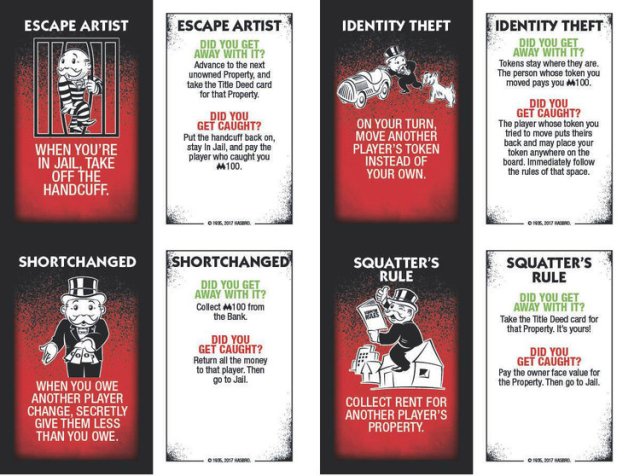
But some players cheated. Capitalizing on this sinister impulse, Monopoly has created a new “Cheaters Edition.” Yes, you read that right.

Christian publications have announced the game’s arrival. The current issue of Citizen notes that even though cheating is actively encouraged in the game, negative consequences are also possible.

Mind you, it’s not that anything goes. Cheat successfully and you get rewarded; get caught and you get punished.

Even the “secular” Bloomberg review of the new game acknowledges the moral confusion of the product, closing its report with:

Clearly this begs some deeper philosophical questions about modern life and the future of morality and humanity, but, wait, did you just land on Boardwalk? Yes, I definitely always had a hotel on there! Trust me.

Nurturing Healthy Behaviors

One does not have to be a parent to recognize this wisdom of this Proverb: “Train up a child in the way he should go; even when he is old he will not depart from it” (Proverbs 22:6).

In fact, even pet “owners” know the necessity of training (e.g. housebreaking) our canine and feline family members.

Many games highlight positive choices, consciously or subconsciously reinforcing good. The simplest and most common method for this process comes not in a board game or a digital alternative. It is found in verbal praise.

There is ongoing debate about the value of praise. It’s clear that insincere or mechanistic praise would be of insignificant worth, and potentially dangerous. Some psychologists go so far as to state that “Positive reinforcement can undercut a child’s intrinsic motivation.”

C.S. Lewis understood that we cannot manufacture our own motivations.

I cannot, by direct moral effort, give myself new motives. After the first few steps in the Christian life we realise that everything which really needs to be done in our souls can be done only by God (Mere Christianity).

Despite this truth, it is also argued that our character can be shaped, in a sense, by consciously and repeatedly choosing to do what is right. Gradually then, by God’s grace, obedience may gradually give way to a more honest and natural motivation as the positive paths become our normal, well-traveled path.

This is not simply a “Christian” concern. The philosopher Aristotle noted “Good habits formed during youth make all the difference.” (What do you think Aristotle would think about the Cheater’s Edition of Monopoly?)

C.S. Lewis would doubtless concur with Aristotle. I assume most of Mere Inkling’s readers agree with the ancient wisdom as well.

A final thought. This cheater’s edition of Monopoly probably possesses less power to damage lives than Hasbro’s Ouijà board game. But that’s a subject for another day


* In Matthew 16 we read the more familiar “For what will it profit a man if he gains the whole world and forfeits his soul? Or what shall a man give in return for his soul?”

cheat card

Lewis, Newman, Purgatory & Writing

csl & newman.png

Those who despise C.S. Lewis seek to eradicate his influence in the Christian Church. They care not that Lewis remains one of the most effective Christian apologists the world has ever seen. Only the Lord knows how many people (literally) have been encouraged in the faith by Lewis’ ministry.

When examining Lewis’ theology, it is necessary to keep in mind several facts. First, he often reminded his readers that he was not a theologian, simply a faithful layman. Second, he formally espoused and practice the orthodox Trinitarian faith as professed by the Anglican communion. Third, Lewis consciously sought to introduce timeless truths to his readers via reason and, more effectively, through fiction and imagination. (The Great Divorce offers a fascinating yet fully fictional exploration of how purgatory might work.)

Thus, Lewis critics will always be able to gather fuel for the foot of his stake. A primary example of this comes in Lewis’ emotive receptivity to the doctrine of purgatory. It is taught only by the Roman Catholic Church, although individuals from other denominations may also be sympathetic to it.

For example, Protestant philosopher Jerry L. Walls includes a chapter in his recent book on purgatory entitled, “C.S. Lewis and the Prospect of Mere Purgatory.”

Although not a Roman Catholic, C.S. Lewis, the most popular Christian writer of the twentieth century, believed in purgatory. This is significant because his influence in Protestant and evangelical circles is perhaps especially strong.

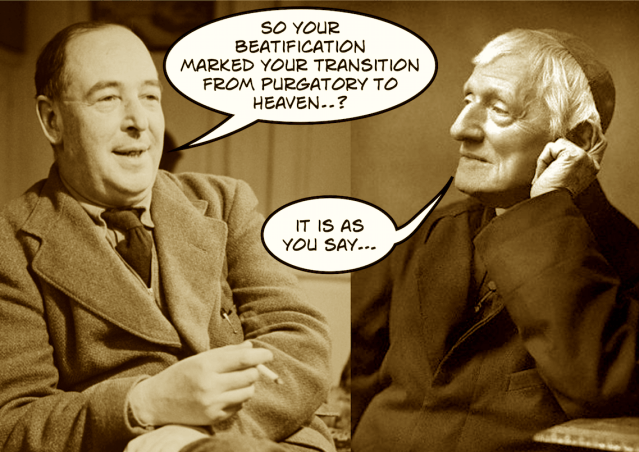
This chapter shows not only that Lewis believed in purgatory, but also that it is integral to his theology of salvation. It explores how he understood the doctrine by examining his comments on Roman Catholic theologians John Fisher, Thomas More, and John Henry Newman. While he was quite critical of Fisher and More, he saw in Newman the recovery of the true substance and spirit of the doctrine.

It is fair for us to acknowledge that Lewis’ understanding of justification was imperfect. Salvation comes through faith (Romans 5:1), not through penitential or purgatorial efforts. But let’s read about his position in his own words. The following comes from Letters to Malcolm: Chiefly on Prayer, which is, itself, a collection of thoughts “shared” with a fictional friend.

I believe in Purgatory.

Mind you, the Reformers had good reasons for throwing doubt on “the Romish doctrine concerning Purgatory” as that Romish doctrine had then become. . . .

The right view returns magnificently in Newman’s Dream.* There, if I remember it rightly, the saved soul, at the very foot of the throne, begs to be taken away and cleansed. It cannot bear for a moment longer “With its darkness to affront that light.” Religion has reclaimed Purgatory.

Our souls demand Purgatory, don’t they? Would it not break the heart if God said to us, “It is true, my son, that your breath smells and your rags drip with mud and slime, but we are charitable here and no one will upbraid you with these things, nor draw away from you. Enter into the joy”?

Should we not reply, “With submission, sir, and if there is no objection, I’d rather be cleaned first.”

“It may hurt, you know”

“Even so, sir.”

This is where I acknowledge Lewis’ view on justification to be deficient. Of course we would wish to be fully washed and clean before standing in our Creator’s presence. And that is precisely how we enter into his presence. Clothed not in our own filthiness and rags—but in the radiant righteousness of our Savior.

As the Apostle John wrote in his first epistle, “But if we walk in the light, as he is in the light, we have fellowship with one another, and the blood of Jesus his Son cleanses us from all sin. . . . If we confess our sins, he is faithful and just to forgive us our sins and to cleanse us from all unrighteousness” (1 John 1:7, 9)

Lewis’ greatest contribution to the Christian Church is found in his skilled apologetics based on the core essence of our faith. Lewis communicated the divine hope that is within us in his lectures, speeches and broadcasts. But it was through the written word that his inspiring words have touched the greatest number of people.

On the Subject of Writing

It is possible that Lewis was familiar with the following advice from Newman about effective writing. Certainly, he agreed with a number of the cardinal’s literary precepts. The following passage relates specifically to writing sermons, but it possesses far broader application. It comes from The Life of John Henry Cardinal Newman.

Newman’s own feeling as to the most effective way of imparting truth by writing is conveyed in the following notes, dated 1868, on the writing of sermons:

A man should be in earnest, by which I mean he should write not for the sake of writing, but to bring out his thoughts.

He should never aim at being eloquent.

He should keep his idea in view, and should write sentences over and over again till he has expressed his meaning accurately, forcibly, and in few words.

He should aim at being understood by his hearers or readers.

He should use words which are likely to be understood. Ornament and amplification will come spontaneously in due time, but he should never seek them.

He must creep before he can fly, by which I mean that humility which is a great Christian virtue has a place in literary composition.

He who is ambitious will never write well, but he who tries to say simply what he feels, what religion demands, what faith teaches, what the Gospel promises, will be eloquent without intending it, and will write better English than if he made a study of English literature.

Reading this helpful advice from Cardinal Newman reminds us we can learn valuable lessons from people with differing theology. And that truth should be quite encouraging, since none of us possess perfect doctrine.


* The full title of the work to which Lewis refers here is The Dream of Gerontius. (You can read it here.)


Dishonest Diagnoses

x-ray.png

Do you prefer honesty—or would you rather hear something that makes you feel good?

It’s pleasant to hear things that feel positive, but that feeling is fleeting, and potentially devastating, when we have heard a lie.

In a recent column devoted to a comedian who passed away two decades ago, I encountered a joke that probes this problem. Henny Youngman poses a dilemma, and solves it with the worldly solution. In the following one-line joke, he proposes an alternative to unwelcome news.

When I told my doctor I couldn’t afford an operation, he offered to touch up my X-rays.

If only it were so simple to change bad news to good. The truth may not always be welcome, but it is nearly always preferable to believing a lie. Sadly, avoiding discomfort by telling people what they want to hear, has become a modern plague.

Well, “modern” isn’t the best word. This dishonesty has been around for a long time, and it will persist until the Parousia. The Apostle Paul described it to a younger pastor by saying, “having itching ears [people] will accumulate for themselves teachers to suit their own passions, and will turn away from listening to the truth . . .” (2 Timothy 4:3-4)

That’s one reason that certain religious messages are more popular than others. They “promise” you that if you follow their teachings, there are only good times ahead.

An Honest Diagnosis

In contrast to these lies, the truth admits life is not always perfect. The truth acknowledges that doing right is often more difficult than going with the flow.

But trading the truth for the lie is dangerous. One can be approaching a sheer precipice, requiring swift avoidance. But if we heed the voices saying “all is well,” we may blindly step into oblivion.

C.S. Lewis described the way that Satan would like to have us deluded about our real condition and circumstances. In the Screwtape Letters, a senior demon offers evil counsel to a junior devil assigned as a tempter.

How much better for us if all humans died in costly nursing homes amid doctors who lie, nurses who lie, friends who lie, as we have trained them, promising life to the dying, encouraging the belief that sickness excuses every indulgence, and even, if our workers know their job, withholding all suggestion of a priest lest it should betray to the sick man his true condition.

If you are one of the minority who welcome the truth, however challenging, I commend you.

If you find yourself preferring those who encourage you to be comfortable and complacent about who you are and how things presently are, I encourage you to listen to other (more honest) voices. Voices that encourage you to become a better woman or man today than you were yesterday. Voices that call you to the true path God is laying out before you.

In the long run, altered x-rays will never help us to recover from the illnesses of body, mind and soul that assail us. Only the Truth is able to set us free.