The Brevity of Life

O Lord, make me know my end and what is the measure of my days; let me know how fleeting I am! Behold, you have made my days a few handbreadths,
and my lifetime is as nothing before you. Surely all mankind stands as a mere breath! Surely a man goes about as a shadow! (Psalm 39:4-6, ESV).

I was reminded this week of that terrible cloud that hangs over all humanity . . . the brevity of our lives.

The Psalmist David lived a long life. Yet, during it he experienced great trials, some of which he failed. In this Psalm, he describes the vast gap between God and his creation.

Even human beings, created in the Lord’s very image so that we might worship him and live in fellowship with him for all time . . . even we human beings, because of sin, are destined to perish. We all die.* It is one of very few certainties that exist; as Benjamin Franklin famously wrote: “In this world nothing can be said to be certain, except death and taxes.”

The Bible can sound almost depressing when touching on the theme of life’s swift passage. But if we begin to despair, we have entirely missed the purpose of these verses. They are simply there to remind us of our utter dependence on God.

We must not trust in the pagan wishful thinking of the “immortality of the soul,” apart from its Creator. Nor should we deny God’s presence and surrender to the belief that there is no existence beyond this life. The latter is a particularly sad “religion,” or worldview. And like all beliefs, it requires “faith” (trust) to believe there is no afterlife. C.S. Lewis described that fact in a 1956 epistle included in Letters to Children.

People do find it hard to keep on feeling as if you believed in the next life: but then it is just as hard to keep on feeling as if you believed you were going to be nothing after death. I know this because in the old days before I was a Christian, I used to try.

The message of the Scriptures is not for us to bemoan the fact that we will die, and that our days in this world are brief. On the contrary, God’s word paints this picture vividly, with the sharp colors of reality (rather than numbing pastels of euphemisms) because it is vital that we understand how this life is merely a prelude to the life that follows.

I began this post by saying I’d recently been reminded of death’s immanence. Last year I had written a brief letter to Calvin Miller, the anointed author I quoted in my previous meditation. He graciously responded. Well, it dawned on me that he might enjoy reading my comments about The Philippian Fragment, so I wrote him again four days ago. I had not heard back, and eagerly awaited his reaction . . . only to learn yesterday that Dr. Miller had passed away two days after I wrote to him.

While I was saddened (on behalf of his family and fans) to hear of his death, I recognize that he is already experiencing a more abundant and true life this very moment, than any he could ever know here. Still, I wish I’d written to him just a few days earlier, since I’m curious what he might have thought about my modest words on the subject of compassionate ministry.

Since we began with a Psalm of David despairing about the brevity of human life, it is fitting to end with another song penned by the same royal composer. Once again he acknowledged the shortness of our lives. But here, he makes it very clear that due to God’s immeasurable love for his children, we have an “everlasting” destiny, which will never end. His children by faith, who have trusted in his only begotten Son, already possess the gift of eternal life. And we will experience it fully after the resurrection, when we have discarded this fallen shell and been clothed in our new body.

As for man, his days are like grass; he flourishes like a flower of the field; for the wind passes over it, and it is gone, and its place knows it no more. But the steadfast love of the Lord is from everlasting to everlasting on those who fear him, and his righteousness to children’s children, to those who keep his covenant and remember to do his commandments. The Lord has established his throne in the heavens, and his kingdom rules over all. (Psalm 103:15-19, ESV).

* For theological clarification, it is possible for God to raise someone to heaven without dying (e.g. Elijah), and those who are still living when Christ returns in the Parousia, will not have to experience physical death.


Lewis’ Appreciation of Architecture

I don’t have much of a gift for drawing, but I often find the simplest artwork quite engaging. Nor do I understand the mathematics necessary to become an accomplished architect—yet I definitely appreciate the majesty of finely designed buildings.

This, I recently learned, is another thing that I have in common with Jack Lewis.

We lunched at Wells after seeing the Cathedral. . . . I am no architect and not much more of an antiquarian. Strange to say it was Uncle H. with his engineering more than our father with his churchmanship that helped me to appreciate it; he taught me to look at the single endless line of the aisle, with every pillar showing at once the strain and the meeting of the strain (like a ship’s framework inverted); it is certainly wonderfully satisfying to look at. The pleasure one gets is like that from rhyme—a need, and the answer of it following so quickly that they make a single sensation. So now I understand the old law in architecture, “no weight without a support, and no support without an adequate weight.” (Letters of C.S. Lewis, 7 August 1921).

Lewis aptly describes how large cathedrals are built. Many “regular” churches display similar construction, albeit in more modest proportion. Like admiring the stained glass common to many houses of worship, gazing at their structural beauty can cause us to “lose ourselves” for a moment. Sometimes massive columns or graceful arches can even spark within us a sense of awe.

Awe inspiring architecture takes varied forms. It can be conveyed by simple scale. I have yet to visit Hagia Sophia (a dream I hold), but I have visited the Cathedral of Notre Dame. With the souvenir shops tastefully hidden away, it’s probably their age that most touches me.

The awareness that my brothers and sisters in Christ have offered prayers in each for nearly a millennia or more is sobering. And, I believe our wonderful friend C.S. Lewis was equally impressed by that fact.

Yes, huge sanctuaries are impressive, but a church does not need to be massive to impress. There is a modest church in Cambridge, England which my wife and I visited several times. It is the Church of the Holy Sepulchre, and it was inspired by the original Church of the Holy Sepulchre in Jerusalem. Crusaders who had worshipped in Jerusalem carried home the vision of the simple edifice, and it was built in Cambridge around 1130.

When we lived in England, the congregation there was vibrant and reaching out to those without hope. Apparently shortly after we departed, it “outgrew” the facilities there and had to relocate to a larger building.

I don’t recall Lewis specifically mentioning this parish, although I can’t imagine him teaching at the University there and not at least visiting the Church of the Holy Sepulchre. And when he entered the holy place, I can easily picture him joining me in admiration of the artistic symmetry of the arches and columns, “with every pillar showing at once the strain and the meeting of the strain.”

Nature’s Melodies

Recently we were walking our five year old granddaughter home after a visit to our house, and she said something remarkable. (Our son’s family lives on a forested parcel adjacent to our own near Puget Sound.)

This precious little girl gazed to the top of the tall pine and fir lining the path and said, “I love the music the woods make.” She went on to describe various elements of nature’s orchestra, including the whistling wind in the treetops, the croaking of innumerable frogs drumming down by the pond, and, of course, the varied melodies of the birds who also call this glorious place “home.”

It was a wonderful moment.

When we pause to appreciate nature, it reminds us of the beneficent God who created it. Nature, especially when it is pristine and untouched by human hand, is truly wondrous. There are, I recognize, some “natural” settings that might actually be improved by human intervention . . . but these are few.

Unspoiled nature is beautiful. And that is a crucial distinction to make—because nature too has been corrupted by humanity’s fall from grace. Its capricious temperament is manifested in storms and other disasters.

So we, as Sons of Adam and Daughters of Eve must be content to savor this blurred image of God’s original creation. For, even this corrupted world, is surely magnificent.

C.S. Lewis appreciated this truth. He and his close friends enjoyed many a long walk across the English countryside.

Nature is an awe-inspiring thing, but she is incapable of communicating ultimate joy. To find that, we must look beyond the forest to see who wrote the music it so eloquently sings.

In The Four Loves, Lewis emphasizes this truth:

Nature cannot satisfy the desires she arouses nor answer theological questions nor sanctify us. Our real journey to God involves constantly turning our backs on her; passing from the dawn-lit fields into some pokey little church, or (it might be) going to work in an East End parish. But the love of her has been a valuable and, for some people, indispensable initiation.

May our Creator grant us the opportunity to enjoy his unfathomable creation—even as we recognize that it is only by his boundless grace we are capable of doing so.

Charting Our Life Course

In our last conversation we considered the fact that life is a journey. And during this journey which encompasses our very existence, we follow a variety of paths.

Not all of the paths lead to “happy endings.” I almost wrote “fairy tale endings,” but then I recalled that some old folk tales conclude in a rather grim fashion.

Signposts stand as sentinels at the junctions. “Take this path to self-fulfillment.” “Follow this lane to explore forbidden pleasures.” “This way leads to power.” They offer promises aplenty, but their veracity is not guaranteed. In fact, the more outlandish the claims, the more suspect they become to the wise.

Speaking of wisdom, some of the most powerful words in the Book of Proverbs relate to this notion of choosing paths cautiously. Wisdom and Folly are personified as two women. One offers life-enriching knowledge and insight. The other proffers more carnal and transitory wares.

My son, keep my words


    and treasure up my commandments with you . . .

Say to wisdom, “You are my sister,”


    and call insight your intimate friend,

to keep you from the forbidden woman,


    from the adulteress with her smooth words.

. . . and I have seen among the simple,


    I have perceived among the youths,


    a young man lacking sense,

passing along the street near her corner,


    taking the road to her house . . .

And behold, the woman meets him,


     dressed as a prostitute, wily of heart.

She is loud and wayward;


     her feet do not stay at home;

now in the street, now in the market,


    and at every corner she lies in wait. . . .

I have spread my couch with coverings,


    colored linens from Egyptian linen;

I have perfumed my bed with myrrh,


    aloes, and cinnamon.

Come, let us take our fill of love till morning;


    let us delight ourselves with love.

For my husband is not at home;


    he has gone on a long journey . . .

With much seductive speech she persuades him;


    with her smooth talk she compels him.

All at once he follows her,


    as an ox goes to the slaughter,

or as a stag is caught fast

    till an arrow pierces its liver;

as a bird rushes into a snare;


    he does not know that it will cost him his life.

And now, O sons, listen to me,


    and be attentive to the words of my mouth.

Let not your heart turn aside to her ways;


    do not stray into her paths,

for many a victim has she laid low,


    and all her slain are a mighty throng.

Her house is the way to Sheol,


    going down to the chambers of death.

The power of this proverb is in its truth. I have actually known the seductresses (and seducers) described in these verses. Well, I’ve been acquainted with emanations of both female and male versions of Folly, since they are legion.

Despite the Lies, There is Still Hope

The key to journeying through life with the fewest deadly detours is to rely on a trustworthy guide. A compass, so to speak. A map or handbook that soundly advises which paths to take, and what precipices to avoid.

Of course, if we would rather take the risk, we can rely on human ignorance (is West to my right or my left?) . . . or worldly counsel (let us take our fill . . .).

The Bible lays out the safe and proven path. What’s more, our Savior—who calls himself “The Way,”—promises to accompany us on the journey itself.

One of C.S. Lewis’ least read books is entitled The Pilgrim’s Regress. It is modeled on the classic Pilgrim’s Progress, written by John Bunyan in 1678. The Pilgrim’s Regress was Lewis’ first published work of prose fiction. His protagonist goes through a period of disbelief, mirroring Lewis’ own. It is well worth the read, although, perhaps, it is best preceded by a reading of Bunyan’s original work.

Toward the end of his allegory, Lewis brilliantly describes the course of travel for many who sojourn for a season in foreign (unbelieving) realms. The traveler learns that all who earnestly seek the Truth ultimately find it in a single Source. I offer the following passage not as a “spoiler,” but to illustrate the importance of following the right path—and to entice you to consider reading The Pilgrim’s Regress.

“What do you see?” said the Guide.

“They are the very same shape as that summit of the Eastern Mountain which we called the Landlord’s castle when we saw it from Puritania.”

“They are not only the same shape. They are the same.”

“How can that be?” said John with a sinking heart, “for those mountains were in the extreme East, and we have been travelling West ever since we left home.”

“But the world is round,” said the Guide, “and you have come nearly round it. The Island is the Mountains: or, if you will, the Island is the other side of the Mountains, and not, in truth, an Island at all.”

“And how do we go on from here?”

The Guide looked at him as a merciful man looks on an animal he must hurt.

“The way to go on,” he said at last, “is to go back. There are no ships. The only way is to go East again and cross the brook.”

“What must be must be,” said John. “I deserve no better. You meant that I have been wasting my labour all my life, and I have gone half-round the world to reach what Uncle George reached in a mile or so.”

“Who knows what your uncle has reached, except the Landlord? Who knows what you would have reached if you had crossed the brook without ever leaving home? You may be sure the Landlord has brought you the shortest way: though I confess it would look an odd journey on a map.”

The Road Taken

They are both important. Where we are going, and how we get there.

It’s quite common for analogies about our lives to assume the form of journeys. The journey, in fact, is a fitting metaphor for all human life.

Aging is a journey. Maturing is a journey that should run parallel to aging (though it seldom seems to do so). Learning is a journey. And the image of the “lifelong learner” is something that appeals to most readers and to all who hunger for daily intellectual growth.

Our spiritual lives are journeys of a sort. They follow “paths,” with branches that invite us to travel in myriad directions. Yet all roads are not “equal.” David, the anointed Psalmist prayed, “Make me to know your ways, O Lord;
 teach me your paths” (Psalm 25:4, ESV).

Even secular poets have recognized the power of this concept. One of the most memorable lines ever penned in English is: “Two roads diverged in a wood and I . . . I took the one less traveled by, and that has made all the difference” (“The Road Not Taken,” Robert Frost).

The Inklings expertly used the metaphor of journey to frame their works. Tolkien’s The Hobbit and Lord of the Rings are both propelled, in fact, by vivid journeys. Likewise, Narnia’s Chronicles contain a number of momentous journeys, which ultimately culminate in the final journey which just begins with the close of The Last Battle.

These journeys are, of course, literal trips. Physical traveling from one place to another. Of course, these physical passages occur simultaneously with far more meaningful changes.

The typical contemporary journey of life may take us to varying locales—but it’s possible to savor a rich life journey without ever traveling far from the home of our youth. Indeed, one could be bedridden from birth, and travel the world in terms of experiencing Life. Thanks to God’s gifts of imagination, dream, wonder and faith.

C.S. Lewis also employs this journeying metaphor in his nonfiction works. In The Problem of Pain, he paints a fascinating panorama of our life in this world. He reveals that suffering is actually a blessing, in that it prevents us from growing too attached to this world. Although God graces us with pleasing moments in this life, they are interrupted by moments of insecurity . . . lest we mistakenly believe this finite world is our true home.

Christian doctrine of suffering explains, I believe, a very curious fact about the world we live in. The settled happiness and security which we all desire, God withholds from us by the very nature of the world: but joy, pleasure, and merriment, He has scattered broadcast. We are never safe, but we have plenty of fun, and some ecstasy. It is not hard to see why. The security we crave would teach us to rest our hearts in this world and pose an obstacle to our return to God: a few moments of happy love, a landscape, a symphony, a merry meeting with our friends, a bathe or a football match, have no such tendency. Our Father refreshes us on the journey with some pleasant inns, but will not encourage us to mistake them for home.

May the roads we choose to follow bring us safely to the wonderful home our heavenly Father has prepared for each of us.

___

The beautiful, copyrighted photograph above appears compliments of Craig Sterken Photography at craigsterken.com. Check out his exceptional gallery!

Avoiding Bad Influences

In our last conversation, we considered the importance of friendship. It is truly a precious treasure. And it soothes the loneliness that scars our souls as a result of humanity’s fall.

Choosing to live our own lives, apart from our heavenly Father, has damaged every other relationship we experience. Our bonds with other human beings, even our own families, are twisted and stretched . . . sometimes beyond the breaking point. Even our relationship with nature has suffered, but that’s a subject for consideration some other day.

One of the temptations that arises from our desire for companionship, is that we settle for having it on the wrong terms, with the wrong people. As C.S. Lewis says in Mere Christianity, “vices may sometimes bring people together: you may find good fellowship and jokes and friendliness among drunken people or unchaste people.”

In such circumstances, it seems to me you experience the trappings of “friendship,” without touching its essence. It’s hollow. For the moment, it may appear and sound similar to the real thing, but when the alcohol wears off and the consequences of our poor choices cascade upon us, it becomes evident this version of friendship was merely a façade.

Simply put, we are wise to avoid bad “friendships.”

It dawned on me when I was teaching at the USAF Chaplain School just how much other people influence my behavior. No one who knows me would call me weak or pliable. And anyone attempting to manipulate me would likely fail. (Aside from my grandchildren, of course.)

Yet, when I spend lots of time around people with worldly values and behaviors, it very subtlety influences my own actions. I recognize it most clearly when it comes to language. As a military veteran who used to work in construction, my tongue knows how to utter a worldly phrase or two. Normally, it’s reined in fairly well in that regard, but if I’m immersed for very long in an “earthy” environment, some of those words unconsciously slip back into my own conversation.

I realize that “cussing” or cursing may seem a small sin to some, but let’s consider a more substantial example. When someone is delivered from addiction to drugs—a process that frequently requires lengthy treatment—one of the critical ways to protect them from returning to the slavery of addiction, is by keeping them away from their so-called friends who remain captive to drugs.

If they restore those destructive bonds, they are like apostates, who have known the truth but later denied their Savior. As the Apostle Peter says, “it would have been better for them never to have known the way of righteousness than after knowing it to turn back from the holy commandment delivered to them. What the true proverb says has happened to them: “The dog returns to its own vomit, and the sow, after washing herself, returns to wallow in the mire.” (2 Peter 2:21-22, ESV).

When I realized how susceptible I was to the behavior of others, I determined to seek out people who were better than me. Men and women who would bring out the best in me. People, especially, who excelled in virtues and traits in which I was conscious of my own shortcomings.

This is a principle I wholeheartedly recommend to everyone. Choose as friends those who are noble, virtuous, selfless, loving, and godly. You will never regret it.

Lewis provides for us an insightful description of how our friendships or overall community of relationships influence us. He is discussing here our universal tendency to justify bad behavior because “everyone is doing it.”

We must guard against the feeling that there is “safety in numbers.” It is natural to feel that if all men are as bad as the Christians say, then badness must be very excusable. If all the boys plough [fail] in the examination, surely the papers must have been too hard? And so the masters at that school feel till they learn that there are other schools where ninety per cent of the boys passed on the same papers. Then they begin to suspect that the fault did not lie with the examiners. Again, many of us have had the experience of living in some local pocket of human society—some particular school, college, regiment or profession where the tone was bad. And inside that pocket certain actions were regarded as merely normal (“Everyone does it”) and certain others as impracticably virtuous and Quixotic [chivalrous].

But when we emerged from that bad society we made the horrible discovery that in the outer world our “normal” was the kind of thing that no decent person ever dreamed of doing, and our “Quixotic” was taken for granted as the minimum standard of decency. What had seemed to us morbid and fantastic scruples so long as we were in the “pocket” now turned out to be the only moments of sanity we there enjoyed. It is wise to face the possibility that the whole human race (being a small thing in the universe) is, in fact, just such a local pocket of evil—an isolated bad school or regiment inside which minimum decency passes for heroic virtue and utter corruption for pardonable imperfection. (C.S. Lewis, The Problem of Pain).

Here is an interesting and valuable exercise: pause and conduct a mental and spiritual survey of the influences your individual friends exert on you. If you find they help you grow in ways that are positive, you are fortunate. If they influence you in ways that are unhealthy, maybe it’s time for some relationship pruning.

All of this discussion leaves unconsidered the role we play in bringing out the best (or worst) in our friends. Then again, if they truly are our friends, there is nothing else we could ever wish for them than the very, very best.

On Death’s Specter

Death is an unpleasant subject. And the knowledge that each of us is destined to face our own, has the potential to overshadow the countless joys this life offers.

Virtually everyone reading this has lost a loved one to death . . . and some reading this may have been informed by doctors that their own days may be limited. If you find yourself counting down in years, months, or weeks, may God strengthen you and pour upon you an overflowing portion of his divine peace. The Scriptures refer to God’s peace in circumstances of great personal trial as a “peace which passes understanding.” And that is precisely what I pray he provides for you.

Those of us who are Christians find ourselves in a bit of a tension. We believe in Jesus’ resurrection, and his promise to raise us to new life as well. So, in that sense death is a defeated “enemy.” It no longer has the final word. In fact, passing through the portal of death actually allows us to enter into the presence of the Lord! Nevertheless, we dread the prospect of dying. Too seldom do people pass peacefully in their sleep.

C.S. Lewis experienced an illness which brought him near to death. Yet he recovered . . . with mixed feelings. Five weeks before his death he wrote to his friend Arthur Greeves:

Tho’ I am by no means unhappy I can’t help feeling it was rather a pity I did revive in July. I mean, having been glided so painlessly up to the Gate it seems hard to have it shut in one’s face and know that the whole process must some day be gone thro’ again, and perhaps far less pleasantly! Poor Lazarus! But God knows best.

The reason we should no longer fear death is because it has no power over those whose sins have been borne by the Messiah. Those who have not experienced this grace may rightfully fear the day of accounting that awaits humanity. Jesus invites all people—even the most sinful and vile people we can imagine—to yield to him and trade their inheritance of death for his righteousness and the gift of eternal life.

That means there is nothing that you have done that is so evil God cannot forgive it. Simply ask him to.

One way this experience of salvation is described in the Bible is as a resurrection. Jesus said to one of his disciples, “I am the resurrection and the life ‘Whoever believes in me, though he die, yet shall he live, and everyone who lives and believes in me shall never die.’” (John 11:25). Jesus is distinguishing between the two deaths. Physical, where this finite body fails . . . and spiritual death, where those who have ignored God’s mercy spend eternity separated from it.

Another aspect of this transformation is found in the fact that through conversion we die to the power of sin over us, and participate (even in this physical life) in Christ’s resurrected life. (Baptism is a “sign” of this, as the immersion is “burial” and rising from the waters is rebirth.) As Paul of Tarsus assures believers: “For if we live, we live to the Lord, and if we die, we die to the Lord. So then, whether we live or whether we die, we are the Lord’s.” (Romans 14:8).

C.S. Lewis bluntly put it this way: “Die before you die. There is no chance after that.” (Till We Have Faces).

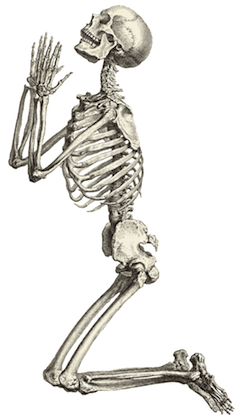
Which brings us to the peculiar image above. It comes from some classical text and whenever I’ve encountered it over the years, I’ve always considered it rather odd that the illustrator decided to portray this skeleton in the posture of prayer. It’s actually a bit disconcerting, since death and decay have nothing to do with our Lord who is the way, the truth and the life.

If we haven’t said our prayers in this mortal life, as Lewis reminds us, we will lack the voice and opportunity to do so in the next.

Besides, knowing Christ is not something with benefits only in the next life. Walking through life in his light makes our days here all the more pleasant and joyful. As I look back on my own life I recognize numerous ways in which his hand directed my path. Had I lived for my own selfish appetites the person I would be today would little resemble the Christian me. Thank God that he delivered me from becoming that man.

The Single Source of All Good

“There is but one good; that is God. Everything else is good when it looks to Him and bad when it turns from Him.” (C.S. Lewis, The Great Divorce).

I believe this thesis. I don’t expect agnostics and humanists to, though. Still, I believe the statement is true, even for them. Consider my explanation below.

What Lewis is saying is that God is the Source of all good. In the Scriptures, in fact, some of the attributes of God can be viewed as so intimately a part of his divine nature that the particular virtue is, in its purity, a facet of the Lord’s identity. Thus God the Father and God the Son are said to truly be: Love, Light, and Truth.

Christians are inclined to attribute any good fruit we see as coming from the Source of good. Thus, when secularists do something inarguably good or altruistic, we have no problem attributing its inspiration to God. Yes, they may see through the glass dimly, and may for example recognize only the beauty of nature or the magnificence of the cosmos. But these are God’s handiwork, and so we return to where we began.

It is actually the second portion of this quotation that most intrigues me. “Everything else is . . . bad when it turns from Him.”

I suppose I can illustrate this truth more effectively than I can explain it.

Patriotism is a good thing. It results in cohesive communities where individuals are willing to make sacrifices on behalf of their fellow citizens. Focus is on the common welfare. However, run amuck, patriotism can become a deformed thing. The Third Reich united and inspired a weak and demoralized nation, but at a bloody price.

Love of Family is a good thing. Most of us experience the joy of this fact. However, carried to obsessive bounds, it can result in horrendous acts. Not a week passes without the news relaying accounts of parents murdering their own children in the face of a divorce, incarceration or some other form of separation. In their depraved minds, the thought of not being together warped into something uglier than death itself.

Human Freedom is a good thing. If that weren’t so, God wouldn’t have created us with free will. It allows human to say “yes” to him and live in a relationship with our Creator as his children rather than as mindless automata. But, apart from God, is there any question that this most wonderful gift becomes a curse? Proof overflows from the pages of our newspapers.

So, Lewis reminds us that the things of this world possess no intrinsic good. When things such as generosity, courage, and creativity are imbued with a divine element, only then do they become capable of being truly good.

The strongest challenge to this belief comes in the notion that even those who do not acknowledge God are capable of doing things we all consider “good.” As I said above, Christians have no problem celebrating selfless acts of their unbelieving neighbors. The reason for this is actually quite simple. Even though secular humanitarian efforts do not look to God, since they are altruistic, they consciously look away from self. In other words, they are not intentionally turning away from God, but, ignorant of his presence, they still transcend selfish or carnal interests. And, insofar as they are free of these sinful considerations, they possess the capacity for actions rightly deemed “good.”

Ultimately I believe this is due to the truth that all women and men are created in the image of our God. Whether we acknowledge it or not, the echoes of that truth resound throughout our being.

Agnostic or Atheist: Does It Matter?

I haven’t forgotten. Well, I have forgotten far too many things in recent years, but I didn’t forget my recent “promise” to address the challenging subject of the distinction between agnosticism and atheism. Last week I wrote: “I suspect that the intimately personal nature of God’s love for us is one of the things that moves some people from agnosticism to atheism.”

It’s not my desire to offend anyone with the discussion which follows. After all, God loves the “lost” just as much as he loves those who have surrendered their lives to him. In fact, there’s an amazing passage that hints at how the rescue of one of those who has “strayed” is even more exciting to the hosts of heaven than the faithfulness of his dedicated disciples. (Check out verses 12-14 in chapter 18 of the Gospel according to Matthew . . . and remember what I have said in the past about how eager any of your Christian acquaintances will be to provide you with a copy of the Bible if you don’t already have one.)

Every soul is precious to God. And yet, many don’t recognize that fact. Many worship false gods (religious and secular). Among those who deny the existence of supernatural deities, there are essentially two camps. Agnostics who (technically) do not deny God’s existence, but merely profess that it is unknowable. Thus they personally remain unpersuaded. Atheists, on the alternative hand, are more adamant about denying God’s existence. Some, in fact, make a living by stridently refuting God himself and all things holy.

Intuitively, most people assume agnostics are not quite as distant from faith as are atheists. After all, agnostics are generally more polite and respectful toward those of us who naively cling to such superstitions . . . right? Atheists, by contrast, tend to ridicule those who would worship a God who laid down his very life, and died a human death.

Take, for example, what is arguably the earliest surviving illustration of Christ’s crucifixion. The illustration above was carved on an ancient plaster wall near Palatine Hill.

It’s a bit difficult to discern, but historical consensus sees the graffito as a pagan insult directed towards a Greek Christian. The scribbled inscription reads: “Alexamenos worships [his] god.” The crucified figure on the cross clearly bears the head of a donkey. The Church Father Tertullian wrote in the second century of slanders alleging Christians followed just such a deity.

Would something like this be likelier to come from the mind of an agnostic, or an atheist?

Agnostics would rarely summon the energy to rail against God like this. However, atheists sometimes feel so imposed upon by God’s children that they lash out with invectives.

So, as I noted above, the gut feeling of most observers would be to say vocal atheists are farther from God than their kindred disbelievers. However—I am convinced that is not the case!

Ironically, it is the tepid individual who lacks any serious conviction who is in greater danger of perishing without seeing God. This is due to the fact that agnostics have, as a rule, come to grips with the fact that there may or may not be a God . . . but they are content to proceed through life without caring much either way. To them the issue is rather trivial, in a sense, since they rarely lose sleep over it.

This is not true of the atheist, who recognizes that the matter is of the utmost importance; that’s why he is not content to simply ignore it. If God truly exists—they comprehend in the core of their being—nothing could be of greater significance.

Agnostics typically have an unreasoned impression that if there is a God, he is probably benevolent, and most likely more concerned with other elements of the universe he created than their small life. They echo the thinking of liberal “Deists” who imagined God as a distant “watchmaker” who set creation in motion and then left it forgotten on the shelf. This Great Watchmaker is not threatening. He isn’t angry at us, because he doesn’t even deign to notice us. He remains oblivious to humanity, just as we presumably live out our lives anonymous to him.

Atheists don’t want to believe in God, because of their overwhelming doubt. Simultaneously, they recognize that the stakes of the gamble are enormous. Eternal, in fact. And they resent God for placing them in this difficult predicament. Why can’t he just make his existence undeniably evident? Faith is the leap they are unwilling to take. But, by the same rational premise, the wise among them realize that in opting against theism, they are actually placing their faith in an equally unprovable tenet. And this has a tendency to make some of them mildly cranky.

Which brings us back to my suspicion that “the intimately personal nature of God’s love for us is one of the things that moves some people from agnosticism to atheism.” You see, when someone deeply ponders the mystery of whether there is a Creator, they understand he would never have created a sentient being with this yearning to cleave to him, without possessing a compassion for them in return.

Agnostics walk about like spiritual zombies, pursuing their various interests. Atheists, though, are tormented by the nagging “fear” that a loving God just may exist. Certainly, they do whatever they can to exorcize the notion, and they publicly celebrate their liberation from ancient and medieval superstitions, but unlike their unaffected agnostic relations, they have recognized the enormity of their choice. Oh to be a blissfully ignorant agnostic, the more thoughtful might muse.

Sadly (from their present perspective), the lot of the atheist is to be closer to God than the agnostic. Atheists may rail against their Maker, but the agnostic’s spiritual indifference causes them to drift farther and farther from the Truth.

The Scriptures offer a parallel to this distinction in the description of one of the early Christian churches. Apparently the believer in Laodicea had grown lackadaisical about their faith and lived lives that differed little from their pagan and agnostic neighbors. The Lord’s judgment of them begins: “I know your works: you are neither cold nor hot. Would that you were either cold or hot! So, because you are lukewarm, and neither hot nor cold, I will spit you out of my mouth.”

Strange, it seems to us, that God might prefer a militant atheistic mindset to an aimless agnostic worldview. But the amazing truth is that, in most cases, atheists are closer to the kingdom of God than their disinterested peers.

In Surprised by Joy, C.S. Lewis describes his own pre-Christian disposition. The grandson of an Anglican priest, he had consciously rejected the faith. Yet, as the possibility of its truth grew more real to him as an adult, he reacted against it. He clearly describes his condition as differing from that of the lukewarm agnostics I’ve described above.

Amiable agnostics will talk cheerfully about “man’s search for God.” To me, as I was then, they might as well have talked about the mouse’s search for the cat.

In the same volume he elaborates on the sentiments I’ve been describing.

I was at this time living, like so many Atheists or Antitheists, in a whirl of contradictions. I maintained that God did not exist. I was also very angry with God for not existing. I was equally angry with Him for creating a world.

So, if you consider yourself “angry with God for not existing,” you may be closer to meeting him than you ever imagined. If you do follow C.S. Lewis’ example, heaven will host a more resounding celebration for you than it does for the ninety-nine who have always remained part of his flock. And, if you’re a dispassionate agnostic who is weakly amused by this thought . . . my sincere prayer is that you, my friend, would become either hot or cold!

How Precious You Are

God loves you.

It doesn’t matter how loveable, or unloveable you are, he loves you.

It doesn’t matter whether you praise his Name or deny his existence, he loves you.

It doesn’t matter whether or not you love him. You can even hate him . . . but he still loves you.

Doesn’t make sense to our fallen human reason, but it’s true. One of the amazing revelations of the Christian Scriptures is that God loves each and every one of the people he has created.

Every human being is unique, and each is precious to God. Whether you feel like it or not . . . whether you feel undeserving or (far more dangerously) you think you are a pretty “good” person . . . you are precious to him.

I find it intriguing how some manmade religions and philosophies consciously downplay the uniqueness of each person. What is clearly evidence of God’s infinite creativity—the glorious diversity of men and women the world over—is seen as something odd. A cosmic fluke to be remedied when all essence returns to the amorphous and undifferentiated “whole.”

The elimination of what makes you and me precisely who we are, seems to be the goal of some of these worldviews. But deep within each of our souls we know that this pursuit is wrong. It’s alien to the core of our existence. Loss of identity is, in a phrase, not that for which we were created. You and I were made for a different purpose. And our distinctive personalities (and even our quirks) in this one-time-in-all-creation combination, are no accident.

In his treatise on why suffering exists, C.S. Lewis offers a powerful glimpse into the singularity of our souls. He argues that Christ’s sacrifice was no generic or blanket wonder. Rather, it was a divinely individualized miracle. Listen to Lewis:

The signature on each soul may be a product of heredity and environment, but that only means that heredity and environment are among the instruments whereby God creates a soul. I am considering not how, but why, He makes each soul unique. If He had no use for all these differences, I do not see why He should have created more souls than one. Be sure that the ins and outs of your individuality are no mystery to Him; and one day they will no longer be a mystery to you. The mould in which a key is made would be a strange thing, if you had never seen a key: and the key itself a strange thing if you had never seen a lock. Your soul has a curious shape because it is a hollow made to fit a particular swelling in the infinite contours of the Divine substance, or a key to unlock one of the doors in the house with many mansions.

For it is not humanity in the abstract that is to be saved, but you—you, the individual reader, John Stubbs or Janet Smith. Blessed and fortunate creature, your eyes shall behold Him and not another’s. All that you are, sins apart, is destined, if you will let God have His good way, to utter satisfaction. The Brocken spectre ‘looked to every man like his first love’, because she was a cheat. But God will look to every soul like its first love because He is its first love. Your place in heaven will seem to be made for you and you alone, because you were made for it—made for it stitch by stitch as a glove is made for a hand. (C.S. Lewis, The Problem of Pain.)

I suspect that the intimately personal nature of God’s love for us is one of the things that moves some people from agnosticism to atheism. And I think I just may address that distinction in my next post.

Christians may cease reading here.

A personal and sincere note to any unbelievers reading this column. I’m not writing this to offend you, or to push any of the buttons that may be holdovers from your days in restrictive or destructive religious settings.

If you’ve never believed, I encourage you to tune out the voices (on both sides of the issue). Go directly to the primary account(s) of Jesus’ life and read them. (There are four “Gospel” accounts of his ministry, but I encourage you to first read the Gospel according to Saint John.) Any of your Christian friends would be eager to offer you a copy of the Bible for no cost, but it’s also available for free download at various sites. For example, here you can download an entire Bible in English Standard Version (ESV) for free.

If you once believed, but have laid your faith aside, I don’t want to offer guilt. Instead, listen to this promise of grace. Just as the father of the Prodigal Son was always awaiting the return of his child, the same joyous welcome home awaits you. If ever you desire to return home, know with certainty that he’ll welcome you again, not as a servant or second class citizen, but as his son or daughter. And you’ll hear the words from that parable proclaimed over you: “It is fitting to celebrate and be glad, for this your brother [or sister] was dead, and is alive; they were lost, and are found.” (Luke 15:32).