C.S. Lewis & Ice Cream

ice cream

What is your favorite dessert? I envy you if it’s something like kale or chia seeds. For me it’s a toss-up between chocolate chip cookies and brownies. However, for my wife, nothing else comes close to ice cream.

A recent study revealed some interesting facts about ice cream and those addicted to it. They say “consuming an entire pint of ice cream was once an act cloaked in shame, conducted from the privacy of one’s couch . . . Now some, even the waistline conscious, are unabashedly eating a whole pint in one sitting. From the container.”

Apparently half of all Americans have done just this. Well, they may have used bowls and sat somewhere other than their couch, but they have devoured a savory pint in one sitting. Unsurprisingly, forty percent felt guilty afterward. However, only ten percent felt sick.

Although there is little evidence C.S. Lewis was susceptible to the temptations of ice cream, he did enjoy its cousin. In a 1920 letter to his father, he describes some recent walking trips during which he enjoyed some exquisite clotted cream. Clotted cream was especially popular before refrigeration became an everyday luxury.

As you see, we have not yet moved: indeed the weather has not encouraged us to set out, though it has not prevented us from a great deal of walking. . . . You need not have any fears about our cuisine here. Remember we are almost in Devon and the clotted cream of the country is a host in itself: also–shades of Oldie–the real ‘Deevonshire’ cider in every thatched and sanded pub.

A few miles away is a little fishing town called Watchet, which saw at least one interesting scene in its obscure history: it was here that Coleridge and the Wordsworths slept (or ‘lay’ as they would have said) on the first night of their walking tour.

In All My Road Before Me, his diary from the mid-twenties, he mentions several times enjoying another cream-based delight.

We then motored back to town to a civilian club of which W[arnie] is a member, where he had provided a royal feast of the sort we both liked: no nonsense about soup and pudding, but a sole each, cutlets with green peas, a large portion of strawberries and cream, and a tankard of the local beer which is very good.

So we gorged like Roman Emperors in a room to ourselves and had good talk.

While there are few improvements I think can be made to the Narnian tales, I do have one. The White Witch, as we know, presides over a snow-covered world where Mr. Tumnus sadly says “it is always winter, but never Christmas.”

Thus, it seems quite evident Queen Jadis could just as easily have bewitched Edmund with ice cream, as with Turkish delight. (Perhaps she didn’t wish to offer it to him because frozen dairy delicacies were her own secret delight.)

Modern Creamery Temptations

We have noted that some people feel remorseful after eating a “large” portion of ice cream. Marketers attempt to assuage such guilt by offering an increasing array of “low-cal” options. They may be better for us than the real thing, but I’ll leave that to the experts to justify. It seems to me if they taste just as good and are less bad for us, they’re worth considering.

There must be something to this line of thought. The afore-cited article compares the sales growth of regular ice cream companies (single digit) and Halo Top low calorie ice cream (555% from 2016 to 2017).

Most people have only enjoyed ice cream from domesticated cattle. The more adventurous have eaten ice cream prepared from the milk of sheep, goats, and other lactating creatures. There are also non-dairy alternatives, but in a civilized world these should rightly go by other names. PETA praises them, so they may well be worth a taste test (just don’t pretend they are the genuine article).

People have experimented with buffalo, yak, and even human ice cream (promoted in London).

Still, even the most curious people would have to draw the line at using cockroach milk, which isn’t milk proper, but is touted by some as the next “SuperFood Trend.” Speaking for myself—and with confidence, for C.S. Lewis as well—I say, “No, thanks.”


Postscript

While the following excerpt from “On Three Ways of Writing for Children” does not offer any insight into Lewis’ relationship with ice cream, it does reveal something he found distasteful in alternative approaches to writing for children.

I think there are three ways in which those who write for children may approach their work; two good ways and one that is generally a bad way.

I came to know of the bad way quite recently and from two unconscious witnesses. One was a lady who sent me the MS of a story she had written in which a fairy placed at a child’s disposal a wonderful gadget. I say ‘gadget’ because it was not a magic ring or hat or cloak or any such traditional matter.

It was a machine, a thing of taps and handles and buttons you could press. You could press one and get an ice cream, another and get a live puppy, and so forth.

I had to tell the author honestly that I didn’t much care for that sort of thing. She replied “No more do I, it bores me to distraction. But it is what the modern child wants.”

My other bit of evidence was this. In my own first story I had described at length what I thought a rather fine high tea given by a hospitable faun to the little girl who was my heroine. A man, who has children of his own, said, “Ah, I see how you got to that. If you want to please grown-up readers you give them sex, so you thought to yourself, ‘That won’t do for children, what shall I give them instead? I know! The little blighters like plenty of good eating.’”

In reality, however, I myself like eating and drinking. I put in what I would have liked to read when I was a child and what I still like reading now that I am in my fifties.

The lady in my first example, and the married man in my second, both conceived writing for children as a special department of ‘giving the public what it wants.’

Children are, of course, a special public and you find out what they want and give them that, however little you like it yourself.

Autobiographical Temptations

autobiography.png

When you get to a certain age, most writers will consider, at least momentarily, penning an autobiography. Often, aware the effort will invite charges of vanity, they will opt to call it a memoir. Whatever the label, the result is the same.

Writers are faced with the question—and they alone can answer it—as to whether or not there is any value in the preservation of notes about their life journey.

I would argue that there is a clear benefit, even when no one else will read it. Self-reflection, in and of itself, enriches one’s life. Even if it is painful, it can be therapeutic. And, since we’re still alive as we examine our past, time remains to rectify some of the mistakes we have made.

This very process of looking at our lives invites us to question our motives for recording these stories. And, if we’re considering merely to praise ourselves, it would be best to abstain.

On the other hand, it seems to me that many “normal” lives can validly serve as an inspiration to others. (I don’t presume my own effort would fit into this category.)

Here is the reason why I’m actually contemplating assembling some notes for a near-the-end-of-my-earthly-sojourn document. It just might be of interest to some of my descendants. I have often wished to have just such a jewel written by my own ancestors.

Putting myself in the place of my great-grandchildren, etc., I suspect some of them and their own grandchildren might be curious about an ancient progenitor. In fact, the more such records, the fuller the picture they stand to gain of their lineage.

The key, I think, to writing a worthwhile memoir is honesty. If we share our challenges and failures, the volume will not only be more interesting, if may offer our descendants encouragement in their own struggles.

As a man vulnerable to the sin of pride, I’m cautious about proceeding. I pulled this disarming contrast from a book review written several years ago by theologian Carl Trueman.

Autobiographies are typically opportunities for the display of ego and the rationalizing of error. They have been so at least since Julius Caesar’s military memoirs. In our day, it is not just politicians and military leaders who indulge in this.

One thinks of the memoirs of Hans Küng: names dropped on every page, always with the purpose of reminding the reader how important—and how correct—Küng has been over the years on every significant issue and how unfairly he has been treated by his mediocre opponents.

Autobiography need not be so, as this volume [A Change of Heart] by Thomas Oden shows. Though Oden seems to have known everyone who was anyone in the theological world of the last sixty years, from Barth and Niebuhr to Dulles, Ratzinger, and Wojtjyla, there is no sense of ego. Names are regularly dropped but no self is ever promoted. Oden is a humble, fascinating, and important man blissfully unaware of the fact.

I’ve had the good fortune to meet several people during my life whose names would be familiar to you. But, God be merciful, I prefer to be an Oden rather than a Küng.

C.S. Lewis was a man like the former, “humble, fascinating and important.” Yet, despite the accolades he received from some quarters, he remained blissfully unaware of the fact that God would continue using his words to inspire others so many decades after he joined his Lord in Paradise.

A Worthy Exemplar

Lewis resisted writing about himself. Not out of a false modesty, but due to a desire to maintain personal privacy and a genuine sense that his life was neither particularly inspirational nor unique. Nevertheless, if it were possible that sharing about his life could help others, he was willing to do so.

His works are sprinkled with autobiographical commentary. His vast correspondence also provides great insight into his life. In 1955, he wrote a traditional autobiography, primarily to explain his conversion.

He entitled it Surprised by Joy: The Shape of My Early Life. As he begins in the Preface:

This book is written partly in answer to requests that I would tell how I passed from Atheism to Christianity and partly to correct one or two false notions that seem to have got about.

He describes his approach, noting how it differs from what readers might expect.

The book aims at telling the story of my conversion and is not a general autobiography, still less “Confessions” like those of St. Augustine or Rousseau.

This means in practice that it gets less like a general autobiography as it goes on. In the earlier chapters the net has to be spread pretty wide in order that, when the explicitly spiritual crisis arrives, the reader may understand what sort of person my childhood and adolescence had made me.

When the “build-up” is complete, I confine myself strictly to business and omit everything (however important by ordinary biographical standards) which seems, at that stage, irrelevant.

I do not think there is much loss; I never read an autobiography in which the parts devoted to the earlier years were not far the most interesting. The story is, I fear, suffocatingly subjective; the kind of thing I have never written before and shall probably never write again.

I have tried so to write the first chapter that those who can’t bear such a story will see at once what they are in for and close the book with the least waste of time.

A Naked Autobiography

As fascinating as Surprised by Joy is, there exists another volume in which the mature Lewis bared his soul as have few others. When he lost his wife, Lewis experienced a profound sorrow that he described in A Grief Observed. So vulnerable was his writing, that Lewis published it under a pseudonym.

In 1988, Madeleine L’Engle penned a Foreword to the book, which now appears under Lewis’ own name.

In the end, what shines through the last pages of his journal of grief is an affirmation of love, his love for Joy and hers for him, and that love is in the context of God’s love.

No easy or sentimental comforts are offered, but the ultimate purpose of God’s love for all of us human creatures is love.

Reading A Grief Observed is to share not only in C. S. Lewis’s grief but in his understanding of love, and that is richness indeed.

Lewis was an exceptional writer, but I daresay that his life was little more amazing than your own. Certainly, Lewis’ life was no more precious to God than yours is.

I encourage you to consider writing (at the appropriate moment) your own memoir. This is particularly important if you have family who may be interested. But even if you don’t, consider writing.

Just remember to follow Lewis’ example and try “to write the first chapter that those who can’t bear such a story will see at once what they are in for and close the book with the least waste of time.”

Rewarding Destructive Behaviors

monopoly

It is almost too obvious to require saying: you reinforce the behaviors you reward. Why then, would any society intentionally train its youth to be dishonest?

One justification I’ve heard, more and more frequently in recent years, is that it’s all about winning—coming out on top. The motto of these folks is “do whatever it takes to win.” Yet this is a recipe for a disastrous life. In the words of Jesus: “what does it profit a man if he gains the whole world and loses or forfeits himself?” (Luke 9:25)*

Our recreational choices say a lot about us and our values. Digital options have reduced the influence of board games, so one perennial favorite has devised a strategy to regain its market share.

Monopoly is based on accumulating wealth and, for the merciless, crushing one’s competitors. Some might argue that the capitalism which provides the basis for the game is corrupt in and of itself. Still, Monopoly has always had clear rules that governed actions.

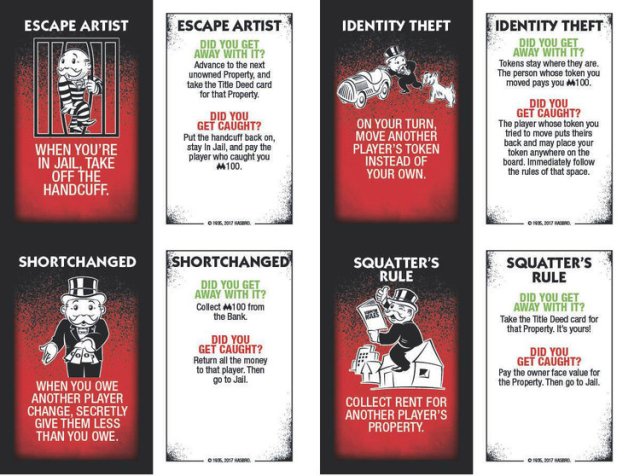
But some players cheated. Capitalizing on this sinister impulse, Monopoly has created a new “Cheaters Edition.” Yes, you read that right.

Christian publications have announced the game’s arrival. The current issue of Citizen notes that even though cheating is actively encouraged in the game, negative consequences are also possible.

Mind you, it’s not that anything goes. Cheat successfully and you get rewarded; get caught and you get punished.

Even the “secular” Bloomberg review of the new game acknowledges the moral confusion of the product, closing its report with:

Clearly this begs some deeper philosophical questions about modern life and the future of morality and humanity, but, wait, did you just land on Boardwalk? Yes, I definitely always had a hotel on there! Trust me.

Nurturing Healthy Behaviors

One does not have to be a parent to recognize this wisdom of this Proverb: “Train up a child in the way he should go; even when he is old he will not depart from it” (Proverbs 22:6).

In fact, even pet “owners” know the necessity of training (e.g. housebreaking) our canine and feline family members.

Many games highlight positive choices, consciously or subconsciously reinforcing good. The simplest and most common method for this process comes not in a board game or a digital alternative. It is found in verbal praise.

There is ongoing debate about the value of praise. It’s clear that insincere or mechanistic praise would be of insignificant worth, and potentially dangerous. Some psychologists go so far as to state that “Positive reinforcement can undercut a child’s intrinsic motivation.”

C.S. Lewis understood that we cannot manufacture our own motivations.

I cannot, by direct moral effort, give myself new motives. After the first few steps in the Christian life we realise that everything which really needs to be done in our souls can be done only by God (Mere Christianity).

Despite this truth, it is also argued that our character can be shaped, in a sense, by consciously and repeatedly choosing to do what is right. Gradually then, by God’s grace, obedience may gradually give way to a more honest and natural motivation as the positive paths become our normal, well-traveled path.

This is not simply a “Christian” concern. The philosopher Aristotle noted “Good habits formed during youth make all the difference.” (What do you think Aristotle would think about the Cheater’s Edition of Monopoly?)

C.S. Lewis would doubtless concur with Aristotle. I assume most of Mere Inkling’s readers agree with the ancient wisdom as well.

A final thought. This cheater’s edition of Monopoly probably possesses less power to damage lives than Hasbro’s Ouijà board game. But that’s a subject for another day


* In Matthew 16 we read the more familiar “For what will it profit a man if he gains the whole world and forfeits his soul? Or what shall a man give in return for his soul?”

cheat card

Degrees of Importance

swiss horn

Not all college degrees are created equal. Some are “marketable,” and lead to well compensated careers. Others do not necessarily make one “employable,” but offer intrinsic satisfaction.

Engineering degrees would probably be in the first category. Creative writing degrees typically fall into the latter.

If I had the good fortune to study at Oxford when C.S. Lewis and J.R.R. Tolkien taught there, I would have savored the opportunity to sit in their presence and explore the wonders of Medieval Literature or Old English. (In America, at least, both of those degrees would fall into the second category identified above.)

As it was, my initial degree was in journalism. It seemed that every quarter our professors at the University of Washington would remind us that five years after graduation, no more than five percent of us would be working in that particular field. (I referred to those sessions as de-motivational chats.)

Still, learning how to write is a skill that serves one well in nearly any field.

Learning to yodel, on the other hand, probably possesses far fewer applications.

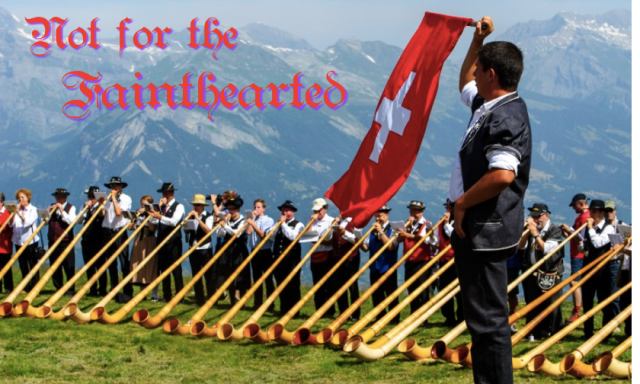
This year the Lucerne University of Applied Sciences and Arts will introduce a course on alpine “singing.” The University has expressed hope they will inspire enough Swiss yodelers to establish a degree program. If their efforts really pay off, they dream of offering a graduate degree in the rarified field.

The BBC reports “Yodelling is enjoying something of a resurgence in Switzerland, even featuring on successful chart albums last year.” I guess that answers the question about what the Swiss do beyond banking and making confectioneries.

If you have led a life so sheltered that you are uncertain exactly what yodeling is, the BBC describes it as “a form of singing which involves wobbling the voice up and down in a rapid change of pitch.”

An online dictionary defines yodel as a verb meaning “to sing with frequent changes from the ordinary voice to falsetto and back again, in the manner of Swiss and Tyrolean mountaineers.”

While most of us prefer our falsetto music in small doses, yodeling capitalizes on the full range of the human larynx, and then some.

The course will be taught by a famous yodeler, Nadja Räss. I’ve linked to one of her performances below.

I was curious as to what Lewis and Tolkien would have thought about this subject’s suitability for academic study. I suspect it would have provided the Inklings a chuckle, but they would affirm the value of studying one’s unique cultural heritage.

I did find one curious encounter Lewis had with a Swiss traveler in 1927. It has nothing to do with yodeling, and only tangentially touches on the university, but it is rather interesting. In a letter to his brother he mentions that Minto (Janie Moore) who lived with him, was being visited by an acquaintance.

You will be surprised to hear that while I write this, Minto is out to dinner. This results from the chief event since you left—the arrival of ‘un ami’ of Florence de Forest—not staying here, thank heavens.

He is a little Swiss commercial traveller, ‘Villie Goût,’ as smart as a bandbox, and very polite. Beyond making horrible noises in clearing his ‘pipes . . .’ and being intensely ugly, he is really quite harmless, tho’ of course very vulgar. He and Florence absolutely insisted on Minto’s dining with them at the Eastgate tonight, and won the day.

They know how to move their monde, as you will see from this fact and also when I tell you that they made me take them up Magdalen Tower this morning—as well as round the College. When I showed them the deer he made one of those extremely simple French jokes with which Maurice and M. Zée have familiarised us.

I had explained that these deer were descendants of a herd wh. had been there before the College was founded (that is quite true by the by, or as true as a College tradition need be), and I added ‘So you may say they are the oldest members of the College’.

‘And ze most intelligent?’ returned M. Goût.

I am confident that Mr. Goût and his companion enjoyed their visit to Oxford. Perhaps he returned home to Switzerland hoping that someday their universities would rival those of Britain.

Lucerne University of Applied Sciences and Arts was not founded until 1997, but their bold academic vision would have made Goût proud.

_____

You can enjoy a sample of Nadja Räss’ singing here.


Pen or Keyboard: A Literary Dilemma

peck typing

Is it better to write by hand or via keyboard? There are those who would argue there is a correct answer to that question, and it is not simply a matter of preference.

Our recent discussion about C.S. Lewis’ handwriting caused a recent article on this subject to draw my close attention.

In “Phenomenology of the Hand,” Mark Bauerlein, an editor of First Things, recently addressed the disassociation from one’s words that results from the intervention of the computer.

Despite all the promises made when keyboards were introduced to classrooms, he says, “Students write faster with keyboard and mouse, but would anybody say that student writing has improved in the last three decades?”

That is a subjective determination, but the rhetorical nature of the question assumes what most of us sense—that today’s graduates are not better writers than their predecessors.

The essay makes pleasurable reading, whatever your opinion.

The pen moves more slowly, but that isn’t a drawback. Like other “slow” movements (slow food, slow reading, slow art), slow writing aims for a fuller and tighter relation to the object, a nearness of mind to the language it utters.

The plodding process of “drawing” letters instead of tapping keys and telling a computer to draw them gives words greater intimacy and presence. The hand­written word is closer, and that makes a writer more deliberate with words.

C.S. Lewis’ Typewriter

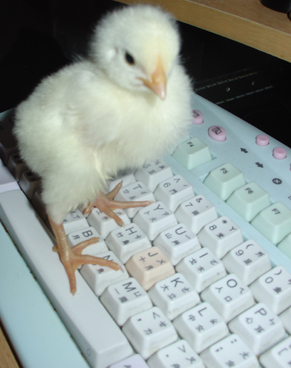
Narnia’s creator did not type. He wrote all of his books and relied on his brother Warnie to type the final versions. Not that Warnie was a particularly talented typist, relying as he did on only his index fingers (the hunt-and-peck method).

Lewis sincerely appreciated his brother’s assistance converting his “scrawl” into a readable text. In 1953, he began a letter with a witty verb describing the typing process.

This will have to be an inadequate scrawl for my brother, who drives the typewriter, is away and I’ve so much to do that I can hardly write– in the double sense that I’ve hardly time and that my right hand is stiff and tired with compulsory scribbling!

You can read an interesting anecdote related to Lewis’ disinterest in typewriters on the Desiring God website.

They sponsored a Lewis-related conference, and nearly included a scene in a promotional video that could have “discredited” their scholarship. (Desiring God provides free access to the sessions of the superb conference here.)

But one scene nobody saw was Lewis at his typewriter, not because we didn’t accidentally film the scene (and delete it later), but because such a scene never happened. Lewis detested typewriters.

Some writers may be accused of being technophobes, but the truth is many are eager to embrace novel technologies. Referring to his sturdy Remington, Samuel Clemens (Mark Twain) famously bragged that he “was the first person in the world to apply the typemachine to literature.”

Curiously, he could not recall which manuscript he first completed on the newfangled contraption. He recalled it was Tom Sawyer in 1874, but historians have determined it was actually Life on the Mississippi, eight years later.

The First Things essay would take issue with Twain’s enthusiastic endorsement. In fact, it concludes with a rather harsh judgment.

The virtues of the computer—faster, easier, simpler—are vices when it comes to writing. The pen personalizes the labor of writing, reminding us that we are responsible for what we write.

C.S. Lewis, who advised a novice writer to avoid typewriters because “the noise will destroy your sense of rhythm,” would likely concur.

Civil Atheism and C.S. Lewis

bennett

Some Christians are obnoxious. Well, okay, quite a few Christians are insufferable when they persistently “witness” to those who are deaf to their appeals. But, truth be told, many atheists are becoming increasingly obnoxious in their attitudes towards Christians as well. Let’s consider which group is worse.

First, some definitions. By Christians I don’t mean people who have some vague deistic notion that there is a God, and Jesus is somehow connected to this divinity because he was such a holy prophet.

By Christian I mean someone who has placed their faith and trust in Jesus the Christ, the only begotten Son of God who declared he was the Way, the Truth and the Life… The Logos (Word) through whom the universe was created.

By Atheist, I don’t mean people who do not share that faith, but who consider it an unprovable thesis. Most people with this viewpoint are ambivalent about whether or not others “believe.” The majority of these folks, many of whom do not feel threatened by religious conversations, are better understood as Agnostics.

By Atheist I mean people who are so convinced that Christianity is fallacious that they feel they must do what they can to stamp it out. They are so emotionally engrossed in the matter that they are genuinely unable to recognize that their own belief is based on nothing other than faith itself.

I can respect the fact that Atheists have historically been mistreated by “Christendom.” By my definition, this institutional entity is not synonymous with actual Christianity. In fact, it’s persecuted far more Christians of different denominational allegiances, than it has unbelievers who simply kept their mouths closed. But that’s a subject for another day.

Christians do not hate agnostics, or even atheists. Their motivation for sharing the Gospel inclines them towards the opposite attitude. Certainly they do it in obedience to their Lord’s command. Most possess a genuine concern and compassion for those they consider to be lost and facing eternal separation from God.

On the other hand, an increasing number of Atheists are insultingly dismissive of Christians who they consider—as a group—to be ignorant and prejudiced.

An Atheist columnist acknowledged this fact, and the discomfort it causes him, in a recent essay. David Harsanyi wrote the following in “Political Idols,” an article about a broader subject.

Unlike many of my fellow non-believers, I don’t feel especially enlightened or rational for my apostasy; I feel kind of unlucky, actually.

The typical non-believer sees the strictures of Christianity or Judaism [the faith in which Harsanyi was raised] as a punishment—mythical limitations set to inconvenience him—but I see people who take profound comfort in a beautiful fate that awaits them as long as they treat people as they would want to be treated themselves.

As a man who believes his story ends in a pile of dirt rather than celestial salvation, I have many reasons to be envious.

Yet, for my entire atheistic life, I’ve been nudged to mock the believer. The unifying doctrine of atheism is a reflexive antagonism toward faith and all the ideas it has dragged along with it through the centuries.

If all Atheists recognized this, and all Christians acknowledged that they are no more deserving of God’s mercy than their neighbor, oh what wonderful conversations about matters of eternal significance we could have!

C.S. Lewis’ Comment about an Atheist Writer

In a 1916 letter to his friend Arthur Greeves, Lewis comments on a book that Greeves had mentioned. He says the particular volume is of little value, without remarking on the author’s work in fiction, for which he as better known.

What is most significant about this particular letter is Lewis’ reference to the writer’s atheism, and the allusion to his own. It must be remembered that Lewis would not experience his conversion to Christianity for another fifteen years!

The book you refer to is ‘How to Form a Literary Taste’ by Arnold Benett: the edition is pretty but the book is not of any value. The very title—as if you set out to ‘learn’ literature the way you learn golf—shews that the author is not a real book-lover but only a priggish hack.

I never read any of his novels & don’t want to. Have you? By the way, he is a rather violent atheist, so I suppose I shall meet him by

‘The fiery, flaming flood of Phlegethon,’ as good old Spenser has it.

Before we look at Arnold Bennett (1867-1931), the author Lewis is describing, let us take a moment to consider the literary allusion Lewis includes in this passage.

“The fiery, flaming flood of Phlegethon” comes from The Faerie Queene, an epic poem which was the masterpiece of Edmund Spenser (1552-1599). Various editions of the fantasy poem are available.

In Spenser’s poem, the Phlegethon is a river found in Hell. The name itself means “flaming,” and it initially appears in Greek mythology as one of the Underworld’s five rivers. In The Faerie Queene, the terrible place where “the damned ghosts in torments fry.”

While his agnosticism assumes there is no afterlife, he acknowledges he may be wrong. And, if so, it is precisely to this tragic, fiery end that the unbelieving Lewis delivers Bennett . . . and himself.

So, who was Arnold Bennett?

Bennett was a versatile writer, and found success not only as a novelist, but also in theater and journalism. He even served as the Director of Propaganda for France during WWI, even though he was English. (He had resided in France since 1903.)

He was outspoken in his view that religious faith was not for the wise. Ironically, he died of typhoid after ignoring a French waiter’s counsel not to drink the “ordinary [tap] water from a carafe,” which was unsafe.

In 1932, Bennett’s widow began editing and publishing his journals. In a review that year, a literary magazine noted his antagonism towards Christianity.

Through it all one gets the impression of a terribly self-centered personality. Perhaps the artist is necessarily self-centered, though I cannot believe that Shakespeare was.

There have been artists like Dante, like Milton, whom it would be absurd to call selfish in the usual sense of the term because, colossal as their egos were, they yet consecrated themselves and all their pride of art and pride of soul to something for which, in the final analysis, their inmost spirits cared immensely more than they cared for self or for art or for any other thing on the earth below or in the heavens above it. . . .

Probably he was as great an artist as a man can be without religion, and the measure of his greatness is to be found in his straining against the limitations he so needlessly imposed upon himself. . . .

He had nothing of the mystic in him. In a moment of illumination he declares that “there is no such thing as ugliness in the world,” but this is as far as he gets. Yet he holds out against Christianity as he holds out against what he thinks of as sentimentalism, and his wife was probably right in her feeling that he might have made a very good Christian if he had only been willing to let himself go.

Civil Atheism

It would be a good thing for us individually and as members of a pluralistic world, to treat one another with civility. As a Christian, I can confess for my brothers and sisters that we do not always do so. Let us strive to do better.

And, as for those who identify themselves as Atheists, perhaps there is some room for improvement in this area as well. If more people resisted atheism’s “reflexive antagonism toward faith,” the world would definitely become a more friendly place.

A final note for those who would read more about Bennett. G.K. Chesterton wrote an essay about morality and punishment, in which he responds to a proposal offered by Bennett that society should not “judge” criminals. You can read “The Mercy of Mr. Arnold Bennett” here.

Since it relates to our discussion here, I must share a portion of Chesterton’s witty introduction to his essay.

Mr. Arnold Bennett recently wrote one of his humorous and humane “causeries” pleading very properly for social imagination and the better understanding of our fellows. He carried it, however, to the point of affirming, as some fatalists do, that we should never judge anybody in the sense of condemning anybody, in connexion with his moral conduct.

Some time ago the same distinguished writer showed that his mercy and magnanimity were indeed on a heroic scale by reviewing a book of mine, and even saying many kind things about it.

But to these he added a doubt about whether true intelligence could be consistent with the acceptance of any dogma. In truth there are only two kinds of people; those who accept dogmas and know it, and those who accept dogmas and don’t know it. My only advantage over the gifted novelist lies in my belonging to the former class.

I suspect that his unconsciousness of his dogmas extends to an unconsciousness of what he means by a dogma. If it means merely the popular idea of being dogmatic, it might be suggested that saying that all dogmatism is unintelligent is itself somewhat dogmatic.

And something of what is true of his veto on dogma is also true of his veto on condemnation; which is really a veto on vetoes.


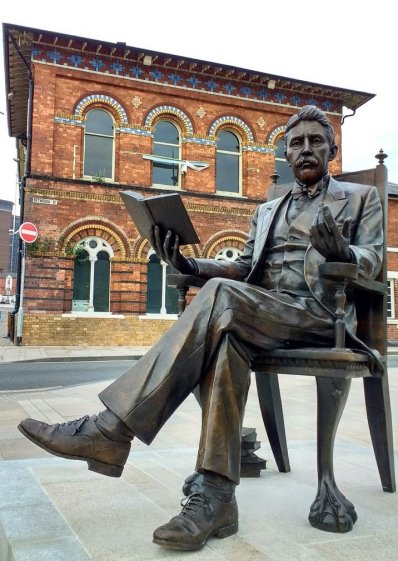
The photograph above is of a statue of Arnold Bennett unveiled this summer in his home town of Stoke-on-Trent.

C.S. Lewis and Flags

flag globe.png

Do you find flags interesting? Even inspirational, perhaps?

A recent article on the subject reminded me that one of my early avocations was as a vexillologist. If you also enjoy learning about flags, you can become a vexillologist too (ability to spell the title not required).

The article discussed the diversity of America state and territory flags. Some are rather mundane, featuring state seals on single colored fields. While my own Washington State flag falls into this category, the fact that the first president’s face dominates the seal makes it rather attractive. Many seals though, are terribly busy and jumbled.

The Nebraska flag is so bland that it once flew over the state capitol for several days, before anyone noticed it was upside down.

One of the most distinctive flags is that of New Mexico, which features “the sun symbol of the Zia Pueblo. The red and yellow imitate Spain’s national colors, paying tribute to the region’s colonial heritage.”

You can view all of the American flags here, if you are interested.

Or, if you are more interested in international flags, you can see and read about them here (compliments of the CIA).

The best part of the article, “Fifty Flags” by John J. Miller, is the author’s citation of C.S. Lewis.

The main purpose of a flag is to unite people behind patriotic, military, or civic causes. A good flag stirs emotions, tingling spines at Olympic ceremonies and encouraging soldiers to hold fast.

“In battle it is not syllogisms that will keep the reluctant nerves and muscles to their post in the third hour of the bombardment, wrote C.S. Lewis in The Abolition of Man. “The crudest sentimentalism . . . about a flag or a country or a regiment will be of more use.”

Inspired by this passage, I’ve gleaned several more references that the Oxford scholar makes to flags.

Quotations from C.S. Lewis Mentioning Flags

The flag serves as the emblem of a nation as it projects its image beyond its own borders.

After breakfast [Lord Bern] asked Caspian to order every man he had into full armor. “And above all,” he added, “let everything be as trim and scoured as if it were the morning of the first battle in a great war between noble kings with all the world looking on.”

This was done; and then in three boatloads Caspian and his people, and Bern with a few of his, put out for Narrowhaven. The King’s flag flew in the stern of his boat and his trumpeter was with him. (Voyage of the Dawn Treader)

The absence of a flag or identifiable markings leaves an enemy uncertain about how to proceed.

Inside, he was wondering if there were any way of getting rid of these unwelcome visitors. Had he known that Caspian had only one ship and one ship’s company with him, he would have spoken soft words for the moment, and hoped to have them all surrounded and killed during the night.

But he had seen a ship of war sail down the straits yesterday and seen it signaling, as he supposed, to its consorts. He had not then known it was the King’s ship for there was not wind enough to spread the flag out and make the golden lion visible, so he had waited further developments. (The Voyage of the Dawn Treader)

The enthusiastic waving of flags can be a visible manifestation of patriotic fervor. In a letter to his brother, written between the wars, Lewis describes conversation with an Anglican priest, William Stead, who had just returned from Italy.

Lewis is rather dismissive of the priest’s comparison of Italy and Great Britain because, unlike Lewis and his brother Warnie, the cleric had never been to the front lines.

Stead, fresh back from Venice and Rome, gave as his verdict that “Italy was a pleasant surprise to him. He had always imagined the Italians a degenerate people but found that they were really quite go ahead and up to date.”

They were also more patriotic than the English, for they were always waving flags and went mad over the name of Italy whereas “he had never found that Englishmen showed any great enthusiasm over the mention of England.”

They and their landscape were, he said, hardy and vigorous whereas one always felt the softness of England. Stead is an American and has not been to the war. (All My Road Before Me: The Diary of C. S. Lewis)

A flag can also be used to gain the attention of a friend or potential ally. Lewis uses the image in his first letter to Charles Williams, who would join him in the Inkling writing community. The story of their mutual respect is fascinating. Williams response to Lewis begins, “My dear Mr Lewis, If you had delayed writing another 24 hours our letters would have crossed.”

I never know about writing to an author. If you are older than I, I don’t want to seem impertinent: if you are younger, I don’t want to seem patronizing. But I feel I must risk it. A book sometimes crosses one’s path which is so like the sound of one’s native language in a strange country that it feels almost uncivil not to wave some kind of flag in answer.

I have just read your Place of the Lion and it is to me one of the major literary events of my life—comparable to my first discovery of George Macdonald, G. K. Chesterton, or Wm. Morris.

In “Religion Without Dogma?” Lewis includes a flag as one of the symbols with more inherent inspirational power than can be uncovered in a lifeless religion. He is discussing spiritualism, which offered supposed communication with ghosts wandering through an ill-defined afterlife.

A minimal religion compounded of spirit messages and bare Theism has no power to touch any of the deepest chords in our nature, or to evoke any response which will raise us even to a higher secular level—let alone to the spiritual life. The god of whom no dogmas are believed is a mere shadow. He will not produce that fear of the Lord in which wisdom begins, and, therefore, will not produce that love in which it is consummated.

The immortality which the messages suggest can produce in mediocre spirits only a vague comfort for our unredeemedly personal hankerings, a shadowy sequel to the story of this world in which all comes right (but right in how pitiable a sense!), while the more spiritual will feel that it has added a new horror to death—the horror of mere endless succession, of indefinite imprisonment in that which binds us all . . .

It can never be a controller or even a rival to our natural sloth and greed. A flag, a song, an old school tie, is stronger than it; much [stronger are] the pagan religions.

The flag can delineate the leading edge of an advance into enemy territory. Lewis uses this notion with great effect in his treatise on pain.

No doubt Pain as God’s megaphone is a terrible instrument: it may lead to final and unrepented rebellion. But it gives the only opportunity the bad man can have for amendment. It removes the veil; it plants the flag of truth within the fortress of a rebel soul. (The Problem of Pain)

In his essay “Answers to Questions on Christianity,” Lewis uses the flag as a metaphor for where one’s ultimate loyalty lies.

When I first became a Christian . .  . I thought that I could do it on my own, by retiring to my rooms and reading theology, and I wouldn’t go to the churches and gospel halls; and then later I found that it was the only way of flying your flag; and, of course, I found that this meant being a target.

It is extraordinary how inconvenient to your family it becomes for you to get up early to go to church. It doesn’t matter so much if you get up early for anything else, but if you get up early to go to church it’s very selfish of you and you upset the house.

If there is anything in the teaching of the New Testament which is in the nature of a command, it is that you are obliged to take the Sacrament, and you can’t do it without going to church.

A Final Observation on Flags & War

In one of Lewis’ less well-known essays, “Talking about Bicycles,” he discusses a fascinating procession through which many of our experiences pass. “Let’s give them names. They are the Unenchanted Age, the Enchanted Age, the Disenchanted Age, and the Re-enchanted Age.”

His illustration using the example of marriage is excellent, and accurately describes the chronicle of many if not most marital unions. It is, however, in his example related to war that he mentions the symbol of the flag.

Let’s take an example that may interest you more. How about war? Most of our juniors were brought up Unenchanted about war. The Unenchanted man sees (quite correctly) the waste and cruelty and sees nothing else.

The Enchanted man is in the Rupert Brooke or Philip Sidney state of mind [both were poets whose lives were cut violently short in war]—he’s thinking of glory and battle-poetry and forlorn hopes and last stands and chivalry.

Then comes the Disenchanted Age—say Siegfried Sassoon [another poet who survived WWI, in contrast to his contemporary, Brooke].

But there is also a fourth stage, though very few people in modern England dare to talk about it. You know quite well what I mean. One is not in the least deceived: we remember the trenches too well. We know how much of the reality the romantic view left out.

But we also know that heroism is a real thing, that all the plumes and flags and trumpets of the tradition were not there for nothing. They were an attempt to honour what is truly honourable: what was first perceived to be honourable precisely because everyone knew how horrible war is. And that’s where this business of the Fourth Age is so important.

C.S. Lewis did, indeed, recall the trenches. He understood the horrors of war, but had matured in his viewpoint to become reenchanted with its glory. Flags, pennants and guidons are visible emblems of its chivalry and honor. Lewis would certainly concur with the declaration of Robert E. Lee, commander of the Confederate States of America army, that “it is well that war is so terrible, otherwise we should grow too fond of it.”

Fortunately, flags fly far more commonly in peace than they do in war. Their peaceful fluttering is far more familiar to the masses than their battle shorn visage. May that always remain true.

_____

The image at the top of the page is copyrighted by its creator, Joel Lisenby, and used with permission.


C.S. Lewis and Reality

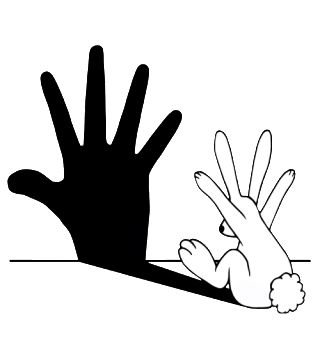
Rabbit-Hand-Shadow.jpg

In this increasingly relativistic cauldron we call “the world,” chaos is fueled by the concept that everyone is entitled to determine their own reality.

It all depends on one’s perspective.

“Perception is reality,” is a common sentiment. More clearly said, “an individual’s perception is their personal reality.” In other words, the way that a person thinks things are, is reality as far as they are concerned.

Changing a person’s perception of reality is no easy thing. Nor should it be (in most cases).

People base their thinking on a variety of approaches. Those who are more analytical are terribly frustrated by others who base their views of reality on their emotions, or what they “want” to be true.

Nowhere do I find this more striking then when people who have nary a religious thought in their daily lives gather together for a funeral. At least 66% of what one hears, for example “he’s looking down on us now,” is based on nothing other than wishful thinking or irrational notions.

C.S. Lewis described how reason is the crucial mechanism for understanding. In his book Miracles, he makes the following argument.

All possible knowledge, then, depends on the validity of reasoning. If the feeling of certainty which we express by words like must be and therefore and since is a real perception of how things outside our own minds really “must” be, well and good.

But if this certainty is merely a feeling in our own minds and not a genuine insight into realities beyond them—if it merely represents the way our minds happen to work—then we can have no knowledge. Unless human reasoning is valid no science can be true.

Mental Illness and Perception

One particularly fascinating aspect of the perception and reality question comes in the case of some mentally ill individuals. Schizophrenia, for instance, frequently involves delusions or hallucinations that are indistinguishable from reality (in the mind of the sufferer).

A well person may find it implausible to accept that a person could genuinely believe impossible things were true. Meanwhile, from the perspective of the deluded, it may make all the sense in the world that they are the only person alive who recognizes how things truly are.

Decades ago I spent several months in a psychiatric ward. (Not as a patient, as a clinical pastoral education student.) I had many conversations with a delightful resident who had been institutionalized because he was utterly convinced that he was one of Jesus’ apostles.

Thanks to the proper medications, he knew that to be illusory, and he was optimistic that he would soon be released to begin his studies to become a mental health worker. One reason for his confidence that he was truly getting better was because his previous hospitalization came when he became certain that he was one of the Old Testament patriarchs.

From his point of view, the increasing chronological proximity between his delusions and reality indicated he was almost well.

Some of these people do become healthy enough to recognize that their perception of reality is askew. These are the few who continue to take their meds so they can function as the majority of us perceive to be “normal.”

Many psychotic individuals, of course, only take their prescriptions under duress and when they are not monitored, cease to take them because they either (1) already feel better, so they obviously don’t need them, or (2) prefer chaos to the side effects such as lethargy.

Truth is Not Based on Perspective

Truth, in the ultimate or alethiological sense, is not relative. It doesn’t shift due to the distortions of individual perception. It remains the same yesterday, today and tomorrow.

Now, since what we human beings regard as truth does shift (e.g. shape of the Earth), ultimate truth must come from a source other than mortal minds, transient philosophies or momentary scientific theories.

Christians believe they have found that source in God’s self-revelation, the Judeo Christian Scriptures. In fact, Christians believe that their Savior, Jesus the Messiah, was the embodiment of truth. We believe he was speaking the eternal truth when he said “I am the way, and the truth, and the life.”

C.S. Lewis was quite candid about the truthfulness of the scriptural testimony being the necessary cornerstone for faith. In dialogue with atheists and agnostics, he wisely points out that the conversation must address this essential question.

One of the great difficulties is to keep before the audience’s mind the question of Truth. They always think you are recommending Christianity not because it is true but because it is good. . . .

One must keep on pointing out that Christianity is a statement which, if false, is of no importance, and if true, of infinite importance. The one thing it cannot be is moderately important. (“Christian Apologetics”)

In a world that wants to relegate Jesus to the status of some great teacher or prophet, it is vital to say that if he was lying when he said “the Father and I are one,” Christianity should be dismissed altogether.

_____

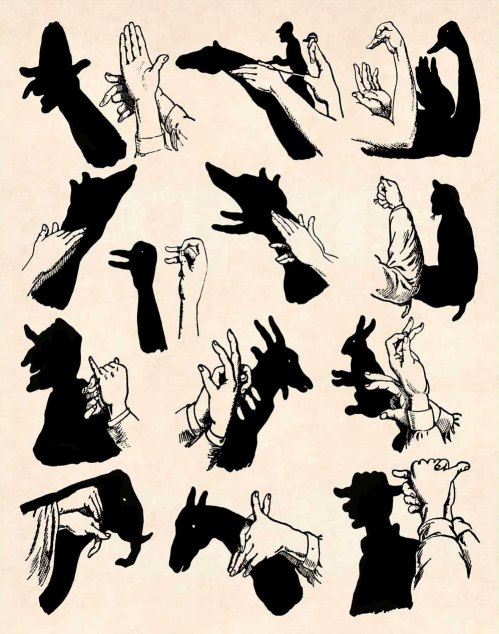
For those who enjoy challenges:

hand shadows

C.S. Lewis and Robots

robot.png

No robots were involved in the writing of this column.

That’s not to say that robots aren’t writing a considerable amount of what you might come across today on the internet.

A recent article, entitled “Robots Wrote this Story,” describes how “in 2013, AI-powered journalism was in its infancy . . . [but today it] identifies the relevant data, matches it with the corresponding phrases in the template, merges them, and then publishes different versions across different platforms.”

The various artificial intelligences writing the news for us have interesting names. Among them are Wibbitz (USA Today), News Tracer (Reuters), Buzzbot (open source), and Heliograf (Washington Post). Rumors are that Skynet may be on the horizon.

A Washington Post reporter optimistically says, “We’re naturally wary about any technology that could replace human beings. But this technology seems to have taken over only some of the grunt work.”

So far.

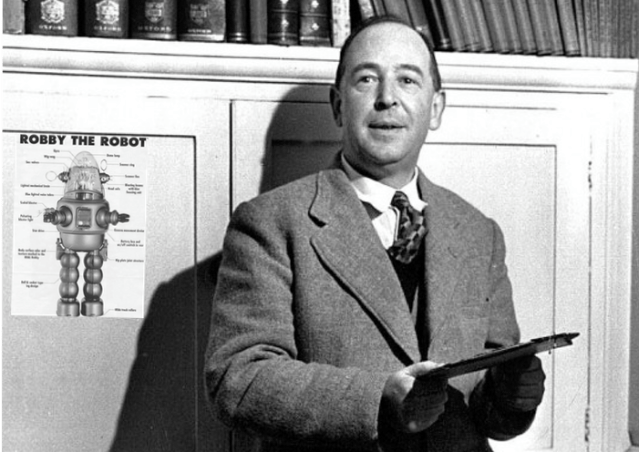
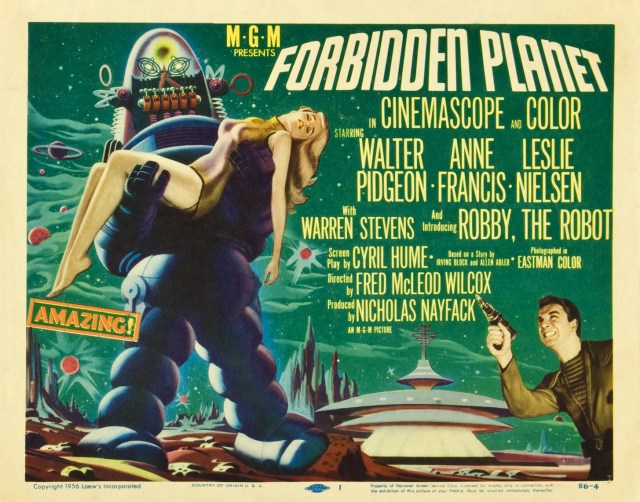
Lewis certainly wasn’t overly impressed by the robot in a classic science fiction film released in 1956.

Before leaving home [for a trip to Northern Ireland] I saw the film of The Forbidden Planet, a post-civilisation version of the Tempest with a Robot for Caliban . . . The contrast between the magnificent technical power and the deplorable level of ethics and imagination in the story was what struck me most.*

Count me as a member of C.S. Lewis’ camp. He possessed little to no fear of robots. He was far more suspicious about a future shaped by the devotees of scientism.

Scientism is that warped theory that, in the words of one Professor of Biological Sciences, surrenders to the “temptation to overreach.”

When I decided on a scientific career, one of the things that appealed to me about science was the modesty of its practitioners. The typical scientist seemed to be a person who knew one small corner of the natural world and knew it very well, better than most other human beings living and better even than most who had ever lived.

But outside of their circumscribed areas of expertise, scientists would hesitate to express an authoritative opinion. This attitude was attractive precisely because it stood in sharp contrast to the arrogance of the philosophers of the positivist tradition, who claimed for science and its practitioners a broad authority with which many practicing scientists themselves were uncomfortable. (Emphasis added.)

Scientism, not robotics, is clearly the danger. However . . . what if the disciples of scientism intend to use robots to further their misanthropic plans?

I suspect taking over our news sources may only be the first stage of the robot blueprint for humanity’s future ruin.

Where are we prepared to draw the line in terms of robots displacing humanity. Apparently, not even in the realm of spiritual matters and worship. I have previously written about a curious, presumably docile, robot. It is, in fact, a Buddhist monk, and presumably a moderately successful evangelist.

A Greater Danger

A futuristic threat that once fell in the domain of science fiction has become science fact. Scientific American has reported that “some of the brightest minds in science and tech think we need a plan to keep humans safe from supersmart machines.”

C.S. Lewis identified a much more ominous alternative than robots seeking to lord it over humans. Lewis worried about the danger of human beings devolving into robots. Well, not robots per se, but beings who have suppressed the qualities that make us who we are, and forfeited our humanity.

The Jewish and Christian scriptures describe an event that must have stunned the angels in heaven. God deigned to create humanity, men and women, in his own image.

It is precisely when we choose to disobey God’s leading, and further distort that divine image, that we become less human.

When I was a child, I wondered why God would create people capable of disobedience. Not only capable but, as the Lord knew in his omniscience, beings who would disobey him. To a more mature mind, the answer seems obvious. No automaton, guided by its programming, can truly love. Lewis explores this dilemma in Mere Christianity.

God created things which had free will. That means creatures which can go either wrong or right. Some people think they can imagine a creature which was free but had no possibility of going wrong; I cannot.

If a thing is free to be good it is also free to be bad. And free will is what has made evil possible. Why, then, did God give them free will? Because free will, though it makes evil possible, is also the only thing that makes possible any love or goodness or joy worth having.

A world of automata—of creatures that worked like machines—would hardly be worth creating.

The happiness which God designs for His higher creatures is the happiness of being freely, voluntarily united to Him and to each other in an ecstasy of love and delight compared with which the most rapturous love between a man and a woman on this earth is mere milk and water. And for that they must be free.

Of course, God knew what would happen if they used their freedom the wrong way: apparently He thought it worth the risk. . . .

If God thinks this state of war in the universe a price worth paying for free will—that is, for making a live world in which creatures can do real good or harm and something of real importance can happen, instead of a toy world which only moves when He pulls the strings—then we may take it it is worth paying.

_____

* The Forbidden Planet received an Academy Award nomination for Best Visual Effects. It is also received the honor of being selected to be preserved for posterity by America’s National Film Preservation Board.

Along with its literary influence, highly influential special effects and visual style, the film also pushed the boundaries of cinematic science fiction. For the first time, all action happened intergalatically (not on Earth) and humans are depicted as space travelers, regularly jetting off to the far reaches of the cosmos. Additionally, Forbidden Planet is remembered for its innovative score—or lack thereof. No music exists on the film’s soundtrack; instead, all ambient sounds are “electronic tonalities.”

forbidden planet.jpg

Understanding the Bible

P52_recto

True or False? The Bible is so simple to understand that studying how to read it is just a waste of time.

Obviously, the answer to that question is a resounding “False.” While some might argue with me, every serious student of the Scriptures knows that probing its depths requires a variety of skills beyond simple faith.

Well, “simple faith” actually is essential for understanding God’s word, but it requires more than simply possessing faith to comprehend its meaning. If that were not true, then everyone being trained in seminaries and colleges to help others explore God’s word are wasting their time.

Exegesis—the focused study of biblical texts—is a core subject for Bible students. It goes deeper than secular “Bible as Literature” courses, and strives to interpret each passage as faithfully as possible. After all, Christians believe these words are inspired.

In 1952 C.S. Lewis wrote a letter in which he noted the value of knowledgeable instructors in understanding the Bible.

It is Christ Himself, not the Bible, who is the true word of God. The Bible, read in the right spirit and with the guidance of good teachers, will bring us to Him.

Bible Study Magazine had an exceptionally good issue several months ago. They provide online access to some of their articles, but sadly, not to the essay I wish to cite. It was written by Karen Jobes, a retired professor of “New Testament and Exegesis” from Wheaton College and Graduate School. She writes:

Different cultures’ writings function in particular ways and settings, and a given literary genre is signaled by textual clues—stock phrases or forms recognizable to anyone familiar with the literature of a given culture.

Jobes begins her article with an example. “Imagine you’re sitting down to read . . . The book in your hands begins, ‘Once upon a time.’” Western readers would know immediately what to anticipate in the pages that follow.

Then she raises a curious question. “Now imagine you’re a student taking a physics course. If your textbook began, ‘Once upon a time,’ you’d no doubt be confused by the phrase and wonder how you should understand it in a scientific context.”

Her article discusses the importance of properly recognizing the genre of what we are reading. This is a concept quite familiar to most readers of Mere Inkling. But what is unfamiliar to many, who have not had opportunity to study biblical exegesis, are the genres and guiding principles employed by Old and New Testament writers.

Reading the Gospels

In two brief pages, Dr. Jobes explains a fundamental principle that we spent weeks discussing in my seminary courses. Knowing the genre of the biblical text is the key to understanding it. Let’s look at the Gospels.

Mark . . . identifies his text as evangelion (“good news,” Mark 1:1), picking up the term Jesus himself used to describe his message (Mark 1:15). The early church came to refer to all four accounts of Jesus’ life using the same term, which survives today in English as “gospel,” a literary genre unique to accounts about Jesus.

The author points out a similarity between the Gospels and “an ancient Greek genre called bioi (“lives”). Rather than provide a day-by-day journal, these “biographies” focus on what is truly important in the perception of the writer.* John offers the prime Christian example of this, in devoting nearly forty percent of his Gospel to the final ten days of Jesus’ life.

C.S. Lewis’ Rules for Exegesis

Hundreds of people sought advice from the Oxford professor. Many asked questions about various Bible passages and religious doctrines. Lewis did his best to point them in the right direction, all the while explaining that he was not a trained theologian.

Within his letters, we find examples of his advice about how to understand the meaning of the Scriptures. “I take it as a first principle that we must not interpret any one part of Scripture so that it contradicts other parts, and specially we must not use an apostle’s teaching to contradict that of Our Lord.” He also wrote:

The two things one must not do are (a) to believe on the strength of Scripture or on any other evidence that God is in any way evil (In Him is no darkness at all) (b) to wipe off the slate any passage which seems to show that He is.

Behind the shocking passage be sure there lurks some great truth which you don’t understand. If one ever does come to understand it, one sees that it is good and just and gracious in ways we never dreamed of. Till then it must just be left on one side.

But why are baffling passages left in at all? Oh, because God speaks not only for us little ones but for the great sages and mystics who experience what we can only read about, and to whom all the words have therefore different (richer) contents.

Would not a revelation which contained nothing that you and I did not understand, be for that very reason rather suspect? To a child it would seem a contradiction to say both that his parents made him and God made him, yet we see how both can be true.

We began with a question, so it’s fitting to end with one.

True or False? Understanding the Bible is so challenging that we should postpone reading it until we become experts at exegesis?

The answer to this question is as obvious as the one with which we began. Don’t delay reading the Scriptures. Immerse yourself in God’s word. But, if you long to know them better, invest some time in learning how to best understand their full meaning.

_____

* In his biographical collection entitled Parallel Lives, the Greek philosopher and historian Plutarch (c. 46 – c. 122) expressly described the bioi genre.

In writing the Lives of Alexander the Great and of Cæsar the conqueror of Pompeius, which are contained in this book, I have before me such an abundance of materials, that I shall make no other preface than to beg the reader, if he finds any of their famous exploits recorded imperfectly, and with large excisions, not to regard this as a fault.

I am writing biography, not history; and often a man’s most brilliant actions prove nothing as to his true character, while some trifling incident, some casual remark or jest, will throw more light upon what manner of man he was than the bloodiest battle, the greatest array of armies, or the most important siege.

Therefore, just as portrait painters pay most attention to those peculiarities of the face and eyes, in which the likeness consists, and care but little for the rest of the figure, so it is my duty to dwell especially upon those actions which reveal the workings of my heroes’ minds, and from these to construct the portraits of their respective lives, leaving their battles and their great deeds to be recorded by others.

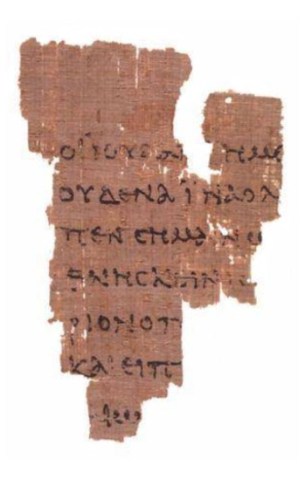
The parchment shown above is the earliest copy of the Gospel According to John. Included on the recto (front) are John 18:32-33.