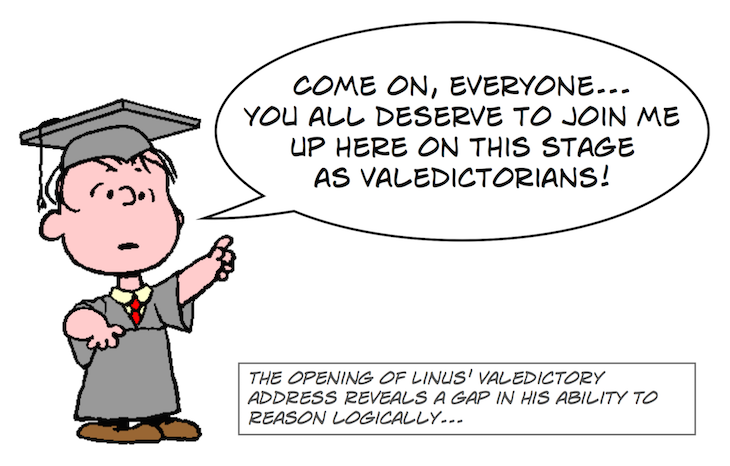
We’re All Valedictorians

valedictoriansWell, not quite. But, if you just graduated from Washington and Lee High School in Arlington, Virginia, there is a fair chance you might be.

That’s because W&L named one hundred and seventeen—that’s right, 117—as valedictorians. And that was out of a class of 457. That means that each of W&L’s graduates had better than a 25% chance to be the/a valedictorian.

Congratulations.

I graduated 22 out of a class of 224. I thought that was a pretty solid accomplishment (especially since military moves meant I attended three different high schools, with both transitions occurring midyear).

My true brilliance was evidenced not in my own academic performance, but the fact that I was smart enough to marry a valedictorian!

Technically the valedictorian does not need to have the top grade point average in their class, although that is the usual custom. In fact, they simply need to be chosen to deliver the valedictory. (Yes, it is a noun, as well as its more familiar appearance as an adjective.)

Apparently, at our afore-celebrated high school, over a hundred students shared in this honor. (Must have been a protracted ceremony.)

It seems that in the modern era, we are so compelled to boost children’s self-esteem, that we feel compelled to exaggerate their accomplishments. Many have argued that this misguided effort has the reverse effect.

On the United States’ opposite coast, Long Beach Polytechnic opted for a measly thirty valedictorians (presumably out of a class of more than sixty).

Julia Jaynes, 17, who shared the valedictorian title with 29 others, said that if her school chose only one, it would destroy collegiality among her classmates. “If everyone wants to be the best, I feel like there’d be less collaboration,” she said. “It makes it so you’re only out for yourself.”

Unfortunately, poor Julia is likely to encounter more competition than collaboration in the world she is entering.

I found the following fact disturbingly humorous. The “dean of admissions at Swarthmore College in Pennsylvania, recalled an applicant whose Midwestern high school reported that every student finished in the top half of the class.”*

Okay. Can we get a little remedial education in mathematics for the administration of that school?

Screwtape lauded this elevation of the average. (Mind you, there is nothing wrong with being average; that’s why it’s called the average.) Screwtape, of course, is the devil whose correspondence fell into C.S. Lewis’ hands and was published to warn humanity of some demonic strategies for harming us.

The basic principal of the new education is to be that dunces and idlers must not be made to feel inferior to intelligent and industrious pupils. That would be “undemocratic.” . . . Children who are fit to proceed to a higher class may be artificially kept back, because the others would get a trauma . . . by being left behind.

The bright pupil thus remains democratically fettered to his own age group throughout his school career, and a boy who would be capable of tackling Aeschylus or Dante sits listening to his coeval’s attempts to spell out A CAT SAT ON A MAT.

In a word, we may reasonably hope for the virtual abolition of education when I’m as good as you has fully had its way. All incentives to learn and all penalties for not learning will vanish. The few who might want to learn will be prevented; who are they to overtop their fellows? And anyway the teachers—or should I say, nurses?—will be far too busy reassuring the dunces and patting them on the back to waste any time of real teaching.

We [i.e. demonkind] shall no longer have to plan and toil to spread imperturbable conceit and incurable ignorance among men. The little vermin themselves will do it for us.

_____

You can read more about the peculiar story of Washington and Lee High School here.

 

Imitating Animals

bearsHave you ever imitated a bear? Perhaps not intentionally. Still, if you are typical, you may do so routinely.

And it’s all because of your acnestis.

When I first saw the word, I thought it might be some recently coined term to address a semi-serious subject. But, the word is neither new, nor is the dilemma it describes exaggerated.

From the 1828 edition of Webster’s Dictionary.

ACNESTIS, n.

That part of the spine in quadrupeds which extends from the metaphrenon, between the shoulder blades, to the loins; which the animal cannot reach to scratch.*

While most human beings may not replicate bears’ behavior with trees, it is not uncommon to seek relief from a handy doorjamb.

Scratching that unreachable epicenter of that infernal itch has motivated the creation of a variety of tools. Yet none of these instruments can match the sheer relief offered by a sturdy doorway. I doubt I am alone, or excessively ursine, for believing that.

It could be worse, of course. At least people (most of them) don’t follow the example of dogs. We’ve all seen how they use the excuse of scratching their backs, to justify picking up unsavory scents while they wriggle around on the ground.

Descending to Subhuman Levels

Emulating animals has implications extending far beyond physical considerations. It is one thing to share a mutual appreciation for scratching one’s acnestis. Quite another to echo their baser natures.

In one of his letters, the Apostle Peter considers the fate of false prophets. After describing the damnation of fallen angels, he writes about those who teach deceitful doctrines. “But these, like irrational animals, creatures of instinct, born to be caught and destroyed, blaspheming about matters of which they are ignorant, will also be destroyed . . .” (2 Peter 2:12, ESV).

The following passage from the Psalms reveals how even the righteous are not immune to behaving like animals. “When my soul was embittered, when I was pricked in heart, I was brutish and ignorant; I was like a beast toward you [God]. Nevertheless, I am continually with you; you hold my right hand. . . . My flesh and my heart may fail, but God is the strength of my heart and my portion forever” (Psalm 73:21-23, 26, ESV).

God’s word is filled with allusions to bestial behaviors. One of the most literal is found in the example of the humiliation of the great King Nebuchadnezzar. You can read it here, from the fourth chapter of the Book of Daniel.

What Distinguishes Us from the Beasts?

C.S. Lewis describes how being a true human being differentiates us from animals. We share physical natures and numerous biological similarities. But we are far more. Lewis explores this in The Abolition of Man, which begins with the chapter “Men Without Chests.”

This image of lacking a “chest” actually refers to a classical reference for the part of a person where our character or virtue resides.

The excerpt below addresses how the enlightened or morally educated individual is capable of transcending the slavery of animals to their fleshly nature.

Without the aid of trained emotions the intellect is powerless against the animal organism. I had sooner play cards against a man who was quite sceptical about ethics, but bred to believe that ‘a gentleman does not cheat,’ than against an irreproachable moral philosopher who had been brought up among sharpers.

In battle it is not syllogisms that will keep the reluctant nerves and muscles to their post in the third hour of the bombardment. The crudest sentimentalism . . . about a flag or a country or a regiment will be of more use.

We were told it all long ago by Plato. As the king governs by his executive, so Reason in man must rule the mere appetites by means of the ‘spirited element.’

The head rules the belly through the chest—the seat, as Alanus tells us, of Magnanimity, of emotions organized by trained habit into stable sentiments.

The Chest-Magnanimity-Sentiment—these are the indispensable liaison officers between cerebral man and visceral man. It may even be said that it is by this middle element that man is man: for by his intellect he is mere spirit and by his appetite mere animal.

It is wise, I believe, for every man and woman to devote themselves to the health and of their own heart and purpose—that which makes us human.

In doing so, we will still share some of the basic behaviors of the animal world about us, such as being plagued by our acnestis . . . but the choices that direct the course of our lives will no longer be dictated solely by carnal instincts.

And such growth, my friends, will make us each day, a little bit more human.

_____

* I realize Noah Webster limited his definition to quadrupeds, but today it has been expanded to aptly apply to all of us who suffer from this curse.

Engage Brain

brainsWhen I attended the University of Washington, we had to learn the old-fashioned way—by studying. Now they are anticipating downloading information directly into students’ brains.

Literal brain dumps are actually still in the future . . . but researchers have documented the first indisputable brain-to-brain interface between humans!

My first paragraph is not an exaggeration of what researchers think may one day happen.

The project could also eventually lead to “brain tutoring,” in which knowledge is transferred directly from the brain of a teacher to a student.

The student would view this shortcut as advantageous. (It could also save a great deal in tuition expenses, if each course only took, say, an hour or two of brain interfacing.)

The university sees another advantage—circumventing limited teaching skills.

“Imagine someone who’s a brilliant scientist but not a brilliant teacher. Complex knowledge is hard to explain – we’re limited by language,” said co-author Chantel Prat, a faculty member at the Institute for Learning & Brain Sciences and a UW assistant professor of psychology.

My main question is, what will the teacher do, once their knowledge has been transferred to a student?

Presumably they will be able to retain a semblance of their knowledge, unlike the experience of the unfortunate Orbanians. They rely on a nanite technology, and it leaves the brilliant brain in a childlike state after the knowledge is siphoned out of it. You can learn more about them in “Learning Curve,” a documentary about the Stargate project.

C.S. Lewis had a great deal to say about education. He was a popular professor, despite the fact many of his students were intimidated by his brilliance. It is possible that if his students were able to download his knowledge, it might have caused their crania to explode.

In one essay, Lewis explains the differences between education and training, declaring “If education is beaten by training, civilization dies.” (“Our English Syllabus”).

Lewis continues, arguing that learning itself, is something distinct. It is not marked by a transfer of knowledge, but by a hunger to grow.

Now learning, considered in itself, has, on my view, no connexion at all with education. It is an activity for . . . all [who] desire to know. . . .

Societies have usually held a belief . . . that knowledge is the natural food of the human mind: that those who specially pursue it are being specially human; and that their activity is good in itself besides being always honourable and sometimes useful to the whole society.

Oh, and if you are waiting to “learn” when they can download knowledge directly into your skull, consider this wise advice from Lewis.

The only people who achieve much are those who want knowledge so badly that they seek it while the conditions are still unfavourable. (“Learning in Wartime”).

_____

The picture above shows two UW guinea pigs transferring brain waves to one another. (I am uncertain whether two-way transfer is already possible, or if one brain is forced to serve in a receptacle role.)

The article announcing the results can be seen here.

Sanctified Languages

petrusOne major difference between Christianity and Islam is their view of language. For the Muslim, Arabic is the language by which the Quran is to be known. For the Christian, there is a great impulse to translate the Scriptures into every tongue in the world.

In Islamic worship, the Quran is properly recited only in Arabic, whether the individual understands Arabic or not. This is similar to the way that most Hindus chant mantras in ancient Sanskrit.

A parallel can be drawn with the medieval practice in the Western branches of Christianity where Latin continued to be used for worship, even after it lost its role as the shared language.

The fact, however, that the Bible had even been translated into Latin was due to the Christian desire to make God’s word accessible to all people. Jerome, an early Christian theologian, became a linguistic scholar with the goal of translating the Vulgate, into the common language of his day.

It would have been a great shock to him, and to Pope Damasus I who commissioned his effort, to see the Latin so ingrained in the church’s usage that their heirs in leadership lost sight of the desire to bring the Lord’s words directly to the people so that all could understand them.

One of the great successes of the Reformation was the successful translation and distribution of the Scriptures into the vernacular of various language groups. Martin Luther’s translation, in fact, standardized the German language which had evolved into several different dialects.

Coincidentally, Lutherans have remained at the forefront of Bible translation, and Lutheran Bible Translators continue that vital work today. They currently have twenty-two Bible translations in process. LBT works in conjunction with Wycliffe Bible Translators, which is an even larger organization.

C.S. Lewis delivered a lecture at the University of London entitled “The Literary Impact of The Authorised Version.” In one portion he addressed the influence of the King James translation on the English language. While not nearly so pronounced as Luther’s on German, it is measurable.

The history of the Authorised Version has been told so often that I will not attempt to re-tell it, and its beauties praised so lavishly that I will not praise them. Instead, I will proceed at once to its influence as an English book. I shall attempt to define that influence, for I think there has been misunderstanding about it and even a little exaggeration.

Lewis’ argument is that the Bible has a profound influence on English literature, the particular translation, less so.

Ideally, all Christians would understand Hebrew and Greek, and be able to read the Scriptures in their original languages. However, there is no stigma in reading a translation. In fact, there are small pockets of people who do not understand the history of the Bible who believe that one particular translation (i.e. the King James Version) is the only authoritative text.

Sadly, I once saw an advertisement in a newspaper inviting worshipers that read: “Are you tired of people changing the Authorized Version of God’s Word with Greek and other languages? If so, come and join us at . . .”

Fortunately, the vast majority of Jesus’ disciples celebrate the translation of God’s word of life into every language spoken today.

Meanwhile, memorization of the Quran in Arabic (even when that is not the reciter’s actual language) remains highly regarded in Islam. Arabic has been regarded as so holy, in fact, that there was great reluctance to contaminate the Quran by using a printing press.

During the Ottoman Empire, until 1729, printing anything in Arabic was a crime. Somewhat ironically, the first printing utilizing Arabic movable type was done by Pope Julius II in the first decade of the sixteenth century. It was created for the benefit of Christians living in Arabic lands.

To provide a powerful illustration of a Christian validation of the authentic inspiration and power of God’s words—in any language—we turn once again to the German reformer.

Since it becomes Christians then to make good use of the Holy Scriptures as their one and only book and it is a sin and a shame not to know our own book or to understand the speech and words of our God, it is a still greater sin and loss that we do not study languages, especially in these days when God is offering and giving us men and books and every facility and inducement to this study, and desires his Bible to be an open book. . . .

In proportion then as we value the gospel, let us zealously hold to the languages. For it was not without purpose that God caused his Scriptures to be set down in these two languages alone—the Old Testament in Hebrew, the New in Greek. Now if God did not despise them but chose them above all others for his word, then we too ought to honor them above all others. St. Paul declared it to be the peculiar glory and distinction of Hebrew that God’s word was given in that language, when he said in Romans 3, “What advantage or profit have those who are circumcised? Much indeed. To begin with, God’s speech is entrusted to them. . . .”

Similarly, the Greek language too may be called sacred, because it was chosen above all others as the language in which the New Testament was to be written, and because by it other languages too have been sanctified as it spilled over into them like a fountain through the medium of translation. (Martin Luther, “To the Councilmen of Germany”).

_____

The image above is an illuminated “P” which begins the name Petrus (Peter). The manuscript is displayed in Malmesbury Abbey in England, but was originally transcribed in Belgium circa 1400.

Literary Martial Arts

nonficOne of the lowest moments in my writing life occurred when a creative writing professor advised me to “stick with nonfiction.” Oh, she said it gently, but it still struck me with the power of a mixed martial arts (MMA) hammerfist.

I was majoring in editorial journalism at the University of Washington. Attempting to expand my scope, I took a short story writing course. It was a mistake.

I thought I had done adequately during the course. I was even moderately pleased with a couple of my stories. The instructor, on the other hand, well let’s just say she was not impressed with my effort.

She was right. At the time, my ear for good fiction was quite immature. I do not claim that it’s particularly well developed today, but I have written a story about a medieval pilgrimage that I hope to unveil in a year or two.

I was reminded of my literature professor’s grim assessment as I recently read an interview with a pastor, who is also a lawyer, and happens to be a writer as well. His name is Randy Singer.

Singer describes the similarity of his professions by saying “They all require skills in persuasion, in telling stories to illustrate things.” I guess he’s right.

The difference being that pastors tell true stories, authors of fiction write imaginary stories, and attorneys weave tales that lie somewhere in between.

The part of the interview, which appeared in World Magazine, that I found particularly insightful was this:

When your only desire is to tell the story so people don’t even notice the wording, at that point you’ve become a fiction author.

Singer’s description struck me with the force of an MMA ridge hand (a reverse knife-hand). When I came to, I finally knew why composing fiction does not come naturally to me.

I love words too much. Too much to sacrifice them simply for the sake of the story. Oh, I value the message also, but getting there is half the fun.

Although I don’t love words to the degree many poets lust after them, I still possess an affection that does not allow me to view them through purely utilitarian lenses.

To add insult to his literary injury, Singer adds the following, in response to the question of what he learned while writing several successful novels.

Third, to be less verbose and let the action carry the story instead of thinking, “What are some really flowery and cool phrases and words that I can weave into this?”

That’s enough, friend. You made your point. I would have responded a bit more colorfully and fragrantly, but I hear you.

Singer doesn’t cite C.S. Lewis in the interview, but his counsel is consistent with that of the Oxford don. Lewis advised using clear and concrete language, “so as to make quite clear what you mean and make sure your sentence couldn’t mean anything else.” (Personal Correspondence, 1956).

Similarly, Lewis would always argue for the words not to draw attention to themselves. Essentially, they need to get out of the way so the message can come through. “Don’t use adjectives which merely tell us how you want us to feel about the things you are describing. I mean, instead of telling us a thing was “terrible,” describe it so that we’ll be terrified.”

It’s wisdom like that which causes us to recognize C.S. Lewis as the brilliant, gifted, creative, versatile and anointed writer that he was.

As for Singer, perhaps I’ll have to check out one of his legal thrillers. The latest is set in antiquity, with a Roman jurist defending Paul before Nero. Should be quite interesting. Not so good as a nonfiction account of such a trial would be . . . but probably worth reading.

Martian Tribute to C.S. Lewis

Malacandra CraterMere Inkling recently named a crater on Mars, in honor of C.S. Lewis. The crater’s name is Malacandra, which was the name for the red planet in the first volume of Lewis’ Space Trilogy, Out of the Silent Planet.

The naming of Malacandra Crater was done through an organization preparing the map which will be used by the Mars One Mission. Mars One is the optimistic international effort to establish a permanent human settlement on the red planet, beginning in 2024.

The über-adventurous (or foolhardy) are able to apply today for consideration to become an astronaut.

The crater naming project is not sponsored by the International Astronomical Union (IAU). Instead, it is coordinated by Uwingu, a for profit company that has a goal of raising $10,000,000 for grants to scientists and educators promoting space exploration.

Due to its limited* budget, Mere Inkling was only able to name a small crater. However, it’s not the expense, it’s the thought that counts.

In addition to Malacandra Crater, I named the impact mark directly to its south in honor of my grandchildren. The process allows one to include a dedication for each named crater. For theirs, I wrote:

Stroud Crater is named in honor of the brilliant grandchildren of Rob & Delores Stroud. Andrew, Ariana, Dominic, Arabelle, Rachel, Rebecca, Kaelyn & Asher. Whether they grow up to be astrophysicists, veterinarians or educators, we know they will all make this world a better place. Soli Deo Gloria.

The tiny basins named above lie in Aurorae Chaos. It’s a rugged neighborhood, but there are surprisingly few craters in the immediate vicinity. I’m always seeking opportunities to encourage my grandchildren to study science, and I hope this will pique their interests, both now and in the years to come.

C.S. Lewis is not primarily known today as a writer of science fiction, but his series (also known as the Cosmic Trilogy, or the Ransom Trilogy, after its protagonist) is quite good. In fact, it was the very first of Lewis’ works I ever read. I was introduced to them by a Christian friend during my college years.

Several influences converged to move Lewis to venture into science fiction. In 1938, he thanked a friend for his praise of Out of the Silent Planet, and wrote:

You are obviously much better informed than I about this type of literature and the only one I can add to your list is Voyage to Arcturus by David Lyndsay (Methuen) which is out of print but a good bookseller will probably get you a copy for about 5 to 6 shillings. It is entirely on the imaginative and not at all on the scientific wing.

What immediately spurred me to write was Olaf Stapledon’s Last and First Men and an essay in J. B. S. Haldane’s Possible Worlds both of which seemed to take the idea of such travel seriously and to have the desperately immoral outlook which I try to pillory in Weston.

I like the whole interplanetary idea as a mythology and simply wished to conquer for my own (Christian) point of view what has always hitherto been used by the opposite side. I think Wells’ 1st Men in the Moon the best of the sort I have read.**

Lewis then appends a comment referring to the other planets in our solar system, but intriguing in light of the recent discovery of numerous planets throughout the galaxy. “The more astronomy we know the less likely it seems that other planets are inhabited: even Mars has practically no oxygen.”

One of Lewis often overlooked science fiction short stories, “Ministering Angels,” is set on Mars. It begins in the following way.

The Monk, as they called him, settled himself on the camp chair beside his bunk and stared through the window at the harsh sand and black-blue sky of Mars. He did not mean to begin his ‘work’ for ten minutes yet. Not, of course, the work he had been brought there to do. He was the meteorologist of the party, and his work in that capacity was largely done; he had found out whatever could be found out.

There was nothing more, within the limited radius he could investigate, to be observed for at least twenty-five days. And meteorology had not been his real motive. He had chosen three years on Mars as the nearest modern equivalent to a hermitage in the desert.

He had come there to meditate: to continue the slow, perpetual rebuilding of that inner structure which, in his view, it was the main purpose of life to rebuild. And now his ten minutes’ rest was over. He began with his well-used formula. ‘Gentle and patient Master, teach me to need men less and to love thee more.’ Then to it. There was no time to waste.

There were barely six months of this lifeless, sinless, unsuffering wilderness ahead of him. Three years were short . . . but when the shout came he rose out of his chair with the practised alertness of a sailor.

The Botanist in the next cabin responded to the same shout with a curse. His eye had been at the microscope when it came. It was maddening. Constant interruption. A man might as well try to work in the middle of Piccadilly as in this infernal camp. And his work was already a race against time. Six months more . . . and he had hardly begun.

The flora of Mars, these tiny, miraculously hardy organisms, the ingenuity of their contrivances to live under all but impossible conditions—it was a feast for a lifetime. He would ignore the shout. But then came the bell. All hands to the main room.
(“Ministering Angels,” Of Other Worlds: Essays and Stories).

Malacandra Crater may be a small feature on a vast and curious planet, but it is a tribute to an author of immense and lasting talent.

_____

* i.e. nonexistent

** The following titles mentioned by Lewis are available for free digital download:

Voyage to Arcturus

Last and First Men

The First Men in the Moon

Navy Nerds

nerdEvery once in a while, the military has a good idea. Sure, they have a knack for technological breakthroughs in warfare . . . but what about other fields? The NAVY NeRD answers that question in the affirmative.

NeRD stands for Navy eReader Device.

Well-informed readers of Mere Inkling are already aware of the growing intensity of international cyberwarfare. It is no joke, and lives are at stake.

Draconian policies are in place to avoid the contamination of the military computer system by innocently transferred viruses. Since virtually all digital platforms allow for the transfer of data, they are potentially dangerous.

Because of that, even ereaders have been off limits in certain environments. Now, however, someone has thought outside the proverbial box and come up with a solution to that problem.

The United States Navy has devised a novel ereader that comes loaded with 300 titles, but has no ports or wireless connectivity to allow for inadvertent viral transfers.

The selection of books sounds pretty well rounded. Some public domain classics, and a number of contemporary best sellers like A Game of Thrones. Fans of J.R.R. Tolkien will be delighted to know the readers also include The Lord of the Rings.

Reading is a productive way to spend one’s free time during a lengthy period at sea. Even for those not prone to opting for it when faced with all the distractions ashore.

During WWII, C.S. Lewis wrote a letter to a former student who was serving in the Navy, “out of reach of libraries.” It acknowledges the perennial problem of sailors—lack of space for personal property. The letter was written in response to a request from Michael Rayner Thwaites for reading recommendations. Thwaites was an Australian poet and military intelligence officer.

A man who has already your linguistic training might well, I think, begin the Anglo Saxon on his own. You will need E. Wardale Old English Grammar. . . . For texts, the ordinary beginning is first Sweet’s Anglo Saxon Primer and then his Old English Reader. But you, being a classic might well, after a dip in the Primer go on to King Alfred’s trans. of Boethius De Consolatione Philosophiae . . .

Whether you can begin O.E. poetry on your own I don’t know. But try getting . . . Beowulf: and with it Clark Hall’s trans. ed. by Wrenn with preface by Tolkien . . . This edition is essential for it is Tolkien’s part of metre wh. is essential. (O.E. verse uses both quality and accent, and your ear is prob. ruined, as mine was, by the false way they teach Latin metre at schools–drastic re-education is required. . . .

As to modern literature. You must not start out to study it ‘as it reveals man’s hesitant advance to the idea of a God-created world’. Don’t you see you are laying down in advance what a phenomenon is to reveal before you have examined the phenomenon? It may reveal that: it may not. You have to find out. I don’t think I can lay down any v. definite course of reading.

All I can point out is that while you are in the navy and out of reach of libraries and new publications, this is the proper time for solid reading through the big (i.e. long) authors, critical works and histories of lit. can come later. Now is the time for Chaucer, Malory, Spenser, Sidney, Shakespeare, Dryden, Pope, Swift, Johnson, Fielding, Richardson, Cowper, Scott, Wordsworth, Byron, Dickens etc etc.

If you usually keep two books of widely different period and type going together (e.g. Faerie Queene & Tom Jones) you won’t get bored. I myself always index a good book when I read it for the first time noting (a) Linguistic phenomena. (b) Good & bad passages. (c) Customs: meal times, social classes, what they read etc. (d) Moral ideas.

All this reading, tho’ dedicated ad Dei gloriam in the long run must not be infected by any immediate theological, ethical, or philosophic reference. Your first job is simply the reception of all this work with your imagination & emotions. Each book is to be read for the purpose the author meant it to be read for: the story as a story, the joke as a joke.

Back to the NeRD

The Navy is making 385 devices at first, with more to follow, with five being sent to each submarine in the Navy to be shared among the crew.

That’s only the start, of course. One would anticipate that even for a military crew (for example, 155 personnel on a Trident sub), a mere five mini-libraries would prove insufficient. (No offense intended; yours truly is a veteran himself.)

Libraries & Imagination

librarycardI just got a new library card. It’s emblazoned with the word “Imagination.” While that would be boring news to most, to people who value reading, it’s noteworthy. Some might wonder, why did he wait until he was nearly sixty to get a library card. That’s because there is more to the story.

I happen to live “across the water” from one of the most literacy-loving communities in the United States—Seattle. (“Across the water” means that the quickest way to get to Seattle is by taking one of our scenic, but outrageously expensive, ferries, across Puget Sound.)

Our relatively small county has superb libraries of our own, but they can’t hope to match the holdings of Seattle’s grandiose institutions. Personally, I am not enticed by the sheer volume of volumes available there. I desire access to their abundant research resources, most notably access to historic newspapers.

The great news is that Kitsap County, where I am blessed to reside, maintains reciprocal library privileges with Seattle! When I made a trip to the metropolis to enroll, not only did they expeditiously process my information, the library pulled open a drawer with a dozen colorful options and said, “which card would you like?” (Now, I see how sheltered a life I live; I didn’t know some libraries actually offered members a choice of what image they want to embellish their cards.)

I selected the one bearing the iconic image of the Space Needle. (I actually visited the Space Needle during the World’s Fair . . . but that’s a story for another day.)

Only after I selected it because of the picture, did I realize each card carried the imprint of a single word. “Imagination,” the librarian said, “a good choice.” A very good choice, I thought to myself. Since I place an extremely high value on that ephemeral trait.

Libraries, I’m afraid, are undervalued today. It’s good to see them continuing to provide a valuable service to our communities. Reading is vital to civilization, growth and culture.

C.S. Lewis enjoyed the family library in the home of his youth, and in one of his boarding schools experienced the library not only as a vestibule of knowledge, but also as a place of refuge. The upper classmen of the school subjected the younger boys to relentless hazing, but the library was off limits to their abusive behaviors.*

The other undisguised blessing of the Coll [Wyvern College] was “the Gurney,” the school library; not only because it was a library, but because it was sanctuary. As the Negro used to become free on touching English soil, so the meanest boy was “un-faggable” once he was inside the Gurney.

It was not, of course, easy to get there. In the winter terms if you were not on the list for “Clubs” you had to go out for a run. In summer you could reach sanctuary of an afternoon only under favorable conditions. You might be put down for Clubs, and that excluded you. Or there might be either a House match or a Coll match which you were compelled to watch. Thirdly, and most probably, on your way to the Gurney you might be caught and fagged for the whole afternoon.

But sometimes one succeeded in running the gauntlet of all these dangers; and then— the books, silence, leisure, the distant sound of bat and ball (“Oh the brave music of a distant drum”), bees buzzing at the open windows, and freedom. In the Gurney I found Corpus Poeticum Bo reale and tried, vainly but happily, to hammer out the originals from the translation at the bottom of the page. There too I found Milton, and Yeats, and a book on Celtic mythology, which soon became, if not a rival, yet a humble companion, to Norse. (Surprised by Joy).

While this passage described the library as a glorious sanctuary, it also reveals a tragic snapshot of the bullying that is endemic to many schools. Since I don’t wish to end these thoughts on a negative image, allow me to offer another revelation from Lewis. In a brief essay, he praises imagination, while acknowledging its limitations.

It must not be supposed that I am in any sense putting forward the imagination as the organ of truth. We are not talking of truth, but of meaning: meaning which is the antecedent condition both of truth and falsehood, whose antithesis is not error but nonsense.

I am a rationalist. For me, reason is the natural organ of truth; but imagination is the organ of meaning. Imagination, producing new metaphors or revivifying old, is not the cause of truth, but its condition. It is, I confess, undeniable that such a view indirectly implies a kind of truth or rightness in the imagination itself. (“Bluspels and Flalansferes: A Semantic Nightmare”).

“Producing new metaphors or revivifying old . . .” What an apt description of the wonders of imagination. And this insight is only one of the countless gems of wisdom I have gratefully received from C.S. Lewis.

_____

* In the language of the school the “Bloods” were the sadistic elites. The youngest and most vulnerable were labeled “fags,” and their mistreatment (forced menial drudgery) was called “fagging.”

Those interested in seeing all five of the Seattle Library options for their new cards, you can do so here.