One Person’s Joy, Another’s Curse

Dislike emoticonEmoticons. Some people love them. Others find them irritating. I’m in the latter camp. That’s why I enjoyed a comic in the paper this week.* A fifty-something husband and wife are talking as she’s typing on her desktop.

Jeannie: I wish I was a little more computer-literate.

Charlie: I don’t really care for that term.

Jeannie: Why not?

Charlie: I don’t like ascribing literacy to people who think emoticons are a part of speech.

I am forced to respond with a wholehearted “ditto!”

I find the evolution of alphabets fascinating. Primitive pictographs amaze me. Emoticons, not so much.

I have to admit that I occasionally use the primitive :) to indicate that something is intended to be humorous, rather than serious. It has served as useful shorthand for written speech, conveying what would be evident in the intonations of oral communication.

However, this nouveau-punctuation has mutated into an abomination. Today there are innumerable graphic variations of that once modest “smile.” And some of them are truly bizarre.

Emoticons run amuck are an evidence of humanity’s demand for novelty. In The Screwtape Letters, C.S. Lewis shows how an incessant demand for something new saps the joy out of the present moment. As the senior demonic tempter declares:

Now just as we pick out and exaggerate the pleasure of eating to produce gluttony, so we pick out this natural pleasantness of change and twist it into a demand for absolute novelty. This demand is entirely our workmanship. If we neglect our duty, men will be not only contented but transported by the mixed novelty and familiarity of snowdrops this January, sunrise this morning, plum pudding this Christmas. . . . Only by our incessant efforts is the demand for infinite, or unrhythmical, change kept up. This demand is valuable in various ways. In the first place it diminishes pleasure while increasing desire.

I realize it’s a bit of a stretch to apply this passage to the subject at hand, but the principle remains the same. When is enough enough? When it comes to emoticons, apparently, that level has yet to be reached. 

I am not seriously suggesting that there is a conspiracy going on here, but one never knows.

Please forgive me if I have offended any Mere Inkling readers who may suffer from emoticonaddiction or some other disorder. It is not my desire to upset you. Feel free to continue your unbridled (ab)use of these tiny monstrosities.

Simply include me (and C.S. Lewis) alongside Charlie in saying, “I don’t like ascribing literacy to people who think emoticons are a part of speech.”

Postscript: I must confess to finding one set of emoticons rather amusing. If you are familiar with Spock from Star Trek, you too may enjoy these Vulcan emoticons that exhibit the full range of Vulcan expression.

vulcan

_____

* You can see the strip I am referring to here.


Discordant Dictionaries

dictionary 1Most “word people” like dictionaries. Some writers go so far as to love dictionaries, but I don’t wish to quibble about where one rests on the affection spectrum in terms of these repositories of words.

This guy, though, has to be pegged on the extreme (idolatry) end of the meter. Ammon Shea wrote Reading the OED: One Man, One Year, 21,730 Pages after having done just that. The Oxford English Dictionary, you may know, comprises 25 volumes, and Shea warns that reading it at such a rapid pace took a toll on his eyesight. It’s not surprising, that he admits he is not your typical reader.

One could say that I collect word books, since by last count I have about a thousand volumes of dictionaries, thesauri, and assorted glossaries. . . . I do not collect these words because I want to impress friends and colleagues with my erudition. . . .

My friends know that I read dictionaries for fun, and have come to accept this proclivity with relative good grace, but they are not terribly interested in or impressed by my word collection.

Pierre Jules Théophile Gautier advised his fellow poets to read the dictionary. No better way to enrich one’s language, he claimed, although he also read cook books, almanacs and the like. In fact, his biographer offered this fascinating observation.

He found pleasure in the most indifferent novels, as he did in books of the highest philosophical conceptions, and in works of pure science. He was devoured with the desire to learn, and said: “No conception is so poor, no twaddle so detestable that it cannot teach us something by which we may profit.”

C.S. Lewis indicated that so-called “definitions” offered outside the ordinances of the dictionary must be approached warily. “When we leave the dictionaries we must view all definitions with grave distrust” (Studies in Words). He offers a very sensible reason for such precautions.

It is the greatest simplicity in the world to suppose that when, say, Dryden defines wit or Arnold defines poetry, we can use their definition as evidence of what the word really meant when they wrote. The fact that they define it at all is itself a ground for scepticism.

Unless we are writing a dictionary, or a text-book of some technical subject, we define our words only because we are in some measure departing from their real current sense. Otherwise there would be no purpose in doing so (Studies in Words).

Dictionaries are, of course, their own genre. Lectionaries, collections of words and meanings, are different than any other type of written composition. For example, glossaries may draw together specialized vocabulary—say for medical or theological purposes—but by their very nature they are not intended to blaze any new literary pathways.

There is, invariably, an exception to this rule. Some “dictionaries” are creative exercises. They are works of fiction, and some are entertaining indeed.

The most famous of these satirical works is Ambrose Bierce’s Devil’s Dictionary (originally published as The Cynic’s Word Book). The volume is not expressly irreverent, although people of faith will encounter some offensive examples in its pages. However, a number of the entries are brilliant.

Kilt

  1. A costume sometimes worn by Scotchmen in America and Americans in Scotland.

Rank

  1. Relative elevation in the scale of human worth.

He held at court a rank so high

That other noblemen asked why.

“Because,” ’twas answered, “others lack

His skill to scratch the royal back.”

Emancipation

  1. A bondman’s change from the tyranny of another to the despotism of himself.

He was a slave: at word he went and came;

     His iron collar cut him to the bone.

Then Liberty erased his owner’s name,

     Tightened the rivets and inscribed his own.

Goose

  1. A bird that supplies quills for writing. These, by some occult process of nature, are penetrated and suffused with various degrees of the bird’s intellectual energies and emotional character, so that when inked and drawn mechanically across paper by a person called an “author,” there results a very fair and accurate transcript of the fowl’s thought and feeling. The difference in geese, as discovered by this ingenious method, is considerable: many are found to have only trivial and insignificant powers, but some are seen to be very great geese indeed.

Another Frenchman, Gustave Flaubert, composed his Dictionary of Received Ideas, which found humor in peculiarities of common understandings.

Absinthe

Extra-violent poison: one glass and you’re dead. Newspapermen drink it as they write their copy. Has killed more soldiers than the Bedouin.

Archimedes

On hearing his name, shout “Eureka!” Or else: “Give me a fulcrum and I will move the world.” There is also Archimedes’ screw, but you are not expected to know what it is.

Omega

Second letter of the Greek alphabet. [Note: this would only apply to biblically literate societies.]

The earliest such example of a satirical dictionary was that by the Persian writer Nezam od-Din Ubeydollah Zâkâni. I have not located a copy of his 14th century lexicon, but it apparently includes entries that are still understandable in our modern world.

Thought

What uselessly makes people ill.

Orator

A donkey.

Word lovers can easily get caught up in conversations like this. In fact, I’m certain more than one Mere Inkling reader has contemplated compiling their own creative dictionary! It’s not an insurmountable project, since it’s accomplished one word at a time.

_____

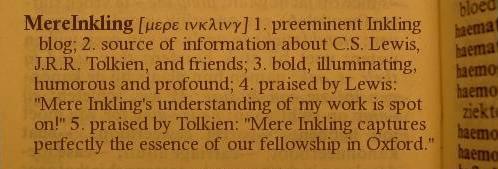
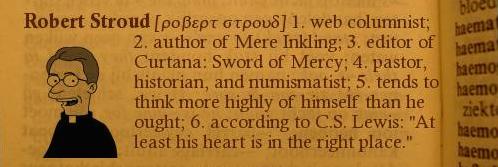
For those desiring to create their own dictionary “entries” such as the one that graces the top of this blog, there a free meme generator you can use online. Available here, it’s a fun little tool. It’s also suitable for creating a little self-deprecating humor.

dictionary 2

Iceland’s Real Elves

warrior elvesI’ve always wanted to visit Iceland.

Not simply because it’s the most sparsely populated country in Europe . . . even though I’m not big on crowds.

Not simply because of its spectacular glaciers and volcanic activity . . . even though these natural wonders inspire genuine awe.

Not simply because it is home to the world’s most ancient parliamentary democracy . . . even though I believe representative democracy is the best sort of government available.

Not simply because they colonized Greenland, from which the Norse were the first Europeans to discover the Americas . . . even though Leif Erikson deserves the accolades rendered to others.

Not simply because 40,000 of my fellow citizens are of Icelandic descent . . . even though I’m pleased they have contributed to our national “melting pot.”

Not simply because Iceland’s tenth largest city is called Fjarðabyggð . . . even though that vivid name is sure to capture the imagination of any writer.

Not simply because the Icelandic alphabet actually includes a runic letter (Þ, þ) named thorn . . . even though this too makes the nation of Iceland unique.

And, not simply because J.R.R. Tolkien and his friend C.S. Lewis established a group called Kolbitar which was devoted to reading Icelandic and Norse sagas. The word itself means “coal biter” and refers to those in a harsh environment drawing so close to the fire’s warmth they can almost bite the coals.

When the Lord of the Rings (as a work in progress) was being in read at meetings of the Inklings, one of the groups members at some point blurted out, “Oh no, not another –– elf!” [I only mention this here because that impetuous comment is often incorrectly attributed to Lewis—a genuine fan of Tolkien’s masterpiece. It was actually voiced by Hugo Dyson, another WWI veteran who taught English at Merton College.]

In the past, all of these reasons have contributed to my curiosity about the Land of Ice, but now I have added one more reason to someday visit.

It turns out that some Icelanders believe that elves, called by them Huldufólk (hidden folk), are real!

The elves have a large enough human constituency, that they are able to block highway construction due to the impact on the local Huldufólk!

Technically, the preservation of the elvish solitude is only the secondary concern in the lawsuits, the first being protection of one of Iceland’s numerous lava fields. Iceland’s Supreme Court has vacillated on the case, which can only raise the ire of any elves that may reside there.

elf houseIf the proponents of the reality of the Huldufólk are right, there remains one shortcoming to the Icelandic elves. Apparently, if the elf homes that dot the countryside are any indication, the northern island breed are a diminutive race. As in tiny, what Americans would think of more as a gnome or perhaps even a fairy.

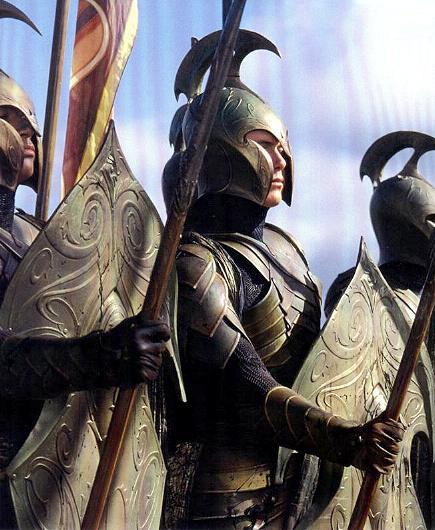
My problem is that I’ve been spoiled by J.R.R. Tolkien’s version of the elvish races. I see them a tall, noble, and wise. The kind of folk you’d want for a friend, if you could get past the aloofness that is apparently characteristic of beings who live centuries rather than decades.

I fear that these Icelandic elves are (pardon me, any Huldufólk who may be reading this) a rather inferior lot. More like leprechauns than warriors. If you live in Iceland and can correct my errors about the hidden folk there, please contact me. Even better if you happen to know some elves personally.

Hitler Versus C.S. Lewis

hitler“Meme.” A ubiquitous word among younger generations, but a concept still rather foreign to many who are slightly more “mature.”

The word was introduced by Richard Dawkins in 1976 and means an idea or social behavior that is transmitted by repetition “in a manner analogous to the biological transmission of genes.” Dawkins echoed the sound of “gene,” using the Greek word mimeisthai (to imitate).

Some memes are quite comical. Other quickly grow wearisome (remember the “dancing baby?”).

One I find particularly creative is a scene of Hitler in his bunker during the final days of the Third Reich. The dialog is in German, and the ingenuity is manifest in all of the hilarious subtitles that people create to coincide with the actions of the characters.

I’m sure there are many tasteless examples (to be avoided), but during the last few years I’ve viewed a couple of dozen and found most quite entertaining.

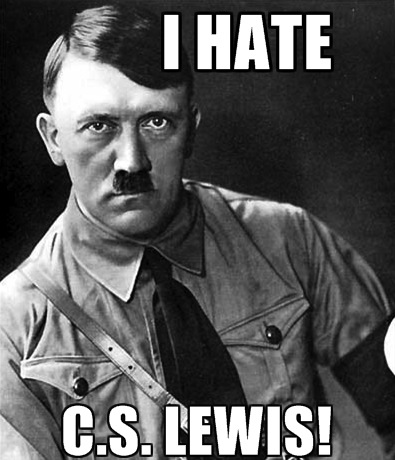
When I discovered a website that allows you to create your own version, I couldn’t resist. And, of course, I could think of no subject better suited to coinciding with Hitler’s demise than the heroic work of C.S. Lewis. In just a moment I’ll share a link to my film “adaptation.”

Lewis, of course, was a patriot who volunteered for the British army and served on the frontlines. He was seriously wounded. (He was not a Christian at the time.)

During the Second World War, Lewis supported the war effort from home. He provided tremendous encouragement to his countrymen via well-received talks broadcast on BBC. And this is the inspiration for my “take” on the Hitler Bunker meme.

His sequel to The Screwtape Letters, “Screwtape Proposes a Toast,” mentions the madman by name. Portraying the demons at the banquet as feasting on the souls of the damned, Screwtape complains:

. . . it would be vain to deny that the human souls on whose anguish we have been feasting tonight were of pretty poor quality. Not all the most skilful cookery of our tormentors could make them better than insipid.

Oh to get one’s teeth again into a Farinata, a Henry VIII, or even a Hitler! There was real crackling there; something to crunch; a rage, an egotism, a cruelty only just less robust than our own. It put up a delicious resistance to being devoured.

Curiously, in English Literature in the Sixteenth Century, Lewis mentioned how Hitler could be viewed in a humorous light.

The mixture of farce and terror would be incredible if we did not remember that boys joked most about flogging under Keate, and men joked most about gallows under the old penal code. It is apparently when terrors are over that they become too terrible to laugh at; while they are regnant they are too terrible to be taken with unrelieved gravity. There is nothing funny about Hitler now.

Lewis’ point, accurate I believe, is that in the terror of the experience itself, humor can provide some relief. Laughing in ridicule at the source of the horror can help to preserve our sanity. Only in the aftermath—once the threat has been dispatched—can we allow the true magnitude of the carnage to be comprehended. And, in that moment, there is nothing at all that is funny.

Of course, years later, when the sights and smells of Dachau are no longer recalled by the living, things shift once again. (Very few of those tragic victims or liberating heroes remain.) When the scarred battlefields have been covered with velvet grass, and it was no longer even “dad’s war,” but now “grandpa’s” or even “great-grandpa’s,” the bitterness has grown stale.

Today, it is natural to scorn and laugh at the tragic dictator who caused so much sorrow. He was a pitiful human being, and without minimizing his crimes, it is fitting that he be ridiculed once again.

History Proves Lewis True

The fact that at a certain point it becomes acceptable to ridicule a monster, is the premise behind the hilarious film “The Producers.” If you’ve never seen it, by all means take a moment to watch the theme song, “Springtime for Hitler.” For a cinematic example of Hitler-ridicule, there may be none finer than that “musical” (overlooking the tasteless burlesque costumes).

Of course, true to Lewis’ maxim, ridicule was also heaped upon the “Bohemian Corporal” during the war itself.

The classic example would be Charlie Chaplin’s celebrated “The Great Dictator.” (In addition to starring in the film, Chaplin wrote, directed and produced the movie. Oh, and he also co-composed the music.) The film was made in 1940, while war already raged, but prior to the entry of the United States.

Chaplin’s movie confirms Lewis’ contention that we should not joke about such matters while the wounds are raw. We learn from Chaplin’s My Autobiography, that in the post-war realization of the depth of Hitler’s evil, he regretted treating him with such levity. “Had I known of the actual horrors of the German concentration camps, I could not have made The Great Dictator, I could not have made fun of the homicidal insanity of the Nazis.”

[Best if viewed in the order presented, beginning with the external link to my parody.]

A Visit to the Cinema

Hitler Versus C.S. Lewis (by Mere Inkling)

Click this link: http://meemsy.com/v/12897

Springtime for Hitler and Germany” from The Producers

Charlie Chaplin’s Version of the German Dictator

The Three Stooges actually beat Chaplin to the screen with their short, “You Nazty Spy!” The sequel, “I’ll Never Heil Again” was released the following year.

A Scene from Nazty Spy

A Brief Clip from I’ll Never Heil Again

And finally, returning full circle to the original meme in which I participated, I was surprised to discover a version of it in which Hitler views the trailer for the 2012 Three Stooges movie. (Apparently, despite their rather disrespectful treatment of him, according to this meme der fuhrer was a fan!) And with that, today’s Hitler cinema will close.

Return to Narnia

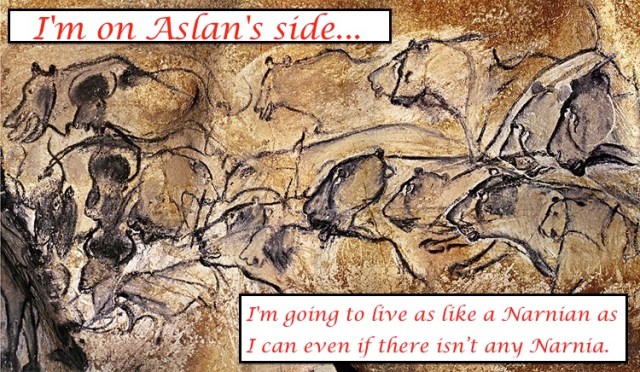
Chauvet Quote

Great news for all fans of Narnia—after a three year delay, it’s just been announced that they will be making a film based on The Silver Chair!

Voyage of the Dawn Treader was released in 2010, although it seems to many of us even more time has passed. And, due to the vagaries of film making, the fourth title in the series may not see the screen until 2018. However, there is additional good news too.

Most fans will be happy to learn that the new partner in the production is Mark Gordon. Among the films and shows Gordon has produced are Saving Private Ryan, The Patriot, Speed, The Day After Tomorrow and Grey’s Anatomy. Gordon is quoted as saying:

Like many readers, both young and old, I am a huge fan of C.S. Lewis’ beautiful and allegorical world of Narnia. These fantasy stories inspire real-world passion among millions of devoted fans around the world. As we prepare to bring the next book to life, we are humbled and excited to contribute to the outstanding legacy of Narnia.

Lewis’ son, Doug Gresham, will continue to work on the project, and strive to maintain fidelity to the author’s vision.

The Silver Chair offers a fascinating tale, much of which takes place in a subterranean realm. I’m certain the cinematography will be spectacular.

The story marks the return of Eustace Scrubb and the addition of a classmate, Jill Pole. The other major character—aside from Aslan, of course—is Puddleglum, a taciturn Marsh-wiggle. (We named the pond on our property in his honor, enjoying the alliteration.)

As the script is written, I’m most concerned about how Puddleglum will be portrayed. He’s not a cartoon character, although much that he says in utter seriousness comes across as slightly silly.

Much of the “humor” comes from the fact that Puddleglum is the archetypal pessimist, as I’ll illustrate in a moment. I just hope they don’t pursue the all too common path of setting him up as comic relief (à la Jar Jar Binks).

Puddleglum, in fact, is the hero of the story. He leads the young children on their dangerous mission to locate the son and heir of King Caspian (who we met in the two previous films). Here are a few quotations from the courageous Marsh-wiggle.

Good morning Guests . . . Though when I say good I don’t mean it won’t probably turn to rain or it might be snow, or fog, or thunder. You didn’t get any sleep, I daresay.

. . . but I’d better not tell you that story. It might lower your spirits, and that’s a thing I never do.

The bright side of it is . . . that if we break our necks getting down the cliff, then we’re safe from being drowned in the river.

Life isn’t all fricasseed frogs and eel pie.

In the climatic confrontation with the Queen of the Underland, Puddleglum champions the truth in this amazing scene.

One word, Ma’am . . . All you’ve been saying is quite right, I shouldn’t wonder. I’m a chap who always liked to know the worst and then put the best face I can on it. So I won’t deny any of what you said. But there’s one more thing to be said, even so. Suppose we have only dreamed, or made up, all those things–trees and grass and sun and moon and stars and Aslan himself. Suppose we have. Then all I can say is that, in that case, the made-up things seem a good deal more important than the real ones. Suppose this black pit of a kingdom of yours is the only world. Well, it strikes me as a pretty poor one.

And that’s a funny thing, when you come to think of it. We’re just babies making up a game, if you’re right. But four babies playing a game can make a play-world which licks your real world hollow. That’s why I’m going to stand by the play world.

I’m on Aslan’s side even if there isn’t any Aslan to lead it. I’m going to live as like a Narnian as I can even if there isn’t any Narnia. So, thanking you kindly for our supper, if these two gentlemen and the young lady are ready, we’re leaving your court at once and setting out in the dark to spend our lives looking for Overland. Not that our lives will be very long, I should think; but that’s a small loss if the world’s as dull a place as you say.

Simply rereading these words has whet my hunger for the new addition to the Narnian cinematic canon. May it arrive soon.

During the next few years, as a script is written, the cast is chosen and the various scenes are filmed and edited, join me in offering an occasional prayer that the movie’s producers will both remain true to Lewis’ message, and produce a film worthy of the novel upon which it is based.

The Purpose of Punctuation

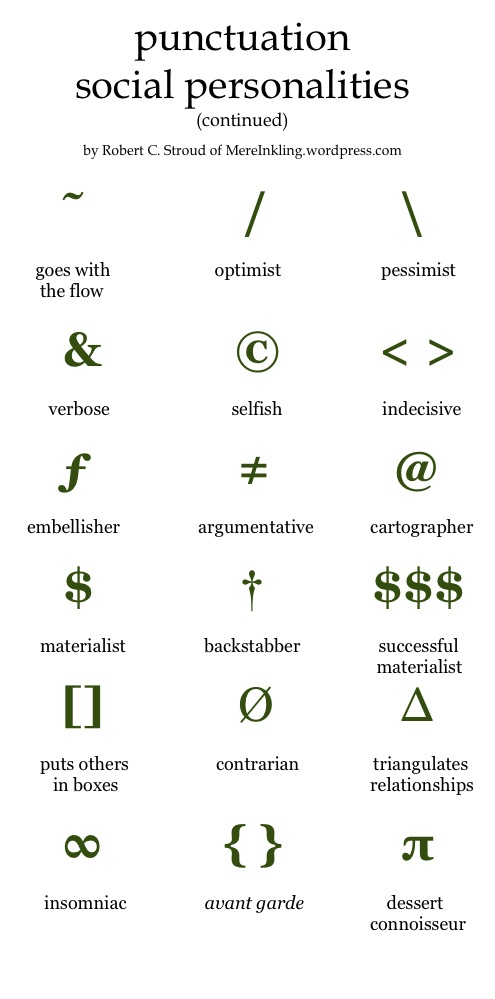
punctuation personalitiesWordsmiths love wordplay.

In fact, they love to toy with everything related to language, including punctuation. The entertaining illustration to the left was created by Carrie Keplinger and inspired me to produce my own supplement to her study.

The idea behind the graphic is to play on the meaning of different punctuation symbols and describe the type of personality they represent.

I took the notion a step further, and based some of my psychological diagnoses on the appearance of the images themselves. I also fudged a bit and included a couple that are common symbols, albeit not punctuation.

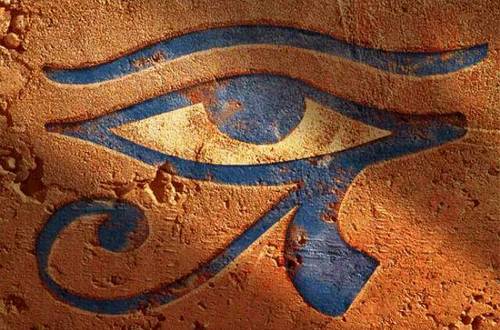
In the past I’ve shared here my fascination with fonts. This extends to pictographic languages like Egypt’s hieroglyphs. Consider this example:

horus

One may not know this particular image is associated with the Egyptian god Horus, but it’s immediately apparent it represents a familiar part of human anatomy.*

If you find the subject of hieroglyphics interesting, you may enjoy reading this article I recently discovered. The author briefly compares the thought of C.S. Lewis with that of the ancient philosopher Plotinus. He writes:

The Hieroglyphs are visible mirrors of the invisible, to use Jean-Luc Marion’s language, the recognition of which brings immediate awareness and experience of meaning rather than strict syllogistic definition. For Lewis, “thinking along” cannot be reduced to concepts.

For Plotinus, Nature cannot be reduced to analysis. As Marion says, when faced with the visible mirror of the invisible one must look beyond the physical and experience the infinite gaze. Although the sunbeam is a physical reality I think it is a great example of “looking along” because it stirs us up to contemplate Beauty itself. Indeed God is Beauty for Lewis and for Plotinus (though not the Christian God for the latter).

Returning to the Subject of Punctuation

Punctuation is a fundamental tool of writers. And, like the broader subject of grammar, it is incumbent on us to do our best to use it properly.

“Improper” usage is not necessarily wrong, however. On numerous occasions we may intentionally make an “error” to achieve a specific purpose. Or, we may object to certain conventions and challenge the ever-evolving status quo. For example, I avoided unnecessarily capitalizing “internet” long before it became acceptable. I also dropped the hyphen from email, etc. prior to that becoming fashionable.**

Naturally, when we are seeking publication of our work, we need to conform to whatever stylistic standards the venue follows. However, in our “personal” writing, I long ago learned there is no value in being enslaved to “official” literary conventions. After all, these seemingly rigid rules themselves are fluid, shifting with ever more frequent speed.

I began with the declaration that lovers of words inherently enjoy wordplay. I certainly do. One evidence of that is found below, in my supplemental list to the chart at the top of this column.

Immediately upon reading “punctuation social personalities,” my own mind, unbidden, began to consider additions. A moment later I had pen in hand, and the rest is history.

Belated Warning: You may experience a similar irresistible response. 

punctuation personalities 2

_____

* A variation of the eye of Horus is actually found on American currency . . . at the peak of the pyramid that adorns the one dollar bill. (It’s officially called the “Eye of Providence,” but its association with the pyramid makes that title rather unconvincing.) It is actually reproduced on America’s money because it is found on the reverse of Great Seal of the United States. Yes, it’s portrayed on the hidden side of the extremely familiar eagle clutching an olive branch and arrows that we see all of the time.

** I’m not suggesting I am a trendsetter . . . merely that I anticipated the eventual elimination of these superfluous elements early on. Well, it’s due to that prediction combined with my own typographical prejudices, such as disliking the over-hyphenation of the English language.

Shut Up He Explained

LardnerMy wife and I love that phrase, and we often recall it when we encounter particularly over-strained (or “broken”) grammar. When I encountered it as the title of a book, I was unaware of its original source.

This is where I reveal that I wasn’t an American Lit major in college. (Well, regular readers probably figured that out long ago.)

I had never heard of Ring Lardner until today. (If you don’t recognize his name either, you needn’t feel embarrassed . . . he died eighty years ago.)

Lardner was a well regarded humorist who considered himself a sports writer. One of his satires was entitled The Young Immigrunts. It was a parody of a popular English book, The Young Visitors, which was allegedly written by a young girl.

The Young Immigrunts is fictitiously ascribed to Lardner’s son, Ringgold Wilmer Lardner, Jr. His son was only four, at the time. Later he would become a successful screenwriter, winning an Academy Award for the film M*A*S*H. He also wrote prolifically for the television series.

Perhaps Lardner Junior is best remembered as one of the Communist writers blacklisted in Hollywood. But we need not go into that, since his father was merely using his young son as a surrogate author for the work.

The book takes the form of the ramblings of a child, and its quaintness will appeal to many readers. You can download a copy of it here.

It’s not my own preferred genre, so I won’t be reading it in its entirety, but in small doses, I find it rather entertaining.

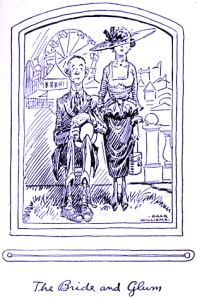
A little later who should come out on the porch and set themselfs ner us but the bride and glum [pictured above].

Oh I said to myself I hope they will talk so as I can hear them as I have always wandered what newlyweds talk about on their way to Niagara Falls and soon my wishs was realized.

Some night said the young glum are you warm enough.

I am perfectly comfertible replid the fare bride tho her looks belid her words what time do we arrive in Buffalo.

9 oclock said the lordly glum are you warm enough.

I am perfectly comfertible replid the fare bride what time do we arive in Buffalo.

9 oclock said the lordly glum I am afrade it is too cold for you out here.

Well maybe it is replid the fare bride and without farther adieu they went in the spacius parlers.

I wander will he be arsking her 8 years from now is she warm enough said my mother with a faint grimace.

The weather may change before then replid my father.

Are you warm enough said my father after a slite pause.

No was my mothers catchy reply.

And now the phrase that always makes me smile.

The lease said about my and my fathers trip from the Bureau of Manhattan to our new home the soonest mended. In some way ether I or he got balled up on the grand concorpse and next thing you know we was thretning to swoop down on Pittsfield.

Are you lost daddy I arsked tenderly.

Shut up he explained.

I am curious as to whether or not C.S. Lewis was acquainted with Lardner’s work. It doesn’t quite conform to his literary tastes, but Lewis was so widely read that I think it’s possible he was at least acquainted with who he was.

My research on the matter did produce an interesting juxtaposition between the two authors. I discovered it in a book by Sherwood Wirt, perhaps the last reporter to interview C.S. Lewis (for Decision magazine, of which he was editor). I was privileged to know “Woody,” so I enjoyed finding that he mentioned both men in his book I Don’t Know what Old is, But Old is Older than Me.

With twentieth century fiction we have to be quite selective. In limiting my comments to the American scene, I will pass by many of the great names of fiction — Henry James, Stephen Crane, Edith Wharton, Jack London, Theodore Dreiser, Ring Lardner, William Faulkner, Sherwood Anderson, Sinclair Lewis, Scott Fitzgerald, Ernest Hemingway, James Baldwin, John Steinbeck, Vladimir Nabokov, Norman Mailer, and Truman Capote.

While most of these are excellent writers, I doubt whether they have much to say to today’s older readers that would make life more pleasant, more interesting, or more fruitful in the closing stretches of life’s journey. Nor do I think that these authors have anything worthwhile to say about what lies beyond death. We might better spend our reading hours riding off into the sunset with Louis L’Amour or Zane Grey, rather than punish ourselves with a ghastly tale like In Cold Blood.

We old boys and girls have been around a long time. We know what the world is like. We know sleaze when we see it, and we don’t need contemporary authors to embellish it or explain it to us.

The reading tastes of the American public have been corrupted almost beyond redemption by blasphemy, vulgarity, and scatology, all for the sake of increased book sales to prurient minds. There are, however, many twentieth-century American novels worth reading, such as Margaret Mitchell’s Gone With the Wind, Thornton Wilder’s The Bridge of San Luis Rey, Harper Lee’s To Kill a Mockingbird, Tom Clancy’s The Hunt for Red October, the Savannah quartet of Eugenia Price, and the Sebastian series of James L. Johnson, to name only a few.

Earlier in the century the Christian novels of Lloyd C. Douglas—The Magnificent Obsession, The Robe, and The Big Fisherman—inspired thousands of readers young and old, but no American has since matched his popular appeal.

The demand for detective fiction continues unabated, and no one needs my advice to read Agatha Christie. I would, therefore, limit my remarks to a reference to two British creations, G.K. Chesterton’s Father Brown and Dorothy Sayers’ Lord Peter Wimsey, since both are written from Christian backgrounds. My two favorite Wimsey stories are Busman’s Honeymoon and The Nine Tailors.

In contrast there is a wealth of devotional literature that makes wonderful reading for older people. One can start with the sermons of D.L. Moody, Charles Spurgeon, Samuel P. Jones, Joseph Parker, and T. DeWitt Talmage of the nineteenth century. The early twentieth century gave us Andrew Murray, Ole Hallesby, P.T. Forsyth, and Oswald Chambers, whose writings are hard to surpass. Amy Carmichael’s poetry and prose written in India, have blessed millions of readers. More contemporary are the writings of C.S. Lewis and A.W. Tozer, which carry seeds of greatness.

The passage above comes from the book’s chapter on “Reading.” If you would like to see more, the entire book (although published as recently as 1992) is legally available for your review online.

“Shut up he explained” may not be proper English, but literature doesn’t need to be proper to be entertaining. And even though Lardner is no longer a familiar name, perhaps his writings are worth visiting.

For the moment, knowing the context of this delightful phrase makes the words all the more entertaining to me. After all, like many others, my dad often “explained” the same thing to me!

Government & Baboons

I recently read an interesting article about battling terrorism from an international base in Djibouti. Many African nations have joined those from Europe and North America in trying to protect vulnerable villages from the ravages of violent extremism.

However, as readers of Mere Inkling know, we don’t deal with political matters here. Everyday life, yes. Writing and self-expression, of course. Faith, definitely. Imagination, most certainly. Current events are also on the table for consideration, insofar as they relate to the aforementioned subjects.

Politics though, as a subject in and of itself, is not on the Mere Inkling menu.

With that in mind, I want to share a passage from the Air Force magazine article. In a description of “a recent personnel recovery mission in Ethiopia,” it says,

The HC-130s landed at night on a pitch-black airstrip, but first had to make a “clearing pass” to scare a congress of baboons and a pod of hippopotamuses off the runway.

Quite a picture. However, the image itself only made part of the impression left on me by this sentence. More lasting was the reminder of what a group of baboons is called.

C.S. Lewis wrote a fascinating essay about government entitled “Democratic Education.” One of many of its many kernels of wisdom is this: “Democracy demands that little men should not take big ones too seriously; it dies when it is full of little men who think they are big themselves.”

Returning to the subject of animals, the second chapter of Genesis tells us,

Now out of the ground the Lord God had formed[f] every beast of the field and every bird of the heavens and brought them to the man to see what he would call them. And whatever the man called every living creature, that was its name. The man gave names to all livestock and to the birds of the heavens and to every beast of the field.

So, Adam named the animals, and I imagine that after her creation, Eve helped her husband refine some of those appellations. What I don’t know is this—exactly who decided how we label groups of the same species?

I would point out how apropos baboons being referred to as a “congress” is . . . except for two considerations. (1) The connection would be lost on many readers whose governments have parliaments, and (2) It turns out this is actually an error. The actual word for baboon bands is a “troop.” So much for their unfortunate association with an organization that has lost the confidence of nine out of ten Americans.

Here are a few of the familiar and unfamiliar collective nouns for a variety of animals, with some brief comments and questions.

Lions | Pride – Aptly named!

Prairie Dogs | Coterie – I never considered prairie dogs snobbish.

Kittens | Intrigue – I should have learned that from simple observation.

Finches | Charm – They really do, don’t they?

Wombats | Wisdom – Wisdom to Aussies, a mystery to me.

Pekingese | Pomp – Well, perhaps just slightly elitist.

Cobras | Quiver – Logical, given the prospect of meeting a group of vipers.

Peacocks | Ostentation – Much nicer than the “pride” option.

Barracudas | Battery – Same as electric eels, I suppose.

Crows | Murder – A term familiar to most literary folk.

Bullfinches | Bellowing – Huh? Sounds more hippopotamusish.

Cows | Kine – Have to thank the medieval English for this one.

Seabirds | Wreck – Beware when they fly overhead.

Bacteria | Culture – And what kind of civilization have they ever built?

Deer | Gang – Must be the teenagers, before they become a herd.

Cockroaches | Intrusion – Accurate, repulsive and ominous.

Guillemots | Bazaar – What’s a guillemot, and what is it selling?

Cormorants | Gulp – Didn’t their momma’s teach them to chew?

Cheetahs | Coalition – Wouldn’t “a ‘sprint’ of cheetahs” sound better?

Woodpeckers | Descent – Am I missing something here?

Clams | Bed – Not much else to do in the clam-world.

Turtledoves | Pitying – Meaning they take pity on us, not vice versa.

Bobolinks | Chain – Cute, but lost on Americans where they’re known as reedbirds or ricebirds.

Snails | Walk – Someone’s lacking a bit in creativity here.

Ravens | Unkindness – Speaking of unkind, who labeled them this?

Flamingoes | Stand – Come on now, isn’t that a bit obvious?

Giraffe | Tower – I guess the flamingoes aren’t the only ones.

Lice | Flock – That is way too nice a word for those vermin!

Alligators | Congregation – As a pastor, I simply don’t want to go there.

This is way too much fun, but I’d better stop now so I can revisit this theme in a year or so. Until then, if you learn who gave that unkind name to groups of ravens, let me know.

Avoid them Like the Plague

cliche bookAvoiding clichés in one’s writing is such oft-repeated advice it’s nearly become a cliché itself.

Many do not make much sense to people approaching a language from a literal perspective. For example, those new to American English may require a bit of explanation to understand that “hit the books” refers to studying rather than literary pugilism.

Some clichés are easily deciphered, especially when read in context. As an admonition to stop obstructing a view, we can understand why someone would say, “You make a better door than a window.”

“Don’t rain on my parade” adequately warns the hearer to avoid dampening the speaker’s special plans or activities.

Folksy adages are common where clichés are concerned. Take “The acorn doesn’t fall far from the tree.” We all know it references a child who shares numerous traits with a parent.

And we have interchangeable versions of the same notion, in case a lazy writer wishes to alternate your redundancies. He/she is a “chip off the old block” means essentially the same thing. And there’s always the classic “like father, like son,” and its corollary “like mother, like daughter.”

“As snug as a bug in a rug” used to be a favorite of my mother, ever applicable as she tucked little ones into their beds. Today, however, with bedbugs plaguing humanity in epidemic proportions, that cuddly image may have lost a touch of its appeal.

Some clichés have clearly outlived any usefulness they may once have possessed. “Too many chiefs, and not enough Indians,” clearly refers to a situation in which everyone is in charge and there no one is able or willing to actually carry out the project. However, few writers would tempt incurring the wrath of readers by using such a dated and rather prejudiced saying.

A cliché, of course, is a typically trite phrase that has lost its element of ingenuity due to overuse. It is something serious writers strive to avoid at all costs. But the final phrase in my previous sentence reveals how difficult it can be to purge these worn out words from our writing. Whenever used, they should be included consciously; writers might utilize them to establish, for example, a comic tone.

Even the gifted C.S. Lewis recognized the threat of clichés worming their way into one’s work. In a 1922 entry in his diary he wrote:

Tried to work at Dymer [his narrative poem] and covered some paper: but I am very dispirited about my work at present—especially as I find it impossible to invent a new opening for the Wild Hunt. The old one is full of clichés and will never do. I have learned too much on the idea of being able to write poetry and if this is a frost I shall be rather stranded . . .

The word cliché itself originated in France, where it was a printing plate or stereotype cast from an original composed of movable type. (The casting freed the movable type for new projects while maintaining the lettering for possible future printings.) The word came to be applied to ready-made phrases. However, the casting of printing plates is one thing. Recycling exhausted phrases ad nauseum is quite another.

Clichés are generally limited to a particular country or culture. Some are restricted to given regions. When outsiders hear or read these phrases, they often make little sense.

Some gain international esteem. More than a century ago Lord Acton described a universal truth of politics that resonates across boundaries. We have all witnessed the truth that “absolute power corrupts absolutely,” but those wise words are not something we should typically parrot in our own writings.

Not knowing the original source of a cliché is common. It is rather tragic, though, when it comes to texts that should be familiar to writers. For example:

“All’s well that ends well” is one of Shakespeare’s best loved maxims. If most Americans were asked whether it came from the pen of the Bard or Benjamin Franklin, we might be sadly disappointed with the results.

“The writing is on the wall” infers the outcome is already determined. But too few recognize this as a reference to a miracle recorded in the Book of Daniel. (If you’re not familiar with it, you can read the story here.)

Some clichés that relate to the art of writing would include the following [with my modest illustrations attached]:

“You can’t judge a book by its cover.”

     Appearances may be misleading.

Someone who appears wonderful when you first meet them may be just like an ebook with a professionally designed cover that contains a poorly scanned reprint replete with typos.

“It’s nothing to write home about.”

     Something that’s boring and not worth retelling.

While the freedom of POD technology has created democracy within the publishing industry, it’s also led to millions of meandering “books” that should “never have seen the light of day.”

A person is “an open book.”

     Someone who readily reveals their personality through word and action.

The type of character skilled authors will wish to introduce in limited quantities, especially if they are writing mysteries.

“Throw the book at him.”

     Give him the maximum possible judicial punishment.

The well-deserved fate of best-selling authors who rest on their laurels and start “phoning in” their sequels.

We turn now to a non-literary but colorful example of an American colloquialism that has spread far from its origins in the swine-breeding communities where it undoubtedly originated. It’s one of my favorite clichés, and it just may have a few good uses left in it, so feel free to include it in your next column or book . . . and no need to cite me as your source:

“You can’t make a silk purse out of a sow’s ear.”

     A task is impossible, given what you have to work with.

The echoing refrain of editors whose clients expect them to transform a few dusty lumps of coal into diamonds.

Possible Valid Uses for Clichés

While it’s safest for writers to avoid them altogether, there are a handful of occasions where they are not utterly inappropriate.

One suitable place for “chesnuts” like these to appear is in dialogue—especially when it’s written for a character a writer desires to portray as rather shallow-thinking.

It’s incorrect to suggest good writers never use clichés in conversation or composition. They do. The difference is that when they do include such tired phrases in their normally witty banter, they do it with a sense of irony.

C.S. Lewis, master of wordplay that he was, illustrated how we can creatively re-imagine or reword a cliché to reinvigorate it. Only the very best minds are up to this task. Yet, when it’s successfully accomplished, it can prove quite entertaining. The following comes from an informal conversation that was recorded before his retirement, preserved in the collection On Stories. Lewis refers in passing to an overly detailed passage in literature that nearly obscured the storyline.

The only trouble is that Golding writes so well. In one of his other novels, The Inheritors, the detail of every sensuous impression, the light on the leaves and so on, was so good that you couldn’t find out what was happening. I’d say it was almost too well done. All these little details you only notice in real life if you’ve got a high temperature. You couldn’t see the wood for the leaves.

Malapropistic Entertainment

marshianWhenever I have an appointment with a doctor, I try to remember to bring along my own magazine or (better yet) the current writing project with which I’m wrestling. Unfortunately, I’m often in a hurry, and sometimes forget . . . which means I need to rely on that odd potpourri of dated magazines that typically migrate to medical waiting rooms.

This week found me in precisely this precarious predicament. I arrived rather early in my dentist’s office, and it turned out that he was slightly behind schedule. Not the best of circumstances. I approached the magazine rack with trepidation.

To my delight I saw a Reader’s Digest with a cover article about “Fifty Dumb Boss Stories.” Having worked for my share of dullards, I thought this should be entertaining. The fact that it included comments from Dwight Schrute of The Office made it just that much more promising.

I wasn’t disappointed. Among the many silly acts recorded in the article were a collection of malaprops voiced by witless bosses. Here are a few:

The Greek pyramids weren’t built in a day.

Spurt me out an email.

Let’s not put the horse before the cart.

We’re not preparing the report because it would be an exercise in fertility.

And my personal favorite, the elegantly mixed metaphor: “It’s not rocket surgery!” Nor is it, I suspect, brain science.

Most of us appreciate humor—even when it’s unintended. C.S. Lewis, in Reflections on the Psalms, wrote: “A little comic relief in a discussion does no harm, however serious the topic may be. (In my own experience the funniest things have occurred in the gravest and most sincere conversations.)”

Now, before ending this post, I need to point out one more truth. Dimwitted bosses aren’t the only people who stumble over words and meld images better left autonomous. Every one of us has occasionally experienced the proverbial “slip of the tongue,” and sometimes with quite entertaining results. Jokes—whether intentional or accidental—can all be appreciated. As the newly created Talking Animals of Narnia are told by Aslan:

“Laugh and fear not, creatures. Now that you are no longer dumb and witless, you need not always be grave. For jokes as well as justice come in with speech.” (The Magician’s Nephew).