Powerful Names

missilesIt’s all in the name. The person who succeeds in naming (or labeling) something wields great power.

Whether it be a concrete object, or an idea, the power to name carries the power to shape perceptions.

Philosophically, we might agree that:

“That which we call a rose by any other name would smell as sweet” (Juliet, Romeo and Juliet).

But, if we are perfectly honest, calling it “skunk cabbage” might affect our perception of its aroma.

A classic example of the power of naming comes from the era of Norse exploration. In the ninth century, Vikings began settling in the inhospitably named “Iceland.” The island was majestic, and its spectacular glaciers and volcanoes still allowed room for extremely fertile farmsteads.

Less than a century and a half later, Erik the Red was exiled from Iceland. He sailed west and established the first colony on a much larger island that he enticingly named Greenland. Erik’s brilliant advertising ploy was quite effective, and hundreds of settlers joined him in the much harsher climes to Iceland’s west.

The specific appellations which led me to ponder the power that resides in naming once again,* actually came from a much more modern source—weaponry.

Military leaders have a knack for generating striking names. Often they are brilliant; occasionally they completely miss the mark. In either case, it’s curious to note the message their choice of nomenclature seeks to emphasize. Consider for a moment two different American missiles.

The AGM-114 Hellfire and the LGM-118A Peacekeeper

The reader naturally assumes the purpose of the former is to rain sulfur and brimstone down on the enemy, while the mission of the latter is to benignly maintain peace. One suspects, however, that being at the epicenter of either explosive device would be equally disastrous.

Another example we might consider is a bit more controversial, but fascinating nonetheless. Consider these labels for movements involved in the abortion debate.

Self-Preferred  ||  Used by Opponents  ||  Used by the Media

Pro-Choice  ||  Pro-Abortion  ||  Pro-Choice

Pro-Life  ||  Anti-Choice  ||  Anti-Abortion

It doesn’t require a brilliant intellect to comprehend the tone each of these labels evokes. Nor should it come as a surprise how the mainstream media tends to line up in the debate.

It’s all in the name. The person who succeeds in naming something wields great power.

C.S. Lewis was a master of language. He knew names exercise significant influence on how things are perceived. In the following passage from “The Humanitarian Theory of Punishment,” he describes how a powerful word—in this case “mercy”—can be dangerously misleading when applied to something inimical to itself.

Mercy, detached from Justice, grows unmerciful. That is the important paradox. As there are plants which will flourish only in mountain soil, so it appears that Mercy will flower only when it grows in the crannies of the rock of Justice: transplanted to the marshlands of mere Humanitarianism, it becomes a man-eating weed, all the more dangerous because it is still called by the same name as the mountain variety.

In another essay, “‘Bulverism:’ or, the Foundation of 20th Century Thought,” Lewis actually coins a word which has found favor with a literate subculture. The peculiar word he created conveys a sense of obtuse, opinionated self-smugness. (Yes, I may be reading just a little bit into “Bulverism,” but I really don’t think so. The aristocratic or remote sounding surname “Bulver,” the “ism” suffix and, of course, the “Bul” prefix all combine to engender an odd and unappealing impression.)

The subject Lewis addresses in this work is the unwillingness of disagreeing parties to honestly debate the merits of an issue. Instead, they rush to employ the invalid (and terribly effective) ad hominem approaches that characterize so much of modern politics.

C.S. Lewis is so talented (and ingenious) that he provides us with a biographical note on the fictional creator of the deficient form of “debate” prevalent in the modern era. “The modern method [of argument],” Lewis begins, “is to assume without discussion [your opponent] is wrong and then distract his attention from this (the only real issue) by busily explaining how he became so silly.”

In the course of the last fifteen years I have found this vice so common that I have had to invent a name for it. I call it “Bulverism.” Some day I am going the write the biography of its imaginary inventor, Ezekiel Bulver, whose destiny was determined at the age of five when he heard his mother say to his father—who had been maintaining that two sides of a triangle were together greater than the third—“Oh, you say that because you are a man.”

“At that moment,” E. Bulver assures us, “there flashed across my opening mind the great truth that refutation is no necessary part of argument. Assume your opponent is wrong, and then explain his error, and the world will be at your feet. Attempt to prove that he is wrong or (worse still) try to find out whether he is wrong or right, and the national dynamism of our age will thrust you to the wall.” That is how Bulver became one of the makers of the Twentieth Century.

. . . Bulverism is a truly democratic game in the sense that all can play it all day long, and that it gives no unfair privilege to the small and offensive minority who reason.

Sadly, Bulver’s disciples continue to increase, rather than diminish.

Since it was military missiles that initially got me thinking about the subject of the power of naming, it might be fitting to end with a few more evocative labels. They certainly elicit a wide range of impressions.

Condor: Argentina’s avian contribution

Piranha: Tiny but vicious and straight from Brazil’s Amazon

Velvet Glove: Canada’s mixed message

Sky Sword: China’s blending of the ancient and modern

Apache: French, which confuses this American veteran**

Meteor: A European offering sure to land hard if it doesn’t disappear in the atmosphere

Martel: Anglo-French venture they surely don’t want Islamists to think is a tribute to Charles Martel, Hero of the Battle of Tours***

V-1 Flying Bomb: Got to Hand it to the Germans for straight-forward labeling.

Rhinemaidens (Rheintöchter): There’s apparently Teutonic Poetry as well

Fateh: Iran’s “Conqueror”

Zelzal: Iran’s “Earthquake”

Sejjil: Iran’s “Baked Clay” (well we can’t expect all the Persian names to be winners)

Jericho: From Israel where we know whose walls tumbled down

Spike: Israeli and probably not a reference to Jael and the Book of Judges****

Hatf: Pakistani “Vengeance” (derived from the gentle sword of Muhammad)

Hyunmoo: Korea’s mythical “Guardian of the Northern Sky” (mayhap a reference to their aggressive northern neighbor)

Penguin: Those Norwegians really know how to frighten their enemies

Malakhit (Малахит): Just one of Russia’s curiously named explosives in their “mineral missile series”

Umkhonto: South African “Spear” from the Zulu tongue

The Brits are uniquely creative when it comes to naming missiles. They include: Blowpipe, Brimstone, Green Cheese, Rapier, Sea Skua and, of course, Fairey Fireflash and it’s less intimidating companion Fairey Stooge.

For some reason, I find a missile named “Green Cheese” particularly disconcerting. Whoever named that specific weapon was devilishly clever. If I were a world leader, I’d surrender immediately, rather than face a foe confident enough in their military prowess to use that sort of twisted culinary nomenclature for their armaments.

______

* I have written on the subject of personal names in the past.

** It just may translate as “Ruffian,” but I don’t think I want to go there, since it hints at political incorrectness.

*** It’s actually a combination of the missile’s guidance options: Missile, Anti-Radiation, Television. I’m sure the parallel with the Frankish defender of the Christian Church is a mere coincidence.

**** The fourth chapter of the Book of Judges.

Boot Camp Religion

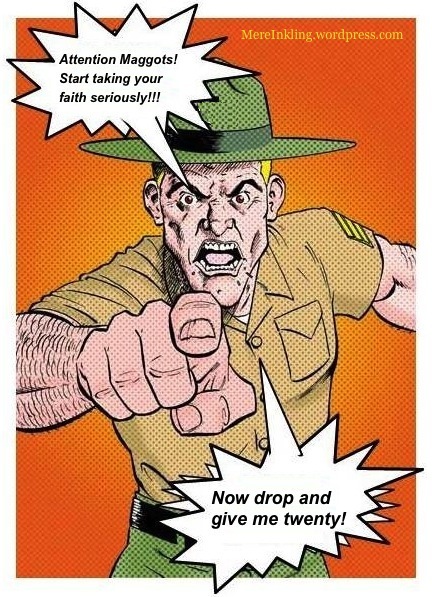
drill instructorShould pastors be more like cheerleaders, or drill instructors? That’s an interesting question recently posed by the president of World Vision United States.

While flying to Saint Louis, I brought along several magazines I hadn’t had an opportunity to read. (The opportunity to read for an extended period is about the only thing I still enjoy about long distance travel.)

One of the magazines included a review of Unfinished: Believing is Only the Beginning by Richard Stearns.

It included an interesting comparison which intrigued both as a pastor and a military chaplain.

The great commandments of Scripture have now become just great suggestions, offered like fortune cookies, to take with us or leave behind in the pews. Jesus said, “If anyone would come after me, he must deny himself and take up his cross daily and follow me” (Luke 9:23). If churches are going to lead a revolution to change the world, then our pastors need to act and speak less like spiritual cheerleaders and more like drill sergeants.

It’s a valid question. But, the truth is that we are talking about a spectrum, not an either/or dichotomy. A pastor should never be a mere cheerleader. Nor should a minister ever be a simple drill sergeant.

Being a pastor is much more complex than either of those labels. Far better to use the metaphor of shepherd.

The author’s point is well made though. In our current “feel good” age, with its divinization of the notion of self esteem, many clergy seem to think their primary role is to “encourage” the saints. They forget that we should be encouraging them to do something. Something, perhaps, like running a race.*

That’s actually the theme of the book—Christian discipleship. Following Christ more closely each day, as we correspondingly come to more and more resemble our Father.

Disciples are not expected to just “talk the talk” of obedience; they are to “walk the walk.” Studying the blueprint in Scripture means that we follow its instructions. It requires that we obey what Scripture teaches. Anyone seeking to truly know God’s calling on his or her life must be serious about obedience. Do we really think that God is going to give a critical kingdom assignment to someone who hasn’t been faithful in day-to-day obedience to his commands?

There’s even a passing C.S. Lewis reference in Unfinished, albeit not a particularly flattering one. The author doesn’t actually speak ill of the Oxford don, but he does criticize the way that some preachers tend to “proof text” their message with pertinent quotations. (I avoid taking personal umbrage at the criticism, since the point Stearns is making is quite valid.)

Far too many Sunday sermons bat around theological ideas like badminton birdies for half an hour. They quote a few verses of Scripture, tell a few stories, throw in a line or two from C.S. Lewis or Dietrich Bonhoeffer, but never challenge the congregation to change anything in their lives.

The sermon is offered like a piece of gum for congregants to chew on for half an hour, but as soon as they get to the parking lot, most will spit it out. The job of the church is not merely to explain the truth but, rather, to use the truth to bring about life change.

I’ve never been accused of preaching chewing gum sermons myself, but I know exactly what he is alluding to.

Unfinished doesn’t actually object to quoting Lewis, just to a shallow, formulaic approach to sermon preparation. The book, in fact, includes several Lewisian citations of its own, referencing no fewer than four of his works.

As a fellow writer and theologian who loves quoting C.S. Lewis, I’ll forgo pointing out the irony.

_____

* The role of the coach, as in training athletes for their competition, is a useful image. Note 1 Corinthians 9:24-25, “Do you not know that in a race all the runners run, but only one receives the prize? So run that you may obtain it. Every athlete exercises self-control in all things. They do it to receive a perishable wreath, but we an imperishable.”

Also, Hebrews 12:1-2, “Therefore, since we are surrounded by so great a cloud of witnesses, let us also lay aside every weight, and sin which clings so closely, and let us run with endurance the race that is set before us, looking to Jesus, the founder and perfecter of our faith, who for the joy that was set before him endured the cross, despising the shame, and is seated at the right hand of the throne of God.”

Ending ALL CAPS

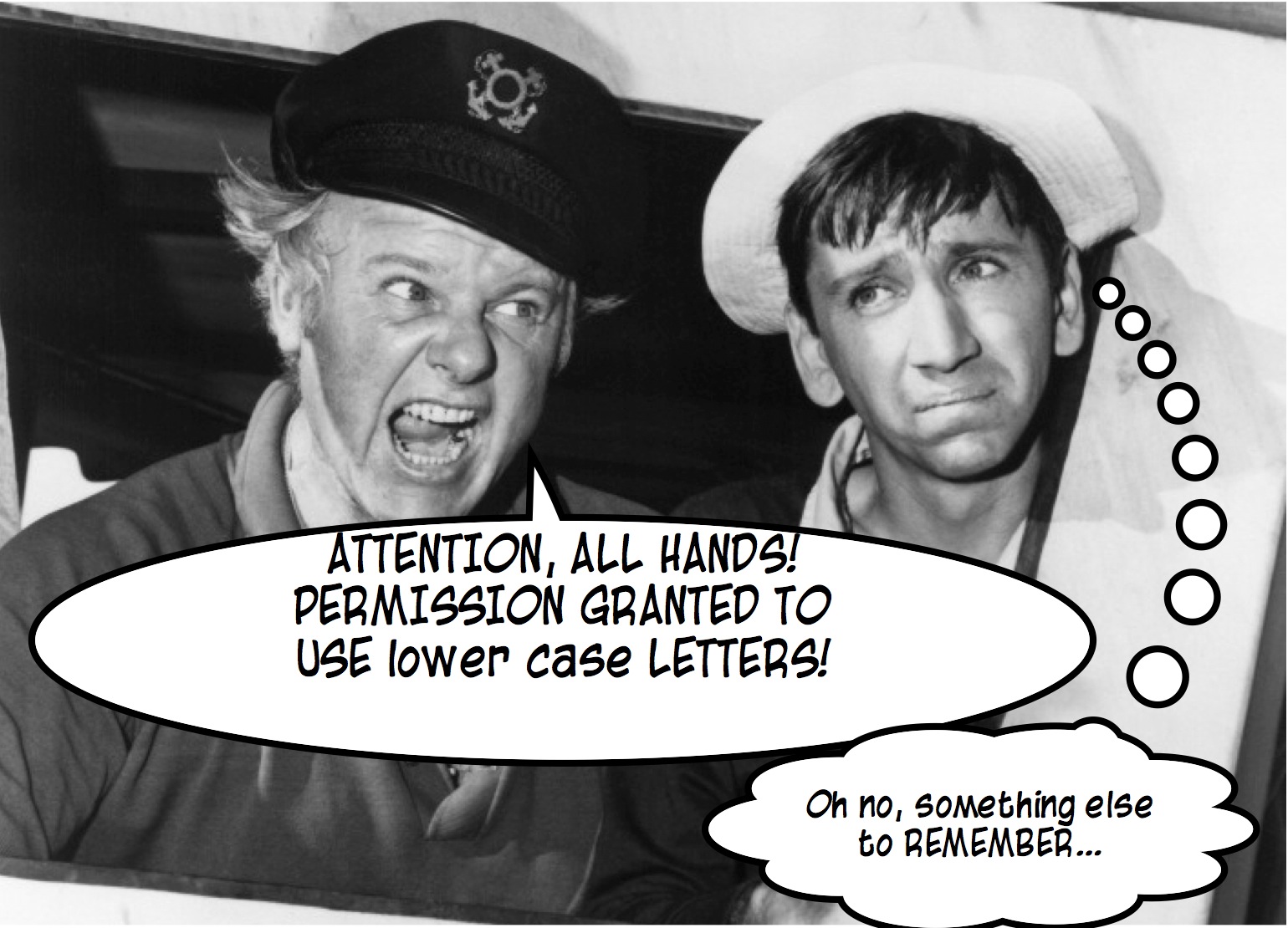
gilliganThe United States Navy finally realized what everyone else long ago recognized—writing in ALL CAPS is obsolete.

Only the most novice users of the internet type in all caps. After all, people quickly learn that it is tantamount to “shouting,” and considered rude behavior.

The occasional word or phrase may properly be rendered in CAPS, in order to emphasize it when italics are not available, BUT WRITING EVERYTHING IN CAPITAL LETTERS IS SURELY TO BE AVOIDED.

The advent of the computer has freed us from the limited conventions forced upon us by typewriters. For emphasis, we lacked boldface and italic fonts (unless one had access to an IBM Selectric or one of its clones).

Back in the “olden days,” we had to be satisfied with unsightly underlining. Surprisingly, many people today seem unaware that underlining is obsolete . . . but that’s a subject for another day.

Returning to the use of all capital letters. Earlier this year, the Navy caught up with the rest of the universe’s practice and changed their official policies which required CAPITALIZATION in internal, official messages.

It was wonderfully fitting that the official memorandum read:

AUTHORIZED TO USE STANDARD, MIXED-CASE CHARACTERS IN THE BODY OF ORGANIZATIONAL MESSAGES.

However, lest any sailors get carried away with this modern fad, the message continued:

RECOMMEND CONTINUE TO USE UPPER CASE IN LINES BEFORE REMARKS.

As a retired military chaplain I love the following (unattributed) quotation from an article on the subject.

“If an ancillary benefit is that sailors reading message traffic no longer feel they’re being screamed at . . . that is a good thing too,” said a Navy official. The official insisted the move was not an example of the service going soft.

Well, we certainly couldn’t have that!

I’m not aware of any places where C.S. Lewis resorts to the use of capital letters to emphasize anything. But in searching for just such a thing, I came across a fascinating passage in the introduction to his English Literature in the Sixteenth Century.

Lewis’ descriptions are always vivid and his description of “ruthless emphasis” does not disappoint.

The rough outline of our literary history in the sixteenth century is not very difficult to grasp. At the beginning we find a literature still medieval in form and spirit. . . . Their prose is clumsy, monotonous, garrulous; their verse either astonishingly tame and cold or, if it attempts to rise, the coarsest fustian. In both mediums we come to dread a certain ruthless emphasis; bludgeon-work. Nothing is light, or tender, or fresh. All the authors write like elderly men. The mid-century is an earnest, heavy-handed, commonplace age: a drab age.*

The use of all caps strikes me as akin to “bludgeon-work.” Not nearly so graceful as occasional italics or the even more skillful manipulation of the English language itself in order to emphasize its message.

At least we can take some small comfort in the fact that the Navy has joined the “mixed-case” twenty-first century. I assume there remain a handful of holdouts in the Admiralty, but eventually these old salts will retire, and the new day of “upper and lower case diversity” will have fully dawned.

_____

* If you are interested in seeing the rest of Lewis’ thoughts about “the rough outline of our literary history in the sixteenth century,” read on.

Then, in the last quarter of the century, the unpredictable happens. With startling suddenness we ascend. Fantasy, conceit, paradox, colour, incantation return. Youth returns. The fine frenzies of ideal love and ideal war are readmitted. Sidney, Spenser, Shakespeare, Hooker—even, in a way, Lyly—display what is almost a new culture: that culture which was to last through most of the seventeenth century and to enrich the very meanings of the words England and Aristocracy. Nothing in the earlier history of our period would have enabled the sharpest observer to foresee this transformation.

Obstreperous Language

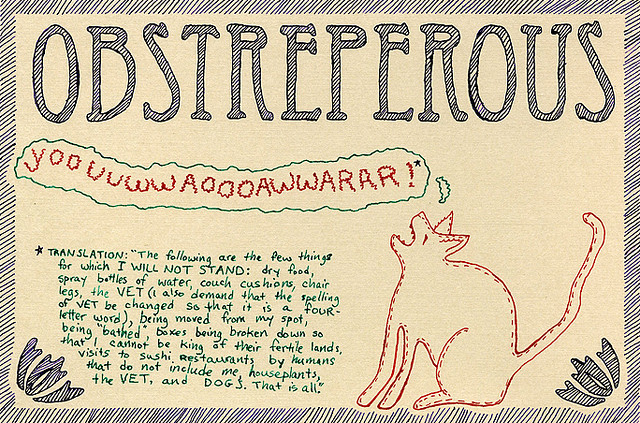
obstreperous

© Stella Belikiewicz and used by permission.

Despite my many shortcomings, I do “pride” myself on possessing a rather considerable vocabulary. My 97th percentile score of the GRE* reinforced my impression that I knew a lot about words.

One technique which has increased my vocabulary is to never let an unknown word pass by without making an effort to learn its meaning. This is simple when I’m working at the computer. If I’m unsure of a definition, I immediately look it up in an online dictionary such as this.

Very rarely do I “guess” at a meaning, based upon its context. This mainly occurs if I’m listening to the radio while I’m driving, and I don’t have recourse to a dictionary. Even then I try to impress the new word on my memory so that I can research it when I return home.

The word in this column’s title motivated me to discuss the importance of accurately understanding word definitions. When I encountered “obstreperous,” it rang vague bells of recollection. And, I was able to discern the word’s general meaning from the context of the article. While some readers of Mere Inkling are already familiar with its meaning—and perhaps use it in daily conversations—allow me to share the context in which I encountered it.

I was reading an article in a military journal about the “battle over ballistic missiles” which was fought inside the Air Force as the manned-bombers-only mindset had to be breached so the United States could advance into the ICBM age. The champions of the two positions were two successive Air Force Chiefs of Staff, Thomas White and Curtis LeMay.

White struggled with how to control the obstreperous LeMay. He knew he didn’t have the political power to force LeMay out, nor could he outwait his [Strategic Air Command] chief. LeMay received his fourth star in 1951 at age 44, which made him the youngest four-star U.S. general since Ulysses S. Grant.**

I’m rarely content with possessing an amorphous definition of a word, so I looked it up. My general impressions of its meaning were confirmed, and I added another word to my personal vocabulary. (The fact that I may never use it beyond its appearance in this post is irrelevant.) Here’s the dictionary entry:

ob·strep·er·ous [uhb-strep-er-uhs]

adjective

1. resisting control or restraint in a difficult manner; unruly.

2. noisy, clamorous, or boisterous: obstreperous children.

Parents give their children a precious gift by encouraging the growth of their own vocabularies. In the pre-computer days, we had a dictionary not far away when we had dinner, and it wasn’t uncommon for it to find its way to the table during our conversations.

Consciously adding new words to our vocabulary is a skill especially vital to writers.

C.S. Lewis wrote about how common usage of familiar words requires no contextual definition. However, he warns of the danger of accepting subjective “definitions” offered outside the context of credible dictionaries.

When we leave the dictionaries we must view all definitions with grave distrust. It is the greatest simplicity in the world to suppose that when, say, Dryden defines wit or Arnold defines poetry, we can use their definition as evidence of what the word really meant when they wrote.

The fact that they define it at all is itself a ground for scepticism. Unless we are writing a dictionary, or a text-book of some technical subject, we define our words only because we are in some measure departing from their real current sense. Otherwise there would be no purpose in doing so. . . .

The word wit will illustrate this. We . . . find old critics giving definitions of it which are contradicted not only by other evidence but out of the critics’ own mouths. Off their guard they can be caught using it in the very sense their definition was contrived to exclude.

A student who should read the critical debate of the seventeenth century on wit under the impression that what the critics say they mean by wit is always, or often, what they really mean by wit would end in total bewilderment.

He must understand that such definitions are purely tactical. They are attempts to appropriate for one side, and to deny to the other, a potent word. You can see the same “war of positions” going on today.

A certain type of writer begins “The essence of poetry is” or “All vulgarity may be defined as,” and then produces a definition which no one ever thought of since the world began, which conforms to no one’s actual usage, and which he himself will probably have forgotten by the end of the month. (Studies in Words)

I find it rather fitting to include this passage from Lewis, with its martial imagery, in a column inspired by a description of a surly advocate of massive nuclear bombing as the best deterrence of World War III.

Writers, particularly those attempting to be persuasive, are wise to ponder Lewis’ wise counsel. We cannot surrender the battlefield to those who would revise the clear and historic meanings of words in an effort “to appropriate for one side, and to deny to the other, a potent word.”

_____

* The Graduate Record Exam is a standardized test used as part of the admission process for many university graduate programs in the United States. We won’t be discussing my mathematics score here . . .

** If the source article interests you, you can read it at Air Force Magazine.

The artwork above is copyrighted by its creator, Stella Belikiewicz, and used with her permission.

Writing Life Scripts

ben hurI was shaped by the heroic religious films of the 1950s and 60s. The powerful messages of epic movies like Ben Hur, Quo Vadis and The Robe planted within my young Christian heart an awareness of nobility and radical self-sacrifice.

About twenty years ago, I spent a year doing graduate work in education. One of my Educational Psychology classes was taught by a professor who was a devotee of Transactional Analysis. I don’t recall too much about TA, aside from one of its principles that resonated with me.

It’s a concept called Life Scripts. Without going into great detail, it is an often subconscious notion of how we “think” our lives will or should play out. It’s adjusted throughout our lives, but the basic theme is established when we are quite young.*

A recent article says “script is broadly understood as a series of decisions, formed as coping strategies in childhood, which continue to shape the life course outside of awareness.”**

It was only as an adult that I realized just how significant an impression these virtuous stories made on me. I recalled the countless times I lay in bed at night rehearsing the story of The Robe. I was the unbelieving Roman soldier, converted by the gentle witness of the wrongfully persecuted Christians.*** Ultimately, I took my stand with them, defending them and voluntarily laying down my life for Christ.

That same plot line still echoes through my mind and soul.

I consider myself blessed to have been exposed to such positive influences while my self identity was being shaped. And I pray for children today whose parents allow them to be exposed (at terribly vulnerable ages!) to violent, fearful and morally ambiguous influences.

Those precious minds and hearts are scarred by the vulgarity and immorality that are endemic in modern cinema, television and music. May God have mercy on them.

C.S. Lewis lived during the era when the virtuous dramas such as those named above were at the peak of their influence.

In a diary entry from the mid-1920s, he mentions Quo Vadis in passing. He is describing his weekend schedule.

Saturday 22 April: Got up about 6.30 and did the same jobs as yesterday. Was settled to work by 9.5 o’clock and put in an excellent morning . . . Sheila Gonner—jolly child—came to tea. Dorothy is to come back tomorrow: so we shall no longer be servantless. At her request I lent her my crib to Tacitus’ History for her sister Rose— I wonder what makes her imagine that she would like it? Possibly early Christian novels of the Quo Vadis type. Worked again after tea, and from supper till ten o’clock, finishing Herodotus. The last few pages of the IXth Book I now read for the first time, having got tired of it on my first reading . . .

I find this diary passage intriguing, in the way that Lewis posits a reader’s potential interest in classical literature as arising from their exposure to ancient Rome via contemporary novels. That’s precisely where my own lifelong fascination with the Roman empire was born.

If you’ve never seen these three movies, I commend them to you. I would also encourage you to consider reading one or all of the novels. They are available for free download in various digital formats.

Quo Vadis

Ben Hur

The Robe

_____

* I’m a pastor and historian, not a psychologist, so I don’t pretend to understand all of the implications. Because of that, I don’t endorse TA as a fully valid theory. What’s more, in our fallen world it’s obvious that many early “life scripts” can be based on wounds inflicted on neglected or abused children. In such cases, particularly where the scripts are destructive, we are not “destined” to live out a tragedy. By the grace of God, even the saddest of stories can be redeemed and “rewritten” into tales of hope and wonder.

** From “Script or Scripture?” by Jo Stuthridge in Life Scripts edited by Richard Erskine (Karnac Books, 2010).

*** It didn’t hurt that the main Christian disciple in the film was the lovely and chaste Diana, played by the British actress Jean Simmons. But that’s another story, and it’s important to note that these life scripts are pre-pubescent creations, so they are motivated by much deeper impulses than hormones. As the previously footnoted quotation referred to them, they are fundamentally “coping strategies” for survival in the calm (or frequently turbulent) world in which children find themselves.

Unimpressive Clergy

sheeps clothingI recently read something alarming. Apparently pastors merit little respect nowadays.

I guess that didn’t surprise me, but it did sadden me, that the once respected “profession” of the ministry has fallen so far in the public’s esteem.

Christianity Today, a fine magazine, reported a Pew Research poll that inquired as to whether people believed that “pastors contribute ‘a lot’ to the well-being of society.”

37% of adults agreed

52% of weekly churchgoers agreed

I’m not surprised only a third of the general American population agrees with that notion . . . but I’m amazed that only half of the people who actually attend religious services concur with the statement.

Only half of the people who go to church think pastors do anything worthwhile!

Perhaps they’re like most people who think so little of members of Congress. They like their own representatives and senators (readily reelecting them), but hold the rest of Congress in disdain.

Students of poll-taking recognize the results depend on a wide range of factors. Most significant is precisely how the question is posed. I suppose the phrasing “a lot” to rate magnitude of the clergy’s contribution could account for some of the negative responses.

Still, it’s logical that most of the people who disagreed with the premise, really do possess a low opinion of clergy. In the wake of child abuse scandals and those infrequent but well publicized cases where ministers commit outrageous crimes, it should come as no surprise.

I suppose it wouldn’t bother me quite so much that clergy were held in low regard, if I wasn’t a pastor myself.

But, as I was ruminating over this gloomy fact, it dawned on me that I actually share the less than glowing opinion of many of the poll’s respondents. I too don’t think that highly of many of the so-called ministers out there either. Especially the self-ordained ones or those pseudo-clergy who just buy a diploma off the internet. (The latter group really irritates me, since I belong to a denomination that requires four full years of seminary education prior to ordination.)

Not that education is all that significant in evaluating ministries. Many highly dedicated and productive ministers never attended seminary at all. And, on the reverse side of the coin, many people who have highly advanced theological degrees are self-aggrandizing hypocrites.

I’m reminded of one of my favorite passages from C.S. Lewis’ allegory about the separation between heaven and hell. In The Great Divorce he relates a conversation involving a lost soul who was a highly regarded theologian while he was alive.

Lewis calls him the “episcopal ghost,” but that’s not a reference to his denomination, merely his ostentatious persona and the fact that he attained the lofty office of “bishop.” Unfortunately, I’ve met more than one person during my life who greatly resembles the misguided theologian in the story.

I enjoy this particular literary encounter so much that I wrote an article about it for a C.S. Lewis journal some years ago.*

If you’ve never read The Great Divorce, you’re missing out on a real gem. It is one of the very few books I have ever read in a single sitting. Once I began it, I couldn’t put it down. (I know that’s a cliche, but in this case it’s literally true.)

The passage I find so provocative appears below. (I didn’t have the heart to edit it, since some readers will want to follow the entire conversation.) After rereading it, I’m beginning to wonder why anyone in Pew’s poll considered clergy praiseworthy.

To understand the dialog, allow me to set the stage. In this fictional work, various “ghosts” (insubstantial souls of those who died without a relationship to Christ) are met at the outskirts of heaven by “bright people” (redeemed, truly real human beings) with whom they were acquainted during their mortal lives. The redeemed individuals attempt to persuade the lost to desire in some small way to draw close to God, so that they might continue a journey drawing closer to his grace.

In this scenario, the two men were both liberal theologians, but one of them, before he died, came to believe that what the Scriptures teach was actually true.

_____

* “Confused Clerics,” The Lamp-Post 18.1 (March 1994): 15-22.

One Sad Pastor

‘My dear boy, I’m delighted to see you,’ [the Ghost] was saying to the Spirit, who was naked and almost blindingly white.** ‘I was talking to your poor father the other day and wondering where you were.’

‘You didn’t bring him?’ said the other.

‘Well, no. He lives a long way from the bus, and, to be quite frank, he’s been getting a little eccentric lately. A little difficult. Losing his grip. He never was prepared to make any great efforts, you know. If you remember, he used to go to sleep when you and I got talking seriously! Ah, Dick, I shall never forget some of our talks. I expect you’ve changed your views a bit since then. You became rather narrow-minded towards the end of your life: but no doubt you’ve broadened out again.’

‘How do you mean?’

‘Well, it’s obvious by now, isn’t it, that you weren’t quite right. Why, my dear boy, you were coming to believe in a literal Heaven and Hell!’

‘But wasn’t I right?’

‘Oh, in a spiritual sense, to be sure. I still believe in them in that way. I am still, my dear boy, looking for the Kingdom. But nothing superstitious or mythological…’

‘Excuse me. Where do you imagine you’ve been?’

‘Ah, I see. You mean that the grey town with its continual hope of morning (we must all live by hope, must we not?), with its field for indefinite progress, is, in a sense, Heaven, if only we have eyes to see it? That is a beautiful idea.’

‘I didn’t mean that at all. Is it possible you don’t know where you’ve been?’

‘Now that you mention it, I don’t think we ever do give it a name. What do you call it?’

‘We call it Hell.’

‘There is no need to be profane, my dear boy. I may not be very orthodox, in your sense of that word, but I do feel that these matters ought to be discussed simply, and seriously, and reverently.’

‘Discuss Hell reverently? I meant what I said. You have been in Hell: though if you don’t go back you may call it Purgatory.’

‘Go on, my dear boy, go on. That is so like you. No doubt you’ll tell me why, on your view, I was sent there. I’m not angry.’

‘But don’t you know? You went there because you are an apostate.’

‘Are you serious, Dick?’

‘Perfectly.’

‘This is worse than I expected. Do you really think people are penalised for their honest opinions? Even assuming, for the sake of argument, that those opinions were mistaken.’

‘Do you really think there are no sins of intellect?’

‘There are indeed, Dick. There is hide-bound prejudice, and intellectual dishonesty, and timidity, and stagnation. But honest opinions fearlessly followed—they are not sins.’

‘I know we used to talk that way. I did it too until the end of my life when I became what you call narrow. It all turns on what are honest opinions.’

‘Mine certainly were. They were not only honest but heroic. I asserted them fearlessly. When the doctrine of the Resurrection ceased to commend itself to the critical faculties which God had given me, I openly rejected it. I preached my famous sermon. I defied the whole chapter. I took every risk.’

‘What risk? What was at all likely to come of it except what actually came—popularity, sales for your books, invitations, and finally a bishopric?’

‘Dick, this is unworthy of you. What are you suggesting?’

‘Friend, I am not suggesting at all. You see, I know now. Let us be frank. Our opinions were not honestly come by. We simply found ourselves in contact with a certain current of ideas and plunged into it because it seemed modern and successful. At College, you know, we just started automatically writing the kind of essays that got good marks and saying the kind of things that won applause. When, in our whole lives, did we honestly face, in solitude, the one question on which all turned: whether after all the Supernatural might not in fact occur? When did we put up one moment’s real resistance to the loss of our faith?’

‘If this is meant to be a sketch of the genesis of liberal theology in general, I reply that it is a mere libel. Do you suggest that men like…’

‘I have nothing to do with any generality. Nor with any man but you and me. Oh, as you love your own soul, remember. You know that you and I were playing with loaded dice. We didn’t want the other to be true. We were afraid of crude salvationism, afraid of a breach with the spirit of
the age, afraid of ridicule, afraid (above all) of real spiritual fears and hopes.’

‘I’m far from denying that young men may make mistakes. They may well be influenced by current fashions of thought. But it’s not a question of how the opinions are formed. The point is that they were my honest opinions, sincerely expressed.’

‘Of course. Having allowed oneself to drift, unresisting, unpraying, accepting every half-conscious solicitation from our desires, we reached a point where we no longer believed the Faith. Just in the same way, a jealous man, drifting and unresisting, reaches a point at which he believes lies about his best friend: a drunkard reaches a point at which (for the moment) he actually believes that another glass will do him no harm. The beliefs are sincere in the sense that they do occur as psychological events in the man’s mind. If that’s what you mean by sincerity they are sincere, and so were ours. But errors which are sincere in that sense are not innocent.’

‘You’ll be justifying the Inquisition in a moment!’

‘Why? Because the Middle Ages erred in one direction, does it follow that there is no error in the opposite direction?’

‘Well, this is extremely interesting,’ said the Episcopal Ghost. ‘It’s a point of view. Certainly, it’s a point of view. In the meantime…’

‘There is no meantime,’ replied the other. ‘All that is over. We are not playing now. I have been talking of the past (your past and mine) only in order that you may turn from it forever. One wrench and the tooth will be out. You can begin as if nothing had ever gone wrong. White as snow. It’s all true, you know. He is in me, for you, with that power. And—I have come a long journey to meet you. You have seen Hell: you are in sight of Heaven. Will you, even now, repent and believe?’

‘I’m not sure that I’ve got the exact point you are trying to make,’ said the Ghost.

‘I am not trying to make any point,’ said the Spirit. ‘I am telling you to repent and believe.’

‘But my dear boy, I believe already. We may
not be perfectly agreed, but you have completely misjudged me if you do not realise that my religion is a very real and a very precious thing to me.’

‘Very well,’ said the other, as if changing his plan. ‘Will you believe in me?’

‘In what sense?’

‘Will you come with me to the mountains? It will hurt at first, until your feet are hardened. Reality is harsh to the feet of shadows. But will you come?’

‘Well, that is a plan. I am perfectly ready to consider it. Of course I should require some assurances…I should want a guarantee that you are taking me to a place where I shall find a wider sphere of usefulness—and scope for the talents that God has given me—and an atmosphere of free inquiry—in short, all that one means by civilisation and—er—the spiritual life.’

‘No,’ said the other. ‘I can promise you none of these things. No sphere of usefulness: you are not needed there at all. No scope for your talents: only forgiveness for having perverted them. No atmosphere of inquiry, for I will bring you to the land not of questions but of answers, and you shall see the face of God.’

‘Ah, but we must all interpret those beautiful words in our own way! For me there is no such thing as a final answer. The free wind of inquiry must always continue to blow through the mind, must it not? “Prove all things”…to travel hopefully is better than to arrive.’

‘If that were true, and known to be true, how could anyone travel hopefully? There would be nothing to hope for.’

‘But you must feel yourself that there is something stifling about the idea of finality? Stagnation, my dear boy, what is more soul-destroying than stagnation?’

‘You think that, because hitherto you have experienced truth only with the abstract intellect. I will bring you where you can taste it like honey and be embraced by it as by a bridegroom. Your thirst shall be quenched.’

‘Well, really, you know, I am not aware of a thirst for some ready-made truth which puts an end to intellectual activity in the way you seem to be describing. Will it leave me the free play of Mind, Dick? I must insist on that, you know.’

‘Free, as a man is free to drink while he is drinking. He is not free still to be dry.’

The Ghost seemed to think for a moment. ‘I can make nothing of that idea,’ it said.

‘Listen!’ said the White Spirit. ‘Once you were a child. Once you knew what inquiry was for. There was a time when you asked questions because you wanted answers, and were glad when you had found them. Become that child again: even now.’

‘Ah, but when I became a man I put away childish things.’

‘You have gone far wrong. Thirst was made for water; inquiry for truth. What you now call the free play of inquiry has neither more nor less to do with the ends for which intelligence was given you than masturbation has to do with marriage.’

‘If we cannot be reverent, there is at least no need to be obscene. The suggestion that I should return at my age to the mere factual inquisitiveness of boyhood strikes me as preposterous. In any case, that question-and-answer conception of thought only applies to matters of fact. Religious and speculative questions are surely on a different level.’

‘We know nothing of religion here: we think only of Christ. We know nothing of speculation. Come and see. I will bring you to Eternal Fact, the Father of all other fact-hood.’

‘I should object very strongly to describing God as a “fact”. The Supreme Value would surely be a less inadequate description. It is hardly…’

‘Do you not even believe that He exists?’

‘Exists? What does Existence mean? You will keep on implying some sort of static, ready-made reality which is, so to speak, “there”, and to which our minds have simply to conform. These great mysteries cannot be approached in that way. If there were such a thing (there is no need to interrupt, my dear boy) quite frankly, I should not be interested in it. It would be of no religious significance. God, for me, is something purely spiritual. The spirit of sweetness and light and tolerance—and, er, service, Dick, service. We mustn’t forget that, you know.’

‘If the thirst of the Reason is really dead…,’ said the Spirit, and then stopped as though pondering. Then suddenly he said, ‘Can you, at least, still desire happiness?’

‘Happiness, my dear Dick,’ said the Ghost placidly, ‘happiness, as you will come to see when you are older, lies in the path of duty. Which reminds me…Bless my soul, I’d nearly forgotten. Of course I can’t come with you. I have to be back next Friday to read a paper. We have a little Theological Society down there. Oh yes! there is plenty of intellectual life. Not of a very high quality, perhaps. One notices a certain lack of grip—a certain confusion of mind. That is where I can be of some use to them. There are even regrettable jealousies…I don’t know why, but tempers seem less controlled than they used to be. Still, one mustn’t expect too much of human nature. I feel I can do a great work among them. But you’ve never asked me what my paper is about! I’m taking the text about growing up to the measure of the stature of Christ and working out an idea which I feel sure you’ll be interested in. I’m going to point out how people always forget that Jesus (here the Ghost bowed) was a comparatively young man when he died. He would have outgrown some of his earlier views, you know, if he’d lived. As he might have done, with a little more tact and patience. I am going to ask my audience to consider what his mature views would have been. A profoundly interesting question. What a different Christianity we might have had if only the Founder had reached his full stature! I shall end up by pointing out how this deepens the significance of the Crucifixion. One feels for the first time what a disaster it was: what a tragic waste… so much promise cut short. Oh, must you be going? Well, so must I. Goodbye, my dear boy. It has been a great pleasure. Most stimulating and provocative. Goodbye, goodbye, goodbye.’

The Ghost nodded its head and beamed on the Spirit with a bright clerical smile—or with the best approach to it which such unsubstantial lips could manage—and then turned away humming softly to itself ‘City of God, how broad and far.’

_____

** Lewis’ use of the nakedness metaphor here is obviously an allusion to the creation of Adam and Eve who, while in a sinless state, required no clothing. It is in no way lewd. Rather, it is an image of purity.


Claiming Divine Inspiration

inspirationSome Christian writers face a terrifying dilemma. They think God has inspired their work. That may be true. But then they proceed a step further and assume that “if God has given these words to me, they can’t be changed.”

The inference, of course, is that the message is essentially inspired in the same sense as Christians normally view the Holy Scriptures themselves. They become, in a word, inviolate.

It’s almost as though the author has appropriated the words of the Apostle John, who in his Revelation was inspired to write:

I warn everyone who hears the words of the prophecy of this book: if anyone adds to them, God will add to him the plagues described in this book, and if anyone takes away from the words of the book of this prophecy, God will take away his share in the tree of life and in the holy city, which are described in this book. (Revelation 22:18-19, ESV).

Naturally, this mindset can cause a bit of a problem when it rears its head in a writing critique group. I’ve witnessed it more times than I can recall, having been a member of such groups on several continents.

I’ve learned to be extremely cautious in how I attempt to explain to the person that while they may rightly feel that their work is inspired by their faith, it doesn’t necessarily follow that it remains in an unblemished condition . . . as it was received by our imperfect human senses, processed by our imperfect minds, and put into words via our imperfect skills and finite vocabulary.

No matter how gently this is said, most of these individuals don’t last long in writers groups. They drop out when others offer suggestions on how to improve their work, seemingly stunned that everyone else doesn’t simply fall prostrate in adoration at their words. It’s quite sad.

That’s why it was so refreshing to read the following in the preface to J. Budziszewski’s What We Can’t Not Know, which I highly recommend.

It seems to me that every writer should end with gratitude to the one who was in the beginning, and whose very name is Word. A reviewer—a friendly one—once remarked that it seemed strange to see that sort of thanks in a book, as though the author were claiming divine inspiration. Of course, for whatever is amiss in these pages (and there will be much), the blame is mine. But permit me to be grateful if anything in them is true.

I love this paragraph. In part, because I share his sentiments. It echoes my own words, spoken at my military retirement, “attribute to me all of the failings and disappointments in my work, and to God any positive or healing results that followed my ministry.”

This worldview proclaims Soli Deo Gloria,* and simultaneously acknowledges that I am not God. It is good for writers to occasionally be reminded of that fact.

It should come as no surprise that our friend C.S. Lewis offers worthwhile insight into inspiration. In his essay, “The Vision of John Bunyan,” he considers that writer’s comments about how the classic Pilgrim’s Progress came to be.

Lewis begins with a quotation, and offers his own wise insights, with which I will close.

For having now my Method by the end;

Still as I pull’d, it came.

It came. I doubt if we shall ever know more of the process called “inspiration” than those two monosyllables tell us.

Perhaps we may hazard a guess as to why it came at just that moment. My own guess is that the scheme of a journey with adventures suddenly reunited two things in Bunyan’s mind which had hitherto lain far apart.

One was his present and lifelong preoccupation with the spiritual life. The other, far further away and longer ago, left behind (he had supposed) in childhood, was his delight in old wives’ tales and such last remnants of chivalric romance as he had found in chap-books. The one fitted the other like a glove. Now, as never before, the whole man was engaged.

_____

* Glory to God alone or all glory be to God.

The Anguish of Suicide

suicideI was present at the scene of a suicide last night.

In my capacity as a volunteer chaplain with a local law enforcement agency, I was riding with a police officer. We were the initial first responders to arrive.

At the end of a rather uneventful shift, we received an urgent call to respond to a shooting. Naturally, I can’t reveal any details about the event beyond mentioning it involved a firearm. It was probably terribly similar to how you would imagine it to be.

To see a life so sadly cast aside is too sad for words. Contemplating the days ahead for those who loved the deceased is sobering. Their lives will never be the same, and that is the universal legacy bequeathed to family and friends by those who end their own lives. God have mercy on them.

C.S. Lewis understood how despair could drive a person to contemplate this irreversible choice. In a letter to a deeply grieving husband who had lost his wife, Lewis relates how suicide would never provide a genuine resolution to the pain caused by the loss.

One way or another the thing [romantic love] had to die. Perpetual springtime is not allowed. You were not cutting the wood of life according to the grain. There are various possible ways in which it could have died though both the parties went on living.

You have been treated with a severe mercy. You have been brought to see (how true & how very frequent this is!) that you were jealous of God. So from us you have been led back to us and God; it remains to go on to God and us.

She was further on than you [in Christian faith], and she can help you more where she now is than she could have done on earth.*

You must go on. That is one of the many reasons why suicide is out of the question. (Another is the absence of any ground for believing that death by that route would reunite you with her. Why should it? You might be digging an eternally unbridgeable chasm. Disobedience is not the way to get nearer to the obedient.)

There’s no other man, in such affliction as yours, to whom I’d dare write so plainly. And that, if you can believe me, is the strongest proof of my belief in you and love for you. To fools and weaklings one writes soft things. (A Severe Mercy by Sheldon Vanauken)

Vanauken, the recipient of the letter, had this response to Lewis’ challenging words: “After this severe and splendid letter, I loved Lewis like a brother. A brother and father combined.”

He continued by explaining how the letter had dispelled any consideration of suicide. “If I had been tempted at all to break my promise to Davy [his wife] about following her by [his] own act, the temptation vanished after one horrified look at Lewis’s ‘eternally unbridgeable chasm.’”

It will take some time for me to “process” my experience last evening. But, having seen death in the past, I found it less traumatic than many others would have.

And, of course, I never knew the person who chose to no longer breathe . . . or smile . . . or dream. I only became “acquainted” with them as I spoke to their spouse in the hours that followed. Sadly, because of a tragic choice, in this world they are merely a memory now.

Naturally, to those who knew and loved them, the vacuum created by their passing cannot be completely filled. Moreover, the wounds caused by the grim nature of their death by choice, will leave permanent scars.

The fact is that during the course of their lives, many people—quite possibly the majority of human beings—consider the possibility that suicide could end the pain they feel. But we must tirelessly remind them, and ourselves, that suicide is a permanent “solution” to temporary circumstances.**

_____

* Lewis is referring to the concept that the saints (i.e. all believers) currently in the presence of the Lord may have the ability to intercede on behalf of those of us who are still “living.” The best way for Protestants to understand this may be by considering this line of thought: (1) we don’t hesitate to ask our sisters and brothers in Christ to pray for us, (2) we believe that God has already given eternal life to his disciples (meaning that even the departed remain alive), thus (3) it is not illogical that children of God now in his presence would be able to intercede for us in heaven.

Traditional Protestant reticence with this understanding is based in the concept most clearly espoused in I Timothy 2:5. Lewis, of course, was a Protestant himself, but Anglicans are among the minority of Protestants who affirm this practice.

** This is not to belittle the intense agony caused by chronic emotional suffering, but I believe there is a path that leads not to death, but to healing and life. If you have suicidal feelings, I strongly encourage you to seek out a skilled Christian counselor. (Not all clergy possess the necessary training, or the faith itself, to provide an adequate lifeline in these situations.)

If you’re unable to find a pastor in your local area, you can contact me at chaplainstroud at mereinkling dot com and I will attempt to get you in touch with a compassionate minister in your local community.

The Purpose of Punctuation

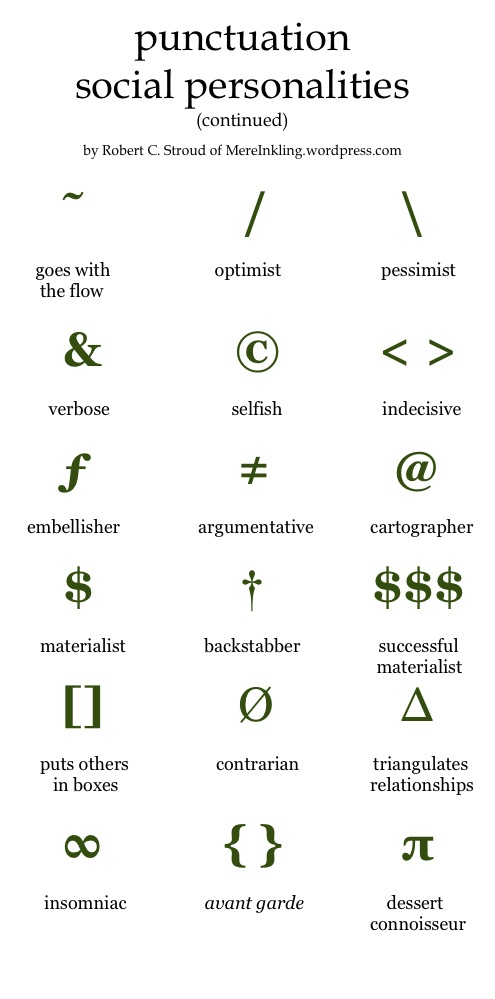
punctuation personalitiesWordsmiths love wordplay.

In fact, they love to toy with everything related to language, including punctuation. The entertaining illustration to the left was created by Carrie Keplinger and inspired me to produce my own supplement to her study.

The idea behind the graphic is to play on the meaning of different punctuation symbols and describe the type of personality they represent.

I took the notion a step further, and based some of my psychological diagnoses on the appearance of the images themselves. I also fudged a bit and included a couple that are common symbols, albeit not punctuation.

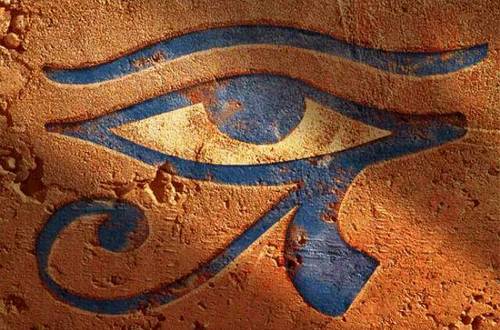
In the past I’ve shared here my fascination with fonts. This extends to pictographic languages like Egypt’s hieroglyphs. Consider this example:

horus

One may not know this particular image is associated with the Egyptian god Horus, but it’s immediately apparent it represents a familiar part of human anatomy.*

If you find the subject of hieroglyphics interesting, you may enjoy reading this article I recently discovered. The author briefly compares the thought of C.S. Lewis with that of the ancient philosopher Plotinus. He writes:

The Hieroglyphs are visible mirrors of the invisible, to use Jean-Luc Marion’s language, the recognition of which brings immediate awareness and experience of meaning rather than strict syllogistic definition. For Lewis, “thinking along” cannot be reduced to concepts.

For Plotinus, Nature cannot be reduced to analysis. As Marion says, when faced with the visible mirror of the invisible one must look beyond the physical and experience the infinite gaze. Although the sunbeam is a physical reality I think it is a great example of “looking along” because it stirs us up to contemplate Beauty itself. Indeed God is Beauty for Lewis and for Plotinus (though not the Christian God for the latter).

Returning to the Subject of Punctuation

Punctuation is a fundamental tool of writers. And, like the broader subject of grammar, it is incumbent on us to do our best to use it properly.

“Improper” usage is not necessarily wrong, however. On numerous occasions we may intentionally make an “error” to achieve a specific purpose. Or, we may object to certain conventions and challenge the ever-evolving status quo. For example, I avoided unnecessarily capitalizing “internet” long before it became acceptable. I also dropped the hyphen from email, etc. prior to that becoming fashionable.**

Naturally, when we are seeking publication of our work, we need to conform to whatever stylistic standards the venue follows. However, in our “personal” writing, I long ago learned there is no value in being enslaved to “official” literary conventions. After all, these seemingly rigid rules themselves are fluid, shifting with ever more frequent speed.

I began with the declaration that lovers of words inherently enjoy wordplay. I certainly do. One evidence of that is found below, in my supplemental list to the chart at the top of this column.

Immediately upon reading “punctuation social personalities,” my own mind, unbidden, began to consider additions. A moment later I had pen in hand, and the rest is history.

Belated Warning: You may experience a similar irresistible response. 

punctuation personalities 2

_____

* A variation of the eye of Horus is actually found on American currency . . . at the peak of the pyramid that adorns the one dollar bill. (It’s officially called the “Eye of Providence,” but its association with the pyramid makes that title rather unconvincing.) It is actually reproduced on America’s money because it is found on the reverse of Great Seal of the United States. Yes, it’s portrayed on the hidden side of the extremely familiar eagle clutching an olive branch and arrows that we see all of the time.

** I’m not suggesting I am a trendsetter . . . merely that I anticipated the eventual elimination of these superfluous elements early on. Well, it’s due to that prediction combined with my own typographical prejudices, such as disliking the over-hyphenation of the English language.

Shut Up He Explained

LardnerMy wife and I love that phrase, and we often recall it when we encounter particularly over-strained (or “broken”) grammar. When I encountered it as the title of a book, I was unaware of its original source.

This is where I reveal that I wasn’t an American Lit major in college. (Well, regular readers probably figured that out long ago.)

I had never heard of Ring Lardner until today. (If you don’t recognize his name either, you needn’t feel embarrassed . . . he died eighty years ago.)

Lardner was a well regarded humorist who considered himself a sports writer. One of his satires was entitled The Young Immigrunts. It was a parody of a popular English book, The Young Visitors, which was allegedly written by a young girl.

The Young Immigrunts is fictitiously ascribed to Lardner’s son, Ringgold Wilmer Lardner, Jr. His son was only four, at the time. Later he would become a successful screenwriter, winning an Academy Award for the film M*A*S*H. He also wrote prolifically for the television series.

Perhaps Lardner Junior is best remembered as one of the Communist writers blacklisted in Hollywood. But we need not go into that, since his father was merely using his young son as a surrogate author for the work.

The book takes the form of the ramblings of a child, and its quaintness will appeal to many readers. You can download a copy of it here.

It’s not my own preferred genre, so I won’t be reading it in its entirety, but in small doses, I find it rather entertaining.

A little later who should come out on the porch and set themselfs ner us but the bride and glum [pictured above].

Oh I said to myself I hope they will talk so as I can hear them as I have always wandered what newlyweds talk about on their way to Niagara Falls and soon my wishs was realized.

Some night said the young glum are you warm enough.

I am perfectly comfertible replid the fare bride tho her looks belid her words what time do we arrive in Buffalo.

9 oclock said the lordly glum are you warm enough.

I am perfectly comfertible replid the fare bride what time do we arive in Buffalo.

9 oclock said the lordly glum I am afrade it is too cold for you out here.

Well maybe it is replid the fare bride and without farther adieu they went in the spacius parlers.

I wander will he be arsking her 8 years from now is she warm enough said my mother with a faint grimace.

The weather may change before then replid my father.

Are you warm enough said my father after a slite pause.

No was my mothers catchy reply.

And now the phrase that always makes me smile.

The lease said about my and my fathers trip from the Bureau of Manhattan to our new home the soonest mended. In some way ether I or he got balled up on the grand concorpse and next thing you know we was thretning to swoop down on Pittsfield.

Are you lost daddy I arsked tenderly.

Shut up he explained.

I am curious as to whether or not C.S. Lewis was acquainted with Lardner’s work. It doesn’t quite conform to his literary tastes, but Lewis was so widely read that I think it’s possible he was at least acquainted with who he was.

My research on the matter did produce an interesting juxtaposition between the two authors. I discovered it in a book by Sherwood Wirt, perhaps the last reporter to interview C.S. Lewis (for Decision magazine, of which he was editor). I was privileged to know “Woody,” so I enjoyed finding that he mentioned both men in his book I Don’t Know what Old is, But Old is Older than Me.

With twentieth century fiction we have to be quite selective. In limiting my comments to the American scene, I will pass by many of the great names of fiction — Henry James, Stephen Crane, Edith Wharton, Jack London, Theodore Dreiser, Ring Lardner, William Faulkner, Sherwood Anderson, Sinclair Lewis, Scott Fitzgerald, Ernest Hemingway, James Baldwin, John Steinbeck, Vladimir Nabokov, Norman Mailer, and Truman Capote.

While most of these are excellent writers, I doubt whether they have much to say to today’s older readers that would make life more pleasant, more interesting, or more fruitful in the closing stretches of life’s journey. Nor do I think that these authors have anything worthwhile to say about what lies beyond death. We might better spend our reading hours riding off into the sunset with Louis L’Amour or Zane Grey, rather than punish ourselves with a ghastly tale like In Cold Blood.

We old boys and girls have been around a long time. We know what the world is like. We know sleaze when we see it, and we don’t need contemporary authors to embellish it or explain it to us.

The reading tastes of the American public have been corrupted almost beyond redemption by blasphemy, vulgarity, and scatology, all for the sake of increased book sales to prurient minds. There are, however, many twentieth-century American novels worth reading, such as Margaret Mitchell’s Gone With the Wind, Thornton Wilder’s The Bridge of San Luis Rey, Harper Lee’s To Kill a Mockingbird, Tom Clancy’s The Hunt for Red October, the Savannah quartet of Eugenia Price, and the Sebastian series of James L. Johnson, to name only a few.

Earlier in the century the Christian novels of Lloyd C. Douglas—The Magnificent Obsession, The Robe, and The Big Fisherman—inspired thousands of readers young and old, but no American has since matched his popular appeal.

The demand for detective fiction continues unabated, and no one needs my advice to read Agatha Christie. I would, therefore, limit my remarks to a reference to two British creations, G.K. Chesterton’s Father Brown and Dorothy Sayers’ Lord Peter Wimsey, since both are written from Christian backgrounds. My two favorite Wimsey stories are Busman’s Honeymoon and The Nine Tailors.

In contrast there is a wealth of devotional literature that makes wonderful reading for older people. One can start with the sermons of D.L. Moody, Charles Spurgeon, Samuel P. Jones, Joseph Parker, and T. DeWitt Talmage of the nineteenth century. The early twentieth century gave us Andrew Murray, Ole Hallesby, P.T. Forsyth, and Oswald Chambers, whose writings are hard to surpass. Amy Carmichael’s poetry and prose written in India, have blessed millions of readers. More contemporary are the writings of C.S. Lewis and A.W. Tozer, which carry seeds of greatness.

The passage above comes from the book’s chapter on “Reading.” If you would like to see more, the entire book (although published as recently as 1992) is legally available for your review online.

“Shut up he explained” may not be proper English, but literature doesn’t need to be proper to be entertaining. And even though Lardner is no longer a familiar name, perhaps his writings are worth visiting.

For the moment, knowing the context of this delightful phrase makes the words all the more entertaining to me. After all, like many others, my dad often “explained” the same thing to me!