Religious Kitsch

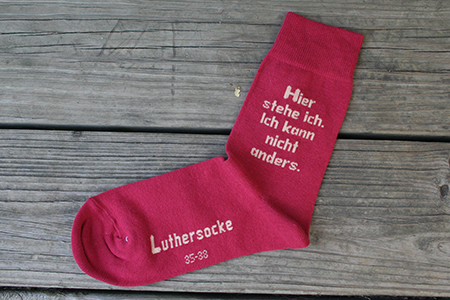
socksAre souvenir socks a good way of celebrating one of the move pivotal points in human history? That’s right, stockings. Socks emblazoned with one of the most famous statements of Christian faith made during the past millennium.

Hier stehe ich!” “Here I stand” (on the clear message of God’s word). This was Martin Luther’s steadfast defense where his salvation on the teaching that we are saved by God’s grace and mercy, not by our own efforts.

Ich kann nicht anders.” I can do no other, Luther continued. He invited his adversaries to correct him if they could show him in error, according to the Scriptures.

We are beginning a season when many people are celebrating the 500th anniversary of the Reformation of the Church. Some of the commemorations are quite noteworthy. Others . . . less so.

On the positive side, I rank near the top The Wittenberg Project, the restoration of the Old Latin School in the city where Luther preached the Gospel.

Near the other extreme, I have to place the “Here I Stand” socks. While I briefly considered purchasing a pair for one of my sons, my admittedly plebian sense of fashion saved me from doing so. (If you, on the other hand, find them tasteful or suitable for an acquaintance, you’ll find a link to the footwear below.)*

In his essay, “What Christmas Means to Me,” C.S. Lewis describes this sort of product. In his description of the “commercial racket” associated with the season, he writes:

I condemn it on the following grounds. . . . Things are given as presents which no mortal ever bought for himself – gaudy and useless gadgets, ‘novelties’ because no one was ever fool enough to make their like before.

Have we really no better use for materials and for human skill and time than to spend them on all this rubbish?

I understand that one person’s “rubbish,” though, can be another’s treasure. Still, as Edward Veith writes in The State of the Arts:

The problem with religious kitsch is that its cuteness and self-gratifying nature can domesticate and thereby distort Biblical faith. Christianity is not a sickly, sweet religion . . . The anemic figurines of Jesus Christ are poor testimony to His deity and His lordship.

Viewing It All in (a Humorous) Perspective

sockeWhile surfing the net researching this peculiar item, I encountered an entertaining website where we see how the Catholic—Reformer struggle lives on today.

A Roman Catholic website comments on the same sort of socks—tastefully offered in the original German. The author of The Ironic Catholic writes:

With all due apologies to my Lutheran brothers and sisters: while this catapults you into a real race with the Catholics for kitsch, we will crush you like grapes in this arena.

It’s all good-natured, of course. I haven’t bothered to research Catholic variations on the footings quotations front, but I imagine they are equally pithy.

I did, however, find one prolific Roman Catholic author whose following statement might be just as suitable for a hat as for stockings.

“It is because we are standing on our heads that Christ’s philosophy seems upside-down.” (G.K. Chesterton)

_____

* You can order your own pair of “Here I Stand” socks here.

** The Ironic Catholic post is here.

Listening to Sermons

pewsPastors aren’t always good at listening to sermons.* That makes my experience this month all the more special.

The statement that pastors aren’t the best “listeners,” may sound strange to some readers. There are many exceptions, of course, but the majority of pastors are handicapped by a couple of factors when it comes to listening to their peers preach.

Many of us were formally trained in our homiletics courses to actively critique other preachers. Even when we can get past this, our minds often (involuntarily) leap to how we would expound on various passages.

Wordsmiths within the clerical ranks are particularly vulnerable to this hazard. Grammatical errors screech like claws on a chalk board. Breaks in logic force us to stifle an inner cry for public redress. God-willing, we are able to remain in our seats and avoid causing embarrassment.

When we experience these uncharitable reactions, we silently ask for God’s forgiveness. We request from the Lord another portion of humility. And we try our best to refocus on what the pastor is preaching, rather than how he is doing it.

I recently spent a few days conducting research at Concordia Seminary. I enjoyed attending the daily chapel services while in St. Louis.

One sermon spoke to me with particular power. (Amazing, since the professors who preach in chapel are restricted to seven minutes! Just try to enforce that at a Baptist seminary!)

The Rev. Dr. Tony Cook preached on a passage from  James. He skillfully wove together a number of the elements in his brief ** sermon. Among his warnings, echoing the biblical text, he noted that we too often “place our confidence in the world,” and offer a “confession without compassion.” Too true.

He offered a timely word about the ecclesiastical practice of finding specks in the eyes of those with whom we differ. He said, “We do what Satan cannot. We tear down the Church from within.”

A final important reminder came in his proclamation that “We are made perfect by Jesus, not by our rhetoric about him.”

Amen.

C.S. Lewis, the Considerate Parishioner

Rev. Will Vaus wrote an informative article about Lewis’ relationship with his home congregation. The article includes a number of beneficial insights. Included in it is the following insight into how respectful he was toward a pastor he found less than stimulating.

Douglas Gresham, Lewis’s step-son . . . showed our mostly-American tour group around Holy Trinity Church [C.S. Lewis’ home parish].

[Gresham mentioned] how Jack sat behind the pillar during the service so that his facial expression could not be seen by the vicar, Ron Head.

“Was that because he disagreed with the vicar’s theology?” I asked.

“No,” said Doug. “It was not so much Ron’s basic theology that Jack objected to, but the slants that he put on it. Ron was a fine scholar of church history and by intellect a High Church Anglican. However, in his sermons there were often many things that would cause a spasm of pain or perhaps a look of total boredom to cross Jack’s face.

Sitting as he did out of sight of Ron, Jack could yawn if he had to without causing pain to a man whom he regarded as something of a bore, one who had become lost in the trivial aspects of his calling whilst ignoring some of the essential ones. Ron was a very nice and indeed I think a good man and none of us would have hurt him for the world.”

In fact Jack referred to Ron Head as “a very trying curate” in a letter written to Mrs. Mary Van Deusen on April 22, 1954. Head was curate at Holy Trinity from 1952 to 1956, prior to serving as vicar. On December 28, 1953, Lewis wrote to the same Mrs. Van Deusen and said:

“I think someone ought to write a book on ‘Christian life for Laymen under a bad Parish Priest’ for the problem is bound to occur in the best churches. The motto would be of course Herbert’s lines about the sermon ‘If all lack sense, God takes a text and preaches patience’”

A Preacher in His Own Right

C.S. Lewis, though he was a layman, was invited to preach on a number of occasions. Another professor offers a great analysis of Lewis’ own preaching here. Hal Poe*** writes:

Forty years after his death, C. S. Lewis still offers preachers a model for how to approach the serious task of bringing the word of God to a congregation of believers or an audience of unbelievers.

The attitude toward preaching that Lewis represents does not produce dull or boring sermons. Rather, it engages people in a way that they must come to grips with what God has said.

_____

* Actually, there are a number of things that pastors are not particularly adept at . . . but those are stories for another day.

** Brevity is not an enemy to powerful communication. Poetry, for example, says in a phrase a truth prose might require several paragraphs to explain. In addition, we’re familiar with writers like Mark Twain who echoed Blaise Pascal’s 1656 statement that “I would have written a shorter letter, but I did not have the time.”

*** Yes, Dr. Poe is an indirect descendant of the famous writer of the macabre.

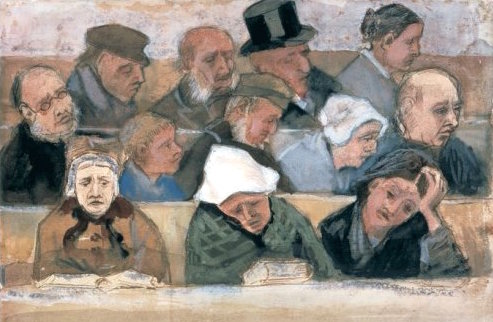
The rather discomforting painting at the top of this column is Church Pew with Worshippers, painted by Vincent van Gogh in 1882. (I’m happy to say I’ve never preached to a congregation that looked quite as miserable as this one.)

Africa Comes to America

saharaYes, you read the title correctly; it’s no typo. Africa itself arrived in America this summer—and it’s an event that apparently takes place every year!

In a recent post by one of Mere Inkling’s earliest subscribers, I learned about the annual Saharan Air Layer. It is an enormous dust cloud that transits the entire Atlantic Ocean and is vital to the western hemisphere, especially the Amazonian rain forests. More about the SAL below.

I find this phenomenon fascinating. It reveals how intricately balanced and interconnected God has created this amazing ecosystem we call earth.

I appreciate this fact, even though I don’t consider myself an environmentalist. That doesn’t mean, of course, that I don’t recycle. What’s more, I would actually like to see brazen polluters incarcerated and tasked with personally cleaning toxic waste dumps . . . but that’s not the theme of this reflection.

It seems to me that part of being truly human, is possessing an appreciation—or even a love—for the world in which our Creator has allowed us to dwell. By love, I mean a deep affection for the flora and fauna, and even the mountains and valleys themselves.

I am not proposing idolatry.

I am in good company in valuing nature. C.S. Lewis found time spent walking in the countryside to be invigorating. It was renewing, for body, mind and soul.

Several years back a book was published with the peculiar subtitle, The Environmental Vision of C.S. Lewis.

The authors of Narnia and the Fields of Arbol explores the way Lewis displays his “ecological” concerns, particularly in his fiction. They also consider J.R.R. Tolkien’s similar attitude.

It is no coincidence that these two men, as soldiers during the Great War, had seen the worst violence humanity could do to nature. The ravages wrought by the orcs surrounding Isengard were echoes of the lifeless terrain of shell-shattered Western Front.

Writing this now, I recall a poem I wrote for Curtana: Sword of Mercy.

“A Foreshadowing of Epics” begins:

Filthy trenches greeted the novice soldiers’ eyes,

their two imaginations envisioned greener lands.

Crimson combat splashed red their vision,

and colored portraits one day painted with their words.

The frontlines were barren,

scarred earth stripped of all life.

Fallen trees mimicked casualties,

not even the smallest of creatures escaped death.

It may seem ironic to some that those very fields now are green, and teeming with life. It is the mercy of God that restores the scarred and heals the broken. And, as impressive as those miracles are evident in nature, they are far more wondrous when it is human lives that are transformed and resurrected.

So it is that I find the wonder of the barren and seemingly lifeless Saharan dust bringing nutrients to hungry forests on the other side of the earth amazing. No mere accident that.

If Jesus delays his return and this globe continues to spin for more centuries still, I would not be surprised to see the Americas returning to Africa a similar gift of life.

_____

Weather.com has a short video about the Saharan Air Layer here.

Pharisaical Cats

catsCats or dogs? Which makes the best companion? This is one of the few topics guaranteed to arouse arguments as intense as political debates.

The fact is, the first three words already elicited a visceral reaction from most readers. “Cats or dogs” might as well read “cats versus dogs.”

Even though many of our homes welcome both species as residents, we all know they are drastically different. Many dogs eagerly solicit feline playful attention, while most cats choose to remain aloof from them, barely tolerating their canine presence.

The humans who share the habitation may genuinely loves both types of animals, but in the deep recesses of their hearts everyone possesses a (sometimes secret) preference for one or the other.

Of course, if we’re a “cat person” we wouldn’t want our dogs to know that; it would hurt their feelings. And, if we’re a “dog person” we wouldn’t want our cats to know, lest they treat us with even greater disdain than they already do.

C.S. Lewis was an animal lover. He had both dogs and cats during his lifetime. And he recognized well their differences. In a 1955 letter to an American correspondent, he wrote:

We were talking about Cats & Dogs the other day & decided that both have consciences but the dog, being an honest, humble person, always has a bad one, but the Cat is a Pharisee and always has a good one. When he sits and stares you out of countenance he is thanking God that he is not as these dogs, or these humans, or even as these other Cats!

I love Lewis’ comparison of their temperaments. I don’t think I’ve ever met a cat who was not at least a little bit self-righteous. As for canines . . . even disobedient rascals (like our yet-to-be-sufficiently-trained adolescent border collie) are quite aware of the fact that they are being “bad.” Some are even grow remorseful.

In a 1961 missive Lewis addresses the psychoanalysis of a cat. He is responding to a correspondent’s announcement that her veterinarian had diagnosed her cat with some behavioral problem.

I hope your vet is not a charlatan? Psychological diagnoses even about human patients seem to me pretty phoney. They must be even phonier when applied to animals.

You can’t put a cat on a couch and make it tell you its dreams or produce words by ‘free association’. Also—I have a great respect for cats—they are very shrewd people and would probably see through the analyst a good deal better than he’d see through them.

Lewis is quite likely correct in this observation. Our cats obviously see through all of their human “family.” They are not only astute, they act disinterested, but actively observe us all day long. (Well, at least during the ninety-four minutes when they are not napping each day.)

I have written about C.S. Lewis’ dogs in the past. I’ll close now with a passing reference Lewis made in a 1962 letter to a fellow cat-lover.

We [you and I] are also both ruled by cats. Joy’s Siamese—my ‘step-cat’ as I call her—is the most terribly conversational animal I ever knew. She talks all the time and wants doors and windows to be opened for her 1000 times an hour.

So it goes with our pharisaical felines. With majestic posture, they patiently wait for us to fulfill their commands.


Do Dads Matter?

dadsaurusThey most certainly do, if you are discussing the influence of parents on their children’s religious practices.

And, as politically uncomfortable as it may make people, the example of the father appears to exert far more influence than that of the mother.

In 2000, a Swiss study was released that revealed, in part, the way parental faith is transmitted to children. I was reminded of it while reading “Dads Being Dads,” in the current issue of The Lutheran Witness.

A Touchstone article (linked below) analyzed the study. It compared the frequency of worship attendance by parents with the consequential involvement of their children as they matured.

If both father and mother attend regularly, 33 percent of their children will end up as regular churchgoers, and 41 percent will end up attending irregularly. Only a quarter of their children will end up not practicing at all.

If the father is irregular and mother regular, only 3 percent of the children will subsequently become regulars themselves, while a further 59 percent will become irregulars. Thirty-eight percent will be lost.

These numbers sound extreme, don’t they? Some of us will be doing calculations in our minds. In my own family, my mother was a faithful Christian. My father was agnostic. (Actually, he was a practicing atheist who would argue “I believe in God.”)

Of the three kids, I am a regular church attender. Not just because I’m a pastor; since I’m “retired” and have no external obligation to attend. My sister attends occasionally. My brother only for special, family events.

Hmmm, that is merely anecdotal, of course, but my observation of other family histories seems to bear out the findings of the demographic study.

While some readers may wish to challenge the applicability of a Swiss study to other nations, the simple fact that the burden to do so rests on them. The experience in Switzerland is almost certainly common to the rest of Europe and the other increasingly secularized countries of the West.

And, since it is about gender distinctions rather than culture variations per se, it may even correlate to less industrialized contexts.

Just how much more significant is a father’s example than a mother’s?

Even when the father is an irregular attender there are some extraordinary effects. An irregular father and a non-practicing mother will yield 25 percent of their children as regular attenders in their future life and a further 23 percent as irregulars. This is twelve times the yield where the roles are reversed.

Let’s consider that statistic a fluke, and cut it in half . . . no, into quarters. Even if is off by that great a magnitude, it would still mean that in this scenario, a father’s example is three times as significant as mother’s.

The study does not concern itself with the reasons for the disparity, but I have a theory. At the risk of sounding like a traditional dinosaur, as C.S. Lewis described himself, allow me to offer it.

  • Women are inherently more receptive to Christian virtues such as compassion, gentleness, and mercy.
  • Even if their mother discounts worship, the hearts of most girls are still attuned to its song.
  • Christian virtues of forgiveness and meekness resonate less in boys (not just because of their upbringings).
  • If a father goes to church without his wife, daughters will still be inclined to desire to accompany him.
  • If a father stays home, it promotes a boy’s innate suspicion (reinforced by external forces) that “religion is women’s business.”

This doesn’t mean, of course, that single mothers should despair. God is the One who draws us to himself, and he can most definitely do so in the absence of any other positive influences.

This is my prayer of gratitude: God bless faithful mothers.

As a reward for those who read these thoughts to their end, I would like to share one of Lewis’ allusions to himself as a dinosaur. This passage comes from his essay, “De Descriptione Temporum.”

If a live dinosaur dragged its slow length into the laboratory, would we not all look back as we fled? What a chance to know at last how it really moved and looked and smelled and what noises it made!

And if the Neanderthaler could talk, then, though his lecturing technique might leave much to be desired, should we not almost certainly learn from him some things about him which the best modern anthropologist could never have told us? He would tell us without knowing he was telling.

One thing I know: I would give a great deal to hear any ancient Athenian, even a stupid one, talking about Greek tragedy. He would know in his bones so much that we seek in vain. At any moment some chance phrase might, unknown to him, show us where modern scholarship had been on the wrong track for years.

Ladies and gentlemen, I stand before you somewhat as that Athenian might stand. I read as a native texts you must read as foreigners. You see why I said that the claim was not really arrogant; who can be proud of speaking fluently his mother tongue or knowing his way about his father’s house. . .

Where I fail as a critic, I may yet be useful as a specimen. I would even dare to go further. Speaking not only for myself but for all other Old Western men whom you may meet, I would say, use your specimens while you can. There are not going to be many more dinosaurs.

_____

You can read the cited article from Touchstone magazine here.


The Bible’s Complexity

locustsWhy is it people say the Bible has many writers, but only one Author? The answer to that question is simpler than it seems.

Many different people, over a span of centuries, wrote the various books we find in the Scriptures. At the same time, each of these diverse individuals was inspired by the same Person—the Holy Spirit. Thus it is said by orthodox Christians that the Scriptures are the “Word of God.”*

The word “scripture” itself simply means a written work, although it is almost always applied to books regarded as sacred.

For Christians, Scripture/s can be singular or plural since the Bible possesses both aspects, being inspired by a single Author, yet compiled by numerous individual scribes.

The current issue of World magazine offers a satisfying interview** with David Skeel, a professor at the University of Pennsylvania Law School.

Skeel was raised with minimal exposure to Christianity, and while majoring in English, he found his ignorance of biblical allusions to be a serious handicap.

To rectify that problem, he decided to read the Bible over the summer after his sophomore year. Riding on a cross country trip with some classmates, he says “by the time I’d gotten a few chapters into Genesis I was persuaded it was true. I had never read anything so beautiful, so psychologically real.”

I was especially intrigued by the following insight offered by Skeel.

Christianity impressed you because it’s complicated?

Absolutely. The psychological complexity of Christianity was really powerful for me, as was the complexity of the language of the Bible. Truth can’t be conveyed in a single genre, so the Bible’s mix of genres, language and images is part of the evidence of its veracity.***

I don’t recall ever thinking of it that way, but he is right. God’s revelation of his mercy and grace is far too vast to be “conveyed in a single genre.”

Back to Oxford

Skeel doesn’t mention C.S. Lewis in his interview, and I have no idea whether Lewis’ work has influenced his life.

Despite that, his response to the question above reinforced for me one of the reasons Lewis has proven to be such a powerful blessing in my own pilgrimage.

Lewis intuitively recognized that same truth. God’s message is too boundless to be restrained to a single means of proclaiming it. And because of that, he used every genre at his command to celebrate it.

Essays, debates, poetry, fantasies and history were all fair game.

Which brings me to a corollary to Skeel’s observation. Not only is Truth too immeasurable to be limited to a single genre . . . by God’s design, humanity’s diversity is too abundant to allow for a single manner of communication to speak with the same power.

Some are moved by God’s poetry in a singing brook. Others by his majesty in the face of a snow-capped summit.

Some are drawn to his embrace through stories of human struggle and redemption. Others by logical arguments that appeal to their confidence in reason.

This is precisely why different individuals favor different books in the Scriptures, just as they prefer various writings over others within the Lewis “canon.”

Fortunately, Skeel’s literary interest in the Bible led him to pick it up without any life-changing expectations. That makes him one of the rare exceptions to Lewis’ observation with which we will close.

It may be asked whether now, when only a minority of Englishmen regard the Bible as a sacred book, we may anticipate an increase of its literary influence. I think we might if it continued to be widely read. But this is not very likely.

Our age has, indeed, coined the expression “the Bible as literature.” It is very generally implied that those who have rejected its theological pretensions nevertheless continue to enjoy it as a treasure house of English prose. It may be so.

There may be people who, not having been forced upon familiarity with it by believing parents, have yet been drawn to it by its literary charms and remained as constant readers. But I never happen to meet them.

Perhaps it is because I live in the provinces. But I cannot help suspecting, if I may make an Irish bull [an incongruous statement], that those who read the Bible as literature do not read the Bible. (“The Literary Impact of the Authorised Version”).

_____

* Although the Bible is commonly referred to as the “Word of God,” it is more properly referred to as the written Word of God. The actual Word is none other than Jesus Christ himself, through whom all things were spoken into existence. This is clear when you compare the following passages from the Scriptures. If you have any questions about this, feel free to write to me here at Mere Inkling.

Creation as described in the book of Genesis, chapter 1.

Echo of creation in the Gospel according to John, chapter 1.

** You can read the interview here.

*** In his response, Skeel wisely answers the actual question by substituting the word “complex” for “complicated.” The latter implies unnecessary complexity and a problem. The former, complexity, simply states the facts. It is impossible to adequately describe an infinite God with finite words.

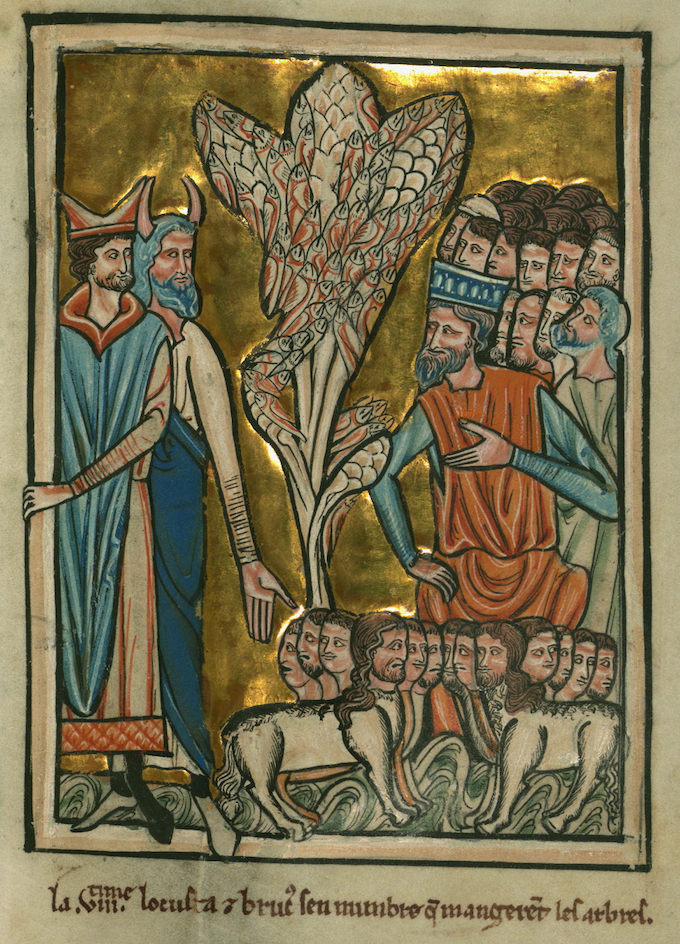
The illustration on this page is from the Walters Art Museum and portrays the plague of locusts visited upon the Egyptians.

Life in Middle Earth

theodenIf you resided in Middle Earth during the Third Age,* which of the major characters might you have been? Boromir,** Pippin, or perhaps Gandalf himself?

And, we’re only talking about the “good guys and gals.” We’ll have no one identifying with villains like Saruman, the Nazgûl ringwraiths or Grima Wormtongue here at Mere Inkling!

In a moment, I’ll help you answer that question.

Unfortunately, the internet abounds with time-consuming black holes. Pouring minutes and hours of our lives into the abyss of mindless videos or addictive games is the sad result.

Some entertaining diversions, however, possess merit. Case in point, an analysis of the leaders of Lord of the Rings, arranged according to their personality types.

Visiting a website such as this is not only fun, it offers insight into human differences. And, for the unwary, it may even reveal some new insights into our own nature.

I believe in the general validity of the best known personality inventory, the Myers-Briggs Type Indicator. I have posted in the past about C.S. Lewis’ (likely) personality type being an INFP. That appropriately identifies him with none other than Frodo, “the idealist.”

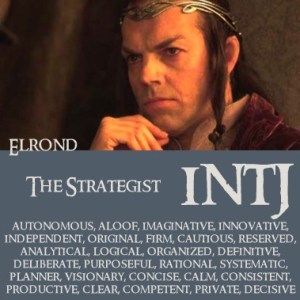
elrondMy own type is ENTJ, which matches with King Théoden above. As I age, however, I am finding myself less extraverted and more desirous of solitude. That means I am progressively becoming an INTJ, and that aligns me with Elrond. Frankly, both of the characterizations suit me quite well.

A person’s type is determined by which of four polarities is dominant.

Extraversion/Introversion

Sensing/Intuition

Thinking/Feeling

Judging/Perceiving

If you don’t know your type, and have the time to take an online assessment now, you can do so for free here.

You don’t need to do it to enjoy the Lord of the Rings chart though. So, which are Middle Earth leader are you? Find out here.

A Note of Caution

While instructive, tools such as this should never be used to put people into boxes (which is ironic, since the MBTI is graphically presented in that fashion).

The last thing we need is someone thinking they are defined by a psychological instrument such as this. After all, today’s Gimli may just well be tomorrow’s Bilbo.

_____

* The complete timeline of Middle Earth is available here.

** I have written in the past about the hero Boromir.


We’re All Valedictorians

valedictoriansWell, not quite. But, if you just graduated from Washington and Lee High School in Arlington, Virginia, there is a fair chance you might be.

That’s because W&L named one hundred and seventeen—that’s right, 117—as valedictorians. And that was out of a class of 457. That means that each of W&L’s graduates had better than a 25% chance to be the/a valedictorian.

Congratulations.

I graduated 22 out of a class of 224. I thought that was a pretty solid accomplishment (especially since military moves meant I attended three different high schools, with both transitions occurring midyear).

My true brilliance was evidenced not in my own academic performance, but the fact that I was smart enough to marry a valedictorian!

Technically the valedictorian does not need to have the top grade point average in their class, although that is the usual custom. In fact, they simply need to be chosen to deliver the valedictory. (Yes, it is a noun, as well as its more familiar appearance as an adjective.)

Apparently, at our afore-celebrated high school, over a hundred students shared in this honor. (Must have been a protracted ceremony.)

It seems that in the modern era, we are so compelled to boost children’s self-esteem, that we feel compelled to exaggerate their accomplishments. Many have argued that this misguided effort has the reverse effect.

On the United States’ opposite coast, Long Beach Polytechnic opted for a measly thirty valedictorians (presumably out of a class of more than sixty).

Julia Jaynes, 17, who shared the valedictorian title with 29 others, said that if her school chose only one, it would destroy collegiality among her classmates. “If everyone wants to be the best, I feel like there’d be less collaboration,” she said. “It makes it so you’re only out for yourself.”

Unfortunately, poor Julia is likely to encounter more competition than collaboration in the world she is entering.

I found the following fact disturbingly humorous. The “dean of admissions at Swarthmore College in Pennsylvania, recalled an applicant whose Midwestern high school reported that every student finished in the top half of the class.”*

Okay. Can we get a little remedial education in mathematics for the administration of that school?

Screwtape lauded this elevation of the average. (Mind you, there is nothing wrong with being average; that’s why it’s called the average.) Screwtape, of course, is the devil whose correspondence fell into C.S. Lewis’ hands and was published to warn humanity of some demonic strategies for harming us.

The basic principal of the new education is to be that dunces and idlers must not be made to feel inferior to intelligent and industrious pupils. That would be “undemocratic.” . . . Children who are fit to proceed to a higher class may be artificially kept back, because the others would get a trauma . . . by being left behind.

The bright pupil thus remains democratically fettered to his own age group throughout his school career, and a boy who would be capable of tackling Aeschylus or Dante sits listening to his coeval’s attempts to spell out A CAT SAT ON A MAT.

In a word, we may reasonably hope for the virtual abolition of education when I’m as good as you has fully had its way. All incentives to learn and all penalties for not learning will vanish. The few who might want to learn will be prevented; who are they to overtop their fellows? And anyway the teachers—or should I say, nurses?—will be far too busy reassuring the dunces and patting them on the back to waste any time of real teaching.

We [i.e. demonkind] shall no longer have to plan and toil to spread imperturbable conceit and incurable ignorance among men. The little vermin themselves will do it for us.

_____

You can read more about the peculiar story of Washington and Lee High School here.


Who is Your Muse?

reposeWhich Muse provides your inspiration? Poetry, history, music, dance, epic?

I’ve always been fascinated by the Greek & Roman concept of the Muse. While I don’t regard these personifications as true “beings,” they provide wonderful insight into the multifaceted nature of inspiration.

The Muses were personifications (representations of abstract concepts in human form). It’s not the same thing as believing in a “god,” although devotional exercises could be offered in “their” honor. (The simple people, in fact, may have regarded them as minor deities.)

The number of Muses—who represented the arts and fields of knowledge—varied in the ancient world. However, nine constituted the final Roman tabulation.

Possessing a historical nature, my “matron” Muse would necessarily be Clio (History).

Sadly, I’ve learned Muses don’t always fulfill their promises. At my suggestion, my wife agreed to name our puppy Calli, abbreviated from Calliope, the Muse of epic poetry. Unfortunately, at ten months her raucous barking sounds anything but poetic.

In his biography, Surprised by Joy: The Shape of My Early Life, C.S. Lewis includes an interesting reference to Muses. It relates to one of their secondary qualities, civility. In the following passage, Lewis had been sent to the Headmaster of his school for review due to “bad work” (i.e. inadequate academic performance).

The Headmaster misunderstood Smewgy’s report and thought there had been some complaint about my manners. Afterward Smewgy got wind of the Head’s actual words and at once corrected the mistake, drawing me aside and saying, “There has been some curious misunderstanding. I said nothing of the sort about you. You will have to be whipped if you don’t do better at your Greek Grammar next week, but naturally that has nothing to do with your manners or mine.”

The idea that the tone of conversation between one gentleman and another should be altered by a flogging (any more than by a duel) was ridiculous. His manner was perfect: no familiarity, no hostility, no threadbare humor; mutual respect; decorum. “Never let us live with amousia” was one of his favorite maxims: amousia, the absence of the Muses. And he knew, as Spenser knew, that courtesy was of the Muses.

For Lewis’ instructor, the concept of the Muse meant more than simply inspiring some form of art or literature. The influence of the Muses flowed into the broader culture. In a sense, it reflected the distinction the Greeks held between themselves and the barbarians. Surely the uncivilized savages had no Muses of their own!

Sources of Inspiration

It isn’t uncommon today for people to use muse (lower case) as a shorthand for a person who inspires them. Pablo Picasso, for example, considered his favorite model (and mistress) to be his muse. The portrait of Marie-Thérèse Walter above, entitled “Repose,” surely conveys the profound vision she provided him.

In cinema, there was the 1999 movie aptly named The Muse, which posits a deflated screenwriter seeking the aid of the supposed “daughter of Zeus.”

Speaking of Christians . . . they too identify a source for their inspiration. In addition to other human beings, who may offer wisdom, insight or encouragement, the preeminent source of inspiration is the Holy Spirit.

There is a danger in considering God himself to be the source of one’s inspiration. When taken to an extreme, it results in God being blamed for a lot of maudlin prose and gross violations of grammar.

Fortunately, few Christians believe their own writing is infallible. That divine quality is reserved for the Scriptures themselves.

Editors at Christian publishing houses would probably argue with my statement that few Christian authors are so presumptuous as to claim God “breathed” into them every word found in their manuscripts.

So, who is your Muse? When I said Clio is mine, it is because History—the story of humanity and especially God’s hand in it—fascinates me more intensely than any other subject. For you, it could be music or poetry.

Even astronomy has its own Muse, Urania. And, gazing at the boundless heavens God spoke into existence, it is no wonder that many would find their inspiration there.

A Classical Lewisian Poem

C.S. Lewis wrote a number of poems that are satires of Greek and Roman poetry. Some of them are quite witty.

For those interested in reading one such poem, I am pleased to offer “A Cliche Came Out of Its Cage.” In C.S. Lewis: Fantasist, Mythmaker, and Poet, Bruce Edwards describes it as “a sharp attack upon moderns who believe they are heralds of a return to the ‘golden age’ of paganism.” Included in his critique are F.R. Leavis and Bertrand Russell whose philosophy he rejected.

A Cliche Came Out of Its Cage

You said ‘The world is going back to Paganism.’
Oh bright Vision! I saw our dynasty in the bar of the House
Spill from their tumblers a libation to the Erinyes,
And [F.R.] Leavis with Lord Russell wreathed in flowers,
heralded with flutes,
Leading white bulls to the cathedral of the solemn Muses
To pay where due the glory of their latest theorem.
Hestia’s fire in every flat, rekindled, burned before
The Lardergods. Unmarried daughters with obedient hands
Tended it. By the hearth the white-armed venerable mother
Domum servabat, lanam faciebat. At the hour
Of sacrifice their brothers came, silent, corrected, grave
Before their elders; on their downy cheeks easily the blush
Arose (it is the mark of freemen’s children) as they trooped,
Gleaming with oil, demurely home from the palaestra or the dance.
Walk carefully, do not wake the envy of the happy gods,
Shun Hubris. The middle of the road, the middle sort of men,
Are best. Aidos surpasses gold. Reverence for the aged
Is wholesome as seasonable rain, and for a man to die
Defending the city in battle is a harmonious thing.
Thus with magistral hand the Puritan Sophrosune
Cooled and schooled and tempered our uneasy motions;
Heathendom came again, the circumspection and the holy fears …
You said it. Did you mean it? Oh inordinate liar, stop.

Or did you mean another kind of heathenry?
Think, then, that under heaven-roof the little disc of the earth,
Fortified Midgard, lies encircled by the ravening Worm.
Over its icy bastions faces of giant and troll
Look in, ready to invade it. The Wolf, admittedly, is bound;
But the bond will break, the Beast run free. The weary gods,
Scarred with old wounds the one-eyed Odin, Tyr who has lost a hand,
Will limp to their stations for the Last Defence. Make it your hope
To be counted worthy on that day to stand beside them;
For the end of man is to partake of their defeat and die
His second, final death in good company. The stupid, strong
Unteachable monsters are certain to be victorious at last,
And every man of decent blood is on the losing side.
Take as your model the tall women with yellow hair in plaits
Who walked back into burning houses to die with men,
Or him who as the death spear entered into his vitals
Made critical comments on its workmanship and aim.
Are these the Pagans you spoke of? Know your betters and crouch, dogs;
You that have Vichy water in your veins and worship the event
Your goddess History (whom your fathers called the strumpet Fortune).

_____

You can read about my true Muse here.

 

Great Grandparent or Great-Grandparent?

ggfI have never been more glad to have a birthday than I was this year. After all, at a mere sixty, I would have been far too young to become a great-grandfather. Now, at sixty-one, I feel adequately prepared for the momentous event which transpired just under an hour ago.

Tobin (meaning “God is Good”) is the child of my grandson and his wife, who currently reside in Texas where dad handles munitions for B-1 bombers.

Age and offspring do not always line up the way that we ourselves would plan. Yet every precious child is a miraculous gift from God.

Our grandson was born to our precious daughter-in-law while she was in high school. We didn’t get to meet him until he was ten, but we’ve done our best to make up for lost time. Our grandson, early on began calling us his “great grandparents.” That didn’t make us feel old, just special.

When my wife worked in a residential care facility for severely handicapped children, one of the aides arrived one morning with joyous news. “I’m a great-grandmother!”

Because the woman seemed too young, Delores responded, “Congratulations, you look so young for being a grandmother.”

The lady laughed and said, “No, a great-grandmother!” It turns out she was not yet forty . . . having been 13 when she had a daughter who was 13 when she had her own daughter who now had birthed her own baby. (I don’t recall the gender of the child.)

As I wrote this, it dawned on me that this all took place thirty-seven years ago, so it’s quite possible there are now several more generations in that particular family tree.

Some people will scoff at the thought of celebrating such early and assumedly unintended pregnancies. But, that caregiver knew the truth—every young life is a gift from God.

As an imperfect parent and grandparent, I recognize all too well that I won’t be the great-grandfather Tobin should have. I do pray, though, that God would grant that my mistakes with him would be few, and the memories forged during this life will help this little one grow into the finest man that he can become.

Most importantly, I pray that he will see Christ in my life and recognize the value of faith. Only the Lord knows what the future will bring, and I will not be here to share too many decades of life with my grandchildren and great-grandchildren. But my hope is that the time we do have will leave a lasting legacy of encouragement, faith, and compassion.

The letters of C.S. Lewis provide insights into the influence of his grandparents on his young life.

In a 1905 letter to his brother Warnie, he describes family festivities on Halloween. They even persuaded his grandfather to join in.

On Halow-een we had great fun and had fireworks; rockets, and Catherine wheels, squbes, and a kind of thing that you lit and twirled and then they made stars. We hung up an apple and bit at it. We got [his paternal] Grandfather down to watch and he tried to bite.

In a 1916 letter to his father, he refers to his grandmother’s declining health. (She died two weeks after he wrote.) Lewis refers to the common sentiment that we should have tried harder to spend time with family while they were with us. “I am sorry to hear what you say about [Lewis’ maternal] Grandmother: I feel that we ought to have seen more of her, but it was not easy.”

I should dearly love to get away for a bit, but, as you say, for so short a time, the expense and the interruption of work is hardly worth it. The Colonel must have had an unpleasant journey: I wish he would keep a diary which we could compare with that of Grandfather Hamilton in the same waters. Two generations of sub-tropical Atlantic and Hamilton temperament would be worth studying!

The diaries left by C.S. Lewis’ grandfather, and by his brother Warnie, provide a reminder to us that a written legacy will outlast our voices. If we have something important to say to our descendants, perhaps that is something we should keep in mind.