Defeating Procrastination

procrastination beast

Procrastination is rearing its head around here, and it’s as ugly as ever.

At times like this, I often remind myself of the wisdom of J.R.R. Tolkien placed on the lips of Samwise Gamgee: “It’s the job that’s never started that takes the longest to finish.”

Sadly, that shrewd insight seldom solves my problem. You see, the breed of procrastibeast that typically plagues me isn’t the one that prevents a person from beginning.

The species that lurks in the shadows of my office is the variety that derails “jobs” that are already well begun.

My problem—and you may share it—is that I’m juggling too many projects simultaneously. A detailed book proposal, a literary contest entry, Mere Inkling, a half dozen articles in various stages, and a technical PTSD article I just agreed to review for a professional journal . . . all of these beckon to me and continue to grow more and more urgent in their pleas.

Sometimes I envy the people who tell me they find it challenging to come up with ideas. That’s never been my difficulty. I normally have a surfeit of topics that juice my creativity.

It has only recently dawned on me that this too easily transforms into procrastination.

Unable or unwilling to see works through to conclusion, I constantly initiate new projects. I often struggle with the need to push my writing through to conclusion.

In my own case it seems to boils down to discipline. I have to focus and consciously strive to revisit manuscripts near their deadlines, even when I’m “inspired” to be working on one of the other projects. Too often, I’m resigned to believe, my Muse is simply out of synch with reality.

C.S. Lewis was highly disciplined. An excellent example of this is found in his devotion to responding to the mountains of correspondence he received. In this burdensome activity he was assisted by his brother Warnie, who absence during his drinking binges created an extreme hardship. At the end of his life, Lewis was appreciative to have gained the assistance of Walter Hooper

Fixing the Problem

We who struggle with procrastination do not need to despair. According to psychologists, “This is a learned behavior and therefore can be unlearned.”

Procrastinators are made and not born. That’s both the good news and the bad news. Good because it’s a learned response, and what’s learned can be unlearned. The bad news is that while it’s possible to change, it takes a lot of psychic energy and you don’t necessarily feel transformed internally.

You should know that some people who think of themselves as procrastinators really aren’t. In a world of unending deadlines, they just put too many things on their “To Do” list. They’re not avoiding tasks, the mark of a bona fide procrastinator; they’re getting things done, just not as many as they would like.

In my own case, I would alter that final sentence to: “they’re getting things done, just not in the order that they would like.”

The article quoted here includes some suggestions for defeating procrastination. The one I like best is “Promise yourself a reward.”

Unfortunately, my most effective rewards seem to be food-based, with items of the chocolate tier in the hierarchy pyramid being the most effective.

I have, however, come upon a tentative substitute. I thought of it while writing this very column.

I have accumulated some writings by and about C.S. Lewis during the past few years that I have yet to read. Too busy. Well, I’ve decided that when I finished some of the most pressing projects that are strangling me, I will treat myself to simply reading some Lewis.

I doubt it will be as effective as chocolate . . . but it is best substitute I can imagine.

_____

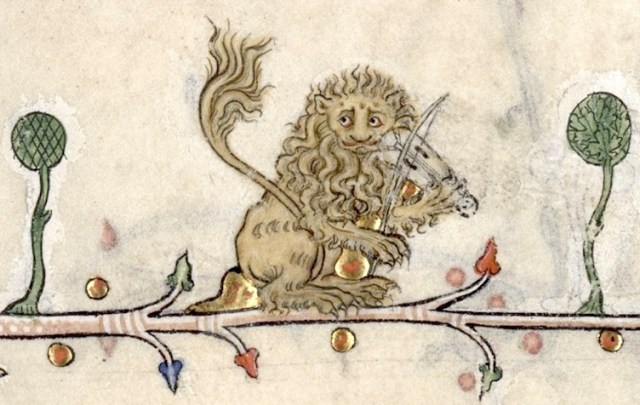
The medieval illumination above may represent one version of the procrastination beast which afflicts Christians… since it did manage to deter at least one monk from carrying on with his proper duties.

Narnia, Oz & an Odd Link Between the Two

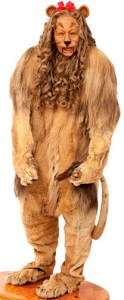
oz-lionFew people know this peculiar fact about The Wizard of Oz. And this oddity shares an interesting link to one of C.S. Lewis’ most familiar novels.

Filmmaking has changed greatly since 1939 when Dorothy first tapped together her ruby slippers. One of those modifications involves the treatment of animals.

Some of us are old enough to remember the initial appearance of the disclaimers: “No animals were injured in the making of this film.” Those announcements disappeared long ago, as people have long supposed the humane treatment of animals required.

As far as I know, no one has alleged the mistreatment of animals in The Wizard of Oz. But the odd fact mentioned above refers to one of the costumes worn by a major character in the film.

Bert Lahr played the Cowardly Lion, who continued acting until he died during the filming of The Night They Raided Minsky’s in 1968. Fortunately, he was in his prime while traipsing across Oz, because his costume weighed at least sixty pounds.

Apparently the costume designer was going for accuracy—in the case of the Cowardly Lion, if not for the citizens of Munchkinland. He opted for using an actual lion pelt. At least two, in fact, since there was a least one backup.

Cinema memorabilia often provides unbelievable dividends. MGM sold the primary costume in 1970 for a mere $2,400. In 2005, after some restoration by a taxidermist, the costume sold for $826,000. Nine years later, in 2014, it became the highest valued male performer’s costume, selling for $3,100,000.

It is quite fitting that Leo the Lion is the mascot for Metro-Goldwyn-Mayer film studio. While there have been seven “Leos” since 1916, it is doubtful that any of them contributed their hide to costuming the Cowardly Lion.

What Has Oz to do with Narnia?

Oz and Narnia resemble one another in the obvious sense that both are fantasy lands. I’m ill-equipped to compare the two beyond that, having no desire to read about the former. Here you’ll find an interesting article that offers some insights into the realm of the Wizard. The literary critics of The Telegraph offer the following contrast.

Even so, [Oz is] a strangely amorphous creation, originally reached by cyclone but in later books by shipwreck (twice), by earthquake and by simply getting lost. As a fantasy land, it has none of the depth or authority of Tolkien’s Middle Earth nor even the physicality of CS Lewis’s Narnia.

Reaching back to the turn of the millennia, you might enjoy reading “Oz vs. Narnia.” Comparing the promotion of the two realms on their respective hundredth and fiftieth anniversaries, the author finds Narnia’s treatment by HarperCollins wanting.

But however much the tribute to Oz exceeds the tribute to Narnia in sumptuousness, it can’t disguise the superiority of Lewis’ book. As a child, I loved Oz’s endless cavalcade of strange creatures and, especially, John R. Neil’s trippy art nouveau illustrations and extravagant marginalia; I still like the books today. But the first time I read “The Lion, the Witch and the Wardrobe” in second grade, I knew that I’d stumbled into a whole new league.

A Tale of Two Lions

The odd overlap in the two stories is not due to the prominent presence of lions in each world. The Cowardly Lion and Aslan have nothing in common, save perhaps, compassion for others.

But the real life costume of Oz’s lion does relate directly to one of Lewis’ most amazing fictional creations.

In the final Chronicle, The Last Battle, we find many people are led astray by a false prophet. There is a liar masquerading as the true king. The horror that he is able to mislead so many vulnerable souls is magnified by the fact that he too wears an obvious costume—the pelt of a lion.

Lewis’ account of the deception is skillful. One of the most brilliant aspects is that the “king” himself (a donkey) is actually tricked into playing the role by the true deceiver (an ape).

“All the same, Shift,” said Puzzle [the donkey], “even if the skin only belonged to a dumb, wild lion, oughtn’t we to give it a decent burial? I mean, aren’t all lions rather— well, rather solemn? Because of you know Who. Don’t you see?”

“Don’t you start getting ideas into your head, Puzzle,” said Shift. “Because, you know, thinking isn’t your strong point. We’ll make this skin into a fine warm winter coat for you.”

“Oh, I don’t think I’d like that,” said the Donkey. “It would look—I mean, the other Beasts might think—that is to say, I shouldn’t feel—”

“What are you talking about?” said Shift, scratching himself the wrong way up as Apes do.

“I don’t think it would be respectful to the Great Lion, to Aslan himself, if an ass like me went about dressed up in a lion-skin,” said Puzzle. “Now don’t stand arguing, please,” said Shift.

“What does an ass like you know about things of that sort? You know you’re no good at thinking, Puzzle, so why don’t you let me do your thinking for you?”

Obviously, a comparison between real and fictional characters wearing lion skins can only go so far. Still, I assume some readers will find the use of a lion’s pelt to camouflage a completely different species, to be a rather peculiar parallel between Oz and Narnia.

Beavers Beware

russian-typoA mere 375,000 rubles buys a fair amount of publicity in Russia; just be sure to proofread the product.

This Christmas season one Russian charity hoped to encourage readers to live good lives, but instead they published a brochure that encouraged beaver genocide.

Beavers are particularly vulnerable rodents. They are quite gentle, and even Talking Beavers are poorly equipped to defend themselves.

The lovely scene on the leaflet featured an innocent girl gazing into a snow globe. Emblazoned above it was supposed to read “Do Good.” Instead, the Russian words spelled out “Exterminate Beavers!”

It just bears out the maxim, “proofread before you publish.” In this case, one could easily add: “if the work is translated, make sure the proofreader understands both languages.”

Some errors are especially heinous.

C.S. Lewis recognized the importance of proofreading.

He was sometimes the victim of inadequate editorial review. So it comes as no surprise that he preferred to see galleys (the uncorrected typeset proofs) of his work before actual publication.

The following reference from a letter in which Lewis attributes the need for such as due to his own poor penmanship, rather than the carelessness of others. This is typical of his generosity, since part of the duties of editors (and pharmacists, for that matter) is to be able to decipher the scribblings of authors (and physicians). Mark Twain did not share Lewis’ grace in this matter.

When his friend Dorothy Sayers died in 1958, Lewis was unable to attend the funeral in London. He was, however, honored to write a panegyric for the service, which was read by one of the bishops in attendance. Following the event, Sayer’s son, Anthony Fleming thanked Lewis and asked if he might include the eulogy in possible collection.

Dear Mr. Fleming

Thank you for your most kind letter. I am relieved to find that the little speech has pleased those whose approval at such a time matters most—it is so easy to go wrong in a thing of that kind and so to give offence.

I am perfectly willing that it should be printed, but please ask whoever sees to it to be sure and let me see a proof. Even if printers made no mistakes, my villainous writing nearly always leads to some.

Lewis, of course, was referring to a literal manuscript, a document written by hand. One assumes that the Russian publisher was given a typescript, so they could not use “villainous writing” as an excuse for their error.

Still, I suspect they were given the text in one language, English perhaps, and asked to translate it for publication. In that case, who actually is responsible for the mistake?

I choose not to worry about attributing liability in this matter. I’m content to use this winter mistake to remind me of the importance of proofreading.

Oh, and on behalf of all of the beavers in Russia, I am relieved to know they will not be distributing these murderous words.

Those Lazy Males

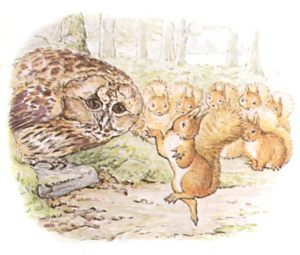
squirrelIn some places a debate rages over the question of who works the hardest, men or women. In our family, there is no such disagreement. We all recognize that the typical woman works far more than her male counterpart.

Take my case. I’m a Type A workaholic who lost (unused) leave every year of my military career. I still keep extremely busy, but when it comes to work ethic and effort, I don’t even pretend to hold a candle to my wife.

Now another example from the animal kingdom has confirmed what most people have suspected—females do far more than their share of the work.

Men have been embarrassed for generations by the example of lazy lions who rely on the lionesses to do nearly all of the hunting. Not to mention taking care of the family’s domestic responsibilities.

And now men have been betrayed by a more modest mammal—the squirrel.

I happen to like squirrels. I always have, even when they try to hijack the birdseed we always have available at our home. I hate hearing people refer to them as “tree rats,” and considered it good fortune that the street where we built our home is named “Squirrel Place.”

C.S. Lewis loved small animals. Reepicheep, a mouse, is one of the great heroes of Narnia. But it was a squirrel who played a role in one of his earliest “mystical” experiences. Fittingly, it also relates to Autumn, the season those of us in the Northern Hemisphere currently enjoy.

The following passage comes from Lewis’ autobiography, Surprised by Joy: The Shape of My Early Life. It describes the impression left on him after reading one of Beatrix Potter’s children’s books.

It will be clear that at this time—at the age of six, seven, and eight—I was living almost entirely in my imagination; or at least that the imaginative experience of those years now seems to me more important than anything else. . . .

But imagination is a vague word and I must make some distinctions. It may mean the world of reverie, daydream, wish-fulfilling fantasy. . . .

The . . . glimpse came through Squirrel Nutkin; through it only, though I loved all the Beatrix Potter books. But the rest of them were merely entertaining; it administered the shock, it was a trouble. It troubled me with what I can only describe as the Idea of Autumn.

It sounds fantastic to say that one can be enamored of a season, but that is something like what happened; and, as before, the experience was one of intense desire. And one went back to the book, not to gratify the desire (that was impossible— how can one possess Autumn?) but to reawake it.

And in this experience also there was the same surprise and the same sense of incalculable importance. It was something quite different from ordinary life and even from ordinary pleasure; something, as they would now say, “in another dimension.”

Squirrely Dads

Returning to the recent research that proved beyond any shadow of doubt that even among industrious, nut-gathering rodents, the males cop out. Don’t be put off by the study’s title—“The secret life of ground squirrels: accelerometry reveals sex-dependent plasticity in above-ground activity”—this is serious.

Apparently, while mom is down in a dark burrow nursing the kids, dad’s out lounging in the sunshine. It’s inexcusable.

And don’t try to use some lame excuse or misogynist argument that these findings are only true for Urocitellus parryii, semi-fossorial arctic ground squirrels, but they’re only fooling themselves. We all know that women work harder than men, especially when it comes to raising kids.

The female squirrels are literally so drained by the demands put upon them that they have to begin their hibernations before the males and end them after the males emerge from their hibernacula!

Following the termination of heterothermy in spring, male arctic ground squirrels remain below ground for a three to five week interval during which they consume a food cache to regain body mass lost during hibernation . . . Males intercept and mate-guard newly emergent females that become pregnant within a few days of emergence; gestation lasts for approximately 25 days, and lactation is another approximately 28–35 days.

Unlike males, females do not cache food and, with the exception of early gestation when they continue to lose body fat, they appear to fuel their reproduction using energy gained concurrently through foraging. [Note: it doesn’t appear the males share. Another strike against them.]

In addition, females are delivering energy to pups as milk during lactation . . . Once their young have been weaned, females undergo a moult and fatten; autumn immergence occurs in August [while] males that fatten and cache food later in the autumn immerge in early- to mid-October.

And there is no doubt that the people who conducted this research are right, after all, they used “collar-mounted light loggers and triaxial accelerometers!”


The Artistry of Nature

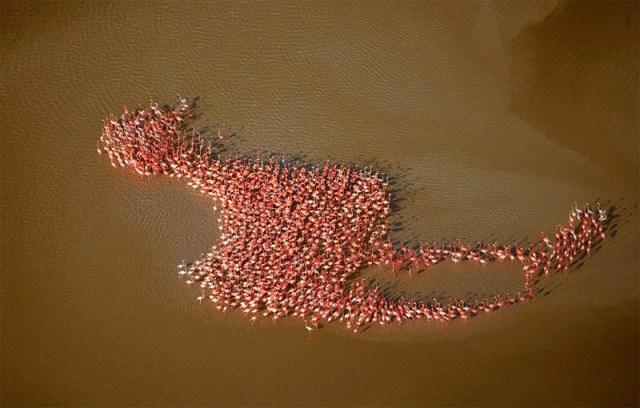
flamingoes
This picture of flamingos is delightful. That they “randomly” arranged themselves into a silhouette of themselves is amazing. Or, perhaps a divine hand painted this glorious portrait?

“What a fanciful thought,” poets muse.

“How absurd!” atheists groan.

“Is he serious?” realists wonder.

“Now that’s something to ponder…” people of faith think.

“Of course God has fashioned nature’s beauties with his hands,” the eremite smiles.

I happen to believe God was speaking literally when he said through the Psalmist:

For every beast of the forest is mine, the cattle on a thousand hills. I know all the birds of the hills, and all that moves in the field is mine (Psalm 50).

It was on the fifth day of creation that the Lord spoke into existence for the first time “every winged bird according to its kind.”

And God blessed them, saying, “Be fruitful and multiply and fill the waters in the seas, and let birds multiply on the earth” (Genesis 1:22).

And, to reveal God’s concern for the creatures he has made did not end with their genesis, allow me one more biblical citation . . . a familiar one. In reminding us of how precious we are to our Father, Jesus describes that God’s concern extends even to the least of his creation.

Are not two sparrows sold for a penny? And not one of them will fall to the ground apart from your Father (Matthew 10:29).

C.S. Lewis touches on the preciousness of creation in a 1956 letter to one of his regular correspondents.

I think God wants us to love Him more, not to love creatures (even animals) less. We love everything in one way too much (i.e. at the expense of our love for Him) but in another way we love everything too little. No person, animal, flower, or even pebble, has ever been loved too much—i.e. more than every one of God’s works deserves (Letters to an American Lady).

Now, does God’s concern for his creatures, in this case flamingoes, mean that he takes the time to direct their flight, their nesting, and the shape of their earthly “congregations?” Of course not. But even in saying that, it is wise to note that if he chose to do so, he could. And there are, of course, some scriptural examples of his using animals in specific ways.

It’s possible, and even likely, that this was a mere coincidence. Like the clouds whose shapes sometimes mirror actual things, even in minute detail. While there are rather odd people who believe cloud shapes can foretell the future, I don’t believe there are any Christians who would base their decisions upon the physical arrangements of a flock, colony, gaggle, or flamboyance (with is fancy name for a group of flamingos).

That said, I still believe that the divine Artist is not above occasionally enjoying some playfulness with the tapestry he has fashioned here on earth, and in the heavens.

Lewis & Flamingos

On 12 July 1956, C.S. Lewis attended a garden party at Buckingham Palace hosted by Queen Elizabeth II. Below you will find excerpts from two letters mentioning the subject. They were written to Ruth Pitter (1897-1992), a well-regarded poet with whom Lewis enjoyed a strong friendship.

Lewis wondered if she might be attending the same event, and suggested they might accompany one another, if so. Less than a week later, following the event, he shares with her his delightful observations of the teeming gathering.

Dear Ruth

Do you play croquet with the Queen on Thursday? (Croquet is not mentioned in the invitation but I am well-read enough to know that a royal garden party will involve hedgehogs, flamingos, soldiers, Heads-man, and the grin of a Cheshire cat). If so are you coming via Oxford? I was thinking of going up by 1.58 and returning by the 6.45 or 7.35 on either of which we could dine. You are an experienced courtier and it would give me great moral support to arrive in your company!

Apparently Pitter was not in attendance at this particular outing, also she had been the first woman to receive the Queen’s Gold Medal for Poetry the previous year. Two decades later the Queen would appoint her a Commander of the Order of the British Empire (CBE) for her contributions to English literature. Two days after the extravaganza, Lewis wrote again.

Dear Ruth

You were well out of it. I learn from the papers that I was one of 8000 guests and also that the Queen was present, a fact of which I had no evidence from my own experience. One could not even get a cup of tea for the crowd round the refreshment tables was reminiscent of Liverpool Street station on an August bank holiday. Most people didn’t know one another. One saw many married couples pathetically keeping up between themselves a dialogue which was obviously wearing very thin. If I hadn’t run across Archbishop Matthew I’d have been in a vast solitude.

There are flamingoes: metal silhouettes of them round the lake—a tasteful device which we perhaps owe to Prince Albert. In a word, it was simply ghastly. Two pints at the little pub on Praed St. were necessary afterwards.

A Postscript on Pitter

Ruth Pitter was a talented poet, but because she was a traditionalist—something quite agreeable to Lewis—she has not been accorded the respect she merits. One scholar who published her letters in 2014 writes:

Pitter, in contrast to T.S. Eliot, Ezra Pound, and W.H. Auden, is a traditional poet in the line of George Herbert, Thomas Treharne, Thomas Hardy, A.E. Housman, W.B. Yeats, and Philip Larkin. Unlike the modernists, she rarely experiments with meter or verse form, nor does she explore modernist themes or offer critiques of modern English society.

Instead, she works with familiar meters and verse forms, and her reluctance to alter her voice to follow in the modernist line explains in part why critics have overlooked her poetry. She is not trendy, avant-garde, nor, thankfully, impenetrable.

As mentioned above, their friendship was deep. Lewis’ friend George Sayer says Lewis once volunteered that if he had not been a confirmed bachelor, Pitter was just the sort of woman to whom he could be happily married.

They influenced one another professionally, sharing poetic advice and critique. Pitter also attributed her spiritual reawakening, her conversion to Christianity, to Lewis’ influence. In 1948 she wrote to a friend:

Did I tell you I’d taken to Christianity? Yes, I went & got confirmed a year ago or more. I was driven to it by the pull of C. S. Lewis and the push of misery. Straight prayer book Anglican, nothing fancy . . . I realize what a tremendous thing it is to take on, but I can’t imagine turning back. It cancels a great many of one’s miseries at once, of course: but it brings great liabilities, too.

In 1985 she wrote to a correspondent about the same subject.

As to my faith, I owe it to C. S. Lewis. For much of my life I lived more or less as a Bohemian, but when the second war broke out, Lewis broadcast several times, and also published some little books (notably The Screwtape Letters), and I was fairly hooked. I came to know him personally, and he came here several times. Lewis’s stories, so very entertaining but always about the war between good and evil, became a permanent part of my mental and spiritual equipment.

Since we have been introduced to this unique woman now, it’s fitting to close with one of her poems. A poem inspired by another of the avian wonders created by our artistic God.

stormcock

Stormcock in Elder

In my dark hermitage, aloof

From the world’s sight and the world’s sound,

By the small door where the old roof

Hangs but five feet above the ground,

I groped along the shelf for bread

But found celestial food instead:

For suddenly close at my ear,

Loud, loud and wild, with wintry glee,

The old unfailing chorister

Burst out in pride of poetry;

And through the broken roof I spied

Him by his singing glorified.

Scarcely an arm’s-length from the eye,

Myself unseen, I saw him there;

The throbbing throat that made the cry,

The breast dewed from the misty air,

The polished bill that opened wide

And showed the pointed tongue inside;

The large eye, ringed with many a ray

Of minion feathers, finely laid,

The feet that grasped the elder-spray;

How strongly used, how subtly made

The scale, the sinew, and the claw,

Plain through the broken roof I saw;

The flight-feathers in tail and wing,

The shorter coverts, and the white

Merged into russet, marrying

The bright breast to the pinions bright,

Gold sequins, spots of chestnut, shower

Of silver, like a brindled flower.

Soldier of fortune, northwest Jack,

Old hard-times’ braggart, there you blow

But tell me ere your bagpipes crack

How you can make so brave a show,

Full-fed in February, and dressed

Like a rich merchant at a feast.

One-half the world, or so they say,

Knows not how half the world may live;

So sing your song and go your way,

And still in February contrive

As bright as Gabriel to smile

On elder-spray by broken tile.

_____

The Bible verses quotes above are taken from the ESV, the English Standard Version.

The “stormcock” in whose humble honor Pitter dedicates this poem is also called the Mistle Thrush. Its informal nickname arises from its eagerness to sing its songs in every sort of weather.
A Mother Knows Her Child

calfWhen we lived in England, we witnessed the birth of a calf in a peculiar setting. We were driving along winding country roads, turned a corner, and saw a newborn calf lying in the middle of the road, covered in her still-warm afterbirth.

During the decades since that day, our (now adult) children complained: “why do you always get to save the baby cows?” (They had been restricted to the safety of our car, pulled off of the road with flashers blazing.)

To describe it succinctly, we were able to set up warnings along the rapprochements and lift the newborn infant into farm-familiar hands. While I attended to approaching traffic, a neighbor farmer picked up the little one and carried him or her to their mother who was mournfully mooing on the hillside above.

You see, she had backed up near the fence that surrounded her pasture, and when the infant was delivered, it slid down the fifteen-foot embankment onto the road.

I directed the traffic, while my wife Delores assisted the farmer in conveying the child to its mother.

I was surprised by what I saw as we climbed up into the field. There was the mother of the lost infant, crying out in her misery for her terrible misfortune. And gathered around her were the rest of her herd, mooing in anguished sympathy for her loss.

When we laid the bloodstained calf on the ground behind its forlorn mother, we called out to it to turn and recognize the deliverance that had dawned. The mother approached the calf, with the rest of the cattle hanging respectfully in her wake.

She sniffed at her little one and began immediately to lick it clean and smother it with love. The plaintive cries gave way to soothing moos, and a holy calm fell upon that field.

It was a glorious moment I will never forget. One of those where we recognize the privilege God has granted us to simply be in his presence as we gaze in awe at his creation.

C.S. Lewis and the Wonder of Cattle

In July 1930, Lewis wrote to his dear friend Arthur Greeves, complaining about the burden of “marking papers” at the end of the academic year. He then gently rebukes his friend for thinking that the discussion of the mundane matters of home life are insignificant.

Thank you for writing–I enjoyed your two letters enormously. Do stop apologising for them and wondering archly . . . how I can read them. Surely it needs no great imagination for you to realise that every mention of things at home now comes to me with the sweetness that belongs only to what is irrevocable.

Those who have left the rural life for academia can relate to the sentiments of C.S. Lewis. He loved the ambiance of Oxford, but missed the simplicity of the common world.

Lewis thanks Greeves for his description of the birth of a calf and confesses his own moral shortcoming in not celebrating without reservation the wondrous moment.

Oh you can’t imagine the poignancy with which your account of the sunny windy day near the dry tree fell across a dreary, dusty afternoon of those sordid papers, when my head was aching and the boys’ horrid handwriting seemed to jump on the page.

I don’t know quite what I feel about your assistance at the accouchement of our sister the cow.

I know what I ought to feel—simply the same thrill that I feel at the first coming up of a flower.

Physical disgust is a sensation which I have very often and of which I am always ashamed. If one lets it grow upon one it will in the end cut one out from all delighted participation in the life of nature. For God is gross and never heard of decency and cares nothing for refinement: nor do children, nor most women, nor any of the beasts, nor men either except in certain sophisticated classes.

And yet its hard to feel that the faculty of disgust is a sheer evil from beginning to end. I don’t know what to make of it. (Perhaps in one way it is, in another, it isn’t!)

Lewis closes his letter with an entertaining reflection on the amazing scenes such as I witnessed long ago in the English countryside.

At any rate there can be no two opinions about the delightfulness of seeing the other cows coming round to inspect the infant. Did they show any signs of congratulating the mother? for I notice that when one of our hens lays an egg, all join in the noise—whether that is congratulation or simply that they regard themselves as a single individual and announce “We have laid an egg.”

If you have another free moment, check out this great post on the spiritual value of maternal instincts . . . You can read Gloria Furman’s thoughts at desiringGod.

C.S. Lewis’ Personality

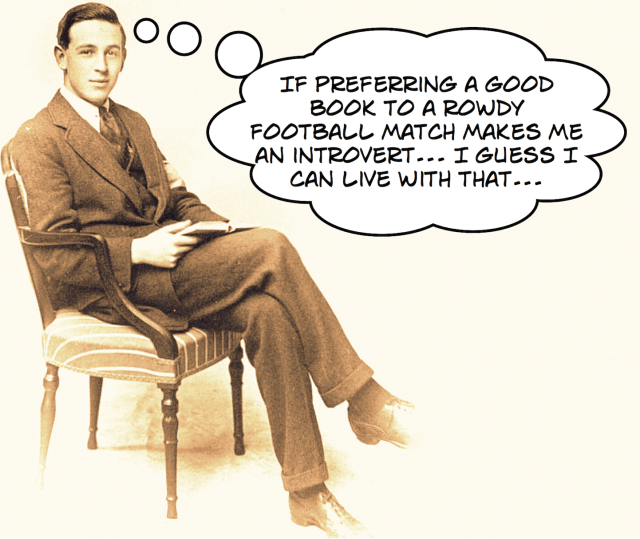
csl introvertLearning about ourselves is a lifelong quest. And the more actively we pursue self-knowledge, the wiser we become.

A well known sixteenth century Christian mystic wrote:

“Self-knowledge is so important that even if you were raised right up to the heavens, I should like you never to relax your cultivation of it.” (Saint Teresa of Ávila, Interior Castle).

This self-knowledge leads to a greater recognition of our dependence on God. She continues, “so long as we are on this earth, nothing matters more to us than humility. . . . As I see it, we shall never succeed in knowing ourselves unless we seek to know God: let us think of His greatness and then come back to our own baseness; by looking at His purity we shall see our foulness; by meditating on His humility, we shall see how far we are from being humble.”

C.S. Lewis echoes this sentiment.

If anyone would like to acquire humility, I can, I think, tell him the first step. The first step is to realise that one is proud. And a biggish step, too. At least, nothing whatever can be done before it. If you think you are not conceited, it means you are very conceited indeed. (Mere Christianity).

As part of my self-examination, I have recently revisited my “personality type” as assessed by the well known Myers Briggs Personality Indicator (MBTI).

Without over-explaining the MBTI, it measures an individual’s preference related to four ways by which we experience and make sense of the world. (News Flash: Not everyone perceives reality the same way!)

These dichotomies are:

Extraversion (E) or Introversion (I)

Whether your preferred focus is outward or inward.

Sensing (S) or Intuition (N)

How you focus on information and process it.

Thinking (T) or Feeling (F)

Primary preference in your decision-making.

Judging (J) or Perceiving (P)

Your orientation towards making sense of existence.

You can get some additional authoritative information here. There are also numerous “unofficial” websites related to the subject.

Sixteen combinations are possible, and each has its respective strengths. (None are “better” than others, of course, since we’re all created in the image of God.)

Speaking of which, I’ve also been studying the different combinations that are more common to Christian ministers than they are within the general population.

For example, the following types (with their shorthand title) range from two to six times more common for male clergy than the general male American population:

ENFJ (The Teacher)

ENFP (The Provider)

INFP (The Healer)

INFJ (The Counselor)

ENTJ (The Field Marshal)

Which type of pastor do you prefer?

Online Surveys to Visit after you finish this post

There are a number of free MBTI-type tests online. Naturally, they are not as reliable as the official inventory given through a certified provider. Nevertheless, the following sites did render accurate assessments for me, based on my formal scoring.

I have mentioned in the past that I am an *NTJ… with the asterisk representing that my I/E preference is too close to call. A previous post shows how that makes me a blend of Middle Earth’s Elrond and Théoden.

Humanmetrics Jung Typology Test

CelebrityTypes Personality Type Test

So, What Is C.S. Lewis’ Personality Type?

This is a subjective question. The MBTI is a self-reported assessment, so guessing the type of another person is by nature dicey.

In Lewis’ case, however, there is a fair degree of consensus. This is due to his openness about his personal life and his extensive writings. The general agreement does not mean though that there are not minority opinions.

The most common argument is that C.S. Lewis was INTJ. I find the reasons persuasive, and not just because it matches my own type!

One student of the subject says “Check out this quote—how INTJ is this?!”

Five senses; an incurably abstract intellect; a haphazardly selective memory; a set of preconceptions and assumptions so numerous that I can never examine more than a minority of them—never become even conscious of them all. How much of total reality can such an apparatus let through? (A Grief Observed)

One blogger writes, “There is no doubt in my mind that Lewis was an INTJ. It seeps off all his writing and is blatant in his behavior in all of his biographies.” She continues:

Highly imaginative child who lived in a dream world? Check.

Someone highly emotional/sensitive but that never showed it on the surface? Check.

A prolific writer who blazed through finishing projects at an astounding rate, who was so successful at everything he did, despite never having done it before, that he quickly rose to the top? Check.

Another site considers both C.S. Lewis and his fellow inkling J.R.R. Tolkien to be INFPs. The aptly titled CelebrityTypes.com offers a brief selection of quotations to illustrate the reasons for their identification.

If the site’s identifications are accurate, the two are in good company. Other writers include John Milton, Augustine of Hippo, Hans Christian Andersen, William Shakespeare, Søren Kierkegaard, George Orwell, A.A. Milne, Edgar Allan Poe, William Blake, J.K. Rowling and George R.R. Martin.

A Warning from Lewis Himself

Understanding ourselves better than we already do, is a good thing.

Being overly curious about the personality of someone who is deceased is another matter. Lewis’ point in the passage that follows is that such concerns must never supersede our regard for others, in the spirit of Matthew 8:22.*

There is a reaction at present going on against the excessive love of pet animals. We have been taught to despise the rich, barren woman who loves her lap dog too much and her neighbor too little. It may be that when once the true impulse is inhibited, a dead poet is a nobler substitute than a live Peke, but this is by no means obvious.

You can do something for the Peke, and it can make some response to you. It is at least sentient; but most poetolaters [worshippers of poets] hold that a dead man has no consciousness, and few indeed suppose that he has any which we are likely to modify. Unless you hold beliefs which enable you to obey the colophons of the old books by praying for the authors’ souls, there is nothing that you can do for a dead poet: and certainly he will do nothing for you. He did all he could for you while he lived: nothing more will ever come.

I do not say that a personal emotion towards the author will not sometimes arise spontaneously while we read; but if it does we should let it pass swiftly over the mind like a ripple that leaves no trace. If we retain it we are cosseting with substitutes an emotion whose true object is our neighbour.

Hence it is not surprising that those who most amuse themselves with personality after this ghostly fashion often show little respect for it in their parents, their servants, or their wives. (The Personal Heresy: A Controversy).

Reflecting on our own nature, and pondering the personalities of those we respect, are worthwhile activities. However, it’s best to remember that all we can see are mere glimpses into the depths of who we truly are.**

_____

* Matthew 8:22 quotes Jesus’ response to a disciple who demurred that he could not follow the Lord until after he attended to his father’s burial. “And Jesus said to him, ‘Follow me, and leave the dead to bury their own dead.’”

** As Paul words in Romans 8:27 are paraphrased in The Message Bible: God “knows us far better than we know ourselves . . .”

Is Fantasy Foolish?

lion of lyonSome of the smartest people around dismiss reading fantasy as a crazy waste of time. At the same time, many of the most brilliant people I know love nothing more than passing from their mundane lives through a magical wardrobe into a land of wonder.

On a recent episode of the television series Castle, the eponymous Richard Castle,* a best-selling author and private eye, has a great line. Castle is defending his hyperactive imagination (which frequently leads to the solving of the crime of the week).

A suspect calls him “reality-challenged.”

To which he responds, “I prefer fantasy-augmented.”

Now, there’s a description that would fit most readers of Mere Inkling. We’re “fantasy-augmented.”

It would also fit most of the Oxford Inklings. Not all of them, of course. Some of them, like C.S. Lewis’ brother Warnie, were more oriented towards factual, historical literature.

The fantasists among their ranks were not lacking as writers of nonfiction either.

However, it was the fact that they were “fantasy-augmented” that has led to the inclusion of several of their members in the first ranks of twentieth century writers.

Narnia and Middle Earth are as real to many people today as Ogre, Latvia, Humpty Do, Australia, Llanfairpwllgwyngyllgogerychwyrndrobwllllantysiliogogogoch, Wales, and Frankenstein, Missouri. (Perhaps more real!)

In 1936, C.S. Lewis wrote a letter to Charles Williams, praising his recent novel.**

A book sometimes crosses ones path which is so like the sound of ones native language in a strange country that it feels almost uncivil not to wave some kind of flag in answer.

I have just read your Place of the Lion and it is to me one of the major literary events of my life–comparable to my first discovery of George Macdonald, G. K. Chesterton, or Wm. Morris.

The following day, Williams wrote a letter of his own to C.S. Lewis. It began:

My dear Mr Lewis, If you had delayed writing another 24 hours our letters would have crossed. It has never before happened to me to be admiring an author of a book while he at the same time was admiring me. My admiration for the staff work of the Omnipotence rises every day. To be exact, I finished on Saturday looking—too hastily—at proofs of your Allegorical Love Poem.

William’s reference to coincidence is poetic. He doesn’t rely on the timeworn “divine Providence,” which is so prevalent in literature of the eighteenth and nineteenth centuries.

Returning to Lewis’ missive, we learn exactly how Williams’ fantasy so deeply impressed him.

A book sometimes crosses ones path which is so like the sound of ones native language in a strange country that it feels almost uncivil not to wave some kind of flag in answer. I have just read your Place of the Lion and it is to me one of the major literary events of my life—comparable to my first discovery of George Macdonald, G.K. Chesterton, or Wm. Morris.

There are layers and layers—first the pleasure that any good fantasy gives me: then, what is rarely (tho’ not so very rarely) combined with this, the pleasure of a real philosophical and theological stimulus: thirdly, characters: fourthly, what I neither expected nor desired, substantial edification.

It’s unlikely that any of us should ever author a work that would equally impress C.S. Lewis. Still, what a grand goal for any fantasy-augmented writer to strive for!

_____

* Castle is played by Nathan Fillion, who captained the spacecraft “Serenity,” in a delightful series entitled Firefly.

** You can download The Place of the Lion in a variety of formats at ManyBooks.

The illustration above is used with the permission of its creator, Charis Tsevis.


Beware of British Cows

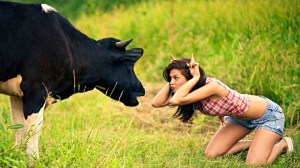
cowMad Cow Disease is no laughing matter. Because my family and I resided in the United Kingdom during the early nineties, we have never been eligible to donate blood back home in the States.

Bovine Spongiform Encephalopathy is a truly terrible, and always fatal, affliction. In a grotesque abuse of these docile herbivores, it turns out that the disease was introduced to cattle via mixing contaminated bone and tissue from sheep into their feed. (Whoever came up with that idea should be in prison.)

I seldom think about the possibility of this disease lying dormant in my body’s cells, and each year the likelihood of that being true diminishes. Frankly, since I’ve never heard of any of the Americans stationed there during that period contracting the disease, I consider it nearly certain that it is not present.

Still, just when I’ve finally accepted the notion that British cows are not a threat to me, I come face to face with the fact that they actually are.

Recently, an official report in the United Kingdom revealed that during the past fifteen years, cattle are responsible for the deaths of seventy-four people. Seventy-four!

That means they kill more Brits than sharks! And I doubt that most of those victims were taunting the cattle like the foolish young woman pictured above.

If you’ve never spent much time around cows, you may not realize how large and heavy they are. They can trample or crush people accidentally, and since they are not aggressive by nature, I assume that most of the deaths they are responsible for are just that, accidents.

Best, I suppose, to avoid farms, unless you crave a life of adrenalin-fueled risk on the edge of disaster.

C.S. Lewis reveals how deceptively innocent cattle can appear. In a letter written to a close friend in 1916, he described the calm pastoral setting for his life.

In fact, taking all things round, the world is smiling for me quite pleasantly just at present. The country round here is looking absolutely lovely: not with the stern beauty we like of course: but still, the sunny fields full of buttercups and nice clean cows, the great century old shady trees, and the quaint steeples and tiled roofs of the villages peeping up in their little valleys–all these are nice too, in their humble way.

Lewis should have been more cautious. It seems to me the cleanliness of the cows was a clear evidence they may have been up to no good.

In 1925 Lewis wrote to his father that the deer at Magdalen College were taking the place of the cattle he had left at home.

My external surroundings are beautiful beyond expectation and beyond hope. . . . My big sitting room looks north and from it I see nothing, not even a gable or spire, to remind me that I am in a town. I look down on a stretch of level grass which passes into a grove of immemorial forest trees, at present coloured with autumn red. Over this stray the deer.

They are erratic in their habits. Some mornings when I look out there will be half a dozen chewing the cud just underneath me, and on others there will be none in sight–or one little stag (not much bigger than a calf and looking too slender for the weight of its own antlers) standing still and sending through the fog that queer little bark or hoot which is these beasts’ ‘moo.’ It is a sound that will soon be as familiar to me as the cough of the cows in the field at home, for I hear it day and night.

Lewis obviously possessed a fondness for the cattle that framed his youthful memories. Likewise the deer that meandered through college grounds without fear for their safety.

Having an uncle who was a farmer, I enjoyed some small exposure to gentle, albeit not quite “clean,” cows when a boy. Today I enjoy many a day when deer leisurely cross in front of my study window to munch on some of the thick grass that we planted more for their benefit than our own.

Obviously, I do not hold bovine diseases against the poor cattle. And, at least for the present, I choose to believe that cattle (unlike cats) do not harbor any plans for world domination.

That doesn’t mean, of course, that I’m foolish enough to trust them where I haven’t already planned a potential escape route . . . especially when I’m in the U.K.

_____

Check out this post for another entertaining C.S. Lewis observation about cows!

I’m informed by my lovely wife that “clean cows” are dairy cows that need to be kept clean for hygiene reasons. Makes sense to me, but I still think that it’s an odd adjective to associate with cattle.

Puppies in Heaven

pupWill dogs and other fauna have a place in the new creation? It’s an interesting—and controversial—subject.

I just reread a delightful essay in which the author, an Orthodox theologian, describes a debate he had with a Roman Catholic scholastic on the subject.* I enjoyed the following description of the discussion so much that I had to share it.

I was once told by a young, ardently earnest Thomist . . . you know, one of those manualist neo-paleo-neo-Thomists of the baroque persuasion you run across ever more frequently these days, gathered in the murkier corners of coffee bars around candles in wine bottles, clad in black turtlenecks and berets, sipping espresso . . . this young Thomist told me that not only could my dog not love me (since he lacks a rational nature), but I could not love my dog (something about there needing to be some rational equality between lover and beloved).

Now, while I admitted that I could only presume the former claim to be incorrect . . . I was adamant that I could be absolutely certain of the falsity of the latter. But my friend was not deterred: “Oh, no,” he insisted, “you don’t really love him; you just think you do because of your deep emotional attachment to him.”

Of course. Foolish of me. Leave it to a two-tier Thomist to devise a definition of love that does not actually involve love. If you can believe in pure nature, I suppose you can believe anything.

{More on the question of animals in paradise below . . .}

Debates (civilized variants of arguments) can be fascinating when they are dissected and examined. Theological debates are particularly enthralling.

C.S. Lewis appreciated the value of debate in sharpening one’s position. This approach to learning can be traced back to the Socratic Method, which is based upon asking and answering questions.

In 1941, the Oxford Socratic Club was formed to “follow the argument wherever it led them.” C.S. Lewis was its first president (faculty sponsor), serving until 1955 when he moved to Cambridge University. In the first issue of the Socratic Digest, Lewis wrote:

In any fairly large and talkative community such as a university, there is always the danger that those who think alike should gravitate together into coteries where they will henceforth encounter opposition only in the emasculated form of rumour that the outsiders say thus and thus.

The absent are easily refuted, complacent dogmatism thrives, and differences of opinion are embittered by group hostility. Each group hears not the best, but the worst, that the other groups can say.

Some of the debates conducted by the club were legendary. You can read a fine article about these “University Battles” here.

Returning to the Question of Animals in Heaven

I wrote on this subject several years ago. That post is worth checking out if only for the amazing graphic that graces it.

You can read my own perspective on the question there, if you are interested.

Today I wish to end, instead, with the summary of my kindred spirit, who debated the philosopher.

The final sentence in this next section is priceless.

The occasion of the exchange, incidentally, was a long and rather tediously circular conversation concerning Christian eschatology. My interlocutor was an adherent to a particularly colorless construal of the beatific vision, one that allows for no real participation of animal creation (except eminently, through us) in the final blessedness of the Kingdom; I, by contrast, hope to see puppies in paradise, and persevere in faith principally for that reason.

His sentiment reminds me of C.S. Lewis’ thoughts in Mere Christianity.

I sometimes like to imagine that I can just see how it might apply to other things. I think I can see how the higher animals are in a sense drawn into Man when he loves them and makes them (as he does) much more nearly human than they would otherwise be.

Hart offers another delightfully sarcastic comment about the weight of different authorities the two debaters were citing. And with that observation, we shall end.

On his side, all the arguments were drawn from Thomas and his expositors; on mine, they were drawn from Scripture; naturally, limited to the lesser source of authority, I was at a disadvantage. . . . [arguing] that the biblical imagery of the redeemed state is cosmic in scope and positively teeming with fauna (lions lying down with lambs and such)—that Paul’s vision of salvation in Romans 8 is of the entirety of creation restored and glorified—things of that sort. All in vain, though; nothing I said could rival the dialectical force of his ringing sic Thomas dixit [so Thomas said].

_____

* The author, David Bentley Hart, is not anti-Catholic. In fact, he has taught at several Roman Catholic universities. The article quoted appears here.