Beavers Beware

russian-typoA mere 375,000 rubles buys a fair amount of publicity in Russia; just be sure to proofread the product.

This Christmas season one Russian charity hoped to encourage readers to live good lives, but instead they published a brochure that encouraged beaver genocide.

Beavers are particularly vulnerable rodents. They are quite gentle, and even Talking Beavers are poorly equipped to defend themselves.

The lovely scene on the leaflet featured an innocent girl gazing into a snow globe. Emblazoned above it was supposed to read “Do Good.” Instead, the Russian words spelled out “Exterminate Beavers!”

It just bears out the maxim, “proofread before you publish.” In this case, one could easily add: “if the work is translated, make sure the proofreader understands both languages.”

Some errors are especially heinous.

C.S. Lewis recognized the importance of proofreading.

He was sometimes the victim of inadequate editorial review. So it comes as no surprise that he preferred to see galleys (the uncorrected typeset proofs) of his work before actual publication.

The following reference from a letter in which Lewis attributes the need for such as due to his own poor penmanship, rather than the carelessness of others. This is typical of his generosity, since part of the duties of editors (and pharmacists, for that matter) is to be able to decipher the scribblings of authors (and physicians). Mark Twain did not share Lewis’ grace in this matter.

When his friend Dorothy Sayers died in 1958, Lewis was unable to attend the funeral in London. He was, however, honored to write a panegyric for the service, which was read by one of the bishops in attendance. Following the event, Sayer’s son, Anthony Fleming thanked Lewis and asked if he might include the eulogy in possible collection.

Dear Mr. Fleming

Thank you for your most kind letter. I am relieved to find that the little speech has pleased those whose approval at such a time matters most—it is so easy to go wrong in a thing of that kind and so to give offence.

I am perfectly willing that it should be printed, but please ask whoever sees to it to be sure and let me see a proof. Even if printers made no mistakes, my villainous writing nearly always leads to some.

Lewis, of course, was referring to a literal manuscript, a document written by hand. One assumes that the Russian publisher was given a typescript, so they could not use “villainous writing” as an excuse for their error.

Still, I suspect they were given the text in one language, English perhaps, and asked to translate it for publication. In that case, who actually is responsible for the mistake?

I choose not to worry about attributing liability in this matter. I’m content to use this winter mistake to remind me of the importance of proofreading.

Oh, and on behalf of all of the beavers in Russia, I am relieved to know they will not be distributing these murderous words.

C.S. Lewis was Not a Dramatist

shakespeare-and-lewisC.S. Lewis’ prolific, genre-crossing success teaches us two things. First, that a very good writer can fruitfully write in a variety of fields. Second, that even the most gifted of authors cannot write with equal talent in all genres.

Students of C.S. Lewis are well acquainted with the fact that one of the great disappointments of his life was failing to succeed as a poet. Although he did write a reasonable amount of poetry, it failed to elicit the response for which he hoped.

Lewis did, of course, receive well-deserved kudos for his literary fiction and children’s stories. His fiction and nonfiction are extraordinary, and over the years I have appreciated the value of his many essays to be among the most precious of his works.

Finally, as a correspondent, Lewis stood in the first ranks. He regarded the responsibility of personally responding to the letters he received as something not to be shirked.

Fortunately, the excellent collections of his letters offer us many insights into Lewis’ life and career. For his Christian fans, they reveal insights into how a disciple of Jesus can gracefully navigate life.

The following letter was written in 1959, to a man who was apparently the editor of a small newspaper. He had requested an article from the exceedingly busy professor. Lewis’ response is quite interesting.

Dear Mr. Aylard,

Yes! my handwriting is awful. It used to be nice but my muscles have stiffened up and the strokes no longer come out as I intend. I give ‘this generation’ all I can in the way of books and articles. Particular articles by request are not usually the good ones: and, you know, I should reach more readers through other organs than your paper. I hope this doesn’t sound stand-offish or conceited, for it is not meant to be. It is really common sense to speak where one can be most widely heard.

I agree that drama is a good medium for our purpose. In this country Dorothy Sayers’ broadcast set of plays on the life and death of Our Lord (The Man Born to be King) did a great deal of good. I don’t attempt this form myself because any talent I may have is narrative, not dramatic. With all good wishes.

I draw several observations from reading this letter.

  • Lewis took the time to personally pen many of his letters, despite the fact that this presented an uncomfortable challenge to him.
  • Lewis preferred to address subjects as he felt moved by the Holy Spirit to do so, rather than on demand.
  • He did not have the time to dress it up in gentle fluff, but candidly expressed the fact that if he had sufficient time and energy to write, it would not be the wisest stewardship to send the piece to a publication with a limited distribution.
  • Even though he did not intend for that remark to be curt or “conceited,” Lewis still felt compelled to offer his “I hope this doesn’t sound…” apology.
  • Lewis appreciated drama, and recognized Sayers’ work as quite noteworthy.
  • He recognized that drama would not be his forte, and wisely preferred to stick with the type of writing wherein he was most accomplished.

Even this final thought is offered with C.S. Lewis’ characteristic—and genuine—humility.

I don’t attempt this form myself because any talent I may have is narrative, not dramatic.

As a writer myself, I find this sentence quite comforting. And not simply because my own extremely modest talents also lie in the narrative realm. Even if I were a poet or a dramatist I would recognize how liberating it is to acknowledge that one cannot be fairly expected to excel at more than one genre.

And “excel” is not really the best word to use here. Perhaps it’s sufficient that writers think of themselves like children of Lake Wobegon, where Garrison Keillor tells us “all the women are strong, all the men are good-looking, and all the children are above average.”

Ultimately, whether we consider ourselves to be adequate or exceptional writers, it is necessary to understand where our skills reside, and to transgress those boundaries only with the greatest trepidation.

Devastated by Criticism

calvin-criticismHow do you feel when others criticize something you’ve written? Do you just want to tear your work up and start all over again? If you do, you have something in common with J.R.R. Tolkien, creator of Lord of the Rings. And he is not the only great writer with whom you share this hypersensitive trait.

Tolkien’s inability to accept constructive criticism is no secret; it is frequently noted in biographies.

Few people enjoy receiving criticism, and we are often suspicious of the mental health of those who do. Yet many writers actively seek out constructive criticism in order to sharpen their skills and improve their work.

That is a major reason for the existence of writers’ groups which pop up in varying expressions wherever serious writers live. While another benefit of such communities is the simple encouragement that comes from gathering with others who share your passion, it is the critical examination of each other’s manuscripts which provides the clearest concrete benefit. It’s no accident many such literary meetings are actually called critique groups.

Tolkien was a member of one of the most famous such fellowships that ever existed, the Inklings. It was in that setting where he first shared the stories of hobbits and elves who would make such a profound impact on Western literature. He said it was primarily through the encouragement of the Inklings—specifically his good friend, C.S. Lewis—that these amazing stories were ever published.

You see, Tolkien had a terrible and frequently fatal flaw . . . When his writing was criticized, he felt compelled to toss it aside and begin anew. Many other writers have been afflicted with this curse, and not all of them had a C.S. Lewis to rescue their words from the dust bin.

I have shared in the past Lewis’ description of his friend’s handicap.

No one ever influenced Tolkien—you might as well try to influence a bander-snatch. We listened to his work, but could affect it only by encouragement. He has only two reactions to criticism; either he begins the whole work over again from the beginning or else takes no notice at all.

Criticism of the Constructive Variety

As I said a moment ago, no one really craves criticism, and yet most serious writers actively solicit it. As I write this very column, it is with the intention of sharing it tomorrow with my friends in my own writing circles.

When you read it, it will likely have changed, probably in subtle, enriching ways. You can gauge the benefit of mutual critiquing by the amount and the quality of the criticism which is shared. And, should you feel violated, rebuke defensiveness and remind yourself that even the greats, like Tolkien and Lewis, gained from the comments and suggestions of their friends.

I recently learned of another individual who struggled with receiving criticism. It was John Calvin, the father of Reformed theology. Belonging to the Lutheran branch of the church universal, my readings in Reformed history have been limited. However, I’m currently reading two similarly titled books* and I discovered something that may be commonly known to Reformed clergy but was news to me.

He often tended to express his disappointment in extravagant terms. When he encountered an obstacle, his reaction was stark: he would burn his manuscript, never write again, never publish anything again. His decision to write was motivated by external factors: a request by his circle of friends and colleagues, or as the result of his emotional reaction to an event or a work that he read. . . . (John Calvin and the Printed Book)

The good news though is Calvin did not allow these obstacles to have the final say. Instead, he turned to those he trusted and sought their counsel.

Indeed, his extreme sensitivity meant that he needed to have the emotional support of close friends. As a Reformer and specifically as an author, Calvin never worked in isolation even though he was the dominant figure in his setting. While he was confident of the quality of his writings, Calvin still had no hesitation in submitting them to his colleagues before publication. (Ibid.)

Not that Calvin always welcomed suggestions. There was one particular Reformer to whom he sent some of his work whose “commend from Zurich were too numerous and detailed. Hence Calvin stopped sending his manuscripts to Bullinger prior to printing, although he maintained cordial relations with the Zurich Reformer.” I can almost read Calvin’s mind at the time: I asked for your suggestions, not a complete rewrite of the manuscript.

So, it appears those of us who feel discomfort at the sting of criticism—even when we request it—stand in good company. So don’t ever let that temporary pain discourage you from continuing to write.

____

* A 2005 volume is called John Calvin and the Printed Book, while a 2015 collection of essays is called Calvin and the Book.

C.S. Lewis and Metaphors

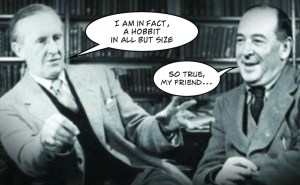
hobbit-quoteLearn how to effectively wield metaphors, and you will be powerful indeed. They are one of the most creative and intrinsically rewarding tools used by communicators.

Metaphors are not simply ornamental. Nor are they limited to abstracts subjects. The following description comes from C.S. Lewis’ book, Miracles.

It is a serious mistake to think that metaphor is an optional thing which poets and orators may put into their work as a decoration and plain speakers can do without. The truth is that if we are going to talk at all about things which are not perceived by the senses, we are forced to use language metaphorically.

Books on psychology or economics or politics are as continuously metaphorical as books of poetry or devotion. There is no other way of talking, as every philologist is aware. . . . All speech about supersensibles is, and must be, metaphorical in the highest degree.

To effectively communicate—especially about deep or profound subjects—metaphors need to be part of a readers’ or speakers’ core vocabulary. That’s what Lewis meant by saying “we are forced to use language metaphorically” when speaking about things that transcend our senses.

Former Time editor James Geary has echoed Lewis’ description of the universality of metaphors.

Metaphor is not just confined to art and literature but is at work in all fields of human endeavor, from economics and advertising, to politics and business, to science and psychology. . . .

There is no aspect of our experience not molded in some way by metaphor’s almost imperceptible touch. (I Is an Other: The Secret Life of Metaphor and How It Shapes the Way We See the World)

Without being conscious of it, we all use metaphors more frequently than we realize it. Geary claims “We utter about one metaphor for every ten to twenty-five words, or about six metaphors a minute.” Granted, most of these are routine like the four appearing in this sentence he quotes from an economic report.

“Britain’s recovery from the worst recession in decades is gaining traction but confused economic data and the high risk of a hung parliament could yet snuff out its momentum.”

Metaphors Versus Similes

Envisioning fresh metaphors may seem challenging, but it is a skill which can be practiced. One need not feel embarrassed if they find the subject of metaphors confusing. In their simplest form, they are like especially meaningful similes.

In a simile we compare two distinctly different things and declare that they are similar. For example, someone might say about the sleek new stealth destroyer, “the USS Zumwalt is like a Porsche.” This simile suggests a number of attributes and the statement contains the familiar phrase “is like.”

By contrast, a metaphor is not merely “like” something else. Using a metaphor implies that the two different things share, in a true sense, some common nature or element. So, a person might write, “the current election season is a nightmare.” Certainly, a less confident writer might weaken the power of this sentence, by diluting it into a simile, it’s “like” a nightmare.

But the bold speaker or writer recognizes how much more sharply the metaphor communicates their message. They want to state that the experience is not just nightmarish. It is a nightmare. It is (to many) horrific, frightening, and something from which we wish we could awaken to resume our lives in a world that still makes sense.

Like any rhetorical or literary tool, metaphors can be misused. They can be stretched so far that they don’t make sense, or they only appeal to individuals who share some narrow interpretation of existence.

While metaphors can be used in an ostentatious or overdone way, that simply weakens their effect. The judicious application of metaphors is a skill well worth practicing.

The Scriptures as a Treasure Trove

The subtitle above can itself be viewed as a similar or a metaphor. But that’s beside the point, since it simply introduces our discussion of the fact that the Bible is filled to overflowing with metaphors.

This is unsurprising, since almost the entire text deals with the story of an infinite Creator’s love for his fallen creation.

Put another way, our God, whose nature is utterly incomprehensible to the beings he fashioned from the earth (adamah), longs to communicate his love for we whose lives in this world are so very brief. How could the Lord accomplish this without metaphors? Thus he describes himself in this fashion:

“I am the alpha and the omega.”

“I am the bread of life.”

“I am the light of the world.”

“I am the vine; you are the branches.”

“I am the resurrection and the life.”

Metaphors are not reserved for God in the Scriptures. On the contrary, they abound, like radiant dandelions in the early days of summer.

“The teaching of the wise is a fountain of life . . .”

“The Lord is my shepherd . . .”

“O Lord . . . we are the clay, and you are our potter . . .”

“If anyone is in Christ, he is a new creation.”

All of us, “new creations” in particular, have much to learn from C.S. Lewis about metaphors. A good place to start is the brief essay “C.S. Lewis and the Apt Metaphor.”

After reflection, you may want to try your hand at creating a novel metaphor. After all, a thought-provoking metaphor is a refreshing breath in any conversation.

_____

I’ve written about metaphors in the past posts, including this one. I also wrote a a column which includes George Orwell’s advice for writers: “Never use a metaphor, simile, or other figure of speech which you are used to seeing in print.”

The Artistry of Nature

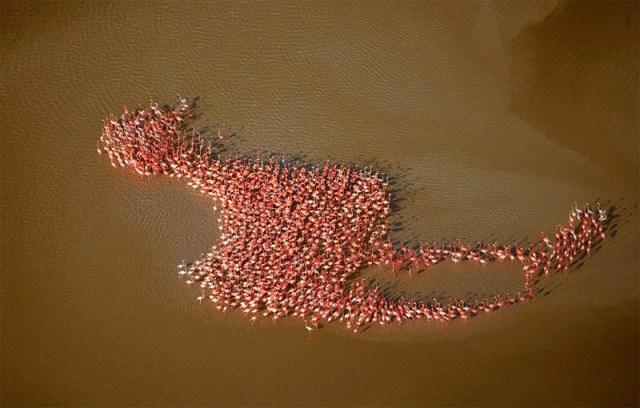
flamingoes
This picture of flamingos is delightful. That they “randomly” arranged themselves into a silhouette of themselves is amazing. Or, perhaps a divine hand painted this glorious portrait?

“What a fanciful thought,” poets muse.

“How absurd!” atheists groan.

“Is he serious?” realists wonder.

“Now that’s something to ponder…” people of faith think.

“Of course God has fashioned nature’s beauties with his hands,” the eremite smiles.

I happen to believe God was speaking literally when he said through the Psalmist:

For every beast of the forest is mine, the cattle on a thousand hills. I know all the birds of the hills, and all that moves in the field is mine (Psalm 50).

It was on the fifth day of creation that the Lord spoke into existence for the first time “every winged bird according to its kind.”

And God blessed them, saying, “Be fruitful and multiply and fill the waters in the seas, and let birds multiply on the earth” (Genesis 1:22).

And, to reveal God’s concern for the creatures he has made did not end with their genesis, allow me one more biblical citation . . . a familiar one. In reminding us of how precious we are to our Father, Jesus describes that God’s concern extends even to the least of his creation.

Are not two sparrows sold for a penny? And not one of them will fall to the ground apart from your Father (Matthew 10:29).

C.S. Lewis touches on the preciousness of creation in a 1956 letter to one of his regular correspondents.

I think God wants us to love Him more, not to love creatures (even animals) less. We love everything in one way too much (i.e. at the expense of our love for Him) but in another way we love everything too little. No person, animal, flower, or even pebble, has ever been loved too much—i.e. more than every one of God’s works deserves (Letters to an American Lady).

Now, does God’s concern for his creatures, in this case flamingoes, mean that he takes the time to direct their flight, their nesting, and the shape of their earthly “congregations?” Of course not. But even in saying that, it is wise to note that if he chose to do so, he could. And there are, of course, some scriptural examples of his using animals in specific ways.

It’s possible, and even likely, that this was a mere coincidence. Like the clouds whose shapes sometimes mirror actual things, even in minute detail. While there are rather odd people who believe cloud shapes can foretell the future, I don’t believe there are any Christians who would base their decisions upon the physical arrangements of a flock, colony, gaggle, or flamboyance (with is fancy name for a group of flamingos).

That said, I still believe that the divine Artist is not above occasionally enjoying some playfulness with the tapestry he has fashioned here on earth, and in the heavens.

Lewis & Flamingos

On 12 July 1956, C.S. Lewis attended a garden party at Buckingham Palace hosted by Queen Elizabeth II. Below you will find excerpts from two letters mentioning the subject. They were written to Ruth Pitter (1897-1992), a well-regarded poet with whom Lewis enjoyed a strong friendship.

Lewis wondered if she might be attending the same event, and suggested they might accompany one another, if so. Less than a week later, following the event, he shares with her his delightful observations of the teeming gathering.

Dear Ruth

Do you play croquet with the Queen on Thursday? (Croquet is not mentioned in the invitation but I am well-read enough to know that a royal garden party will involve hedgehogs, flamingos, soldiers, Heads-man, and the grin of a Cheshire cat). If so are you coming via Oxford? I was thinking of going up by 1.58 and returning by the 6.45 or 7.35 on either of which we could dine. You are an experienced courtier and it would give me great moral support to arrive in your company!

Apparently Pitter was not in attendance at this particular outing, also she had been the first woman to receive the Queen’s Gold Medal for Poetry the previous year. Two decades later the Queen would appoint her a Commander of the Order of the British Empire (CBE) for her contributions to English literature. Two days after the extravaganza, Lewis wrote again.

Dear Ruth

You were well out of it. I learn from the papers that I was one of 8000 guests and also that the Queen was present, a fact of which I had no evidence from my own experience. One could not even get a cup of tea for the crowd round the refreshment tables was reminiscent of Liverpool Street station on an August bank holiday. Most people didn’t know one another. One saw many married couples pathetically keeping up between themselves a dialogue which was obviously wearing very thin. If I hadn’t run across Archbishop Matthew I’d have been in a vast solitude.

There are flamingoes: metal silhouettes of them round the lake—a tasteful device which we perhaps owe to Prince Albert. In a word, it was simply ghastly. Two pints at the little pub on Praed St. were necessary afterwards.

A Postscript on Pitter

Ruth Pitter was a talented poet, but because she was a traditionalist—something quite agreeable to Lewis—she has not been accorded the respect she merits. One scholar who published her letters in 2014 writes:

Pitter, in contrast to T.S. Eliot, Ezra Pound, and W.H. Auden, is a traditional poet in the line of George Herbert, Thomas Treharne, Thomas Hardy, A.E. Housman, W.B. Yeats, and Philip Larkin. Unlike the modernists, she rarely experiments with meter or verse form, nor does she explore modernist themes or offer critiques of modern English society.

Instead, she works with familiar meters and verse forms, and her reluctance to alter her voice to follow in the modernist line explains in part why critics have overlooked her poetry. She is not trendy, avant-garde, nor, thankfully, impenetrable.

As mentioned above, their friendship was deep. Lewis’ friend George Sayer says Lewis once volunteered that if he had not been a confirmed bachelor, Pitter was just the sort of woman to whom he could be happily married.

They influenced one another professionally, sharing poetic advice and critique. Pitter also attributed her spiritual reawakening, her conversion to Christianity, to Lewis’ influence. In 1948 she wrote to a friend:

Did I tell you I’d taken to Christianity? Yes, I went & got confirmed a year ago or more. I was driven to it by the pull of C. S. Lewis and the push of misery. Straight prayer book Anglican, nothing fancy . . . I realize what a tremendous thing it is to take on, but I can’t imagine turning back. It cancels a great many of one’s miseries at once, of course: but it brings great liabilities, too.

In 1985 she wrote to a correspondent about the same subject.

As to my faith, I owe it to C. S. Lewis. For much of my life I lived more or less as a Bohemian, but when the second war broke out, Lewis broadcast several times, and also published some little books (notably The Screwtape Letters), and I was fairly hooked. I came to know him personally, and he came here several times. Lewis’s stories, so very entertaining but always about the war between good and evil, became a permanent part of my mental and spiritual equipment.

Since we have been introduced to this unique woman now, it’s fitting to close with one of her poems. A poem inspired by another of the avian wonders created by our artistic God.

stormcock

Stormcock in Elder

In my dark hermitage, aloof

From the world’s sight and the world’s sound,

By the small door where the old roof

Hangs but five feet above the ground,

I groped along the shelf for bread

But found celestial food instead:

For suddenly close at my ear,

Loud, loud and wild, with wintry glee,

The old unfailing chorister

Burst out in pride of poetry;

And through the broken roof I spied

Him by his singing glorified.

Scarcely an arm’s-length from the eye,

Myself unseen, I saw him there;

The throbbing throat that made the cry,

The breast dewed from the misty air,

The polished bill that opened wide

And showed the pointed tongue inside;

The large eye, ringed with many a ray

Of minion feathers, finely laid,

The feet that grasped the elder-spray;

How strongly used, how subtly made

The scale, the sinew, and the claw,

Plain through the broken roof I saw;

The flight-feathers in tail and wing,

The shorter coverts, and the white

Merged into russet, marrying

The bright breast to the pinions bright,

Gold sequins, spots of chestnut, shower

Of silver, like a brindled flower.

Soldier of fortune, northwest Jack,

Old hard-times’ braggart, there you blow

But tell me ere your bagpipes crack

How you can make so brave a show,

Full-fed in February, and dressed

Like a rich merchant at a feast.

One-half the world, or so they say,

Knows not how half the world may live;

So sing your song and go your way,

And still in February contrive

As bright as Gabriel to smile

On elder-spray by broken tile.

_____

The Bible verses quotes above are taken from the ESV, the English Standard Version.

The “stormcock” in whose humble honor Pitter dedicates this poem is also called the Mistle Thrush. Its informal nickname arises from its eagerness to sing its songs in every sort of weather.


Desiring Silence

coptic quietDo you enjoy noise, or do your mind and soul long for moments of silence? If you appreciate escaping the cacophony of sounds that weigh against you, you’re in good company. The Inklings were men who respected the value of silence.

I attended a funeral for a former parishioner today. The fact that I did not conduct the service allowed me to sit beside my wife who shared my sincere fondness for the saint we were bidding farewell.

The service was comforting, being resurrection-focused as such matters ought to be. Despite our singing three hymns during its course, it was also quiet. Quiet in the sense of calm and peaceful like a deep brook that rushes along in relative silence, compared to its chattering companions that dance across the rocks in a shallow creek.

Joe was a humble man, though he was one of the rare breed who truly deserve the accolade of being part of the “greatest generation.” Though he never bragged about it, he served throughout the Second World War, and survived D-Day while landing in just the second wave at Omaha Beach.

It was a service that befitted a humble ninety-two-year-old man who faithfully ushered at his church up until his death. A man who had spent most of his life in activities serving others, and who kept his marital vows to his now widowed bride for seventy years.

Reflecting on that quality this afternoon, I recalled how silence was appreciated by the Inklings. C.S. Lewis expressed this thought on many occasions. One of the best known comes from The Weight of Glory.

We live, in fact, in a world starved for solitude, silence, and private: and therefore starved for meditation and true friendship.

Lewis’ opinion of noise went beyond disdain. He even included a description in The Screwtape Letters of how noise itself could serve malevolent purposes.

My dear Wormwood: Music and silence—how I detest them both! How thankful we should be that ever since our Father [Lucifer] entered Hell . . . no square inch of infernal space and no moment of infernal time has been surrendered to either of those abominable forces, but all has been occupied by Noise–Noise, the grand dynamism, the audible expression of all that is exultant, ruthless, and virile—Noise which alone defends us from silly qualms, despairing scruples, and impossible desires.

We will make the whole universe a noise in the end. We have already made great strides in this direction as regards the Earth. The melodies and silences of Heaven will be shouted down in the end. But I admit we are not yet loud enough, or anything like it. Research is in progress.

The world has only gotten noisier since Lewis wrote those words. And silence is in ever-shorter supply. That’s one of the reasons, I suppose, why I appreciate living in the forest, where even the tentacles of cable television do not reach. Their absence contributes to an involuntary amplification of the silence that resides around our home.

Tolkien Shared Lewis’ Opinion

Since I’ve been reading some of J.R.R. Tolkien’s correspondence recently, the following excerpt came to my mind.

Like many thinkers, and nearly all writers, Tolkien found noise distracting. In a 1964 letter, he wrote the following description of the sounds that assaulted him in his neighborhood. (The last sentence is particularly delightful.)

Headington is no paradise of peace. Sandfield Road was a cul-de-sac when I came here, but was soon opened at the bottom end, and became for a time an unofficial lorry by-pass, before Headley Way was completed. Now it is a car-park for the field of ‘Oxford United’ at the top end. While the actual inhabitants do all that radio, tele, dogs, scooters, buzzbikes, and cars of all sizes but the smallest, can do to produce noise from early morn to about 2 a.m.

In addition in a house three doors away dwells a member of a group of young men who are evidently aiming to turn themselves into a Beatle Group.

What a vivid description. But one would expect nothing less from the creator of Middle Earth.

The same year as the Allied attack on Normandy, Tolkien wrote to his son Christopher who was in South Africa earning his wings with the Royal Air Force. A veteran of the First World War, the concerned father knew all too well what might lie ahead. In 1944 he wrote the following:

I have the autumn wanderlust upon me, and would fain be off with a knapsack on my back and no particular destination, other than a series of quiet inns. One of the too long delayed delights we must promise ourselves, when it pleases God to release us and reunite us, is just such a perambulation, together, preferably in mountainous country, not too far from the sea, where the scars of war, felled woods and bulldozed fields, are not too plain to see.

Like Tolkien, C.S. Lewis was also a veteran of the “war to end all wars.” The Inklings, like all Europeans of their generation, were acutely acquainted with warfare and its costs. Still, because of their wisdom and faith, Tolkien and Lewis were confident the Allies would prevail. They trusted that the blessed silence of peace would ultimately triumph over war’s cries.

In that light, we continue reading from Tolkien’s letter to Christopher. Immediately after his suggestion to Christopher that the two of them take a walking tour, Tolkien describes the plans the Inklings had already established to celebrate the eventual end of the war.

The Inklings have already agreed that their victory celebration, if they are spared to have one, will be to take a whole inn in the country for at least a week, and spend it entirely in beer and talk, without reference to any clock!

I don’t recall reading about their intentions before, but it has made me curious as to whether or not these dreams were ever realized. If they were, I am certain that the absence of other guests, and the removal of all clocks, would have made for a calm, quiet and renewing week indeed.

_____

The image above comes from an eighth century Coptic fresco.

A more modern image of silence, although originating all the way back in 1965, would be the “cone of silence,” which will be familiar to fans of the series Get Smart. For reflections on that theme, you might want to check out the this article.

If you aren’t familiar with the aforementioned cone, take two minutes to rectify that shortcoming by watching this video.

Who Said That?

thoms and lewisWho said that? It’s a question people ask when they recall a familiar saying and don’t remember the source.

Occasionally when we are reminded of the source, we shake our heads and think that’s right; how could I have forgotten!

At other times though, discovering the source of the maxim doesn’t help at all. It could be because the proverb is anonymous, or it might be due to the fact that it’s originator was not particularly well known.

That’s the case of the following statement, which is familiar to many Christians.

“Be careful how you live; you will be the only Bible some people ever read.”

When I thought of this phrase several weeks ago, I had a bit of trouble tracking it down. I actually found it on a number of sites, but the problem was that the author’s name was so unfamiliar it was almost always misspelled.

He was usually cited as “William Toms.” Yet I was pretty sure the saying hadn’t originated, however, with an Irish footballer.*

Just when I assumed I had encountered a clichéd brick wall, I stumbled upon the truth. Like so many classic maxims, the quotation did indeed originate from the British Isles.

The British writer William J. Thoms penned this thoughtful maxim, and it isn’t the only wise thing he wrote.

William John Thoms (1803 – 1885) was a British writer credited with coining the term “folklore” in the 1840s. Thoms’ investigation of folklore and myth led to a later career of debunking longevity myths. Hence, he is an early advocate of “validation research” when examining demographics.

Several of Thoms’ works are available online. They include:

C.S. Lewis had more in common with Thoms than simply being British and engaging in literary pursuits. The two men shared an interest in simple tales that intrigued and inspired men and women through the ages.

It was Thoms, in fact, who in 1846 introduced into English the term “folklore.”

A shared interest in legends and even the supernatural, suggests that the two may well have enjoyed one another’s company, had their lives intersected.

Sadly, Thoms’ desire to compile a comprehensive “Folk-Lore of England” was never realized, as this superb article describes.

The two scholars shared another trait of bookish people. (“Bookish,” by the way, is a compliment here at Mere Inkling.) Neither man sought out the frivolities of popular society. They were both content to socialize with similar minds in more intimate community. The following description of Thoms, from the Dictionary of National Biography,could just as naturally have been written about Lewis.

Thoms went little into society, but at congenial resorts, such as the ‘Cocked Hat Club,’ he was remarkable for a ready play of wit and an almost inexhaustible fund of humorous anecdote and reminiscence.

Can’t you just picture the Cocked Hat Club meeting at one table in the Eagle and Child while the Inklings shared their own warm friendship at their table at the other end of the pub?

_____

* Not that I follow English football, but I learned an athlete by that name played forward for Plymouth Argyle and Manchester United.

** The Book of the Court, published in 1838 with the second edition, linked here, printed six years later, has the delightful, if rather lengthy, subtitle: Exhibiting the History, Duties, and Privileges of the Several Ranks of the English Nobility and Gentry, Particularly of the Great Officers of State and members of the Royal Household; Including Vaious Forms of Court Etiquette, Tables of Precedency, Rules to be Observed at Levers and Drawing Rooms, Etc.

Tolkien’s Inspiration

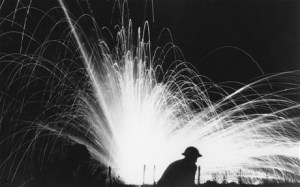
night patrolThe poetry of a dead veteran spoke to me today. He was a close friend of J.R.R. Tolkien, and in a sense his life lives on in the descriptions of Middle Earth.

In a recent column my Canadian friend Brenton Dickieson, introduced me to one of the many poets whose lives tragically ended on the battlefields of WWI.

Professor Dickieson describes the context of a new film about the impact of the war on J.R.R. Tolkien. It is called Tolkien’s Great War. It is based on the book Tolkien and the Great War: The Threshold of Middle-earth.

You will find a link to the half hour documentary below, and I strongly—yes, strongly—encourage you to watch it. It is quite moving.

Like most members of their generation, Tolkien and C.S. Lewis were deeply moved by the horrors of the First World War. Both served on the front lines, in the grim trenches, during the bloody conflict. And they lost friends. I’ve written in the past about their military service, including posts herehere, and here.

The Deceased Poet

The documentary describes the untimely deaths of two of Tolkien’s closest friends during the war. One of them, Geoffrey Bache Smith, was a poet.

Following his death, Tolkien gathered together his writings and published them as a tribute to his friend. It was one of the earliest contributions to a wealth of soldier’s poetry that would deluge grieving Europeans by the close of the conflict.

Due to the brevity of his life, the collection, published as A Spring Harvest, is short. Tolkien also penned an introduction to the work which is equally Spartan. The literary austerity is fitting, given the sad reason for the volume’s brevity. The introduction, in full, reads:

The poems of this book were written at very various times, one (“Wind over the Sea”) I believe even as early as 1910, but the order in which they are here given is not chronological beyond the fact that the third part contains only poems written after the outbreak of the war. Of these some were written in England (at Oxford in particular), some in Wales and very many during a year in France from November 1915 to December 1916, which was broken by one leave in the middle of May.

“The Burial of Sophocles,” which is here placed at the end, was begun before the war and continued at odd times and in various circumstances afterwards; the final version was sent me from the trenches.

Beyond these few facts no prelude and no envoi is needed other than those here printed as their author left them.

J.R.R.T., 1918.

The poems themselves run the gamut of emotions. This is unsurprising, given that some were born during the idyll dreams of youth, while others were forged by the anvil of war.

The limited press run of the book has made it difficult to find. Fortunately, it is now available for free via Project Gutenberg.

While the poems include the familiar references to the “old gods” so common to the period, there are also some moving references to a more Christian ethos.

Creator Spiritus

The wind that scatters dying leaves

And whirls them from the autumn tree

Is grateful to the ship that cleaves

With stately prow the scurrying sea.

Heedless about the world we play

Like children in a garden close:

A postern bars the outward way

And what’s beyond it no man knows:

For careless days, a life at will,

A little laughter, and some tears,

These are sufficiency to fill

The early, vain, untroubled years,

Till at the last the wind upheaves

His unimagined strength, and we

Are scattered far, like autumn leaves,

Or proudly sail, like ships at sea.

Tolkien and Smith formed half of the T.C.B.S., a communion knit together during the school years. The war would cut that number in half, as poignantly described in Tolkien and the Great War. The first of the companions had already died, and five months later Smith was spending the final moments of his own life encouraging his friend to press on, whatever might befall him.

Before reading Smith’s “So We Lay Down the Pen,” consider his final letter to Tolkien. He wrote it as he prepared to lead a night scout through dead man’s land at the front. It was dangerous duty which did indeed, that very evening, cost him his life.

My chief consolation is that if I am scuppered [ambushed and killed] tonight—I am off on duty in a few minutes—there will still be left a member of the great T.C.B.S. to voice what I dreamed and what we all agreed upon. For the death of one of its members cannot, I am determined, dissolve the T.C.B.S.

Death can make us loathsome and helpless as individuals, but it cannot put an end to the immortal four! A discovery I am going to communicate to Rob before I go off tonight. And do you write it also to Christopher. May God bless you my dear John Ronald and may you say things I have tried to say long after I am not there to say them if such be my lot.

Yours ever,

G.B.S.

Tolkien compiled Smith’s poems as a tribute. And, when he wrote his masterpieces, there is a profound sense in which he truly did say things his friends had tried to say, long after they were not there to say them.

So We Lay Down the Pen

So we lay down the pen,

So we forbear the building of the rime,

And bid our hearts be steel for times and a time

Till ends the strife, and then,

When the New Age is verily begun,

God grant that we may do the things undone.


Enlarging C.S. Lewis’ Vocabulary

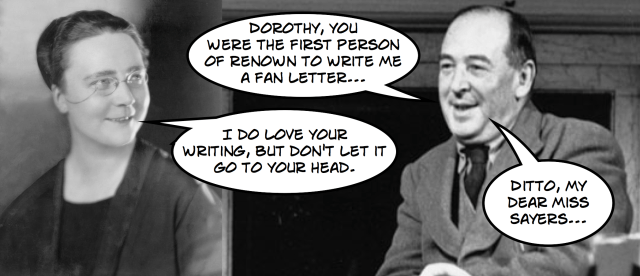
csl sayersCan you imagine receiving a compliment like this from C.S. Lewis? Your work “even enlarged my vocabulary.”

Shocking . . . but another writer did receive that rare praise.

In 1954, Lewis wrote a lengthy letter to his friend Dorothy Sayers, praising her recent publication of Introductory Papers on Dante. Lewis’ opening sentence reveals his delight. “Your Introductory Papers have given me a regular feast.”

Lewis specifically comments on a number of insights he found particularly worthwhile. And remember, Lewis was an expert on Dante in his own right.

One evidence that Lewis’ praise is sincere, and not mere flattery, comes in his comment that “every essay and nearly every page enriched me.” Not every page, mind you, but very nearly every one of them.

Offering Gentle Criticism

Consistent with the nature of friendly literary criticism (like one receives in a healthy writers group), Lewis does offer some specific advice on how to strengthen a specific point that he regards as overemphasized. In this case it relates to a classical Latin phrase.

At one point Lewis expresses awe about a portion of the book, and then immediately proceeds to make an enjoyable comment about the limitations of the English language.

P. 52 is a blaze of (just) splendour. (Drat our homophones: by just I don’t mean ‘nothing but,’ I mean ‘justified,’ ‘veracious.’)

Toward the close of his letter, Lewis raises a profound notion about our perception of humor. He cautions Sayers, in her interpretation of Dante’s Comedy, not to read it directly through the lens of our own day. “I’ve a feeling that in handling particular passages you are too certain that whatever is comic to us was, and was meant to be, comic at the time.” He continues:

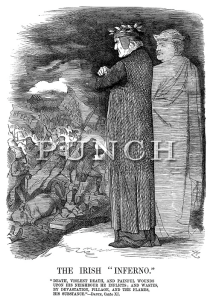
Because, as any one can see even from the old Punches,* nothing changes so quickly as the sense of humour: so that in reading any old book there is nothing we are less sure of than which places wd. welcome a smile. And oughtn’t we to start by a recognition that our generation (yours & mine) was quite abnormally ‘tickle o’ the sere’** (already the young people are less so).

A Poetic Postscript

Lewis ends his letter to Sayers with some advice for her subsequent work with Dante. He courteously writes, “Don’t give me the next set, I’ll buy it.”

Then he makes a suggestion to protect her from the spurious criticisms of ignorant literary critics. (Note that he doesn’t use the choice descriptive in a vulgar sense common today, but in more classical sense of extreme foolishness.)

And do put in an essay on D. as ‘poet’ in the old, narrowest sense—his sheer poeticalness. Otherwise we shall have some ass saying that because you like so many other qualities, you are oblivious to that.

_____

* Punch Magazine was published in England until 1992. The 1881 image below is inspired by Dante’s Inferno, and applied to the violence in Ireland.

** Easily made to laugh. From Hamlet: “The clown shall makes those laugh whose lungs are tickle o’ the sere.” The seare, or sere, was part of the trigger of old matchlock guns, so arranged that the slightest movement would make the gun discharge. Lungs, then, “tickle o’ the sere,” are those easily moved to laughter.

punch dante

Hunting Facts

librariansI’m having a serious problem. One that was shared by C.S. Lewis.

Unfortunately, it has reached its greatest intensity as I am striving to meet the deadline for my doctoral dissertation.

The problem is one that should be simple to remedy, yet I’m crippled by it. The solution is so simple that it is almost embarrassing to admit what it is.

But, confession is good for the soul. (That’s not a biblical verse, by the way, in case you were wondering. Nevertheless, it’s quite true.)

So, here’s my confession. I love to conduct research.

The internet is tailor made for a lifelong student like me; I can follow any avenue that piques my interest from one corner of the world wide web to the other.

And, I do.

That’s the problem, of course. I always over-research the things that I write. And this dissertation is no different. I have so much research—good stuff—to cram into it that I’m dreading hearing back from my advisor . . . who now has the first three chapters in hand.

So, how does this plight resonate with the life of C.S. Lewis? Well, not in the sense of my possessing his brilliant intellect and memory. Lewis had no need of the internet to sort out all of the material he had studied.

Still, the two of us do share one important character trait. He too, was an inveterate collector of information.

In his anthology of George MacDonald’s writings, Lewis confesses his pleasure at conducting research. He says it in this fashion:

“I am a don, and “source-hunting” (Quellen-forschung) is perhaps in my marrow.”

Alas, my marrow is filled with the same unquenchable hunger.

Considering Your Own Writing

It may be that some Mere Inkling readers share this passion for pursuing knowledge for its own sake.

It can certainly be argued that it is an important facet of writing. But there are other aspects of writing, and it is quite natural for different elements of the process to appeal to different individuals.

Perhaps you prefer the initial brainstorming, daydreaming or idea phase of a writing project.

Or, as we have discussed, researching information may be the high point of your writing efforts.

This typically leads to outlining, in various shades of detail. Some writers prefer to proceed without any structure in mind. (This is usually not a good idea when writing nonfiction.) I like outlining. I find establishing a logical structure satisfying work, probably because I’m NTJ.

There are, of course those who honestly love the writing itself, especially when they are in the zone and the creativity is really flowing. Frankly, for me the writing is work. (That doesn’t mean I don’t enjoy the feeling that flashes when you come upon the perfect word or phrase.)

And, although I’m a brutal editor of my own work, and find sharpening an article rewarding work, I must admit I am a little surprised when I encounter a writer who enjoys this phase of the process the most of all.

Then there is sharing or submitting a manuscript for publication. Most writers are a little nervous about this, but some find it exhilarating.

Once someone has published a book, it is now normal for the bulk of responsibility for its promotion to rest upon their own shoulders, as the author. I’m still waiting to meet someone who claims that this is their favorite phase of the writing cycle.

Back Again to the Oxford Don

Lewis’ writing is so enjoyable that I want to close with a longer excerpt from the introduction.

C.S. Lewis’ high regard for MacDonald is well known. This anthology of his work was a tribute to him, in the hopes of introducing many more readers to his work. This book is insightful into the hearts of both men. After all, the editor’s choice of quotations cannot help but reveal much about them too.

In making this collection I was discharging a debt of justice. I have never concealed the fact that I regarded him as my master; indeed I fancy I have never written a book in which I did not quote from him. But it has not seemed to me that those who have received my books kindly take even now sufficient notice of the affiliation.

Honesty drives me to emphasize it. And even if honesty did not— well, I am a don, and “source-hunting” (Quellen-forschung) is perhaps in my marrow. It must be more than thirty years ago that I bought— almost unwillingly, for I had looked at the volume on that bookstall and rejected it on a dozen previous occasions— the Everyman edition of Phantastes. A few hours later I knew that I had crossed a great frontier.

_____

There is no authoritative step-by-step list of the writing process. Some sources call the idea stage “prewriting.” Others break writing down into two parts: “drafting” and “revising.” Some consider editing primarily to be “proofreading,” while you can see from post that I merge the revising and proofreading into what I call “editing.” There are various other structures that are used to describe the writing process. My suggestion is to go with what works for you.

MacDonald’s works are now in the public domain. You can download a free copy of Phantastes here. There is a LibriVox (audio) recording available at the same site.