C.S. Lewis’ Personality

csl introvertLearning about ourselves is a lifelong quest. And the more actively we pursue self-knowledge, the wiser we become.

A well known sixteenth century Christian mystic wrote:

“Self-knowledge is so important that even if you were raised right up to the heavens, I should like you never to relax your cultivation of it.” (Saint Teresa of Ávila, Interior Castle).

This self-knowledge leads to a greater recognition of our dependence on God. She continues, “so long as we are on this earth, nothing matters more to us than humility. . . . As I see it, we shall never succeed in knowing ourselves unless we seek to know God: let us think of His greatness and then come back to our own baseness; by looking at His purity we shall see our foulness; by meditating on His humility, we shall see how far we are from being humble.”

C.S. Lewis echoes this sentiment.

If anyone would like to acquire humility, I can, I think, tell him the first step. The first step is to realise that one is proud. And a biggish step, too. At least, nothing whatever can be done before it. If you think you are not conceited, it means you are very conceited indeed. (Mere Christianity).

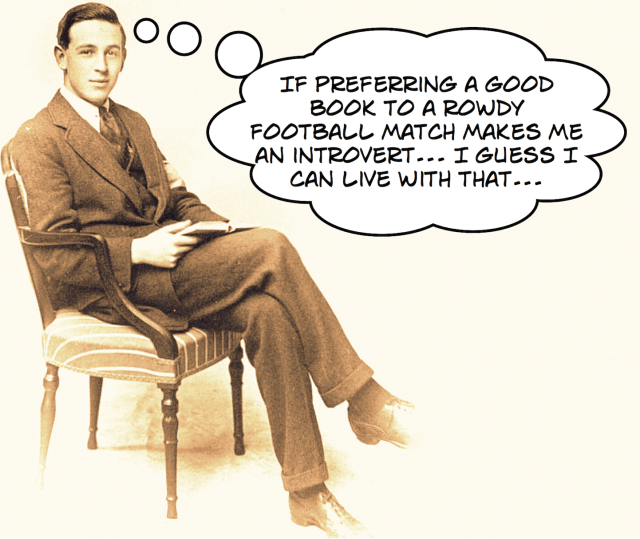
As part of my self-examination, I have recently revisited my “personality type” as assessed by the well known Myers Briggs Personality Indicator (MBTI).

Without over-explaining the MBTI, it measures an individual’s preference related to four ways by which we experience and make sense of the world. (News Flash: Not everyone perceives reality the same way!)

These dichotomies are:

Extraversion (E) or Introversion (I)

Whether your preferred focus is outward or inward.

Sensing (S) or Intuition (N)

How you focus on information and process it.

Thinking (T) or Feeling (F)

Primary preference in your decision-making.

Judging (J) or Perceiving (P)

Your orientation towards making sense of existence.

You can get some additional authoritative information here. There are also numerous “unofficial” websites related to the subject.

Sixteen combinations are possible, and each has its respective strengths. (None are “better” than others, of course, since we’re all created in the image of God.)

Speaking of which, I’ve also been studying the different combinations that are more common to Christian ministers than they are within the general population.

For example, the following types (with their shorthand title) range from two to six times more common for male clergy than the general male American population:

ENFJ (The Teacher)

ENFP (The Provider)

INFP (The Healer)

INFJ (The Counselor)

ENTJ (The Field Marshal)

Which type of pastor do you prefer?

Online Surveys to Visit after you finish this post

There are a number of free MBTI-type tests online. Naturally, they are not as reliable as the official inventory given through a certified provider. Nevertheless, the following sites did render accurate assessments for me, based on my formal scoring.

I have mentioned in the past that I am an *NTJ… with the asterisk representing that my I/E preference is too close to call. A previous post shows how that makes me a blend of Middle Earth’s Elrond and Théoden.

Humanmetrics Jung Typology Test

CelebrityTypes Personality Type Test

So, What Is C.S. Lewis’ Personality Type?

This is a subjective question. The MBTI is a self-reported assessment, so guessing the type of another person is by nature dicey.

In Lewis’ case, however, there is a fair degree of consensus. This is due to his openness about his personal life and his extensive writings. The general agreement does not mean though that there are not minority opinions.

The most common argument is that C.S. Lewis was INTJ. I find the reasons persuasive, and not just because it matches my own type!

One student of the subject says “Check out this quote—how INTJ is this?!”

Five senses; an incurably abstract intellect; a haphazardly selective memory; a set of preconceptions and assumptions so numerous that I can never examine more than a minority of them—never become even conscious of them all. How much of total reality can such an apparatus let through? (A Grief Observed)

One blogger writes, “There is no doubt in my mind that Lewis was an INTJ. It seeps off all his writing and is blatant in his behavior in all of his biographies.” She continues:

Highly imaginative child who lived in a dream world? Check.

Someone highly emotional/sensitive but that never showed it on the surface? Check.

A prolific writer who blazed through finishing projects at an astounding rate, who was so successful at everything he did, despite never having done it before, that he quickly rose to the top? Check.

Another site considers both C.S. Lewis and his fellow inkling J.R.R. Tolkien to be INFPs. The aptly titled CelebrityTypes.com offers a brief selection of quotations to illustrate the reasons for their identification.

If the site’s identifications are accurate, the two are in good company. Other writers include John Milton, Augustine of Hippo, Hans Christian Andersen, William Shakespeare, Søren Kierkegaard, George Orwell, A.A. Milne, Edgar Allan Poe, William Blake, J.K. Rowling and George R.R. Martin.

A Warning from Lewis Himself

Understanding ourselves better than we already do, is a good thing.

Being overly curious about the personality of someone who is deceased is another matter. Lewis’ point in the passage that follows is that such concerns must never supersede our regard for others, in the spirit of Matthew 8:22.*

There is a reaction at present going on against the excessive love of pet animals. We have been taught to despise the rich, barren woman who loves her lap dog too much and her neighbor too little. It may be that when once the true impulse is inhibited, a dead poet is a nobler substitute than a live Peke, but this is by no means obvious.

You can do something for the Peke, and it can make some response to you. It is at least sentient; but most poetolaters [worshippers of poets] hold that a dead man has no consciousness, and few indeed suppose that he has any which we are likely to modify. Unless you hold beliefs which enable you to obey the colophons of the old books by praying for the authors’ souls, there is nothing that you can do for a dead poet: and certainly he will do nothing for you. He did all he could for you while he lived: nothing more will ever come.

I do not say that a personal emotion towards the author will not sometimes arise spontaneously while we read; but if it does we should let it pass swiftly over the mind like a ripple that leaves no trace. If we retain it we are cosseting with substitutes an emotion whose true object is our neighbour.

Hence it is not surprising that those who most amuse themselves with personality after this ghostly fashion often show little respect for it in their parents, their servants, or their wives. (The Personal Heresy: A Controversy).

Reflecting on our own nature, and pondering the personalities of those we respect, are worthwhile activities. However, it’s best to remember that all we can see are mere glimpses into the depths of who we truly are.**

_____

* Matthew 8:22 quotes Jesus’ response to a disciple who demurred that he could not follow the Lord until after he attended to his father’s burial. “And Jesus said to him, ‘Follow me, and leave the dead to bury their own dead.’”

** As Paul words in Romans 8:27 are paraphrased in The Message Bible: God “knows us far better than we know ourselves . . .”
Poet-olatry: Poetry Misperceived

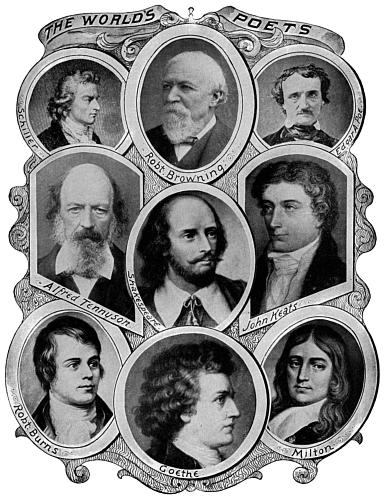
poetsWhen does our appreciation of a particular writer border on literary idolatry? Well, not idolatry proper, since even shrines like Poet’s Corner at Westminster Abbey don’t endorse “worship.”

We naturally appreciate the memory of those whose work has contributed to our lives. And that’s fine. But when we begin to focus more on them, than on the real, breathing people around us, our priorities are skewed.

In 1989, Hollywood released a film entitled “Dead Poet’s Society.” It was nominated for an Oscar for Best Picture, and ironically won the Oscar for Best Writing. In the movie, an English teacher awakens his moribund students to literature, and the more reflective aspects of life.

At last week’s writers meeting, we were introducing ourselves to a visitor, and as part of that process, mentioned the type of writing each of us pursues. I listed several genres and concluded with the words “but I’m not a poet.”

A member of the group immediately “corrected” me, since I have, in fact, written several poems during the past couple of years. Well, I guess I should get used to saying something like, “I don’t consider myself a poet.”

Poetry, some poets insinuate, carries a more artistic air than other, pedestrian genres. Fiction, of course, has its own advocates, and they too occasionally look down on folks like me who typically muddle around in the nonfiction worlds history and religion.*

In the following paragraphs, C.S. Lewis offers some provocative thoughts about how we should rightly feel toward departed writers. His argument is really about how we must not neglect our duty to living humanity by focusing on those who are “gone.”

A special treat in the selection is his coining of the word which inspires the title of this post.

There is a reaction at present going on against the excessive love of pet animals. We have been taught to despise the rich, barren woman who loves her lap dog too much and her neighbor too little.

It may be that when once the true impulse is inhibited, a dead poet is a nobler substitute than a live Peke, but this is by no means obvious. You can do something for the Peke, and it can make some response to you. It is at least sentient; but most poetolaters hold that a dead man has no consciousness, and few indeed suppose that he has any which we are likely to modify.

Unless you hold beliefs which enable you to obey the colophons of the old books by praying for the authors’ souls, there is nothing that you can do for a dead poet: and certainly he will do nothing for you.

He did all he could for you while he lived: nothing more will ever come. I do not say that a personal emotion towards the author will not sometimes arise spontaneously while we read; but if it does we should let it pass swiftly over the mind like a ripple that leaves no trace.

If we retain it we are cosseting with substitutes an emotion whose true object is our neighbour. Hence it is not surprising that those who most amuse themselves with personality after this ghostly fashion often show little respect for it in their parents, their servants, or their wives. (The Personal Heresy).**

Lewis alleges our emotional “bonds” with departed writers are fruitless, imaginary, and perhaps even detrimental. I agree that when they displace our connections with living people, it is tragic.

While I rarely disagree with the Magister Lewis, I will in this case. I would make an exception to his argument—in a single sense. For Christians, our filial affection for a departed Christian writer, is a unique case. The distinction being the fact, that in light of the resurrection, and the gift of eternal life, we are not talking about others who are permanently severed from a genuine relationship with us.

On the contrary, there are many other disciples of Jesus living today who feel a powerful connection to writers like Lewis himself. And, with all eternity ahead, there should be ample time for each of us to enjoy his company, and thank him for the blessing he bequeathed to us through his work.

Postscript:

I recognize that it may be in questionable taste, but the subject of departed artists reminds me of a humorous song from Monty Python’s Flying Circus. It’s called “Decomposing Composers,” and the modestly disconcerting lyrics are rendered in a somber, classical manner. If interested, you can listen to it here.

_____

* I intentionally refer to “religion” as nonfiction, since I regard it to be just that. (And also because I know that pushes some people’s buttons.)

** Last year I approached this same passage by Lewis from a different perspective. If you would like to read some thoughts related to pet fads, check them out here.

Iceland’s Real Elves

warrior elvesI’ve always wanted to visit Iceland.

Not simply because it’s the most sparsely populated country in Europe . . . even though I’m not big on crowds.

Not simply because of its spectacular glaciers and volcanic activity . . . even though these natural wonders inspire genuine awe.

Not simply because it is home to the world’s most ancient parliamentary democracy . . . even though I believe representative democracy is the best sort of government available.

Not simply because they colonized Greenland, from which the Norse were the first Europeans to discover the Americas . . . even though Leif Erikson deserves the accolades rendered to others.

Not simply because 40,000 of my fellow citizens are of Icelandic descent . . . even though I’m pleased they have contributed to our national “melting pot.”

Not simply because Iceland’s tenth largest city is called Fjarðabyggð . . . even though that vivid name is sure to capture the imagination of any writer.

Not simply because the Icelandic alphabet actually includes a runic letter (Þ, þ) named thorn . . . even though this too makes the nation of Iceland unique.

And, not simply because J.R.R. Tolkien and his friend C.S. Lewis established a group called Kolbitar which was devoted to reading Icelandic and Norse sagas. The word itself means “coal biter” and refers to those in a harsh environment drawing so close to the fire’s warmth they can almost bite the coals.

When the Lord of the Rings (as a work in progress) was being in read at meetings of the Inklings, one of the groups members at some point blurted out, “Oh no, not another –– elf!” [I only mention this here because that impetuous comment is often incorrectly attributed to Lewis—a genuine fan of Tolkien’s masterpiece. It was actually voiced by Hugo Dyson, another WWI veteran who taught English at Merton College.]

In the past, all of these reasons have contributed to my curiosity about the Land of Ice, but now I have added one more reason to someday visit.

It turns out that some Icelanders believe that elves, called by them Huldufólk (hidden folk), are real!

The elves have a large enough human constituency, that they are able to block highway construction due to the impact on the local Huldufólk!

Technically, the preservation of the elvish solitude is only the secondary concern in the lawsuits, the first being protection of one of Iceland’s numerous lava fields. Iceland’s Supreme Court has vacillated on the case, which can only raise the ire of any elves that may reside there.

elf houseIf the proponents of the reality of the Huldufólk are right, there remains one shortcoming to the Icelandic elves. Apparently, if the elf homes that dot the countryside are any indication, the northern island breed are a diminutive race. As in tiny, what Americans would think of more as a gnome or perhaps even a fairy.

My problem is that I’ve been spoiled by J.R.R. Tolkien’s version of the elvish races. I see them a tall, noble, and wise. The kind of folk you’d want for a friend, if you could get past the aloofness that is apparently characteristic of beings who live centuries rather than decades.

I fear that these Icelandic elves are (pardon me, any Huldufólk who may be reading this) a rather inferior lot. More like leprechauns than warriors. If you live in Iceland and can correct my errors about the hidden folk there, please contact me. Even better if you happen to know some elves personally.

Claiming Divine Inspiration

inspirationSome Christian writers face a terrifying dilemma. They think God has inspired their work. That may be true. But then they proceed a step further and assume that “if God has given these words to me, they can’t be changed.”

The inference, of course, is that the message is essentially inspired in the same sense as Christians normally view the Holy Scriptures themselves. They become, in a word, inviolate.

It’s almost as though the author has appropriated the words of the Apostle John, who in his Revelation was inspired to write:

I warn everyone who hears the words of the prophecy of this book: if anyone adds to them, God will add to him the plagues described in this book, and if anyone takes away from the words of the book of this prophecy, God will take away his share in the tree of life and in the holy city, which are described in this book. (Revelation 22:18-19, ESV).

Naturally, this mindset can cause a bit of a problem when it rears its head in a writing critique group. I’ve witnessed it more times than I can recall, having been a member of such groups on several continents.

I’ve learned to be extremely cautious in how I attempt to explain to the person that while they may rightly feel that their work is inspired by their faith, it doesn’t necessarily follow that it remains in an unblemished condition . . . as it was received by our imperfect human senses, processed by our imperfect minds, and put into words via our imperfect skills and finite vocabulary.

No matter how gently this is said, most of these individuals don’t last long in writers groups. They drop out when others offer suggestions on how to improve their work, seemingly stunned that everyone else doesn’t simply fall prostrate in adoration at their words. It’s quite sad.

That’s why it was so refreshing to read the following in the preface to J. Budziszewski’s What We Can’t Not Know, which I highly recommend.

It seems to me that every writer should end with gratitude to the one who was in the beginning, and whose very name is Word. A reviewer—a friendly one—once remarked that it seemed strange to see that sort of thanks in a book, as though the author were claiming divine inspiration. Of course, for whatever is amiss in these pages (and there will be much), the blame is mine. But permit me to be grateful if anything in them is true.

I love this paragraph. In part, because I share his sentiments. It echoes my own words, spoken at my military retirement, “attribute to me all of the failings and disappointments in my work, and to God any positive or healing results that followed my ministry.”

This worldview proclaims Soli Deo Gloria,* and simultaneously acknowledges that I am not God. It is good for writers to occasionally be reminded of that fact.

It should come as no surprise that our friend C.S. Lewis offers worthwhile insight into inspiration. In his essay, “The Vision of John Bunyan,” he considers that writer’s comments about how the classic Pilgrim’s Progress came to be.

Lewis begins with a quotation, and offers his own wise insights, with which I will close.

For having now my Method by the end;

Still as I pull’d, it came.

It came. I doubt if we shall ever know more of the process called “inspiration” than those two monosyllables tell us.

Perhaps we may hazard a guess as to why it came at just that moment. My own guess is that the scheme of a journey with adventures suddenly reunited two things in Bunyan’s mind which had hitherto lain far apart.

One was his present and lifelong preoccupation with the spiritual life. The other, far further away and longer ago, left behind (he had supposed) in childhood, was his delight in old wives’ tales and such last remnants of chivalric romance as he had found in chap-books. The one fitted the other like a glove. Now, as never before, the whole man was engaged.

_____

* Glory to God alone or all glory be to God.

Stephen King Echoes C.S. Lewis

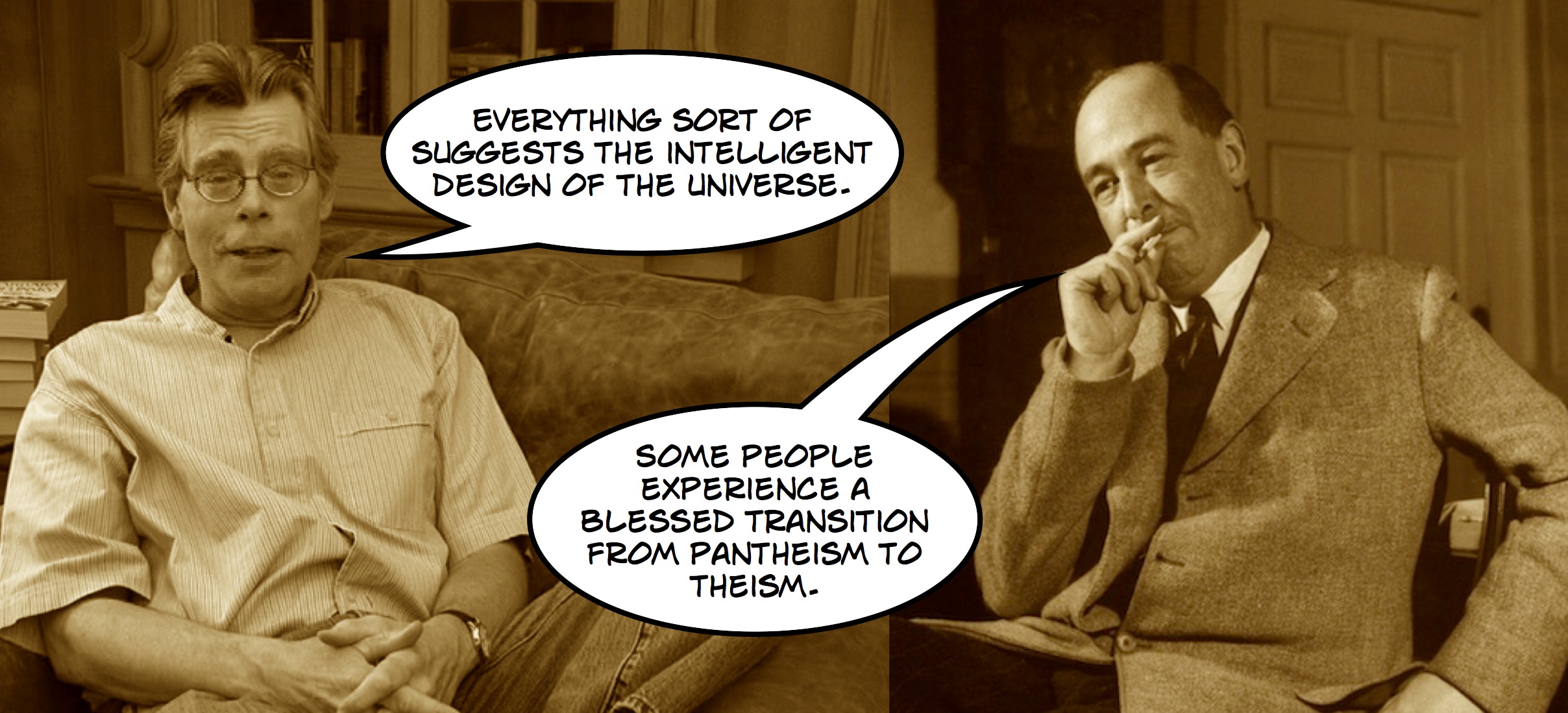
csl and kingAuthor Stephen King surprised quite a few fans during a recent PBS interview when he expressed his belief in the universe’s intelligent design. In nature and the cosmos, like theist C.S. Lewis before him, he views a creation so complex and wondrous that he thinks it makes more sense to believe in a divine power than to dismiss faith.

During the interview, King said,

I choose to believe it, yeah. I think that . . . there’s no downside to that, and the downside—if you say, well, OK, I don’t believe in God, there’s no evidence of God—then you’re missing the stars in the sky, and you’re missing the sunrises and sunsets, and you’re missing the fact that bees pollinate all these crops and keep us alive and the way that everything seems to work together at the same time.

In an essay, “Christianity and Culture,” C.S. Lewis alludes to the “Theist” phase of his own life. He points out how limiting a faith that recognizes God only abstractly, in his handiwork, can be.

There is an easy transition from Theism to Pantheism; but there is also a blessed transition in the other direction. For some souls I believe, for my own I remember, Wordsworthian contemplation can be the first and lowest form of recognition that there is something outside ourselves which demands reverence.

To return to Pantheistic errors about the nature of this something would, for a Christian, be very bad. But once again, for “the man coming up from below” the Wordsworthian experience is an advance. Even if he goes no further he has escaped the worst arrogance of materialism: if he goes on he will be converted.

King is, of course, far from what one would properly call a “person of faith.”** Still, it may be that he is presently moving in a positive direction. The following words reveal his yearning for hope, criticism of institutional religion, and his as yet unanswered questions about why God allows suffering in our world.

It’s certainly a subject that’s interested me, and I think it interests me more the older that I get. And I think we’d all like to believe that after we shuffle off this mortal coil, that there’s going to be something on the other side because for most of us, I know for me, life is so rich, so colorful and sensual and full of good things, things to read, things to eat, things to watch, places to go, new experiences, that I don’t want to think that you just go to darkness. . . .

But as far as God and church and religion and . . . that sort of thing, I kind of always felt that organized religion was just basically a theological insurance scam where they’re saying if you spend time with us, guess what, you’re going to live forever, you’re going to go to some other plain where you’re going to be so happy, you’ll just be happy all the time, which is also kind of a scary idea to me. . . .

Everything is sort of built in a way that to me suggests intelligent design. But at the same time there’s a lot of things in life where you say to yourself, well, if this is God’s plan, it’s very peculiar. And you have to wonder about that guy’s personality, the big guy’s personality. . . . What I’m saying now is I choose to believe in God, but I have serious doubts.

For many intelligent people, like C.S. Lewis and Stephen King, coming to faith cannot be severed from their reason. They desire to make sense of the world. Some, sadly, determine that human beings perish forever with their final breath. With that worldview, using King’s words, “you just go to darkness.”

Fortunately many others—brilliant and simple people alike, for God shows no partiality—possess true wisdom and heed the words of Jesus, that he is the way, the truth and the life. Both of these writers experienced an ineffective exposure to the church when they were young. Unfortunately, it served as more of an inoculation than a foundation.

Eventually C.S. Lewis followed that path from theism to Christianity. It’s not impossible that Stephen King may, as well.

_____

* A full transcript of the PBS interview is available here.

** In the interview, King “commends” the entertainment value of enthusiastic, emotionally-charged preaching, while disparaging his own mainline upbringing.

I went to a Methodist church for years as a kid, and Methodist youth fellowship on Thursday nights, and it was all pretty – you know, think of a bottle of soda with the cap off for 24 hours. There weren’t very many bubbles left in that stuff by then. It was pretty – it was Yankee religion, Terry, and there’s really not much in the world that’s any more boring than that. They tell you that you’re going to go to hell, and you’re half-asleep.

Avoid them Like the Plague

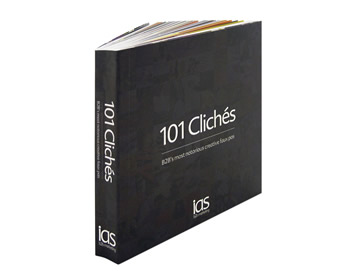
cliche bookAvoiding clichés in one’s writing is such oft-repeated advice it’s nearly become a cliché itself.

Many do not make much sense to people approaching a language from a literal perspective. For example, those new to American English may require a bit of explanation to understand that “hit the books” refers to studying rather than literary pugilism.

Some clichés are easily deciphered, especially when read in context. As an admonition to stop obstructing a view, we can understand why someone would say, “You make a better door than a window.”

“Don’t rain on my parade” adequately warns the hearer to avoid dampening the speaker’s special plans or activities.

Folksy adages are common where clichés are concerned. Take “The acorn doesn’t fall far from the tree.” We all know it references a child who shares numerous traits with a parent.

And we have interchangeable versions of the same notion, in case a lazy writer wishes to alternate your redundancies. He/she is a “chip off the old block” means essentially the same thing. And there’s always the classic “like father, like son,” and its corollary “like mother, like daughter.”

“As snug as a bug in a rug” used to be a favorite of my mother, ever applicable as she tucked little ones into their beds. Today, however, with bedbugs plaguing humanity in epidemic proportions, that cuddly image may have lost a touch of its appeal.

Some clichés have clearly outlived any usefulness they may once have possessed. “Too many chiefs, and not enough Indians,” clearly refers to a situation in which everyone is in charge and there no one is able or willing to actually carry out the project. However, few writers would tempt incurring the wrath of readers by using such a dated and rather prejudiced saying.

A cliché, of course, is a typically trite phrase that has lost its element of ingenuity due to overuse. It is something serious writers strive to avoid at all costs. But the final phrase in my previous sentence reveals how difficult it can be to purge these worn out words from our writing. Whenever used, they should be included consciously; writers might utilize them to establish, for example, a comic tone.

Even the gifted C.S. Lewis recognized the threat of clichés worming their way into one’s work. In a 1922 entry in his diary he wrote:

Tried to work at Dymer [his narrative poem] and covered some paper: but I am very dispirited about my work at present—especially as I find it impossible to invent a new opening for the Wild Hunt. The old one is full of clichés and will never do. I have learned too much on the idea of being able to write poetry and if this is a frost I shall be rather stranded . . .

The word cliché itself originated in France, where it was a printing plate or stereotype cast from an original composed of movable type. (The casting freed the movable type for new projects while maintaining the lettering for possible future printings.) The word came to be applied to ready-made phrases. However, the casting of printing plates is one thing. Recycling exhausted phrases ad nauseum is quite another.

Clichés are generally limited to a particular country or culture. Some are restricted to given regions. When outsiders hear or read these phrases, they often make little sense.

Some gain international esteem. More than a century ago Lord Acton described a universal truth of politics that resonates across boundaries. We have all witnessed the truth that “absolute power corrupts absolutely,” but those wise words are not something we should typically parrot in our own writings.

Not knowing the original source of a cliché is common. It is rather tragic, though, when it comes to texts that should be familiar to writers. For example:

“All’s well that ends well” is one of Shakespeare’s best loved maxims. If most Americans were asked whether it came from the pen of the Bard or Benjamin Franklin, we might be sadly disappointed with the results.

“The writing is on the wall” infers the outcome is already determined. But too few recognize this as a reference to a miracle recorded in the Book of Daniel. (If you’re not familiar with it, you can read the story here.)

Some clichés that relate to the art of writing would include the following [with my modest illustrations attached]:

“You can’t judge a book by its cover.”

     Appearances may be misleading.

Someone who appears wonderful when you first meet them may be just like an ebook with a professionally designed cover that contains a poorly scanned reprint replete with typos.

“It’s nothing to write home about.”

     Something that’s boring and not worth retelling.

While the freedom of POD technology has created democracy within the publishing industry, it’s also led to millions of meandering “books” that should “never have seen the light of day.”

A person is “an open book.”

     Someone who readily reveals their personality through word and action.

The type of character skilled authors will wish to introduce in limited quantities, especially if they are writing mysteries.

“Throw the book at him.”

     Give him the maximum possible judicial punishment.

The well-deserved fate of best-selling authors who rest on their laurels and start “phoning in” their sequels.

We turn now to a non-literary but colorful example of an American colloquialism that has spread far from its origins in the swine-breeding communities where it undoubtedly originated. It’s one of my favorite clichés, and it just may have a few good uses left in it, so feel free to include it in your next column or book . . . and no need to cite me as your source:

“You can’t make a silk purse out of a sow’s ear.”

     A task is impossible, given what you have to work with.

The echoing refrain of editors whose clients expect them to transform a few dusty lumps of coal into diamonds.

Possible Valid Uses for Clichés

While it’s safest for writers to avoid them altogether, there are a handful of occasions where they are not utterly inappropriate.

One suitable place for “chesnuts” like these to appear is in dialogue—especially when it’s written for a character a writer desires to portray as rather shallow-thinking.

It’s incorrect to suggest good writers never use clichés in conversation or composition. They do. The difference is that when they do include such tired phrases in their normally witty banter, they do it with a sense of irony.

C.S. Lewis, master of wordplay that he was, illustrated how we can creatively re-imagine or reword a cliché to reinvigorate it. Only the very best minds are up to this task. Yet, when it’s successfully accomplished, it can prove quite entertaining. The following comes from an informal conversation that was recorded before his retirement, preserved in the collection On Stories. Lewis refers in passing to an overly detailed passage in literature that nearly obscured the storyline.

The only trouble is that Golding writes so well. In one of his other novels, The Inheritors, the detail of every sensuous impression, the light on the leaves and so on, was so good that you couldn’t find out what was happening. I’d say it was almost too well done. All these little details you only notice in real life if you’ve got a high temperature. You couldn’t see the wood for the leaves.

Treasuring Books

Most of us love and respect books, don’t we? We take care of our literary treasures, and the more deeply we are attached to a particular volume, the better we treat it.

Many of us are reluctant to loan out the books which line our shelves like so many gems, resting in a jeweler’s pristine cases. When we do agree to share them, we’re afraid they may never find their way home. And, when they eventually return to our welcoming grasp, they sometimes bear the scars of their sojourn in the paws of others who do not esteem them as they ought to. Page corners may be scored. Coffee or tea stains may have “embellished” the text. Bindings may have been carelessly mistreated. And, unbelievably, the borrowers are likely to be unaware of how they have abused the tome’s dignity and disfigured its beauty.

Speaking honestly, my own bookshelves are in constant disarray, and too many of my books still remain unpacked after our move into our retirement home. But I am absolutely serious about how painful I find it to witness the mistreatment of books by those ignorant of their value.

C.S. Lewis loved books. He recognized their power. He embraced their wonder. And—most wonderfully for us—he penned a number of classics that will continue to inspire readers for generations.

Yet, as much as Lewis treasured books, he took his own creations for granted. This changed in December of 1954, when he received a precious package from his publisher. Among his Christmas gifts that year were specially bound copies of Surprised by Joy and Mere Christianity. Receipt of the thoughtful present opened his eyes to an interesting notion. On the twenty-second day of the month, he wrote:

I never had a handsomer present. . . . Perhaps these two charming volumes will teach me at last to have for the bodies of my own books the same reverence I have for the bodies of all other books. For it is a curious fact that I never can regard them as being really books; the boards and print, in however mint a condition, remain a mere pretense behind which one sees the scratchy, inky old manuscript.

I daresay that those writers among us can relate to Lewis’ mindset. Even with the pride that accompanies having books or articles in print, our work somehow seems “different” than the other published materials we invariably respect. This is due in large part, I believe, to their familiarity. Writers, better than most, understand what familiarity breeds. We know these works that flowed from our own consciousness and sweat . . . we know them intimately. And we are keenly aware that if given another opportunity, there are parts of them we would even now edit to be clearer, sharper, and more eloquent.

I never cease to be surprised by the humility of new writers who almost whisper their accomplishments to others. It’s as though they are embarrassed . . . that they assume their friends would consider them braggarts if they spoke with the pride they genuinely feel about their work. Some of us hold onto our rejection letters. (I do.) How much better though, to print out high quality copies of articles or devotions we’ve written and place them in a prominent binder or display located near our keyboard.

Who knows, I may actually follow my own advice and do something like that. Sadly, I don’t have a grateful publisher eager to prepare special editions for me. Nevertheless, I’m glad Lewis did. I learned from his insight that whenever we release our literary progeny to the world, they merit the same degree of respect and affection that we book-lovers bestow so generously on the works of others.

___

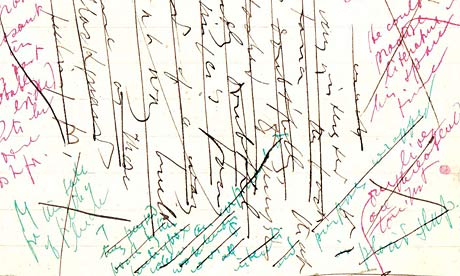
Postscript: The image above is an actual manuscript page from James Joyce’s Ulysses. (It makes me feel much more confident about my own initial scribblings.)

Your Writing Style

Each of us writes in a unique manner.

You can study writing patterns in various ways, by considering vocabulary, changes in sentence lengths, repeated phrases, and various other measurable elements.

Then there are more subjective aspects of our writing, but these too are recognizable. They would include tone and more abstract things like pacing.

When you add them all together, you arrive at an amorphous quality called the writer’s “voice.” And, as I said above, each of our “voices” are different.

It may be that we dabble in a variety of forms and genres. For example, in addition to these casual blog posts, I also write about theology and military ministry from a much more “professional” perspective. And, shockingly (to my own writing identity) I’ve recently received encouragement related to poetry with which I’ve been experimenting.

Even when we write in various literary forms, and they clearly differ from one another in their voice, the truth is that for each of these documents we develop a personal, inimitable voice.

Now, after emphasizing our literary uniqueness, I want to switch perspectives and consider that our various styles and voice resemble those of others. Occasionally, when reading someone’s work it strikes you as familiar. You may even recall the author that the work reminds you of. (I’m not referring to plagiarism, of course, although the internet has apparently made that particular plague even more common now than in the past.)

It would be vanity to claim that our own writing voice resembles that of no one else. Yes, some voices are so peculiar that they are clearly “rarities,” but others have shared even those odd personalities in the past. I suspect that’s even true for the senseless ramblings with which some self-styled “artists” assail the public. (Even insanities can resemble one another.)

In any case, if you ponder this subject it’s natural to wonder: who do I write like?

Today, through the amazing processing abilities of the computer, you may be able to get an answer to that very question. It’s not a definitive answer, because as I said above, our writing voice possesses both material (words and syntax) and spiritual (ephemeral and aesthetic) dimensions. And, while a computer may be without peer in comparing the former, I believe it to be quite deficient in discerning the latter.

Nevertheless, a rudimentary program is available online to compare your writing with that of a number of writers of varying reputation. The program has a number of limitations, but I think there may be something to it. It requires an extensive section of your writing (several paragraphs, at least). I assume more would be better, in terms of promoting accuracy.

As I just mentioned, it includes a limited number of authors currently entered into the database, and I suspect that the gifted C.S. Lewis is not among them. (I say this not because I expected to be aligned with him, but because of some of the included authors I am aware of. In addition, the program’s creator is actually Russian, so I would be curious to learn how the represented English authors were selected.)

It would limit the program’s value, for example, if I only input data on three writers and you were matched with the one you resembled most closely. Would you prefer, for example, to be told you write like Edward Bulwer-Lytton, Georgette Heyer, or Fabius Planciades Fulgentius?

Even with a significant number of writers included, the program’s accuracy will be affected by the quantity (and specific choice) of what is included to represent each. For example, the programmer properly included Stephen King. How valuable would that be, however, if he had only used King’s poetry and excluded his prose works? (Yes, the horror master has also penned poetry—now, that’s a scary thought!)

Well, despite the limitations of the “I Write Like” program, it is fun to try out. And it sounds impressive, in that it relies upon a naive Bayesian classifier. (Well, the “naive” part doesn’t sound especially remarkable, but the formula looks pretty imposing to someone who never took calculus.

You can use take the “test” at this site.

Make sure you include lengthy selections from your work. Also, testing the program with different genres (assuming you write in different styles) will actually give you new matches. (That is, of course, as it should be.)

If you do decide to experiment with it, a comment below about your results would be interesting for others. And now, for the moment that you have been awaiting . . . with whose writing did the program match mine?

I tried a number of times (no—not fishing for results I wanted, but using a variety of types of my writing) and here were the repeated results:

For my blog posts: H.P. Lovecraft or J.R.R. Tolkien

For my more formal essays: J.R.R. Tolkien or Jonathan Swift

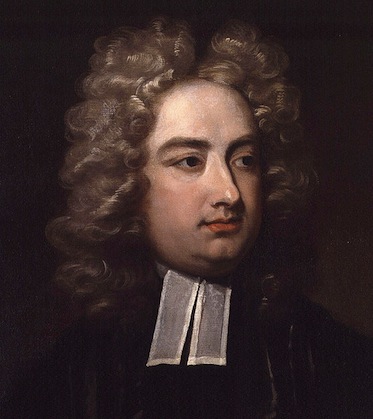
(It’s Swift’s picture, you’ll note, that begins this post.) Actually, the majority of the results linked to Swift, whose work I don’t recall ever reading in full, not even Gulliver’s Travels. However, our shared emphasis on wit, advocacy and satire account for what I deem a genuinely accurate assessment. And it does not hurt that Swift was Anglo-Irish, like my favorite author!

So, until Dmitry Chestnykh adds C.S. Lewis to the writers included in the “classifier,” I’m quite content to rest on my matches. Because even if I don’t share Lovecraft’s worldview, I can still respect his literary skill. And being identified with the other gentlemen, is a grand compliment.

[Special thanks to Julie Catherine who introduced me to the site via her post on the subject.]

Screwtape Goes to War

I edit a free online journal for military chaplains. Articles have been contributed by clergy from most of the world’s continents, sharing their experiences and opinions. Much of the material will be of interest to anyone interested in the nature of ministry within the armed forces.

The current issue was “published” at the end of June, and includes one article that may be of particular interest to the readers of Mere Inkling.

On page fifty-seven you’ll find the preface to a series of six letters. They are collected under the same title as this post, “Screwtape Goes to War.” It is available via this link: Curtana: Sword of Mercy.

Those familiar with C.S. Lewis’ masterpiece of diabolical correspondence will require no introduction. Here’s an excerpt from one of the six epistles gathered in this modest collection. Remember, it is from the pen of a senior demon advising a junior Tempter on how to corrupt his “patient” (in this case a chaplain).

While preaching can in theory be used by the Enemy to draw his servants closer to himself, it’s equally possible to use the pulpit to drive a wedge between the Enemy and those ordained to serve him. In fact, there is something uniquely satisfying about using a chaplain’s own preaching to immunize him to the disgusting message of hope and forgiveness.

There are so many tactics to undermining the effectiveness of your chaplain’s sermons . . . where to begin? I have found the following methods to be most useful.

1. Encourage him to subscribe to all sorts of periodicals and keep him as far away from the Enemy’s book as possible. Tell him that by this means he “will remain in touch with the culture” to which he is preaching. We do not want him opening the Scriptures. It’s not too challenging persuading many clergy today that they’ll bore and alienate their audience by citing passages from that archaic text. Let him explore all sorts of publications so he discovers ones he honestly enjoys. That will make the choice easier when he looks on his desk at a tempting contemporary publication lying next to that black book.

Not all journals are created equal, of course. Some actually contribute to the knowledge and comprehension of the Enemy’s book. Avoid these. Secular publications are usually safe, the more so when they celebrate selfishness, man’s favorite religion. The most precious, however, are those published by “religious” presses. You know those to which I refer. The ones penned by our allies who where wear the garb of the Enemy but live with either themselves or some other idol on the throne of their souls. Those who may praise him with their lips but deny him access to their hearts. Mind you, these documents need to be chosen with great care. But if you can find some which appeal to him, it will aid you immeasurably in bringing about his demise. . . .

Curtana discusses both historical matters and contemporary issues. It is interfaith and international in scope. The website includes a “subscription” form for those who wish to be notified whenever a new issue of the journal is published.

Don’t be confused when you see the date on the current issue. Like many minimally-staffed, free publications, we’ve fallen slightly “behind schedule.” Thus, the current issue is dated Fall & Winter 2011. (I promise this is due not merely to procrastination, but also to the editor’s chronic propensity for terribly over-extending himself.) At any rate, Curtana 3.1 is indeed the issue which includes the afore-described article.

Writing Awards

It’s good to be appreciated. For a lesson I’m teaching later this week I’ll be using a profound song entitled “Legacy,” which was written and recorded by Nichole Nordeman. I’ll place a link for it at the end of the blog. (Wouldn’t want you to get distracted and not return to this page!)

Nordeman’s anointed words remind us to treasure what is truly important, and to consciously ponder the legacy we desire to leave when we’ve breathed our last. She acknowledges that it’s nice to receive praise, but suggests there is so much more to life. What follows is only a portion of her inspiring ballad.

I don’t mind if you’ve got something nice to say about me

And I enjoy an accolade like the rest

You could take my picture and hang it in a gallery

Of all who’s who and so-n-so’s that used to be the best

At such’n’such . . . it wouldn’t matter much

I won’t lie, it feels alright to see your name in lights

We all need an ‘’Atta boy’ or ‘’Atta girl’

But in the end I’d like to hang my hat on more besides

The temporary trappings of this world

I want to leave a legacy

How will they remember me?

Did I choose to love?

Did I point to You enough

To make a mark on things?

I want to leave an offering

A child of mercy and grace

   who
 blessed your name unapologetically

And leave that kind of legacy

It’s in this context that I mention I’ve been nominated for the Versatile Blogger Award. It’s nice that someone wanted to pat me on the back this way, and I like the title of the award, so I decided to accept it. I guess the confirmation of your acceptance (and the actual awarding of the accolade) happens automatically (but presumably not supernaturally) when you post seven points that illustrate your personal versatility. I’ll do that, momentarily.

The gifted C.S. Lewis was noted for his own versatility. Few other people have excelled in such diverse literary fields. Very few. Lewis was a brilliant author of fiction and nonfiction. He was a preeminent literary historian and critic. Much of his poetry was inspiring, although it never attained the measure he desired for it. He is also one of the most highly regarded Christian apologists of the twentieth century. He had few literary equals. Very few.

While Lewis was the recipient of various awards, and accepted them gracefully, he remained quite modest. (One of his most noteworthy honors came in the Carnegie Award, the United Kingdom’s highest honour for children’s literature.) The desire for accolades didn’t sway Lewis from his course.

Likewise, I’ll remain on my course, and not pursue awards or praise. That said, I am pleased to see so many people enjoying this modest blog. (Thank you all!)

Seven quick things about me:

1. I was Thespian of the Year my senior year in high school.

2. While stationed in the Republic of Korea during the 1988 Olympics I watched the United States fall before the Soviet Union in soccer.

3. Although I never played a musical instrument in high school, I joined the University of Washington Husky Marching Band while in college.

4. First car was a 1961 MGA sports car. I’m not quite as old as that sounds; it was already a classic when I got it. (Sure wish I still had it today.)

5. I wrote a Master’s Thesis on the Odes of Solomon, the first Christian hymnal.

6. I once served on a Christian conference committee with Jim Otto, the greatest center ever to play in the NFL.

7. Speaking of awards, in addition to Air Force and Joint medals, during my military career I also received medals from the United States Army and the United States Navy.

P.S. – I promised a link to a Nichole Nordeman’s ballad “Legacy.” Here it is: Legacy by Nichole Nordeman.