C.S. Lewis and Time’s Meaning

What is time, and why are we subject to its ofttimes harsh burdens? After his conversion from atheism, C.S. Lewis discovered some comforting truths about time, and the limits of time’s constraints.

Each year the four seasons seem to pass more rapidly. Before we know it, our parents have gown old, and we may well have children of our own. In retrospect, it all happens in the proverbial flash.

Ultimately, there will come a day when our lives reach their own “winter,” and even our most precious memories may drift away from us in time’s relentless breeze.

The C.S. Lewis Institute has an interesting article titled “The Point at which Time Touches Eternity.” They quote some wisdom from The Screwtape Letters, and end with a query which can help us live happier lives.

As you think about your own life, do you sometimes think too much about the Past or the Future, and not chiefly attend to the Present and Eternity?

Lewis answers that very question in his essay “Historicism.” He acknowledges that too often we become slaves to the regrets of our past and the dread of challenges awaiting us in the future. He reminds Christians that “God will supply every need of yours according to his riches in glory in Christ Jesus” (Philippians 4).* Therefore, Lewis encourages us to throw off the bondage of past and future, since “where, except in the present, can the Eternal be met?”

Janie Cheaney recently wrote “Eternity in Our Hearts” for World Magazine. Inspired by Saint Augustine and C.S. Lewis, it is subtitled “What if time astonishes us because we are meant to one day live outside of it.”

More of Lewis’ Thoughts about Time

In Mere Christianity, Lewis describes our universal human experience. “Our life comes to us moment by moment. One moment disappears before the next comes along: and there is room for very little in each. That is what Time is like.” He then describes just how limited our perspective is.

And of course you and I tend to take it for granted that this Time series – this arrangement of past, present, and future – is not simply the way life comes to us but the way all things really exist. We tend to assume that the whole universe and God himself are always moving on from past to future just as we do. But many learned men do not agree with that. Almost certainly God is not in Time. His life does not consist of moments following one another . . .

If you picture Time as a straight line along which we have to travel, then you must picture God as the whole page on which the line is drawn. We come to the parts of the line one by one: we have to leave A behind before we get to B, and cannot reach C until we leave B behind. God, from above or outside or all around, contains the whole line, and sees it all.

In Miracles, C.S. Lewis describes God’s transcendence over time as our Creator’s “eternal Now.”

It is probable that Nature is not really in Time and almost certain that God is not. Time is probably (like perspective) the mode of our perception. There is therefore in reality no question of God’s at one point in time (the moment of creation) adapting the material history of this universe in advance to free acts which you or I are to perform at a later point in Time.

To Him all the physical events and all the human acts are present in an eternal Now. The liberation of finite wills and the creation of the whole material history of the universe (related to the acts of those wills in all the necessary complexity) is to Him a single operation. In this sense God did not create the universe long ago but creates it at this minute – at every minute.

That is pretty deep. The sort of stuff that philosophers love to ponder and debate. Even before his conversion to Christianity, while still clinging to his formal atheism, Lewis contemplated time’s role in existence. In 1918 he wrote to his close friend Arthur Greeves about these matters. 

You see the conviction is gaining ground on me that after all Spirit does exist; and that we come in contact with the spiritual element by means of these “thrills.” I fancy that there is Something right outside time & place, which did not create matter, as the Christians say, but is matter’s great enemy: and that Beauty is the call of the spirit in that something to the spirit in us. You see how frankly I admit that my views have changed.

Sheldon Vanauken (1914-1996) was an American author who preserved in A Severe Mercy several of C.S. Lewis’ letters of consolation following the death of Sheldon’s wife. In some ways, the Vanauken story foreshadowed Lewis’ own marriage and widowhood. Pointing toward the Resurrection, Lewis wrote the following.

You say the materialist universe is “ugly.” I wonder how you discovered that! If you are really a product of a materialistic universe, how is it you don’t feel at home there? Do fish complain of the sea for being wet? Or if they did, would that fact itself not strongly suggest that they had not always been, or would not always be, purely aquatic creatures?

Notice how we are perpetually surprised at Time. (“How time flies! Fancy John being grown-up & married! I can hardly believe it!”) In heaven’s name, why? Unless, indeed, there is something in us which is not temporal.

C.S. Lewis writes much more about time, but we will conclude here with two passages that use the metaphor of author to describe God’s nature. The first comes from an essay entitled “The Seeing Eye.”

My point is that, if God does exist, He is related to the universe more as an author is related to a play than as one object in the universe is related to another. If God created the universe, He created space-time, which is to the universe as the metre is to a poem or the key is to music.

To look for Him as one item within the framework which He Himself invented is nonsensical. If God – such a God as any adult religion believes in – exists, mere movement in space will never bring you any nearer to Him or any farther from Him than you are at this very moment.

You can neither reach Him nor avoid Him by travelling to Alpha Centauri or even to other galaxies. A fish is no more, and no less, in the sea after it has swum a thousand miles than it was when it set out.

This final quotation appears in Mere Christianity. It is most certainly true, and my hope is that all who read this post will come to celebrate this joy. Both now, and for eternity.

God is not hurried along in the Time-stream of this universe any more than an author is hurried along in the imaginary time of his own novel. He has infinite attention to spare for each one of us.

He does not have to deal with us in the mass. You are as much alone with Him as if you were the only being He had ever created. When Christ died, He died for you individually just as much as if you had been the only man in the world.


* This gracious, eternal gift is available to all people.
C.S. Lewis and the Five Senses

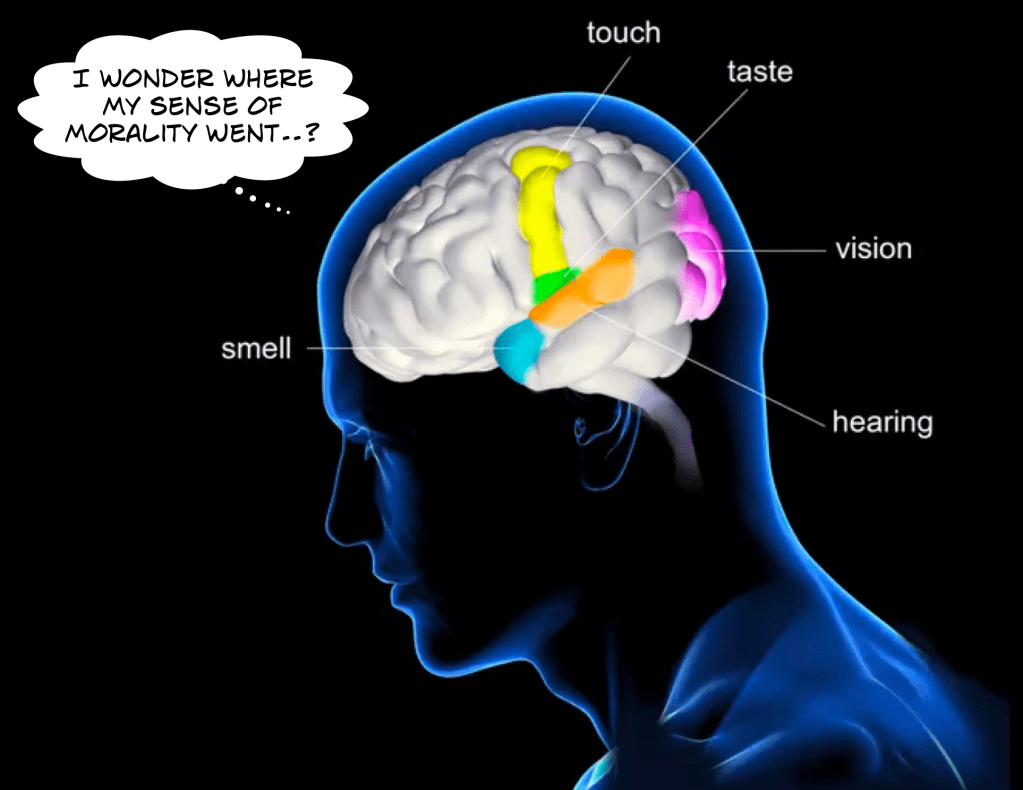
One of the earliest lessons children learn is how many senses the human being possesses. You know the answer off the top of your head, right? Five. But, apparently, that’s no longer correct. Oh, you may think I must be including that long-time poser, extrasensory perception (ESP), which purports to be a sense of sorts beyond the five we all experience. If you thought that . . . sorry, but you are wrong again.

We all agree on the basic five: the faculties of sight, hearing, taste, smell, and touch. To this list, science has recently added several other senses we experience. They’re not actually new; Adam and Eve knew them too (with the possible exception of nociception). They actually make sense (in the other use of the word), as well. Here they are:

Proprioception – perceiving where your body parts are relative to one another, and the strength of effort being employed in movement

Thermoception – sensing temperature

Equilibrioception – perception of balance

Chronoception – sensing the passage of time

Interoception – feeling internal needs such as hunger and thirst

Nociception – experiencing pain

More expansive lists exist as well. Some are discussed online at The United Kingdom’s Sensory Trust. The Trust is devoted to “sensory design . . . [using] nature and the outdoors to improve the health and wellbeing of people living with disability and health issues.” They describe how “neurological classification” can result in numbers up to fifty-three. (It makes one long for the simplicity of the past when we followed Aristotle’s citation of only five.)

C.S. Lewis’ Celebration of Life

You can pick up nearly any one of Lewis’ essays or fiction, open to any page of his autobiography, read almost any of his letters, and you will see his love for nature. And Lewis is often quite vivid in his description of his encounter with God’s creation. The sights, sounds and smells he describes make the depictions real. Consider his description of Tash, the “god” worshipped by the Calormenes, in The Last Battle.

[King Tirian said] “What foul smell is this?”

“Phew!” gasped Eustace. “It’s like something dead. Is there a dead bird somewhere about? And why didn’t we notice it before?”

With a great upheaval Jewel [the unicorn] scrambled to his feet and pointed with his horn. “Look!” he cried. “Look at it! Look, look!” Then all six of them saw; and over all their faces there came an expression of uttermost dismay.

In the shadow of the trees on the far side of the clearing something was moving. It was gliding very slowly Northward. At a first glance you might have mistaken it for smoke, for it was gray and you could see things through it. But the deathly smell was not the smell of smoke. Also, this thing kept its shape instead of billowing and curling as smoke would have done. It was roughly the shape of a man but it had the head of a bird; some bird of prey with a cruel, curved beak. . . . It floated on the grass instead of walking, and the grass seemed to wither beneath it. . . .

[They] watched it for perhaps a minute, until it streamed away into the thicker trees on their right and disappeared. Then the sun came out again, and the birds once more began to sing. Everyone started breathing properly again and moved. They had all been still as statues while it was in sight.

From a more philosophical, even metaphysical perspective, Lewis ponders the senses experienced by angels in his poem, “On Being Human.” He describes the differences between how angels and humanity experience God’s creation. Lewis suggests that in exchange for their unblurred perception of cosmic reality, they lack the more mundane (i.e. earthly) experience of physical perception of creation.*

Angelic minds, they say, by simple intelligence
Behold the Forms of nature. They discern
Unerringly the Archtypes, all the verities
Which mortals lack or indirectly learn.
Transparent in primordial truth, unvarying,
Pure Earthness and right Stonehood from their clear,
High eminence are seen; unveiled, the seminal
Huge Principles appear.

The Tree-ness of the tree they know—the meaning of
Arboreal life, how from earth’s salty lap
The solar beam uplifts it, all the holiness
Enacted by leaves’ fall and rising sap;
But never an angel knows the knife-edged severance
Of sun from shadow where the trees begin,
The blessed cool at every pore caressing us
—An angel has no skin.

They see the Form of Air; but mortals breathing it
Drink the whole summer down into the breast.
The lavish pinks, the field new-mown, the ravishing
Sea-smells, the wood-fire smoke that whispers Rest.
The tremor on the rippled pool of memory
That from each smell in widening circles goes,
The pleasure and the pang—can angels measure it?
An angel has no nose.

The nourishing of life, and how it flourishes
On death, and why, they utterly know; but not
The hill-born, earthy spring, the dark cold bilberries
The ripe peach from the southern wall still hot,
Full-bellied tankards foamy-topped, the delicate
Half-lyric lamb, a new loaf’s billowy curves,
Nor porridge, nor the tingling taste of oranges—
An angel has no nerves.

Far richer they! I know the senses’ witchery
Guards us, like air, from heavens too big to see;
Imminent death to man that barb’d sublimity
And dazzling edge of beauty unsheathed would be.
Yet here, within this tiny, charm’d interior,
This parlour of the brain, their Maker shares
With living men some secrets in a privacy
Forever ours, not theirs.

This notion that we comprehend things the angels cannot—for example, the indwelling of God’s Holy Spirit—is expressed in the spirit of the First Epistle of Peter. These wondrous miracles are “things into which angels long to look.”

As amazing as our human senses are, we should never delude ourselves into thinking they are infallible. Far from it. As precious as they are, due to our fallen nature, they possess two shortcomings. First, they may misperceive reality. Such is the case with allodynia, in which a person “feels pain from non-painful stimuli,” such as a light touch or a cool temperature.⁑

The second limitation comes in the obvious fact of our finite nature. We are simply incapable of perceiving, much less processing, all the information that washes over us. Perhaps you would join me in identifying with C.S. Lewis’ description of himself in A Grief Observed.

Five senses; an incurably abstract intellect; a haphazardly selective memory; a set of preconceptions and assumptions so numerous that I can never examine more than a minority of them-never become even conscious of them all. How much of total reality can such an apparatus let through?

The number of human senses is not important. Our recognition of their divine source is, however, of eternal import.


* Chris Armstrong, Senior Editor of the Christian History Institute, wrote an exceptional article on the importance of our senses. Citing C.S. Lewis’ “On Being Human,” he declares our senses are the only means by which we can “know God.”

Nor is sense-knowledge about God through his Creation, second-class knowledge. Lewis expresses this idea memorably in his poem “On Being Human,” which compares the angels’ incorporeal way of knowing with our way—to the advantage of the latter.

The Christian History Institute publishes the exceptional Christian History magazine, which is offered for a simple donation. They also provide free, downloadable copies of past issues. I strongly encourage your support of this superb ministry.

⁑ From Medical News Today. “Some people feel extreme pain from something minor, such as a paper cut. Feeling increased pain or being hypersensitive to mild pain is called hyperalgesia. Individuals with allodynia, however, feel pain when something is ordinarily painless.”

Timing the Reformation

wristwatch

I had an entrepreneurial epiphany on how to get rich during the 500th anniversary of the Reformation, and since I’m not an entrepreneur, I’m passing the idea on gratis, to readers of Mere Inkling.

Inspired by the shocking success of the Playmobil Martin Luther—their fastest-selling item ever—I wondered what other commemorative items might result in a windfall for investors.

The insight struck like the lightning bolt that dropped Luther to his knees and sent him off to the monastery.

Since this celebration hearkens back to the beginning of the Reformation . . . back to the day when the 95 Theses were nailed to the door of the Castle Church in Wittenberg . . . it dawned on me that we so indebted to what happened that moment that we are, in a true sense, living on Wittenberg time.

What better item to remind us of the significance of this than to turn to expert horologists* and design a Wittenberg Watch? Ideally it would be permanently linked to Wittenberg time. The wearer would also benefit from learning more about time zones and mathematics, trying to sort out the local time, especially when traveling.

More about the details in a moment.

C.S. Lewis and the Importance of Time

The nature and passage of time was of great importance to C.S. Lewis. He devoted an entire chapter to the subject in Mere Christianity. In “Time and Beyond Time,” he explores how God acts within history, but is not subject to time’s constraints.

If you picture Time as a straight line along which we have to travel, then you must picture God as the whole page on which the line is drawn. We come to the parts of the line one by one: we have to leave A behind before we get to B, and cannot reach C until we leave B behind. God, from above or outside or all round, contains the whole line, and sees it all.

Lewis then proceeds to explain his understanding by saying this “idea has helped me a good deal. If it does not help you, leave it alone. It is a ‘Christian idea’ in the sense that great and wise Christians have held it and there is nothing in it contrary to Christianity. But it is not in the Bible or any of the creeds. You can be a perfectly good Christian without accepting it, or indeed without thinking of the matter at all.”

Another difficulty we get if we believe God to be in time is this. Everyone who believes in God at all believes that He knows what you and I are going to do tomorrow. But if He knows I am going to do so-and-so, how can I be free to do otherwise?

Well, here once again, the difficulty comes from thinking that God is progressing along the Time-line like us: the only difference being that He can see ahead and we cannot. Well, if that were true, if God foresaw our acts, it would be very hard to understand how we could be free not to do them.

But suppose God is outside and above the Time-line. In that case, what we call “tomorrow” is visible to Him in just the same way as what we call “today.” All the days are “Now” for Him. He does not remember you doing things yesterday; He simply sees you doing them, because, though you have lost yesterday, He has not. He does not “foresee” you doing things tomorrow; He simply sees you doing them: because, though tomorrow is not yet there for you, it is for Him.

You never supposed that your actions at this moment were any less free because God knows what you are doing. Well, He knows your tomorrow’s actions in just the same way—because He is already in tomorrow and can simply watch you.

In a sense, He does not know your action till you have done it: but then the moment at which you have done it is already “Now” for Him.

Since God was/is witness to that day in Wittenberg, just as he knows our tomorrows today, we see his placing of creation within the linear progression of history is intentional. It does not restrict our Lord in any way, but it enables us to comprehend our existence. And thus, we are compelled to mark the passage of time.

What Might the Wittenberg Watch be Like?

Something elegant and tasteful, yet modest and unobtrusive. A watch like the one pictured above. It’s produced by Swisstime and has the added benefit that it is part of their “Rebellion” line, which means that Roman Catholics shouldn’t be excluded from the market. The only minor drawback is the price, $930,000.

It seems to me that a wise businessperson could undercut that by thirty or forty thousand, and only need to sell two or three watches to retire in comfort.

An alternative to this timepiece, for the less prosperous, would be to get a regular Timex or Casio and just set the time to that of Wittenberg! That’s the key anyway—the Wittenberg Watch measures the hour based on the time there in hallowed birthplace of the Reformation. (For those who like details, that would be the Central European Time Zone, UTC/GMT +1.)

An astute investor will recognize that the Wittenberg Watch concept easily translates for an ecumenical audience. One easily imagines other editions for various denominations.

Aldersgate Watch for Methodists (Greenwich Mean, GMT)

Azuza Street Timepiece for Pentecostals (Pacific Standard, UTC/GMT -9)

Canterbury Timepiece for Anglicans (Greenwich Mean, GMT)

Geneva Timepiece for Calvinists (Central European, UTC/GMT +1)

Edinburgh Edition for Presbyterians (Greenwich Mean, GMT)

Hollywood Timepiece for Televangelists** (Pacific Standard, UTC/GMT -9)

London Chronometer for Quakers (Greenwich Mean, GMT)

Münster Timepiece for Anabaptists (Central European, UTC/GMT +1)

Rome Timepiece for Roman Catholics (Central European, UTC/GMT +1)

Anyone who desires can feel free to run with this idea. I relinquish all rights to the concept of religious timepieces.

As for now, I’ve been rethinking the idea altogether. I’ve decided it’s best for me to reset my own watch to Jerusalem time.

_____

* Horology relates to the science of measuring time and making timepieces. (Yes, I had to look it up also, even though I remembered enough Latin to know hora means hour.)

** It’s quite possible that televangelists already own the Rebellion Reb 5 Diamond timepiece pictured above, however, the members of their digital congregations may be in the market for something more modest.