Can We Ignore Modern Slavery?

I can’t answer this question for you, but I know how I want to be able to answer when I stand before our Creator. 

Many Christians include corporate confession and absolution (forgiveness) as part of their regular worship. We often ask forgiveness our sins of commission and omission – the wrongs we do, and the wrongs we are responsible for when we fail to do what we should.

God forbid that any of us would actively support slavery, but . . . how little most of us do to reduce it or free people from its deadly grasp.

In Britain, the National Society for the Prevention of Cruelty to Children, founded in 1884, recognizes modern slavery as one of the world’s greatest challenges. As they say: “Any child is at risk of child trafficking.”

Save the Children states that “children account for 27% of all the human trafficking victims worldwide, and two out of every three child victims are girls.”

Sometimes sold by a family member or an acquaintance, sometimes lured by false promises of education and a “better” life – the reality is that these trafficked and exploited children are held in slave-like conditions without enough food, shelter or clothing, and are often severely abused and cut off from all contact with their families.

The children’s condition is not “slave-like;” these precious victims literally are slaves, in every cruel sense of the word. While no unenslaved person would be so ignorant as to presume they understand slavery, C.S. Lewis mentioned in a 1939 letter several torments it inflicts. At the break of the Second World War, he was reflecting on his experiences in the First.

My memories of the last war haunted my dreams for years. Military service, to be plain, includes the threat of every temporal evil; pain and death which is what we fear from sickness; isolation from those we love which is what we fear from exile: toil under arbitrary masters, injustice, humiliation, which is what we fear from slavery: hunger, thirst and exposure which is what we fear from poverty.

The most shocking part of this description from Save the Children, is the acknowledgment that the children are “sometimes sold by a family member . . .” I discussed this grim truth in my 2014 post, “Loving Prostitutes.”

In that article I express a sentiment I hope you share: “I love prostitutes because God has granted me the vision to see them as he does.”

What You & I Can Do Today

Obviously, if this subject is new to you, you can become informed. The links I’ve provided offer a good starting point.

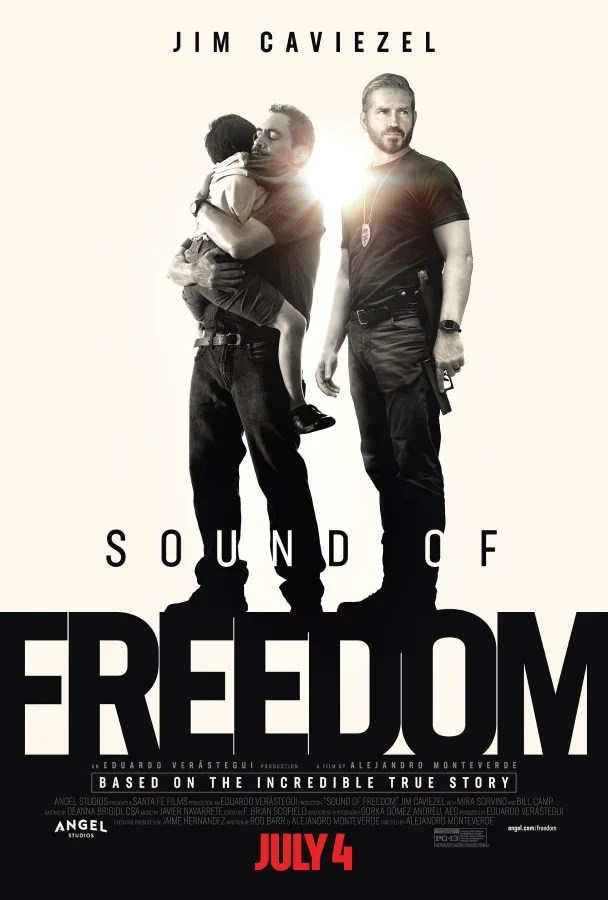
At the present moment we have a truly unique opportunity to make a contribution toward addressing this massive horror. We can support a superb, first-class film that is currently showing in hundreds of cinemas. 

Sound of Freedom is a true story with a superb cast and excellent cinematography. Despite its serious subject, the film is well worth viewing while it is still in theaters. Simply by attending, and even more by encouraging family and friends to join you, we can raise the awareness of this tragedy.

Together, you and I truly can help rescue people from this fate, and promoting this message of hope and deliverance is a small step in that journey. 

When faced with ugly things, the timid response is to turn away and pretend it doesn’t exist. In cases like this, particularly involving children, a cowardly response in ignoring the evil constitutes nothing less than a sin of omission. 

Check with your local theaters today, and reserve a seat at a showing of Sound of Freedom. (And, for those who see this suggestion months or years after the film’s 2023 release, check it out soon on a streaming service.)

Postscript & Resources:

While I was still on active duty, the United States Department of Defense initiated a long-overdue program. In recognition that military members are literally on the “front lines” of encountering modern slavery, Combating Trafficking in Persons is an official program established to confront the crime.

The program includes provisions requiring training for all DoD personnel, civilian as well as uniformed. This site describes the various levels of training required. To actually “take” the training and testing requires login privileges. However, various resources – including some very informative videos – are available to the public.

Similarly, agencies such as INTERPOL restrict their courses to members. Nevertheless, they offer a variety of educational resources and updates on current efforts to battle this crime around the globe.

While I haven’t personally vetted the following, a number of public and governmental organizations offer free training for interested individuals. Among them are: 

the U.S. Department of Homeland Security, and the Office for Victims of Crime. The U.S. Institute Against Human Trafficking lists six free classes, several of which offer certificates of completion.

The Home Office in the United Kingdom hosts a site with a number of related resources. One is “A typology of modern slavery offences in the UK” which breaks “down the broad categories of modern slavery into 17 distinct types of offences identified in the UK.” No doubt, most other enlightened nations promote similar materials.

In a 1943 essay entitled “Equality,” C.S. Lewis discusses the subject of the nature of Democracy, as a form of government. His argument includes the clearest possible reason why slavery never has been, and never could be a good, or morally neutral, thing.

I am a democrat because I believe in the Fall of Man. I think most people are democrats for the opposite reason. A great deal of democratic enthusiasm descends from the ideas of people like Rousseau, who believed in democracy because they thought mankind so wise and good that everyone deserved a share in the government.

The danger of defending democracy on those grounds is that they’re not true. . . . I find that they’re not true without looking further than myself. I don’t deserve a share in governing a hen-roost, much less a nation. . . .

The real reason for democracy is . . . Mankind is so fallen that no man can be trusted with unchecked power over his fellows. Aristotle said that some people were only fit to be slaves. I do not contradict him. But I reject slavery because I see no men fit to be masters.

I know that C.S. Lewis would add his “amen” to my challenge today that each of us might look for ways to help eradicate this plague of slavery, which has cursed humanity for millennia.

A Bible Translation for Slaves

Only three copies of an abridged Bible printed in the United Kingdom remain in existence. To some, their very existence is scandalous. To others, they evidence the desire of Christians to promote spiritual liberation, even for those shackled by human chains.

The sole copy held in North America is in the possession of Fisk University in Nashville, Tennessee. Fisk is one of the United States’ distinguished  Historically Black Colleges & Universities (HBCUs), and was founded only six months after the end of the Civil War by the American Missionary Association.

Prior to returning the volume to Fisk, this extremely rare Bible was on loan to the Museum of the Bible in Washington, D.C.* During its exhibition there, the museum described it thusly:⁑

The Slave Bible, as it would become known, is a missionary book. It was originally published in London in 1807 on behalf of the Society for the Conversion of Negro Slaves, an organization dedicated to improving the lives of enslaved Africans toiling in Britain’s lucrative Caribbean colonies.

They used the Slave Bible to teach enslaved Africans how to read while at the same time introducing them to the Christian faith.

A Liberty Fund essay on the volume describes the thought process behind the editing. “The unknown editors intended to steer clear of any revolutionary verses that might spark interest in the idea of liberty,” they say.

For example, the selections from Genesis include the first three chapters, which cover the creation of the world and Adam and Eve in Eden but omits chapter four, which tells the story of Cain and Abel and the first murder.

Even an abbreviated Bible, however, retains the power to communicate a divine message. When C.S. Lewis discussed whether the Bible will become fashionable for secular literary study, he said the challenge would come in the fact that it is, in fact, sacred.

Unless the religious claims of the Bible are again acknowledged, its literary claims will, I think, be given only “mouth honour” and that decreasingly. For it is, through and through, a sacred book.

Most of its component parts were written, and all of them were brought together, for a purely religious purpose (“The Literary Impact of the Authorised Version”).

Because of that, I believe that C.S. Lewis would agree with me that this translation (stunted though it is) would retain the power to enlighten its readers. After all, we are not considering a version of the Bible to which human words have been added. What remains is still inspired. 

But in most parts of the Bible everything is implicitly or explicitly introduced with “Thus saith the Lord.” It is, if you like to put it that way, not merely a sacred book but a book so remorselessly and continuously sacred that it does not invite, it excludes or repels, the merely aesthetic approach. . . .

It demands incessantly to be taken on its own terms: it will not continue to give literary delight very long except to those who go to it for something quite different. I predict that it will in the future be read as it always has been read, almost exclusively by Christians (“The Literary Impact of the Authorised Version”).

Thus, I believe the missionaries who devised this edited version of the Scriptures did so with good intent. They would, I am sure, have preferred to deliver to their enslaved hearers the complete Word. However, in cases where slaveowners would bar the Bible altogether because of its themes of rescue, freedom, and the judgment of the powerful, the missionaries compromised their desires.

They deemed the benefits outweighed the compromise. The benefits being the opportunity to learn to read, and even more importantly, the Light that would still shine through the portions of God’s Word to which these precious souls would have access.

As C.S. Lewis noted in a 1952 letter, “it is Christ Himself, not the Bible, who is the true word of God. The Bible, read in the right spirit and with the guidance of good teachers, will bring us to Him.” And, upon making their compromise, these formerly barred missionaries would gain access to those who might otherwise never meet humanity’s Savior, who is the Word incarnate.

So, in order to provide at least a portion of the true Bible, they risked violating the New Testament precedent established in the Book of Revelation.

I warn everyone who hears the words of the prophecy of this book: if anyone adds to them, God will add to him the plagues described in this book, and if anyone takes away from the words of the book of this prophecy, God will take away his share in the tree of life and in the holy city, which are described in this book (22:18-19).

This is a fascinating subject, the various attitudes toward the education of people held in bondage. Various books have been written on the subject, and numerous primary sources describe the differing opinions all those involved. The perspective of “freemen” is particularly poignant. A freeman (or freedman), is a person who has been delivered from a state of slavery.

In the biblical sense, as defined in the International Standard Bible Encyclopedia, it is “one who was born a slave and has received freedom” and is commonly used to describe those who were delivered from “bondage to sin [and] presented with spiritual freedom by the Lord.”

For he who was called in the Lord as a bondservant is a freedman of the Lord. Likewise he who was free when called is a bondservant of Christ (1 Corinthians 7:22).

As we used to pray in the liturgy of my childhood – Grant this, O Lord, unto us all!

Online Resources for Further Reflection

Internet Archive not only offers many public domain works for free download. They also host many great texts that you can “borrow” online. Your local library remains a great place, but they probably don’t offer the following books related to this subject.

“When I can read my title clear:” Literacy, Slavery, and Religion in the Antebellum South

Masters & Slaves in the House of the Lord: Race and Religion in the American South, 1740-1870

Memoir of Mrs. Chloe Spear, a Native of Africa, who was Enslaved in Childhood, and Died in Boston, January 3, 1815

And, even more exciting, there are some period writings you can read and even download. A quick search turned up a copy of The Duty of Masters: a Sermon, Preached in the Presbyterian Church, in Danville, Kentucky. In 1846, the Rev. John C. Young devoted a significant portion of his message to the responsibility of slaveowners to promote literacy.

The duty of attending to the religious improvement of our servants comprises among others two important particulars – teaching and encouraging them to read God’s word, and inducing them to attend his worship. Many have avowed the doctrine that it is not right to teach servants to read the Bible – and in some of the States their instruction is prohibited by law.

Our posterity will doubtless wonder how so monstrous a doctrine could ever prevail to any great extent in a Christian land; and how good men could ever delude themselves into the belief that such a doctrine was consistent with the first principles of that gospel which is sent to the bond as well as the free, and which requires all who receive it to impart a knowledge of it to the utmost of their ability to all who have it not.

Amazingly, you can even download your own copy of Select Parts of the Holy Bible for the Use of the Negro Slaves in the British West-India Islands from Internet Archives. Determine for yourself whether it was better to share with the captives in the British West Indies these “select parts” or to ignore their plight altogether. A wise man once wrote:

The Church exists for nothing else but to draw men into Christ, to make them little Christs. If they are not doing that, all the cathedrals, clergy, missions, sermons, even the Bible itself, are simply a waste of time.

God became Man for no other purpose. It is even doubtful, you know, whether the whole universe was created for any other purpose (Mere Christianity).


* Coincidentally, the Museum of the Bible will also be hosting a live performance this summer of C.S. Lewis’ “The Horse and His Boy.” Check out the promo on their site to see how they creatively present the equine stars of the book on stage!

⁑ Yes, I understand that the “-ly” appended to “thus” is superfluous, since the word itself is an adverb, but it just sounds so right to my (as C.S. Lewis might appreciate) dinosaur ears.

The picture above, “Reading the Scriptures,” was painted in 1874 by Thomas Waterman Wood. 

C.S. Lewis and the Horrors of War

The world is weeping today for the bloody collapse of a nascent democracy in Asia.

But not only are tears falling; prayers are rising. And history has shown us repeatedly that out of the ashes of suffering, God can raise a phoenix.*

Afghanistan is today a land of terror. Yet, even as the Taliban tightens its merciless grip on a population that for much of a generation has enjoyed a taste of freedom, it is not as if the darkness will ultimately triumph. War is not eternal. And for those who look to God for deliverance, even death does not have the final word.

Some familiar words in the Book of Ecclesiastes remind us of the fact wars ultimately end.

For everything there is a season, and a time for every matter under heaven:
a time to be born, and a time to die . . .
a time to weep, and a time to laugh;
a time to mourn, and a time to dance . . .
a time for war, and a time for peace (Ecclesiastes 3).

While these words are of little or no comfort to those in the midst of the terror. And these innocent people are the ones we must do everything possible to help—especially the children, in which group I most certainly include the young girls forced into sexual slavery through involuntary marriages to the victorious terrorists.

“For everything there is a season, and a time for every matter under heaven . . . a time for war, and a time for peace.” Let us all pray that the season of peace comes soon.

Surviving War’s Cauldron and Discovering New Life

C.S. Lewis entered the trenches of World War One as a confirmed agnostic. His childhood faith had been extinguished before he embarked for the battlefield.

Seriously wounded in the conflict, Lewis emerged from the carnage with a conviction there was no God.

As we all continue to pray for the people of Afghanistan, I found an encouraging article that may offer some hope that God can—ultimately—rebuild something out of broken rubble. Even as we continue to intercede now for the suffering, and seek God’s protection of those who are in acute danger, I encourage you to read this story.

Jeremiah Braudrick was similar in some ways to C.S. Lewis. His story is available in a brief Guideposts article linked here. Allow me to share the article’s beginning, in the hope that you will read his story.

For much of my life, I have assumed that I was a spiritual failure. . . .

Wind back the clock 12 years. I was transitioning to civilian life after eight years of military service, including combat duty in Afghanistan. My marriage was falling apart. I’d pretty much abandoned my faith during my time in the service. I suffered from depression. I was convinced God saw me as a worthless failure, and I agreed.

You know what pulled me out of all that? A quote I saw on Facebook. It was one of those random inspirational quotes people post. It read: “I have found (to my regret) that the degrees of shame and disgust which I actually feel at my own sins do not at all correspond to what my reason tells me about their comparative gravity.”

The language was complicated and formal, like something an Oxford don would write. I heard a simple message: Maybe my feelings of spiritual worthlessness weren’t the final word about me. Maybe I wasn’t the best judge of God’s attitude. Maybe I had a chance after all.

The author’s name? C. S. Lewis. Was that the same C. S. Lewis who wrote the Chronicles of Narnia books I’d read as a child . . ? It was like he knew exactly what I felt and exactly what I needed to hear.

Braudrick’s story of redemption and hope continues today. I encourage you to visit his website after reading his Guideposts story.

There you will find his post entitled “C.S. Lewis Goes to War: Some Silver-Linings in Chaos and Unrest,” which was written nearly a year ago. He describes how Lewis’ wartime experiences transformed him.

His pessimism did not plague his life for long however, as his atheistic façade began to encounter cracks . . . After suffering his wounds, Lewis found himself breathing in the English countryside on a train ride to London where he was sent to heal. Staring out of the window, in both physical and mental recovery, he recognized a slight spiritual opening.

“I think I never enjoyed anything so much as that scenery – all the white in the hedges, and the fields so full of buttercups that in the distance that seemed to be of solid gold,” he wrote a friend. “You see the conviction is gaining ground on me that after all Spirit does exist. I fancy that there is something right outside time and place . .  You see how frankly I admit that my views have changed.”

The wounded and strident atheist, after surviving humankind’s bloodiest war, saw beauty and was receptive to the spiritual, perhaps, for the first time as a young adult.

Lewis was not yet a Christian, theism being a waystation in his conversion, but he had encountered Light in the midst of the darkness. Sadly, that was not the experience of all (as “Wilfred Owen, C.S. Lewis, and the ‘Great War’” illustrates).

Let it be our prayer that those suffering today might follow the same path to the One who is the Light, the Way, the Truth and the Life.


* Yes, I realize the phoenix was a pre-Christian myth, but the early church sometimes used it as a symbol of the resurrection. You can see that in Lactantius, and Clement of Rome.

Climbing Ladders of Faith

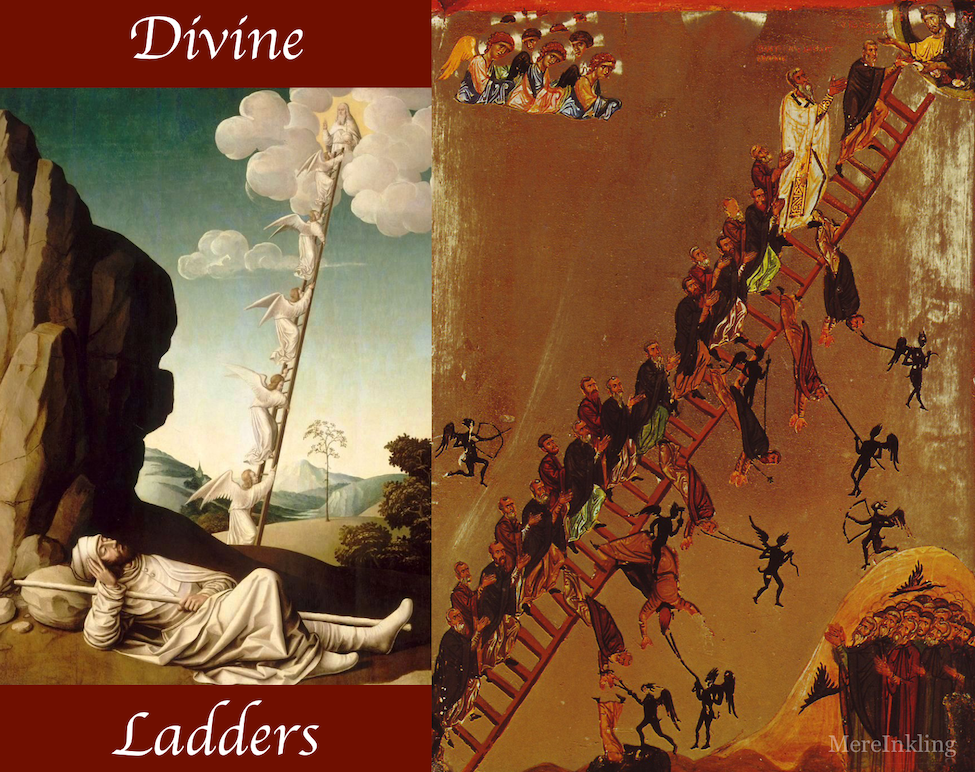
One of the pivotal events in the history of God’s grace is found in the Torah account of a dream. Jacob was the heir of Abraham, through whom the Lord promised to redeem the world. But Jacob was far from noble.

Nevertheless, because of the Lord’s mercy (the same mercy he offers to us), he forgave Jacob and promised to bless his descendants. In his dream, Jacob saw a ladder extending from earth all the way to heaven. “And behold, the angels of God were ascending and descending on it!” (Genesis 28).

This dynamic connection between heaven and earth reveals God’s constant concern for his creation. Some, such as Martin Luther, have seen in the dream a foreshadowing of the Incarnation itself.

This ladder or stairway can be interpreted in a variety of ways. One thing it is not, however, is a guide to human ascent from our fallen world to the presence of our Creator. (The Lord is the one who comes to us.)

Having acknowledged that the dream’s purpose is not to model sanctification or individual spiritual ascent, it is easy to see why the metaphor of ladders, and the action of climbing, give way to other applications.

The most vivid contemporary example comes in the form of a Christian spiritual entitled “We are Climbing Jacob’s Ladder.” A number of versions of the lyrics exist. This is quite unsurprising since it began as part of an oral tradition. According to one website devoted to spirituals, the following lyrics are typical.*

We are climbing Jacob’s ladder
Soldier of the Cross

Ev’ry round goes higher ‘n’ higher
Soldier of the Cross

Brother do you love my Jesus
Soldier of the Cross

If you love him why not serve him
Soldier of the Cross

While there are longer versions, this one aptly illustrates how the metaphor of the ladder—in this case, explicitly Jacob’s ladder—offered a powerful image of deliverance. Climbing the ladder with Jesus, was tantamount to experiencing deliverance from the ills of this world.

America’s Library of Congress offers a useful page which describes “African American Gospel music [as] a form of euphoric, rhythmic, spiritual music rooted in the solo and responsive church singing of the African American South.” They add that “its development coincided with—and is germane to—the development of rhythm and blues.” The site offers links to four 1943 recordings of spirituals. None of these, however, is the hymn we are discussing.

“We are Climbing Jacob’s Ladder” was one of the earliest spirituals to be widely adopted by the interracial faith community. It is familiar in many denominations, and was recently sung in my own Lutheran congregation. Hymnary.org states the song has been “published in 79 hymnals.” Even those who consider themselves unfamiliar with the hymn often recognize its rousing refrain: “Rise and shine and give God the glory, glory, Soldiers of the Cross.”

The talented Paul Robeson recorded the hymn on a number of his albums. The inspiring rendition by scholar Bernice Johnson Reagon was included in Ken Burn’s documentary, The Civil War.

C.S. Lewis and the Spiritual Ladder

The ladder offers such a convenient analogy for growth or spiritual maturation that others have also applied it in this manner. The ladders inspired by Jacob’s dream include the following two which continue to influence Christian disciples today, even though they were written many centuries ago. The second of these was considered by C.S. Lewis to be one of the works of faith influential in his life.

John Climacus (579-649) was a Christian teenager when he entered the monastic life at the foot of Mount Sinai. He soon earned the respect of his elders in that barren land. In the words of Fathers of the Desert, “in this ascetic seclusion he became ripe for the designs of God.”

The abbot of a monastery on the Red Sea requested guidance on the ascetic life to use with his monks. John responded with The Ladder of Divine Ascent. You can download a modern translation of this priceless work here. While the treatise was written specifically to guide monastics in their spiritual growth, many other Christians have also found its wisdom helpful in their own, non-monastic settings.

John introduces the virtue of obedience with two vivid images used by the Apostle Paul, the athlete in training and the armor of God.

Our treatise now appropriately touches upon warriors and athletes of Christ [and the manner in which] the holy soul steadily ascends to heaven as upon golden wings. And perhaps it was about this that he who had received the Holy Spirit sang: Who will give me wings like a dove? And I will fly by activity, and be at rest by contemplation and humility.

But let us not fail, if you agree, to describe clearly in our treatise the weapons of these brave warriors: how they hold the shield of faith in God and their trainer, and with it they ward off, so to speak, every thought of unbelief and vacillation; how they constantly raise the drawn sword of the Spirit and slay every wish of their own that approaches them; how, clad in the iron armour of meekness and patience, they avert every insult and injury and missile.

And for a helmet of salvation they have their superior’s protection through prayer. And they do not stand with their feet together, for one is stretched out in service and the other is immovable in prayer.

The following passage will be of particular interest to Christian writers. John advises those drawing closer to God to maintain a journal of their progress and insights. I offer it within its wise context.

Let all of us who wish to fear the Lord struggle with our whole might, so that in the school of virtue we do not acquire for ourselves malice and vice, cunning and craftiness, curiosity and anger. For it does happen, and no wonder!

As long as a man is a private individual, or a seaman, or a tiller of the soil, the King’s enemies do not war so much against him. But when they see him taking the King’s colours, and the shield, and the dagger, and the sword, and the bow, and clad in soldier’s garb, then they gnash at him with their teeth, and do all in their power to destroy him. And so, let us not slumber.

I have seen innocent and most beautiful children come to school for the sake of wisdom, education and profit, but through contact with the other pupils they learn there nothing but cunning and vice. The intelligent will understand this.

It is impossible for those who learn a craft whole-heartedly not to make daily advance in it. But some know their progress, while others by divine providence are ignorant of it. A good banker never fails in the evening to reckon the day’s profit or loss. But he cannot know this clearly unless he enters it every hour in his notebook. For the hourly account brings to light the daily account.

In the fourteenth century, an Augustinian mystic in England wrote a book called The Scale [Ladder] of Perfection.” Walter Hilton (c. 1340-1396) provides spiritual exercises requested by a woman adopting life as an anchoress.⁑ You can download a free copy of Evelyn Underhill’s 1923 edition of Hilton’s counsel at Internet Archive.

In 1940, C.S. Lewis wrote to Roman Catholic monk Bede Griffiths in response to the latter’s question about his familiarity with Hilton’s work. “Yes, I’ve read the Scale of Perfection with much admiration. I think of sending the anonymous translator a list of passages that he might reconsider for the next edition.” That same decade Lewis’ collected correspondence reveals he recommended the title to at least two individuals.

Of greatest interest to students of C.S. Lewis will be his mention of the medieval treatise in his autobiography, Surprised by Joy. Here the great author describes his worldly understanding of prayer served as a terrible stumbling block to his faith.

To these nagging suggestions my reaction was, on the whole, the most foolish I could have adopted. I set myself a standard. No clause of my prayer was to be allowed to pass muster unless it was accompanied by what I called a “realization,” by which I meant a certain vividness of the imagination and the affections.

My nightly task was to produce by sheer will power a phenomenon which will power could never produce, which was so ill-defined that I could never say with absolute confidence whether it had occurred, and which, even when it did occur, was of very mediocre spiritual value.

If only someone had read to me old Walter Hilton’s warning that we must never in prayer strive to extort “by maistry” what God does not give! But no one did; and night after night, dizzy with desire for sleep and often in a kind of despair, I endeavored to pump up my “realizations.” The thing threatened to become an infinite regress.

One began of course by praying for good “realizations.” But had that preliminary prayer itself been “realized”? This question I think I still had enough sense to dismiss; otherwise it might have been as difficult to begin my prayers as to end them.

How it all comes back! The cold oilcloth, the quarters chiming, the night slipping past, the sickening, hopeless weariness. This was the burden from which I longed with soul and body to escape. It had already brought me to such a pass that the nightly torment projected its gloom over the whole evening, and I dreaded bedtime as if I were a chronic sufferer from insomnia. Had I pursued the same road much further I think I should have gone mad.

This ludicrous burden of false duties in prayer provided, of course, an unconscious motive for wishing to shuffle off the Christian faith; but about the same time, or a little later, conscious causes of doubt arose.

David Downing, co-director of the Wade Center wrote an excellent essay entitled “Into the Region of Awe: Mysticism in C.S. Lewis” which describes in the broader context what C.S. Lewis wrote in Surprised by Joy.

Note for example a passage in Surprised by Joy in which Lewis discusses the loss of his childhood faith while at Wynyard School in England. He explains that his schoolboy faith did not provide him with assurance or comfort, but created rather self-condemnation.

He fell into an internalized legalism, such that his private prayers never seemed good enough. He felt his lips were saying the right things, but his mind and heart were not in the words. Lewis adds “if only someone had read me old Walter Hilton’s warning that we must never in prayer strive to extort ‘by maistry’ [mastery] what God does not give.”

This is one of those casual references in Lewis which reveals a whole other side to him which may surprise those who think of him mainly as a Christian rationalist. “Old Walter Hilton” is the fourteenth-century author of a manual for contemplatives called The Scale of Perfection. This book is sometimes called The Ladder of Perfection, as it presents the image of a ladder upon which one’s soul may ascend to a place of perfect unity and rest in the Spirit of God . . . [passage continued in footnotes]. ⁂

We’ve considered four separate ladders today. Despite their differences, they all share a common trait—they are meaningful to those who are earnest about growing in the faith. Whether slave or free, wise or simple, or hermit or cosmopolitan—each of these ladders affirms eternal truths.

Underhill described Hilton’s motivation for writing in this way: “It is for those who crave for this deeper consciousness of reality, and feel this impulse to a complete consecration, that Hilton writes.” I believe this is true for the authors of each of these four treasures.


* The following, simpler version appears to follow an earlier tradition. A musical accompaniment for this example can be found in The Books of American Negro Spirituals. The author, James Weldon Johnson (1876-1938), provides a rich and earnest introduction to the book, originally published in two volumes. He expresses his hope that collection “will further endear these sons to those who love Spirituals, and will awaken an interest in many others.”

We am clim’in’ Jacob’s ladder
Soldiers of the cross

O

Ev’ry roun’ goes higher, higher
Soldiers of the cross

⁑ An anchoress (or anchorite) was a religious woman (or man) who would often be walled off in their monastic cell near a church, to foster their life of prayer by freeing them from interruption.

⁂ Downing’s discussion of C.S. Lewis’ reference to Walter Hinton’s insights on prayer is so valuable that I am compelled to offer the rest of it here. You can read the entire essay via the link on the article’s title.

The passage about “maistry” Lewis wished he’d known as a boy comes early in The Scale of Perfection, a section about different kinds of prayer, including liturgical prayers, spontaneous prayers, and “prayers in the heart alone” which do not use words.

Hilton’s advice for people “who are troubled by vain thoughts in their prayer” is not to feel alone. He notes it is very common to be distracted in prayer by thoughts of what “you have done or will do, other people’s actions, or matters hindering or vexing you.”

Hilton goes on to explain that no one can keep fully the Lord’s command to love the Lord your God with all your heart, soul, strength, and mind. The best you can do is humbly acknowledge your weakness and ask for mercy. However badly one’s first resolve fades, says Hilton, you should not get “too fearful, too angry with yourself, or impatient with God for not giving you savor and spiritual sweetness in devotion.”

Instead of feeling wretched, it is better to leave off and go do some other good or useful work, resolving to do better next time. Hilton concludes that even if you fail in prayer a hundred times, or a thousand, God in his charity will reward you for your labor. Walter Hilton was the canon of a priory in the Midlands of England and an experienced spiritual director of those who had taken monastic vows. His book is full of mellow wisdom about spiritual growth, and Lewis considered it one of “great Christian books” that is too often neglected by modern believers.

Hilton’s recurring theme—do what you know to be right and don’t worry about your feelings—is one that appears often in Lewis’s own Christian meditations. But, alas, Lewis as a boy did not have the benefit of Hilton’s advice.

In those boyhood years at Wynyard, he was trapped in a religion of guilt, not grace. More and more he came to associate Christianity with condemnation of others, as in Northern Ireland, or condemnation of oneself, for not living up to God’s standards.


A Note on the Illustration

Nicolas Dipre was a French early Renaissance painter, who flourished 1495-1532. His painting of Jacob’s Ladder portrays the biblical account of the Jewish patriarch’s dream. The icon Ladder of Divine Ascent was painted four centuries earlier by an anonymous iconographer. It is from Saint Catherine’s Monastery beside Mount Sinai, and portrays the ascent of saints in the pursuit of holiness. While fallen angels (devils) seek to drag them from the path, John Climacus leads other in the path to heaven.


Free C.S. Lewis Course

hillsdaleA free college course about C.S. Lewis? Too good to be true? No, it’s for real . . . and it’s offered by a well respected American College that traces its roots back more than 170 years. (Note, for the Europeans reading this, that makes it quite mature here in North America.)

Hillsdale college is currently offering its online course, “An Introduction to C.S. Lewis: Writing and Significance” at no charge. Here is the link to the enrollment page.

In addition to being a first class college today, Hillsdale has a very distinguished past. Founded in 1844, its leadership in the anti-slavery cause allowed it to host two speeches by Frederick Douglass. The first was delivered during the Civil War itself.*

C.S. Lewis offered a fascinating twist on the injustice of slavery. In an essay entitled “Equality,” written 80 years after Douglass decried slavery at Hillsdale, Lewis advocated democracy as an imperfect philosophy. I agree with his inference that despite its shortcomings, it is the least-flawed form of government.

I am a democrat because I believe in the Fall of Man. I think most people are democrats for the opposite reason. A great deal of democratic enthusiasm descends from the ideas of people like Rousseau, who believed in democracy because they thought mankind so wise and good that everyone deserved a share in the government. The danger of defending democracy on those grounds is that they’re not true. . . . I find that they’re not true without looking further than myself. I don’t deserve a share in governing a hen-roost, much less a nation. Nor do most people—all the people who believe advertisements, and think in catchwords and spread rumours.

The real reason for democracy is . . . Mankind is so fallen that no man can be trusted with unchecked power over his fellows. Aristotle said that some people were only fit to be slaves. I do not contradict him. But I reject slavery because I see no men fit to be masters.

This is the barest example of C.S. Lewis’ keen mind. Enrolling in the course will certainly introduce participants to much, much more.

Like most online resources, this class is offered for personal growth. While a certificate is offered to those who complete the course, it doesn’t result in formal college “credit.” That said, the course could also be of great benefit to a motivated high school student.

Formal studies, even those like this one for which we set a personal pace, are worthwhile. Not only do we profit from the wisdom of the team of professors. Most of us also benefit from the discipline a course offers. Left to our own devices, most of us would not end up with the well-rounded familiarity with Lewis’ work that this class promises.

Shared Wisdom from Douglass and Lewis

One contemporary author noted a parallel thought in the writings of these two men. Thomas Sowell is a distinguished thinker and a talented writer. (Traits he shares with these two gifted authors.) On his website** Sowell has an extremely selective collection of quotations, on which he pairs the following. The first was written by Frederick Douglass and the second by C.S. Lewis.

Everybody has asked the question. . . “What shall we do with the Negro?” I have had but one answer from the beginning. Do nothing with us! Your doing with us has already played the mischief with us. Do nothing with us! If the apples will not remain on the tree of their own strength, if they are wormeaten at the core, if they are early ripe and disposed to fall, let them fall! I am not for tying or fastening them on the tree in any way, except by nature’s plan, and if they will not stay there, let them fall. And if the Negro cannot stand on his own legs, let him fall also. All I ask is, give him a chance to stand on his own legs! Let him alone! (Frederick Douglass, “What the Black Man Wants”).

Of all tyrannies, a tyranny sincerely exercised for the good of its victims may be the most oppressive. It would be better to live under robber barons than under omnipotent moral busybodies. The robber baron’s cruelty may sometimes sleep, his cupidity may at some point be satiated; but those who torment us for our own good will torment us without end for they do so with the approval of their own conscience. (C.S. Lewis, “The Humanitarian Theory of Punishment”).

I think Sowell’s connection of these two excerpts is quite perceptive. Although he is an economist by PhD, I regard him as a brilliant sociologist as well.

Education is a worthwhile pursuit. It is one embraced by Douglass, Lewis and Sowell. Hillsdale’s invitation to enroll in this course allows all of us to engage in the same meaningful exercise. After all, learning is one of the pleasures that makes life truly worth living.

_____

* You can read about Douglass’ speeches at Hillsdale College here.

** This link will take you to Sowell’s website.

Loving Prostitutes

comfort womenI love prostitutes.

It’s true.

Although I have never in my life “physically” loved one, I possess great compassion for them.

Sharing physical intimacy with a prostitute would have nothing to do with “love,” anyway.

My empathy for prostitutes grew significantly during the year I spent stationed with the United States Air Force in South Korea during the 1980s.

My love for them has just been reignited by an article I read about the plight of aged Korean prostitutes who are being evicted from their hovels so that developers can profit. These women, ostracized by their own society and discarded by their pimps and the soldiers, sailors and airmen who abused them, have nowhere to go.

Americans have a perverse understanding of prostitution. Calling it a “victimless crime” is incomprehensible. For every one American call girl living in comfort and able to choose her “clients,” there are probably five thousand who are beaten daily, and driven to an early (often welcome) death.

No woman, at least none with a healthy mind, wants to sell their body and forfeit their future.

The gifted author and professor, C.S. Lewis, recognized this fact.

Prostitutes are in no danger of finding their present life so satisfactory that they cannot turn to God: the proud, the avaricious, the self-righteous, are in that danger (The Problem of Pain).

I love prostitutes because God has granted me the vision to see them as he does. Jesus spoke with true love (agape love) to one unloved and physically used woman he met at a well. You can read the story here.

She had been passed from one man to another and no longer had any options. Her current partner had not even bothered to marry her. She was not unlike the poor prostitutes of South Korea.

Jesus looked into this woman’s scarred soul and offered her forgiveness, healing and peace.

South Korea is prosperous today. It was not always so. During the Second World War, and the Japanese occupation, thousands of woman were enslaved as “comfort women.” The Korean government provides these victims with special compensation. Not so the post-war “comfort women” who serviced the country’s allies.

They did not have a choice either. Which is one reason C.S. Lewis writes, “a cold, self-righteous prig who goes regularly to church may be far nearer to hell than a prostitute.” (Mere Christianity).

And now they languish. Others, working in bars and “clubs” near bases today, are in their “prime.” It won’t last. This will be their destiny as well.

Because I love prostitutes, I pray that they might be liberated from their bondage. And, I also pray, that if they remain trapped in their current plight, that their souls might be free . . . that they might encounter the Messiah who can offer them “a spring of water welling up to eternal life” (John 4:14).

The article I read, and linked to above, ends with a potent yet tragic image.

Jang Young-mi, 67, who was orphaned as a girl and worked in a military camptown for nearly two decades, lives with three mangy dogs. A bite from one of them left the long white scar on her hand, but she refuses to abandon the offending animal.

Dogs too, are often outcasts in many societies. The irony is not lost that in Korea a dog is as likely to be devoured, as it is to be embraced and protected.

_____

The WWII image of so-called “comfort women” is of Indonesian women. It is estimated that the Imperial Japanese Army enslaved a quarter of a million women in Asia to serve in this cruel and vile manner. Due to the large number of victims, many still live today, still hoping for an official apology for their suffering.