The Lion’s Command

crowned lionI recently had a few free moments while waiting for a flight, and I decided to revisit that enjoyable childhood treasure, Aesop’s Fables. It had been many years since I explored them, and I found the following tale particularly entertaining.

Aesop may have been a fable himself. Aristotle refers to him as an historical figure, but since Aesop supposedly lived three centuries before the philosopher’s day, he had already transformed into a legend.

Plutarch describes Aesop’s death as occurring when he was thrown from a cliff during a failed diplomatic mission. Presumably after insulting the city of Delphi, they accused him of stealing some temple items. (Perhaps he tried to be too witty for his own good.)

Whether he was an actual person or not, the anecdotes that have accreted around his name have entertained countless generations. On now to the story that captured my imagination.

The Kingdom of the Lion

The beasts of the field and forest had a Lion as their king. He was neither wrathful, cruel, nor tyrannical, but just and gentle as a king could be. During his reign he made a royal proclamation for a general assembly of all the birds and beasts, and drew up conditions for a universal league, in which the Wolf and the Lamb, the Panther and the Kid, the Tiger and the Stag, the Dog and the Hare, should live together in perfect peace and amity.

The Hare said, “Oh, how I have longed to see this day, in which the weak shall take their place with impunity by the side of the strong.” And after the Hare said this, he ran for his life.

The Moral: Saying something does not make it so. (Aesop’s Fables).

Although Aesop’s Lion bears a resemblance to C.S. Lewis’ own vision, he is no Aslan. Both are the kings of their respective domains. Both dictate that there be peace among their subjects.

Aslan alone, though, can make this pacific vision reality. And, because sin had entered Narnia, he had to do it by creating a new Narnia. The amazing story of the conclusion of the temporary and inauguration of the eternal is told in The Last Battle. The original plan, recorded in The Magician’s Nephew, was that the creatures live in divine harmony.

The chosen beasts who remained were now utterly silent, all with their eyes fixed intently upon the Lion. The cat-like ones gave an occasional twitch of the tail but otherwise all were still. For the first time that day there was complete silence . . .

The Lion, whose eyes never blinked, stared at the animals as hard as if he was going to burn them up with his mere stare. And gradually a change came over them. The smaller ones— the rabbits, moles, and such-like— grew a good deal larger. The very big ones— you noticed it most with the elephants— grew a little smaller. Many animals sat up on their hind legs. Most put their heads on one side as if they were trying very hard to understand.

The Lion opened his mouth, but no sound came from it; he was breathing out, a long, warm breath; it seemed to sway all the beasts as the wind sways a line of trees. Far overhead from beyond the veil of blue sky which hid them the stars sang again; a pure, cold, difficult music. Then there came a swift flash like fire (but it burnt nobody) either from the sky or from the Lion itself, and every drop of blood tingled in the children’s bodies, and the deepest, wildest voice they had ever heard was saying:

“Narnia, Narnia, Narnia, awake. Love. Think. Speak. Be walking trees. Be talking beasts.”

Such love and harmony would not last. Just as in our own world, selfishness and idolatry came to reign. Lewis recognized sin’s corruption cannot be bandaged. It needs to be excised. A broken vessel can be repaired, but it can never regain the purity of its origin without miraculous intervention.

That’s why Christians—who believe in the “resurrection of the (physical) body”—know that these restored bodies will be new.

There are heavenly bodies and earthly bodies, but the glory of the heavenly is of one kind, and the glory of the earthly is of another. There is one glory of the sun, and another glory of the moon, and another glory of the stars; for star differs from star in glory.

So is it with the resurrection of the dead. What is sown is perishable; what is raised is imperishable. It is sown in dishonor; it is raised in glory. It is sown in weakness; it is raised in power. It is sown a natural body; it is raised a spiritual body. . . . The first man [Adam] was from the earth, a man of dust; the second man [Christ] is from heaven.

As was the man of dust, so also are those who are of the dust, and as is the man of heaven, so also are those who are of heaven. Just as we have borne the image of the man of dust, we shall also bear the image of the man of heaven. (First Corinthians 15:40f).

Just as Aesop’s lion commanded, and Lewis’ Aslan ordained, the Messianic age will one day arrive. And when it does, “The wolf and the lamb shall graze together; the lion shall eat straw like the ox, and dust shall be the serpent’s food” (Isaiah 65:25).

The Moral: When God says something, that does make it so.

A Song has Ended

lyric christmasSix months of life with someone you love, is too brief. Far too brief.

Only last June I invited you to share our joy with the adoption into our family of Lyric, a border collie mix.

Tragically, last night the precious girl passed away. And our family is now dealing with the shock and grief that are such a painful (but inescapable) part of loving the pets who join our families.

After Lyric had been with us for several months, we saw evidence (excessive salivation and frantic, happy racing around the house) of a health concern. When we later witnessed a seizure that lasted just a minute or two, it was nearly as traumatic to us as it was to her. That feeling of helplessness is horrible, isn’t it?

Visits to the vet resulted in the suspicion that it may have been caused by the mushrooms that grow abundantly in the Pacific Northwest forest where we live. (This has been a particularly favorable year to all forms of fungi, and this is a fairly common cause of canine seizures.)

We took precautions to minimize her exposure to that source, but she had several more seizures, weeks apart. Our two vets said that if she experienced a “cluster” of seizures, there were some drugs we could try. However, we never saw any indications of that, so we remained in a monitoring status.

Tragically, late last night, while lying beside me as I was writing, she began what became a relentless series of attacks on her system. She briefly stabilized between each seizure, but they grew longer and more severe. Finally, her strong heart (mercifully) surrendered, and she was gone.

C.S. Lewis was writing about the death (and resurrection) of human beings in his essay “Some Thoughts,” but his words about the alien nature of death resonate with what I am feeling today.

Of all men, we hope most of death [as in, not being the end of all, but a passage to an even more real life]; yet nothing will reconcile us to—well, its unnaturalness. We know that we were not made for it; we know how it crept into our destiny as an intruder; and we know Who has defeated it.

Because Our Lord is risen we know that on one level it is an enemy already disarmed; but because we know that the natural level also is God’s creation we cannot cease to fight against the death which mars it, as against all those other blemishes upon it, against pain and poverty, barbarism and ignorance. Because we love something else more than this world we love even this world better than those who know no other.

Animals, of course, don’t share humanity’s souls. But when you gaze into those love-filled, adoring eyes of your dog, only someone spiritually blind would fail to recognize there is a precious spark within.

I have written in the past about the possibility of God restoring our pets to us in heaven. I won’t belabor that possibility here. After all, it’s merely conjecture. But, in these moments of grief, many find some small comfort in the possibility of God restoring to life these beloved, and innocent, victims of humanity’s disobedience in the Garden.

I began my first post about Lyric with these words:

Last night a new member joined our family. Her name is musical. We didn’t choose it; her previous family did. But we think it fits and she’ll live up to it.

It was for far too short a time, but Lyric definitely did live up to the beauty of her name.

Confusing Creeds

Nicene CreedThere are a couple of sentences in the traditional translation of the basic Christian creeds (statements of faith) that lead to confusion.

Due to the literary examples below, Christian readers may find the following discussion more interesting than non-Christians—but everyone interested in clarity versus confusion should find something intriguing.

The creeds offer a prime example of why it is absolutely crucial to ensure that gradual shifts in language do not undermine or blur the intended meaning of a given sentence. To illustrate, consider this line from the Nicene Creed.

. . . [Jesus] who for us men and for our salvation came down from heaven and was incarnate by the Holy Spirit of the virgin Mary and was made man. (1662, Anglican Book of Common Prayer).*

The potential confusion here lies in the archaic usage of the word “of.” Whose Holy Spirit are we referring to? Mary’s innate holiness and purity? The educated Christian may stumble over that dated phrase—which is still used in some denominations—but a person not acquainted with the doctrine of the Trinity might easily misinterpret it as a Maryological, rather than Christological, confession.

Let’s consider two more recent translations, and note how the first restores the intent of the original writers. The second of these commonly used translations reflects the hand(s) of “politically correct” revisers.

For us and for our salvation he [Jesus] came down from heaven: by the power of the Holy Spirit he became incarnate from the Virgin Mary, and was made man. (1975 International Consultation on English Texts version).

For us and for our salvation he came down from heaven, was incarnate of the Holy Spirit and the Virgin Mary and became truly human. (1988, English Language Liturgical Consultation version).

We will consider a second example momentarily, but let’s first look at something C.S. Lewis wrote about reflecting on the importance of the creeds. He noted that too often we rattle through the words without considering their significance. This is unfortunate.

In an essay entitle “On Forgiveness,” Lewis describes a personal epiphany and offers counsel to those tempted to take familiar words for granted.

We say a great many things in church (and out of church too) without thinking of what we are saying. For instance, we say in the Creed “I believe in the forgiveness of sins.” I had been saying it for several years before I asked myself why it was in the Creed. At first sight it seems hardly worth putting in. “If one is a Christian,” I thought “of course one believes in the forgiveness of sins. It goes without saying.”

But the people who compiled the Creed apparently thought that this was a part of our belief which we needed to be reminded of every time we went to church. And I have begun to see that, as far as I am concerned, they were right. To believe in the forgiveness of sins is not so easy as I thought. Real belief in it is the sort of thing that easily slips away if we don’t keep on polishing it up.

As usual, the Oxford don was correct. However, just as good translations possess the power to inspire, so too poor or antiquated translations exercise the ability to confuse.

Here is the promised second example.

And the third day he rose again according to the Scriptures . . . (1662).

Ah, I understand, think the uncatechized, the Bible teaches us that Jesus rose from the dead on Easter. Well, yes it does, but that is not the sense in which the second phrase is intended. Here, “according to the Scriptures,” means that Jesus’ life, death and resurrection were all accomplished in accordance with the promises of the Word of God.

In other words, “just as was promised in the Garden of Eden and foretold by the prophets, Jesus won victory when he rose from the grave in accordance with the loving plan of God the Father.” The newer versions make that fact only slightly clearer.

On the third day he rose again in accordance with the Scriptures . . . (1975 and 1988).

Perhaps a future revision will replace “in accordance with,” using something like “as foretold in” or “fulfilling the scriptural promises.”

Some of us worship in congregations using a variant of the seventeenth century creed, but at least we can take comfort in the fact that most of them have at least replaced “And he shall come again with glory to judge both the quick and the dead” with “both the living an the dead.” After all, we wouldn’t want people to think that one’s salvation is dependent upon their speed.

_____

* This slightly contemporized version of the creed has already remedied the terribly confusing term “Holy Ghost,” which evokes images of disembodied souls and hauntings.

Face to Face with God

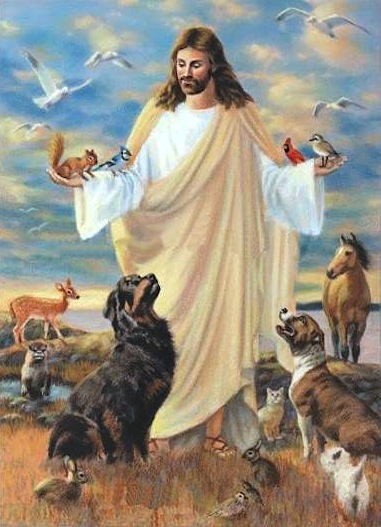
Jesus with animalsA recent letter to the editor of Lutheran Witness includes a delightful example of the wondrous glory of childhood simplicity.

When our four-year-old son . . . saw a bird outside the window, he commented “I wish I were a bird with wings so I could fly up to heaven and talk to Jesus.” [His parents] asked what he would say to Jesus if he were a bird. His simple reply . . . “Tweet, tweet.”

How gloriously innocent. So unpretentious and joyously pure. I think this captures the essence of what Jesus was referring to when he said “Truly, I say to you, unless you turn and become like children, you will never enter the kingdom of heaven. Whoever humbles himself like this child is the greatest in the kingdom of heaven” (Matthew 18:3-4, ESV).

C.S. Lewis discussed the innocence of children in his essay “The Abolition of Man.” He is discussing the monolithic power of society, or government, in reshaping what it means to be human. God preserve us from those who would redefine and eradicate the very qualities of humanity Jesus praised.

Human nature will be the last part of Nature to surrender to Man. The battle will then be won. . . . But who, precisely, will have won it? For the power of Man to make himself what he pleases means, as we have seen, the power of some men to make other men what they please. . . .

Hitherto the plans of educationalists have achieved very little of what they attempted and indeed, when we read them—how Plato would have every infant “a bastard nursed in a bureau,” and Elyot would have the boy see no men before the age of seven and, after that, no women, and how Locke wants children to have leaky shoes and no turn for poetry—we may well thank the beneficent obstinacy of real mothers, real nurses, and (above all) real children for preserving the human race in such sanity as it still possesses.

But the man-moulders of the new age will be armed with the powers of an omnicompetent state and an irresistible scientific technique: we shall get at last a race of conditioners who really can cut out all posterity in what shape they please.

When you and I stand in the presence of God, our adult words will vary. We’ll all drop to our knees—some in adoration, others perhaps in fear—but what will we say?

I can imagine some of the words that will come to our lips.

“Thank you.”

“Why did you allow . . ?”

“I love you.”

“I despise you because . . ?”

“Hallelujah.”

Or, perhaps, “Why did you delay so long?”*

I suspect we will probably be speechless. Certainly, at first. There’s a song that captures well the mystery that awaits us when we find ourselves face to face with our Creator. It’s more in spirit with the response of the young child who simply tweeted out his greeting to God.

Surrounded by Your Glory, what will my heart feel?

Will I dance for you, Jesus? Or in awe of You, be still?

Will I stand in Your presence, or to my knees will I fall?

Will I sing ‘Hallelujah!’? Will I be able to speak at all?

I can only imagine! I can only imagine!

We used to sing this song at chapel services in southwest Asia. I have often thought it would be very meaningful to record this song in my own voice, to be played at my own funeral (should the Lord tarry).

That’s not nearly as morbid as some might think. It’s a song of praise, awe and wonder, in my rendition I would end it with the words “I no longer imagine,” for my faith in God will have given way to sight.

_____
* The answer to that question is actually found in the Scriptures. From the third chapter of Peter’s second epistle:

This is now the second letter that I am writing to you, beloved. In both of them I am stirring up your sincere mind by way of reminder, that you should remember the predictions of the holy prophets and the commandment of the Lord and Savior through your apostles, knowing this first of all, that scoffers will come in the last days with scoffing, following their own sinful desires. They will say, “Where is the promise of his coming? For ever since the fathers fell asleep, all things are continuing as they were from the beginning of creation.” For they deliberately overlook this fact, that the heavens existed long ago, and the earth was formed out of water and through water by the word of God, and that by means of these the world that then existed was deluged with water and perished. But by the same word the heavens and earth that now exist are stored up for fire, being kept until the day of judgment and destruction of the ungodly.

But do not overlook this one fact, beloved, that with the Lord one day is as a thousand years, and a thousand years as one day. The Lord is not slow to fulfill his promise as some count slowness, but is patient toward you, not wishing that any should perish, but that all should reach repentance. But the day of the Lord will come like a thief, and then the heavens will pass away with a roar, and the heavenly bodies will be burned up and dissolved, and the earth and the works that are done on it will be exposed.

Since all these things are thus to be dissolved, what sort of people ought you to be in lives of holiness and godliness, waiting for and hastening the coming of the day of God, because of which the heavens will be set on fire and dissolved, and the heavenly bodies will melt as they burn! But according to his promise we are waiting for new heavens and a new earth in which righteousness dwells.

The Anguish of Suicide

suicideI was present at the scene of a suicide last night.

In my capacity as a volunteer chaplain with a local law enforcement agency, I was riding with a police officer. We were the initial first responders to arrive.

At the end of a rather uneventful shift, we received an urgent call to respond to a shooting. Naturally, I can’t reveal any details about the event beyond mentioning it involved a firearm. It was probably terribly similar to how you would imagine it to be.

To see a life so sadly cast aside is too sad for words. Contemplating the days ahead for those who loved the deceased is sobering. Their lives will never be the same, and that is the universal legacy bequeathed to family and friends by those who end their own lives. God have mercy on them.

C.S. Lewis understood how despair could drive a person to contemplate this irreversible choice. In a letter to a deeply grieving husband who had lost his wife, Lewis relates how suicide would never provide a genuine resolution to the pain caused by the loss.

One way or another the thing [romantic love] had to die. Perpetual springtime is not allowed. You were not cutting the wood of life according to the grain. There are various possible ways in which it could have died though both the parties went on living.

You have been treated with a severe mercy. You have been brought to see (how true & how very frequent this is!) that you were jealous of God. So from us you have been led back to us and God; it remains to go on to God and us.

She was further on than you [in Christian faith], and she can help you more where she now is than she could have done on earth.*

You must go on. That is one of the many reasons why suicide is out of the question. (Another is the absence of any ground for believing that death by that route would reunite you with her. Why should it? You might be digging an eternally unbridgeable chasm. Disobedience is not the way to get nearer to the obedient.)

There’s no other man, in such affliction as yours, to whom I’d dare write so plainly. And that, if you can believe me, is the strongest proof of my belief in you and love for you. To fools and weaklings one writes soft things. (A Severe Mercy by Sheldon Vanauken)

Vanauken, the recipient of the letter, had this response to Lewis’ challenging words: “After this severe and splendid letter, I loved Lewis like a brother. A brother and father combined.”

He continued by explaining how the letter had dispelled any consideration of suicide. “If I had been tempted at all to break my promise to Davy [his wife] about following her by [his] own act, the temptation vanished after one horrified look at Lewis’s ‘eternally unbridgeable chasm.’”

It will take some time for me to “process” my experience last evening. But, having seen death in the past, I found it less traumatic than many others would have.

And, of course, I never knew the person who chose to no longer breathe . . . or smile . . . or dream. I only became “acquainted” with them as I spoke to their spouse in the hours that followed. Sadly, because of a tragic choice, in this world they are merely a memory now.

Naturally, to those who knew and loved them, the vacuum created by their passing cannot be completely filled. Moreover, the wounds caused by the grim nature of their death by choice, will leave permanent scars.

The fact is that during the course of their lives, many people—quite possibly the majority of human beings—consider the possibility that suicide could end the pain they feel. But we must tirelessly remind them, and ourselves, that suicide is a permanent “solution” to temporary circumstances.**

_____

* Lewis is referring to the concept that the saints (i.e. all believers) currently in the presence of the Lord may have the ability to intercede on behalf of those of us who are still “living.” The best way for Protestants to understand this may be by considering this line of thought: (1) we don’t hesitate to ask our sisters and brothers in Christ to pray for us, (2) we believe that God has already given eternal life to his disciples (meaning that even the departed remain alive), thus (3) it is not illogical that children of God now in his presence would be able to intercede for us in heaven.

Traditional Protestant reticence with this understanding is based in the concept most clearly espoused in I Timothy 2:5. Lewis, of course, was a Protestant himself, but Anglicans are among the minority of Protestants who affirm this practice.

** This is not to belittle the intense agony caused by chronic emotional suffering, but I believe there is a path that leads not to death, but to healing and life. If you have suicidal feelings, I strongly encourage you to seek out a skilled Christian counselor. (Not all clergy possess the necessary training, or the faith itself, to provide an adequate lifeline in these situations.)

If you’re unable to find a pastor in your local area, you can contact me at chaplainstroud at mereinkling dot com and I will attempt to get you in touch with a compassionate minister in your local community.

Seeking the Living

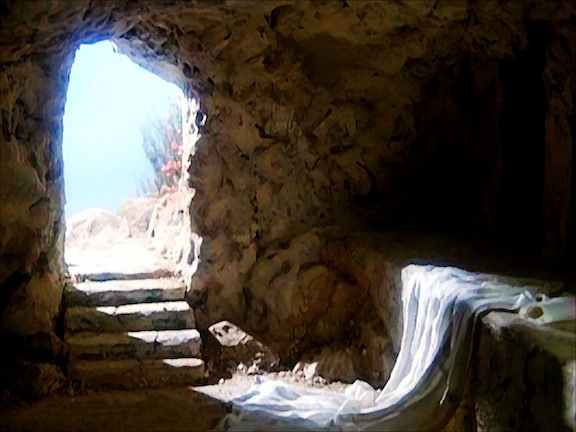
tombOne of the readings at our celebration of the Resurrection, this Easter morning, came from the Gospel according to Saint Luke. It included the powerful words of the angels waiting beside the empty tomb. To Mary Magdalene and the other women who had arrived to complete the ceremonial preparations for Jesus’ burial, they said: “Why do you seek the living among the dead?”

That’s precisely what separates Christianity from every other religious faith; for two millennia, Jesus’ disciples have followed a resurrected and living Lord.

This is what non-Christians are ultimately unable to fathom. Christianity is far more than the adoption of a particular lifestyle. It is infinitely more than a cognitive acquiescence a set of doctrines. It is nothing less than a dynamic, living relationship with our Creator through his only begotten Son.

Many regard Jesus as a great teacher from an ancient epoch—whose words are worthy of preserving. This is a good thing . . . but it’s not Christianity.

Many consider Jesus the model of a noble life—and strive to emulate his compassion and humility. This too is a good thing . . . but it’s not Christianity.

Many regard Jesus as an object of superstition—and they spout religious jargon while living hypocritical lives utterly devoted to their carnal appetites. This is not a good thing . . . and it’s most certainly not Christianity.

C.S. Lewis refers to this inherent inability to “persuade” an unbeliever to see beyond Christianity as a creedal profession or even a simple lifestyle and comprehend it as a relationship.

Our opponents, then, have a perfect right to dispute with us about the grounds of our original assent. But they must not accuse us of sheer insanity if, after the assent has been given, our adherence to it is no longer proportioned to every fluctuation of the apparent evidence. They cannot of course be expected to know on what assurance feeds, and how it revives and is always rising from its ashes.

They cannot be expected to see how the quality of the object which we think we are beginning to know by acquaintance drives us to the view that if this were a delusion then we should have to say that the universe had produced no real thing of comparable value and that all explanations of the delusion seemed somehow less important than the thing explained.

That is knowledge we cannot communicate. But they can see how the assent, of necessity, moves us from the logic of speculative thought into what might perhaps be called the logic of personal relations. What would, up till then, have been variations simply of opinion become variations of conduct by a person to a Person. Credere Deum esse turns into Credere in Deum. And Deum here is this God, the increasingly knowable Lord. (C.S. Lewis, “On Obstinacy in Belief”).

Ultimately, inviting others to share the joy and peace that we disciples of Jesus know—undeserving as all of us are—is not about persuasion. It is about introducing them to Jesus.

It’s about echoing the words of the angels in that Judean cemetery. “Don’t seek Jesus among the dead. He is risen and living, and he offers eternal life to all who call upon his name.”

Grasping for Immortality

memorial cakeToday’s news carried a truly bizarre story. Yesterday, Venezuela’s dictator died after a lengthy illness. Today we learned that his body is due to be preserved for future generations to venerate. Like his forebear Lenin, he’ll be on call in a glass casket in case someone needs to gaze at him to have their socialist energies reinvigorated.

And that was only half of the surprising news report about Chavez’s demise.

The head of the presidential guard, a general close to the leader, related his final words. He was at his bedside and reported that he was too weak to verbalize the words, but clearly mouthed the plea “I don’t want to die; please don’t let me die.”

It’s shocking that General Ornella would divulge this fact about Chavez, particularly during the actual process of his divinization. The general attributes Chavez’s reluctance to receive his “eternal reward” to his love of country and desire to remain here to lead his nation for ever.

I, on the other hand, would attribute his reluctance to die to other sentiments.

The article that related the morbid plans for the display of Chavez’s body cited the familiar example of Lenin, which I mentioned above. It also noted two other former rulers whose bodies have also been preserved for an adoring posterity: Mao Zedong and Ho Chi Minh. Preparing this post I found that Kim Il-sun and his son Kim Jong-Il share a mausoleum. Likewise, Lenin’s successor Stalin would still be on display, had it not been for eventually falling out of political favor.

Now, there’s something obvious that all of these men have in common. They were leaders of oppressive communist regimes—which oppressed their own citizens because of their atheistic worldview.

Having rejected God and knowing no hope of resurrection or eternal life, they feebly grasped for immortality the only way they knew. They sought to leave a monumental mark on history, in order to be long remembered. And, considering a monument and a statue insufficient mnemonic devices . . . well, enough about that.

A Far Better Way

We who know the Creator of all life have much to be grateful for. Not least of which, his gracious gift of eternal life. Christians believe we will trade in this weak and worn body for a new one. So, while we treat the bodies of those who have died with dignity, we feel absolutely no impulse to venerate them. On the contrary, “ashes to ashes and dust to dust.”

C.S. Lewis wrote something in Mere Christianity which relates directly to this sharp contrast in worldviews.

Immortality makes this other difference between totalitarianism and democracy. If individuals live only seventy years, then a state, or a nation, or a civilisation, which may last for a thousand years, is more important than an individual. But if Christianity is true, then the individual is not only more important but incomparably more important, for he is everlasting and the life of a state or a civilisation, compared with his, is only a moment.

That, dear friends, is quite a paradigm shift. To regard each human life as more precious than any abstract government or institution created by humanity’s hand. Having that perspective is akin to seeing with God’s own eyes.

I hope the people of Venezuela soon recognize the futility of the shrine that is being built. Infinitely better to seek “immortality” (eternal life) in the one place where it may truly be found.

On Burying One’s Father

marine flagI just buried my father yesterday. Well, not literally, since the service was held in a chapel at the cemetery, but my family and I said goodbye to him in a traditional Christian service. Because he was a combat veteran Marine Corps sergeant major, he received also very impressive military honors at graveside.

It was quite nice. Although he had passed rather quickly, and completely unexpectedly, he had lived a long and full life. That sounds cliché, but during his 84 years he had a successful career in the Corps, enjoyed a long and peaceful retirement, was blessed with a loving and faithful wife, and found great joy in his three children, nine grandchildren and ten great-grandchildren.

Best of all, though, after what some would call a rather misspent youth, he became a good man . . . and ended his days with faith in Christ and with virtues such as repentance, forgiveness and charity evident in his life.

As the day of the funeral was approaching, I recalled one of Jesus’ conversations with several prospective disciples.

As they were going along the road, someone said to [Jesus], “I will follow you wherever you go.” And Jesus said to him, “Foxes have holes, and birds of the air have nests, but the Son of Man has nowhere to lay his head.” To another [Jesus] said, “Follow me.” But he said, “Lord, let me first go and bury my father.” And Jesus said to him, “Leave the dead to bury their own dead. But as for you, go and proclaim the kingdom of God.” (Luke 9:57-60, ESV).

To some, Jesus’ words here sound harsh. However, the Messiah was not encouraging people to cease honoring their parents. After all, that would be in direct disobedience to the Commandments God delivered to us through Moses. No, Jesus affirmed our call to respect and care for our parents. What he was condemning was the excuses we make to delay accepting his invitation to follow him.

While we might offer a truly important reason for our procrastination, we often push back the spiritual “season” of our life with far more lame reasoning. “I’ll settle down after I get married, but right now I just need some time to “enjoy” life.” or “I’ll start going to church once I have kids and they can benefit from it.”

On Sundays we rarely think twice about disobeying another of the Commandments by ignoring the Sabbath and not preserving it’s holiness. Years ago Keith Green wrote a song “Asleep in the Light,” which featured the convicting lyrics:

How can you be so dead

When you’ve been so well fed

Jesus rose from the grave

And you, you can’t even get out of bed.

Most of us live long enough to suffer the loss of a parent. It’s something, perhaps, that you don’t really understand until you experience it yourself. Even then it’s difficult to console others by saying we’ve shared their loss. After all, every relationship is unique, and each human being processes grief in a unique manner.

C.S. Lewis knew well what it was like to lose his parents. His beloved mother died when he was quite young. In Surprised by Joy, he describes the pain. With my mother’s death all settled happiness, all that was tranquil and reliable, disappeared from my life. There was to be much fun, many pleasures, many stabs of Joy; but no more of the old security. It was sea and islands now; the great continent had sunk like Atlantis.

Alas, Lewis does not describe his father’s passing in his too-brief autobiography. What he does say, reminds me of my own father’s vast reservoir of humor and encouragement as his health waned. Lewis simply writes: “My father’s death, with all the fortitude (even playfulness) which he displayed in his last illness, does not really come into the story I am telling.”

Many of you who have lost your parents can empathize with me, and with the journey I am facing as I adjust to life without either of my parents. Because I loved them, I miss them. And the love makes the pain worth it. Besides, as Paul reminded young Christians in his first letter to the Church in Thessalonica, we “do not grieve as other do who have no hope.” Our hope is secure, resting in the very One who said, “I am the resurrection and the life.”

The Brevity of Life

O Lord, make me know my end and what is the measure of my days; let me know how fleeting I am! Behold, you have made my days a few handbreadths,
and my lifetime is as nothing before you. Surely all mankind stands as a mere breath! Surely a man goes about as a shadow! (Psalm 39:4-6, ESV).

I was reminded this week of that terrible cloud that hangs over all humanity . . . the brevity of our lives.

The Psalmist David lived a long life. Yet, during it he experienced great trials, some of which he failed. In this Psalm, he describes the vast gap between God and his creation.

Even human beings, created in the Lord’s very image so that we might worship him and live in fellowship with him for all time . . . even we human beings, because of sin, are destined to perish. We all die.* It is one of very few certainties that exist; as Benjamin Franklin famously wrote: “In this world nothing can be said to be certain, except death and taxes.”

The Bible can sound almost depressing when touching on the theme of life’s swift passage. But if we begin to despair, we have entirely missed the purpose of these verses. They are simply there to remind us of our utter dependence on God.

We must not trust in the pagan wishful thinking of the “immortality of the soul,” apart from its Creator. Nor should we deny God’s presence and surrender to the belief that there is no existence beyond this life. The latter is a particularly sad “religion,” or worldview. And like all beliefs, it requires “faith” (trust) to believe there is no afterlife. C.S. Lewis described that fact in a 1956 epistle included in Letters to Children.

People do find it hard to keep on feeling as if you believed in the next life: but then it is just as hard to keep on feeling as if you believed you were going to be nothing after death. I know this because in the old days before I was a Christian, I used to try.

The message of the Scriptures is not for us to bemoan the fact that we will die, and that our days in this world are brief. On the contrary, God’s word paints this picture vividly, with the sharp colors of reality (rather than numbing pastels of euphemisms) because it is vital that we understand how this life is merely a prelude to the life that follows.

I began this post by saying I’d recently been reminded of death’s immanence. Last year I had written a brief letter to Calvin Miller, the anointed author I quoted in my previous meditation. He graciously responded. Well, it dawned on me that he might enjoy reading my comments about The Philippian Fragment, so I wrote him again four days ago. I had not heard back, and eagerly awaited his reaction . . . only to learn yesterday that Dr. Miller had passed away two days after I wrote to him.

While I was saddened (on behalf of his family and fans) to hear of his death, I recognize that he is already experiencing a more abundant and true life this very moment, than any he could ever know here. Still, I wish I’d written to him just a few days earlier, since I’m curious what he might have thought about my modest words on the subject of compassionate ministry.

Since we began with a Psalm of David despairing about the brevity of human life, it is fitting to end with another song penned by the same royal composer. Once again he acknowledged the shortness of our lives. But here, he makes it very clear that due to God’s immeasurable love for his children, we have an “everlasting” destiny, which will never end. His children by faith, who have trusted in his only begotten Son, already possess the gift of eternal life. And we will experience it fully after the resurrection, when we have discarded this fallen shell and been clothed in our new body.

As for man, his days are like grass; he flourishes like a flower of the field; for the wind passes over it, and it is gone, and its place knows it no more. But the steadfast love of the Lord is from everlasting to everlasting on those who fear him, and his righteousness to children’s children, to those who keep his covenant and remember to do his commandments. The Lord has established his throne in the heavens, and his kingdom rules over all. (Psalm 103:15-19, ESV).

* For theological clarification, it is possible for God to raise someone to heaven without dying (e.g. Elijah), and those who are still living when Christ returns in the Parousia, will not have to experience physical death.

On Death’s Specter

Death is an unpleasant subject. And the knowledge that each of us is destined to face our own, has the potential to overshadow the countless joys this life offers.

Virtually everyone reading this has lost a loved one to death . . . and some reading this may have been informed by doctors that their own days may be limited. If you find yourself counting down in years, months, or weeks, may God strengthen you and pour upon you an overflowing portion of his divine peace. The Scriptures refer to God’s peace in circumstances of great personal trial as a “peace which passes understanding.” And that is precisely what I pray he provides for you.

Those of us who are Christians find ourselves in a bit of a tension. We believe in Jesus’ resurrection, and his promise to raise us to new life as well. So, in that sense death is a defeated “enemy.” It no longer has the final word. In fact, passing through the portal of death actually allows us to enter into the presence of the Lord! Nevertheless, we dread the prospect of dying. Too seldom do people pass peacefully in their sleep.

C.S. Lewis experienced an illness which brought him near to death. Yet he recovered . . . with mixed feelings. Five weeks before his death he wrote to his friend Arthur Greeves:

Tho’ I am by no means unhappy I can’t help feeling it was rather a pity I did revive in July. I mean, having been glided so painlessly up to the Gate it seems hard to have it shut in one’s face and know that the whole process must some day be gone thro’ again, and perhaps far less pleasantly! Poor Lazarus! But God knows best.

The reason we should no longer fear death is because it has no power over those whose sins have been borne by the Messiah. Those who have not experienced this grace may rightfully fear the day of accounting that awaits humanity. Jesus invites all people—even the most sinful and vile people we can imagine—to yield to him and trade their inheritance of death for his righteousness and the gift of eternal life.

That means there is nothing that you have done that is so evil God cannot forgive it. Simply ask him to.

One way this experience of salvation is described in the Bible is as a resurrection. Jesus said to one of his disciples, “I am the resurrection and the life ‘Whoever believes in me, though he die, yet shall he live, and everyone who lives and believes in me shall never die.’” (John 11:25). Jesus is distinguishing between the two deaths. Physical, where this finite body fails . . . and spiritual death, where those who have ignored God’s mercy spend eternity separated from it.

Another aspect of this transformation is found in the fact that through conversion we die to the power of sin over us, and participate (even in this physical life) in Christ’s resurrected life. (Baptism is a “sign” of this, as the immersion is “burial” and rising from the waters is rebirth.) As Paul of Tarsus assures believers: “For if we live, we live to the Lord, and if we die, we die to the Lord. So then, whether we live or whether we die, we are the Lord’s.” (Romans 14:8).

C.S. Lewis bluntly put it this way: “Die before you die. There is no chance after that.” (Till We Have Faces).

Which brings us to the peculiar image above. It comes from some classical text and whenever I’ve encountered it over the years, I’ve always considered it rather odd that the illustrator decided to portray this skeleton in the posture of prayer. It’s actually a bit disconcerting, since death and decay have nothing to do with our Lord who is the way, the truth and the life.

If we haven’t said our prayers in this mortal life, as Lewis reminds us, we will lack the voice and opportunity to do so in the next.

Besides, knowing Christ is not something with benefits only in the next life. Walking through life in his light makes our days here all the more pleasant and joyful. As I look back on my own life I recognize numerous ways in which his hand directed my path. Had I lived for my own selfish appetites the person I would be today would little resemble the Christian me. Thank God that he delivered me from becoming that man.