C.S. Lewis & Medicine

[I originally penned this post in 2020, but delayed its publication due to failing in my attempt to secure permission to receive this perfect illustration. Five years later, AI allowed me to create the image shown above. Since the message remains pertinent, I’m offering my thoughts on this subject today.]

Medicines are precious. Right now we are seeing the release of the first antiviral drugs devised to protect us from the covid plague. The trials have been positive, and now the caregivers on the frontlines are receiving these protective injections.

Unfortunately, some so-called medicines are not effective. They can even be harmful. That’s the case with “patent medicines” hawked by shysters lying about their results. Originally the term was positive. According to one museum, “patent medicines originally referred to medications whose ingredients had been granted government protection for exclusivity.”

Sadly, though, “the recipes of most 19th century patent medicines were not officially patented. Most producers (often small family operations) used ingredients quite similar to their competitors—vegetable extracts laced with ample doses of alcohol.

In a previous post, I shared Lewis’ view of God’s role in healing.

In his essay entitled “Miracles,” C.S. Lewis described during World War II the Christian viewpoint that God is the author of healing. After discussing the natural order of creation, he argues that God is at work in restoring the health of the those who are ailing.

In 1962, Lewis commiserated with a correspondent complaining about the number of pills she needed to take. He acknowledges the problem, and then points to a very positive corollary.

Yes, and one gets bored with the medicines too–besides always wondering ‘Did I remember to take them after breakfast?’ and then wondering whether the risk of missing a dose or the risk of an over dose is the worst!

Yes, one gets sick of pills. But thank God we don’t live in the age of horrible medicines such as our grandparents had to swallow.

In A Grief Observed, Lewis used an illustration of physical pain to explore the emotional pain caused by his sorrow at his wife’s passing.

I once read the sentence “I lay awake all night with a toothache, thinking about the toothache and about lying awake.” That’s true to life. Part of every misery is, so to speak, the misery’s shadow or reflection: the fact that you don’t merely suffer but have to keep on thinking about the fact that you suffer. I not only live each endless day in grief, but live each day thinking about living each day in grief.

In some ways, psychological suffering is particularly painful. The mentally ill have historically been ostracized. For all of the neurological discoveries that have been made in recent years, the human brain remains a mystery.

Fortunately, medical science has experienced some success formulating medicines that are helpful in treating mental disorders. One problem, however, is that (like nearly all meds) psychological formulas occasionally produce extreme side effects.

C.S. Lewis’ primary experience of psychological suffering came through grief. Tweaking Optimism, a great blog, has gathered a number of Lewis’ thoughts on mental anguish. One passage he cites from The Problem of Pain aptly contrasts physical and mental suffering.

Mental pain is less dramatic than physical pain, but it is more common and frequently more difficult to bear. The common attempt to conceal mental pain increases the burden: it is easier to say “My tooth is aching” than to say “My heart is broken.”

In the same book, Lewis lifts up the truth about suffering. In cases where no cure can bring relief, he beautifully describes various ways to survive journeying through the valley.

When pain is to be born, a little courage helps more than much knowledge, a little human sympathy more than much courage, and the least tincture of the love of God more than all.

C.S. Lewis’ Prescription for Christians Today

We live in an uncertain and turbulent time. Only God knows how long this world will last, but he has promised to deliver from death and hell those who call on his name. Thus, Jesus’ followers need not live in dread or despair.

We live with hope, and look forward with enthusiasm to our Lord’s return. It is to that glorious day, the Parousia, that Lewis refers in his essay “The World’s Last Night.”

The doctrine of the Second Coming, then, is not to be rejected because it conflicts with our favorite modern mythology. It is, for that very reason, to be the more valued and made more frequently the subject of meditation. It is the medicine our condition especially needs.

An Entertaining Tolkien “Game”

The inspiration for this revisitation of Lewis’ thoughts about medicine came from a fun website I recently encountered. Some creative soul noticed the similarity between two dissimilar matters—antidepressant medications and residents of Middle Earth.

The game offers 24 words, and you are challenged to identify the group into which it falls. Is it the name of a pharmaceutical, or is it one of the characters created by J.R.R. Tolkien? One name is a giveaway, but you may find many of the others rather difficult to discern.

Kudos to anyone who gets over twenty correct. (I almost did . . . well, if sixteen is close.) Have fun, and learn something, at the very same time!

Antidepressants or Tolkien Character?

C.S. Lewis, Stereotypes & Polarization

Do you think in terms of stereotypes? Be careful before answering, since nary an adult is free of them. (Case in point, you may well have preconceptions or prejudices about a writer who would use the word “nary” in an opening sentence.)

Stereotyping is common, despite the fact most of us would disavow its use. Most of us would agree with C.S. Lewis who described how stereotypes bar us from embracing new knowledge. In his inaugural lecture on the faculty of Cambridge University, he cautioned that “a stereotyped image can obliterate a man’s own experience” (“De Desciptione Temporum”).

Oddly, while most of us would intuit that thinking stereotypically is a pattern for “the less intelligent,” it appears the reverse is true. According to one study,

Superior cognitive abilities are often associated with positive outcomes, such as academic achievement and social mobility . . . However, our work shows that some cognitive abilities can have negative consequences – specifically, that people who are adept at detecting patterns are especially quick to learn and apply social stereotypes.

Fortunately, although “people with better pattern detection abilities are at greater risk of picking up on and applying stereotypes about social groups,” there is still hope for those “afflicted” with cognitive skill. Fortunately, “these individuals are better able to diminish their stereotyping when presented with new patterns that challenge existing stereotypical associations.”

Another study argues that “our brains want our expectations to be supported . . . Because of that reward engagement, we can start becoming addicted, in a way, to stereotyping.” The researchers offer this suggestion for combatting the addiction: “simply understanding that this happens is an important way to check those assumptions and not let them influence your judgment.”

Generalizing by way of stereotypes can indeed be addictive, if its endemic presence in western culture is any indication. In America, for example, if there is ever a season when nasty stereotypes run unbridled, it is during political campaigns. Especially during presidential elections, where a person of faith would hope to witness the greatest amount of compassion and earnest intercession for God’s guidance.

Stereotypes give way to even uglier projections when we come to despise others. Several years ago I wrote an article about how wartime propaganda often strives to portray a nation’s enemies as evil, and unworthy of treatment in a humane way. It is titled “Demonizing Our Enemies & Dehumanizing Ourselves.”

When nations war, it is in the interests of the leaders of the opposing causes to engage their people in that effort heart, mind and (if possible) soul. A soldier who cognitively recognizes the need for fighting, but does not  possess a visceral animus for the foe, will only be a half-hearted warrior.

On the other hand, if rulers can generate a mental and emotional disgust, or even hatred, for the enemy, they have a winning formula. Soldiers who not only understand their cause, but also desire the utter destruction of their opponent, are single-minded in their purpose. Such fighters win wars.

You can see this sort of us/them polarization during peacetime too, even in non-election years. Sadly, it seems to be manifesting more and more frequently. And, surprisingly, it appears to have become just as common within national populations, as in international contexts. The results can be catastrophic, which is why First Lady Eleanor Roosevelt pled: 

Pit race against race, religion against religion, prejudice against prejudice. Divide and conquer! We must not let that happen here.

Stereotyping the Inklings

Although none of the Inklings have been spared, I believe C.S. Lewis has been the subject of the worst stereotyping. (I have an educated suspicion why that is true.)

Diana Pavlac Glyer has an excellent article which addresses this injustice head on.

There’s a rumor going around that C. S. Lewis was an irritable introvert, isolated and lonely and scared to death of girls. Maybe it all comes from some grim stereotype of smart people or college professors or, maybe, published writers.

That whole image is completely wrong. Lewis wasn’t an introvert. Or a loner. No – he was a large man with a booming voice, a hearty laugh, a robust enjoyment of everyday life. And that is why he was a man with friends.

At A Pilgrim in Narnia, Brenton Dickieson dispels another common misperception of the great author – that he was narrow-minded. 

So much of C.S. Lewis’ uniqueness comes down to his sheer love of diversity. He loved variability, colour, the exchange, the alienation of encounter and unity with others. His weird dystopia That Hideous Strength was, in many ways, a protest against the tendency of totalitarianism to create monoculture by erasing the individual. . . .

Lewis loved difference and diversity and freedom of expression–doctrines in danger in today’s culture war. It doesn’t take long within any of today’s major social movements to find out that diversity is fine and great as long as everyone acts like us or looks like us or thinks like us or uses the same secret words we use.

Most readers of Mere Inkling would be exceptions to the rule that human beings (especially those with “superior cognitive abilities”) default to stereotyping. Most of you, I sincerely believe, share my appreciation for respectful conversation and debate with others who do not share my opinions. 

Such interaction – with unique individuals, and not cardboard caricatures – often result in my own growth. And I dare to hope that those with whom I dialog might also feel the same.

Tinker Bell, the Inklings, and Disney

Poor Tinker Bell. The political prejudices of our day have caught up with the sparkling fairy, and relegated her to a significantly reduced presence in the Disney universe.

Inside the Magic reported “Tinker Bell seems to have left Walt Disney World and is now on her way back to Neverland following a recent change at Walt Disney World Resort.” You can read the tragic tale on their site.

. . . once more, Disney’s animated classic, Peter Pan (1953), is under scrutiny, with Disney issuing a statement regarding Captain Hook and Tinker Bell as characters with potential concerns.

Linking poor Tink to a murderous pirate seems a bit of a stretch, and she has not been fully banished, but she has definitely been demoted. According to TMZ, Disney alleges the company’s “own people felt she wasn’t a good role model for girls in the 21st century.”

Well, eventually she too will be in the public domain, like Mickey Mouse. Actually, her literary portrait as introduced in the play, coincidentally just entered the public domain this year (2024)!

However, should you reside in the United Kingdom, beware that in 1988, the copyright holder, Great Ormond Street Hospital, was granted the rights to Peter Pan “in perpetuity.”

The Creator of Tinker Bell & Peter Pan

Tinker Bell is one of the most memorable characters in Neverland, the creation of James Matthew Barrie (1860-1937). He was a prolific Scottish writer and is best known for his 1911 novel, Peter and Wendy – which initially debuted in the form of a stage play in 1904, as Peter Pan; or, the Boy Who Wouldn’t Grow Up.

Peter Pan was actually introduced to the world as a baby in The Little White Bird. Tinker Bell does not appear in the novel, but the following description of J.M. Barrie’s fairy mythology is quite fanciful.

One of the great differences between the fairies and us is that they never do anything useful. When the first baby laughed for the first time, his laugh broke into a million pieces, and they all went skipping about. That was the beginning of fairies.

They look tremendously busy, you know, as if they had not a moment to spare, but if you were to ask them what they are doing, they could not tell you in the least. They are frightfully ignorant, and everything they do is make-believe.

They have a postman, but he never calls except at Christmas with his little box, and though they have beautiful schools, nothing is taught in them; the youngest child being chief person is always elected mistress, and when she has called the roll, they all go out for a walk and never come back.

It is a very noticeable thing that, in fairy families, the youngest is always chief person, and usually becomes a prince or princess; and children remember this, and think it must be so among humans also, and that is why they are often made uneasy when they come upon their mother furtively putting new frills on the basinette.

Barrie continues, describing how infants are simply following fairy “ways” when they misbehave, and they naturally experience “exasperation, because we don’t understand [them], though [they are] talking an intelligible language . . . fairy.”

Returning to the person of Tinker Bell herself, she outgrew her supporting role as, in the words of her creator, “a common fairy.” She was literally a tinker, who died following the departure of Wendy and her brothers from Neverland. 

Presumably, some of the gatekeepers at Disney would have preferred that the affection of the crowds had not restored her to life. 

The Inklings

The Imaginative Conservative offers an interesting take on C.S. Lewis’ view of fairies. I quote a portion related to our present subject.

Lewis treats the subject of fairies in . . . The Discarded Image. . . . After explaining the medieval understanding of the heavens and planetary systems, Lewis turns to what he calls the Longaevi. He avoids the term “fairies” because it is “tarnished by pantomime and bad children’s books with worse illustrations.” (Probably referring to Barrie’s popular play and Princess Mary’s Gift Book – the book from which Elsie and Frances clipped the pictures they used in their fake photos.)

Jane Douglass, an American actress and playwright, contributed a fascinating essay to C.S. Lewis at the Breakfast Table, and Other Reminiscences. One wonderful portion of “An Enduring Friendship” describes Lewis’ thoughts about the possible dramatization of The Lion, the Witch, and the Wardrobe

C.S. Lewis deemed the prospect absurd on its face, saying “I believe plays should be plays, poems, poems, novels, novels, stories, stories, and certainly the book you mention is pure narrative.” So much for a partially surviving 1967 series, the 1979 animation, the 1988 BBC television series, and the cinematic version(s) which began in 2005. Oh, and there is the matter of the impending Netflix telling which remains a closely guarded secret. Douglass continued with a reference to Disney.

He repeated his dread of such things as radio and television apparatus and expressed his dislike of talking films. I said I quite understood this, and that nothing would distress me more than that he should think that I had in mind anything like the Walt Disney shows; I hoped nobody had suggested the book to Mr. Disney.

This seemed to relieve Mr. Lewis to such an extent that I thought perhaps Mr. Disney had been after the book, but of course I did not ask. And in his usual generous way, Mr. Lewis said, “Too bad we didn’t know Walt Disney before he was spoiled, isn’t it?”

Author Jim Denney has a nice article on “What C.S. Lewis and J.R.R. Tolkien Thought of Walt Disney” in which he describes parallels between the live of Lewis and Disney and concludes, “you might think that, with all that C.S. Lewis and Walt Disney had in common, they might have been mutual admirers – but that was not the case.”

Disney’s Snow White and the Seven Dwarfs debuted in the United States in 1937 and in the United Kingdom in 1938. . . . A few months later, Lewis went to see it again, this time with his good friend (and fellow Oxford professor) J.R.R. Tolkien.

Coincidentally, Tolkien’s first novel The Hobbit had been published in September 1937, just three months before the American debut of Snow White.

Their greatest disappointment was in Disney’s utterly comical take on dwarves and the absence of the slightest air of “the mythic nobility of the dwarves from Germanic folklore.”

Although Snow White is itself a fairy tale, fairy characters are not to be found in the film. In the same way, J.R.R. Tolkien referred to the Lord of the Rings as a “fairy story” for adults, yet they do not appear to dwell in Middle Earth.

In fact, according to The Encyclopedia of Arda, “the name ‘Faerie’ belongs to an early period of Tolkien’s writings, and is never seen in The Lord of the Rings, but it does survive in a single usage in the earlier book The Hobbit.” And even in that case, it refers not to a population, but to a place.

On the Effect of Tinker Bell

Tinker Bell’s significance in the world is not confined to literature, or the interests of children. There is a brilliant application of her legend which has been transposed into the psychological realm. 

It’s call the “Tinker Bell Effect,” and “Be(lie)ve It or Not,” from Psychology Today, offers the following description.

One theory manifesting connections among belief, psychology, and mythology is the Tinkerbell effect named for the fairy Tinker Bell of Peter Pan whose resuscitation depends upon the audience expressing their belief in fairies through clapping . . .

The Tinkerbell effect refers to those things that exist only through imaginative acts and because people believe in them. The Reverse Tinkerbell effect maintains that, somewhat paradoxically, the more people believe in something the more likely it is to disappear. 

In their article, the psychologists parenthetically offer an additional application of Tinker Bell’s nature to their area of study. (It actually appears in the paragraph above, where I replaced it with an ellipsis.)

(because she is so small that she can only hold one feeling at a time, Tinkerbell is also a model for mood disorders and difficulties with emotional self-regulation)

Fascinating. It seems to me this insight opens the door to further literary exploration of the Tinker Bell Phenomenon that would be of interest to writers and literary critics alike. I close with my proposal for a new label for an ancient plague afflicting fictional works. If it interests any scholars among you, I invite you to develop it further and claim it as your own.

Tinker Bell (var. Tinkerbell) Crippling Character Creation Complete Content Complexity Phenomenon: The invention of fictional characters who lack depth and bear no resemblance to real people. Literary tropes that are often referred to as one-dimensional or “flat” characters. (See nearly all Marvel supervillains.)

P.S. – Feel free to abbr. the admittedly verbose proposed title; keeping in mind most readers prefer brief reads.

C.S. Lewis and Self-Awareness

Who are you? If you were to fully answer that question, it would require serious introspection. However, if you were to answer it completely, it would also require an honesty that is extremely rare.

That’s because anyone who reveals everything about themself, comes to a point where the qualities and actions are no longer flattering. They ultimately arrive at the place where the exposé becomes a confession.

The truth is that no one actually knows everything about themself. But some of the things we are aware of . . . some of the secrets we desire to hide, even from ourselves . . . are seldom shared. That is one great value of the “confessional.” There, one can unburden themselves and face their demons, so to speak, in a setting where they know their confidence won’t be violated.

As a Protestant pastor, who has never used a physical confessional stall or screen, I note that I have nevertheless heard thousands of confessions. They are, as one would expect, a common element of counseling as people seek to experience healing and restoration. As a Lutheran, I belong to a tradition that guarantees the privacy of these confessions, or what is considered “privileged communication.” Moreover, as a military chaplain, I was grateful to serve a nation that enshrines the same promise in the Uniform Code of Military Justice.

As Lewis wrote, “if there is a particular sin on your conscience, repent and confess it” (Letters to an American Lady). Once that is done, the pastor (or any “confessor”) can assist the individual with working to make as right as possible in the future what was damaged or destroyed by their choices in the past.

From the Psychological Vantage Point

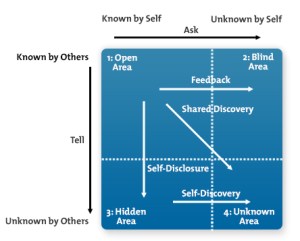
If you have never encountered it before, I commend to you the model called the Johari Window. I have written about it in the past in the context of honesty and dishonesty.

The model illustrates just how complex our personalities are. The arrows on the model below reveal how we can expand the “open” part of ourselves. Naturally, there are some “hidden” aspects that should only be disclosed in certain contexts.

When it comes to the darkness in our lives, that which we strive to keep veiled, psychologists describe it in a variety of ways. One chaplain with whom I worked was particularly enamored with the work of Carl Jung. He loved to toss around the word “shadow,” and suggest there was some dark psychological significance to even the most offhand comment or expression. In essence, the shadow is the part of our personality we don’t want to admit to having. In terms of the Johari Window, you might think of it as the sinister stuff in the Hidden quadrant.*

C.S. Lewis wrote about Jung in an essay entitled “Psycho-Analysis and Literary Criticism.” Lewis disparages the Freudian theory, saying “poetry is not a substitute for sexual satisfaction, nor sexual satisfaction for poetry.” Jung, he argues, presents “a much more civil and humane interpretation of myth and imagery.” Of course, Lewis is discussing these psychoanalysts from the perspective of a literary critic, not a psychologist. In that regard, we can appreciate his assessment of one of Jung’s major works.

Thanks to my training I can suspend my judgement about the scientific value of Jung’s essay on “Mind and the Earth:” but I perceive at once that even if it turns out to be bad science it is excellent poetry.

From the Christian Point of View

I have already described how confession can serve as a means of expanding our self-awareness in a constructive and healing way. That’s why confession and absolution are a formal part of many worship service, going back to the earliest times. If we want to read the finest primer on confession, we need look no further than the book of Psalms.

As King David, in recognition of this great sins, prays in the fifty-first psalm:

Have mercy on me, O God,
according to your steadfast love;
according to your abundant mercy
    blot out my transgressions.
Wash me thoroughly from my iniquity,
    and cleanse me from my sin!

One of the earliest Christian classics (outside the Bible itself) was aptly entitled Confessions. It was written by Augustine, the bishop of a North African city called Hippo. His description of our self-awareness is so deep and profound, it will likely require more than a single reading.

No one knows what he himself is made of, except his own spirit within him, yet there is still some part of him which remains hidden even from his own spirit; but you, Lord, know everything about a human being because you have made him . . .

Let me, then, confess what I know about myself, and confess too what I do not know, because what I know of myself I know only because you shed light on me, and what I do not know I shall remain ignorant about until my darkness becomes like bright noon before your face. (Augustine, The Confessions, translation by Maria Boulding)

One of C.S. Lewis’ many correspondents was a man who was acutely troubled by his own self-awareness, and in particular, the consciousness of his own selfishness and egotism. Lewis offered some comforting and sound spiritual direction to the man. Since I believe the letter has a message for us all, I choose to close with it.

You are of course perfectly right in defining your problem (which is also mine and everyone’s) as “excessive selfness.” But perhaps you don’t fully realise how far you have got by so defining it. All have this disease: fortunate are the minority who know they have it.

To know that one is dreaming is to be already nearly awake, even if, for the present, one can’t wake up fully. And you have actually got further than that. You have got beyond the illusion (very common) that to recognise a chasm is the same thing as building a bridge over it.

Your danger now is that of being hypnotized by the mere sight of the chasm, of constantly looking at this excessive selfness. The important thing now is to go steadily on acting, so far as you can—and you certainly can to some extent, however small—as if it wasn’t there. You can, and I expect you daily do—behave with some degree of unselfishness. You can and do make some attempt at prayer.

The continual voice which tells you that your best actions are secretly filled with subtle self-regard, and your best prayers still wholly egocentric—must for the most part be simply disregarded—as one disregards the impulse to keep on looking under the bandage to see whether the cut is healing. If you are always fidgeting with the bandage, it never will

A text you should keep much in mind is I John iii, 20: “If our heart condemns us God is greater than our heart.” I sometimes pray “Lord give me no more and no less self-knowledge than I can at this moment make a good use of.” Remember He is the artist and you are only the picture. You can’t see it. So quietly submit to be painted—i.e. keep on fulfilling all the obvious duties of your station (you really know quite well enough what they are!), asking forgiveness for each failure and then leaving it alone. You are in the right way. Walk—don’t keep on looking at it.


* In contrast to the insignificant or embarrassing things we are aware of that we may prefer to keep to ourselves. For example, although I sing decently, I am an exceptionally poor instrumentalist. This despite the fact I married a talented and patient music teacher. It’s not my lack of talent which motivates my secrecy, it is the sad fact that I am a total sluggard when it comes to practicing. And this reveals a major flaw in my personality—if something is not inherently fun or doesn’t come easily to me, I have a terribly difficult time applying myself to the task. (And this shortcoming has very real consequences, both in terms of professional success and interpersonal relationships.)

⁑ Several years ago, a member of our Mere Inkling described in her blog how everyone experiences seasons of restlessness.

In his Confessions, Augustine wrote, “Thou hast made us for thyself, O Lord, and our heart is restless until it finds its rest in thee.” Yet even those who have found Christ feel restless at certain times, and these times lead us to a salutary discovery.

Augustine’s Confessions is a Christian classic. You can download a free copy here.

A Better Wig

wigHow important is honesty? When is it okay to fudge on the truth? If the main point is valid, how necessary is it to keep all of the details straight?

I just read a bizarre story that got me thinking about this subject. A director of Senior Services in Rhode Island wanted to promote snow removal assistance for the elderly, and couldn’t rustle up a suitable “Cranston Senior Home Resident” to be featured during a news report.

So, she did the next best thing. She manufactured one.

The only apparent flaw in her plan was forgetting that such facilities also have male residents. So, the bus driver she pressed into the role had to don a wig, makeup and earrings. (Perhaps she just thought that an elderly female would elicit greater sympathy.

At any rate, her nefarious plot was revealed when local television viewers did not fall for the questionable disguise. The coup de grâce, or the punch line as you may read it, came in the pronouncement of the salon owner who prepped the man for his debut.

“I probably would have given him a better wig if I had known.”

You see, the problem wasn’t the misrepresentation. The error was in not doing it persuasively.

I suppose this odd story struck me as timely (even though it apparently occurred this past winter) because we in the United States are currently suffering in the midst of a lengthy presidential primary season. (No comments, please, on whether any of the candidates might benefit from wearing “a better wig.”)

C.S. Lewis & the Subject of Deception

C.S. Lewis thought a great deal about the subjects of truth, and deception. For much of his life, well into adulthood, he was deceived by sirens who denied the reality of a loving God.

One of his accurate observations is that deception must be reasonable to be successful.

Nothing can deceive unless it bears a plausible resemblance to reality. (“An Experiment in Criticism”)

Obviously, the incident above did not pass the plausibility standard.

In the same essay, Lewis declared scenarios that represent imaginary realities as being innocent of deception.

No one can deceive you unless he makes you think he is telling the truth. The un-blushingly romantic has far less power to deceive than the apparently realistic. Admitted fantasy is precisely the kind of literature which never deceives at all. Children are not deceived by fairy-tales; they are often and gravely deceived by school-stories. Adults are not deceived by science-fiction; they can be deceived by the stories in the women’s magazines. (“An Experiment in Criticism”).

We would be inclined today to add “men’s magazines” as an equally disingenuous source. I believe Lewis was referring to the kind of story that manipulates one’s emotions and exaggerates reality to provoke the desired response.

Self-Deception as a Danger

As a Christian, Lewis reflected in great depth on how prone you and I are to deceiving ourselves. Some of this self-deception is not intentional. In correspondence with an American acquaintance he discussed Martin Buber’s book, I and Thou.

What I had not yet thought about was your objection, that he ignores the Me. You are probably right. He might even have said that just as the Thou is deeper than the Me, so the I is deeper than the Me. For I believe self consciousness to be full of deception and that the object I call me and think about (both in my moments of pride and in my moments of humility) is very different from the I who think about it.

I agree with Lewis that we are often unaware of aspects of our own personality. And, unfortunately, we are prone to misperceiving what we do observe. This is not a conscious twisting of the truth to our own benefit, as in proclaiming that we are exceptional and never fail.

johariThis raises the question of our self-awareness. The Johari Window is a simple resource that illustrates the four aspects of our identity, based on two axes—what is known/unknown and by whom the traits are recognized.

You can see how it works out in this simple diagram. And you can read a brief description of the tool here.

It seems evident that one key to living with integrity and enjoying greater happiness is to be honest in all of our dealings. Honest with others. And honest with ourselves.

It was good to be reminded once again of that vital truth.

_____

Here’s a piece of Lewisian trivia. The collection of essays available in the United States as God in the Dock was originally published in the United Kingdom with the title Undeceptions. Ironically, the British reference in the American version of the title still creates confusion for those who don’t realize “in the dock” refers to a person who is on trial.

Writing Life Scripts

ben hurI was shaped by the heroic religious films of the 1950s and 60s. The powerful messages of epic movies like Ben Hur, Quo Vadis and The Robe planted within my young Christian heart an awareness of nobility and radical self-sacrifice.

About twenty years ago, I spent a year doing graduate work in education. One of my Educational Psychology classes was taught by a professor who was a devotee of Transactional Analysis. I don’t recall too much about TA, aside from one of its principles that resonated with me.

It’s a concept called Life Scripts. Without going into great detail, it is an often subconscious notion of how we “think” our lives will or should play out. It’s adjusted throughout our lives, but the basic theme is established when we are quite young.*

A recent article says “script is broadly understood as a series of decisions, formed as coping strategies in childhood, which continue to shape the life course outside of awareness.”**

It was only as an adult that I realized just how significant an impression these virtuous stories made on me. I recalled the countless times I lay in bed at night rehearsing the story of The Robe. I was the unbelieving Roman soldier, converted by the gentle witness of the wrongfully persecuted Christians.*** Ultimately, I took my stand with them, defending them and voluntarily laying down my life for Christ.

That same plot line still echoes through my mind and soul.

I consider myself blessed to have been exposed to such positive influences while my self identity was being shaped. And I pray for children today whose parents allow them to be exposed (at terribly vulnerable ages!) to violent, fearful and morally ambiguous influences.

Those precious minds and hearts are scarred by the vulgarity and immorality that are endemic in modern cinema, television and music. May God have mercy on them.

C.S. Lewis lived during the era when the virtuous dramas such as those named above were at the peak of their influence.

In a diary entry from the mid-1920s, he mentions Quo Vadis in passing. He is describing his weekend schedule.

Saturday 22 April: Got up about 6.30 and did the same jobs as yesterday. Was settled to work by 9.5 o’clock and put in an excellent morning . . . Sheila Gonner—jolly child—came to tea. Dorothy is to come back tomorrow: so we shall no longer be servantless. At her request I lent her my crib to Tacitus’ History for her sister Rose— I wonder what makes her imagine that she would like it? Possibly early Christian novels of the Quo Vadis type. Worked again after tea, and from supper till ten o’clock, finishing Herodotus. The last few pages of the IXth Book I now read for the first time, having got tired of it on my first reading . . .

I find this diary passage intriguing, in the way that Lewis posits a reader’s potential interest in classical literature as arising from their exposure to ancient Rome via contemporary novels. That’s precisely where my own lifelong fascination with the Roman empire was born.

If you’ve never seen these three movies, I commend them to you. I would also encourage you to consider reading one or all of the novels. They are available for free download in various digital formats.

Quo Vadis

Ben Hur

The Robe

_____

* I’m a pastor and historian, not a psychologist, so I don’t pretend to understand all of the implications. Because of that, I don’t endorse TA as a fully valid theory. What’s more, in our fallen world it’s obvious that many early “life scripts” can be based on wounds inflicted on neglected or abused children. In such cases, particularly where the scripts are destructive, we are not “destined” to live out a tragedy. By the grace of God, even the saddest of stories can be redeemed and “rewritten” into tales of hope and wonder.

** From “Script or Scripture?” by Jo Stuthridge in Life Scripts edited by Richard Erskine (Karnac Books, 2010).

*** It didn’t hurt that the main Christian disciple in the film was the lovely and chaste Diana, played by the British actress Jean Simmons. But that’s another story, and it’s important to note that these life scripts are pre-pubescent creations, so they are motivated by much deeper impulses than hormones. As the previously footnoted quotation referred to them, they are fundamentally “coping strategies” for survival in the calm (or frequently turbulent) world in which children find themselves.

Greek Mythology & Modern Humanity

narcissusThere is a very important mental health tome that describes psychological disorders in detail. It’s called The Diagnostic and Statistical Manual of Mental Disorders (DSM).

Since the American Psychiatric Association is constantly discovering new mental ailments—and they occasionally recognize that previously unhealthy mindsets and behaviors have become so pervasive they can no longer be considered aberrations—the DSM requires periodic revision.

The current authoritative version is DSM-IV-TR, or DSM, fourth edition, text revision. That means that if you were diagnosed with a defect according to the third edition standards, you may now have a clean bill of health. And, for those of you whose diagnosis is still included in DSM IV, don’t despair; they are currently consulting about version five, and who knows what psychoses may soon become “normal.”

I had to study these things during my seminary training, for my counseling work as a chaplain and civilian pastor. I was thinking about the manual recently as I pondered the spirit of Narcissus that seems to hold sway in our age. Like C.S. Lewis, I understand there is value in studying Greek and Roman myths, as many contain seeds of Truth. (Lewis’ appreciation for myth is most evident in Till We Have Faces, which is a reworking of one ancient Greek tale.)

Narcissus, of course, is the mythological Greek who was so consumed by his own handsomeness that he perished because he was unable to tear himself away from gazing at his own likeness. (The image above was painted by Michelangelo Caravaggio in the sixteenth century.)

Narcissism, which echoes his name, describes the unbridled vanity and self-concern (i.e. selfishness) that motivates growing numbers in our individualistic and hedonistic world. Since narcissism has become so rampant, the DSM now concerns itself only with “pathological narcissism.” That distinction will probably remain, even if Narcissistic Personality Disorder (NPD) is eliminated from the fifth edition as a distinct illness, as many have recommended.

God Save Us from the Narcissists

Pathological narcissists are terrible indeed. Their characteristic arrogance, envy, sense of entitlement and lack of empathy make them unhealthy members of society. In fact, large numbers of sociopaths and psychopaths are also narcissists.

But here’s the problem. At the rotten core of the disorder we find a putrid seed that negatively affects many of us who appear otherwise to be so normal. The source of the corruption is, in part, sinful pride.

Let’s take a look at the “diagnostic criteria” for NPD which confronted me when I first studied DSM III. (Perhaps you may wish to skip this section, since modest hints of some of these traits may strike close to home.) I’ve added my own introspective comments in italics.

Diagnostic criteria for 301.81, Narcissistic Personality Disorder:

A pervasive pattern of grandiosity (in fantasy or behavior) hypersensitivity to the evaluation of others, beginning by early adulthood and present in a variety of contexts, as indicated by at least five of the following:

(1) Reacts to criticism with feelings of rage, shame, or humiliation (even if not expressed).

— I’ve never “raged,” but it’s embarrassing to be criticized in public

(2) Is interpersonally exploitive: takes advantage of others to achieve his or her own ends.

— Never. I won’t tolerate manipulation–either as the manipulator or the manipulatee.

(3) Has a grandiose sense of self-importance, e.g., exaggerates achievements and talents, expects to be noticed as “special” without appropriate achievement.

— Have I told you lately about being Thespian of the Year when I graduated from high school . . ?

(4) Believes that his or her problems are unique and can be understood only by other special people.

— Not this trait, I’m aware everyone in this fallen world is faced with challenges . . . many of them worse than my own.

(5) Is preoccupied with fantasies of unlimited success, power, beauty, or ideal love.

— I do daydream about accomplishing special goals, although I never lusted after power and I accepted the facts about “beauty” long ago. I have, however, found ideal love, and we’ve been married 37 years!

(6) Has a sense of entitlement: unreasonable expectations of especially favorable treatment, e.g., assumes that he or she does not have to wait in line when others must do so.

— I’m the opposite. I always pick the longest and slowest line to stand in.

(7) Requires constant attention and admiration, e.g., keeps fishing for compliments.

— If people weren’t so frugal with compliments, I wouldn’t need to.

(8) Lack of empathy: inability to recognize and experience how others feel, e.g., annoyance and surprise when a friend who is seriously ill cancels a date.

— Nope. I really do care about others. That’s the reason good clergy and caregivers often suffer compassion fatigue.

(9) Is preoccupied with feelings of envy.

— Well, what about those cases where the person doesn’t deserve the honors they’ve received . . ?

There, I feel much better, having made a public confession of my almost-narcissistic human self-centeredness.

In his essay “Christianity and Culture,” C.S. Lewis warns that “A man is never so proud as when striking an attitude of humility.”

When we admit, instead, that there remains much in our soul that is base and prideful, we’re on the proper path. The course that leads to a rejection of Narcissus-in-us, and the embracing of what is precious in our neighbors and our world, is the road that leads to contentment.