
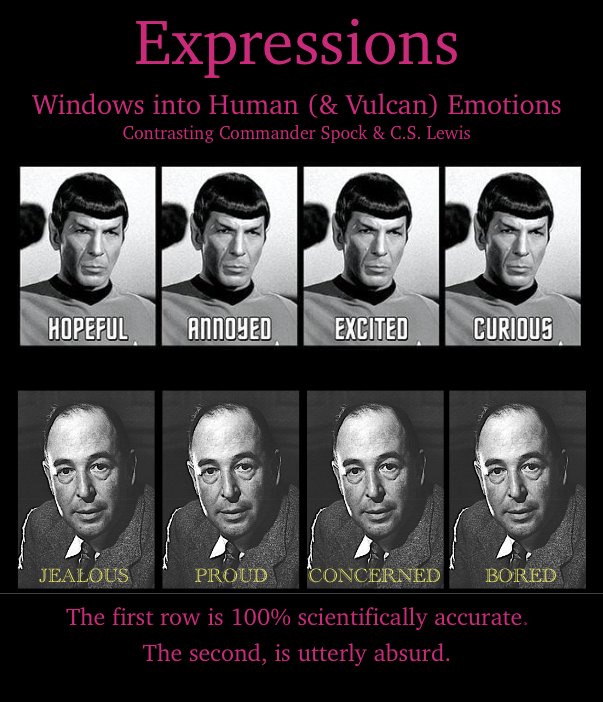
Are you one of those people who pride themselves on not being particularly emotional? Probably not, since the pendulum has swung far in the opposite direction in our current day. (Consider how few clicks a Tik Tok influencer with “flat affect” would get.)
Most of us know some people (most commonly men – forgive me the generalization) who keep their emotions under tight rein.
Back when I was a child, in the mid-twentieth century, it was not uncommon for men to “guard” their notion of masculinity by acting emotionless. And various ethnicities, including my own ancestors, possessed a reputation for being staid.
I can’t recall my Norwegian grandfather, who died when I was about ten, ever expressing truly warm sentiments. I know he must have laughed, and my grandmother had a great sense of humor, but I have no memory of it.
For some reason, many people picture C.S. Lewis as an emotionally sober intellectual. Perhaps it’s because he wrote so many profound essays. The truth is that Lewis was extremely jovial and fun-loving. I have noted some of this humor in the past.
Like most of us, C.S. Lewis’ closest friends saw him most clearly. They witnessed his jocularity in their regular gatherings. His fellow Inklings witnessed it frequently, but I don’t see how anyone can read the Chronicles of Narnia, and perceive their author as reserved, much less grave.
One reason some readers misunderstand C.S. Lewis’ exquisite sense of humor is because it is British. For Americans, for example, appreciating British humor is an acquired taste. As reported by the BBC, the wit often includes elements of “sarcasm, understatement [and] self-deprecation.”
In The Screwtape Letters, C.S. offers an insight into one of the Tempter’s tactics in undermining human nature, in terms of being fashioned in the image of our Creator.
[Englishmen] take their “sense of humour” so seriously that a deficiency in this sense is almost the only deficiency at which they feel shame. Humour is for them the all-consoling and (mark this) the all-excusing, grace of life.
Hence it is invaluable as a means of destroying shame. [. . .] A thousand bawdy, or even blasphemous, jokes do not help towards a man’s damnation so much as his discovery that almost anything he wants to do can be done, not only without the disapproval but with the admiration of his fellows, if only it can get itself treated as a Joke.
And this temptation can be almost entirely hidden from your patient by that English seriousness about Humour. Any suggestion that there might be too much of it can be represented to him as “Puritanical” or as betraying a “lack of humour.”
Lewis’ humor was on full display to his intimate friends, and uninhibitedly on display to the world in a number of his writings. But his openness didn’t end there.
Just Like the Rest of Us:
a Person of Humor and Grief
I don’t recall anyone labeling C.S. Lewis a “humorist” – likely because his corpus is so diverse and complex – but I think a literary critic could make that case.
Ironically, I once cited an autobiographical reference in which C.S. Lewis applied that very attribute to his own father, a serious solicitor.
In contrast, C.S. Lewis would mature to the point where he was willing to expose that deepest of emotions, grief, with the entire world. In A Grief Observed, he explored his pain in the wake of his wife’s untimely passing. Joy Davidman was the precious wife this confirmed bachelor never anticipated having, and her death crippled him.
His description of his thoughts, doubts, and spiritual struggle in the aftermath has helped many others to survive the nightmare of bereavement. Curiously, for privacy C.S. Lewis initially used a pen name for the volume. (You can read about that here.)
He did not wish to have his authorship of the book distract from its subject matter. He would have known that would only be a temporary tool, since pseudonyms are nearly always uncovered. Initially, however, it was so effective that when it was published, readers recognized it could speak to Lewis’ own grief, and offered him gift copies.
T.S. Eliot was one of its first advocates for the volumes publication, and you can read that story at Faber & Faber.
A Final Lewisian Observation on Emotions
Some people view the intensity of emotions associated with events to be a measure of their validity. If my passions are aroused by an activity, we incorrectly think, it must be real!
This error is particularly dangerous when related to so-called “matters of the heart” and matters of faith.
C.S. Lewis was cautious in both realms. We already noted his resignation to live out his life as a single man. In terms of faith, he was just as circumspect. His conversion from atheism to Christianity was long, thoughtful, and reluctant.
And this, I found, was something I had not wanted. But to recognize the ground for my evasion was of course to recognize both its shame and its futility.
I know very well when, but hardly how, the final step was taken. I was driven to Whipsnade [Zoo] one sunny morning. When we set out I did not believe that Jesus Christ is the Son of God, and when we reached the zoo I did.
Yet I had not exactly spent the journey in thought. Nor in great emotion. “Emotional” is perhaps the last word we can apply to some of the most important events.
It was more like when a man, after long sleep, still lying motionless in bed, becomes aware that he is now awake. And it was, like that moment on top of the bus, ambiguous.
Freedom, or necessity? Or do they differ at their maximum? At that maximum a man is what he does; there is nothing of him left over or outside the act.
Certainly, many people are blessed with emotional confirmation in their spiritual lives. The obvious peril, of course, is in evaluating the veracity of something by how giddy it makes us feel.
After all, there will always come “dark nights of the soul” when the feelings have fled . . . but Jesus, still remains.

 Mere Inkling Press