Gathering Palms & Preparing for War

The Christian church has just celebrated Palm Sunday, and I recalled one of my favorite memories in preparing for the journey through Holy Week.

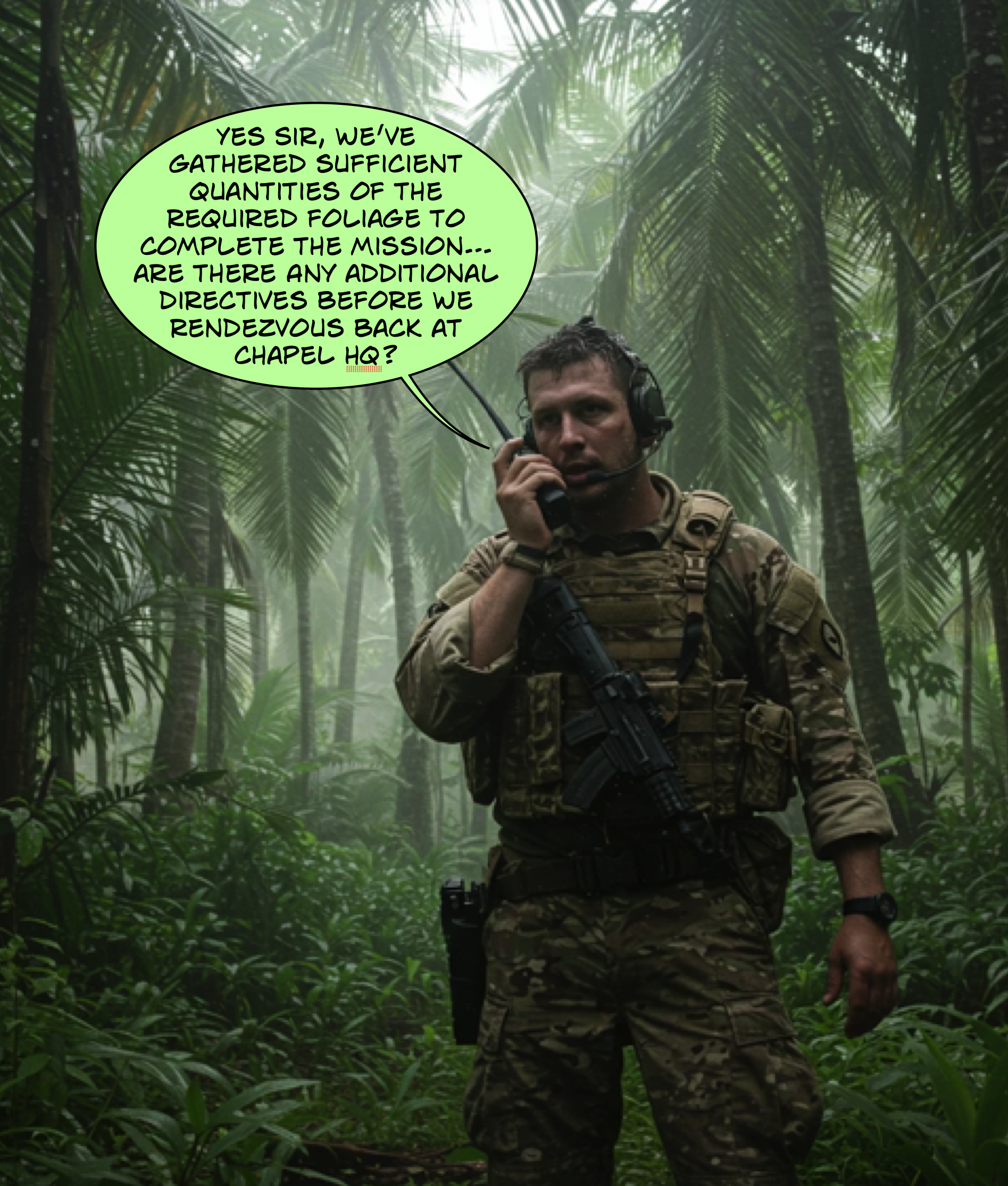
When I was stationed in Guam a few years ago (in the nineties), I enjoyed the annual tradition of gathering all of the palms to decorate the chapel and provide for worshippers in our very own jungle. Each year the chaplains and chaplain assistants, our whole team, would spend half a day gathering leaves that would put to shame any stateside palms.

Taking place in a tropical jungle, the event was sweaty, but fun. Good fellowship and even some seasonal early-Easter music. Fortunately, this didn’t take place during the typhoon season, as when the island was smashed by Super Typhoon Paka during our residency.

Jungles are fascinating places. Because the word possesses some rather ominous and even threatening overtones, a number of years ago they were rechristened “rainforests.” Even though most are tropical, there are temperate rainforests, such as in the Olympic National Forest, whose mountains I admire daily from our backyard.

C.S. Lewis alluded to the negative connotation of jungles in his study of “Vivisection,” with its repudiation of animal cruelty.

In justifying cruelty to animals we put ourselves also on the animal level. We choose the jungle and must abide by our choice.

A Modern Use for Jungles

In recent years, the jungles of Guam have been put to a military use. Unsurprisingly, soldiers and their Marine, Navy and Air Force cousins, must be prepared to do their jobs in a wide range of environments. That results in the existence of a variety of training settings, tuned to the specific needs of particular career fields.

For example, I served as the Wing Chaplain at Fairchild AFB where the USAF trains its pilots and aircrew members how to survive when they find themselves in unfriendly settings. Survival, Evasion, Resistance and Escape (SERE) training saves lives.

Anyway, not long ago the Air Force established a Jungle Agile Combat Employment (JACE) Course in, of all places, Guam.

This new course took knowledge from the U.S. Marine Corps Jungle Warfare Training Center and the Lightning Academy in Hawaii and tweaked it for non-combatant career fields to be prepared under the USAF’s Agile Combat Employment (ACE) concept.

This is part of America’s shift in focus to the threats in the Pacific theater. China has never renounced, and constantly proclaims, its intent to force the Republic of China (Taiwan) into their fascist empire. Of course, the fate of Hong Kong reveals just how unbenevolent the so-called People’s Republic is when it comes to maintaining any semblance of democratic freedoms. 

C.S. Lewis, of course, had much to say about the tragedies of fascism and war. However, that is not the focus of this reflection. Instead, the theme of this post reflects two thoughts. 

The less important idea, to which I have paradoxically devoted the most space, is the value of memories. Guam occupies a very special place in my family’s history, in part because all three of our kids were there during their teens. Lifechanging events occurred there.

And it was the wonderful people, military friends and wonderful Chamorro residents that made the most lasting impressions. Remembering the harvesting of palms, and recently learning about the jungle training course turned my thoughts back to that Micronesian paradise.

What’s Truly Vital

The infinitely more important message in this post is to acknowledge the holiest of seasons in which we find ourselves. Beginning with Palm Sunday’s celebration of the joy experienced by God’s people as they welcomed their Messiah into Jerusalem, we have the opportunity now to also join together with Jesus and our brothers and sisters in the faith as we:
~ commemorate the institution of the Lord’s Supper on Maundy Thursday,
~ contemplate the despair of the disciples as they stood at the foot of the cross as Jesus breathed his last mortal breath on Good Friday, and
~ celebrate in awe and wonder how our Savior rose from the grave and encouraged his disciples before ascending to Heaven and resuming his place at the right hand of God the Father. 

Christ’s atoning death, and his glorious resurrection, give us hope in the depths of our despair. And his promised return ensures us that there truly will come a day when we need never again prepare for war – or ever taste the pain of death.

We do well to heed C.S. Lewis’ encouragement to his friend Don Giovanni Calabria in 1948, when the priest was distraught over the troubles transpiring around the world.

Tomorrow [Easter] we shall celebrate the glorious Resurrection of Christ. I shall be remembering you in the Holy Communion. Away with tears and fears and troubles!

United in wedlock with the eternal Godhead Itself, our nature ascends into the Heaven of Heaven. So it would be impious to call ourselves “miserable.”

On the contrary, Man is a creature whom the Angels – were they capable of envy – would envy. Let us lift up our hearts! At some future time perhaps even these things it will be a joy to recall.

Theological Humor

Pope Francis jokes with a newlywed couple in Rome.

Don’t be surprised, but many clergy possess keen senses of humor. Sure, there are staid, grimacing ministers who consider acting dour to be a virtue. (They’re often legalistic.) But most of the pastors and military chaplains I’ve worked beside, love to laugh. I think I’ve written enough about humor to verify that.

C.S. Lewis maintained strong bonds with a number of clergy, from a variety of denominations, and that would hardly have been true if they had lacked a sense of humor. Humor, to Lewis, is an essential part of life. He proclaims this truth from the lips of Aslan himself, as the newly created Talking Animals hear the first (accidental) joke.

“Laugh and fear not, creatures. Now that you are no longer dumb and witless, you need not always be grave. For jokes as well as justice come in with speech.” (The Magician’s Nephew)

I recently read about a fascinating incident one historian described as “perhaps the only really satisfactory practical joke in the whole history of theology.” Allow me to set the scene.

The Byzantine Empire lasted for a thousand years, before being defeated and desecrated* by Islamic armies. During the centuries surrounding its apex, it suffered from the political intrigue and competition with which we are all too familiar.

Photios I was a Byzantine scholar who was twice the Patriarch of Constantinople during the ninth century. Twice is unusual, but it was due to the machinations of emperors and empresses who meddled in the affairs of the church.

He had a troubled relationship with another priest named Ignatius, who also served two times as Patriarch. The good news is that the men were eventually reconciled and both are regarded by Orthodox Christians as saints.

The anecdote comes from the period of their rivalry. Photios, whose brilliance was widely acknowledged, and presumably envied by Ignatius, decided to pull an embarrassing public prank on his nemesis.

Photios devised a bizarre theory that human beings have two souls. His goal was to trick Ignatius into taking it seriously, whereupon Photius withdrew the thesis and admitted he had not been serious. Apparently, everyone unsatisfied with Ignatius’ leadership found it quite entertaining.

Fortunately, among clergy the humiliation of others is rarely the object of humor. Yet, sadly, I have seen it attempted. I personally repent of ever having done so myself, and regard it as sharing, along with vulgarity and blasphemy, the lowest level of “humor.” 

The Wisdom of Lewis

In Reflections on the Psalms, C.S. Lewis relates something I know to be true from my own experience.

A little comic relief in a discussion does no harm, however serious the topic may be. (In my own experience the funniest things have occurred in the gravest and most sincere conversations.) 

Clergy deal with serious topics, like death, quite frequently. Perhaps that is one reason a well-developed sense of humor is common among their ranks.


Skip this footnote if you want to end on a “happy” note.

* “Desecration” may sound like a harsh word to our interfaith-sensitive ears, but it is accurate here. Islam is rarely a gentle master for Christians, and it has been common to see churches and holy places seized and converted to foreign religious uses. For example, in the capital Constantinople (now called Istanbul), Orthodox Christianity’s most magnificent church, Hagia Sophia, saw much of its glorious and historic iconography destroyed when it was converted to a mosque. Many years later, in 1934, an enlightened Turkish government ended the insult, and chose to treat the holy place as a museum. Sadly, the current regressive government under Recep Tayyip Erdoğan, reversed that decision, and in 2020 the Church of Holy Wisdom was returned to its usage as a mosque.

An Interstellar Accomplishment

Whoever says “getting there is half the fun” is not referring to the arduous journey undertaken by writers seeking publication.

We writers – I say “we” because odds are you share my literary interests – we writers believe we have something to say that is worth hearing. Something that can genuinely benefit others.

That’s why we undertake the labor of writing, often without any financial reward. That’s why we risk revealing ourselves, becoming vulnerable to criticism and even ridicule.

This desire to share is why we invest the time and emotional energy required to imprint our thoughts and feelings on paper, literal and digital. It’s also the reason we strive to improve our literary skills. Writing well, is not easy.

Some writers enjoy the actual process of writing, but for many of us it is too akin to “work” to be considered fun. A decade ago, I wrote about “The Satisfaction of Writing.” 

In the post I confessed I don’t find the writing process all that grand. It was enlightening when I realized it’s not writing I enjoy, but the “satisfaction of having written.” And, having something published multiplies that level of satisfaction, particularly when what I have written finds a home in a publication edited by others.

And that brings me to my good news.

My Recent Publication

This week I received a complimentary copy of a new volume published by Rowman & Littlefield, an academic publishing house.

Theology and Star Trek gathers a group of scholars from various religious and theological disciplines to reflect upon the connection between theology and Star Trek anew.

Among the twenty chapter essays included in the volume is one written by yours truly. In “Starfleet’s AWOL Chaplain: Why Star Trek’s Federation Lacks Chaplains,” I explore Gene Roddenberry’s firm rejection of chaplains in his fictional universe.

I have been a fan of Star Trek ever since I watched the first episode of the original series air on September 8, 1966. And I am extremely proud to have contributed a chapter to Theology and Star Trek.

Allow me to share with you an insight I gained from this experience. It has to do with the project’s extended timeline. Admittedly, part of the delay was apparently caused by the covid epidemic, but even without that interruption, it takes a long time for an academic collection such as this to finally see print.

In October of 2018, I learned about the project and submitted an initial proposal for inclusion in the book. On New Year’s Eve I received acceptance of the proposal and an invitation to submit a “manuscript of approximately 5,000 words” by the first of May 2019. Deadline was extended to June first. First draft was mailed to the co-editors. After my extensive research, the manuscript numbered an immodest 17,442 words.

On July first I accepted the invitation to abbreviate my manuscript, which might be published in some future day, in an appropriately independent version as “a short book.” Revised chapter forwarded on 11 July: “Full word count now is 5549, but since 1528 are in the endnotes, the actual text for the chapter is only 4011, of which 169 constitute the abstract.”

Nearly a year later, on June 9, 2020, I received editorial suggestions from the editors and on June 30, 2020 I submitted my edited chapter. On September 11, 2021, the editors apologized for delays and said they were sending all of the essays out for peer review. On  June 11, 2022 I inquired with the editors as to whether the project may have been dropped, and was pleased to learn that it was still underway. The editor said the essays had been returned to writers to incorporate peer review comments. Since my essay had “only minor comments,” they were able to amend it without involving me. 

In July 2022 we worked together online with the Index, and reviewed our bio entries for the volume. On March 17, 2023 the publisher’s proofs for Theology and Star Trek were available for our personal review of our essays. April 11, 2023 marked completion of the corrected proof copy, and we added the actual pages for each of the subjects we had added to the index. Sent my final confirmation of the indexing, noticed a minor error in my chapter that was too late to fix, and waited for the arrival of my copy of the finished work . . . which arrived slightly under five years after I asked to join the project.

Lessons learned: (1) be more conscientious about meeting the word length guidelines, (2) be patient, and (3) remain patient.

Even as I share this extended timetable, I’m conscious of the fact I am no expert on the subject. I feel a bit like the people to whom C.S. Lewis referred in a 1952 letter to his publisher, Geoffrey Bles.

I often smile when I compare my ignorance with the knowingness of some people who, on the strength of having published one book, seem to have the whole mystery of publishing, printing, & binding by heart.

Advice to Writers

If you’ve followed Mere Inkling for a while, you’re aware I occasionally offer modest writing tips. 

Two years ago I wrote a post entitled “Are You an Author or an Editor?” In it I discussed some distinctions between different aspects of our writing lives. In “C.S. Lewis and the Oddities of Editors,” I highlighted that great author’s amazement at the arbitrary decisions made by editors.

I discussed a skill I have never mastered in “Brevity & Clear Communication.” In “Does Sincerity Result in Good Writing” I discussed C.S. Lewis’ thoughts about The Pilgrim’s Progress.

In “On Choosing Between a Child and a Book,” I even addressed the delicate subject of whether an individual would prefer to leave a book, rather than a child, as their legacy. Several more articles on related subjects are linked here.

A Word of Encouragement

Sadly, many aspiring writers feel like they will never “arrive” – in terms of seeing their words in “traditional” print. We must, nevertheless, remain persistent since, if we quit writing, that end is all but guaranteed.

However, when we read widely, and physically sit down with pen or keyboard, our chance of seeing our name in print rises geometrically. When we continue to study the art of writing and when we continue to sharpen our skills by stretching beyond our comfort zones, our efforts are often rewarded.

The internet abounds with stories of people who were not published until late in life. And there are many whose work only gained fame after their deaths.

Some popular writers, including C.S. Lewis and J.R.R. Tolkien, were prolific. They enjoyed some renown during their lives, but have only grown in their popularity posthumously. Many writers have left unfinished projects which have been published after their passing. In the case of these Inklings, this effort was spearheaded by Lewis’ secretary Walter Hooper and Tolkien’s son Christopher.

Waterstones, the British bookseller,  goes so far as to say “J.R.R. Tolkien is arguably one of the most posthumously-published authors there has ever been. The Silmarillion was compiled from notes he left behind, likewise The Children of Hurin and, in 2014, Tolkien’s prose translation of Beowulf was released.”

It may be unlikely that you are I will have anything published after our life ends. But, the words we pen might one day prove a blessing to others in a future family memoir. 

I encourage you to continue to write, whether publishers reinforce you or not. However small your audience may seem, virtually everyone recognizes there is value in expressing ourselves in this way. 

And, may the cost of your literary labors be outweighed by the satisfaction you gain as its reward.

Star Trek Postscript

Yes, if you check out the publication site, you will see that my name is listed last among all of Theology and Star Trek’scontributors. Even if this isn’t a consequence of alphabetical considerations, I’m not bothered. My simple inclusion in the volume is sufficient . . . and we struggling writers must never forget the words of Matthew 20:16.

C.S. Lewis and Self-Awareness

Who are you? If you were to fully answer that question, it would require serious introspection. However, if you were to answer it completely, it would also require an honesty that is extremely rare.

That’s because anyone who reveals everything about themself, comes to a point where the qualities and actions are no longer flattering. They ultimately arrive at the place where the exposé becomes a confession.

The truth is that no one actually knows everything about themself. But some of the things we are aware of . . . some of the secrets we desire to hide, even from ourselves . . . are seldom shared. That is one great value of the “confessional.” There, one can unburden themselves and face their demons, so to speak, in a setting where they know their confidence won’t be violated.

As a Protestant pastor, who has never used a physical confessional stall or screen, I note that I have nevertheless heard thousands of confessions. They are, as one would expect, a common element of counseling as people seek to experience healing and restoration. As a Lutheran, I belong to a tradition that guarantees the privacy of these confessions, or what is considered “privileged communication.” Moreover, as a military chaplain, I was grateful to serve a nation that enshrines the same promise in the Uniform Code of Military Justice.

As Lewis wrote, “if there is a particular sin on your conscience, repent and confess it” (Letters to an American Lady). Once that is done, the pastor (or any “confessor”) can assist the individual with working to make as right as possible in the future what was damaged or destroyed by their choices in the past.

From the Psychological Vantage Point

If you have never encountered it before, I commend to you the model called the Johari Window. I have written about it in the past in the context of honesty and dishonesty.

The model illustrates just how complex our personalities are. The arrows on the model below reveal how we can expand the “open” part of ourselves. Naturally, there are some “hidden” aspects that should only be disclosed in certain contexts.

When it comes to the darkness in our lives, that which we strive to keep veiled, psychologists describe it in a variety of ways. One chaplain with whom I worked was particularly enamored with the work of Carl Jung. He loved to toss around the word “shadow,” and suggest there was some dark psychological significance to even the most offhand comment or expression. In essence, the shadow is the part of our personality we don’t want to admit to having. In terms of the Johari Window, you might think of it as the sinister stuff in the Hidden quadrant.*

C.S. Lewis wrote about Jung in an essay entitled “Psycho-Analysis and Literary Criticism.” Lewis disparages the Freudian theory, saying “poetry is not a substitute for sexual satisfaction, nor sexual satisfaction for poetry.” Jung, he argues, presents “a much more civil and humane interpretation of myth and imagery.” Of course, Lewis is discussing these psychoanalysts from the perspective of a literary critic, not a psychologist. In that regard, we can appreciate his assessment of one of Jung’s major works.

Thanks to my training I can suspend my judgement about the scientific value of Jung’s essay on “Mind and the Earth:” but I perceive at once that even if it turns out to be bad science it is excellent poetry.

From the Christian Point of View

I have already described how confession can serve as a means of expanding our self-awareness in a constructive and healing way. That’s why confession and absolution are a formal part of many worship service, going back to the earliest times. If we want to read the finest primer on confession, we need look no further than the book of Psalms.

As King David, in recognition of this great sins, prays in the fifty-first psalm:

Have mercy on me, O God,
according to your steadfast love;
according to your abundant mercy
    blot out my transgressions.
Wash me thoroughly from my iniquity,
    and cleanse me from my sin!

One of the earliest Christian classics (outside the Bible itself) was aptly entitled Confessions. It was written by Augustine, the bishop of a North African city called Hippo. His description of our self-awareness is so deep and profound, it will likely require more than a single reading.

No one knows what he himself is made of, except his own spirit within him, yet there is still some part of him which remains hidden even from his own spirit; but you, Lord, know everything about a human being because you have made him . . .

Let me, then, confess what I know about myself, and confess too what I do not know, because what I know of myself I know only because you shed light on me, and what I do not know I shall remain ignorant about until my darkness becomes like bright noon before your face. (Augustine, The Confessions, translation by Maria Boulding)

One of C.S. Lewis’ many correspondents was a man who was acutely troubled by his own self-awareness, and in particular, the consciousness of his own selfishness and egotism. Lewis offered some comforting and sound spiritual direction to the man. Since I believe the letter has a message for us all, I choose to close with it.

You are of course perfectly right in defining your problem (which is also mine and everyone’s) as “excessive selfness.” But perhaps you don’t fully realise how far you have got by so defining it. All have this disease: fortunate are the minority who know they have it.

To know that one is dreaming is to be already nearly awake, even if, for the present, one can’t wake up fully. And you have actually got further than that. You have got beyond the illusion (very common) that to recognise a chasm is the same thing as building a bridge over it.

Your danger now is that of being hypnotized by the mere sight of the chasm, of constantly looking at this excessive selfness. The important thing now is to go steadily on acting, so far as you can—and you certainly can to some extent, however small—as if it wasn’t there. You can, and I expect you daily do—behave with some degree of unselfishness. You can and do make some attempt at prayer.

The continual voice which tells you that your best actions are secretly filled with subtle self-regard, and your best prayers still wholly egocentric—must for the most part be simply disregarded—as one disregards the impulse to keep on looking under the bandage to see whether the cut is healing. If you are always fidgeting with the bandage, it never will

A text you should keep much in mind is I John iii, 20: “If our heart condemns us God is greater than our heart.” I sometimes pray “Lord give me no more and no less self-knowledge than I can at this moment make a good use of.” Remember He is the artist and you are only the picture. You can’t see it. So quietly submit to be painted—i.e. keep on fulfilling all the obvious duties of your station (you really know quite well enough what they are!), asking forgiveness for each failure and then leaving it alone. You are in the right way. Walk—don’t keep on looking at it.


* In contrast to the insignificant or embarrassing things we are aware of that we may prefer to keep to ourselves. For example, although I sing decently, I am an exceptionally poor instrumentalist. This despite the fact I married a talented and patient music teacher. It’s not my lack of talent which motivates my secrecy, it is the sad fact that I am a total sluggard when it comes to practicing. And this reveals a major flaw in my personality—if something is not inherently fun or doesn’t come easily to me, I have a terribly difficult time applying myself to the task. (And this shortcoming has very real consequences, both in terms of professional success and interpersonal relationships.)

⁑ Several years ago, a member of our Mere Inkling described in her blog how everyone experiences seasons of restlessness.

In his Confessions, Augustine wrote, “Thou hast made us for thyself, O Lord, and our heart is restless until it finds its rest in thee.” Yet even those who have found Christ feel restless at certain times, and these times lead us to a salutary discovery.

Augustine’s Confessions is a Christian classic. You can download a free copy here.

Good, Bad and Ugly Hymns

There’s good “church music.” There’s mediocre church music. (And, there’s even terrible church music.) Read on and I’ll provide a link to an article I wrote about one questionable ditty that wormed its way into a military hymnal.

C.S. Lewis was not a fan of most church music. I’ve written about his musical tastes previously.

His assessment is no secret. He deemed most hymns to be “fifth-rate poems set to sixth-rate music.”

When it comes to hymns, there is general agreement on what’s good. These songs have passed the test of time. They have proven edifying and inspirational for generations. Some contemporary music is also biblically faithful and possesses the potential to join the ranks of the church’s lasting hymnody.

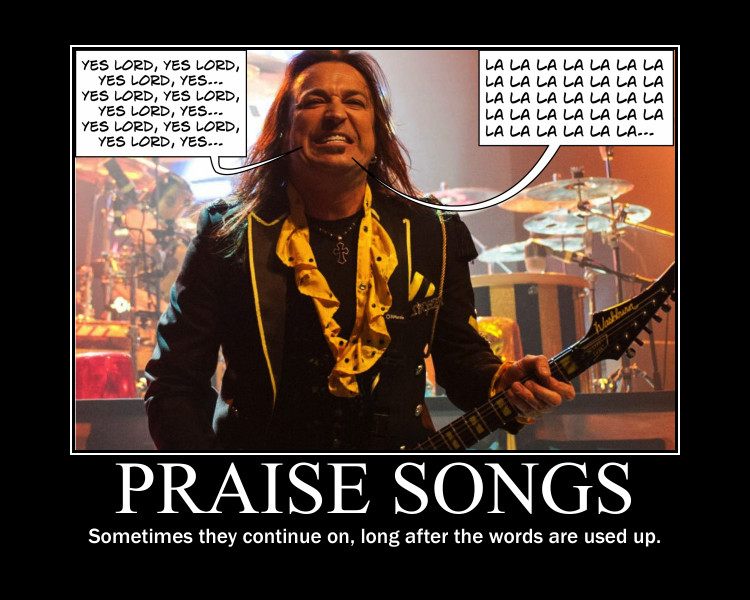
Then there are the others. Uninhibited redundancy, for example, suggests a corresponding shallowness. I forego the idiom about something being broad but shallow, since such songs are actually narrow and shallow. Case in point, the song “Yes, Lord.”

It begins promisingly enough:
I’m trading my sorrow
I’m trading my shame
I’m laying it down for the joy of the Lord

Then the theology gets a wee bit blurrier, especially for believers who still suffer after praying for healing:

I’m trading my sickness
I’m trading my pain
I’m laying it down for the joy of the Lord

But it’s the chorus that undermines the song’s edificatory potential.

And we say
Yes Lord yes Lord yes yes Lord
Yes Lord yes Lord yes yes Lord Amen

Yes Lord yes Lord yes yes Lord
Yes Lord yes Lord yes yes Lord Amen

The last two chorus breaks are replaced by the less challenging:

La la la la la la
La la la la la
La la la la la la
La la la la la
La la la la la la la la la
La la la la

La la la laLa la
La la la la la
La la la la la la
La la la la la
La la la la la la la la la
La la la laLa la la la

To those of you who adore this particular song—please accept my apologies for singling it out. Yet I stand by my view of these lyrics. And I can certainly imagine what C.S. Lewis would have thought of it.

The Power of Music

Various Christian leaders have expressed the opinion it’s more important to write the church’s hymns than its theological books. Hopefully that’s hyperbole, but few would deny the words we sing directly influence our thinking.

Arius, one of the early heretics who denied the divinity of Christ, knew this. His movement created tremendous confusion and resulted in much persecution. One of his most successful tools consisted of composing heretical songs. The words were “religious,” and the tunes were catchy, so people were singing them even when they didn’t agree with his doctrine.

C.S. Lewis & Church Music

As mentioned above, C.S. Lewis was very candid about his own disaffection for most church hymnody. In “Answers to Questions on Christianity,” Lewis answers the question of whether it’s necessary to attend worship services. He describes how duty rather than desire brought him to congregational worship.

When I first became a Christian . . . I thought that I could do it on my own, by retiring to my rooms and reading theology, and I wouldn’t go to the churches and Gospel Halls; and then later I found that it was the only way of flying your flag . . .

[However,] I disliked very much their hymns, which I considered to be fifth-rate poems set to sixth-rate music. But as I went on I saw the great merit of it. I came up against different people of quite different outlooks and different education, and then gradually my conceit just began peeling off.

I realized that the hymns (which were just sixth-rate music) were, nevertheless, being sung with devotion and benefit by an old saint in elastic-side boots in the opposite pew, and then you realize that you aren’t fit to clean those boots. It gets you out of your solitary conceit.

In light of Lewis’ attitude toward religious hymnody, it’s ironic that in 1946 he was invited to help evaluate new hymns.

The Hymn Society of Great Britain and Ireland is opening a file of new hymns to which modern hymn-writers are to be asked to contribute. I have been asked to write to you and ask if you will be a member of the panel to whom new hymns may be submitted in order that their merit may be assessed . . .

Lewis’ response to the invitation is as revealing as it is (unintentionally, I’m sure) curt.

The truth is that I’m not in sufficient sympathy with the project to help you. I know that many of the congregation like singing hymns: but I am not yet convinced that their enjoyment is of a spiritual kind. It may be: I don’t know.

To the minority, of whom I am one, the hymns are mostly the dead wood of the service. Recently in a party of six people I found that all without exception would like fewer hymns. Naturally, one holding this view can’t help you.

Two months later, the men exchanged letters again, and Lewis clarified his thoughts.

I can’t quite remember my own last letter; but I was wrong if I said or implied that . . . hymns, were bad in principle. . . . In modern England, however, we can’t sing—as the Welsh and Germans can. Also (a great pity, but a fact) the art of poetry has developed for two centuries in a private and subjective direction.

That is why I find hymns ‘dead wood.’ But I spoke only for myself and a few others. If an improved hymnody—or even the present hymnody—does edify other people, of course it is an elementary duty of charity and humility for me to submit. I have never spoken in public against the use of hymns . . .

The Gospel Coalition has an informative essay on Lewis’ broader view of worship here.

The Armed Forces Hymnal Scandal

At the outset of this column I promised readers a link to a recently published article. If you would like to read about a bizarre hymn that (temporarily) slithered into the Book of Worship for United States Forces, check it out here. The article begins on page fifteen of the new issue of Curtana: Sword of Mercy.

The hymn in question may be thought-provoking, but it belongs in a discussion group, not in a worship service. The lyrics are placed on the tongue of thief crucified beside Jesus. The criminal who was not invited by Jesus to “be with [him] in paradise” (Luke 23). The first stanza will amply illustrate the spirit of the piece.

It was on a Friday morning that they took me from my cell,
And I saw they had a carpenter to crucify as well
You can blame it on to Pilate, you can blame it on the Jews,
You can blame it on the Devil, It’s God I accuse.
(Refrain)
It’s God they ought to crucify, instead of you and me.
I said to the carpenter a-hanging on the tree.

If you read the article, and consider me unfair to the song’s writer, please leave a comment below. I would love the chance to respond. Likewise, if you think I’ve been too harsh in my evaluation of “Yes, Lord.” Given a choice between mediocre and terrible hymns, there’s no contest.

One wonders how Lewis would have rated “It was on a Friday Morning.” I suspect it would not even rise to the bar of being a “fifth-rate poem.”

C.S. Lewis’ Wedding

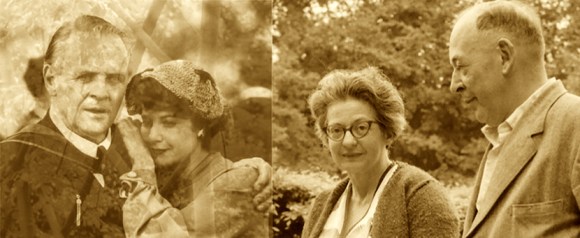
jack & joyC.S. Lewis put his priest in an awkward position, relying on him to perform a wedding ceremony that was contrary to church rules—for at least two reasons. (More on this below.)

I performed a wedding this past weekend. Clergy commonly say “I married so-and-so,” but that phrase sometimes leads to confusion, and occasionally elicits snickers.

At any rate, I’m marrying fewer couples now that I’m semi-retired. Serving as a military chaplain, with a youngish population, I sometimes got weighed down by the number of requests to conduct wedding ceremonies. That’s no longer the case, although ironically both bride and groom in this case are on active duty in the United States armed forces (the Air Force and Army respectively).

The reason I allude to weddings being a bit of a burden, is that—for the conscientious pastor, which I strive, imperfectly, to be—they involve far more than the ceremony itself.

The majority of pastors I know require premarital counseling . . . and that requires time. It may come as a shock to some, but pastors don’t schedule those counseling sessions for their own benefit. Pastors provide them (and even require them) for the benefit of the couple. It’s called “pastoral care,” and decently done, it can only enhance the chances for a marriage’s success.

This was one of those wonderful weddings where I am quite confident the couple will live happily ever after. I really don’t mean to be trite, but they have the qualifications that strongly influence marital success, e.g. emotional maturity and a shared faith in Christ (who will be the cornerstone of their union, just as he is of the Church).

They understand, insofar as our finite minds are capable, that God truly has accomplished the miracle of making of the two of them a single flesh. And now they are living out that adventure.

So, as I write this post my thoughts are not about Independence Day (although it is the fourth day of July). Instead I’ve been rereading the story of C.S. Lewis’ two weddings with Joy Davidman. Their initial union was a sham, in the sense that it was a legal act conducted for ulterior reasons (circumventing immigration laws).

And this fact, that they were not married with the intention of truly being husband and wife, is one reason to validly question the validity of the very act.

If you’ve never read about Joy, or at least viewed the film Shadowlands, you are missing out on a fascinating story . . . and you lack familiarity with one of the most important elements of C.S. Lewis’ life. I’ve briefly discussed Lewis and Joy at Mere Inkling in the past, including “Dating Like an Inkling” and “C.S. Lewis and Women.”

When the two of them married, it was in a purely civil ceremony, on 23 April 1956, in Oxford. Naturally, they continued to live separately.

Only after she was diagnosed with terminal cancer did Lewis realize he had fallen in love. He accordingly sought to make of their fiction a true marriage. This meant, for Lewis and Joy, marrying “in the church.”

Unfortunately, the Church of England would not sanction the marriage, since Joy was divorced. (The fact that her husband, William Gresham was a serial adulterer did not excuse that fact.)

And thus we arrive at the focus of my reflection.

Since the church could not officially bless his marriage, Lewis turned to an Anglican priest who was a former student and a personal friend. His name was Peter Bide.

Pastoral Flexibility

I suspected that the Reverend Bide needed to give the request some prayerful consideration. After all, a pastor does not “bend” the practices of the church (and faith) he represents without serious reflection. Still, Christian ministers do possess what is referred to as pastoral discretion.

The concept is already developed in early Christian theology. In the Orthodox churches, it is referred to as pastoral economy (οἰκονομία, oikonomia). It relates to the pastoral principle of following the spirit, rather than the strictest letter of the law.*

Joy’s death was thought to be imminent when Bide joined them in marriage at her hospital bedside. Yet, they were blessed with a three year remission of the cancer, and enjoyed some precious time together before its grim return. Bide had initially been asked by Lewis simply to come and pray for her.

In a fascinating letter to Dorothy Sayers, written on the 25th of June, Lewis alludes to this concept while relating his special news.

I ought to tell you my own news. On examination it turned out that Joy’s previous marriage, made in her pre-Christian days, was no marriage: the man had a wife still living. The Bishop of Oxford said it was not the present policy to approve re-marriage in such cases, but that his view did not bind the conscience of any individual priest.

Then dear Father Bide (do you know him?) who had come to lay his hands on Joy—for he has on his record what looks very like one miracle—without being asked and merely on being told the situation at once said he would marry us. So we had a bedside marriage with a nuptial Mass.

It is interesting that Lewis uses the words “without being asked.”

That’s not quite how Bide recalls it.

Fortunately, Bide provided an account of this event, published under the title “Marrying C.S. Lewis.” (The title provides a prime example of what I said earlier about how pastors talk about weddings.) It appears in C.S. Lewis and His Circle: Essays and Memoirs from the Oxford C.S. Lewis Society

When I got there, up to the quarry where he lived, Jack said, ‘Peter, what I’m going to ask you isn’t fair. Do you think you could marry us? I’ve asked the Bishop, I’ve asked all my friends at the faculty here, and none of them will.’ He said, ‘It doesn’t seem to me to be fair. They won’t marry us because Joy was divorced, but the man she married in the first place was a divorced man, so in the eyes of the church, surely there isn’t any marriage anyway. What are they making all this fuss about?’

Well, I must admit that I had always thought that the Church of England’s attitude to marriage was untenable. They rested everything upon the promises given in the marriage service, and said that they couldn’t possibly be repeated elsewhere. However, there was one exception. If the man turned out not to be able to consummate the marriage, then a Decree of Nullity would go through the courts and be recognized by the church. This made the whole thing collapse in my view. I mean, if you promise for better or worse, and non-consummation isn’t for worse, I don’t know what is.

On the other hand, I went to a minor public school, and a public school is a terrible place not least because it gives you a lasting fear of authority. ‘The headmaster wants to see you.’ And that lasts all through life—I’ve never got rid of it totally. And so the fact that there were church laws by the dozen which forbade me to do anything of the sort really worried me. I mean it worried me because it wasn’t something that I just thought was a superficial thing, something I could just push to one side. I wasn’t in my own parish, I wasn’t in my own diocese. What right had I to go charging into a situation like this which everybody else had refused to have anything to do with?

Well, I know you’ll probably find this a rather corny thing, but after long cogitations—and it took me the best part of an hour—I said to myself, ‘What would He [Jesus] have done?’ and then there wasn’t any further answer at all. Of course He would have married them, wouldn’t He? Would He have regarded the law and everything else above the expression of love which this woman had made both towards the church and Himself and to her future husband? And so I married them in the hospital, with Warnie and the ward sister as witnesses.

Bide continues, expressing his frustration at how differing versions of the story have proliferated, while the truth of the matter has been left unexplored.

I don’t understand this, I never have . . . but that is the story, and what you see in Shadowlands has little or nothing to do with it. It made me very cross that there have been about six different treatments of this episode in the course of the last ten years and nobody has ever come and asked me what happened. It strikes me as absolutely extraordinary.

A.N. Wilson went all the way to America to talk to somebody who had talked to me: an expensive journey, when he could have walked down the road and found me himself. It’s a very odd thing, but now you know what the truth is.

Reverend Bide died in 2003, and his obituary includes some fascinating facts. I had not realized that, like Joy, in his early and foolishly idealistic years he too became a communist!

The article in The Telegraph describes his reprimand by the Bishop of Oxford, and the gentler correction offered by his own bishop. And it uses a word rarely seen in the United States to describe the episode.

A year at Wells Theological College was followed by ordination at Chichester in 1949 and appointment to a curacy at Portslade with Hangleton, near Hove. His dynamic ministry there led to the creation of a separate Hangleton parish, with himself as its first vicar since the Middle Ages. Then came the contretemps over the Lewis/Davidman marriage and his move to Goring-by-Sea in 1957.

It is interesting to note that Bide was no child when he chose to conduct the marriage ceremony. Although he had only been ordained for eight years, he was a veteran of WWII and MI6 before attending seminary.

A Sad Postscript

Lewis and Bide shared the pain of losing their wives the same year. Immediately after learning about Bide’s wife’s death, Lewis wrote the following letter. It provides a fitting conclusion to our reflections on the subject of the contretemps of Lewis’ wedding.

The Kilns, Headington Quarry, Oxford 20 Sept 1960

My dear Peter I have just come in from saying my morning prayers in the wood, including as always one for ‘Peter and Margy and Joy and me,’ and found your letter. I hope they are allowed to meet and help one another. You and I at any rate can. I shall be here on Wed. next. If you could let me have a card mentioning the probable time of your arrival, all the better. If not, I shall just ‘stand by’. Yes–at first one is sort of concussed and ‘life has no taste and no direction.’ One soon discovers, however, that grief is not a state but a process–like a walk in a winding valley with a new prospect at every bend God bless all four of us.

Yours Jack

_____

* Several New Testament passages refer to the “letter of the law,” including Romans 7:6-7 and 2 Corinthians 3:5-6.

The photograph above was created by combining images of the real couple with a transparent image of the couple as portrayed in Shadowlands by Anthony Hopkins and Debra Winger.

The Satisfaction of Writing

Many people who don’t write live a bit in awe of those who do. Even in this POD age, an almost mystical aura surrounds those who “successfully” write. This is especially true for those who are published, but not restricted to them.

Over the years, many friends and family members have asked why I “like to write.” Some years ago, the vague responses I once offered assumed clarity. It was, in a sense, due to a personal epiphany. I now answer such queries with the words, “it’s not that I enjoy writing itself . . . but I find the satisfaction of having written to be deeply rewarding.” (Well, that’s not a verbatim quote of how I respond, but you get the idea.)

One of my driving desires when I retired from the Air Force was to spend more time pursuing my lifelong avocation. Toward that end, I’ve devoted a serious amount of time to publishing a free online journal about the military chaplaincy. It is semi-annual, and even at that, it’s currently behind its publication schedule. (Mea culpa.)

I’m happy to share that the latest issue of the journal is now ready for free download. You can find it here. In fact, all four issues of the journal are available for download in PDF.

Curtana features new articles, editorials, poetry and reviews. In addition, since a major purpose of the journal is to gather chaplaincy history from disparate sources, we also compile biographical notes and other material.

As Curtana’s editor, I’m proud of the international scope of the journal. We’ve received contributions from Australia, Bangladesh, Canada, Great Britain, Haiti, Ireland, and even the United States. Most articles have been written by chaplains, but that’s not a requirement. Skim the contents of the issues and you’ll note the breadth and depth that characterize Curtana.

C.S. Lewis recognized the value of thoughtful literary works. Good literature might be fiction or nonfiction, but it bears the mark of genuine reflection.

Literature adds to reality, it does not simply describe it. It enriches the necessary competencies that daily life requires and provides; and in this respect, it irrigates the deserts that our lives have already become.

I hope that in some small way Curtana: Sword of Mercy helps irrigate the arid minds of modern men and women. Please share news of its existence with your acquaintances who may be interested in ministry within the armed forces.