C.S. Lewis & Mining Minds

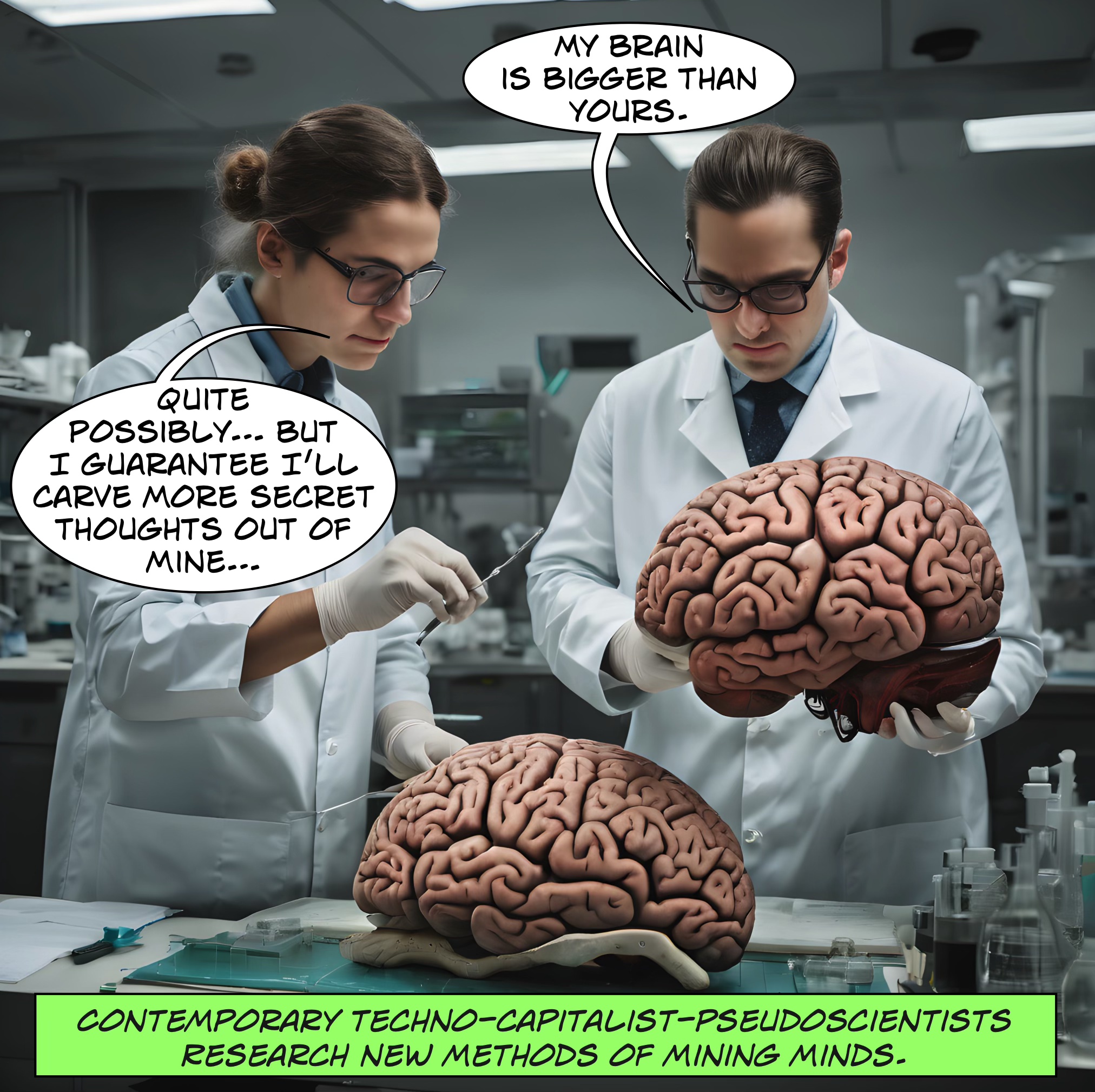
When we are young, it is common for us to think of “brain” and “mind” as synonyms. Today, (potentially nefarious) scientific advances are probing the brain, to gain commercially beneficial access to the mind.

What would C.S. Lewis think? Perhaps his 1955 comment about commercialism provides a hint?

I wish we didn’t live in a world where buying and selling things (especially selling) seems to have become almost more important than either producing or using them.

Seventy years later it is strange to apply this economic principle to the ineffable nature of the mind. And it’s even more odd to apply Lewis’ observation to this situation. He would definitely consider using one’s brain more important than marketing it.

As a young man, C.S. Lewis used the word “brain” when referring to dredging up pleasant memories of past holidays. Even in 1921 he realized that memories are capable of adding a resplendent glow to past experiences.

I still feel that the real value of such a holiday is still to come, in the images and ideas which we have put down to mature in the cellarage of our brains, thence to come up with a continually improving bouquet.

Already the hills are getting higher, the grass greener, and the sea bluer than they really were; and thanks to the deceptive working of happy memory our poorest stopping places will become haunts of impossible pleasure and Epicurean repast.

It is certainly no accident one neurologist calls the relationship between brain and mind “the enchanted loom.”

So, why is it that we began with a question about the commercial incentive to secure the “brain data” of willing – and unsuspecting – people? 

Well, it turns out that since “tech companies [already] collect brain data that could be used to infer our thoughts,” it is “vital we get legal protections right” (MIT Technology Review).

Two months ago, California amended their Consumer Privacy statute to include neural data. It quite appropriately immediately follows the protection of “a consumer’s genetic data.) According to the MIT report:

The law prevents companies from selling or sharing a person’s data and requires them to make efforts to deidentify the data. It also gives consumers the right to know what information is collected and the right to delete it.

Which is crucial because:

Brain data is precious. It’s not the same as thought, but it can be used to work out how we’re thinking and feeling, and reveal our innermost preferences and desires (emphasis in original).

Brain Versus Mind

Before proceeding, let’s clarify the difference between the brain and the mind. The brain is a physical organ which controls our autonomous (typically unconscious) bodily functions such as our heart rate and digestion. It also controls our movements and, to a degree, our emotions. 

The mind, on the other hand, is not physical. It cannot be seen or touched, due to its intangible nature. It can, however, be examined and manipulated, which is another subject I have addressed elsewhere.

The mind is involved with thinking and deciding actions. When they are physical actions, such as whether to indulge in a second helping of dessert, the physical actions involved in that indulgence are relayed by the brain to the appropriate muscles required to perform the act.

The mind is commonly equated with our consciousness. As such, it exists in that realm where we can make moral evaluations and arrive at good decisions, even when they may be against our own self-interest.

Here is a simple illustration of the difference. The brain enables a body (person) to rise and possess the balance to walk along a winding path. The mind allows the person to determine which path is the noble or life-affirming option among the innumerable paths before us.

The brain can only assess a path in the physical sense, through vision, balance, etc. The mind comprehends that “path” means far more than physical orientation.

In C.S. Lewis’ address “Transposition,” he discusses his concept of how simpler concepts and knowledge are sometimes forced to attempt to convey greater knowledge. This can only be accomplished imperfectly. Britain’s monthly The Critic offers an excellent discussion of how transposition illuminates Lewis’ “philosophy of the mind.”

A transposition occurs, he argues, when a richer set of conceptual categories must necessarily be represented by a poorer set of conceptual categories.

In his essay “Is Theology Poetry?” Lewis describes how the mind transcends the physical limitations of the brain itself.

If minds are wholly dependent on brains, and brains on bio-chemistry, and bio-chemistry (in the long run) on the meaningless flux of the atoms, I cannot understand how the thought of those minds should have any more significance than the sound of the wind in the trees.

I might summarize this by declaring “we are more than our brains.” Atheists, sadly, will disagree. They acknowledge our accomplishments may leave behind some ephemeral residue, but once that brain perishes due to the lack of oxygen, everything that is/was us, evaporates, never to exist again. 

As the leader of the Church in Jerusalem wrote, without Christ and the promise of the resurrection, what hope exists? 

What is your life? For you are a mist that appears for a little time and then vanishes. (James 4).

And this returns us to the question of precisely what these mind scientists are after. Knowing more about the brain is valuable, so that we might prevent and treat the diseases which assail it. 

But far more valuable, I suspect, is a window into the mind. So we might discover keys to how we exercise the miracle of thought.

Knowing fallen humanity’s propensity to abuse science and technology, forgive me if I remain a bit leery of experiments such as this. And, for those who may be tempted to get involved with developing technologies and allow their brains/minds to be probed for a pittance, I encourage you to ponder the ramifications a little longer.

C.S. Lewis Bonus Material

The quotation above from “Is Theology Poetry?” may have whetted your curiosity about the broader context of the sentence. For those who are interested, read on. [Personal note: I absolutely love his phrase “mythical cosmology derived from science…”]

When I accept Theology I may find difficulties, at this point or that, in harmonising it with some particular truths which are imbedded in the mythical cosmology derived from science. But I can get in, or allow for, science as a whole.

Granted that Reason is prior to matter and that the light of that primal Reason illuminates finite minds. I can understand how men should come, by observation and inference, to know a lot about the universe they live in. 

If, on the other hand, I swallow the scientific cosmology as a whole, then not only can I not fit in Christianity, but I cannot even fit in science.

If minds are wholly dependent on brains, and brains on bio-chemistry, and bio-chemistry (in the long run) on the meaningless flux of the atoms, I cannot understand how the thought of those minds should have any more significance than the sound of the wind in the trees.

And this is to me the final test. This is how I distinguish dreaming and waking. When I am awake I can, in some degree, account for and study my dream. The dragon that pursued me last night can be fitted into my waking world.

I know that there are such things as dreams: I know that I had eaten an indigestible dinner: I know that a man of my reading might be expected to dream of dragons.

But while in the nightmare I could not have fitted in my waking experience. The waking world is judged more real because it can thus contain the dreaming world: the dreaming world is judged less real because it cannot contain the waking one.

For the same reason I am certain that in passing from the scientific point of view to the theological, I have passed from dream to waking. Christian theology can fit in science, art, morality, and the sub-Christian religious. The scientific point of view cannot fit in any of these things, not even science itself (“Is Theology Poetry?”).

Those who wish to read more about C.S. Lewis’ thoughts on Transposition and the mind are invited to read the following excerpt, in its fuller context.

. . . Transposition occurs whenever the higher reproduces itself in the lower. Thus, to digress for a moment, it seems to me very likely that the real relation between mind and body is one of Transposition.

We are certain that, in this life at any rate, thought is intimately connected with the brain. The theory that thought therefore is merely a movement in the brain is, in my opinion, nonsense; for if so, that theory itself would be merely a movement, an event among atoms, which may have speed and direction but of which it would be meaningless to use the words “true” or “false.”

. . . We now see that if the spiritual is richer than the natural (as no one who believes in its existence would deny) then this is exactly what we should expect. And the sceptic’s conclusion that the so-called spiritual is really derived from the natural, that it is a mirage or projection or imaginary extension of the natural, is also exactly what we should expect; for, as we have seen, this is the mistake which an observer who knew only the lower medium would be bound to make in every case of Transposition.

The brutal man never can by analysis find anything but lust in love; the Flatlander never can find anything but flat shapes in a picture; physiology never can find anything in thought except twitchings of the grey matter.

It is no good browbeating the critic who approaches a Transposition from below. On the evidence available to him his conclusion is the only one possible. . . .

I have tried to stress throughout the inevitableness of the error made about every transposition by one who approaches it from the lower medium only. The strength of such a critic lies in the words “merely” or “nothing but.” He sees all the facts but not the meaning.

Quite truly, therefore, he claims to have seen all the facts. There is nothing else there; except the meaning. He is therefore, as regards the matter in hand, in the position of an animal.

You will have noticed that most dogs cannot understand pointing. You point to a bit of food on the floor: the dog, instead of looking at the floor, sniffs at your finger. A finger is a finger to him, and that is all. His world is all fact and no meaning. And in a period when factual realism is dominant we shall find people deliberately inducing upon themselves this doglike mind (“Transposition”).


Enriching Your Writing

lit crit

Writers find literature inspiring. That sounds self-evident—and cliché—when we think of the statement aesthetically. It seems to me, however, that the words are also true in a literal sense. The very act of reading inspires us to fashion our own creations, each of which is consciously or unconsciously indebted to all that we have read and learned during our lives.

This activity is sometimes called bricolage. I wrote about it recently. Skilled writers frequently use devices to enrich their work. Quotations, allusions, pastiche and parody are obvious examples. Some critics would even include plagiarism as an intertextual exercise, and in the strictest sense, it is. While unacknowledged direct quotations are inappropriate, many readers savor reading volumes filled with well-done allusions.

Our minds are a composite of all that to which we have been exposed. When we come up with fresh ideas, they are seldom “new” in a true sense. When they are genuinely novel, at best they offer a unique take on a subject. Still, our expression relies in many aspects on what we ourselves have read in the past. After all, there is nothing new under the sun.*

When we owe a large debt to another source, it is right to offer credit. Not doing so invites people who recognize the source to question our integrity. The exception being when the source is so familiar to the anticipated reader, that it would be redundant. For example, the final sentence in the previous paragraph did not require a citation. If it is not known from its original biblical source, it is recognized as a common proverb . . . or, perhaps, from the Pete Seeger song, “Turn! Turn! Turn!”

One of the striking things about C.S. Lewis is his powerful grasp of the vast breadth of literature he had read. As I wrote in the aforementioned post, “Lewis was generous in thanking thinkers to whom he was indebted, and only failed to do so when he assumed any educated reader would recognize the source of an image or phrase.”

So, what about those times when we have forgotten a source, or don’t even recall that a particular idea came from anywhere other than our own cranium?

Unintentional Bricolage

While teaching at Oxford and Cambridge, Lewis taught many individuals who achieved notoriety in their own right. J.A.W. Bennett, studied under Lewis at Oxford, and eventually replaced him as professor of Medieval and Renaissance literature at Cambridge.

In “The Humane Medievalist: An Inaugural Address,” Bennett describes how Lewis’ vast familiarity with diverse literature meant that his own creative work was permeated by the wisdom of others.

The whole man was in all his judgements and activities . . . and a discriminating zest for life, for “common life,” informs every page he wrote. “Grete Clerke” as he was, he was never wilfully esoteric: Quotations and allusions rose unbidden to the surface of his full and fertile mind, but whether they are to Tristram Shandy or James Thurber they elucidate, not decorate. His works are all of a piece: a book in one genre will correct, illumine or amplify what is latent in another.

As a reader who relishes allusions (especially to the Scriptures), I approach Lewis knowing I’ve been invited to a feast. With C.S. Lewis we find bricolage at its richest and most refined.

In An Experiment in Criticism, Lewis describes two types of readers, literary and unliterary. He says the measure of a book is the extent to which it entices its literary readers to reread it.

In the following excerpt, Lewis mentions how the talented writer weaves together an elegant tapestry (via bricolage). Because literature is so complex and intricate, we benefit from rereading it. He also discusses how literature interacts with our preexisting thoughts and sometimes reshapes them.

Nevertheless, we have already seen that the literary sometimes fall into what I think bad modes of reading, and even that these are sometimes subtler forms of the same errors that the unliterary commit.

They may do so when reading poems. The literary sometimes ‘use’ poetry instead of ‘receiving’ it. They differ from the unliterary because they know very well what they are doing and are prepared to defend it. ‘Why,’ they ask, ‘should I turn from a real and present experience—what the poem means to me, what happens to me when I read it—to inquiries about the poet’s intention or reconstructions, always uncertain, of what it may have meant to his contemporaries?’

There seem to be two answers. One is that the poem in my head which I make from my mistranslations of Chaucer or misunderstandings of Donne may possibly not be so good as the work Chaucer or Donne actually made.

Secondly, why not have both? After enjoying what I made of it, why not go back to the text, this time looking up the hard words, puzzling out the allusions, and discovering that some metrical delights in my first experience were due to my fortunate mispronunciations, and see whether I can enjoy the poet’s poem, not necessarily instead of, but in addition to, my own one?

If I am a man of genius and uninhibited by false modesty I may still think my poem the better of the two. But I could not have discovered this without knowing both. Often, both are well worth retaining.

Do we not all still enjoy certain effects which passages in classical or foreign poets produced in us when we misunderstood them? We know better now.

We enjoy something, we trust, more like what Virgil or Ronsard meant to give us. This does not abolish or stain the old beauty. It is rather like revisiting a beautiful place we knew in childhood. We appraise the landscape with an adult eye; we also revive the pleasures—often very different—which it produced when we were small children.

Admittedly, we can never quite get out of our own skins. Whatever we do, something of our own and of our age’s making will remain in our experience of all literature.

Equally, I can never see anything exactly from the point of view even of those whom I know and love best. But I can make at least some progress towards it. I can eliminate at least the grosser illusions of perspective.

Literature helps me to do it with live people, and live people help me to do it with literature. If I can’t get out of the dungeon I shall at least look out through the bars. It is better than sinking back on the straw in the darkest corner. (An Experiment in Criticism)

An Experiment in Criticism may not be Lewis’ simplest essay to understand, but it is a rich one. In fact, I can almost guarantee that if you should reread the passage quoted above, you will gain new insights that you missed during your first reading.

And that dynamic interplay between our thoughts and the literature we read is exactly what Lewis is explaining, and illustrating.

When it comes to choosing between what we personally receive from a work, and what the author originally intended to say, I love Lewis’ solution: “why not have both?”

_____

* “What has been is what will be, and what has been done is what will be done, and there is nothing new under the sun. Is there a thing of which it is said, ‘See, this is new?’ It has been already in the ages before us” (Ecclesiastes 1:9-10).


A Better Wig

wigHow important is honesty? When is it okay to fudge on the truth? If the main point is valid, how necessary is it to keep all of the details straight?

I just read a bizarre story that got me thinking about this subject. A director of Senior Services in Rhode Island wanted to promote snow removal assistance for the elderly, and couldn’t rustle up a suitable “Cranston Senior Home Resident” to be featured during a news report.

So, she did the next best thing. She manufactured one.

The only apparent flaw in her plan was forgetting that such facilities also have male residents. So, the bus driver she pressed into the role had to don a wig, makeup and earrings. (Perhaps she just thought that an elderly female would elicit greater sympathy.

At any rate, her nefarious plot was revealed when local television viewers did not fall for the questionable disguise. The coup de grâce, or the punch line as you may read it, came in the pronouncement of the salon owner who prepped the man for his debut.

“I probably would have given him a better wig if I had known.”

You see, the problem wasn’t the misrepresentation. The error was in not doing it persuasively.

I suppose this odd story struck me as timely (even though it apparently occurred this past winter) because we in the United States are currently suffering in the midst of a lengthy presidential primary season. (No comments, please, on whether any of the candidates might benefit from wearing “a better wig.”)

C.S. Lewis & the Subject of Deception

C.S. Lewis thought a great deal about the subjects of truth, and deception. For much of his life, well into adulthood, he was deceived by sirens who denied the reality of a loving God.

One of his accurate observations is that deception must be reasonable to be successful.

Nothing can deceive unless it bears a plausible resemblance to reality. (“An Experiment in Criticism”)

Obviously, the incident above did not pass the plausibility standard.

In the same essay, Lewis declared scenarios that represent imaginary realities as being innocent of deception.

No one can deceive you unless he makes you think he is telling the truth. The un-blushingly romantic has far less power to deceive than the apparently realistic. Admitted fantasy is precisely the kind of literature which never deceives at all. Children are not deceived by fairy-tales; they are often and gravely deceived by school-stories. Adults are not deceived by science-fiction; they can be deceived by the stories in the women’s magazines. (“An Experiment in Criticism”).

We would be inclined today to add “men’s magazines” as an equally disingenuous source. I believe Lewis was referring to the kind of story that manipulates one’s emotions and exaggerates reality to provoke the desired response.

Self-Deception as a Danger

As a Christian, Lewis reflected in great depth on how prone you and I are to deceiving ourselves. Some of this self-deception is not intentional. In correspondence with an American acquaintance he discussed Martin Buber’s book, I and Thou.

What I had not yet thought about was your objection, that he ignores the Me. You are probably right. He might even have said that just as the Thou is deeper than the Me, so the I is deeper than the Me. For I believe self consciousness to be full of deception and that the object I call me and think about (both in my moments of pride and in my moments of humility) is very different from the I who think about it.

I agree with Lewis that we are often unaware of aspects of our own personality. And, unfortunately, we are prone to misperceiving what we do observe. This is not a conscious twisting of the truth to our own benefit, as in proclaiming that we are exceptional and never fail.

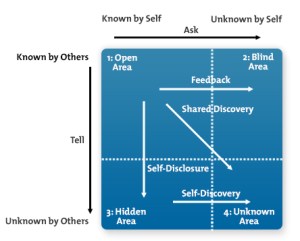
johariThis raises the question of our self-awareness. The Johari Window is a simple resource that illustrates the four aspects of our identity, based on two axes—what is known/unknown and by whom the traits are recognized.

You can see how it works out in this simple diagram. And you can read a brief description of the tool here.

It seems evident that one key to living with integrity and enjoying greater happiness is to be honest in all of our dealings. Honest with others. And honest with ourselves.

It was good to be reminded once again of that vital truth.

_____

Here’s a piece of Lewisian trivia. The collection of essays available in the United States as God in the Dock was originally published in the United Kingdom with the title Undeceptions. Ironically, the British reference in the American version of the title still creates confusion for those who don’t realize “in the dock” refers to a person who is on trial.

Engage Brain

brainsWhen I attended the University of Washington, we had to learn the old-fashioned way—by studying. Now they are anticipating downloading information directly into students’ brains.

Literal brain dumps are actually still in the future . . . but researchers have documented the first indisputable brain-to-brain interface between humans!

My first paragraph is not an exaggeration of what researchers think may one day happen.

The project could also eventually lead to “brain tutoring,” in which knowledge is transferred directly from the brain of a teacher to a student.

The student would view this shortcut as advantageous. (It could also save a great deal in tuition expenses, if each course only took, say, an hour or two of brain interfacing.)

The university sees another advantage—circumventing limited teaching skills.

“Imagine someone who’s a brilliant scientist but not a brilliant teacher. Complex knowledge is hard to explain – we’re limited by language,” said co-author Chantel Prat, a faculty member at the Institute for Learning & Brain Sciences and a UW assistant professor of psychology.

My main question is, what will the teacher do, once their knowledge has been transferred to a student?

Presumably they will be able to retain a semblance of their knowledge, unlike the experience of the unfortunate Orbanians. They rely on a nanite technology, and it leaves the brilliant brain in a childlike state after the knowledge is siphoned out of it. You can learn more about them in “Learning Curve,” a documentary about the Stargate project.

C.S. Lewis had a great deal to say about education. He was a popular professor, despite the fact many of his students were intimidated by his brilliance. It is possible that if his students were able to download his knowledge, it might have caused their crania to explode.

In one essay, Lewis explains the differences between education and training, declaring “If education is beaten by training, civilization dies.” (“Our English Syllabus”).

Lewis continues, arguing that learning itself, is something distinct. It is not marked by a transfer of knowledge, but by a hunger to grow.

Now learning, considered in itself, has, on my view, no connexion at all with education. It is an activity for . . . all [who] desire to know. . . .

Societies have usually held a belief . . . that knowledge is the natural food of the human mind: that those who specially pursue it are being specially human; and that their activity is good in itself besides being always honourable and sometimes useful to the whole society.

Oh, and if you are waiting to “learn” when they can download knowledge directly into your skull, consider this wise advice from Lewis.

The only people who achieve much are those who want knowledge so badly that they seek it while the conditions are still unfavourable. (“Learning in Wartime”).

_____

The picture above shows two UW guinea pigs transferring brain waves to one another. (I am uncertain whether two-way transfer is already possible, or if one brain is forced to serve in a receptacle role.)

The article announcing the results can be seen here.

Harry Potter in the Bible

potterSo much for the effectiveness of “state churches.” The European ones appear to have become abject failures. There is ample evidence that the “establishment” of religions has rarely served either church or state very well.

Here’s the latest proof from the United Kingdom. The BBC recently reported a study that shows three in ten teenaged Brits don’t know the Nativity of Jesus came from the Bible. Similar numbers had never heard about the Crucifixion or Adam and Eve.

I imagine they’ll consider the new Noah film just another work of Hollywood fiction. (Actually, half of them didn’t know that very story comes from the Bible.)

What’s more—their parents are nearly as ignorant.

Many of the teens did, however, think that the plotlines from the Harry Potter series were based on Bible stories.

As a person who was genuinely inspired by England’s magnificent cathedrals while I lived there, it is painful to contemplate the terrible loss. The great-great-grandchildren of saints who suffered and sacrificed for the Gospel have disregarded the good news.

And, lest any readers think I’m pointing fingers as a “self-righteous” American, let me assure you I take no pride in my own nation’s slide into apostasy. The words of Micah’s prophecy seem closer to fulfillment each day. “The faithful have been swept from the land; not one upright person remains.”

C.S. Lewis saw this coming. Consider the following from his 1950 essay, “The Literary Impact of the Authorised Version.”

It may be asked whether now, when only a minority of Englishmen regard the Bible as a sacred book, we may anticipate an increase of its literary influence. I think we might if it continued to be widely read. But this is not very likely. Our age has, indeed, coined the expression “the Bible as literature.” It is very generally implied that those who have rejected its theological pretensions nevertheless continue to enjoy it as a treasure house of English prose.

It may be so. There may be people who, not having been forced upon familiarity with it by believing parents, have yet been drawn to it by its literary charms and remained as constant readers. But I never happen to meet them. Perhaps it is because I live in the provinces. But I cannot help suspecting, if I may make an Irish bull, that those who read the Bible as literature do not read the Bible.

Speaking of reading the Bible “as literature,” that’s not a bad thing. It informs so much Western literature, that an ignorance of the Scriptures is tantamount to possessing an inadequate education. An excellent online resource for exploring this truth can be found at the Bible Literacy Project.

The site includes a copy of a comprehensive 2006 study of English professors from America’s top-rated schools, including Yale, Harvard, Princeton, Stanford, Texas A&M, UC-Berkeley and others. In the study, not a single professor disagreed with the statement that: “Regardless of a person’s faith, an educated person needs to know the Bible.”

If some people could get past their prejudices against the Bible, they would recognize the truth of this statement. Everyone should be reading the Bible, even if only as a significant literary work.

Perhaps, if this widespread study comes to pass, one day people will be able to recognize the difference between the Scriptures and Harry Potter.

Lessons Taught by Onions

This column has been written backwards. Not sdrawkcab literally, but in the opposite direction of its natural order. Usually I find something illuminating (most commonly in C.S. Lewis’ work), and then I offer some reflections on that insight. Occasionally, the post’s subject arises from a different source, and in my subsequent thoughts, I consciously consider what Lewis might have thought about the matter.

This is the first time when something utterly bizarre struck me as a valid starting point. And, only later did I find a suitable “proof text” or two from Lewis to validate discussing the odiferous subject at hand.

There’s a show I’ve been enjoying called “Parks and Recreation.” While I can’t recommend it to others, due to the casual portrayal of promiscuity which is endemic to American “entertainment.” Nevertheless, they often have quite witty writing that satirizes the crazy nature of life in our world today. This episode features a political debate between candidates for mayor of a small town.

One of the candidates responds to a question with, “No, I’m not a Vegan. I’m an Onionarian. I only eat onions and onion-based juices.”

I wonder how many other cultures can garb their dietary preferences in the robes of religious faith and devotion? Now, I love an onion more than the average person, but the notion of narrowing our diet down from God’s vast table to a single item just strikes me as a bit humorous (see Acts 10:9f).

As I enjoyed a chuckle, the thought flashed that I might relate this dialog for others who share my peculiar sense of humor . . . and I immediately wondered whether or not a Lewisian connection would be possible. Oh me of little faith. Lewis was so prolific that it doesn’t even require me to stretch.

You see, onions can teach us many lessons.

For example, look at this demonic advice offered by Screwtape to his protégé Wormword. He says Tempters should persuade human beings to care overly about what others think of them. The entire advertising world seems to be established on this principle. And how terribly vulnerable we are to this whisper. But, by the grace of God, it appears some are immune.

The man who truly and disinterestedly enjoys any one thing in the world, for its own sake, and without caring two pence what other people say about it, is by that very fact forearmed against some of our subtlest modes of attack. You should always try to make the patient abandon the people or food or books he really likes in favor of the “best” people, the “right” food, the “important” books. I have known a human defended from strong temptations to social ambition by a still stronger taste for tripe and onions. (C.S. Lewis, Screwtape Letters)

Thus we see that onions can, in some contexts, possess salvific influences. (Well, that might be pushing the lesson just a wee bit . . . but there is an important truth to be found in this epistle.)

Lewis’ arguably most famous discussion of onions is found in his discussion of concentric rings of secrecy, power, intimacy and knowledge described in his 1944 address entitled “The Inner Ring.” Rather than paraphrase his fine argument, I shall allow the following portions of his talk to speak eloquently for themselves.

Badly as I may have described it, I hope you will all have recognized the thing I am describing. Not, of course, that you have been in the Russian Army or perhaps in any army. But you have met the phenomenon of an Inner Ring. You discovered one in your house at school before the end of the first term. And when you had climbed up to somewhere near it by the end of your second year, perhaps you discovered that within the Ring there was a Ring yet more inner, which in its turn was the fringe of the great school Ring to which the house Rings were only satellites. It is even possible that the School Ring was almost in touch with a Masters’ Ring. You were beginning, in fact, to pierce through the skins of the onion. And here, too, at your university-shall I be wrong in assuming that at this very moment, invisible to me, there are several rings-independent systems or concentric rings-present in this room? And I can assure you that in whatever hospital, inn of court, diocese, school, business, or college you arrive after going down, you will find the Rings—what Tolstoy calls the second or unwritten systems. . . .

Of all the passions the passion for the Inner Ring is most skilful in making a man who is not yet a very bad man do very bad things. My second reason is this. The torture allotted to the Danaids in the classical underworld, that of attempting to fill sieves with water, is the symbol not of one vice but of all vices. It is the very mark of a perverse desire that it seeks what is not to be had. The desire to be inside the invisible line illustrates this rule. As long as you are governed by that desire you will never get what you want. You are trying to peel an onion: if you succeed there will be nothing left. Until you conquer the fear of being an outsider, an outsider you will remain. . . .

I must now make a distinction. I am not going to say that the existence of Inner Rings is an evil. It is certainly unavoidable. There must be confidential discussions: and it is not only not a bad thing, it is (in itself) a good thing, that personal friendship should grow up between those who work together. And it is perhaps impossible that the official hierarchy of any organization should quite coincide with its actual workings. If the wisest and most energetic people invariably held the highest posts, it might coincide; since they often do not, there must be people in high positions who are really deadweights and people in lower positions who are more important than their rank and seniority would lead you to suppose. In that way the second, unwritten system is bound to grow up. It is necessary; and perhaps it is not a necessary evil. But the desire which draws us into Inner Rings is another matter. A thing may be morally neutral and yet the desire for that thing may be dangerous.

While I have no doubt a number of other worthwhile onion-lessons are waiting to be found in the Inklings corpus, I would like to close now with my personal favorite. In the following passage, Lewis reverses the analogy, with each peeling away of a layer revealing ever more of reality.

In the closing paragraphs of the final Narnia Chronicle, The Last Battle, Lewis transforms the savory bulb into a metaphor for never ending epiphany.

[Lucy said:] “I see now. This garden is like the stable. It is far bigger inside than it was outside.”

“Of course, Daughter of Eve,” said the Faun. “The further up and the further in you go, the bigger everything gets. The inside is larger than the outside.”

Lucy looked hard at the garden and saw that it was not really a garden but a whole world, with its own rivers and woods and sea and mountains. But they were not strange: she knew them all.

“I see,” she said. “This is still Narnia, and more real and more beautiful than the Narnia down below, just as it was more real and more beautiful than the Narnia outside the stable door! I see . . . world within world, Narnia within Narnia. . . .”

“Yes,” said Mr. Tumnus, “like an onion: except that as you continue to go in and in, each circle is larger than the last.”

What a glorious description. And, like our Lord who elevated the humble mustard seed to literary immortality, Lewis has lifted the modest genus Allium, and secured for it a lasting place in English literature.

Biblical Illiteracy

A person does not have to be religious to recognize the importance of the Ten Commandments on western civilization, literature and life. Even when one disregards their intrinsic merit, their literary significance remains. That said, it is important that those who consider themselves well educated should be acquainted with the message of this foundational document.

The statistics reveal a rather surprising picture. It turns out sixty percent of Americans cannot identify even half of the commandments. What I find stunning about that is the fact that since they are mostly prohibitions of destructive behavior, even the illiterate should be able to guess half of them. “Okay . . . we shouldn’t commit murder . . . steal from others . . . or lie about and slander others.” Pretty common sense, and we’re already over halfway there.

“Let’s see . . . the commandments are about God, so there’s probably one that says ‘worship the real God.’” Simple logic, and we’ve nearly arrived. Four out of the five and it wasn’t all that challenging. But how do we arrive at a fifth commandment? Here are two possible paths:

“Oh, doesn’t ‘religion’ believe that it’s sinful to cheat on your spouse . . . that’s probably on the list.”

or

“What’s that weird word the Bible uses about wanting stuff that belongs to others . . . oh yeah, ‘coverting’ or something like that . . . we’re not supposed to desire the possessions of others.”

Since our world has programmed us all with insatiable materialistic desires, it’s probably unlikely that someone would “guess” that coveting our neighbor’s property is wrong, so let’s substitute a more likely alternative.

“Christians get so worked up about swearing, especially when people curse using ‘God’ or ‘Jesus’ . . . so there’s probably something about that in the Ten Commandments.”

Congratulations, we’ve reached our goal of five.

As for the enumeration of the commandments—which varies among Jewish, Roman Catholic and Protestant communions—that’s a subject for another day.

Addendum:

Don’t forget the observance of this commandment which would transform our world: “Honor your father and mother” (this is the first commandment with a promise), “that it may go well with you and that you may live long in the land.”