
Military Hymns & Ents

The United States is schizophrenic about its religious heritage, and the armed forces provide us with today’s example. Most people, including veterans themselves, are unaware of the fact that while we have official songs for the different branches of the armed forces, we don’t have any official hymns.

C.S. Lewis and J.R.R. Tolkien, both combat veterans, were quite familiar with martial music. However, as members of a (nominally) Christian kingdom, neither would have been uncomfortable with explicitly Christian elements in their military’s hymnody. Across the ocean in the former colonies, it’s a different matter. 

Here, the confusion about the “official” status of religious military hymns abounds because spiritual hymnody has been part of our nation’s martial history ever since the colonies decided to band together and seek independence. Yet, some consider that to be unlawful.

The rejection of music expressing faith in God can be attributed to the modern crusade against such hymns by strident anti-theists. Many in this camp are practicing atheists, who misinterpret the two clauses of the First Amendment which the nation’s founders did not consider mutually exclusive. 

Congress shall make no law respecting an establishment of religion, or prohibiting the free exercise thereof . . .

Since most of the creators of the Constitution – and the majority of American citizens up to this day – have been theists (believing in a Supreme Being), it is self-evident that they did not intend to exorcise all expressions of faith from the public forum. Some states, in fact, already had their own “established churches when the First Amendment was ratified.”

Up until this generation, generic references to a heavenly Father or a benevolent Creator have traditionally remained welcome at civic events.

Even the non-Christian Thomas Jefferson (who argued against religious establishment) was essentially a Deist, acknowledging “the god who gave us life, gave us liberty at the same time . . .”

Jefferson even edited the New Testament Gospels, deleting “objectionable passages” and producing his personally-sanctioned Life and Morals of Jesus of Nazareth

So, What about the Music?

My goal is not to discuss the First Amendment per se – though I included the introductory note above for the benefit of the many international readers who find their way to Mere Inkling.

Rather, I wish to discuss the premise above, that America celebrates generally secular martial music, while remaining wary of military hymnody with religious themes. 

Ironically, soldiers throughout the nation’s history passively assumed that the songs they heard at rallies and civic events had the government’s tacit imprimatur, that was questionable. Take the “Battle Hymn of the Republic,” for example. Composed in 1861 by abolitionist Julia Ward Howe, Union soldiers would have been shocked to learn that some would deem its use in the ranks as a violation of the First Amendment.

Mine eyes have seen the glory of the coming of the Lord;
He is trampling out the vintage where the grapes of wrath are stored;
He hath loosed the fateful lightning of His terrible swift sword:
His truth is marching on.

I have read a fiery gospel writ in burnished rows of steel:
“As ye deal with My contemners, so with you My grace shall deal;”
Let the Hero, born of woman, crush the serpent with His heel,
Since God is marching on.

Modern Military Hymns

The Department of Defense hosts a website titled Guide to U.S. Military Bands and Music. It describes the wide repertoire of military musicians. 

Whether you like jazz music, a marching band or orchestra music, the U.S. military has you covered. Each branch of the military boasts a diverse offering of musical talent that serves for ceremonial purposes but also for entertainment and outreach. Check out these bands to stay in tune with military music.

One Christian hymn has deep roots in the military community. The song traditionally referred to as “The Navy Hymn” in America, originated in Britain. It is also used by the French. Its maritime themes make it popular in civilian communities as well. 

Eternal Father, strong to save,
Whose arm does bind the restless wave,
Who bids the mighty ocean deep
Its own appointed limits keep;
O hear us when we cry to Thee
For those in peril on the sea.

O Savior, whose almighty word
The winds and waves submissive heard,
Who walked upon the foaming deep,
And calm amid the rage did sleep;
O hear us when we cry to Thee
For those in peril on the sea.

“There exist a myriad of alternate verses to the hymn. One, for example, was written by David B. Miller in 1965 and specially dedicated to naval submariners.”

Musicians were not just present for official ceremonies and off-duty entertainment. They could also inspire the troops in the violent din of battle. More common in distant ages, even in twentieth century Europe, we find a dramatic illustration.

In the military archives of the Irish Republican Army, Michael J. Crowley described the inspiration provided by the brigade’s musician in the heat of the battle called the “Battle of Crossbarry” and the “Crossbarry Ambush,” by the IRA and the Brits respectively.

From the opening shot of the engagement, our piper, Florrie Begley of Brandon, played warlike airs on the bagpipes until the last shot was fired.

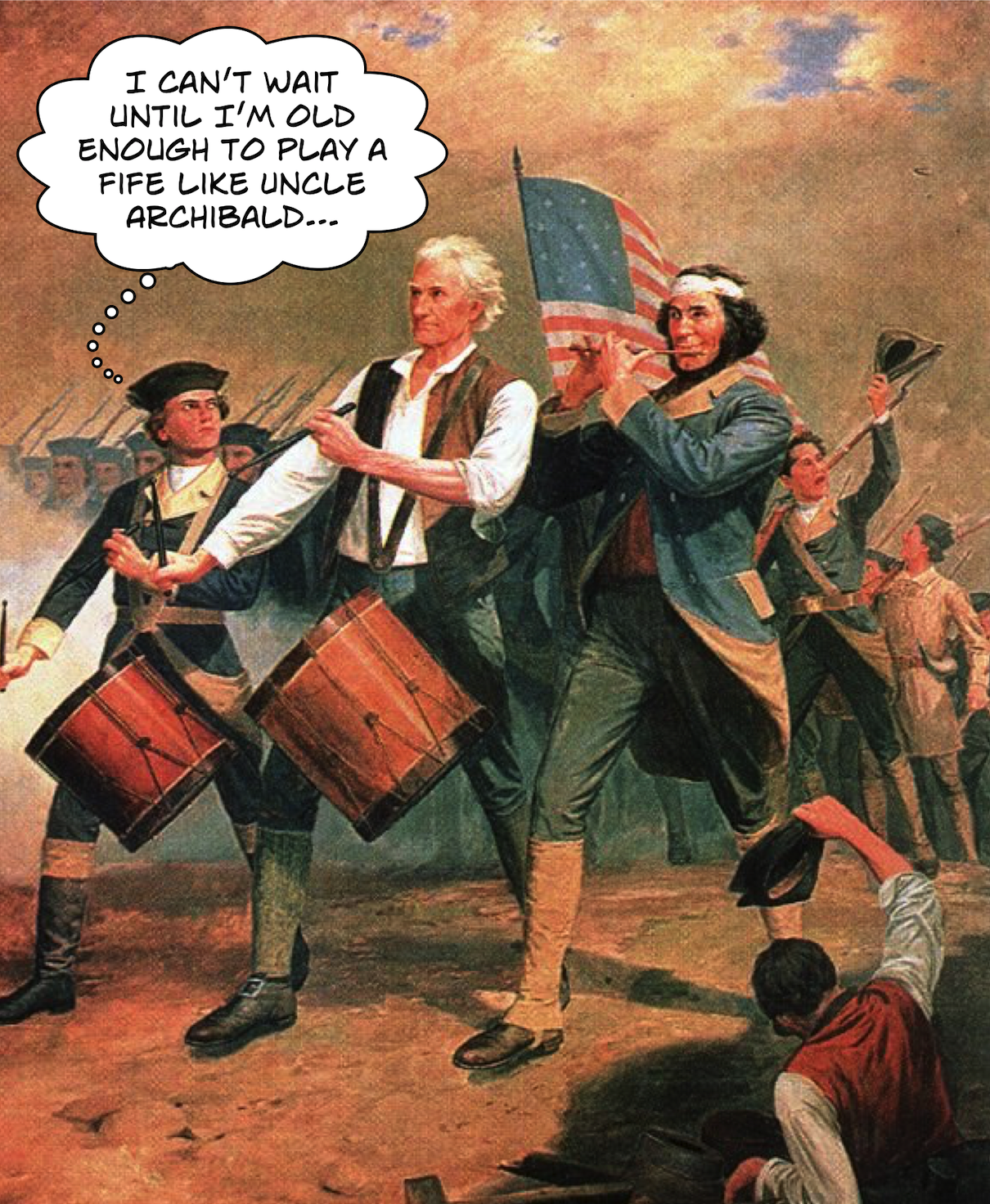
The illustration above provides an idealized portrait of military musicians bravely facing enemy fire. “The Spirit of ’76,” painted for the centenary of the American Revolution, met with tepid enthusiasm during the 1876 Centennial Exposition in Philadelphia. However, it rose in popularity when it subsequently toured the country.

For centuries, armies used music as the means to communicate the military orders of the day to soldiers. The high pitch of the fife and the sharp sound of the drum allowed messages to be heard at great distance . . .

Leaping from the Revolution to the twenty-first century, the recently birthed United States Space Force now has a hymn. Well, sort of. It is an unsolicited hymn composed by a former Air Force officer. You can hear “Creator of the Universe” here.

For more space music, check out the official anthem of “the mighty watchful eye.” Some consider this proposed anthem far more inspiring.

My personal favorite is the version of the Space Force Anthem proposed by its original, cinematic commander, General Naird, played by Steve Carell. (Carell even plays his own fife in the episode.)

The Middle Earth Military March

Howard Shore composed a powerful soundtrack for Lord of the Rings. Yet he wasn’t the first to create music for the great saga. One Tolkienist writes:

My first contact with Tolkien-inspired music dates back to the late 1980s . . . I was watching TV with my parents seeing a performance of Military Bands. Later I would discover that it was the Dutch composer Johan de Meij’s Symphony No. 1 (The Lord of the Rings) I’d heard.

From among the ranks of the Inklings, only one writer wrote an explicit military song. J.R.R. Tolkien provided the timeless Ents with a somber marching song as they face the powers of Isengard.

We come, we come with roll of drum: ta-runda runda runda rom!
We come, we come with horn and drum: ta-rūna rūna rūna rom!

To Isengard! Though Isengard be ringed and barred with doors of stone;
Though Isengard be strong and hard, as cold as stone and bare as bone,
We go, we go, we go to war, to hew the stone and break the door;
For bole and bough are burning now, the furnace roars – we go to war!
To land of gloom with tramp of doom, with roll of drum, we come, we come;
To Isengard with doom we come!
With doom we come, with doom we come!

If you have a moment, you will likely enjoy the performance of this song as arranged by Clamavi De Profundis.


Free Books Offered Monthly

Would you like to receive free books for the simple exchange of a short, honest review of them? If so, join me at LibraryThing. Best of all, they offer additional benefits for readers (and writers).

You may already have a free account there, since they offer a book cataloging system connecting you to fellow readers, which appeals to many book lovers.

They also offer TinyCat, which is a sophisticated cataloging system designed for small libraries. And it is free for personal use! I don’t have the time to input my own library, despite all of their tools for making that easy, but it could well work for you. [Warning: if your library includes more than 20,000 items, it may be a tad too large.]

Requesting a book for review is simple. Each month they list a bunch of new, mostly self-published titles that are available. You express your interest and they distribute the quantity that are available. You can see current offerings here: LibraryThing Early Reviewers.

The truth is that I rarely request a title. The vast majority are fiction, while my tastes strongly lean toward nonfiction. Even there, available time restricts my interests to a handful of topics. Still, I wrote a review about a book I received entitled  A Curmudgeon’s Guide to Postmodern Times: Aphorisms. (I am a sucker for thought-provoking maxims, especially if they are witty.) More on my review in a moment.

In the past I’ve written book reviews for military and theological journals. Most publications offer specific guidelines as to what they desire in a review. If you opt to ignore these, you are wasting everyone’s time. Most online sites are more tolerant.

Writing Book Reviews

Writing effective reviews is an art in itself. To do it well requires some conscious effort. To simply describe something as “good” or “boring” is basically not worth the effort. You need to think about what you, as a potential reader, are interested in knowing about a title before you invest your time and money in procuring it.

It appears there are hundreds of online sites describing the process. This one from Grammarly is a quick, clear read. One piece of their advice relates directly to my latest review.

Remember that you’re reviewing a book that another human poured their heart and soul into to write. Express your honest opinion, but don’t be nasty about it.

That sentiment is similar to one I just read in an old magazine I was perusing.

Concerning satire, I’ve always followed the rule laid down by an old college professor: “I only pick on those I love.” If I have trouble loving someone, it’s better if I refrain from jokes, satire, and teasing.

C.S. Lewis & the Art of Reviewing Books

If one were to tally all the reviews that have been written about the works of C.S. Lewis, their number might rival the grains of sand spread around the world’s beaches.*

It is unsurprising that Lewis, being a professor of English literature, wrote a significant number of book reviews himself. Some of the most notable are gathered in Image and Imagination. While the volume includes a number of valuable essays, it is the collection of his published book reviews which are of interest to us today.

You see, in Image and Imagination we encounter ten of his reviews written about books authored by his fellow Inklings. These include Owen Barfield, J.R.R. Tolkien and Charles Williams. The volume is edited by Walter Hooper, who ably introduces each of the reviews, and provides unique insight. For example, he notes C.S. Lewis’ ongoing debate with Owen Barfield about anthroposophy.

Barfield’s conversion to Anthroposophy . . . marked the beginning of . . . the ‘Great War’ between [the two friends]. . . . While the ‘Great War’ had ended years before, the problem Lewis faced in reviewing Romanticism Comes of Age is that it contains in the Introduction and other places Barfield’s ‘case’ for Anthroposophy (“Who Gaf Me Drink?”).

Lewis’ review of the culmination of the Lord of the Rings is worth the full price of the collection. Doesn’t the following ring true?

The other excellence is that no individual, and no species, seems to exist only for the sake of the plot. All exist in their own right and would have been worth creating for their mere flavour even if they had been irrelevant.

Treebeard would have served any other author (if any other could have conceived him) for a whole book. His eyes are ‘filled up with ages of memory and long, slow, steady thinking.’

Through those ages his name has grown with him, so that he cannot now tell it; it would, by now, take too long to pronounce. When he learns that the thing they are standing on is a hill, he complains that this is but ‘a hasty word’ for that which has so much history in it (“The Dethronement of Power”).

On My Review of the Curmudgeon’s Concerns

My recent review (to which I referred above) was not easy to write. What made it difficult was my mixed opinion of the aphorisms chosen for the publication. Most were quite interesting, and a few were downright brilliant. The problem was the strong bias of the author when he addressed two “controversial” topics – politics and religion.

Unlike Mark Twain, to whom I refer in the review, this author forsakes humor when he deplores subjects with which he disagrees. Twain made it clear how he stood, but usually in a manner that left even his opponents entertained. This particular book is much more “curmudgeonly,” in that some of it is delivered in an ill-tempered, alienating manner.

If you are curious in seeing how I threaded the needle of honestly reviewing a book with problematic material, you can read it here. While praising many aspects of the book, I did make one critical observation related to an aphorism related to The Chronicles of Narnia.

Greene even invokes my favorite author to mischaracterize Christianity. “C.S. Lewis depicted God as a lion. The lion, of course, is a predator.” So much for agnus dei and Aslan’s manifestation as a lamb.

A Final Encouragement

If you are a writer, or an aspiring writer, consider writing some book reviews. It can provide a more welcoming entrée into the publishing world than other features. Write it in a style similar to the reviews they normally run, and be sure to read any guidelines they provide for contributions. As with other submissions, it’s best to query first. Best of luck!


* The World Atlas estimate of 2.5 to 10 sextillions may suggest this estimate of Lewisian reviews may be hyperbole. But at least I did not refer to the number of stars, which is estimated at 10 to 200 sextillion.

The Good, Bad & Ugly of Dendroglyphs

Have you ever carved your initials, or some other pictograph (perhaps a heart?) in the bark of a tree? I never thought much about such things until I learned about the key role played by their bark in a tree’s health. Now I tend to consider this arboreal graffiti* as unfortunate.

I haven’t found any reference in C.S. Lewis to such carvings. However, I suspect that due to his love of nature and hiking, he would discourage the wounding of trees in this way. And there is another reason I believe the Inklings would be wary of this practice. More on that in a moment.

Tree carvings can actually record history for preliterate peoples. I even learned a new word, the meaning of which is easy to decipher from its parts—dendroglyphs. Not all tree scars are considered dendroglyphs. Just those, as Brittanica says, “the dendroglyph [is] an engraving on a living tree trunk. Carved in the usual geometric style, dendroglyphs featured clan designs or made references to local myths. They were used to mark the graves of notable men or to indicate the perimeters of ceremonial grounds.”⁑

One unique people group living “at the edge of the world” faced the fate of most pacifists who are not protected by a benign power. The Moriori lost their island home to the Māori people to whom they were related. Some of their stories survive, partly due to their dendroglyphs.

An academic article on the subject of dendroglyphs is available here.

Dendroglyphs are distinct from scarred trees, the former being decorative marks cut into the bark or heartwood of living trees, while the latter result from resource use, such as bark removal for making implements, obtaining native honey or hunting. A further distinction can be made between two types of dendroglyphs: Indigenous dendroglyphs and dendrograffiti.

Indigenous dendroglyphs are a form of visual expression that reflects affiliation with the land and special cultural association with the landscape and its resources. Dendrograffiti are carvings made by land users, such as shepherds and pastoralists, and often display names, dates, symbols and images that mark boundaries, communications and light entertainment.”

The image above comes from an ancient Australian tree. You can read more about it here, but this is the myth it portrays:

The tale behind the tree has been passed on for generations. It’s the story of two Western Yalanji men who have gone over into Eastern Yalanji country and tried to get a woman. . . . The family of the girl they were trying to take pursued the men.

The Western Yalanji men were chased and speared. One of the men that got speared . . . became a lizard, crawled up the tree and became that carving.

History aside, cutting bark should be avoided in general. And, should you visit a national forest in the United States, be forewarned—“carving into trees is illegal in all national forests!” As the National Park Service pleads: “please respect the law, the trees, and your fellow public land users by not carving words, initials, or anything into tree bark!”

Other Places Where Dendroglyphs are Dangerous

The United States isn’t the only place where a person desiring to mark a tree with a blade should be cautious. This activity is generally inadvisable in both Narnia and Middle Earth.

At Narnia’s very creation, Aslan bestowed sentience on some of the trees of that blessed land. “After Aslan gave certain animals the gift to speech, he declared to the Narnian creatures; “Be walking trees. Be talking beasts. Be divine waters.”

And their creator loved their company. Later we read: “Aslan stood in the center of a crowd of creatures who had grouped themselves round him in the shape of a half-moon. There were Tree-Women there and Well-Women (Dryads and Naiads as they used to be called in our world) who had stringed instruments . . .”

Yet, as gentle as these dryads were, the Witch was able to deceive some of their number. As Tumnus warns the children, “the woods are full of her spies, even some of the trees are on her side.” Still, most continued to follow Aslan, and some of these dryads were among the stone statues restored to life by their lord.

In one of The Last Battle’s saddest scenes, King Tirian is addressed by a tree nymph who warns that Aslan’s imposter is cutting down the forest.

King Tirian and the two Beasts knew at once that she was the nymph of a beech tree. “Justice, Lord King!” she cried. “Come to our aid. Protect your people. They are felling us in Lantern Waste. Forty great trunks of my brothers and sisters are already on the ground.”

“What, Lady! Felling Lantern Waste? Murdering the talking trees?” cried the King, leaping to his feet and drawing his sword. “How dare they? And who dares it? Now by the Mane of Aslan—”

“A-a-a-h,” gasped the Dryad, shuddering as if in pain—shuddering time after time as if under repeated blows. Then all at once she fell sideways as suddenly as if both her feet had been cut from under her. For a second they saw her lying dead on the grass and then she vanished. They knew what had happened. Her tree, miles away, had been cut down.

Narnia is not the only land where trees are damaged at one’s risk. J.R.R. Tolkien populated Middle Earth with amazing creatures. Among these were the Ents.

Ents are not actual trees. They are ancient “shepherds of the trees,” who care for the forests. (The Entwives preferred to care for smaller plants, such as gardens.)

When the hobbits awake Treebeard, he mistakes them for little orcs and is prepared to crush them. Orcs, after all, are destructive by nature and always deserving of a good stomping. When they explain their quest and inform the ancient Ent of Saruman’s burning of their forests near Isengard, he calls on his brethren who respond to the threat.

Treebeard is pleased and says, “Indeed I have not seen them roused like this for many an age. We Ents do not like being roused; and we never are roused unless it is clear to us that our trees and our lives are in great danger.”

I can almost hear Treebeard calling out now, “the Ents are going to war.”

We’ll close now with the marching song of the Ents, and let these words provide a sharp warning to those among us who might contemplate violating trees in the future.

Though Isengard be strong and hard, as cold as stone and bare as bone,
We go, we go, we go to war, to hew the stone and break the door;
For bole and bough are burning now, the furnace roars—we go to war!
To land of gloom with tramp of doom,
with roll of drum, we come, we come;
To Isengard with doom we come!


* I came up with the term “arboreal graffiti” myself, but was pleased to find that other creative minds have also used it online. This post on the subject offers an interesting twist, and is well worth the quick read.

⁑ This quotation is taken from their article on Australian aboriginal art.