C.S. Lewis & Medicine

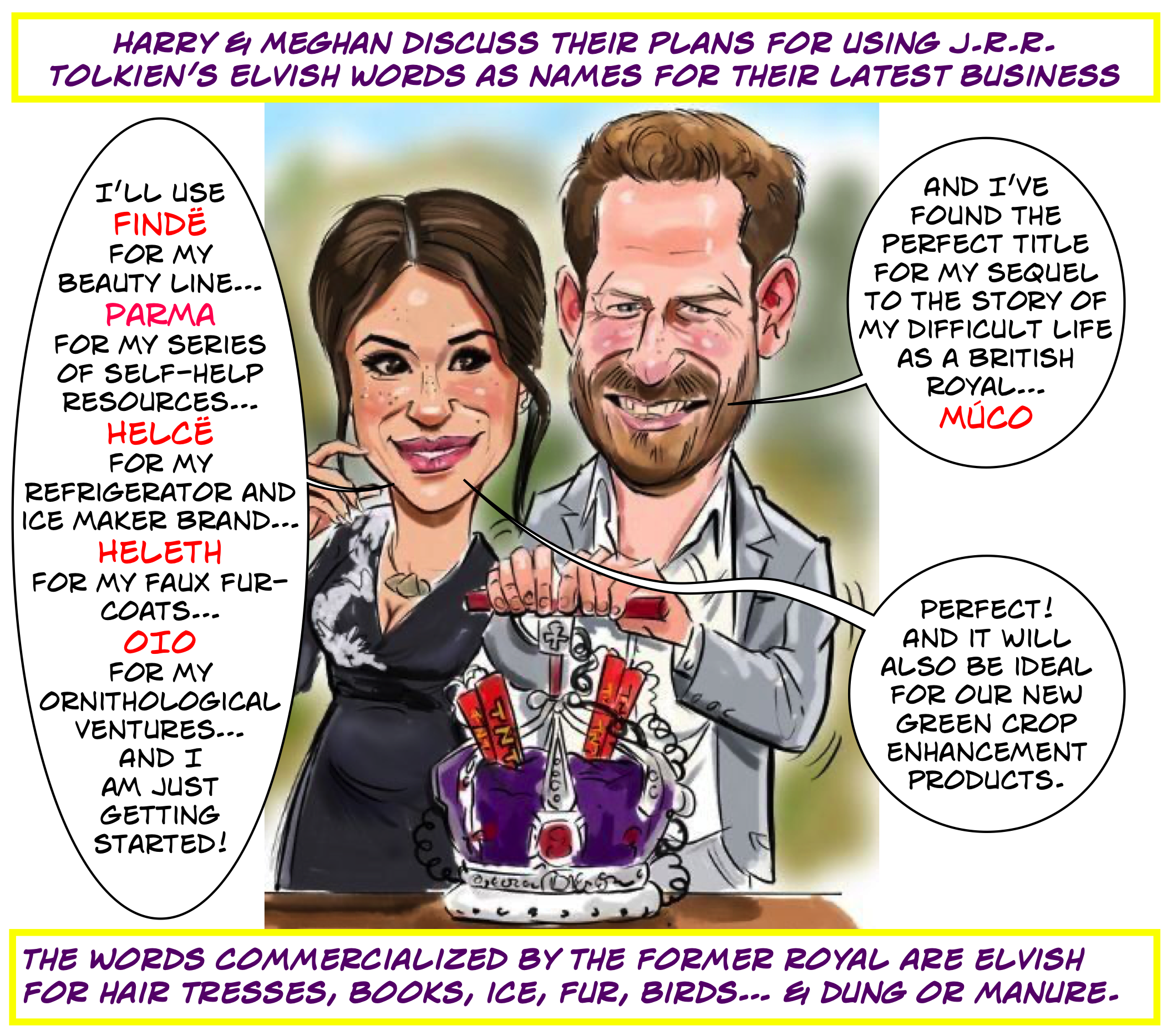
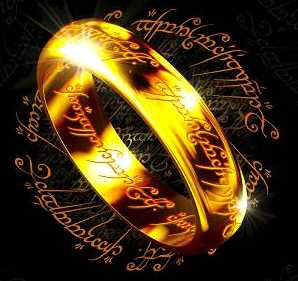
[I originally penned this post in 2020, but delayed its publication due to failing in my attempt to secure permission to receive this perfect illustration. Five years later, AI allowed me to create the image shown above. Since the message remains pertinent, I’m offering my thoughts on this subject today.]

Medicines are precious. Right now we are seeing the release of the first antiviral drugs devised to protect us from the covid plague. The trials have been positive, and now the caregivers on the frontlines are receiving these protective injections.

Unfortunately, some so-called medicines are not effective. They can even be harmful. That’s the case with “patent medicines” hawked by shysters lying about their results. Originally the term was positive. According to one museum, “patent medicines originally referred to medications whose ingredients had been granted government protection for exclusivity.”

Sadly, though, “the recipes of most 19th century patent medicines were not officially patented. Most producers (often small family operations) used ingredients quite similar to their competitors—vegetable extracts laced with ample doses of alcohol.

In a previous post, I shared Lewis’ view of God’s role in healing.

In his essay entitled “Miracles,” C.S. Lewis described during World War II the Christian viewpoint that God is the author of healing. After discussing the natural order of creation, he argues that God is at work in restoring the health of the those who are ailing.

In 1962, Lewis commiserated with a correspondent complaining about the number of pills she needed to take. He acknowledges the problem, and then points to a very positive corollary.

Yes, and one gets bored with the medicines too–besides always wondering ‘Did I remember to take them after breakfast?’ and then wondering whether the risk of missing a dose or the risk of an over dose is the worst!

Yes, one gets sick of pills. But thank God we don’t live in the age of horrible medicines such as our grandparents had to swallow.

In A Grief Observed, Lewis used an illustration of physical pain to explore the emotional pain caused by his sorrow at his wife’s passing.

I once read the sentence “I lay awake all night with a toothache, thinking about the toothache and about lying awake.” That’s true to life. Part of every misery is, so to speak, the misery’s shadow or reflection: the fact that you don’t merely suffer but have to keep on thinking about the fact that you suffer. I not only live each endless day in grief, but live each day thinking about living each day in grief.

In some ways, psychological suffering is particularly painful. The mentally ill have historically been ostracized. For all of the neurological discoveries that have been made in recent years, the human brain remains a mystery.

Fortunately, medical science has experienced some success formulating medicines that are helpful in treating mental disorders. One problem, however, is that (like nearly all meds) psychological formulas occasionally produce extreme side effects.

C.S. Lewis’ primary experience of psychological suffering came through grief. Tweaking Optimism, a great blog, has gathered a number of Lewis’ thoughts on mental anguish. One passage he cites from The Problem of Pain aptly contrasts physical and mental suffering.

Mental pain is less dramatic than physical pain, but it is more common and frequently more difficult to bear. The common attempt to conceal mental pain increases the burden: it is easier to say “My tooth is aching” than to say “My heart is broken.”

In the same book, Lewis lifts up the truth about suffering. In cases where no cure can bring relief, he beautifully describes various ways to survive journeying through the valley.

When pain is to be born, a little courage helps more than much knowledge, a little human sympathy more than much courage, and the least tincture of the love of God more than all.

C.S. Lewis’ Prescription for Christians Today

We live in an uncertain and turbulent time. Only God knows how long this world will last, but he has promised to deliver from death and hell those who call on his name. Thus, Jesus’ followers need not live in dread or despair.

We live with hope, and look forward with enthusiasm to our Lord’s return. It is to that glorious day, the Parousia, that Lewis refers in his essay “The World’s Last Night.”

The doctrine of the Second Coming, then, is not to be rejected because it conflicts with our favorite modern mythology. It is, for that very reason, to be the more valued and made more frequently the subject of meditation. It is the medicine our condition especially needs.

An Entertaining Tolkien “Game”

The inspiration for this revisitation of Lewis’ thoughts about medicine came from a fun website I recently encountered. Some creative soul noticed the similarity between two dissimilar matters—antidepressant medications and residents of Middle Earth.

The game offers 24 words, and you are challenged to identify the group into which it falls. Is it the name of a pharmaceutical, or is it one of the characters created by J.R.R. Tolkien? One name is a giveaway, but you may find many of the others rather difficult to discern.

Kudos to anyone who gets over twenty correct. (I almost did . . . well, if sixteen is close.) Have fun, and learn something, at the very same time!

Antidepressants or Tolkien Character?

Pilfering Tolkien Linguistics

When a great author, say of the magnitude of J.R.R. Tolkien, creates ingenious new words, and even entire languages, there are several common reactions. Most readers simply respond with silent awe. Others are inspired to emulate their efforts. A small number reuse those very words as a sincere homage

And a handful of “admirers” go so far as to “appropriate” the words themselves, for their personal benefit.

C.S. Lewis, no mean linguist himself, recognized his friend Tolkien’s brilliance. In his preface to That Hideous Strength he praised Tolkien’s yet-to-be-published Silmarillion. In a 1951 letter he mentions misspelling the word Numenor.

My Numinor was a mispelling: it ought to be Numenor. The private mythology to which it belongs grew out of the private language which Tolkien had invented: a real language with roots and sound-laws such as only a great philologist could invent.

He says he found that it was impossible to invent a language without at the same time inventing a mythology.

J.R.R. Tolkien was an internationally renowned philologist, and his impressive skill is one of the great wonders we encounter in Middle Earth. A number of words from his created languages – particularly his ethereal Elvish tongues – have been lifted to be used in commercial activities unconnected to Tolkien’s interests.

For example, Palantir. This was the word for the “seeing stone,” which played a prominent role in The Two Towers. In light of Tolkien’s love of nature, and corresponding suspicion of technological advancement, it is especially odd that the company adopting this label is on the leading edge of Artificial Intelligence.

Perhaps Tolkien’s dread would have been dispelled by one of Palantir’s disarming mottos: “We believe in augmenting human intelligence, not replacing it.”

A combat veteran of WWI, like his fellow Inkling C.S. Lewis, Tolkien was appalled by war’s horrors. Even in the War of the Rings, with its moments of glorious heroism and sacrifice, the bloody heart of Mars remains nearly invincible. Because of this mixed attitude toward war, some have wondered how he would have felt about a defense (i.e. military) corporation adopting one of his creations.

Andúril was the name of the most important weapon forged in Middle Earth. It was actually reforged from the broken fragments of Narsil, the longsword which defeated Sauron by severing the One Ring from his hand.

While this description from the Anduril company resonates with our modern ear, I am not convinced that it sounds very Tolkienesque. Anduril: “Transforming defense capabilities with advanced technology. The battlefield has changed. How we deter & defend needs to change too.”

For an article about a billionaire investor who is consumed by mining Tolkien’s tomes for the businesses he founds (PayPal excepted), check out “The hidden logic of Peter Thiel’s ‘Lord of the Rings’-inspired company names.”

C.S. Lewis’ Unconscious Sharing

In a 1965 letter, written after Lewis’ death, Tolkien commented on how his friend had used subtle variations of several Elvish words in several of his fictional works.

Tolkien says Lewis “had the peculiarity that he liked to be read to. All that he knew of my ‘matter’ was what his capacious but not infallible memory retained from my reading to him as sole audience.” Thus, he surmises that:

C.S. Lewis was one of the only three persons who have so far read all or a considerable part of my ‘mythology’ of the First and Second Ages, which had already been in the main lines constructed before we met. . . . His spelling numinor is a hearing error, aided, no doubt, by his association of the name with Latin nūmennūmina, and the adjective ‘numinous.’

Lewis was, I think, impressed by ‘the Silmarillion and all that,’ and certainly retained some vague memories of it and of its names in mind. For instance, since he had heard it, before he composed or thought of Out of the Silent Planet, I imagine that Eldil is an echo of the Eldar; in Perelandra ‘Tor and Tinidril’ are certainly an echo, since Tuor and Idril, parents of Eärendil, are major characters in ‘The Fall of Gondolin,’ the earliest written of the legends of the First Age. But his own mythology (incipient and never fully realized) was quite different.

An Entertaining Diversion

Years ago I linked to an entertaining game that plays on the linguistic eloquence and mystery Tolkien exhibited in naming his characters. I was delighted to see now that it is still available online.

Antidepressants or Tolkien challenges players – you can play solo, but it’s more fun with others – to guess if a given word is an antidepressant drug or the name of one of Tolkien’s characters. Don’t expect to score 100%, but do expect to smile at some of the examples.

Elven Inspiration from Space

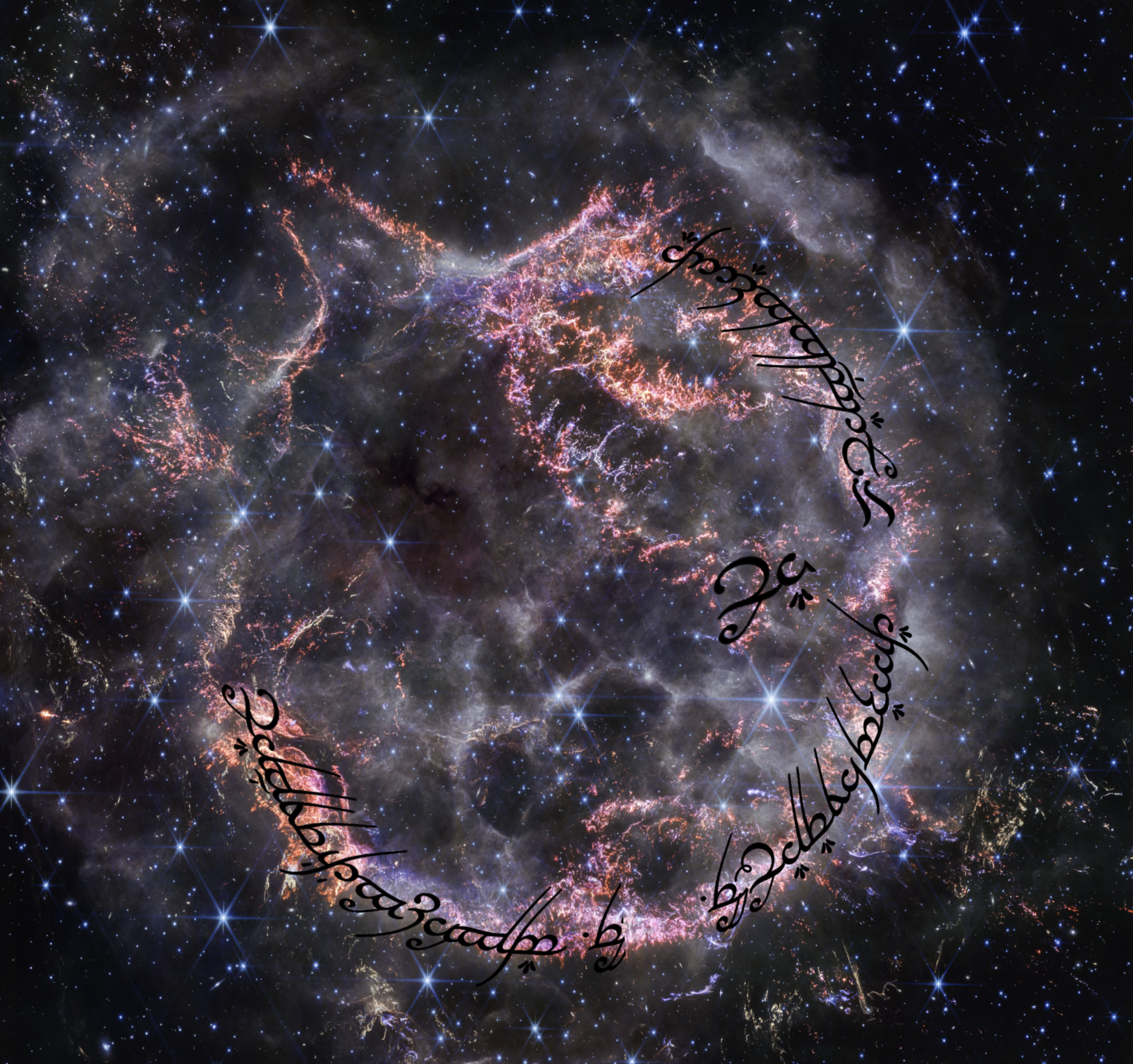
A newly captured image of a supernova remnant in our Milky Way galaxy has me curious about where J.R.R. Tolkien may have gained inspiration for the elegant style of his Elvish scripts.*

America’s NASA has gifted all of Earth’s citizens with an array of stunning, and enlightening images. Recently, the James Webb Space Telescope directed its focus to Cassiopeia A, created thousands of years ago when a star 11,000 light years away went supernova. 

It may be my imagination, or perhaps its an elevated mental talent for “core object recognition,” but for some inscrutable reason, I have recognized in the aftermath of the explosion faint echoes of Elvish script.

The light from Cassiopeia A (or Cas A, as we pseudo-astronomers refer to it) “first reached us around 340 years ago. As that was approximately 272 years before The Lord of the Rings was published, Tolkien had ample time to analyze the spectacular light source. Even factoring in the fact that the stories were composed between 1937 and 1949, the supernova’s existence had been known for a millennia and a half before LOR was written. 

I will leave it to other researchers to determine just how Tolkien was able to gain a detailed view of the explosion’s aftermath. My purpose here is to simply alert the public to the unexplainable parallel between the cosmic residue and Tolkien’s own renditions of Elvish writing as he perceived it. 

In a moment, I will allow the self-evident facts to speak for themselves.

Like his friend C.S. Lewis, Tolkien was a student of astronomy. As Professor Kristine Larsen says, “J.R.R. Tolkien based the stars and constellations of his created world of Middle-earth on ‘real world’ astronomy.” Dr. Larsen, a preeminent “Tolkienian Astronomer,” has published widely on the subject. 

Of particular interest to readers of Mere Inkling will be “Medieval Cosmology and Middle-earth: A Lewisian Walk Under Tolkienian Skies,” which can be downloaded here. In the essay, Larsen points out,

. . . as is well known in Tolkien scholarship, during and after writing The Lord of the Rings Tolkien made various attempts to more closely align his cosmology with 20th century astronomical knowledge.

Fortunately for those of us who are drawn to the mythological textures of his legendarium, Tolkien never completed this “radical transformation of the astronomical myth” (as son Christopher termed it), but it is important to understand that this tension existed within Tolkien’s mind.

Having narrowly escaped the snare of surrendering to twentieth century astronomical theories, Tolkien preserved the mythical spirit of his cosmology. Larsen’s essay considers “whether or not Tolkien’s subcreation would, in reality, pass muster as a medieval cosmology, as defined by Lewis.” Thesis established, she takes readers on a pleasing journey. “So let us take a stroll under Middle-earth skies, and observe just how well the Dome of Varda matches with Lewis’s challenge.”

Returning to Cas A

As the images below will clearly illustrate, the preservation of the medieval nature of Middle Earth’s heavens does not mean that Tolkien ignored the realities of interstellar space. As I said a moment ago, the visual proof is definitive.

The fluid strokes of Tolkien’s Elven scripts are clearly foreshadowed in the plumes of this cosmic canvas. 

This image speaks fluently for itself.

This pair of images from NASA contrasts the Near-Infrared and Mid-Infrared observations. It is quite possible the second influenced J.R.R. Tolkien’s perceptualization of Sauron’s eye. (Admit it, you see the dramatic similarities.)

We may never learn how Tolkien was able vividly see the details of Cassiopeia A with the earthbound telescopes accessible eighty years ago. Nevertheless, the evidence provided herein is irrefutable.

It seems fitting, when pondering the majesty of the stars as echoed in a masterpiece of literary subcreation, to close with an observation by Tolkien’s friend, C.S. Lewis. In an early letter to a close friend, Lewis described the wonder he experienced in reading Dante’s Paradise.

Here Lewis lyrically shares an experience of spiritual ecstasy which, this writer humbly suggests, can be shared by many, as we stand in awe of the majestic intricacy of the universe our Creator has fashioned.

[I read] Aristotle’s Ethics all morning, walk after lunch, and then Dante’s Paradiso for the rest of the day. The latter has really opened a new world to me. I don’t know whether it is really very different from the Inferno [Owen Barfield] says it’s as different as chalk from cheese – heaven from hell, would be more appropriate!) or whether I was specially receptive, but it certainly seemed to me that I had never seen at all what Dante was like before.

Unfortunately the impression is one so unlike anything else that I can hardly describe it for your benefit – a sort of mixture of intense, even crabbed, complexity in language and thought with (what seems impossible) at the very same time a feeling of spacious gliding movement, like a slow dance, or like flying. It is like the stars – endless mathematical subtility of orb, cycle, epicycle and ecliptic, unthinkable & unpicturable, & yet at the same time the freedom and liquidity of empty space and the triumphant certainty of movement.

I should describe it as feeling more important than any poetry I have ever read. . . . Its blend of complexity and beauty is very like Catholic theology – wheel within wheel, but wheels of glory, and the One radiated through the Many (The Letters of C.S. Lewis to Arthur Greeves).

Perhaps it was one of these very wheels – or rings – that Tolkien observed so many years ago in the heavens?


* For those who are interested in fonts for your computers, you can download Tolkien-inspired typefaces here.

Inkling Linguistics

Last week I wrote about “Learning Languages,” and I promised to follow up with a related theme – the creation of new words and languages. Let’s consider the simple matter first.

Adding New Words

Anyone can make up a new word. The problem is whether we have enough influence to have it adopted and used by another human being. (I add this qualifier to eliminate those who might attempt to skirt the question by simply training parrots to mimic the new word.) As Scientific American relates, 

When parrots are kept as pets, they learn their calls from their adoptive human social partners. Part of their appeal as pets is their ability to sing lower notes than smaller birds and so better reproduce human voices.

So, while you may be able to trick one of your parrots into repeating a novel “word,” that doesn’t count for our purposes here.

Likewise, any other birds who mimic speech, including musk ducks and corvids (ravens, crows and their ilk). In fact, let’s exclude all nonhuman “speakers” from consideration. After all, AZ Animals introduces readers to seven specific animals of different species (only one of which is avian) whose “forebrain is . . . responsible for some animals’ ability to mimic speech.” 

So, animals aside, who embraces and disseminates newly invented new words? Some words, of course, find a partially prepared or receptive audience because they are imported from other tongues. The global influence of English makes other languages especially vulnerable to its influence, which can be deeply resented. The “corruption” of mother tongues sometimes elicits reactionary responses – such as Italy’s current effort to purge English from the Italian Republic.

And some Italians are extremely serious about the task, proposing fines up to €100000. (That is not a typo; at today’s exchange rate it would be $109,857.50.) Their animus toward English follows the path established by the French, who frequently default to Napoléon’s order to refer to Britain as “perfidious Albion.” The Académie Française goes so far as to repudiate specific words, including business, cash, digital, vintage, label, and deadline.

Vocabulary adopted from other nation’s may be “new” to their most recent users, but such importation is certainly not the same as fabricating novel words from the proverbial “whole cloth.”

True Neologisms

I wrote a moment ago that creating words is easy, but persuading others to use them is quite another thing. I’ve discussed this subject in the past, in “Create a Word Today” and “Creative Definitions.” Sadly – and fittingly – none of my personal neologisms have caught on.

Popular creative writers may, however, find their fancies adopted by larger audiences. Shakespeare’s “bedazzled” was birthed in The Taming of the Shrew. The “chortle” was first heard in Lewis Carol’s “Jabberwocky.” “Pandemonium” was revealed as the capital of Hell in Milton’s Paradise Lost. And the first “Nerd” was encountered in Dr. Seuss’ If I Ran the Zoo.

Some neologists were particularly prolific. How about these few additional examples from the Bard: 

Bandit ~ Henry VI
Dauntless ~ Henry VI
Lackluster ~ As You Like It
Dwindle ~ Henry IV

Oh, and Grammarly adds, “Shakespeare must have loved the prefix un- because he created or gave new meaning to more than 300 words that begin with it.” Can you imagine a world without:

Unaware ~ Venus & Adonis
Uncomfortable ~ Romeo & Juliet
Undress ~ Taming of the Shrew
Unearthly ~ The Winter’s Tale
Unreal ~ Macbeth

Before moving on, it would be fair to note that some voices consider this achievement by Shakespeare to be “a common myth.”

It turns out that Shakespeare’s genius was not in coining new words – it was in hearing new words and writing them down before they became widespread, and in wringing new meaning out of old, worn-out words: turning “elbow” into a verb and “where” into a noun. He didn’t invent the words, but he knew how to use them better than anyone.

C.S. Lewis was not a philologist, but he did create a few novel words. The Inkling scholar who pens A Pilgrim in Narnia has written on this subject here and here.

J.R.R. Tolkien was no slouch at inventing English words himself. Some which now reside in our common vocabulary include hobbit and orc. The latter he derived from an Old English word, orcþyrs, a devouring monster associated with Hell. More surprisingly, Tolkien created the modern word “tween,” albeit in the context of hobbits, who lived longer lives than we.

At that time Frodo was still in his tweens, as the hobbits called the irresponsible twenties between childhood and coming of age at thirty-three.

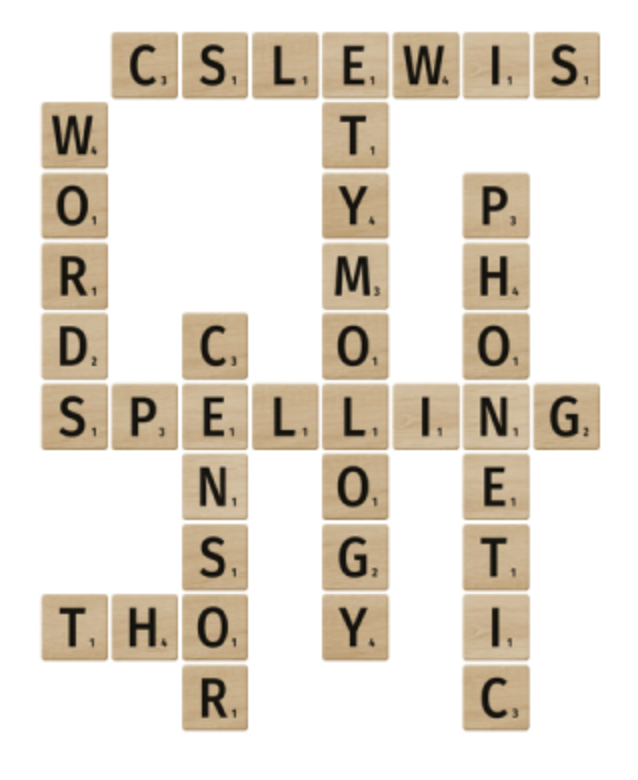
Envisioning novel words is relatively simple, but inventing an entire language, is an infinitely more complex challenge. The universally acknowledged master is J.R.R. Tolkien, whose Elvish tongue has become a “living” language.* But he was not alone in building internally consistent linguistic systems. Albeit, no philologist came near to Tolkien’s expertise, which included elaborate etymologies.

Before considering Tolkien himself, we will note several other efforts of a similar kind. And, following a discussion of Tolkien, we will conclude with a note about his good friend, C.S. Lewis. For, despite the fact that Lewis was not a philologist himself, it is interesting to note that he too dabbled in creatio linguarum.

Inventing New Languages

Some “constructed languages” are formed with practical purposes. Esperanto, birthed in 1887, incorporated elements from existing languages and was envisioned as a common “international auxiliary language.” It boasts its own flag, and claims to be the native language of approximately a thousand people.

One curious use of Esperanto came in its adoption by the United States Army as the “Aggressor Language” used in twentieth century wargames. The curious can download a copy of the now-rescinded Field Manual 30-101-1, which provided guidance for its usage “which will enhance intelligence play and add realism to field exercises.”

Another genuine constructed language is Interlingua. Developed between 1937 and 1951, it is based primarily on the shared (and simplified) grammar and vocabulary of Western European languages. 

In addition to languages constructed for international use, there are a variety of tongues created for fictional applications. “To learn Klingon or Esperanto” describes how linguistic anthropologist Christine Schreyer “invented several languages for the movie industry: the Kryptonian language for ‘Man of Steel,’ Eltarian for ‘Power Rangers,’ Beama (Cro-Magnon) for “Alpha” and Atlantean for ‘Zack Snyder’s Justice League.’” While none of these could ever rival the languages of Middle Earth, her bona fide linguistic credentials place her in a context similar to J.R.R. Tolkien. The interview reveals how Schreyer balances her creative impulses with her anthropological concerns.

I teach a course on linguistic anthropology, in which I give my students the task of creating new languages as they learn about the parts of languages. Around the time I started doing that, “Avatar” came out. The Na’vi language from that movie was very popular at the time and had made its way into many news stories about people learning the language – and doing it quickly.

My other academic research is on language revitalization, with indigenous or minority communities. One of the challenges we have is it takes people a long time to learn a language. I was interested to know what endangered-language communities could learn from these created-language fan communities, to learn languages faster.

Other fictional languages that exist include R’lyehian (from Lovecraft’s nightmare cosmos), Lapine (from Watership Down), Fremen, the Arabic/alien blending (from Dune), Parseltongue (ala Harry Potter), Dothraki (from Game of Thrones), Ewokese, etc. (from Star Wars), Goa’uld and others (from Stargate), Minbari and more (from Babylon 5), and the gutturally combative Klingon and others (from Star Trek). This brief list is far from exhaustive.

Tolkien, Lewis & New Languages

The languages forged by J.R.R. Tolkien are unrivaled by any conceivable measure one might employ. They are no mere stage dressing, like some of the aforementioned examples. Even those with developed vocabularies and consistent grammar fall far short of Tolkien’s creation. In terms of the histories of his languages, his diligent etymologies beggar all other such efforts. Of course, for Tolkien this was no competition. He was driven to make his languages as flawless – not “perfect,” but realistic – as humanly possible. It was a linchpin in his subcreative labor.

As a skilled calligrapher, Tolkien devised unique alphabets to complement his languages. The letters in his alphabets were not devised as mere adornments. Tolkien left that to lesser imaginations. Nor were his scripts restricted to Tolkien’s fiction. The Tolkien Estate offers an insightful essay on “Writing Systems.”

Tolkien also used invented scripts that were not associated with any of his fictional worlds. An early example is the Privata Kodo Skauta (Private Scout Code), which appears in a still unpublished notebook from 1909 called the Book of the Foxrook. This makes use of a phonetic code-alphabet, as well as a number of ideographic symbols representing full words. . . .

Toward the end of his life, Tolkien made use of the New English Alphabet, a phonetic script that combined the logical structural principles of the Angerthas and the Tengwar with letters that looked more like Greek or Latin. The alphabet has not yet been published in full, but examples can be seen in . . . J.R.R. Tolkien: Artist & Illustrator.

The footnote below links to some resources for those who would like to learn how to speak the languages of the elves. By way of help with pronunciations, remember the following advice:

Use an Italian accent to pull off Quenya speech patterns. In general, you can kind of sound Elvish – even without following the rules of the language – by applying an Italian accent when pronouncing Quenyan words. Native Italian speakers tend to use speech patterns from their native tongues to interpret English words, which can make your Elvish sound practiced even when it isn’t.

Speak with an Irish or Scottish accent to pull off a natural Sindarin accent. Irish and Scottish speakers tend to speak English by emphasizing sounds in the front of a word regardless of the standard pronunciation. This is a pretty good method for pronouncing Sindarin words, since the vast majority of them stress the first syllable.

For those who want to quickly capture some Elvish script without the effort of studying, consider the English to Elvish online translator, which is offered by the company that fashioned The One Ring for Peter Jackson’s cinematic epics. I decided to test the translation tool and posed the question: “Does AI translation of English to Quenya actually work?” The software swiftly complied.

It looks elegantly correct, but unfortunately, I’m unable to personally verify its accuracy. And I must confess to modest trepidation since the site advises:

USE CAUTION BEFORE COMMITTING TO ANY TATTOOS, INSCRIPTIONS AND ENGRAVINGS” [triple emphasis in original].

The Jens Hansen site sells jewelry, as befits the fasioners of The One Ring. In addition to hosting the translator, they offer a free pdf document called Elvish 101 in 5 Minutes. It’s an interesting document, but it reveals a limitation I assume is shared by the online generator. It is a resource for transliterating, not translating, words. Not quite the same thing . . . but the script still looks elegant. 

Tolkien was the master of creating languages for his subcreation, but C.S. Lewis also used the same technique in the writing of his Space Trilogy. Each work focuses on an individual planet in our solar system, which is referred to in the books as the Field of Arbol.

While a number of languages have developed over time, the original language, known as Old Solar, is retained by some, and learned by the series’ protagonist Dr. Elwin Ransom. Ransom is a philologist at Cambridge, and as he is modeled after Tolkien, it’s no surprise his first name means “elf friend.”

In Perelandra, Ransom describes how a language he learned on Mars was once shared by all.

“It appears we were quite mistaken in thinking Hressa-Hlab the peculiar speech of Mars. It is really what may be called Old Solar, Hlab-Eribol-ef-Cordi. . . . there was originally a common speech for all rational creatures inhabiting the planets of our system: those that were ever inhabited, I mean – what the eldila (angels) call the Low Worlds. . . .

That original speech was lost on Thulcandra, our own world, when our whole tragedy [the Fall] took place. No human language now known in the world is descended from it.”

Lewis’ use of Old Solar is sparing, but a partial lexicon can be found at FrathWiki. There, for example, you will learn that “honodraskrud” is Old Solar for a “Groundweed; an edible pinkish-white kind of weed, found all over the handramit” of Malacandra (Mars).

The accomplishments of Tolkien and Lewis are difficult to compare. These two brilliant scholars shared a great many interests, but wrote with far different goals. We rightfully expect genius to vary between such individuals. This is well illustrated by their differing treatments of constructed languages, as Martha Sammons describes so well in War of the Fantasy Worlds.

Tolkien began with invented languages and then developed an elaborate mythology to create a world where his languages could exist. Lewis’s works began with mental pictures; he would then find the appropriate ‘‘form’’ to tie together the images. . . .

[Tolkien’s] penchant for historical and linguistic detail is unparalleled. In contrast . . . Lewis uses just enough language, geography, and science to make his novels believable.

While either approach may inspire those among us who aspire to writing, we best avoid attempting to emulate either author. Best, I believe, to compose our epics with the language that most naturally flows from our pen.


* While some fans of Klingon and Na’vi may learn to speak in those tongues, the students of the languages of Arda, typically possess greater ardor for the languages of Middle Earth. For example, an online guide to learning Elven languages begins by answering the question, “why study Elvish?” And a free online course for learning Quenya is offered here. Among the Quenya dictionaries, the finest free example is available at Quenya-English Dictionary English-Quenya Dictionary.

C.S. Lewis and the History of Words

Like many of you, I love words. Like C.S. Lewis, I recognize the value of understanding each word’s etymology—its origin and history.

That’s why I was hooked right from the beginning by a short essay on “Language and the Bible” that I read in a magazine to which I subscribe. Dr. Mark Ward’s column goes by the heading Word Nerd. (Yes, I recognize the title is dweebish, but bear with me, his insights are worthwhile).

Word histories are for precocious nine-year-old homeschoolers who enjoy presenting irrelevant factoids to bemused adults. But word histories are history, and they come with all the drama that human life does.

You don’t have to be a geek to have fun with etymologies. Right here at Mere Inkling we enjoyed exploring Viking words that found their way into English. We also discussed the importance of using the etymological meanings of one’s name when determining how that name is properly rendered in the Elvish tongues of Middle Earth.

Etymology is serious business to those of us who study history and, especially, theology. The article I just cited is available online in a delightful video presentation. I’ll link to it below, for those interested in language as it relates to the Bible. Yet, even for those without these theological or historical interests, learning the life story of words can be fascinating, and even inspiring.

Listen to C.S. Lewis’ thoughts on the importance of philology, the broader study of languages which incorporates etymology.

I am sometimes told that there are people who want a study of literature wholly free from philology; that is, from the love and knowledge of words. Perhaps no such people exist. If they do, they are either crying for the moon or else resolving on a lifetime of persistent and carefully guarded delusion.

If we read an old poem with insufficient regard for change in the overtones, and even the dictionary meanings, of words since its date—if, in fact, we are content with whatever effect the words accidentally produce in our modern minds—then of course we do not read the poem the old writer intended.

What we get may still be, in our opinion, a poem; but it will be our poem, not his. If we call this tout court “reading” the old poet, we are deceiving ourselves. If we reject as “mere philology” every attempt to restore for us his real poem, we are safeguarding the deceit.

Of course any man is entitled to say he prefers the poems he makes for himself out of his mistranslations to the poems the writers intended. I have no quarrel with him. He need have none with me. Each to his taste. (Studies in Words)

Exciting News for Word Lovers

The Oxford English Dictionary (OED) provides an unrivaled treasure-trove of information about the world’s most influential language. And—it is currently being expanded. The second edition, published in 1989, consists of twenty volumes (21,728 pages). The new edition will, of course, eclipse that.

Best of all, will be the OED’s deeper exploration of each word’s etymology. As they say in the already-released Preface to the Third Edition of the OED:

The revision of the Oxford English Dictionary’s etymological component is a substantial undertaking. In the First Edition many entries whose origin was taken to be self-evident (typically native English formations) were not provided with etymologies.

In the revised material each entry has a formal etymology. . . . the most significant changes relate to the analytical content of the revised etymologies, which for the most part update text which appeared in the First Edition of the Dictionary, and therefore represented the state of scholarly knowledge approximately one hundred years ago.

Your reward for reading this far: At the beginning of this post, I quoted from the Bible Study Magazine article that inspired it. This is a link to the article itself . . . but I strongly recommend you follow this link to the video version by the author, which I mentioned earlier.

A Bonus Surprise from C.S. Lewis

I suspect most fans of C.S. Lewis would imagine him to be very fastidious, even punctilious, about spelling. The following letter will prove otherwise.

Lewis recognized the purpose of language is to communicate, and although there are valid reasons to investigate their etymologies, such pursuits need not muddy the conversation, so to speak. This letter was published on New Year’s Day in 1960 in the London Times Educational Supplement. It was written in response to a contemporary debate about “spelling reform.”

Nearly everything I have ever read about spelling reform assumes from the outset that it is necessary for us all to spell alike. Why? We got on for centuries without an agreed common orthography.

Most men of my age [i.e. officers serving during WWI] remember censoring the letters of soldiers and know that even the wildest idiosyncrasies of spelling hardly ever made them unintelligible.

Printing houses will always have, as they have now, their own rules, whether authors like them or not. Scholars, who know the ancestry of the words they use, will generally spell them accordingly.

A few hard words will still have to be learned by everyone. But for the rest, who would be a penny the worse if though and tho, existence and existance, sieze, seize and seeze were all equally tolerated?

If our spelling were either genuinely phonetic or genuinely etymological, or if any reform that made it either the one or the other were worth the trouble, it would be another matter.

As things are, surely Liberty is the simple and inexpensive ‘Reform’ we need? This would save children and teachers thousands of hours’ work. It would also force those to whom applications for jobs are made to exercise their critical faculties on the logic and vocabulary of the candidate instead of tossing his letter aside with the words “can’t even spell.”

So, console yourself today with the knowledge that C.S. Lewis would not judge you for accidentally writing “sieze,” or using personal shorthand like “tho” or “thru.” Lewis respected the value of etymology, but he also understood quite well its proper place.

Iceland’s Real Elves

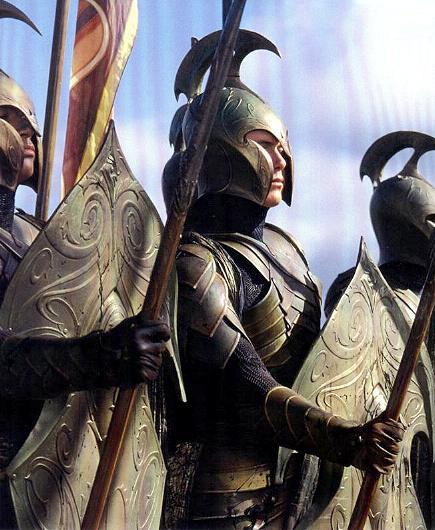
warrior elvesI’ve always wanted to visit Iceland.

Not simply because it’s the most sparsely populated country in Europe . . . even though I’m not big on crowds.

Not simply because of its spectacular glaciers and volcanic activity . . . even though these natural wonders inspire genuine awe.

Not simply because it is home to the world’s most ancient parliamentary democracy . . . even though I believe representative democracy is the best sort of government available.

Not simply because they colonized Greenland, from which the Norse were the first Europeans to discover the Americas . . . even though Leif Erikson deserves the accolades rendered to others.

Not simply because 40,000 of my fellow citizens are of Icelandic descent . . . even though I’m pleased they have contributed to our national “melting pot.”

Not simply because Iceland’s tenth largest city is called Fjarðabyggð . . . even though that vivid name is sure to capture the imagination of any writer.

Not simply because the Icelandic alphabet actually includes a runic letter (Þ, þ) named thorn . . . even though this too makes the nation of Iceland unique.

And, not simply because J.R.R. Tolkien and his friend C.S. Lewis established a group called Kolbitar which was devoted to reading Icelandic and Norse sagas. The word itself means “coal biter” and refers to those in a harsh environment drawing so close to the fire’s warmth they can almost bite the coals.

When the Lord of the Rings (as a work in progress) was being in read at meetings of the Inklings, one of the groups members at some point blurted out, “Oh no, not another –– elf!” [I only mention this here because that impetuous comment is often incorrectly attributed to Lewis—a genuine fan of Tolkien’s masterpiece. It was actually voiced by Hugo Dyson, another WWI veteran who taught English at Merton College.]

In the past, all of these reasons have contributed to my curiosity about the Land of Ice, but now I have added one more reason to someday visit.

It turns out that some Icelanders believe that elves, called by them Huldufólk (hidden folk), are real!

The elves have a large enough human constituency, that they are able to block highway construction due to the impact on the local Huldufólk!

Technically, the preservation of the elvish solitude is only the secondary concern in the lawsuits, the first being protection of one of Iceland’s numerous lava fields. Iceland’s Supreme Court has vacillated on the case, which can only raise the ire of any elves that may reside there.

elf houseIf the proponents of the reality of the Huldufólk are right, there remains one shortcoming to the Icelandic elves. Apparently, if the elf homes that dot the countryside are any indication, the northern island breed are a diminutive race. As in tiny, what Americans would think of more as a gnome or perhaps even a fairy.

My problem is that I’ve been spoiled by J.R.R. Tolkien’s version of the elvish races. I see them a tall, noble, and wise. The kind of folk you’d want for a friend, if you could get past the aloofness that is apparently characteristic of beings who live centuries rather than decades.

I fear that these Icelandic elves are (pardon me, any Huldufólk who may be reading this) a rather inferior lot. More like leprechauns than warriors. If you live in Iceland and can correct my errors about the hidden folk there, please contact me. Even better if you happen to know some elves personally.

Discovering Your Elvish Name

Most readers of Mere Inkling are either fans of C.S. Lewis and his fellow Inklings, or writers interested in similar topics such as adventure, virtue, imagination, and spirituality. In light of that, and the fact that the finale of the trilogy won Oscar for Best Film, I assume the vast majority have seen “The Lord of the Rings.”

When you watched the films, with whom did you most identify? Ladies had options from warriors, to counselors, to royalty. Likewise for the men. Then there were the different races of Middle Earth . . . did you cast yourself as human, elf or dwarf? Or perhaps, as a modest, earthy hobbit? (I hope there weren’t too many who identified with the orcs, and if you did, I’d suggest an appointment with your local therapist.)

If the notion of living a long, peaceful life, studying the arts and enjoying God’s creation inspires you, then it may be you possess a kinship with the Elvish soul. And if you do (or even if you’re merely curious) there is a wonderful website where you can learn not only how to speak your name in the Elf tongue, but also to write it in the Elf script.

J.R.R. Tolkien, C.S. Lewis’ treasured friend, was at heart a philologist. Few people have ever lived who shared the intensity of his love for language. Not everyone knows though, that the matchless realm of Middle Earth with its timeless sagas grew neither from a vision for the heroic story nor out of the visualization of any of its vibrant inhabitants. No, the seeds of the most renowned fantasy realm ever envisioned, were planted and watered by Tolkien’s love of language.

It was primarily linguistic in inspiration and was begun in order to provide the necessary background of ‘history’ for Elvish tongues. (J.R.R. Tolkien, Forward to the Second Edition of The Lord of the Rings).

Tolkien’s passion for the languages of Middle Earth is legend. Today, other linguists continue to study, document and teach the sophisticated system. Tolkien’s creation was so complex that it resulted in the creation (and evolution) of several languages—distinguished by both history and geography. In the same way, Tolkien was not content to settle for a single version of text with which to pen these musical dialects. He created no fewer than three styles, with Tengwar being most familiar. (You can download these and related fonts here.)

So, how exactly do you discover your Elvish name?

There have long been “random generators” for Middle Earth-sounding names. The generator at one site renders my Elvish name as Eöl Séregon, which does sound fairly distinguished. (Who knows whether or not it means anything?) These programs may satisfy the curiosity of the passing surfer seeking random oddities. However, for those who respect the love Tolkien invested in his linguistic progeny, this will never suffice.

Fortunately, there is an amazing website, overseen by a bona fide lover of languages. Moreover, his site is devoted to maintaining the integrity of Tolkien’s Elvish tongues. (And many of us who are writers are similarly enamored with language itself, making this a worthwhile domain to visit.)

The host of Quenya101 embraced the tongue so completely that in college he even took lecture notes in the language! Today he teaches Quenya through his website and other means. Although there’s a long waiting list (that can be circumvented, I believe, by donating to the site) he will actually translate names into Quenya. Note that I said “translate.” This is no mere transposing of letters.

He does not waste his time with transliterations. He actually applies the etymology of your given name to rendering the very same meaning in the Elvish language. For good measure, he provides a Tengwar rendition of your Elvish name. (It may be that he has already translated your name and has it posted at the site.)

Here’s how it works, as illustrated by my own name. Fortunately, my father’s name has also been translated, so I am seeking the Quenya for “Robert (son of) Charles.”

Robert

From: Germanic name Hrodebert.

Meaning: Bright fame, derived from the Germanic elements

     hrod ”fame” and beraht “bright”.

Quenya: Calialcaro

     (calima+alcar+[o] = bright+splendour, glory+[masculine names suffix])

Charles

From: Germanic name Karl, which was derived from the same Germanic word. However, an alternative theory states that it is derived from the common Germanic element hari

Meaning: Karl means “man” & hari means “army, warrior”

Quenya: Nér (nér = man) or Ohtatyaro (ohtatyaro = warrior)

So, henceforth you may address me as Calialcaro Ohtatyaro!

It is encouraging to see people keeping alive the vision and wonder of Middle Earth. The same is true for Narnia, of course, though you cannot really compare the purpose. These magical realms were both created by geniuses. It is a divine coincidence that these men, with major differences in their temperaments and imaginations, were lifelong friends.

Discovering your unique Elvish name can establish a dramatic connection with an imaginary, but at the same time gloriously real, realm.