
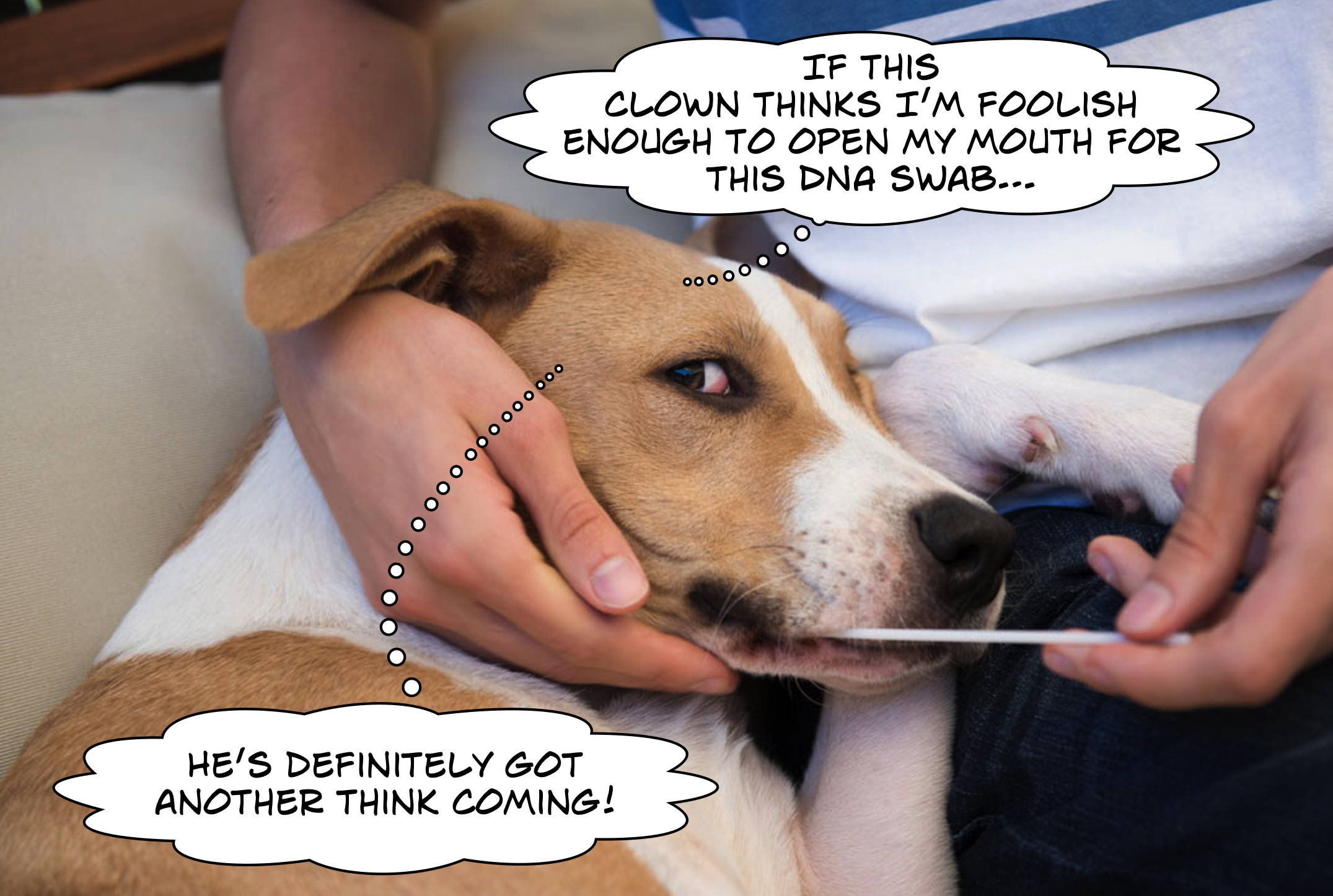
It is surprising how inexpensive and accessible DNA testing has become. Many readers of Mere Inkling have submitted samples ourselves. But how many of us have had our pets tested?
The science of genetics is quite recent. Gregor Mendel (1822-1884) is considered the father of such studies. As Britannica describes the history, “The word genetics was introduced in 1905 by English biologist William Bateson, who was one of the discoverers of Mendel’s work and who became a champion of Mendel’s principles of inheritance.”
Molecular genetics did not begin in earnest until 1941 . . . A major landmark was attained in 1953 when American geneticist and biophysicist James D. Watson and British biophysicists Francis Crick and Maurice Wilkins devised a double helix model for DNA structure.
The Human Genome Project didn’t begin until 1990, and didn’t reach its goal until the new millennia. The astute reader will recognize that C.S. Lewis lived before these genetic studies reached their current status, so we should not expect comment from him on DNA per se. Nevertheless, as Francis Sellers Collins, director of the Human Genome Project (2009-2018), says his work is quite compatible with C.S. Lewis’ writings.
In fact, in a lecture at Cambridge, he described how Mere Christianity was pivotal in his conversion from agnosticism to Christianity. According to this preeminent geneticist, “even in the first few pages, all my arguments about faith just fell apart. It was breathtaking . . . Lewis remains my best teacher.”
There is some question as to whether the DNA testing market has peaked. Unsurprising, since it isn’t like tobacco, coffee or rich desserts that “addict” customers to generate repeated purchases. As Advisory Board says, “given one’s genetic data is unlikely to change, most consumers may not see a reason to purchase another DNA testing kit.”
So, how might these corporations remain profitable? Why, by expanding their offerings to the animal kingdom. One such company called Embark claims to offer the “most accurate dog DNA test available.”
Some people purchase the service to satisfy their curiosity about a pet’s breed (often a blend of several). A more valuable benefit is gaining insights into their health and traits. The oddest aspect of the process appears to be Embark’s boast that they offer “the world’s first canine relative finder.”
Like many of us, C.S. Lewis loved dogs. He didn’t, however, go so far as to worship them. I suspect that C.S. Lewis would opt out of the chance to DNA-define his pets. Best to just love them and savor their companionship.
In his essay “The Personal Heresy,” C.S. Lewis proposes an interesting argument about expressing love only to those capable of receiving it.
There is a reaction at present going on against the excessive love of pet animals. We have been taught to despise the rich, barren woman who loves her lap dog too much and her neighbor too little. It may be that when once the true impulse is inhibited, a dead poet is a nobler substitute than a live Peke, but this is by no means obvious.
You can do something for the Peke, and it can make some response to you. It is at least sentient; but most poetolaters hold that a dead man has no consciousness, and few indeed suppose that he has any which we are likely to modify.*
DNA service businesses are probably licking their lips at the prospects offered by a new market. The French are blazing a new trail for the rest of us. According to Euronews, Béziers will require pet owners to “carry a ‘genetic passport’ for their dog.”
The reason is simple. Too many dog walkers are failing to perform their civic (and humane) duty of cleaning up after their pets.
Dog excrement found on the streets would be collected and tested then sent to the police. They would match the DNA to national pet registers, locate the owner and charge them up to €122 for cleaning up the streets.
Apparently, similar efforts have been attempted in Valencia, Tel Aviv and portions of London.
It sounds like a rather extreme way to address what superficially appears to be a simple problem. But, sadly, in many places, public sanitation has declined to unbelievable depths. In San Francisco, for example, the once picturesque metropolis has voluntarily surrendered many areas to criminals and addicts who feel no compunction about defecating in public. While I can’t speak for European, Asian, African or Latin American countries, in the U.S. a similar story of decay is repeated in many urban centers.
San Franciscans can’t be criticized for not throwing money at the problem. Nevertheless, when progressive Slate magazine reported last year on the city’s newest public toilet, they said “cities shouldn’t need $1.7 million and years of design review to build a municipal toilet.”
Not that San Francisco treats such facilities with care. One space age toilet lasted only a few days before malfunctioning. But it was expensive, stainless steel, and bore the upgraded title of “kiosk.”
A highly hyped new SF bathroom hailed as “the future of public toilets” lasted only three days into said future, as the high-tech bathroom kiosk quickly had to be relieved of its duty and found itself closed for repairs.
Since these are manufactured by a Paris-based company, perhaps they can design a canine kiosk to solve the Béziers dilemma? After all, the cost might well be equivalent to the sum of all of the DNA tests the citizens are being forced to cover.
A Final Thought about Animal DNA
Many of us, like C.S. Lewis, are pet lovers. And many also care about the suffering of other animals, domesticated and wild. There may come a day when DNA testing offers ways to enhance the lives of these other creations of God.
However, it does seem frivolous, does it not, to apply such advanced (and not inexpensive) processes for the purpose of tracking down derelict dog walkers? Or, in other judicatories, which have not yet embraced that level of surveillance, simply to attempt to track down doggie-relatives?
As to the matter of checking pet DNA for genetic abnormalities, “Should you get your pet’s DNA tested? Scientists urge caution” counsels careful consideration.
In the interview, Elinor Karlsson, director of vertebrate genomics at the Broad Institute in Cambridge, Massachusetts says,
With genetic tests for humans, there have been so many studies that look at whether or not a certain mutation in your genes actually leads to you developing a certain disease. There just isn’t this massive body of work on dog genomes. So many of these tests are telling owners that their dog could get a certain disease without any major studies on how likely that is to happen. The science needs to catch up.
In response to the question “what are the dangers of potentially inaccurate test results?” Lisa Moses, a veterinarian affiliated with Harvard Medical School in Boston advises,
In my veterinary practice, I’ve seen more and more people coming in with results that show their dog has a chance of developing conditions like epilepsy, heart disease, and degenerative muscular disorders, and they want to make treatment decisions right away.
They’re ready to pay for more tests or medical interventions that the dog might not actually need, that could be quite expensive, and that could be invasive for the dog. In some cases, people preemptively end their dog’s life if they think their dog is predisposed to a degenerative disease, because don’t they want their pet to suffer.
So once again we see that, as they often do, silly scenarios can lead to serious subjects.
* The passage from “The Personal Heresy” continues:
Unless you hold beliefs which enable you to obey the colophons of the old books by praying for the authors’ souls, there is nothing that you can do for a dead poet: and certainly he will do nothing for you. He did all he could for you while he lived: nothing more will ever come.
I do not say that a personal emotion towards the author will not sometimes arise spontaneously while we read; but if it does we should let it pass swiftly over the mind like a ripple that leaves no trace. If we retain it we are cosseting with substitutes an emotion whose true object is our neighbour. Hence it is not surprising that those who most amuse themselves with personality after this ghostly fashion often show little respect for it in their parents, their servants, or their wives.
 Mere Inkling Press