

C.S. Lewis, J.R.R. Tolkien & Naomi Mitchison

Have your feelings about particular authors changed over time? C.S. Lewis’ attitude toward the work of prolific novelist Naomi Mitchison illustrates this type of progression.

Mitchison’s work possesses a direct link to another Oxford Inkling – J.R.R. Tolkien – whose Fellowship of the Ring she read in proof and favorably reviewed. Brenton Dickieson provides a priceless letter written by Tolkien to Mitchison in 1954.

Naomi Mary Margaret Mitchison was a Scottish novelist who lived more than a century (1897 – 1999). She penned more than ninety books, primarily historical fiction, and including science fiction.

With the outbreak of the First World War, Mitchison joined a Voluntary Air Detachment in a London hospital. (Other familiar women who served in a VAD included Agatha Christie and Amelia Earhart.)

Politically she identified as a Socialist. She was sufficiently leftist that George Orwell regarded her as unsuited for writing anti-Soviet materials for the United Kingdom during the Cold War.

Mitchison’s brother, J.B.S. Haldane, did not equivocate on his radical views, announcing his position as a Marxist. He was a scientist and his atheism brought him into serious disagreement with the Christian views of C.S. Lewis. (I will devote my next post to that interaction.)

Coincidentally, artist Pauline Baynes (who also worked with C.S. Lewis and J.R.R. Tolkien), provided the illustrations for at least one of Mitchison’s children’s books, Graeme and the Dragon. This quick review offers a concise synopsis and discussion of “the charming illustrations [which] go a long way toward making this a fun read.”

An additional coincidence: the same year Lewis published The Lion, the Witch and the Wardrobe, Mitchison also published a fantasy novel for children. The Big House involves time travel and some occultic themes associated with Halloween, etc.

For a thorough synopsis of The Big House and comparison to Lewis’ Chronicles of Narnia, check out this essay from the University of Glasgow. (That reviewer’s preference is clearly for Mitchison’s more complex approach with its themes related to class struggle.)

C.S. Lewis’ Perspective on Naomi Mitchison

I cannot locate any mention of C.S. Lewis by Mitchison, but he did mention her in passing in several pieces of correspondence. In essence, he praised her skill, but was put off by her graphic use of violent imagery.

In a 1932 letter to Arthur Greeves, he writes:

I thought we had talked about Naomi Mitchison before. I have only read one (Black Sparta) and I certainly agree that it ‘holds’ one: indeed I don’t know any historical fiction that is so astonishingly vivid and, on the whole, so true.

I also thought it astonishing how, despite the grimness, she got such an air of beauty–almost dazzling beauty–into it. As to the cruelties, I think her obvious relish is morally wicked, but hardly an artistic fault for she could hardly get some of her effects without it.

But it is, in Black Sparta, a historical falsehood: not that the things she describes did not probably happen in Greece, but that they were not typical–the Greeks being, no doubt, cruel by modern standards, but, by the standards of that age, extremely humane.

She gives you the impression that the cruelty was essentially Greek, whereas it was precisely the opposite. That is, she is unfair as I should be unfair if I wrote a book about some man whose chief characteristic was that he was the tallest of the pigmies, and kept on reminding the reader that he was very short. I should be telling the truth (for of course he would be short by our standards) but missing the real point about the man–viz: that he was, by the standards of his own race, a giant. 

Still, she is a wonderful writer and I fully intend to read more of her when I have a chance.

C.S. Lewis echoed his concern in a 1942 letter to another of his regular correspondents, Sister Penelope. “I gave up Naomi Mitchison some time ago because of her dwelling on scenes of cruelty. But I recognise real imagination and a sort of beauty in the writing.”

In 1951, C.S. Lewis congratulated author Idrisyn Oliver Evans (1894–1977) on the publication of The Coming of a King; A Story of the Stone Age. Ironically, speculative fiction set in this ancient era, referred to as “Prehistoric SF,” was also the setting of works such as H.G. Wells’ Story of the Stone Age series, which you can read here. Naomi Mitchison also dabbled in the prehistoric field. Lewis wrote to Evans: 

I congratulate you. And I think it is a great thing to put that idea of the Stone Age – which is at least as likely to be the true one – into boys’ heads instead of Well’s or Naomi Mitchison’s. It’s all good. The marriage customs are amusing . . . I hope it will be a great success. 

In 1959, C.S. Lewis provided some wise counsel to a young, aspiring author. The American student was contemplating a volume about the Roman subjugation of Gaul, which Lewis encouraged.

A story about Caesar in Gaul sounds very promising. Have you read Naomi Mitchison’s The Conquered? And if not, I wonder should you? It might be too strong an influence if you did (at any rate until your own book is nearly finished). On the other hand, you may need to read it in order to avoid being at any point too like it without knowing you are doing so.

I don’t know what one should read on Gaul. Apart from archaeological finds (Torques and all that) I suppose Caesar himself is our chief evidence? He will be great fun and I hope you will enjoy yourself thoroughly.

Which side will you be on? I’m all for the Gauls myself and I hate all conquerors. But I never knew a woman who was not all for Caesar – just as they were in his life-time.

C.S. Lewis’ most significant mention of Naomi Mitchison occurs in his brief 1943 essay, “Equality.”

It delivers a brilliant discussion of the subject, one that merits full reading. He commends one of Mitchison’s insights into inequality – although, ironically, she relates it to eroticism.* (You must read it in full context to understand how it supports his independent argument.)

This last point needs a little plain speaking. Men have so horribly abused their power over women in the past that to wives, of all people, equality is in danger of appearing as an ideal. But Mrs. Naomi Mitchison has laid her finger on the real point. Have as much equality as you please – the more the better – in our marriage laws, but at some level consent to inequality, nay, delight in inequality, is an erotic necessity.

Mrs. Mitchison [in The Home and a Changing Civilization] speaks of women so fostered on a defiant idea of equality that the mere sensation of the male embrace rouses an undercurrent of resentment. Marriages are thus shipwrecked.

A final reference to Mitchison brings us back around to my early note that she reviewed Fellowship of the Ring. C.S. Lewis refers to her review in his own, suggesting that she has not gone quite far enough in her praise.

Nothing quite like it was ever done before. ‘One takes it,’ says Naomi Mitchison, ‘as seriously as Malory.’ But then the ineluctable sense of reality which we feel in the Morte d’Arthur comes largely from the great weight of other men’s work built up century by century, which has gone into it.

The utterly new achievement of Professor Tolkien is that he carries a comparable sense of reality unaided. Probably no book yet written in the world is quite such a radical instance of what its author has elsewhere called ‘sub-creation.’

Sadly, Naomi Mitchison was less enamored with the subsequent volumes in The Lord of the Rings . . . but this post has already condensed more than enough information.


* An article in Michigan Feminist Studies notes how Naomi Mitchison’s recurrent references to sexual themes distracted from broader matters throughout her literary career.

Despite Mitichison’s attempts to move the discussion of her body of work from the salacious, it is the frank and open inclusion of sexuality that continues to intrigue her critics and reviewers. Racy, heated passages of Mitchison’s historical novels inspired comment from poet W.H. Auden in the 1930s (“Monstrous Sex: The Erotic in Naomi Mitchison’s Science Fiction”).

The essay’s thesis is what one might expect in a journal devoted to contemporary feminism.

I intend to demonstrate that the ribald sexuality of Mitchison’s work registers as more than merely provocative. Sexual encounters between female characters and aliens, as well as those between women, threaten an imperialising capitalism that dictates who may be loved in a gendered, racialised order.
C.S. Lewis & Cruelty to Animals

gagh.jpg

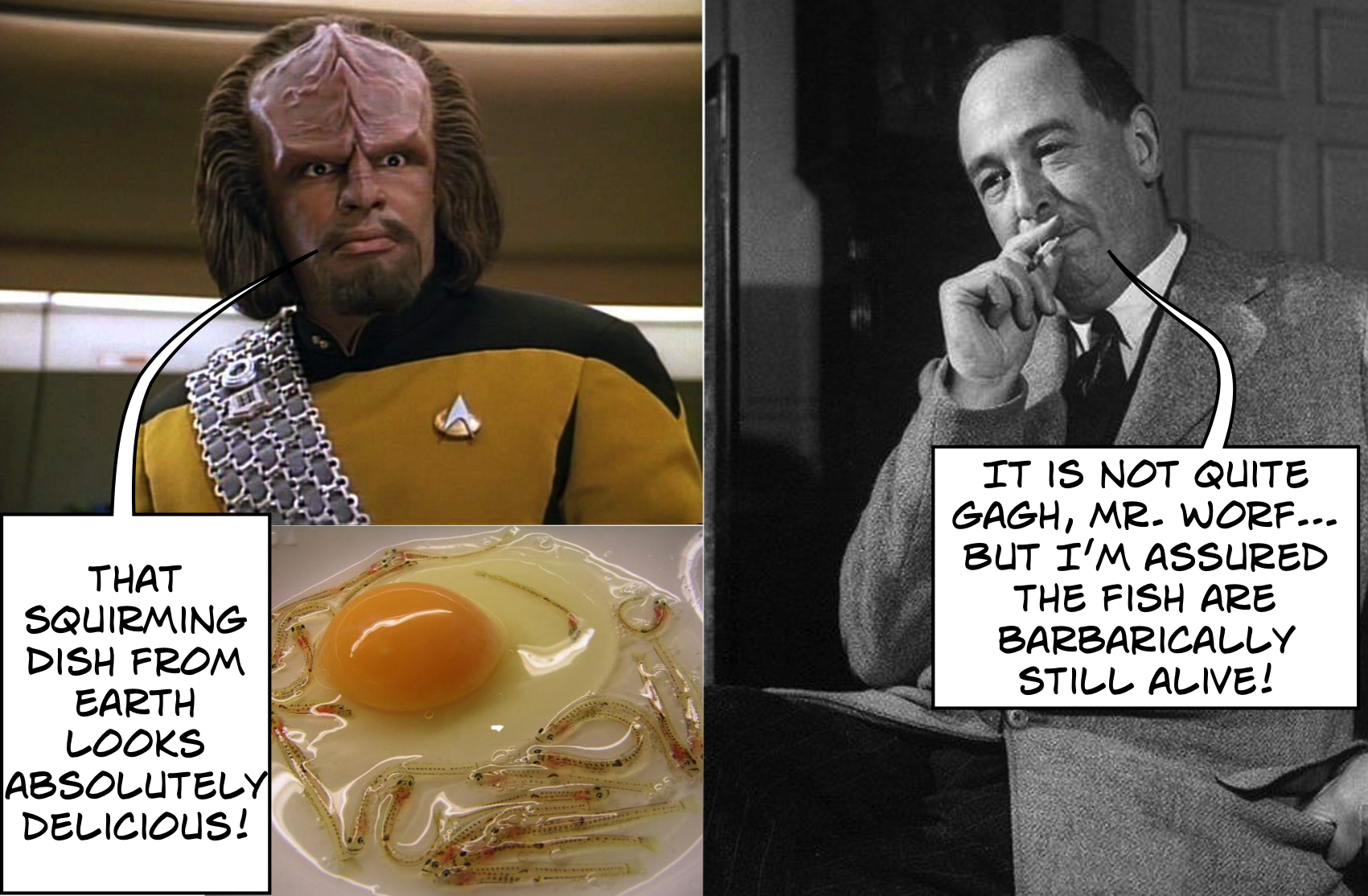
I recently read something quite disturbing about human beings. Something that revealed we have in common with Klingons and Ferengis one of their most disgusting traits. These people eat living creatures while they’re still alive (redundancy intentional).

Gene Roddenberry, creator of the Star Trek universe, foresaw a future in which humanity would rise above its omnivorous ways. “Replicated” food could still take the form of meat, but it would just be made of assorted atoms. The epitome of this view is found in Star Trek: The Next Generation. There, Commander William T. Riker declares to a diplomat from a race that consumes living mammals, “we no longer enslave animals for food purposes.”

In Roddenberry’s dream, humans have attained utopia on Earth. One way other races reveal their inferiority is by their diet. In addition to larvae and slugs, a main part of the Ferengi diet consists of squirmy Tube Grubs.* The more aggressive Klingons prefer assorted mollusks and their staple, the appropriately named Gagh. Gagh could be eaten cold or cooked, but the “serpent worms” were preferred live.**

I had deluded myself to think the devouring of living creatures was relegated to science fiction and the predators of the animal world. Sadly I recently learned about two Asian meals that merit the same stigma.

Goong ten is a Thai meal known as “dancing shrimp,” because the crustaceans are devoured alive.

In the Northeast Thailand region of Isaan, cooks often serve meat raw . . . Street vendors sometimes take the uncooked element one step further, selling a dish known as “dancing shrimp” (goong ten) from double-basket carts. On one side, seasonings await. On the other, a heap of small, translucent shrimp try in vain to escape from beneath a cloth. . . .

Those who might be anxious about eating a still-moving snack can opt to eat each bite swathed in a betel leaf. The traditional wrap conveniently prevents diners from accidentally making eye contact with their meal. Should curiosity get the better of you, however, a standard serving offers dozens of creatures you can stare down before eating alive.

In Japan, shirouo no odorigui describes another squirming delight.

Odorigui refers to the feeling of eating live sea creatures, or “dance-eating.” When it comes to shirouo no odorigui, the creatures dancing to their death are minnow-sized, transparent fish. In Japan’s Fukuoka prefecture, diners down these fish, also known as ice gobies, in shot glasses. As they’re served with nothing but a dash of soy sauce, there’s no hiding from the tiny faces of these slippery, still-moving snacks.

Eating Animals

I would be a hypocrite to condemn eating fish and other animals. However, I find myself utterly repelled by the notion of chewing something that is still alive. It seems unnecessarily cruel. I doubt I’ll ever hold membership in PETA, but I agree with their view that the abuse of animals is a grievous wrong.

C.S. Lewis would share this conviction that the abuse of these creatures is immoral. He wrote that “in justifying cruelty to animals we put ourselves also on the animal level. We choose the jungle and must abide by our choice.”

The merciful treatment of animals is one of Scripture’s most overlooked themes.

Judaism places great stress on proper treatment of animals. Unnecessary cruelty to animals is strictly forbidden, and in many cases, animals are accorded the same sensitivity as human beings. This concern for the welfare of animals is unusual in Western civilization. Most civilized nations did not accept this principle until quite recently; cruelty to animals was not outlawed until the 1800s, and even now it is not taken very seriously.

The primary principle behind the treatment of animals in Jewish law is preventing tza’ar ba’alei chayim, the suffering of living creatures. . . . Judaism has always recognized the link between the way a person treats animals and the way a person treats human beings. A person who is cruel to a defenseless animal will undoubtedly be cruel to defenseless people.

Even the slaughtering of animals is intended, under Kosher rules, “to be as fast and painless as possible . . . Hunting for sport is strictly prohibited, and hunting and trapping for legitimate needs is permissible only when it is done in the least painful way possible.

More on the Subject from Lewis

C.S. Lewis possessed a concern for suffering animals. We used to call this regard “humane,” because it reflected a natural compassion that God instills within us. Sadly, in many people it has been all but extinguished.

In 1940, Lewis included a full chapter on “Animal Pain” in The Problem of Pain. There he advocates a compassionate attitude, without being so doctrinaire as the aforementioned PETA. His concern is theological. He desires to explain how animals can suffer despite the “goodness” of God’s creation. Lewis recognizes that, in a word, the suffering of animals is an evil.

The problem of animal suffering is appalling . . . because the Christian explanation of human pain cannot be extended to animal pain. So far as we know beasts are incapable either of sin or virtue: therefore they can neither deserve pain nor be improved by it.

Lewis also confronted a distortion of biblical teaching that is often employed to justify the mistreatment of animals. Some say humanity is intended to lord over creation (including animals) however we see fit. However, in 1956 Lewis wrote to a correspondent that animals should be treasured.

I think God wants us to love Him more, not to love creatures (even animals) less. We love everything in one way too much (i.e. at the expense of our love for Him) but in another way we love everything too little. No person, animal, flower, or even pebble, has ever been loved too much—i.e. more than every one of God’s works deserves.

The Ethics & Religious Liberty Commission of the Southern Baptist Convention offers an excellent article on the positive place of animals in creation. Animals are precious to God. “They aren’t the product of happenstance or fortuitous natural processes any more than humans are.” Their ten biblical observations about animals echo the thoughts of Lewis, and are quite worthy of your consideration.

One of Lewis’ essays, “Vivisection,” upset a number of his contemporaries who had no reservations at all about experimentation on animals. It appears in the collection God in the Dock, but here are a few excerpts.

The vast majority of vivisectors have no such [Christian] theological background. They are most of them naturalistic and Darwinian. Now here, surely, we come up against a very alarming fact.

The very same people who will most contemptuously brush aside any consideration of animal suffering if it stands in the way of “research” will also, on another context, most vehemently deny that there is any radical difference between man and the other animals. On the naturalistic view the beasts are at bottom just the same sort of thing as ourselves. . . .

We sacrifice other species to our own not because our own has any objective metaphysical privilege over others, but simply because it is ours.

Once the old Christian idea of a total difference in kind between man and beast has been abandoned, then no argument for experiments on animals can be found which is not also an argument for experiments on inferior men. . . . The victory of vivisection marks a great advance in the triumph of ruthless, non-moral utilitarianism over the old world of ethical law; a triumph in which we, as well as animals, are already the victims, and of which Dachau and Hiroshima mark the more recent achievements.

In justifying cruelty to animals we put ourselves also on the animal level. We choose the jungle and must abide by our choice.

And what does this human jungle bring into being?

If we cut up beasts simply because they cannot prevent us and because we are backing our own side in the struggle for existence, it is only logical to cut up imbeciles, criminals, enemies, or capitalists for the same reasons.

If you are interested in learning more about Lewis’ view of the ethical treatment of animals, download “C.S. Lewis and Animal Experimentation” by Michael Gilmour.

It appeared in 2015 in Perspectives on Science and Christian Faith. All issues of the journal, going back to its founding in 1949, are accessible for free online.

The older I have grown, the more sympathetic to animals I have become. Admittedly, the live worms and crustaceans concern me less than the agony of mammals, which are far more conscious of their pain. And . . . I sincerely grieve for people who do not feel compassion for their suffering.


* The Ferengi also love their Slug-o-Cola, with its guaranteed “43% live algae in every bottle.”

** There are presumably more than 5- types of gagh, some of which had feet. And if that doesn’t gag you, your gut has a much higher quotient of iron than does mine.

*** For a lively discussion of whether “the human race has gone vegetarian in Star Trek,” check out this site.

Crimes Against Animals

ferretYou may already have seen this picture which has spread like wildfire across the internet. I’m ashamed to say I shared the common initial response to the story—laughter at the foolishness of consumers looking for bargains. Fortunately, as I learned more of the facts of the deeper crime committed here became apparent, and the humor was displaced by sympathy.

So, just what does this image show? Apparently in Argentina, some criminals have devised a very profitable type of deception. They sell cute toy poodles at a fraction of typical prices.

The only problem with this transaction, is that when owners take their puppies in for vaccinations, the veterinarians have to break the news to them that what they really purchased is not a poodle . . . but a ferret.

How in the world could someone confuse the two, you doubtless wonder. After all, one is Canis lupus familiaris (canine) and the other is Mustela putorius furo (weasel)!

The thieves go to extremes to camouflage their crime. In addition to grooming their fur in similar ways, apparently they abbreviate the poor creatures lives by loading them with steroids as soon as they are born. This adds bulk to disguise the slinky build of these crepuscular mammals that are closely related to polecats. [Don’t feel bad, I had to look up “crepuscular” myself; it refers to animals most active during dawn and twilight hours.]

From the photo you can see the “subtle” differences. I suppose the vendor could explain some of them away with comments like “the muzzle of really young puppies always looks slightly pointed, until they mature.”

While I despise theft, I can chuckle at the thought of someone’s jaw dropping at the news of how they were duped—but I do not regard as at all humorous the suffering inflicted on those innocent creatures.

I don’t own one of the estimated 800,000 domestic ferrets that are part of American families. That doesn’t prevent me, though, from being angered by the cruelty of man toward a species with which humanity has enjoyed a cooperative relationship since before the days of Caesar Augustus. (Augustus shipped ferrets to the Balearic Islands to control a rabbit infestation in 6 BC.)

Some readers might consider my concern for mere weasels as misguided. I believe they are wrong. As C.S. Lewis wrote to a correspondent in 1956:

I think God wants us to love Him more, not to love creatures (even animals) less. We love everything in one way too much (i.e. at the expense of our love for Him) but in another way we love everything too little. No person, animal, flower, or even pebble, has ever been loved too much—i.e. more than every one of God’s works deserves.

It should come as no surprise that the creator of Narnia gave much thought to humanity’s relationship with the other creatures with which the Lord has populated our world. God in the Dock includes his fine essay on “Vivisection.”

After weighing the arguments for and against experimentation on animals, Lewis suggests that our justifications for doing so are often dehumanizing.

The reason why we do not dare [to strongly object to experimentation on higher life forms in the animal kingdom] is that the other side has in fact won. And though cruelty even to beasts is an important matter, their victory is symptomatic of matters more important still.

The victory of vivisection marks a great advance in the triumph of ruthless, non-moral utilitarianism over the old world of ethical law; a triumph in which we, as well as animals, are already the victims, and of which Dachau and Hiroshima mark the more recent achievements. In justifying cruelty to animals we put ourselves also on the animal level. We choose the jungle and must abide by our choice.

I pray that the Argentinean authorities are able to dismantle this abominable trade. And I also hope they will not only prosecute the perpetrators of the crime for theft . . . but for the far more morally corrupt crime of cruelty to animals as well.