Must Writing be a Solitary Endeavor?

It’s often said that “writing is a solitary task.” I find that’s only half true.

Sure, each individual is responsible for putting the words on the page (AI-cheats aside), but sharing your work with others before publishing it provides amazing dividends.

Not only can “other eyes” see flaws we are too close to the piece to recognize, good critiques often include suggestions to make our writing stronger.

I’ve occasionally described the benefits I’ve received from being a member of writers [critique] groups around the globe. I titled one of my posts “Be an Inkling,” because this mutual sharing was central to those brilliant minds who gathered together in Oxford.

In 1967, J.R.R. Tolkien described his reason for using that particular word in just such settings. He said he used the word Inkling as “a ‘jest,’ because it was a pleasantly ingenious pun in its way, suggesting people with vague or half-formed intimations and ideas plus those who dabble in ink.”

I too find it “pleasantly ingenious” and have echoed it here in my own domain. 

Conferences can be helpful too, but my experience is that nothing surpasses the encouragement that emanates from the mutual commitment shared by writers who physically gather to share their creations.

I noted above two concrete ways writing friends can contribute to strengthening our work. However, this third element – encouragement – cannot be underestimated. It was precisely this element that brought that masterpiece, The Lord of the Rings, to the world’s attention.

A Pilgrim in Narnia provides a superb account of C.S. Lewis’ essential role in boosting the confidence of his friend J.R.R. Tolkien. He cites a letter in which Tolkien describes how Lewis’ most precious gift was in challenging him to complete his opus.

The unpayable debt that I owe to him was not ‘influence’ as it is ordinarily understood, but sheer encouragement. He was for long my only audience. Only from him did I ever get the idea that my ‘stuff’ could be more than a private hobby. But for his interest and unceasing eagerness for more I should never have brought The L. of the R. to a conclusion.

Melancholy Transitions

Critique groups are weighing on my mind, since the one I’ve been part of for many years has come to its end. The passing of various members during the past decade left too few of us to continue, and we few who were left are mourning the fact that it was not sensible to continue meeting regularly.

It is another reminder of Solomon’s wisdom when he wrote, “For everything there is a season, and a time for every matter under heaven.”

Sadly, I lack the energy to help establish another new writing fellowship at this point in my life. Perhaps I will join one of the online communities. Christian Writers looks promising.

I actually participated in an online critique community back when primitive “bulletin board systems” were giving way to the nascent internet. No doubt the modern equivalent would be far better in every way.

In the meantime, I do have a few readers I trust to review my work before submitting it to an editor. One is my very talented wife. The problem there, however, is that her love (and compassionate nature) make her too gentle when she critiques my work. 

This drawback is one side of the coin to which author Dan Brown refers when he says: “I learned early on not to listen to either critique – the people who love you or the people who don’t like you.”

This does not mean, of course, that those who love us are unsuitable candidates. It simply suggests that we need to (often repeatedly) give them permission to offer genuinely critical comments, especially when they are accompanied by suggestions for how we might improve a given passage.

In essence although people like William Faulkner are correct in stating that “writing is a solitary job,” most of us can benefit from sharing our drafts with others. 

And fortunate are those of us who discover such friendship, where our writing companions are like-minded, trustworthy, self-confident, and honest. (I personally find having a sense of humor an essential trait, as well.)

In a word, we are greatly blessed to personally become part of our own fellowship of Inklings.
Books Enjoyed by C.S. Lewis

Reading is not only one of life’s pleasures, the content and ethos of what we read, subtly influences the shape of our very lives.

C.S. Lewis loved books with genuine passion. While many people only perceive books as compilations of information or as sources of fleeting entertainment, he knew them as far more. Only someone sharing Lewis’ affection and wisdom will identify with the following passage from his essay “An Experiment in Criticism.”

The man who is contented to be only himself, and therefore less a self, is in prison. My own eyes are not enough for me, I will see through those of others. Reality, even seen through the eyes of many, is not enough. I will see what others have invented. . . .

Literary experience heals the wound, without undermining the privilege, of individuality. There are mass emotions which heal the wound; but they destroy the privilege. In them our separate selves are pooled and we sink back into sub-individuality.

But in reading great literature I become a thousand men and yet remain myself. Like the night sky in the Greek poem, I see with a myriad eyes, but it is still I who see. Here, as in worship, in love, in moral action, and in knowing, I transcend myself; and am never more myself than when I do.

Lewis scholar and emeritus professor of English, Dale J. Nelson, has been providing a wonderful service in recent years as he explores the books which found a place in C.S. Lewis’ personal library. “Jack and the Bookshelf” is a continuing series which appears in CSL, journal of the New York C.S. Lewis Society. Founded in 1969, the organization “is the oldest society for the ​appreciation and discussion of C.S. Lewis in the world.”

Nelson’s task of editorially archiving C.S. Lewis’ library is complemented by the work of our mutual friend, Dr. Brenton Dickieson. In a “comment” praising Dickieson’s compilation of “C.S. Lewis’ Teenage Bookshelf,” Nelson offers a commendation with which I fully concur.

Thank you for assembling that list of books . . . I’d encourage Lewis’s admirers to take their appreciation of CSL to the next step and delve into the things he liked to read throughout his life.

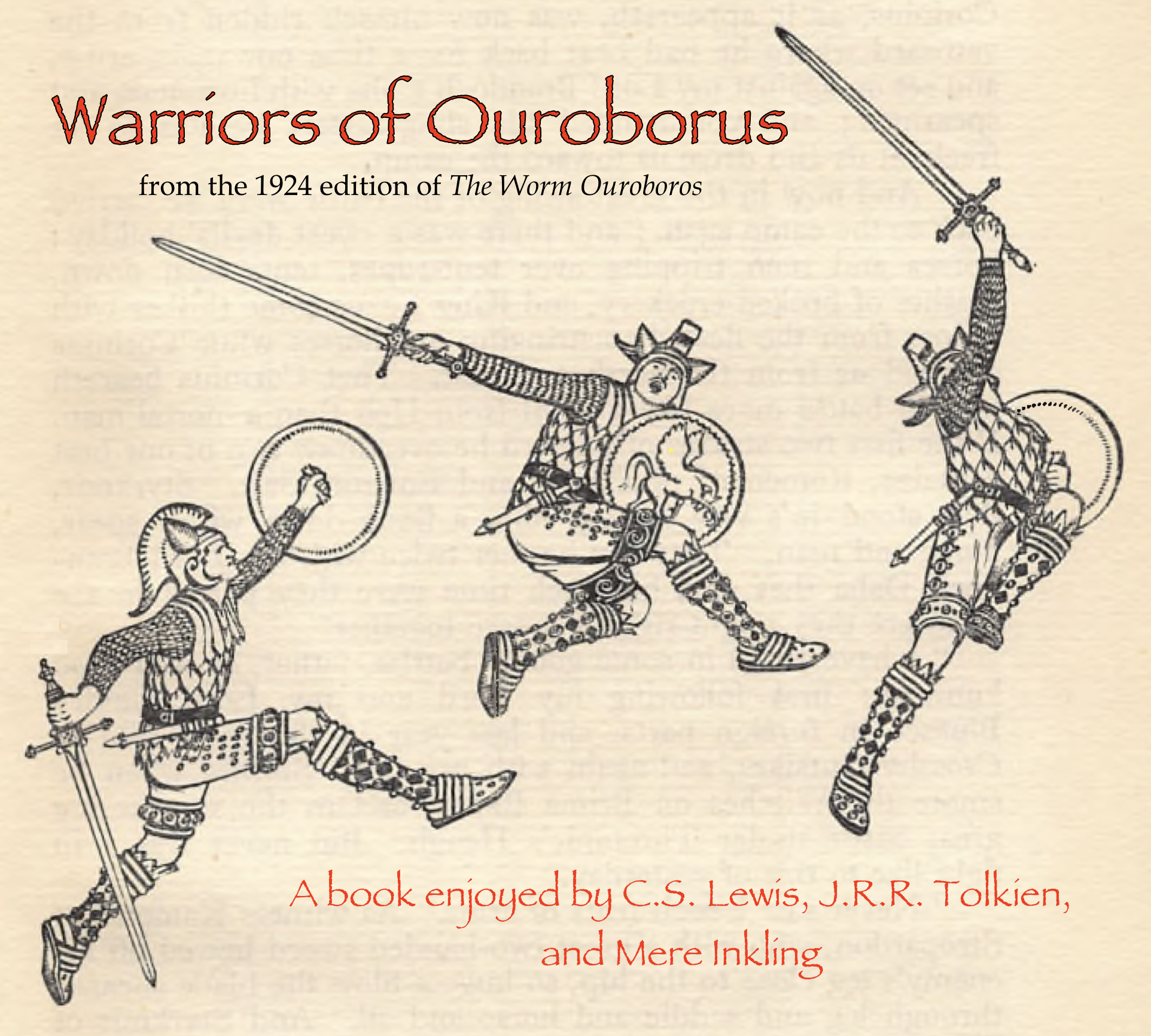
Nelson’s contribution to the December 2023 issue is the fifty-ninth in his series, and discusses a fantasy work titled The Worm Ouroboros by E.R. Eddison. Eddison (1882-1945) was a Norse scholar, and his fascination with mountains combined with that, to resonate with Lewis’ passion for northernness.

Dr. Nelson, who has added an array of science fiction to his own academic work, possesses superb credentials for exploring the connection between Lewis and Eddison. 

Nelson relates that, at C.S. Lewis’ invitation, Eddison attended two gatherings of the Inklings. At the second, Eddison – who relished critiques of his works in progress, as do many serious writers – read from a project which would not be published due to his death the following year.

Eddison’s themes more closely resembled J.R.R. Tolkien’s than Lewis’ own. In Nelson’s words, both “Tolkien and Eddison wrote masterpieces of heroic fantasy whose values differed markedly.” 

Another distinction is that while Tolkien’s Lord of the Rings has maintained its mythic rigor, Eddison’s oeuvre feels rather anchored to the formative years of the genre, prior to the so-called Golden Age of science fiction (and fantasy).

If you would like to read this book, which was enjoyed by both Lewis and Tolkien, you can download a copy of it at Internet Archive. If you enjoy dwarves, goblins, manticores and hippogriffs, you are unlikely to be disappointed.

C.S. Lewis, Satellites & Cemeteries

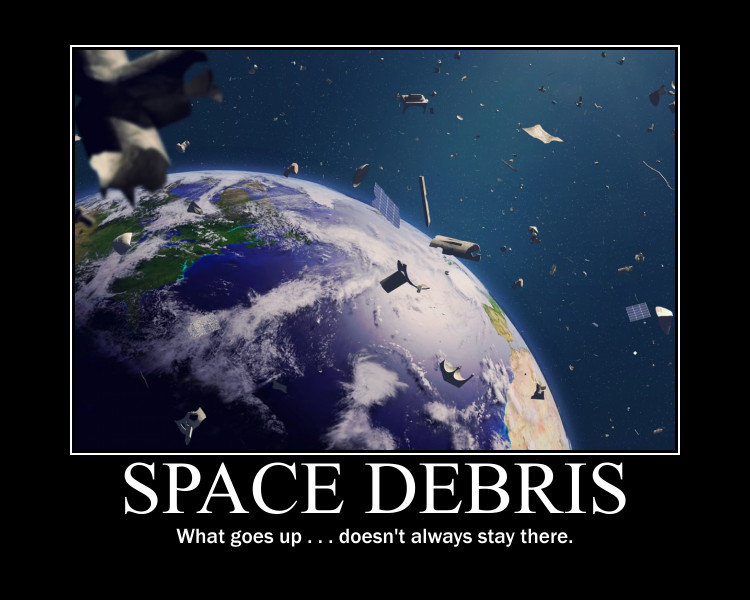
Where do all the satellites go when their utility ends? No, they don’t all just burn up on reentry into the Earth’s atmosphere as their orbits decay. Many are too large for that, and they must be escorted to a remote and desolate Spacecraft Cemetery.

While a great deal of debris and smaller satellites burn up upon re-entry, larger items—including entire space stations—need to be disposed of in a way that keeps the hazardous materials out of public circulation. And what better place than the dark depths of the ocean? Among the craft that have been scuttled at the spot are unmanned satellites . . . and, possibly most remarkably, the entire decommissioned Russian space station, Mir.

The isolated location of this unique graveyard is near the “oceanic pole of inaccessibility,” which marks the location on earth which lies the farthest from any land. The cemetery, which is already the final resting place for more than 260 spacecraft from Russia, Europe, Japan and the United States, lies on the deep seabed approximately 1,500 miles between Pitcairn Island, Easter Island, and Antarctica.

This remote locate is truly mysterious. Members of my critique group expressed concern that residual extraterrestrial elements aboard the satellites might birth some variation of ゴジラ [Godzilla]. Another member, steeped in the Lovecraftian lore of the Cthulhu mythos, pointed out that this “oceanic pole of inaccessibility” is virtually identical with the location of R’lyeh, the subterranean cavern wherein Cthulhu awaits his terrible awakening. In response to these observations, I reminded my colleagues that I happen to be writing nonfiction.

The international space race formally launched in 1957 when the Soviet Union placed Sputnik in orbit. The United States scrambled to catch up, and in 1959, the USSR placed the first human in space. Cosmonaut Yuri Gagarin was preceded by a precious little dog, the first living being to reach out for the stars. Her name was Laika, and we will consider Laika’s sad tale in a moment.

C.S. Lewis & the Space Race

The realm of space was not unfamiliar to Lewis. From 1938 to 1945 he authored three volumes of science fiction that would come to be known as the Space Trilogy (or Cosmic Trilogy).

In one book he describes the danger posed to spacecraft by interstellar debris. Presumably similar dangers led to the early demise of some of the residents of the Space Cemetery. In the first volume, Lewis describes the protagonist’s initial exposure to the “undimensioned, enigmatic blackness.”

The period spent in the spaceship ought to have been one of terror and anxiety for Ransom. He was separated by an astronomical distance from every member of the human race except two whom he had excellent reasons for distrusting. He was heading for an unknown destination, and was being brought thither for a purpose which his captors steadily refused to disclose.

All was silence but for the irregular tinkling noises. He knew now that these were made by meteorites, small, drifting particles of the world-stuff that smote continually on their hollow drum of steel; and he guessed that at any moment they might meet something large enough to make meteorites of ship and all. But he could not fear. He now felt that Weston had justly called him little-minded in the moment of his first panic. The adventure was too high, its circumstance too solemn, for any emotion save a severe delight. (Out of the Silent Planet)

Lewis’ initial foray into space was influenced by H.G. WellsFirst Men in the Moon. In The War of the Worlds, the second chapter is entitled “The Falling-Star.” It describes the terrible dangers that can fall from space. Earth’s “greatest authority on meteorites, stated that the height of its first appearance was about ninety or one hundred miles.” So common are meteorites that “no one seems to have troubled to look for the fallen mass that night.” However, the next morning they discovered,

An enormous hole had been made by the impact of the projectile, and the sand and gravel had been flung violently in every direction over the heath, forming heaps visible a mile and a half away. The heather was on fire eastward, and a thin blue smoke rose against the dawn.

It is precisely due to the destruction that would be caused by a crash-landing catastrophe such as this, that the nations of the world have identified an unpopulated spacecraft cemetery.

This international competition, one of the most publicized elements of the Cold War, unfolded as C.S. Lewis was at the height of his professional influence. Unlike many, who regarded sputnik’s orbit as alarming, Lewis offered a measured, yet realistic, assessment of the advance.

I don’t feel that ‘Sputnik’ in itself is anything very dangerous, but one doesn’t like the underlying implication, i.e. that its existence proves that Russia is far ahead of your country in inter-continental missiles. (Letter to Vera Gebbert, 12 November 1957)

Lewis understood that the race to control the thermosphere and exosphere would not be won in a day. His insight was affirmed as the United States overtook the Soviets’ early advantage and planted a flag on the moon.

In his preface to a theological book, Lewis refers to Sputnik in passing, using its fame as a counterpoint to what is truly lasting and of profound significance.

Dr. Farrer is far too wise and workmanlike in his pastoral office to waste any time on being topical. You will find nothing here about the [nuclear] Bombs or Sputniks. What is usually called ‘the contemporary’ is in fact a composite picture of the recent past, based on secondary sources (chiefly newspapers) and touched up with guesses about the future.

Dr. Farrer . . . has no leisure to spare for such a phantom. He deals with what is really and knowably contemporary–with the august and terrible coincidence of the present moment and the eternal, in which each one of us lives. He is never speaking to the abstraction ‘modern man,’ always to you and me. (Preface to Austin Farrer’s A Faith of Our Own)

C.S. Lewis recognized well how the flash of “the contemporary” served to outshine what was of lasting import. He recognized Sputnik’s scientific breakthrough for what it was. And then he turned his attention to more significant concerns.

The space race, however, never ended. Today we see another shift in the transnational race for space with many nations vying for a role in exploration of the solar system. Likewise, after a period of rewarding international cooperation, the three superpowers are now all actively pursuing the militarization of space. Where it will end only our descendants will witness.

Still, like C.S. Lewis, we have personally witnessed much progress when it comes to humanity’s desire to touch space. And many of the most powerful memories have involved tragedy.

Soyuz 1 (1967) and Soyuz 11 (1971) cost four lives. In the West, entire crews were lost in three disasters: Apollo 1 (1967) and Space Shuttles Challenger (1986) and Columbia (2003). Humans, though, were not the only ones to sacrifice their lives in the exploration of space. In our next post, we’ll reflect on the price paid by animals in beginning this extraplanetary journey.

Be an Inkling

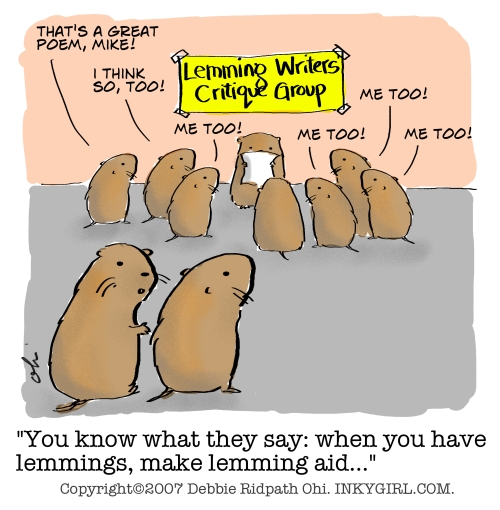
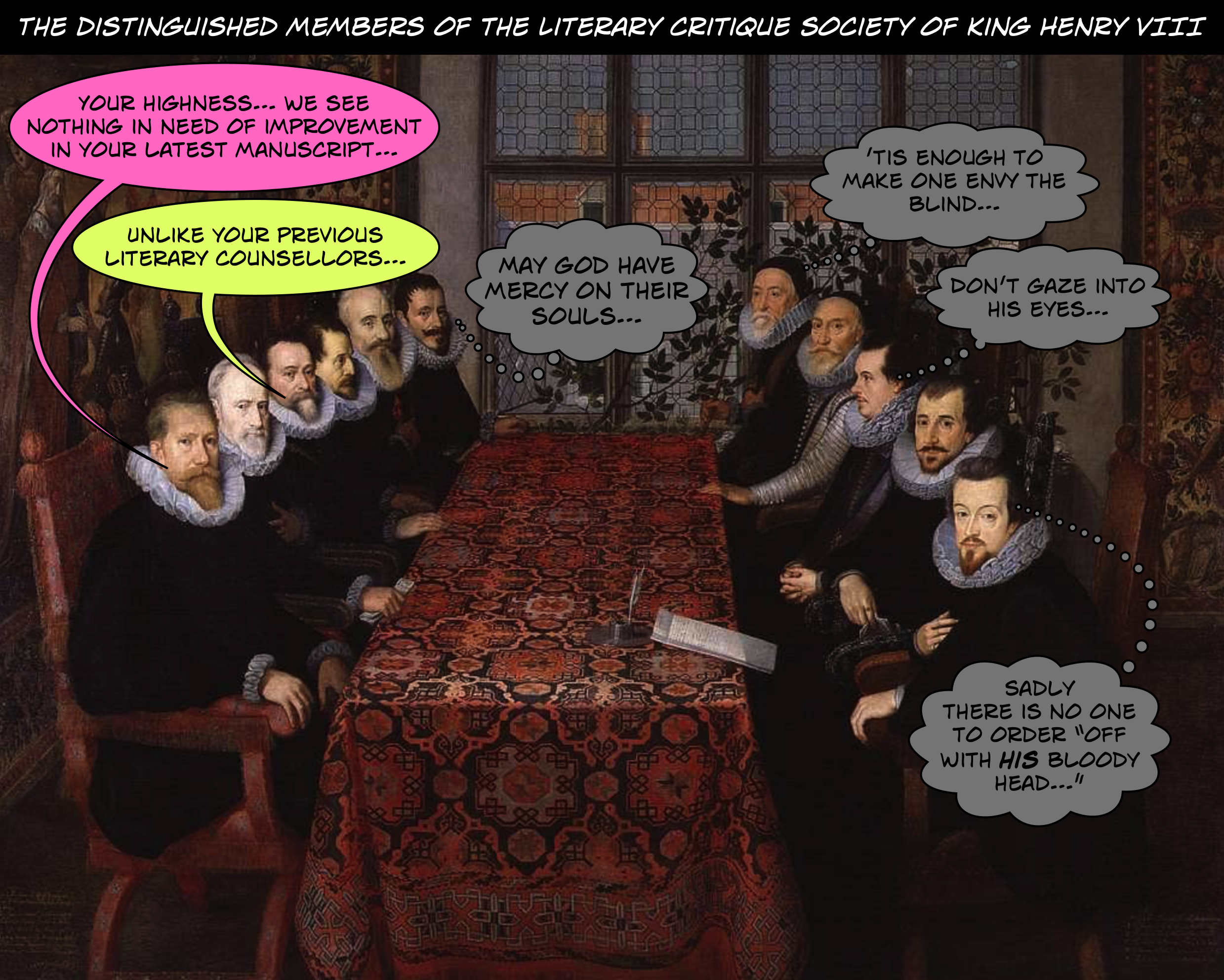
Lemming Critique

Do you invite others to critique your writing before you publish it? If you want to be successful, you definitely should.

I never cease to be amazed at how presumptuous some writers are. I’m referring to those who deny their work could be improved by having others offer suggestions for improving it.

When I reflect on the fact that C.S. Lewis and J.R.R. Tolkien subjected their own work to the critical eyes (and ears) of their peers, I realize I must do no less.

Just as their involvement in the Inklings made them better authors, in the same way our participating in writing or critiquing fellowship is vital to our advancing in the art.

Lewis recognized this early in life. Long before the birth of the Inklings, he exchanged “works in progress” with his lifelong friend, Arthur Greeves.

Lewis went so far as to declare, in a 1916 letter to Greeves: “It is impossible to write one’s best if nobody else ever has a look at the result.”

Benefits of Writing Fellowships

Some profitable results that come from participating in a support group are obvious. Depending on the group, your compatriots identify places where your writing is not as clear as you intend it to be. Some participants may also be good copy editors, and willing to share their skills.

Then there are the proverbial “grammar Nazis” whose contributions are actually valuable, if you desire to write well. (Of course, the comments of others are only suggestions, and all writers are free to implement, or dismiss, the advice.)

In longer works, your writing companions can help you identify when your pace is erratic or your story is going off track. It’s not uncommon for them to offer worthwhile ideas that would never have come to you if you relied solely on your own cranium.

Another benefit comes from gaining new insights into the writing life. For example, one of my writing partners made this observation that continues to guide me. Discussing how frequently I digress to extinguish any possibility of misunderstanding, he said, “The instinct of the journalist is to be concise. The instinct of the historian is to be thorough. You’re a historian.” Realizing that I invariably default to the latter, the historian, helps me to consciously attempt to temper that orientation. (I know, I don’t succeed too well with that, but just imagine what my writing would be like if I surrendered unconditionally to my innate inclination.)

Encouraging Others

Participating in a writing collective means we never have to be isolated, alone with words destined never to be seen by another human eye. At the very least, we share them with our friends. And, potentially, the collaborative process helps see them through to publication

It is well known that without C.S. Lewis’ persistent encouragement, Tolkien’s Lord of the Rings and The Hobbit would never have seen print.

Lewis revealed his nature as an encourager early in his life. The quotation above comes, in fact, from a letter when he is challenging Greeves to continue faithfully sending his work for Lewis to comment upon.

I do really want to see something of yours, and you must know that it is impossible to write one’s best if nobody else ever has a look at the result.

However, I told you I would proceed to serious measures, so here is my manifesto. I, Clive Staples Lewis, student, do hereby give notice that unless some literary composition of Arthur Greeves be in my possession on or before midnight on the last night of June in the year nineteen hundred and sixteen, I shall discontinue from that date forward, all communication to the said Arthur Greeves of every kind, manner, and description whatsoever, until such composition or compositions be forwarded. ‘So there’ as the children say. Now let us go on.

This amusing passage reminds us of two final things. First, if we have difficulty connecting with a local writing group, remember that we are not limited by geographic proximity. (Never truer than in today’s wired world.)

A second lesson is that, as in most human relations, humor makes good things even better. Oh, how the halls of Magdalen College and the Eagle and Child must have echoed with their laughter.