
Tinker Bell, the Inklings, and Disney

Poor Tinker Bell. The political prejudices of our day have caught up with the sparkling fairy, and relegated her to a significantly reduced presence in the Disney universe.

Inside the Magic reported “Tinker Bell seems to have left Walt Disney World and is now on her way back to Neverland following a recent change at Walt Disney World Resort.” You can read the tragic tale on their site.

. . . once more, Disney’s animated classic, Peter Pan (1953), is under scrutiny, with Disney issuing a statement regarding Captain Hook and Tinker Bell as characters with potential concerns.

Linking poor Tink to a murderous pirate seems a bit of a stretch, and she has not been fully banished, but she has definitely been demoted. According to TMZ, Disney alleges the company’s “own people felt she wasn’t a good role model for girls in the 21st century.”

Well, eventually she too will be in the public domain, like Mickey Mouse. Actually, her literary portrait as introduced in the play, coincidentally just entered the public domain this year (2024)!

However, should you reside in the United Kingdom, beware that in 1988, the copyright holder, Great Ormond Street Hospital, was granted the rights to Peter Pan “in perpetuity.”

The Creator of Tinker Bell & Peter Pan

Tinker Bell is one of the most memorable characters in Neverland, the creation of James Matthew Barrie (1860-1937). He was a prolific Scottish writer and is best known for his 1911 novel, Peter and Wendy – which initially debuted in the form of a stage play in 1904, as Peter Pan; or, the Boy Who Wouldn’t Grow Up.

Peter Pan was actually introduced to the world as a baby in The Little White Bird. Tinker Bell does not appear in the novel, but the following description of J.M. Barrie’s fairy mythology is quite fanciful.

One of the great differences between the fairies and us is that they never do anything useful. When the first baby laughed for the first time, his laugh broke into a million pieces, and they all went skipping about. That was the beginning of fairies.

They look tremendously busy, you know, as if they had not a moment to spare, but if you were to ask them what they are doing, they could not tell you in the least. They are frightfully ignorant, and everything they do is make-believe.

They have a postman, but he never calls except at Christmas with his little box, and though they have beautiful schools, nothing is taught in them; the youngest child being chief person is always elected mistress, and when she has called the roll, they all go out for a walk and never come back.

It is a very noticeable thing that, in fairy families, the youngest is always chief person, and usually becomes a prince or princess; and children remember this, and think it must be so among humans also, and that is why they are often made uneasy when they come upon their mother furtively putting new frills on the basinette.

Barrie continues, describing how infants are simply following fairy “ways” when they misbehave, and they naturally experience “exasperation, because we don’t understand [them], though [they are] talking an intelligible language . . . fairy.”

Returning to the person of Tinker Bell herself, she outgrew her supporting role as, in the words of her creator, “a common fairy.” She was literally a tinker, who died following the departure of Wendy and her brothers from Neverland. 

Presumably, some of the gatekeepers at Disney would have preferred that the affection of the crowds had not restored her to life. 

The Inklings

The Imaginative Conservative offers an interesting take on C.S. Lewis’ view of fairies. I quote a portion related to our present subject.

Lewis treats the subject of fairies in . . . The Discarded Image. . . . After explaining the medieval understanding of the heavens and planetary systems, Lewis turns to what he calls the Longaevi. He avoids the term “fairies” because it is “tarnished by pantomime and bad children’s books with worse illustrations.” (Probably referring to Barrie’s popular play and Princess Mary’s Gift Book – the book from which Elsie and Frances clipped the pictures they used in their fake photos.)

Jane Douglass, an American actress and playwright, contributed a fascinating essay to C.S. Lewis at the Breakfast Table, and Other Reminiscences. One wonderful portion of “An Enduring Friendship” describes Lewis’ thoughts about the possible dramatization of The Lion, the Witch, and the Wardrobe

C.S. Lewis deemed the prospect absurd on its face, saying “I believe plays should be plays, poems, poems, novels, novels, stories, stories, and certainly the book you mention is pure narrative.” So much for a partially surviving 1967 series, the 1979 animation, the 1988 BBC television series, and the cinematic version(s) which began in 2005. Oh, and there is the matter of the impending Netflix telling which remains a closely guarded secret. Douglass continued with a reference to Disney.

He repeated his dread of such things as radio and television apparatus and expressed his dislike of talking films. I said I quite understood this, and that nothing would distress me more than that he should think that I had in mind anything like the Walt Disney shows; I hoped nobody had suggested the book to Mr. Disney.

This seemed to relieve Mr. Lewis to such an extent that I thought perhaps Mr. Disney had been after the book, but of course I did not ask. And in his usual generous way, Mr. Lewis said, “Too bad we didn’t know Walt Disney before he was spoiled, isn’t it?”

Author Jim Denney has a nice article on “What C.S. Lewis and J.R.R. Tolkien Thought of Walt Disney” in which he describes parallels between the live of Lewis and Disney and concludes, “you might think that, with all that C.S. Lewis and Walt Disney had in common, they might have been mutual admirers – but that was not the case.”

Disney’s Snow White and the Seven Dwarfs debuted in the United States in 1937 and in the United Kingdom in 1938. . . . A few months later, Lewis went to see it again, this time with his good friend (and fellow Oxford professor) J.R.R. Tolkien.

Coincidentally, Tolkien’s first novel The Hobbit had been published in September 1937, just three months before the American debut of Snow White.

Their greatest disappointment was in Disney’s utterly comical take on dwarves and the absence of the slightest air of “the mythic nobility of the dwarves from Germanic folklore.”

Although Snow White is itself a fairy tale, fairy characters are not to be found in the film. In the same way, J.R.R. Tolkien referred to the Lord of the Rings as a “fairy story” for adults, yet they do not appear to dwell in Middle Earth.

In fact, according to The Encyclopedia of Arda, “the name ‘Faerie’ belongs to an early period of Tolkien’s writings, and is never seen in The Lord of the Rings, but it does survive in a single usage in the earlier book The Hobbit.” And even in that case, it refers not to a population, but to a place.

On the Effect of Tinker Bell

Tinker Bell’s significance in the world is not confined to literature, or the interests of children. There is a brilliant application of her legend which has been transposed into the psychological realm. 

It’s call the “Tinker Bell Effect,” and “Be(lie)ve It or Not,” from Psychology Today, offers the following description.

One theory manifesting connections among belief, psychology, and mythology is the Tinkerbell effect named for the fairy Tinker Bell of Peter Pan whose resuscitation depends upon the audience expressing their belief in fairies through clapping . . .

The Tinkerbell effect refers to those things that exist only through imaginative acts and because people believe in them. The Reverse Tinkerbell effect maintains that, somewhat paradoxically, the more people believe in something the more likely it is to disappear. 

In their article, the psychologists parenthetically offer an additional application of Tinker Bell’s nature to their area of study. (It actually appears in the paragraph above, where I replaced it with an ellipsis.)

(because she is so small that she can only hold one feeling at a time, Tinkerbell is also a model for mood disorders and difficulties with emotional self-regulation)

Fascinating. It seems to me this insight opens the door to further literary exploration of the Tinker Bell Phenomenon that would be of interest to writers and literary critics alike. I close with my proposal for a new label for an ancient plague afflicting fictional works. If it interests any scholars among you, I invite you to develop it further and claim it as your own.

Tinker Bell (var. Tinkerbell) Crippling Character Creation Complete Content Complexity Phenomenon: The invention of fictional characters who lack depth and bear no resemblance to real people. Literary tropes that are often referred to as one-dimensional or “flat” characters. (See nearly all Marvel supervillains.)

P.S. – Feel free to abbr. the admittedly verbose proposed title; keeping in mind most readers prefer brief reads.

Some Fresh Words

Here at Mere Inkling our admiration for C.S. Lewis moves us to emulate some of his practices. Thus, we are avid readers and we also enjoy learning new words.

Some of us even enjoy inventing new words. No, we’re not so presumptuous as to desire to wend our ways into the dictionary. We just find this creative game to be both fun and useful for promoting mental health.

The challenge is providing rational definitions for our neologisms. These meanings can be serious or absurd; that doesn’t matter. Here are four I recently devised. (More, from years past, are available in the links I have included above.)

: Zambaloney : noun

A succulent cut of meat served only in skating rinks while the ice is being resurfaced during formal sporting competitions.

: Teguchigulper : noun

The indigenous name for the Honduran species of Chupacabra.

: Belladonut : noun

The presentation of poison derived from the perennial Atropa belladonna in appealing confectionaries. See also, doughnut. 

: Sinderella : noun

The Brothers Grimm story about a beneficent stepmother who learns her two biological daughters are being terrorized by their physically beautiful yet wicked stepsister.

We’re Not Alone

If you have tried your hand at this, or at least think it’s curious, you might be surprised to learn there are online “word generators” that perform at least part of this function. Let me mention a couple before sharing some more of my own inventions.

Unfortunately, some only toss out made up words, in literary isolation. This is the case of Random Word Generator, which did, however, suggest the intriguing word “picneted.”

Nonsense Word Generator “generates nonsense words based on a frequency list of phonemes as they occur in legitimate English words.” They claim “an actual word may slip through occasionally but it should mostly generate pronounceable gibberish.”

Since gibberish isn’t what I’m after, and I haven’t yet found an artificial intelligence website offering what I seek, it’s up to human beings to fill the gap. I hope you enjoy at least one or two of my other neologisms which follow.

New Words & Apropos Definitions 

: Dramadairy : noun

A business offering various products created from camelid milk. Suspense is generated by the uncertainty as to the particular species from the genus Camelus that provided the day’s primary ingredient.

: Sir Mize : proper noun

A minor noble of the Carolingian dynasty noted for his skill at accurately assessing situations despite lacking clear evidence for his hypotheses.

: Fleedom : verb

The attempt to escape restrictions imposed by an autocratic government.

: Califate : noun

The final destiny awaiting those who seek to impose their religion on others by means of violence rather than through thoughtful conversation and compassionate service.

: Hippocampus : noun

Commonly considered a region of the brain, the word originally referred to the special academies where priestesses of Taweret schooled Egypt’s hippopotami to serve Pharaoh.

: Integreation : verb

The process through which individuals or different groups are incorporated into a common whole, resulting in a truly synergistic benefit to all.

: Sinergy : noun

The crippling illusion that one should embrace diverse expressions of evil simply because they have become a standard practice under a decadent worldview.

: Laboratorinthine : adjective

Applied to extremely complex, often inescapable, research and medical facilities hosting arcane experiments on human subjects. See also, “science fiction and horror tropes.”

: Confort : noun, verb

noun : The false sense of security felt by a vulnerable individual who is being successfully deceived by a criminal. See conforter.

verb : The act of pretending to render aid or support to someone in need while laying the groundwork for a malevolent action toward them.

: Pintacostal : noun

Members of an ecstatic religious sect who allege that their ancestors arrived in America in the fifteenth century aboard one of Christopher Columbus’ smaller caravels.

: Calumknee : noun

Defamatory statements, especially directed toward athletes, related to the largest joint in a particular person’s anatomy.

: Commaraderie : noun

The collegiality felt by writers who advocate the use of the Oxford comma in lists of three or more items.

: Peripathetic : adjective

Traveling from place to place and job to job without ever finding the right fit.

: Lyberry : noun

A fruit concoction comprised of berries cleansed with minute amounts of lye water, which can be fatal if mismeasured. Not to be confused with the tragic mispronunciation of “library.”

: Indogtrination : noun

The process of training people to uncritically embrace a canine belief system and obedience to arbitrary and sometimes self-injurious commands. Antonym of catechesis.

: Banalgesic : noun

A drug designed to reduce the pain induced by participating in a banal conversation.

: Farmageddon : noun

Subterranean postapocalyptic nutrient harvesting plants specializing in either edible algae or plant-based meat alternatives (derived from algae).

: Olympipad : noun

Special edition of Apple’s iPad scheduled for release in conjunction with Olympiad XXXIV in Los Angeles in 2028.

And, as a final tribute to that great writers and saints, C.S. Lewis and J.R.R. Tolkien:

: Nearnia : noun

A fantastical world which does not require a Wardrobe to discover, but is as close as one’s own inspired imagination. See also, “Median Earth.”

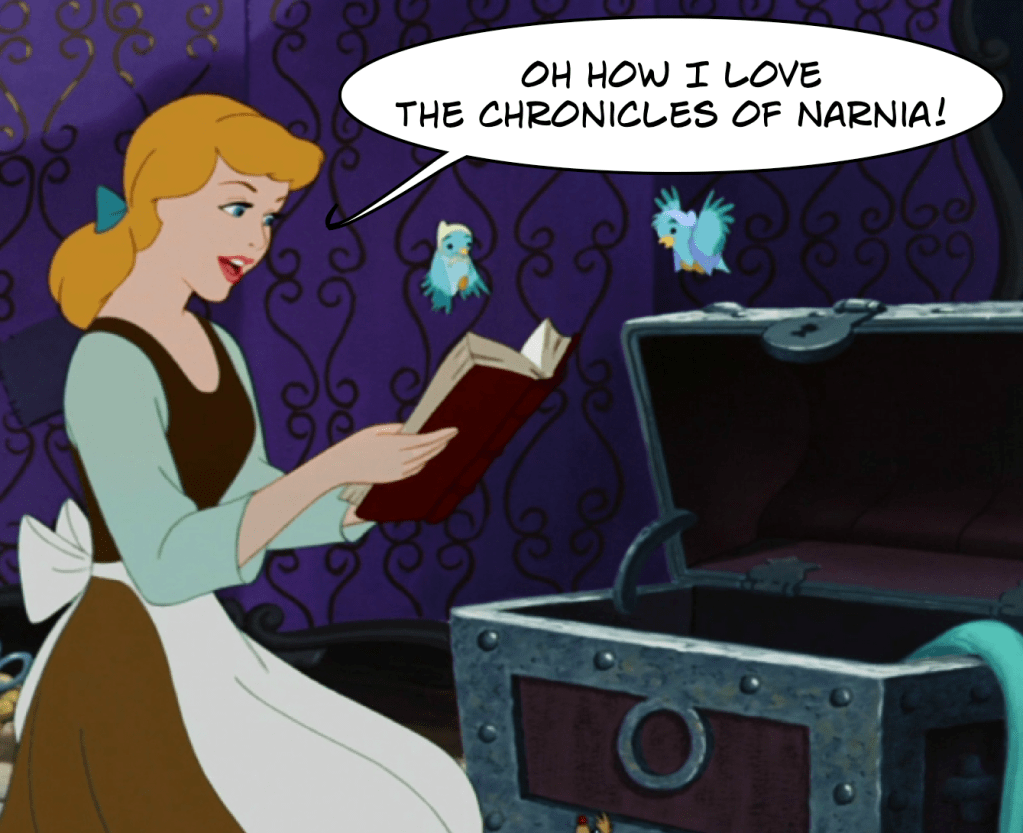
C.S. Lewis & Cinderella

C.S. Lewis did not write a Cinderella story of his own, but he did refer to one of his books as his “Cinderella,” for a different reason.

The Cinderella folk tale is familiar to many cultures. Like the Ugly Duckling, it celebrates real life occasions where events turn upside down, and the disadvantaged are vindicated.

More than two thousand years ago, the Greeks told the story of Rhodopis, a Greek slave girl whose sandal was snatched by an eagle and dropped into the lap of the Egyptian pharaoh. His search for the lovely foot that graced the footwear culminated in a joyous marriage.

I was thinking about step parenting recently, and how some people care for their own children differently than they treat children brought into the union from a spouse’s previous relationship. The subject arose during my prayers, when I thought to offer thanks to God for the depth of love he has given me for my “step-grandchildren.” It is, as far as I can tell, indistinguishable from the love I hold for my biological grandkids.

Following my prayers, I reflected further on family. And—because it reflects real life in terms of raising children, I thought of the story of Cinderella. In particular, I was wondering whether the “wicked stepsisters” were destined to be cruel simply because they were raised by their “wicked stepmother.”

The answer to that dilemma is obvious. Do bad parents raise bad kids? Sometimes, but thankfully, not always. Do good parents raise good kids? Sometimes, but sadly, not always.

If you remove the outliers—the saints on one side and the sociopaths on the other—kids have a reasonable chance to turn out “okay.” Basically, just because someone’s parents are disreputable, doesn’t mean the kids will grow up to be bums as well.

This comes as no shock to any of us, of course. We are too sophisticated to impute the sins of the parents to their children. But are we really? In truth, we often make judgments based upon things utterly beyond a child’s control. Nationality, social status, physical or mental disability . . . some people default to an unconscious ranking of desirability.

I’m reminded of the rewards of working with orphans and the tragic manner in which even these victims are “ranked” in terms of their perceived worth. So much for viewing the world through carnal eyes.

C.S. Lewis described the way a children’s story can flip things around in a way that reveals truth. In 1947 he described this to an American correspondent.

About stories for children. (a) Don’t the ordinary fairy tales really already contain much of the Spirit, in solution? Does not Cinderella give us exaltavit humiles,* and is not Redemption figured in The Sleeping Beauty? (b) For something a little more explicit, what about Geo. MacDonald’s⁑ The Princess & the Goblins, Curdie & the Princess, The Wise Woman, and The Golden Key?

In a 1943 letter to Sister Penelope, Lewis commented on a manuscript she had sent for his review. He suggests a “longish speech” by Melchizedek would be better presented in a different manner.

He’s got to have the sense of mystery about him. That means, for purposes of these plays, he must sound like a king out of a fairy tale. Actually in this speech he sounds more like a Bampton Lecturer! Represents, condemnation, include, mediator all strike the wrong note. I am referring only to the style: the matter is perfectly right. It is easier, of course, to pick holes than to mend them!

He then offers a note about the power of stories to communicate facts and deeper truths.

If I were trying to do it myself I should make it a speech about the Kings of Salem, not about ‘kingship’ in general—like a special magic in that family. (The Kings of Salem are not ordinary kings. . . .)

On the imaginative level I think the deepest truths enter the mind much better as arbitrary marvels than as universal theorems. Cinderella had to be back at midnight—Psyche must not see Cupid’s face—Adam and Eve must not eat the fruit: how much better these statements are than any philosophical generalities about obedience.

C.S. Lewis’ Personal Cinderella

Each reader of C.S. Lewis has their personal favorite, thoughtfully selected from the rich buffet of his diverse works. While I treasure many of his works, my personal favorite is The Great Divorce. It pleases me that the title also occupied a special place in Lewis’ own estimation.

Lewis described the underappreciated volume as his “Cinderella.” The beauty and nobility were there all of the time, though unrecognized.

Writing in 1954 to his editor, Jocelyn Gibb, he expresses appreciation for two handsomely bound copies of his books. He says, “perhaps these two charming volumes will teach me at last to have for the bodies of my own books the same reverence I have for the bodies of all other books.” In the same letter he writes, “I am always glad to hear of anyone’s taking up that Cinderella, The Great Divorce.”

Kathryn Lindskoog wrote an article about the book, calling the volume “C.S. Lewis’s Divine Comedy.” She begins with a personal anecdote.

C. S. Lewis beamed, then said “It’s my Cinderella.” I had just told him how much I loved The Great Divorce. (If I had been forced to choose one favorite of all his books, that would have been my choice.) He said he didn’t understand why Screwtape Letters got all the attention when The Great Divorce was so much better.

The Screwtape Letters is another of Lewis’ works that continues to impress me for its unique and effective way of illustrating the malevolent mind that shapes so many of the temptations that assail us. But, for sheer pleasure, I too prefer the wisdom, and the witness to heaven’s reality, that shine so brightly in The Great Divorce.

——

* Exaltavit humiles comes from the Magnificat (Luke 1:46-55) and means God “has exalted the humble.”

⁑ Most of MacDonald’s books are available for free download at Google and Kindle.