
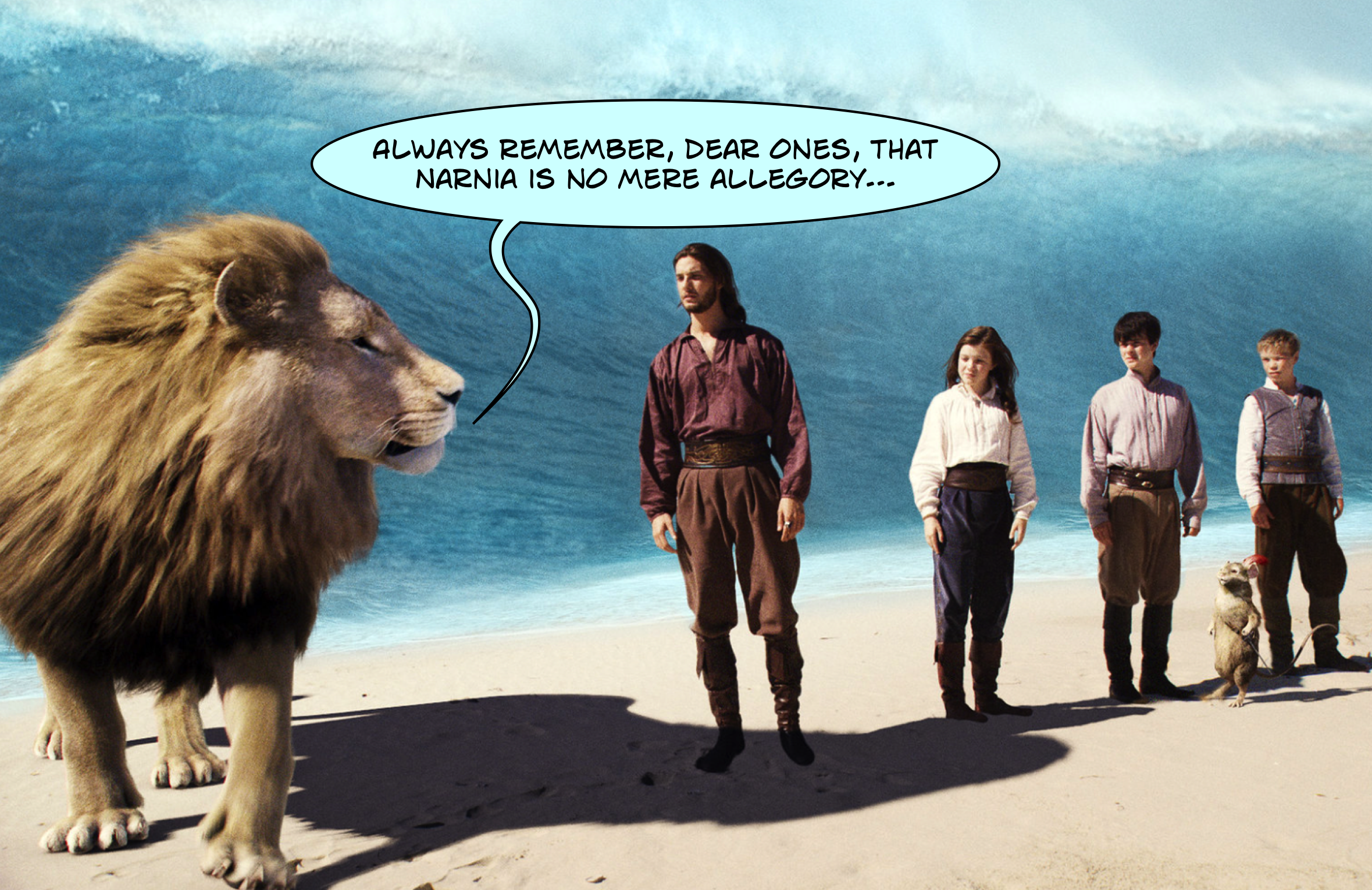
It has been argued that C.S. Lewis wrote apologues, but I humbly disagree.
An “apologue,” you see, is defined as “a moral fable, especially one with animals as characters.” From that core definition, it makes sense to some that works such as The Chronicles of Narnia might be described as apologues.
However, this term is usually applied to much simpler, more concise stories – short moral fables (think Aesop) rather than an extended tales. “Apologue” is a vastly insufficient label for what J.R.R. Tolkien described as subcreation. Narnia is not a fable, it is a world.
Years ago I compared Aesop’s brief “The Kingdom of the Lion,” with C.S. Lewis’ brilliant vision of Aslan.
In “The Lion’s Command,” I identified a virtuous parallel between the brief regent in the fable and the well-developed protagonist of Narnia. In the Chronicles, Narnia’s hero is nothing other than the Alpha and Omega, reigning over its creation and preserving his kingdom to its ultimate culmination.
In “C.S. Lewis and the Art of the Apologue,” Samuel Joeckel argues that “The Screwtape Letters and The Great Divorce might be read as pure apologues, while Lewis’s other works of mythopoeia contain elements of the apologue.” This is an intriguing proposal, which has not gained much traction. Of course, Joeckel’s point that “elements” of apologue are present is certainly true, but that would be so when considering the work of numerous authors.
If not an Apologue, might Narnia be an Allegory?
An interesting article about parables contrasts parables and apologues in the following manner.
Another story style that is related to parables is the apologue. Apologues are short stories that are intended to convey a lesson, and they often use animals as characters. . . . Unlike parables, which generally have realistic scenarios, apologues allow an element of fantasy while maintaining a moral point.
The same article describes differences between parables and apologues as contrasted with allegories, such as George Orwell’s Animal Farm.
Parables are not the only type of story that present a moral lesson. Allegories are stories or poems where different elements are designed to convey abstract or spiritual meaning. . . . Allegories and parables are related in their use of symbolic language.
The difference is, in essence, one of complexity. While parables (and apologues) normally focus on a single lesson, allegories feature broader elements fleshing out a more elaborate lesson or message.
Allegories are more metaphorical and often involve characters representing abstract ideas, and the symbolism can be deeply complex. However, parables are more direct, with a simple narrative that usually involves a human character facing a moral dilemma or the consequences of a bad decision (“Allegory Vs. Parable”).
“Allegory vs Apologue,” offers a similar distinction between these two literary exercises.
Allegory and apologue are both forms of extended metaphor that use symbolic characters and events to convey a deeper meaning. However, there are some important distinctions between the two. . . .
Apologue, on the other hand, is a more general term that refers to any story or fable that teaches a moral lesson. Unlike allegory, apologue does not necessarily have a hidden meaning . . .
C.S. Lewis challenges the notion that allegories possess “hidden” themes. In his preface to The Pilgrim’s Regress, he argues that true allegories do not mask their message.
People . . . suppose that allegory is a disguise, a way of saying obscurely what could have been said more clearly. But in fact all good allegory exists not to hide but to reveal; to make the inner world more palpable by giving it an (imagined) concrete embodiment.
In The Allegory of Love: A Study of Medieval Tradition, C.S. Lewis describes the unique goal of this literary device.
The function of allegory is not to hide but to reveal, and it is properly used only for that which cannot be said, or so well said, in literal speech.
The inner life, and specially the life of love, religion, and spiritual adventure, has therefore always been the field of true allegory; for here there are intangibles which only allegory can fix and reticences which only allegory can overcome.
In an essay about the author of The Faerie Queene, “Edmund Spenser, 1552–99,” Lewis lauds the path allegories pursue to illumine readers.
We shall understand it best (though this may seem paradoxical) by not trying too hard to understand it. Many things – such as loving, going to sleep, or behaving unaffectedly – are done worst when we try hardest to do them. Allegory is not a puzzle.
With C.S. Lewis’ genuine appreciation for good allegory, it is unsurprising that some readers are tempted to label The Chronicles of Narnia as such. After all, too brief and far too elaborate to be a collection of mere apologues, it seems logical. Yet, Lewis himself dispelled that conclusion. His opinion is expressed clearly in the following passage from a letter written in 1958.
If Aslan represented the immaterial Deity in the same way in which Giant Despair represents Despair [in The Pilgrim’s Progress], he would be an allegorical figure.
In reality however he is an invention giving an imaginary answer to the question, “What might Christ become like, if there really were a world like Narnia and He chose to be incarnate and die and rise again in that world as He actually has done in ours?” This is not allegory at all.
No, the Chronicles offer no mere allegory. Aslan and Narnia are something altogether more rare and precious . . . and uniquely inspiring.
Bonus:
For those inclined to see how the AI at ChatGPT might compose an analogue, consider the following examples. I offered three brief prompts and amazingly swift apologues.
⌘ Write an apologue in ancient roman style about why a porcupine is hard to get along with.
Certainly! Here’s an apologue in the style of ancient Roman moral tales – think Aesop with a Roman flavor (e.g., Phaedrus) – explaining why the porcupine is hard to get along with. This style uses simple characters, a brief narrative, and a moral at the end.
Apologue: The Porcupine and the Burrowers
Characters:
~ Porcupine (Hystrix)
~ Mole (Talpa)
~ Hedgehog (Erinaceus)
Moralitas at the end.
In the time when the earth still whispered secrets to beasts, a bitter winter approached. The animals who dwelt below ground gathered to find warmth together.
The Mole, who dug deep and dark tunnels, said, “Let us share one chamber, and none shall freeze.”
The Hedgehog, with bristles soft enough in the cold, agreed. “We are small and spined, but kindred in spirit.”
Then came the Porcupine, bristling with long, sharp quills. “I seek shelter,” he said. “Let me in.”
The others, though wary, welcomed him. “There is warmth in many bodies, if none poke too hard.”
But when the Porcupine curled to sleep, his quills pricked every side of the burrow. The Mole winced. The Hedgehog bled. They shifted, gave him space – but no space was enough.
“Friend Porcupine,” said the Mole, “can you not soften your stance?”
The Porcupine replied, “My quills are my nature. I mean no harm, yet I cannot change.”
So, one by one, the others left, seeking colder but safer places.
The Porcupine remained, alone in warmth – but with no friend near.
Moralitas:
He who cannot bend his nature to spare his neighbors must be content with solitude, for warmth of company is given only to those who wound not.
Having delivered the moral of the fable, the AI was so thoughtful as to ask: “Would you like a Latin version of the apologue as well?”
~ ~ ~ ~ ~ ~ ~
⌘ Write an apologue in the style of C.S. Lewis about why classical music is better than rock and roll.
Certainly! Here is an apologue in the style of C.S. Lewis – reminiscent of his storytelling in The Screwtape Letters, The Chronicles of Narnia, and The Pilgrim’s Regress. Lewis often used allegory and fable to convey theological or philosophical arguments through richly imagined, morally charged tales.
Apologue: The Two Gardens
In an ancient land that bordered both silence and song, there lived two brothers: Eldarion and Ruckus.
Their father, the Keeper of Harmony, was a master gardener who tended to two great gardens, each grown from a different seed of music.
One garden was called Lyrion, and it bloomed with strange and delicate flowers. Trees sang there – not with words, but with symphonies. The air was always filled with the faint sound of strings, like something half-remembered from a dream. This was the realm of Classica, the music that had deep roots and slow unfolding blossoms.
The other garden, Thundra, was younger, wilder. Vines twisted with fire, and great drums beat like the hearts of giants. Flames leapt from the leaves when touched. This was the realm of Rocka, born of storm and impulse. It throbbed with noise and power.
One day, the father called his sons. “Each of you shall choose a garden to tend,” he said. “But take heed: a garden grows into the likeness of its gardener.”
Eldarion, quiet and curious, chose Lyrion. He studied the old scores carved into the bark of the elder trees. He listened for the faintest cadences hidden in the wind. His garden grew slowly, but with order and depth. Some who visited said they heard truth in its song – though they could not explain it.
Ruckus chose Thundra. He brought iron tools and thunderous machines. He shouted into the wind and danced among the fire-vines. His garden grew quickly, wildly, and it drew many visitors who loved its power. But the soil became hard, and the songs repeated themselves. At night, when the fire died, there was silence – and the silence frightened him.
Years passed.
One evening, Ruckus visited his brother’s garden. It was still and strange, yet somehow more alive. The music there did not grab the ear – it waited, like a cathedral waits for a footstep.
“I do not understand this,” said Ruckus.
“You’re not meant to at first,” Eldarion said gently. “But if you sit long enough, you may find it is not music you hear – but yourself.”
Moral:
Not all noise is music, and not all music is noise. That which is deep may not dazzle, but it endures.
~ ~ ~ ~ ~ ~ ~
⌘ Write an apologue in the style of C.S. Lewis showing how reading nonfiction and fiction can be equally beneficial.
Certainly! Here’s an apologue in the style of C.S. Lewis, with his characteristic blend of gentle allegory, rational argument, and spiritual insight. Think of something akin to The Great Divorce or The Pilgrim’s Regress – a story that carries philosophical weight through symbolic characters and a clear moral undercurrent.
Apologue: The Library of the Lantern
There was once a Traveller who came upon an ancient Library, tucked between the hills of two realms: Factland, where the roads were straight and numbered, and Fablemere, where the paths curled like ivy and sometimes moved when you weren’t looking.
The Traveller, weary from debate and burdened with questions, was greeted by an old librarian named Lucidus, who wore a cloak woven from both parchment and ink.
“You may read whatever you like here,” said Lucidus. “But I warn you: some shelves are straight, others crooked – and both are true.”
The Traveller began in the Hall of Records, where volumes bore names like The History of the World, Natural Laws, The Mind Explained, and Economics in Twelve Systems. The books were hard, clear, and bright like winter ice. Every sentence pointed like an arrow, and the Traveller felt smarter with every page. “Here,” he thought, “is what I came for: answers.”
But after a time, the light grew harsh, and the words – though sharp – offered no rest. He felt he had learned much, and yet not grown.
So he wandered next into the Chamber of Tales. Here were strange books that spoke of dragons and dying stars, of heroes who were cowards and cowards who became saints. The logic bent like a rainbow, and the truth came sideways.
At first he scoffed. “These things never happened!”
Lucidus appeared beside him and said quietly, “No – but they always happen.”
So the Traveller read on. And he wept when the fox died, and laughed when the king made a fool of himself. He saw his pride in the villain and his longing in the wandering knight. He saw the world as it might be – and in doing so, saw more clearly what the world was.
Time passed. The Traveller read from both wings of the library, sometimes walking the marble floors of Factland, sometimes lying on the mossy rugs of Fablemere. One sharpened his mind; the other softened his heart. One taught him how things work; the other, why they matter.
At last, he approached Lucidus.
“Which was truer?” the Traveller asked. “The world I could measure, or the one I could feel?”
Lucidus smiled. “Ah. One is the lamp, the other the flame. But both are needed to see.”
Moral:
Fiction teaches the soul what nonfiction explains to the mind – and wisdom lives where both meet.
This proved to be a very interesting exercise, indeed.

 Mere Inkling Press