Give Yourself a Holiday Gift

space trilogyChristmas is the season of giving, and as a grandfather I can truly say it’s more wonderful to give than to receive. Those little smiles and squeals of joy are precious indeed.

Sadly, many children (and adults) will be forgotten this season. Worthwhile programs to reach out to the overlooked are sponsored by countless churches and communities. One of the most highly regarded, Angel Tree, provides gifts to the children of men and women who are incarcerated. These innocent children are already suffering due to the poor choices of adults; God alone knows how special the most modest Christmas gift might be to these little ones.

That is one end of the spectrum—those who have little. Equally sadly, many children (and adults) will overindulge this season. They will bury themselves under piles of soon-to-be-forgotten presents. Most will also bury themselves further under mounds of debt.

C.S. Lewis colorfully captured this quandary in “Xmas and Christmas.”

And they buy as gifts for one another such things as no man ever bought for himself. For the sellers, understanding the custom, put forth all kinds of trumpery, and whatever, being useless and ridiculous, they have been unable to sell throughout the year they now sell as an Exmas gift. And though the Niatirbians [British] profess themselves to lack sufficient necessary things, such as metal, leather, wood and paper, yet an incredible quantity of these things is wasted every year, being made into the gifts.

Striving for balance in gift exchanging is important. For years now my father has said it’s unnecessary to give him Christmas or birthday gifts. It’s true. He’s able to purchase whatever he wants, and even the most thoughtful gifts are either redundant or undesired. He’s grateful, of course, but only out of courtesy. Last month, for his birthday, I took him up on his words. Instead of spending money on a gift, we made a special donation to the Gideons in his honor. He was delighted. I’ve known others who made the same request, that gifts intended for them be diverted to the benefit of others. It’s a grand custom.

After the homily on selflessness above, it may sound strange to hear that there is a Christmas gift I would like to suggest you consider giving to yourself. Actually, I’d advise a friend or loved one to purchase it for you, but since you probably haven’t encouraged them to subscribe to Mere Inkling (yet), I must satisfy myself with advising you to check out this special offer.

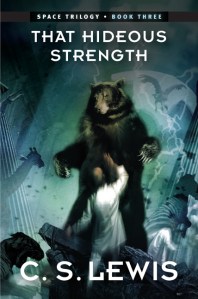
During the holiday season, HarperOne is running a special on C.S. Lewis’ Cosmic Trilogy (often referred to as the Space Trilogy). You can get them in various digital editions for only $1.99 each. Quite a bargain. And it leaves you plenty of resources to practice the truth that it’s better to give than receive.

Out of the Silent Planet, the first of these science fiction works, was the first Lewis book I read. A friend in a college fellowship group suggested it, and it introduced me to one of the greatest mentors a person could ever have! The books are available through this link: Cosmic Trilogy.

Oh, and if the Cosmic Trilogy is already in your library, or not your cup of tea, they are also discounting an illustrated edition of The Screwtape Letters.

The Trilogy is suitable for Christian and secular readers alike. It’s not overtly “religious.” In fact, in his C.S. Lewis: Companion and Guide, Walter Hooper says many of the intial reviewers of the title were rather confused about its intended meaning. (This despite offering positive reviews.) One person who did comprehend its significance was an Anglican theologian named Eric Mascall. In a 1939 issue of Theology he wrote:

This is an altogether satisfactory story, in which fiction and theology are so skillfully blended that the non-Christian will not realize that he is being instructed until it is too late. It is excellent propaganda and first-rate entertainment.

I’m certain he meant “propaganda” in the most positive, pre-war sense. Actually, one does not need to be a follower of Jesus of Nazareth to appreciate the series. If you’ve never read it before—and you don’t have a 100% aversion to the science fiction genre—the two dollar price means you’ll rarely have a better opportunity.

Our Personal Libraries

printing lettersWhat a blessing it is to live in an age when even the most modest home can treasure its personal library. Public libraries are a community boon, but because of the printing press, books are no longer restricted to the homes of the wealthy.

Books—or, more properly the reading of books—has a direct correlation to human intelligence, knowledge and (occasionally) even to wisdom itself.

In 1905, at the age of seven, C.S. Lewis moved with his family into a large home in the countryside. It was so spacious, in fact that in his autobiography Surprised by Joy, Lewis says, “to a child it seemed less like a house than a city.”

Lewis proceeds to describe the “mansion,” and its most notable feature . . . the profusion of books.

The New House is almost a major character in my story. I am a product of long corridors, empty sunlit rooms, upstairs indoor silences, attics explored in solitude, distant noises of gurgling cisterns and pipes, and the noise of wind under the tiles.

I am a product . . . of endless books. My father bought all the books he read and never got rid of any of them. There were books in the study, books in the drawing room, books in the cloakroom, books (two deep) in the great bookcase on the landing, books in a bedroom, books piled as high as my shoulder in the cistern attic, books of all kinds reflecting every transient stage of my parents’ interest, books readable and unreadable, books suitable for a child and books most emphatically not. Nothing was forbidden me. In the seemingly endless rainy afternoons I took volume after volume from the shelves. I had always the same certainty of finding a book that was new to me as a man who walks into a field has of finding a new blade of grass.

I’m privileged to own a large library. It’s not a matter of pride. It’s a matter of joy. Like Lewis, and most readers of Mere Inkling, I love books. And, like most bibliophiles, I am fascinated by numerous things related to books.

While attending college I worked for a small publisher. I was able to do a bit of writing, but most of the job involved using an enormous Linotype Phototypesetting machine and pasting up the projects. It was an interesting process, which is now long obsolete.

letterpress

Nevertheless, due to my love for books, reinforced by my own experience as a “printer’s devil,”* I have an affection for items related to publishing. I recently purchased several items from a family business called Type-tiques.

They offer a wide range of reasonably priced letterpress printer’s blocks which look wonderful on bookshelves and literary desktops.**

I also recently accepted an offer for ten free letterpress bookmarks from Peach Farm Studio. You can read about their promotion here. (Since my comment there is still awaiting “moderation,” I’m unsure of the status of the project, but I’ll keep you posted.)

___

* Just a note that, should you be unfamiliar with the term “printer’s devil,” it’s simply trade parlance for the shop’s apprentice or flunkey.

** When my wife proofread this, she asked if I literally meant “literary desktops.” Then she motioned towards my own book-laden desk and queried, “and where will you put them?” Fortunately, I have lots of shelves!

Greek Mythology & Modern Humanity

narcissusThere is a very important mental health tome that describes psychological disorders in detail. It’s called The Diagnostic and Statistical Manual of Mental Disorders (DSM).

Since the American Psychiatric Association is constantly discovering new mental ailments—and they occasionally recognize that previously unhealthy mindsets and behaviors have become so pervasive they can no longer be considered aberrations—the DSM requires periodic revision.

The current authoritative version is DSM-IV-TR, or DSM, fourth edition, text revision. That means that if you were diagnosed with a defect according to the third edition standards, you may now have a clean bill of health. And, for those of you whose diagnosis is still included in DSM IV, don’t despair; they are currently consulting about version five, and who knows what psychoses may soon become “normal.”

I had to study these things during my seminary training, for my counseling work as a chaplain and civilian pastor. I was thinking about the manual recently as I pondered the spirit of Narcissus that seems to hold sway in our age. Like C.S. Lewis, I understand there is value in studying Greek and Roman myths, as many contain seeds of Truth. (Lewis’ appreciation for myth is most evident in Till We Have Faces, which is a reworking of one ancient Greek tale.)

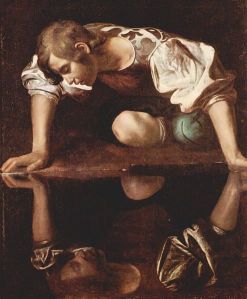
Narcissus, of course, is the mythological Greek who was so consumed by his own handsomeness that he perished because he was unable to tear himself away from gazing at his own likeness. (The image above was painted by Michelangelo Caravaggio in the sixteenth century.)

Narcissism, which echoes his name, describes the unbridled vanity and self-concern (i.e. selfishness) that motivates growing numbers in our individualistic and hedonistic world. Since narcissism has become so rampant, the DSM now concerns itself only with “pathological narcissism.” That distinction will probably remain, even if Narcissistic Personality Disorder (NPD) is eliminated from the fifth edition as a distinct illness, as many have recommended.

God Save Us from the Narcissists

Pathological narcissists are terrible indeed. Their characteristic arrogance, envy, sense of entitlement and lack of empathy make them unhealthy members of society. In fact, large numbers of sociopaths and psychopaths are also narcissists.

But here’s the problem. At the rotten core of the disorder we find a putrid seed that negatively affects many of us who appear otherwise to be so normal. The source of the corruption is, in part, sinful pride.

Let’s take a look at the “diagnostic criteria” for NPD which confronted me when I first studied DSM III. (Perhaps you may wish to skip this section, since modest hints of some of these traits may strike close to home.) I’ve added my own introspective comments in italics.

Diagnostic criteria for 301.81, Narcissistic Personality Disorder:

A pervasive pattern of grandiosity (in fantasy or behavior) hypersensitivity to the evaluation of others, beginning by early adulthood and present in a variety of contexts, as indicated by at least five of the following:

(1) Reacts to criticism with feelings of rage, shame, or humiliation (even if not expressed).

— I’ve never “raged,” but it’s embarrassing to be criticized in public

(2) Is interpersonally exploitive: takes advantage of others to achieve his or her own ends.

— Never. I won’t tolerate manipulation–either as the manipulator or the manipulatee.

(3) Has a grandiose sense of self-importance, e.g., exaggerates achievements and talents, expects to be noticed as “special” without appropriate achievement.

— Have I told you lately about being Thespian of the Year when I graduated from high school . . ?

(4) Believes that his or her problems are unique and can be understood only by other special people.

— Not this trait, I’m aware everyone in this fallen world is faced with challenges . . . many of them worse than my own.

(5) Is preoccupied with fantasies of unlimited success, power, beauty, or ideal love.

— I do daydream about accomplishing special goals, although I never lusted after power and I accepted the facts about “beauty” long ago. I have, however, found ideal love, and we’ve been married 37 years!

(6) Has a sense of entitlement: unreasonable expectations of especially favorable treatment, e.g., assumes that he or she does not have to wait in line when others must do so.

— I’m the opposite. I always pick the longest and slowest line to stand in.

(7) Requires constant attention and admiration, e.g., keeps fishing for compliments.

— If people weren’t so frugal with compliments, I wouldn’t need to.

(8) Lack of empathy: inability to recognize and experience how others feel, e.g., annoyance and surprise when a friend who is seriously ill cancels a date.

— Nope. I really do care about others. That’s the reason good clergy and caregivers often suffer compassion fatigue.

(9) Is preoccupied with feelings of envy.

— Well, what about those cases where the person doesn’t deserve the honors they’ve received . . ?

There, I feel much better, having made a public confession of my almost-narcissistic human self-centeredness.

In his essay “Christianity and Culture,” C.S. Lewis warns that “A man is never so proud as when striking an attitude of humility.”

When we admit, instead, that there remains much in our soul that is base and prideful, we’re on the proper path. The course that leads to a rejection of Narcissus-in-us, and the embracing of what is precious in our neighbors and our world, is the road that leads to contentment.

Avoid Living in Fear

nuclear blast

Nuclear war. It’s an extremely unpleasant subject, and its grim specter still haunts the world. Oddly, though—even as we anticipate the day when Iran’s lunatic Mullah’s develop them and North Korea’s deranged generals learn how to deliver them—the world is in a sort of “nuclear hiatus” at this very moment.

The Mutual Assured Destruction apparently worked, as the former Soviet Union and the United States decided against nuclear suicide. At the present moment the three world powers show little appetite for total war, so today’s children don’t have to learn the Civil Defense precautions that kept an earlier generation safe.

I was one of those young Americans indoctrinated in the sophisticated “duck and cover” method of nuclear blast survival. This video provides a nostalgic look at the paramilitary training we received. (A link to the full training film appears below.)

C.S. Lewis lived during the height of nuclear paranoia. Yet he retained his composed Northern Irish demeanor as he reflected on the threat. In an essay entitled “On Living in an Atomic Age” he wisely advised:

If we are all going to be destroyed by an atomic bomb, let that bomb when it comes find us doing sensible and human things—praying, working, teaching, reading, listening to music, bathing the children, playing tennis, chatting to our friends over a pint and a game of darts—not huddled together like frightened sheep and thinking about bombs. They may break our bodies (any microbe can do that) but they need not dominate our minds.

In his essay “Is Progress Possible,” Lewis addresses those who used the uncertainty of the future as an excuse for making irresponsible life choices. His words ring just as true today, when so many youth turn to nihilism and self-destructive behaviors.

As a Christian I take it for granted that human history will some day end; and I am offering Omniscience no advice as to the best date for that consummation. I am more concerned by what the Bomb is doing already. One meets young people who make the threat of it a reason for poisoning every pleasure and evading every duty in the present. Didn’t they know that, Bomb or no Bomb, all men die (many in horrible ways)? There’s no good moping and sulking about it.

If only remaining safe in this fallen world was as simple as dropping to the ground and sheltering one’s head. It isn’t, of course, but we need not live our lives under the shadow of fear.

Returning to “On Living in an Atomic Age,” Lewis adroitly places the entire menace—and all perils to human life—in their proper perspective. It may not be the most comforting words we will ever read, but they are certainly true.

In one way we think a great deal too much of the atomic bomb. “How are we to live in an atomic age?” I am tempted to reply: “Why, as you would have lived in the sixteenth century when the plague visited London almost every year, or as you would have lived in a Viking age when raiders from Scandinavia might land and cut your throat any night; or indeed, as you are already living in an age of cancer, an age of syphilis, an age of paralysis, an age of air raids, an age of railway accidents, an age of motor accidents.”

In other words, do not let us begin by exaggerating the novelty of our situation. Believe me, dear sir or madam, you and all whom you love were already sentenced to death before the atomic bomb was invented: and quite a high percentage of us were going to die in unpleasant ways. We had, indeed, one very great advantage over our ancestors—anaesthetics; but we have that still. It is perfectly ridiculous to go about whimpering and drawing long faces because the scientists have added one more chance of painful and premature death to a world which already bristled with such chances and in which death itself was not a chance at all, but a certainty.

_____

You can watch the entire “Stop and Drop” Civil Defense Video here.

Knowing Our ABCs

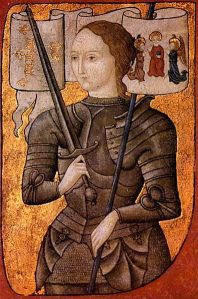
Most readers are familiar with the amazing story of Jeanne D’ Arc (Joan of Arc). She was a French peasant who received visions which proved accurate. She foresaw victory for a humbled nation which had not experienced a major military victory for an entire generation.

Jeanne led the army of the Dauphin (the heir to France’s throne who would reign as Charles VII) to unimaginable victories. She was seriously wounded but inspired her troops with her swift return to battle. She counseled, and prayed for mercy, but recognized England could only be repulsed from French shores by force.

Tragically, she was captured and the English, following a sham trial, judged her guilty of heresy. Jeanne was only nineteen when she perished in flames in an English blaze. Just twenty-five years later, a special court convened by the Pope found her “not guilty” of the crime, and proceeded to declare her a martyr. She was canonized in 1920, nearly five centuries after her brief but brilliant life.

Recently, while reading more about her life I was reminded of something startling she said during her first “inquisition.” When she originally presented herself to the Dauphin, no one could believe a modest young farm girl could be France’s rescuer. A commission of inquiry, comprised of a number of senior clergy, offered the Dauphin a “favorable presumption” that she might, indeed, have divine sanction.

During that “trial,” she was vigorously questioned. The following account comes from Medieval History by Israel Smith Clare.

It is very interesting to see how she evaded the difficulties, overcame the objections, and quietly set aside the learned cavils of the doctors by the simplicity and directness of her replies. They first asked her what signs she could show them to prove her mission. She answered: “I have not come to Poitiers to show a sign. Give me some men-at-arms and lead me to Orleans, and I will then show you signs. The sign I am to give is to raise the siege of Orleans.” One of the [theological] doctors responded thus: “But if God wished to deliver the city he could do it without soldiers.” Jeanne replied: “The soldiers will fight, and God will give them the victory.” Brother Seguin of Limousin asked her, in his provincial dialect, in what idiom her angels spoke. She answered: “In a better idiom than yours.” Said he, somewhat angrily: “Do you believe in God?” Jeanne replied: “I have more faith in God than you have.” The sharp man was thus silenced.

Still the doctors proceeded with their examinations, asking repeated questions and suggesting many learned difficulties. Said Jeanne: “Why do you ask me all these things? I do not know even my A, B, C; but I have come, by God’s command, to raise the siege of Orleans and crown the king.” Having nothing more to say, the doctors finally decided in the maiden’s favor, to which they were somewhat influenced by the great reverence which she inspired among the people of Poitiers by her holiness and piety . . .

Jeanne’s final comment which stands out. The fact that she was illiterate was, to her, no disgrace. She was confident God had chosen her to accomplish the historic events which surely followed.

We live in an era where nearly all adults in the industrialized world are literate. Even in less privileged lands, literacy rates hover around fifty percent.

We—especially those of us who love words and write—tend to look down on those who are not as eloquent as we consider ourselves to be. A woman like Jeanne reminds us that one need not be educated to be truly eloquent. She put the ecclesiastical patricians in their proper place. And rubbed their proverbial noses in it, when she emphasized her illiteracy. Devout, courageous, humble . . . and sarcastic toward condescending clerics—I’m eager to one day meet her!

While knowing one’s ABCs bears little correlation to personal virtue or merit, literacy is essentially a good thing. How impoverished our lives would be if books were sealed to us and we could not be transported to novel places and new epiphanies in their pages.

C.S. Lewis shared this awareness that illiteracy was something that could bar some from experiencing life’s most important treasures. In The Pilgrim’s Regress, he draws a wonderful picture of the relationship between the image and the word. In this allegory, the Landlord represents God.

“. . . The Landlord has circulated other things besides the Rules. What use are Rules to people who cannot read?”

“But nearly everyone can.”

“No one is born able to read: so that the starting point for all of us must be a picture and not the Rules. And there are more than you suppose who are illiterate all their lives, or who, at the best, never learn to read well.”

“And for those people the pictures are the right thing?”

“I would not quite say that. The pictures alone are dangerous, and the Rules alone are dangerous. That is why the best thing of all is to find Mother Kirk at the beginning, and to live from infancy with a third thing which is neither the Rules nor the pictures and which was brought into the country by the Landlord’s Son. That, I say, is the best: never to have known the quarrel between the Rules and the pictures. But it very rarely happens. The Enemy’s agents are everywhere at work, spreading illiteracy in one district and blinding men to the pictures in another. . . . As often as men become Pagans again, the Landlord again sends them pictures and stirs up sweet desire and so leads them back to Mother Kirk even as he led the actual Pagans long ago. There is, indeed, no other way.”

“. . . The Landlord succeeded in getting a lot of
messages through.”

“. . . These pictures woke desire.”

“. . . And then the Pagans made mistakes. They would keep on trying to get the same picture again: and if it didn’t come, they would make copies of it for themselves. Or even if it did come they would try to get out of it not desire but satisfaction.”

Elsewhere, in the essay “Some Thoughts” in God in the Dock, Lewis expressly (and correctly) declares literacy itself as one of the things for which Europe should be grateful to the Church.

[One looking at] Christian activities which are, in a sense directed toward this present world . . . would find that this religion had, as a mere matter of historical fact, been the agent which preserved such secular civilisation as survived the fall of the Roman Empire; that to it Europe owes the salvation, in those perilous ages, of civilised agriculture, architecture, laws, and literacy itself. He would find that this same religion has always been healing the sick and caring for the poor; that it has, more than any other, blessed marriage; and that arts and philosophy tend to flourish in its neighbourhood.

Fatherhood as Modeled by Two Historical Giants

Thanksgiving is a very special holiday. In truth, it’s a “holy-day” for all those who offer their thanks to a benevolent God.

Like all holidays, it can be good or bad, depending on the way it is perceived by each individual, and the unique circumstances in which they find themselves. Most of us are thankful, for example, for our loving families. And, even if we can’t be together at these special times, we draw warmth and strength from their love. Tragically, others have been victimized by those who should have protected them, and “family” in their eyes is not something to be thankful for at all.

I was not a perfect son. I strove to be a better father. And, now that I’m blessed with seven grandchildren, I’m trying to be the best grandfather I can be

Many years ago, shortly after having our first child, I gave myself a Father’s Day gift. (That’s not a typo. I purchased for myself a modest plaque with a priceless message.) It reads: “the greatest gift a man can ever give his children is to love their mother.”

I displayed this proverb in my office through the years, as a reminder to myself and others of this profound truth. It’s easy to love one’s spouse as a newlywed in the hot flush of youth. It’s also easy, I’m learning, to love my wife in the snug and warm autumn of life. For many, however, the trials and tribulations that are a natural part of all relationships appear insurmountable. Between the newlywed and maturelywed days, it’s not all easy. While our hormones still surge and familiarity breeds corrosive contempt, we may take for granted the person we once vowed to cherish above all others.

The desire to be a decent father greatly amplifies the importance of being a devoted husband. Knowing this made my reading of a recent article quite painful. I had known for years that President John F. Kennedy was rather promiscuous. Yet a recent article in The Atlantic reveals just how debauched the man was. The article, if you have the stomach for it, praises the strength of his wife Jackie, and is available online here.

It describes just a few of his disease spawning liaisons, and noted that he often traveled with one of his so-called secretaries, should there be “any trouble scaring up local talent.” One imagines the dirtiness felt by the Secret Service agents tasked with protecting him during his sordid escapades in the White House pool. The saddest tale for me was his deflowering of a sophomore intern from Wheaton “right there on his wife’s bed.” I won’t sully you with any more accounts.

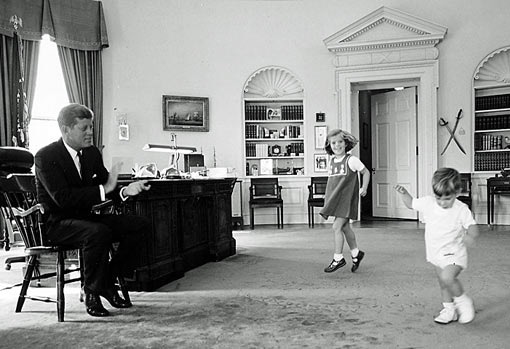
When I read the article, it nearly made me sick. He was a vile husband. I recalled the numerous famous pictures of him playing with his children—the doting father, one would think. Yet, in reality, just because he was such a malignant husband, he was also an appalling father. To mistreat his wife so badly, was to dishonor his children as well.

The image that came to me as I looked again at the pictures of Kennedy’s glorious Camelot brought to mind Jesus’ words about whitewashed sepulchers “which outwardly appear beautiful, but within are full of dead people’s bones and all uncleanness.” (Matthew 23:26-28, ESV). The verse which follows could be JFK’s epitaph: “So you also outwardly appear righteous to others, but within you are full of hypocrisy and lawlessness.”

A More Godly Alternative

C.S. Lewis experienced neither the normal, nor ideal, form of fatherhood. While he loved and respected his own father, theirs was not a close relationship. And then, at the end of his life, the death of his beloved Joy caused him to transition from the already tentative role of stepfather into the fullest demands of single parenthood. Lewis loved his two sons. He was the best father he knew how to be.

Despite being ill equipped, he did the honorable and right thing—he could do no other. He provided for all the physical needs of his sons, and did his best to meet their emotional needs as well. In Lenten Lands, his son Douglas Gresham describes how painful it was to be at The Kilns following his mother’s passing.

In cowardice and self-pity, I deserted the home and the two men whose company and loving support had for so long been all that had preserved my sanity. When at home from school, I was rarely at home. I know now that I could have done far more than I did to help both Jack and Warnie to bear the burdens which were their lot, but with the blind selfishness which is characteristic of egocentric teen-aged boys, I was too wrapped up in myself to spare time for others.

Strangely, Jack and I had, through these difficult years, become very close, and I think that he understood quite well the reasons for my reluctance to be a part of The Kilns at that time. At first, after Mother’s death, with almost unbelievably naïve complacency, I never doubted that The Kilns and Jack would always be there for as long as I needed them. Then, when it began to dawn on me that there was an increasing likelihood of Jack being snatched away, and with him The Kilns, I reacted by rejecting The Kilns entirely and by not daring to love Jack any more than I already irrevocably did.

For his part, Lewis comprehended just how important understanding fatherhood was. In his tribute George MacDonald: An Anthology, he says this about his mentor:

An almost perfect relationship with his father was the earthly root of all his wisdom. From his own father, he said, he first learned that Fatherhood must be at the core of the universe. He was thus prepared in an unusual way to teach that religion in which the relation of Father and Son is of all relations the most central.

Lewis concurred with MacDonald that “Fatherhood must be at the core of the universe.” And, if this is indeed true, our emulation of it in this life possesses even more importance than I ever imagined.

Humor & Health

I had to have blood drawn today for an upcoming physical exam. It’s not one of my favorite things to do, but I consciously try not to allow my feelings to negatively affect the caregivers who provide these essential procedures for our wellbeing. (Trust me, dentists especially are sorely in need of our appreciation.) I often try to add a little smile to their day employing a touch of light humor.

Today, for example, I was repeating a blood test I had already accomplished earlier this week. When the corpsman (Naval hospital) asked which arm I said, “you better take it out of my left arm . . . they weren’t happy with the numbers in the sample they got from my right.”

Now, a modest joke like that won’t make it into any comedians’ monologues, but it did inspire a chuckle from the four of us in the lab at that moment.

It reminded me of getting my flu shot last year and having my choice of four different corpsmen to administer it. Each had a waiting line. I could only imagine what it was like to be puncturing one anonymous arm after another for eight hours. Most “victims” silent, but many grimacing and some feeling compelled to describe to you just how much they hate shots.

Three of the corpsmen were normal sized human beings. But the fourth was a behemoth. The seams of his uniform were near to bursting due to his extraordinary musculature. I doubt he was on steroids, but his massive figure could have fit into the offensive line of any team in the NFL. And, for some mysterious reason, his waiting line was the shortest.

When I approached him to receive my vaccination, I ventured (in a voice loud enough for his companions to hear): “I chose you because you look like you’re gentle.” Everyone got a laugh out of that, and I felt pleased at having momentarily brightened their day.

My kids are always wary when I make comments like this. They recognize that every time we open our mouths, it’s a gamble. We can achieve our goal, and elicit someone’s precious smile . . . or we can make a fool of ourselves.

As a grandfather, I have the added “protection” of not having too much expected of me, in the wittiness department. By the grace of God, I’m still in possession of the bulk of my mental capacities. I imagine that, should I live long enough, most of my attempts at humor may grow rather lame. But, if there remains any cultural respect for our elders, even these attempts will be recognized for what they are—goodwill. And, as such, there are those from whom they will still elicit a smile.

We should not be afraid of humor, especially in its most humble and intimate forms. Woven amidst the threads of our daily conversations, it enriches life.

C.S. Lewis recognized this quite well. In The Magician’s Nephew, which recounts the creation of Narnia, Aslan says to the newly anointed animals: “Laugh and fear not, creatures. Now that you are no longer dumb and witless, you need not always be grave. For jokes as well as justice come in with speech.”

Lewis notes something in Reflections on the Psalms that I too have found to be true. “A little comic relief in a discussion does no harm, however serious the topic may be. (In my own experience the funniest things have occurred in the gravest and most sincere conversations.)”

Because of this, it’s not uncommon when we sit with those who have lost a loved one, to find that the conversation often drifts towards those happy and humorous moments that were shared with the departed. I’ve heard much healing laughter in the still sorrowing presence of the grieving. And, whether the words or thoughts evoke bold laughter or simple smiles, I tend to consider them a good thing indeed.

Avoiding Fantasy Clichés

We’re all familiar with that classic paradigm of suspenseful introductions: “It was a dark and stormy night.” While this is not intrinsically poor writing, it has been parroted and ridiculed for so long as a lightweight cliché, that the author’s name has become a byword for writing “purple prose.”

In the same way, there are certain plotlines or story devices that are overused, particularly in genre literature. For example, J.R.R. Tolkien’s genius in creating Middle Earth cannot be exaggerated. Yet, since his epic, dwarves, elves and orcs innumerable have been written about in chronicles ad nauseum by lesser poets. Many of Tolkien’s inventions seem rather tired when repeated by contemporary writers for the hundredth time. (Hundred thousandth time, if you count fan fiction.)

This literary dilemma has led to the creation of “The Fantasy Novelist’s Exam,” designed to be taken by aspiring authors before submitting their manuscripts for publication. (The link for the exam will be found below.)

The purpose of the test is to determine how derivative your storytelling is. If you use too many of the listed elements, you are in danger of composing a parody rather than a masterpiece. Some of the questions posed in the exam are astute, many are glib, and most are humorous. Here’s a sampling, with my responses (speculative, of course, since I haven’t written any fantasy proper).

Is your main character the heir to the throne but doesn’t know it?

How about an anonymous member of minor nobility?

Do inns in your book exist solely so your main characters can have brawl?

I never visit bars, but isn’t hosting altercations a primary purpose of all drinking establishments?

Do you think you know how feudalism worked but really don’t?

Ah, a conundrum. If I know I don’t really know . . .

Do any of your female characters exist solely to be captured and rescued?

You mean they have another role they can perform? (Wait, I’m just joking!)

Do you think that “mead” is just a fancy name for “beer?”

My Viking ancestors would never forgive me if I did!

Do you think horses can gallop all day long without rest?

I wasn’t raised on a ranch, but I’m not that stupid.

Is this the first book in a planned trilogy?

Whoops.

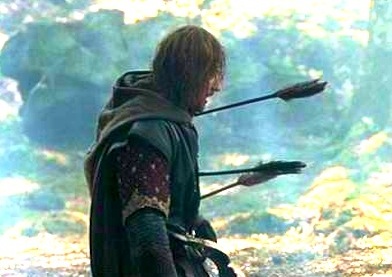
As you see, the questions are fun to read, but there’s one that bothered me a bit. Well, not the question itself. It’s innocent enough. But it alludes to a particular scene in The Lord of the Rings films which I find stunning—in the original sense of the word. It strikes me viscerally, almost leaving me breathless.

Do you really think it frequently takes more than one arrow in the chest to kill a man?

Generally, no . . . but if that hero is Boromir, most certainly!

The Death of Boromir

One of the most moving scenes in The Lord of the Rings involves the death of Boromir as he sacrifices his life in a futile battle to allow the hobbits time to escape the Uruk-hai. It’s impact is magnified by the fact that it immediately follows Boromir’s near-betrayal, under the corrupting influence of the Ring.

The irony is that this spectacular scene is not described in detail in Tolkien’s book. It is a tribute to director Peter Jackson’s cinematic brilliance. This is the original telling:

Even as [Aragorn] gazed his quick ears caught sounds in the woodlands below, on the west side of the River. He stiffened. There were cries, and among them, to his horror, he could distinguish the harsh voices of Orcs. Then suddenly with a deep-throated call a great horn blew, and the blasts of it smote the hills and echoed in the hollows, rising in a mighty shout above the roaring of the falls.

“The horn of Boromir!” he cried. “He is in need!” He sprang down the steps and away, leaping down the path. “Alas! An ill fate is on me this day, and all that I do goes amiss. Where is Sam?”

As he ran the cries came louder, but fainter now and desperately the horn was blowing. Fierce and shrill rose the yells of the Orcs, and suddenly the horn-calls ceased. Aragorn raced down the last slope, but before he could reach the hill’s foot, the sounds died away; and as he turned to the left and ran towards them they retreated, until at last he could hear them no more. Drawing his bright sword and crying Elendil! Elendil! he crashed through the trees.

A mile, maybe, from Parth Galen in a little glade not far from the lake he found Boromir. He was sitting with his back to a great tree, as if he was resting. But Aragorn saw that he was pierced with many black-feathered arrows; his sword was still in his hand, but it was broken near the hilt; his horn cloven in two was at his side. Many Orcs lay slain, piled all about him and at his feet.

Aragorn knelt beside him. Boromir opened his eyes and strove to speak. At last slow words came. “I tried to take the Ring from Frodo” he said. “I am sorry. I have paid.” His glance strayed to his fallen enemies; twenty at least lay there. “They have gone: the Halflings: the Orcs have taken them. I think they are not dead. Orcs bound them.” He paused and his eyes closed wearily. After a moment he spoke again. “Farewell, Aragorn! Go to Minas Tirith and save my people! I have failed.”

“No!” said Aragorn, taking his hand and kissing his brow. “You have conquered. Few have gained such a victory. Be at peace! Minas Tirith shall not fall!” Boromir smiled.

“Which way did they go? Was Frodo there?” said Aragorn.

But Boromir did not speak again.

“Alas!” said Aragorn. “Thus passes the heir of Denethor, Lord of the Tower of Guard! This is a bitter end. Now the Company is all in ruin. It is I that have failed. Vain was Gandalf’s trust in me. What shall I do now? Boromir has laid it on me to go to Minas Tirith, and my heart desires it; but where are the Ring and the Bearer? How shall I find them and save the Quest from disaster?”

He knelt for a while, bent with weeping, still clasping Boromir’s hand. So it was that Legolas and Gimli found him. (Lord of the Rings, Book III Chapter 1).

So, we understand that while a single arrow might slay a common warrior, it could well take a quiver full to lay low a champion such as this.

___

If you would like to review “The Fantasy Novelist’s Exam,” simply follow this link.

C.S. Lewis’ Beloved Dogs

When the internet throws unsolicited information at me, I do my best to ignore it. Yesterday I failed to duck at the right moment and Wikipedia suggested to me a “featured article” I found irresistible. It featured the earliest reference to a named dog—Abuwtiyuwwho died more than four thousand years ago and was buried in Giza in accordance with the wishes of the unknown pharaoh he guarded.

He was almost certainly a Tesem (“hunting dog”), an ancient breed resembling modern greyhounds. (Curiously, a 2004 DNA study found greyhounds are more closely related to herding breeds.)

We contemporary dog lovers understand how a pharaoh could love one of his canine companions enough to have him mummified and buried in an elaborate ceremony. In the image above, our border collie mix is juxtaposed to a hieroglyph tesem. If you’re interested in the subject, you might enjoy one of my February blogs entitled “Pets in Heaven.”

C.S. Lewis was also a dog lover. Pastor Bruce Johnson wrote a delightful article about eight of his dogs, entitled “All My Dogs Before Me.” You can read the brief but thorough article here.

Johnson walks us from Jacksie (who provided Lewis with his “adopted” name of Jack) to the friendly Ricky who was ever “anxious to be friendly.” In between, the author’s family included Tim, Pat, Mr. Papworth, Troddles, Bruce and Susie. Lewis spoke fondly of all of them, with the exception of Bruce, who possessed a predilection for barking through the night and was terribly spoiled by Mrs. Moore.

I also recommend a fine post about one of Lewis’ dogs which appeared on A Pilgrim in Narnia. It’s entitled “The Society of Tim.” The author of the blog is Brenton Dickieson, a Canadian professor and Lewisian scholar.

A Multiplicity of Polls

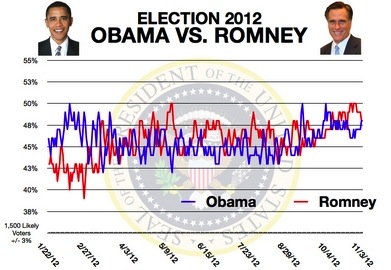
Here in the United States, our presidential election season is nearing its end. This is something people on both sides of the political spectrum are anticipating with joy. It’s been a grim process, grimmer than usual. The nation’s financial woes appear to have ramped up the vitriol. Christian values, especially, are maligned by many candidates and the partisan press that ingenuously professes objectivity. Yes, it will be a relief when it ends.

One of the features of modern elections that continues to grow in importance is polling. Scores of different pollsters—with widely varying results—compete for the public’s attention. Some of it is quite interesting, but the dizzying whirlwind of contradictory results creates confusion about their accuracy.

That, however, doesn’t slow their multiplication. Polling as we know it today is a fairly recent invention. It was 1958, when George Gallup gathered all of his nascent polling operations into a single organization. Gallup founded the American Institute of Public Opinion, the precursor of The Gallup Organization, in 1935. Gallup has maintained its reputation for integrity by refusing to accept any funding from political parties or candidates. Today, the company conducts opinion polls in more than 140 countries around the world.

As I was pondering the surplus of polls, I grew curious as to whether or not C.S. Lewis had ever commented on their like. I’m no expert on British politics, but I imagine they had occasional surveys, projections or prognostications. C.S. Lewis and his works have been the subject of innumerable contemporary polls . . . but did the Oxford don ever discuss such matters?

Desiring to avoid superficial attachments that might prove distracting to his literary goals, Lewis maintained a distance from political issues. It was for this reason he declined the well-deserved honor of becoming a “Commander of the British Empire.”

Lewis’ thoughts about politics reflect those of all who have grown tired of empty promises and venomous threats related to the election of “the opposition.” He would have longed, like many of us, for a reasonable and respectful conversation about charting the best course for his country.

Lewis longed for peace, in the spirit of Paul’s exhortation in his epistle to the young pastor, Timothy: “I urge that supplications, prayers, intercessions, and thanksgivings be made for all people, for kings and all who are in high positions, that we may lead a peaceful and quiet life, godly and dignified in every way.” (I Timothy 2:1-2, ESV).

In that spirit he wrote to his brother Warnie in 1940 about the tragedy of living in an epic era, wracked by not one, but two global conflicts.

Lord! How I loathe great issues! ‘Dynamic’ I think is one of the words invented by this age which sums up what it likes and I abominate. Could one start a Stagnation Party—which at General Elections would boast that during its term of office no event of the least importance had taken place? (Maundy Thursday, 21 March 1940).

Lewis’ collected Poems include the following delightful reflection on political campaigning.

Lines During a General Election

Their threats are terrible enough, but we could bear

All that; it is their promises that bring despair.

If beauty, that anomaly, is left us still,

The cause lies in their poverty, not in their will.

If they had power (‘amenities are bunk’), conceive

How their insatiate gadgetry by this would leave

No green, nor growth, nor quietude, no sap at all

In England from The Land’s-End to the Roman Wall.

Think of their roads—broad as the road to Hell—by now

Murdering a million acres that demand the plough,

. . .

And all our coasts one Camp till not the tiniest wave

Stole from the beach unburdened with its festal scum

Of cigarette-ends, orange-peel, and chewing-gum.

Nor would one island’s rape suffice. Their visions are

Global; they mean the desecration of a Star;

Their happiest fancies dwell upon a time when Earth,

Flickering with sky-signs, gibbering with mechanic mirth,

One huge celestial charabanc [tour bus], will stink and roll

Through patient heaven, subtopianized from pole to pole.

As I mentioned above, there are an abundance of polls about Lewis and his writings. It’s fitting to close this post with a related discussion from the introduction to The Quotable C.S. Lewis.

A quick survey of the Encyclopedia Britannica’s great books of the Western world reveals that an average of approximately three authors per century have been included in that august collection. This being so, what authors from this century will be read in the next? Of course, we can no more than guess; only time will tell. If votes are going to be cast, however, the name C. S. Lewis ought at least to be on the ballot.

The influence of his pen can hardly be overestimated. One observer noted that Lewis “is read with enormous affection and loyalty by a wide and diversified audience today. . . . In fact, more of his books are sold today than those of any other Christian writer in history.” Indeed, with over sixty of his books in print, Lewis has for many in this century become the dominant exponent and champion of thoughtful Christianity. Lewis wrote on a wide variety of subjects in many literary forms.

These words were written during the twentieth century. A decade into the new century they ring just as true. Lewis’ contributions to literature and faith are passing the test of time. And I suspect that will remain true at the close of this century, whether polls anticipate it or not.

Those of you with extra time on your hands may wish to participate in Mere Inkling’s nonscientific poll, below.