Orwellian Advice

cls orwellThe title of this post is slightly misleading. In truth, it does contains advice from Eric Arthur Blair (1903-1950) whose pen name was George Orwell. However, because of the impact of his two dystopian classics, Nineteen Eighty-Four and Animal Farm, the author’s name has actually become a true English adjective . . . one that might suggest I’m alluding to futuristic or totalitarian matters.

Or·well·i·an [awr-wel-ee-uhn] means something that resembles his literary work, especially as described in the aforementioned novel and novella. (Within the Christian literary community, “Lewisian” is common shorthand for referring to C.S. Lewis . . . but that word is unlikely to ever find its way into standard dictionaries.)

Despite the enormous (and eternal) differences between Orwell and Lewis, they did have something significant in common. More about that in a moment.

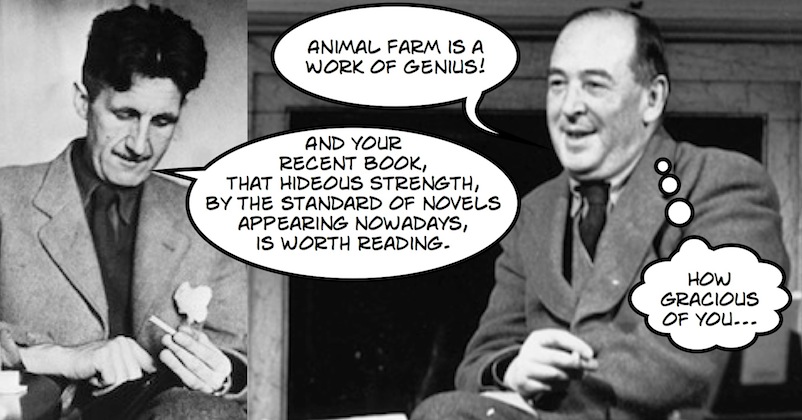
As the graphic I created above reveals (from actual quotations), Lewis had a better opinion of Orwell’s work than vice versa. Orwell disliked Lewis and resented the fact that he was popular among many common people. He particularly disliked Lewis’ traditional (evangelical) Christianity. In his review of That Hideous Strength, Orwell dismissed the biblically based supernatural as a version of “magic.”

Much is made of the fact that the scientists are actually in touch with evil spirits, although this fact is known only to the inmost circle. Mr. Lewis appears to believe in the existence of such spirits, and of benevolent ones as well. He is entitled to his beliefs, but they weaken his story . . .

Orwell was one of those “professing” Christians who is accurately labeled a hypocrite. He was a communing member of the Church of England, and advocated a Judeo-Christian moral code, but did not believe in an afterlife. The following letter, written to Eleanor Jaques in 1932, reveals his hypocrisy.

It seems rather mean to go to HC [Holy Communion] when one doesn’t believe, but I have passed myself off for pious & there is nothing for it but to keep up with the deception.

In a comment to my last post, a good friend of Mere Inkling, Brenton Dickieson at A Pilgrim in Narnia, reminded me of a thought-provoking essay on English written by Orwell. His essay, “Politics and the English Language,” addresses a number of problems with the language. He considers dying metaphors, verbal false limbs, pretentious diction, and meaningless words.

A Similarity in the Two Writers’ Advice

Orwell’s goal is “the scrapping of every word or idiom which has outworn its usefulness. It has nothing to do with correct grammar and syntax, which are of no importance so long as one makes one’s meaning clear, or with the avoidance of Americanisms, or with having what is called a ‘good prose style.’”  [As irritating as I imagine most Europeans find Americanisms!] Writers of fiction will enjoy the way Orwell explains the challenge of “showing, not telling.”

What is above all needed is to let the meaning choose the word, and not the other way around. In prose, the worst thing one can do with words is surrender to them. When you think of a concrete object, you think wordlessly, and then, if you want to describe the thing you have been visualizing you probably hunt about until you find the exact words that seem to fit it.

When you think of something abstract you are more inclined to use words from the start, and unless you make a conscious effort to prevent it, the existing dialect will come rushing in and do the job for you, at the expense of blurring or even changing your meaning. Probably it is better to put off using words as long as possible and get one’s meaning as clear as one can through pictures and sensations. Afterward one can choose—not simply accept—the phrases that will best cover the meaning, and then switch round and decide what impressions one’s words are likely to make on another person.

This last effort of the mind cuts out all stale or mixed images, all prefabricated phrases, needless repetitions, and humbug and vagueness generally. But one can often be in doubt about the effect of a word or a phrase, and one needs rules that one can rely on when instinct fails. I think the following rules will cover most cases:

1. Never use a metaphor, simile, or other figure of speech which you are used to seeing in print.

2. Never use a long word where a short one will do.

3. If it is possible to cut a word out, always cut it out.

4. Never use the passive where you can use the active.

5. Never use a foreign phrase, a scientific word, or a jargon word if you can think of an everyday English equivalent.

6. Break any of these rules sooner than say anything outright barbarous.

These rules sound elementary, and so they are, but they demand a deep change of attitude in anyone who has grown used to writing in the style now fashionable.

Students of Lewis will note in the final passage the parallel with advice he provided to a correspondent in 1956. Although the context is different—Orwell’s is a formal essay and Lewis’ a casual correspondence written to a child, the similarities are significant. Lewis would have been familiar with Orwell’s essay, composed a decade before his letter, but the resemblance between their words is better attributed to shared literary philosophies and the self-evident nature of the principles. Lewis identified five important considerations when writing.

1. Always try to use language so as to make quite clear what you mean and make sure [your] sentence couldn’t mean anything else.

2. Always prefer the plain, direct word to the long, vague one. Don’t implement promises, but keep them.

3. Never use abstract nouns when concrete ones will do. If you mean “More people died” don’t say “Mortality rose.”

4. Don’t use adjectives which merely tell us how you want us to feel about the things you are describing. I mean, instead of telling us a thing was “terrible,” describe it so that we’ll be terrified. Don’t say it was “delightful;” make us say “delightful” when we’ve read the description. You see, all those words (horrifying, wonderful, hideous, exquisite) are only like saying to your readers, “Please, will you do my job for me?”

5. Don’t use words too big for the subject. Don’t say “infinitely” when you mean “very;” otherwise you’ll have no word left when you want to talk about something really infinite.

Whatever the two authors thought about the other, they certainly shared some similar views on the subject of effective writing. And, I think we can assume with confidence that Lewis would concur with Orwell’s final rule. Under no circumstances should we resort to barbarity! For, as Lewis wrote in The Four Loves, “Who does not prefer civility to barbarism?”

____

If you are interested in reading Orwell’s “Politics and the English Language” in its entirety, you can find it here.

Avoid them Like the Plague

cliche bookAvoiding clichés in one’s writing is such oft-repeated advice it’s nearly become a cliché itself.

Many do not make much sense to people approaching a language from a literal perspective. For example, those new to American English may require a bit of explanation to understand that “hit the books” refers to studying rather than literary pugilism.

Some clichés are easily deciphered, especially when read in context. As an admonition to stop obstructing a view, we can understand why someone would say, “You make a better door than a window.”

“Don’t rain on my parade” adequately warns the hearer to avoid dampening the speaker’s special plans or activities.

Folksy adages are common where clichés are concerned. Take “The acorn doesn’t fall far from the tree.” We all know it references a child who shares numerous traits with a parent.

And we have interchangeable versions of the same notion, in case a lazy writer wishes to alternate your redundancies. He/she is a “chip off the old block” means essentially the same thing. And there’s always the classic “like father, like son,” and its corollary “like mother, like daughter.”

“As snug as a bug in a rug” used to be a favorite of my mother, ever applicable as she tucked little ones into their beds. Today, however, with bedbugs plaguing humanity in epidemic proportions, that cuddly image may have lost a touch of its appeal.

Some clichés have clearly outlived any usefulness they may once have possessed. “Too many chiefs, and not enough Indians,” clearly refers to a situation in which everyone is in charge and there no one is able or willing to actually carry out the project. However, few writers would tempt incurring the wrath of readers by using such a dated and rather prejudiced saying.

A cliché, of course, is a typically trite phrase that has lost its element of ingenuity due to overuse. It is something serious writers strive to avoid at all costs. But the final phrase in my previous sentence reveals how difficult it can be to purge these worn out words from our writing. Whenever used, they should be included consciously; writers might utilize them to establish, for example, a comic tone.

Even the gifted C.S. Lewis recognized the threat of clichés worming their way into one’s work. In a 1922 entry in his diary he wrote:

Tried to work at Dymer [his narrative poem] and covered some paper: but I am very dispirited about my work at present—especially as I find it impossible to invent a new opening for the Wild Hunt. The old one is full of clichés and will never do. I have learned too much on the idea of being able to write poetry and if this is a frost I shall be rather stranded . . .

The word cliché itself originated in France, where it was a printing plate or stereotype cast from an original composed of movable type. (The casting freed the movable type for new projects while maintaining the lettering for possible future printings.) The word came to be applied to ready-made phrases. However, the casting of printing plates is one thing. Recycling exhausted phrases ad nauseum is quite another.

Clichés are generally limited to a particular country or culture. Some are restricted to given regions. When outsiders hear or read these phrases, they often make little sense.

Some gain international esteem. More than a century ago Lord Acton described a universal truth of politics that resonates across boundaries. We have all witnessed the truth that “absolute power corrupts absolutely,” but those wise words are not something we should typically parrot in our own writings.

Not knowing the original source of a cliché is common. It is rather tragic, though, when it comes to texts that should be familiar to writers. For example:

“All’s well that ends well” is one of Shakespeare’s best loved maxims. If most Americans were asked whether it came from the pen of the Bard or Benjamin Franklin, we might be sadly disappointed with the results.

“The writing is on the wall” infers the outcome is already determined. But too few recognize this as a reference to a miracle recorded in the Book of Daniel. (If you’re not familiar with it, you can read the story here.)

Some clichés that relate to the art of writing would include the following [with my modest illustrations attached]:

“You can’t judge a book by its cover.”

     Appearances may be misleading.

Someone who appears wonderful when you first meet them may be just like an ebook with a professionally designed cover that contains a poorly scanned reprint replete with typos.

“It’s nothing to write home about.”

     Something that’s boring and not worth retelling.

While the freedom of POD technology has created democracy within the publishing industry, it’s also led to millions of meandering “books” that should “never have seen the light of day.”

A person is “an open book.”

     Someone who readily reveals their personality through word and action.

The type of character skilled authors will wish to introduce in limited quantities, especially if they are writing mysteries.

“Throw the book at him.”

     Give him the maximum possible judicial punishment.

The well-deserved fate of best-selling authors who rest on their laurels and start “phoning in” their sequels.

We turn now to a non-literary but colorful example of an American colloquialism that has spread far from its origins in the swine-breeding communities where it undoubtedly originated. It’s one of my favorite clichés, and it just may have a few good uses left in it, so feel free to include it in your next column or book . . . and no need to cite me as your source:

“You can’t make a silk purse out of a sow’s ear.”

     A task is impossible, given what you have to work with.

The echoing refrain of editors whose clients expect them to transform a few dusty lumps of coal into diamonds.

Possible Valid Uses for Clichés

While it’s safest for writers to avoid them altogether, there are a handful of occasions where they are not utterly inappropriate.

One suitable place for “chesnuts” like these to appear is in dialogue—especially when it’s written for a character a writer desires to portray as rather shallow-thinking.

It’s incorrect to suggest good writers never use clichés in conversation or composition. They do. The difference is that when they do include such tired phrases in their normally witty banter, they do it with a sense of irony.

C.S. Lewis, master of wordplay that he was, illustrated how we can creatively re-imagine or reword a cliché to reinvigorate it. Only the very best minds are up to this task. Yet, when it’s successfully accomplished, it can prove quite entertaining. The following comes from an informal conversation that was recorded before his retirement, preserved in the collection On Stories. Lewis refers in passing to an overly detailed passage in literature that nearly obscured the storyline.

The only trouble is that Golding writes so well. In one of his other novels, The Inheritors, the detail of every sensuous impression, the light on the leaves and so on, was so good that you couldn’t find out what was happening. I’d say it was almost too well done. All these little details you only notice in real life if you’ve got a high temperature. You couldn’t see the wood for the leaves.

Seeking the Living

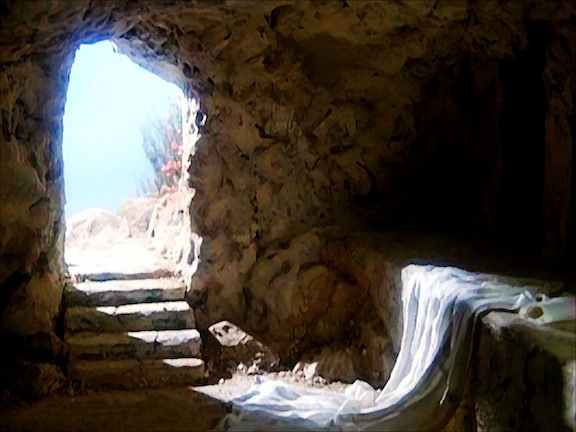
tombOne of the readings at our celebration of the Resurrection, this Easter morning, came from the Gospel according to Saint Luke. It included the powerful words of the angels waiting beside the empty tomb. To Mary Magdalene and the other women who had arrived to complete the ceremonial preparations for Jesus’ burial, they said: “Why do you seek the living among the dead?”

That’s precisely what separates Christianity from every other religious faith; for two millennia, Jesus’ disciples have followed a resurrected and living Lord.

This is what non-Christians are ultimately unable to fathom. Christianity is far more than the adoption of a particular lifestyle. It is infinitely more than a cognitive acquiescence a set of doctrines. It is nothing less than a dynamic, living relationship with our Creator through his only begotten Son.

Many regard Jesus as a great teacher from an ancient epoch—whose words are worthy of preserving. This is a good thing . . . but it’s not Christianity.

Many consider Jesus the model of a noble life—and strive to emulate his compassion and humility. This too is a good thing . . . but it’s not Christianity.

Many regard Jesus as an object of superstition—and they spout religious jargon while living hypocritical lives utterly devoted to their carnal appetites. This is not a good thing . . . and it’s most certainly not Christianity.

C.S. Lewis refers to this inherent inability to “persuade” an unbeliever to see beyond Christianity as a creedal profession or even a simple lifestyle and comprehend it as a relationship.

Our opponents, then, have a perfect right to dispute with us about the grounds of our original assent. But they must not accuse us of sheer insanity if, after the assent has been given, our adherence to it is no longer proportioned to every fluctuation of the apparent evidence. They cannot of course be expected to know on what assurance feeds, and how it revives and is always rising from its ashes.

They cannot be expected to see how the quality of the object which we think we are beginning to know by acquaintance drives us to the view that if this were a delusion then we should have to say that the universe had produced no real thing of comparable value and that all explanations of the delusion seemed somehow less important than the thing explained.

That is knowledge we cannot communicate. But they can see how the assent, of necessity, moves us from the logic of speculative thought into what might perhaps be called the logic of personal relations. What would, up till then, have been variations simply of opinion become variations of conduct by a person to a Person. Credere Deum esse turns into Credere in Deum. And Deum here is this God, the increasingly knowable Lord. (C.S. Lewis, “On Obstinacy in Belief”).

Ultimately, inviting others to share the joy and peace that we disciples of Jesus know—undeserving as all of us are—is not about persuasion. It is about introducing them to Jesus.

It’s about echoing the words of the angels in that Judean cemetery. “Don’t seek Jesus among the dead. He is risen and living, and he offers eternal life to all who call upon his name.”

Sinister Initiations

fumieSomething unbelievable just happened in America. Something offensive, abusive, and utterly intolerant.

At Florida Atlantic University, one of the professors taught a lesson so distasteful that, had it maligned any faith other than Christianity, it would have led to his dismissal. Instead, the student who challenged it was suspended from the course.

The class is entitled “Intercultural Communication,” and the instructor happens to be the county vice-chair of one America’s major political parties.

So, what was the malicious class exercise? The students were instructed to write the name “Jesus” in large letters on a piece of paper which they laid on the floor in front of them. Then, they were directed to stomp—yes, stomp—on the name of the person millions of people throughout the world regard as their Savior.

It’s difficult to comprehend anyone would design such an offensive “lesson,” let alone that they would actually attempt to implement it. And, since lessons are created to teach someone, one wonders precisely what Deandre Poole wanted his students to learn by encouraging their blasphemy . . .

C.S. Lewis would not be surprised by this event. He foresaw precisely where the wholesale rejection of God within academia would lead. There is a passage in his book That Hideous Strength that seems almost prescient. In this scene the protagonist, a sociology professor named Mark Studdock, is being initiated into an elite and secretive inner circle at the Institute where he has come to work. The organization has global plans and great influence. Studdock is a confirmed agnostic, yet he is disturbed by something his mentors describe as a “minor” portion of the initiation process.

Meanwhile, in the Objective Room [where candidates are taught to think properly], something like a crisis had developed between Mark and Professor Frost. As soon as they arrived there Mark saw that the table had been drawn back. On the floor lay a large crucifix, almost life size, a work of art in the Spanish tradition, ghastly and realistic.

“We have half an hour to pursue our exercises,” said Frost looking at his watch. Then he instructed Mark to trample on it and insult it in other ways.

Now whereas Jane had abandoned Christianity in early childhood, along with her belief in fairies and Santa Claus, Mark had never believed in it at all.

At this moment, therefore, it crossed his mind for the very first time that there might conceivably be something in it. Frost who was watching him carefully knew perfectly well that this might be the result of the present experiment. He knew it for the very good reason that [he had briefly experienced, and dismissed, the same thought during his own initiation].

“But, look here,” said Mark.

“What is it?” said Frost. “Pray be quick. We have only a limited time at our disposal.”

“This,” said Mark, pointing with an undefined reluctance to the horrible white figure on the cross. “This is all surely a pure superstition.”

“Well?”

“Well, if so, what is there objective about stamping on the face? Isn’t it just as subjective to spit on a thing like this as to worship it? I mean— damn it all— if it’s only a bit of wood, why do anything about it?”

“That is superficial. If you had been brought up in a non-Christian society, you would not be asked to do this. Of course, it is a superstition; but it is that particular superstition which has pressed upon our society for a great many centuries. It can be experimentally shown that it still forms a dominant system in the subconscious of many individuals whose conscious thought appears to be wholly liberated. An explicit action in the reverse direction is therefore a necessary step towards complete objectivity. It is not a question for a priori discussion. We find it in practice that it cannot be dispensed with.”

The parallels are evident. I can readily imagine Dr. Poole justifying his own exercise in similar language. However, that something like this could happen in a civilized land is sobering indeed.

This incident reminded me of powerful scene in the book and miniseries Shogun. [Appended below.]

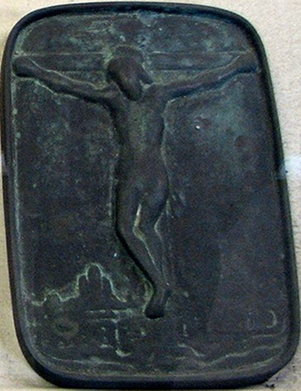
Christianity had been embraced by a number of provinces early in Japan’s history, but the rising ruler had vowed to extinguish it. The Shogun required that samurai suspected of being “Kirishitan” prove they were not by stepping on holy images of Christ or Mary. The Christians (all Roman Catholic in the seventeenth century) would not abuse holy images and were arrested on the spot. Fumi-e were images created for the sole purpose of desecrating, and some examples (like the tile shown above) have survived to this day.

If the individual failed to recant their faith in Jesus, they would be tortured and ultimately martyred. As recently as 2008, the Roman Catholic Church beatified a new group of 188 Japanese Christians. They joined 45 saints and 395 previously beatified martyrs. They represent only a small segment of the estimated 35,000 believers who accepted death rather than denying their Lord.

The newly beatified include 183 lay people, four priests and one monk. The laity included thirty samurai warriors, as well as farmers, artisans, civil servants, teachers, painters, writers, former slaves, pregnant women and even children as young as three.

If Dr. Poole was historically-informed, he would recognize that the odious ritual he thrust upon his vulnerable students carried a significant deal of baggage. And that’s not to mention the direct affront it poses to those who believe Jesus’ claim that he “is the way, the truth, and the life.” Ultimately, all people of goodwill—believers and atheists alike—will find his behavior repugnant.

Excerpt from Shogun:

In James Clavell’s book, it is the English protagonist who ironically desires to weed the [Roman Catholic] Christians out of his samurai contingent. (Their loyalties rest in a cause other than his own.)

. . .

“Can’t it wait until tomorrow?”

“No, Sire, so sorry.” Uraga was looking up at him in front of the assembled samurai vassals, the Dutch crew gathering into a nervous knot near the quarterdeck railing. “Please excuse me, but it is most important you find out at once. You are their most enemy. Therefore you must know, for your protection. I only wish to protect you. Not take long, neh?”

“Are they all on deck?”

“Yes, Sire.”

Blackthorne went closer to the railing and called out in Japanese, “Is anyone Christian?” There was no answer. “I order any Christian come forward.” No one moved. So he turned back to Uraga. “Set ten deck guards, then dismiss them.”

“With your permission, Anjin-san.” From under his kimono Uraga brought out a small painted icon that he had brought from Yedo and threw it face upward on the deck. Then, deliberately, he stamped on it. Blackthorne and the crew were greatly disquieted by the desecration. Except Jan Roper. “Please. Make every vassal do same,” Uraga said.

“Why?”

“I know Christians.” Uraga’s eyes were half hidden by the brim of his hat. “Please, Sire. Important every man do same. Now, tonight.”

“All right,” Blackthorne agreed reluctantly.

Uraga turned to the assembled vassals. “At my suggestion our Master requires each of us to do this.”

The samurai were grumbling among themselves and one interrupted, “We’ve already said that we’re not Christians, neh? What does stamping on a barbarian god picture prove? Nothing!”

“Christians are our Master’s enemy. Christians are treacherous—but Christians are Christian. Please excuse me, I know Christians—to my shame I forsook our real gods. So sorry, but I believe this is necessary for our Master’s safety.”

At once a samurai in front declared, “In that case, there’s nothing more to be said.” He came forward and stamped on the picture. “I worship no barbarian religion! Come on, the rest of you, do what’s asked!”

They came forward one by one. Blackthorne watched, despising the ceremony.

Van Nekk said worriedly, “Doesn’t seem right.”

Vinck looked up at the quarterdeck. “Sodding bastards. They’ll all cut our throats with never a thought. You sure you can trust ’em, Pilot?”

“Yes.”

Ginsel said, “No Catholic’d ever do that, eh, Johann? That Uraga-sama’s clever.”

“What’s it matter if those buggers’re Papist or not, they’re all . . . samurai.”

“Yes,” Croocq said.

“Even so, it’s not right to do that,” van Nekk repeated.

The samurai continued to stamp the icon into the deck one by one, and moved into loose groups. It was a tedious affair and Blackthorne was sorry he had agreed to it, for there were more important things to do before dusk. His eyes went to the village and the headlands. Hundreds of the thatch lean-tos of the Musket Regiment camp spotted the foothills. So much to do, he thought, anxious to go ashore, wanting to see the land, glorying in the fief Toranaga had given him which contained Yokohama. Lord God on high, he told himself, I’m lord of one of the greatest harbors in the world.

Abruptly a man bypassed the icon, tore out his sword, and leaped at Blackthorne. A dozen startled samurai jumped courageously in his way, screening the quarterdeck as Blackthorne spun around, a pistol cocked and aimed. Others scattered, shoving, stumbling, milling in the uproar. The samurai skidded to a halt, howling with rage, then changed direction and hacked at Uraga, who somehow managed to avoid the thrust. The man whirled as other samurai lunged at him, fought them off ferociously for a moment, then rushed for the side and threw himself overboard.

Four who could swim dropped their killing swords, put their short stabbing knives in their mouths, and jumped after him, the rest and the Dutchmen crowding the side.

Blackthorne jumped for the gunwale. He could see nothing below; then he caught sight of swirling shadows in the water. A man came up for air and went down again. Soon four heads surfaced. Between them was the corpse, a knife in his throat.

“So sorry, Anjin-san, it was his own knife,” one called up over the roars of the others.

“Uraga-san, tell them to search him, then leave him to the fish.”

The search revealed nothing. When all were back on deck, Blackthorne pointed at the icon with his cocked pistol. “All samurai-once more!” He was obeyed instantly and he made sure that every man passed the test.

Then, because of Uraga, and to praise him, he ordered his crew to do the same.

Saintly Newspaper Clippings

stfrancisMy brother, sister and I have nearly finished the somber task of going through my father’s possessions. We distributed many items to various family members, but the local charities have probably benefited most, as we cleared out the three bedroom home.

Sadly, my mother died nearly twenty years ago. My sister inherited her cedar chest, but had left it in our father’s house. As she prepared to take it home, we discovered some interesting items, including forty pictures my father had sent home during his 1967-68 tour in Vietnam.

We also found a Bible my mother had used when she attended studies. She was born in the generation which would never dare to highlight passages or scribble in the margins. Thus, the Bible bears no evidence it ever belonged to her . . . aside from some inspiring bookmarks, and a few newspaper clippings she had found meaningful.

One of the quotations that I too found particularly edifying, came from the pen of a Roman Catholic priest named Francis de Sales:

Do not look forward to what might happen tomorrow; the same everlasting Father who cares for you today will take care of you tomorrow and every day. Either He will shield you from suffering or he will give you the unfailing strength to bear it. Be at peace, then, and put aside all anxious thoughts and imaginations.

Francis was a post-Reformation Bishop of Geneva who was noted for his gentle approach toward religious divisions—in an era when such moderation was extremely rare. He is known for writings on spiritual growth (in Roman Catholic parlance, “spiritual formation”).

Although I have not read it, his book Introduction to the Devout Life comes highly recommended, and is available for free download here. I suspect even agnostics could enjoy it for its historical value.

By all accounts, Francis led a chaste and humble life, much like his namesake, Francis of Assisi. (Both men were canonized by their Church.)

Speaking of the first St. Francis, I have always wondered why no Pope ever honored his legacy by assuming his name. I suppose this is because his most prominent characteristics are not those most Popes seek to emulate. The assumption of Francis’ name by the new Pope, I believe, bodes well for his papacy. If he follows in the footsteps of Francis of Assisi, he cannot stray too far afield.

C.S. Lewis appreciated the thirteenth-century saint who began life as a self-indulged soldier and ended it living under a strict vow of poverty. Francis’ celebrated affection for animals—he is considered their “patron saint”—could not help but endear the monk to the creator of Narnia. Each year, many Christians participate in Roman Catholic and Anglican ceremonies for the blessing of animals on Saint Francis’ feast day.

In The Four Loves, Lewis discusses the nature of our physical body. He notes that there are several competing perspectives about our corporeal constitution, with the extremes either demeaning or glorifying humanity’s material nature. Lewis suggests that a metaphor created by Saint Francis provides a more biblical view.

Man has held three views of his body. First there is that of those ascetic Pagans who called it the prison or the “tomb” of the soul, and of Christians like Fisher to whom it was a “sack of dung,” food for worms, filthy, shameful, a source of nothing but temptation to bad men and humiliation to good ones. Then there are the Neo-Pagans (they seldom know Greek), the nudists and the sufferers from Dark Gods, to whom the body is glorious.

But thirdly we have the view which St. Francis expressed by calling his body “Brother Ass.” All three may be—I am not sure—defensible; but give me St. Francis for my money. Ass is exquisitely right because no one in his senses can either revere or hate a donkey. It is a useful, sturdy, lazy, obstinate, patient, lovable and infuriating beast; deserving now the stick and now a carrot; both pathetically and absurdly beautiful. So the body. There’s no living with it till we recognise that one of its functions in our lives is to play the part of buffoon.

Yes, I have to live for a while yet in this donkey of a shell, which illustrates daily the wisdom of the Apostle Paul who wrote that the spirit is willing but the flesh is weak . . . and short-sighted . . . and lazy . . . and stubborn . . .

This body, my flesh, argues that I should spend my day worrying about tomorrow. But the Holy Spirit speaks a more hopeful word. A promise. As God inspired Francis de Sales to eloquently proclaim: “Do not look forward to what might happen tomorrow; the same everlasting Father who cares for you today will take care of you tomorrow and every day.”

Echoes of Narnia

garrelsI just met an amazing new artist. Well, not literally.

I met him, figuratively speaking, through his innovative music. And, although he is “new” to me, he’s been recording for more than a decade. His name is Josh Garrels, and in a moment, I’ll introduce you to two examples of his lyrical poetry.

The reason I first checked out his work was because I received word that he is giving away his music! Amazing, isn’t it? Right now you can download any of his albums for free. However . . . oh, there’s a string attached, you’re thinking . . . he is requesting that you make a donation to aid the suffering in the war-ravaged Democratic Republic of the Congo. So there’s really no string at all, since it’s merely a suggestion, and the gift would be tax deductible anyway. The albums are free. Garrels doesn’t want a penny from us. But he does want us to consider aiding the 70 million struggling people of the Congo.

Despite the Congo being the eleventh largest country in the world, few Westerners follow the terrible news flowing from the wounded nation. For the next two weeks, one hundred percent of the “tips” received for Garrels’ albums will go to World Relief—for their work saving precious lives and bringing peace to the hopeless.

In listening to some of Garrels’ music, I was reminded of the versatility of C.S. Lewis, who wrote so skillfully in so many different genres. I’m not sure how to describe Garrels’ songs; perhaps they defy categorization. It’s not the music I typically listen to . . . but the depth of his lyrics have won me over. Consider the following two songs. I’ll share the lyrics here, and then offer links to each of them below. I encourage you to read the words first and then listen to the music.

“Slip Away”

Hold on, before I slip away

The flames gone dark, I am afraid

How strong is flesh and blood

I cannot can take back what I’ve done

To you, my sweetest friend

I betrayed you, I walked away again

Hold on, before I slip away

The flame’s gone dark, I am afraid

How strong is flesh and blood

I cannot take back what I’ve done

To you, my sweetest friend

I betrayed you, I walked away again

Now all that’s left, is what might have been

Please forgive me, before we reach the end

Please forgive me, before we reach the end

And—for a delightful tale composed in the spirit of Narnia, be sure to listen to “Rabbit and the Bear.” Much of its imagery is shared with the homeland of the Chronicles of Narnia, but it’s clearly the Bible that provides both “composers” with their strongest inspiration.

“Rabbit & the Bear”

Run, run so fast

Over fields and grass

At last, at last

We escaped from the trap

With the rabbit and the bear

And the sparrows of the air

Come one, come all

The hunter is gone

And this is our chance

To crawl under the wire

Through the darkest wood

On up to the mountain of fire

Where everything is free

In the light of the sun

Where every creature sings

Oh Lord, you rescued us all

Don’t listen to the snake

For he lies and he takes

Your hope, your faith

Away from you

But when the lion comes around

With his claw and his crown

Follow, follow

His every move

After you’ve listened to these two pieces, I encourage you to visit this site and download his albums—for free. And, if you feel so inclined, I add my voice to Garrels’ in encouraging you to support World Vision’s vital work in the Congo.

Translating the Word

translationsThe science of translation is only partially scientific. It is also an art—with the insight into intuiting the intent of the original author a critical dimension of good translating.

First, of course, the translator must possess a sound grasp of the original language. Second, he or she must know the language into which they are translating the work equally well. With this knowledge, the translator can do an adequate job.

Only with that indefinable intuition mentioned above, is a translator empowered to do justice to a writer’s work when recreating it in a different language.

All translation work is demanding, but those entrusted with transferring documents of faith into new languages face an additional burden. The adherents of various religions typically regard this literature as “inspired,” and therefore to be approached with only the most serious and respectful of intentions.

This is certainly true for Christianity. Transferring the Scriptures from Hebrew, Aramaic and Greek into Latin, German and English involved devout theologians who approached the task with reverence as well as skill.

That balance remains a constant these many centuries after the earliest translation efforts. Today the Christian Bible is still being translated into languages where it has never been available before. The Wycliffe Bible Translators community is the largest organization working toward this end, although there are many others, such as the Lutheran Bible Translators, who are laboring in noncompetitive venues.

Wycliffe estimates that 350 million people do not yet have the Bible available in their native language. They have been instrumental in putting God’s Word into 700 different tongues, and with various other organizations are committed to continuing their vital work.

Some of the targeted language groups actually speak dialects of more common tongues. For example, De Nyew Testament is now available for speakers of Gullah. Spoken by the descendants of slaves residing in the South Carolina and Georgia coastlines. It is an English-based creole language featuring numerous African contributions. A comparison of a sample verse will illustrate the differences. The first verse of the Gospel according to John reads:

Fo God mek de wol, de Wod been dey. De Wod been dey wid God, an de Wod been God. Fo God mek de wol, de Wod been dey wid God. Shru dat Wod, God mek ebryting. Ain nottin een de whole wol wa God mek dat been done dout de Wod. (Gullah New Testament).

In the beginning was the Word, and the Word was with God, and the Word was God. The same was in the beginning with God. All things were made by him; and without him was not any thing made that was made. (King James Version).

At the beginning God expressed himself. That personal expression, that word, was with God, and was God, and he existed with God from the beginning. All creation took place through him, and none took place without him. (J.B. Phillips’ New Testament).

Why, you may wonder, have I included the relatively unknown translation by Phillips? Because none other than the brilliant and devout scholar, C.S. Lewis, regarded it highly. Lewis recognized that the archaic usage of the Authorized (King James) Version impeded its use by many people. In fact, in a 1961 letter he wrote: “A modern translation is for most purposes far more useful than the Authorised Version.”

Lewis was one of the readers of Phillips’ initial translation of the Pauline epistles who encouraged him to proceed with the task of translating the entire New Testament. Lewis, in fact, was key in encouraging Geoffrey Bies to publish the new version. Technically, though, calling this text a “translation” is a bit misleading; in many ways it is more honestly labeled a “paraphrase.” Still, it did make the Scriptures more accessible to many younger readers.

Phillips’ New Testament in Modern English is available online at the Christian Classics Library.

C.S. Lewis wrote an entire essay on the subject of translating God’s revelation. It is entitled “Modern Translations of the Bible,” and included in the God in the Dock collection. The following wisdom comes from that source.

The only kind of sanctity that Scripture can lose (or, at least, New Testament scripture) by being modernized is an accidental kind which it never had for its writers or its earliest readers. The New Testament in the original Greek is not a work of literary art: it is not written in a solemn, ecclesiastical language, it is written in the sort of Greek which was spoken over the Eastern Mediterranean after Greek had become an international language and therefore lost its real beauty and subtlety. In it we see Greek used by people who have no real feeling for Greek words because Greek words are not the words they spoke when they were children. It is a sort of “basic” Greek; a language without roots in the soil, a utilitarian, commercial and administrative language.

Does this shock us? It ought not to, except as the Incarnation itself ought to shock us. The same divine humility which decreed that God should become a baby at a peasant-woman’s breast, and later an arrested field-preacher in the hands of the Roman police, decreed also that He should be preached in a vulgar, prosaic and unliterary language. If you can stomach the one, you can stomach the other. The Incarnation is in that sense an irreverent doctrine: Christianity, in that sense, an incurably irreverent religion.

Grasping for Immortality

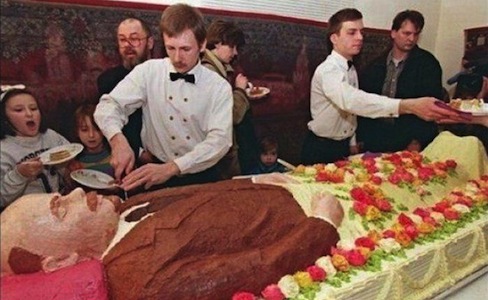
memorial cakeToday’s news carried a truly bizarre story. Yesterday, Venezuela’s dictator died after a lengthy illness. Today we learned that his body is due to be preserved for future generations to venerate. Like his forebear Lenin, he’ll be on call in a glass casket in case someone needs to gaze at him to have their socialist energies reinvigorated.

And that was only half of the surprising news report about Chavez’s demise.

The head of the presidential guard, a general close to the leader, related his final words. He was at his bedside and reported that he was too weak to verbalize the words, but clearly mouthed the plea “I don’t want to die; please don’t let me die.”

It’s shocking that General Ornella would divulge this fact about Chavez, particularly during the actual process of his divinization. The general attributes Chavez’s reluctance to receive his “eternal reward” to his love of country and desire to remain here to lead his nation for ever.

I, on the other hand, would attribute his reluctance to die to other sentiments.

The article that related the morbid plans for the display of Chavez’s body cited the familiar example of Lenin, which I mentioned above. It also noted two other former rulers whose bodies have also been preserved for an adoring posterity: Mao Zedong and Ho Chi Minh. Preparing this post I found that Kim Il-sun and his son Kim Jong-Il share a mausoleum. Likewise, Lenin’s successor Stalin would still be on display, had it not been for eventually falling out of political favor.

Now, there’s something obvious that all of these men have in common. They were leaders of oppressive communist regimes—which oppressed their own citizens because of their atheistic worldview.

Having rejected God and knowing no hope of resurrection or eternal life, they feebly grasped for immortality the only way they knew. They sought to leave a monumental mark on history, in order to be long remembered. And, considering a monument and a statue insufficient mnemonic devices . . . well, enough about that.

A Far Better Way

We who know the Creator of all life have much to be grateful for. Not least of which, his gracious gift of eternal life. Christians believe we will trade in this weak and worn body for a new one. So, while we treat the bodies of those who have died with dignity, we feel absolutely no impulse to venerate them. On the contrary, “ashes to ashes and dust to dust.”

C.S. Lewis wrote something in Mere Christianity which relates directly to this sharp contrast in worldviews.

Immortality makes this other difference between totalitarianism and democracy. If individuals live only seventy years, then a state, or a nation, or a civilisation, which may last for a thousand years, is more important than an individual. But if Christianity is true, then the individual is not only more important but incomparably more important, for he is everlasting and the life of a state or a civilisation, compared with his, is only a moment.

That, dear friends, is quite a paradigm shift. To regard each human life as more precious than any abstract government or institution created by humanity’s hand. Having that perspective is akin to seeing with God’s own eyes.

I hope the people of Venezuela soon recognize the futility of the shrine that is being built. Infinitely better to seek “immortality” (eternal life) in the one place where it may truly be found.

Malapropistic Entertainment

marshianWhenever I have an appointment with a doctor, I try to remember to bring along my own magazine or (better yet) the current writing project with which I’m wrestling. Unfortunately, I’m often in a hurry, and sometimes forget . . . which means I need to rely on that odd potpourri of dated magazines that typically migrate to medical waiting rooms.

This week found me in precisely this precarious predicament. I arrived rather early in my dentist’s office, and it turned out that he was slightly behind schedule. Not the best of circumstances. I approached the magazine rack with trepidation.

To my delight I saw a Reader’s Digest with a cover article about “Fifty Dumb Boss Stories.” Having worked for my share of dullards, I thought this should be entertaining. The fact that it included comments from Dwight Schrute of The Office made it just that much more promising.

I wasn’t disappointed. Among the many silly acts recorded in the article were a collection of malaprops voiced by witless bosses. Here are a few:

The Greek pyramids weren’t built in a day.

Spurt me out an email.

Let’s not put the horse before the cart.

We’re not preparing the report because it would be an exercise in fertility.

And my personal favorite, the elegantly mixed metaphor: “It’s not rocket surgery!” Nor is it, I suspect, brain science.

Most of us appreciate humor—even when it’s unintended. C.S. Lewis, in Reflections on the Psalms, wrote: “A little comic relief in a discussion does no harm, however serious the topic may be. (In my own experience the funniest things have occurred in the gravest and most sincere conversations.)”

Now, before ending this post, I need to point out one more truth. Dimwitted bosses aren’t the only people who stumble over words and meld images better left autonomous. Every one of us has occasionally experienced the proverbial “slip of the tongue,” and sometimes with quite entertaining results. Jokes—whether intentional or accidental—can all be appreciated. As the newly created Talking Animals of Narnia are told by Aslan:

“Laugh and fear not, creatures. Now that you are no longer dumb and witless, you need not always be grave. For jokes as well as justice come in with speech.” (The Magician’s Nephew).

Not Another Funeral

threeFollowers of Mere Inkling will recall that my father passed away last month. Yesterday found our family attending the funeral of our last surviving uncle. My mother was not a superstitious person. Nevertheless, whenever two deaths occurred near the same time, she used to almost reflexively say, “deaths come in threes.”

You may have heard that adage yourself. It’s apparently been around some time, and is occasionally applied to catastrophes in general. However it is used, it is merely a superstition. And, like most such things, if you diligently search for evidence to support it, you can frequently discover some.

I assume that some Christians may even be vulnerable to believing in credulous notions, but this would be a particularly bizarre one for them to affirm since (in terms of biblical numerology) the number three is anything but eerie. Three, after all, represents the Persons of the Trinity.

Of course, many may regard the study of biblical numerology to be a variant of superstition itself. I suppose that depends on the traits you attribute to them. For example, if they are signs of meaning—e.g. completeness such as twelve for the twelve tribes of Israel or four for the writers of the Gospels—there is little controversy.

However, if the numbers themselves are perceived as being imbued with some sort of mystical nature or power, the percentage of scoffers would likely increase. Nevertheless, the ancient Chinese culture, with its billions of members, are keenly attuned to “lucky” and “unlucky” numbers. Good are two and eight, which are homophones for the words “easy/bright” and “prosper/wealth.” Bad are four and six, which are pronounced similarly to “death” and “drop/decline.”

In The Screwtape Letters, C.S. Lewis has the senior demonic tempter advising his protégé about the value of superstitions in numbing human beings to the Truth. In the context of a letter advising how to encourage cowardice in a soldier, he writes:

The main point is that precautions have a tendency to increase fear. The precautions publicly enjoined on your patient, however, soon become a matter of routine and this effect disappears. What you must do is to keep running in his mind (side by side with the conscious intention of doing his duty) the vague idea of all sorts of things he can do or not do, inside the framework of the duty, which seem to make him a little safer. Get his mind off the simple rule (‘I’ve got to stay here and do so-and-so’) into a series of imaginary life lines (‘If A happened—though I very much hope it won’t—I could do B—and if the worst came to the worst, I could always do C’). Superstitions, if not recognised as such, can be awakened.

The point is to keep him feeling that he has something, other than the Enemy and courage the Enemy supplies, to fall back on, so that what was intended to be a total commitment to duty becomes honeycombed all through with little unconscious reservations. By building up a series of imaginary expedients to prevent ‘the worst coming to the worst’ you may produce, at that level of his will which he is not aware of, a determination that the worst shall not come to the worst. Then, at the moment of real terror, rush it out into his nerves and muscles and you may get the fatal act done before he knows what you’re about. For remember, the act of cowardice is all that matters; the emotion of fear is, in itself, no sin and, though we enjoy it, does us no good.

I strive to leave as little room in my life for superstition as possible. Whenever I become aware of it, I immediately seek to weed it out. Life in our fallen world, with my own sinful nature, is difficult enough without adding the burden of carrying superstitions.

Thus, I’m reflecting on our family’s two recent funerals . . . without anticipating another