
Religious Kitsch

socksAre souvenir socks a good way of celebrating one of the move pivotal points in human history? That’s right, stockings. Socks emblazoned with one of the most famous statements of Christian faith made during the past millennium.

Hier stehe ich!” “Here I stand” (on the clear message of God’s word). This was Martin Luther’s steadfast defense where his salvation on the teaching that we are saved by God’s grace and mercy, not by our own efforts.

Ich kann nicht anders.” I can do no other, Luther continued. He invited his adversaries to correct him if they could show him in error, according to the Scriptures.

We are beginning a season when many people are celebrating the 500th anniversary of the Reformation of the Church. Some of the commemorations are quite noteworthy. Others . . . less so.

On the positive side, I rank near the top The Wittenberg Project, the restoration of the Old Latin School in the city where Luther preached the Gospel.

Near the other extreme, I have to place the “Here I Stand” socks. While I briefly considered purchasing a pair for one of my sons, my admittedly plebian sense of fashion saved me from doing so. (If you, on the other hand, find them tasteful or suitable for an acquaintance, you’ll find a link to the footwear below.)*

In his essay, “What Christmas Means to Me,” C.S. Lewis describes this sort of product. In his description of the “commercial racket” associated with the season, he writes:

I condemn it on the following grounds. . . . Things are given as presents which no mortal ever bought for himself – gaudy and useless gadgets, ‘novelties’ because no one was ever fool enough to make their like before.

Have we really no better use for materials and for human skill and time than to spend them on all this rubbish?

I understand that one person’s “rubbish,” though, can be another’s treasure. Still, as Edward Veith writes in The State of the Arts:

The problem with religious kitsch is that its cuteness and self-gratifying nature can domesticate and thereby distort Biblical faith. Christianity is not a sickly, sweet religion . . . The anemic figurines of Jesus Christ are poor testimony to His deity and His lordship.

Viewing It All in (a Humorous) Perspective

sockeWhile surfing the net researching this peculiar item, I encountered an entertaining website where we see how the Catholic—Reformer struggle lives on today.

A Roman Catholic website comments on the same sort of socks—tastefully offered in the original German. The author of The Ironic Catholic writes:

With all due apologies to my Lutheran brothers and sisters: while this catapults you into a real race with the Catholics for kitsch, we will crush you like grapes in this arena.

It’s all good-natured, of course. I haven’t bothered to research Catholic variations on the footings quotations front, but I imagine they are equally pithy.

I did, however, find one prolific Roman Catholic author whose following statement might be just as suitable for a hat as for stockings.

“It is because we are standing on our heads that Christ’s philosophy seems upside-down.” (G.K. Chesterton)

_____

* You can order your own pair of “Here I Stand” socks here.

** The Ironic Catholic post is here.
The Bible’s Complexity

locustsWhy is it people say the Bible has many writers, but only one Author? The answer to that question is simpler than it seems.

Many different people, over a span of centuries, wrote the various books we find in the Scriptures. At the same time, each of these diverse individuals was inspired by the same Person—the Holy Spirit. Thus it is said by orthodox Christians that the Scriptures are the “Word of God.”*

The word “scripture” itself simply means a written work, although it is almost always applied to books regarded as sacred.

For Christians, Scripture/s can be singular or plural since the Bible possesses both aspects, being inspired by a single Author, yet compiled by numerous individual scribes.

The current issue of World magazine offers a satisfying interview** with David Skeel, a professor at the University of Pennsylvania Law School.

Skeel was raised with minimal exposure to Christianity, and while majoring in English, he found his ignorance of biblical allusions to be a serious handicap.

To rectify that problem, he decided to read the Bible over the summer after his sophomore year. Riding on a cross country trip with some classmates, he says “by the time I’d gotten a few chapters into Genesis I was persuaded it was true. I had never read anything so beautiful, so psychologically real.”

I was especially intrigued by the following insight offered by Skeel.

Christianity impressed you because it’s complicated?

Absolutely. The psychological complexity of Christianity was really powerful for me, as was the complexity of the language of the Bible. Truth can’t be conveyed in a single genre, so the Bible’s mix of genres, language and images is part of the evidence of its veracity.***

I don’t recall ever thinking of it that way, but he is right. God’s revelation of his mercy and grace is far too vast to be “conveyed in a single genre.”

Back to Oxford

Skeel doesn’t mention C.S. Lewis in his interview, and I have no idea whether Lewis’ work has influenced his life.

Despite that, his response to the question above reinforced for me one of the reasons Lewis has proven to be such a powerful blessing in my own pilgrimage.

Lewis intuitively recognized that same truth. God’s message is too boundless to be restrained to a single means of proclaiming it. And because of that, he used every genre at his command to celebrate it.

Essays, debates, poetry, fantasies and history were all fair game.

Which brings me to a corollary to Skeel’s observation. Not only is Truth too immeasurable to be limited to a single genre . . . by God’s design, humanity’s diversity is too abundant to allow for a single manner of communication to speak with the same power.

Some are moved by God’s poetry in a singing brook. Others by his majesty in the face of a snow-capped summit.

Some are drawn to his embrace through stories of human struggle and redemption. Others by logical arguments that appeal to their confidence in reason.

This is precisely why different individuals favor different books in the Scriptures, just as they prefer various writings over others within the Lewis “canon.”

Fortunately, Skeel’s literary interest in the Bible led him to pick it up without any life-changing expectations. That makes him one of the rare exceptions to Lewis’ observation with which we will close.

It may be asked whether now, when only a minority of Englishmen regard the Bible as a sacred book, we may anticipate an increase of its literary influence. I think we might if it continued to be widely read. But this is not very likely.

Our age has, indeed, coined the expression “the Bible as literature.” It is very generally implied that those who have rejected its theological pretensions nevertheless continue to enjoy it as a treasure house of English prose. It may be so.

There may be people who, not having been forced upon familiarity with it by believing parents, have yet been drawn to it by its literary charms and remained as constant readers. But I never happen to meet them.

Perhaps it is because I live in the provinces. But I cannot help suspecting, if I may make an Irish bull [an incongruous statement], that those who read the Bible as literature do not read the Bible. (“The Literary Impact of the Authorised Version”).

_____

* Although the Bible is commonly referred to as the “Word of God,” it is more properly referred to as the written Word of God. The actual Word is none other than Jesus Christ himself, through whom all things were spoken into existence. This is clear when you compare the following passages from the Scriptures. If you have any questions about this, feel free to write to me here at Mere Inkling.

Creation as described in the book of Genesis, chapter 1.

Echo of creation in the Gospel according to John, chapter 1.

** You can read the interview here.

*** In his response, Skeel wisely answers the actual question by substituting the word “complex” for “complicated.” The latter implies unnecessary complexity and a problem. The former, complexity, simply states the facts. It is impossible to adequately describe an infinite God with finite words.

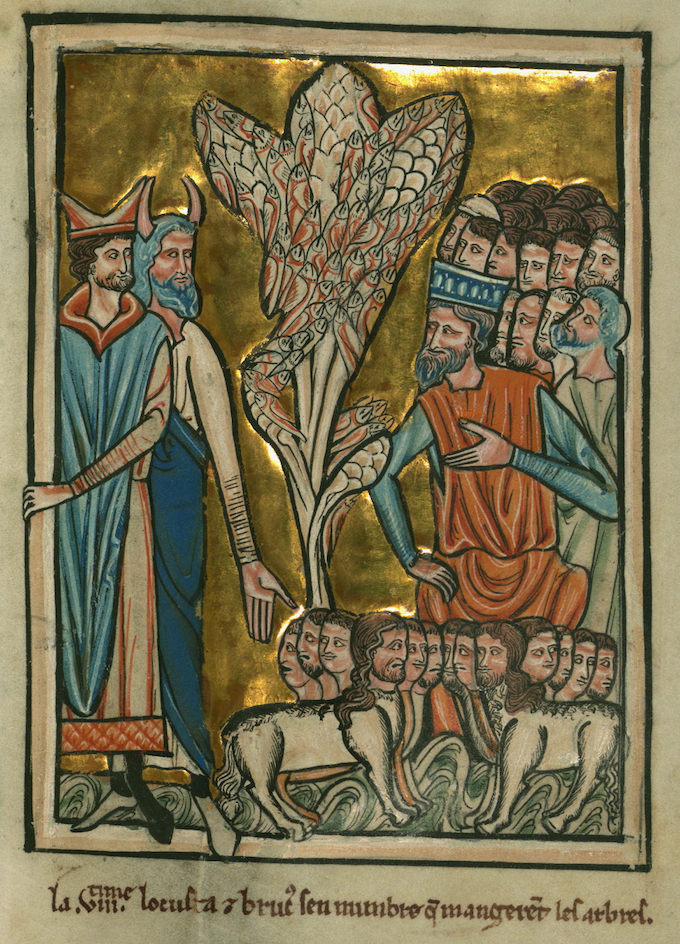
The illustration on this page is from the Walters Art Museum and portrays the plague of locusts visited upon the Egyptians.

Great Grandparent or Great-Grandparent?

ggfI have never been more glad to have a birthday than I was this year. After all, at a mere sixty, I would have been far too young to become a great-grandfather. Now, at sixty-one, I feel adequately prepared for the momentous event which transpired just under an hour ago.

Tobin (meaning “God is Good”) is the child of my grandson and his wife, who currently reside in Texas where dad handles munitions for B-1 bombers.

Age and offspring do not always line up the way that we ourselves would plan. Yet every precious child is a miraculous gift from God.

Our grandson was born to our precious daughter-in-law while she was in high school. We didn’t get to meet him until he was ten, but we’ve done our best to make up for lost time. Our grandson, early on began calling us his “great grandparents.” That didn’t make us feel old, just special.

When my wife worked in a residential care facility for severely handicapped children, one of the aides arrived one morning with joyous news. “I’m a great-grandmother!”

Because the woman seemed too young, Delores responded, “Congratulations, you look so young for being a grandmother.”

The lady laughed and said, “No, a great-grandmother!” It turns out she was not yet forty . . . having been 13 when she had a daughter who was 13 when she had her own daughter who now had birthed her own baby. (I don’t recall the gender of the child.)

As I wrote this, it dawned on me that this all took place thirty-seven years ago, so it’s quite possible there are now several more generations in that particular family tree.

Some people will scoff at the thought of celebrating such early and assumedly unintended pregnancies. But, that caregiver knew the truth—every young life is a gift from God.

As an imperfect parent and grandparent, I recognize all too well that I won’t be the great-grandfather Tobin should have. I do pray, though, that God would grant that my mistakes with him would be few, and the memories forged during this life will help this little one grow into the finest man that he can become.

Most importantly, I pray that he will see Christ in my life and recognize the value of faith. Only the Lord knows what the future will bring, and I will not be here to share too many decades of life with my grandchildren and great-grandchildren. But my hope is that the time we do have will leave a lasting legacy of encouragement, faith, and compassion.

The letters of C.S. Lewis provide insights into the influence of his grandparents on his young life.

In a 1905 letter to his brother Warnie, he describes family festivities on Halloween. They even persuaded his grandfather to join in.

On Halow-een we had great fun and had fireworks; rockets, and Catherine wheels, squbes, and a kind of thing that you lit and twirled and then they made stars. We hung up an apple and bit at it. We got [his paternal] Grandfather down to watch and he tried to bite.

In a 1916 letter to his father, he refers to his grandmother’s declining health. (She died two weeks after he wrote.) Lewis refers to the common sentiment that we should have tried harder to spend time with family while they were with us. “I am sorry to hear what you say about [Lewis’ maternal] Grandmother: I feel that we ought to have seen more of her, but it was not easy.”

I should dearly love to get away for a bit, but, as you say, for so short a time, the expense and the interruption of work is hardly worth it. The Colonel must have had an unpleasant journey: I wish he would keep a diary which we could compare with that of Grandfather Hamilton in the same waters. Two generations of sub-tropical Atlantic and Hamilton temperament would be worth studying!

The diaries left by C.S. Lewis’ grandfather, and by his brother Warnie, provide a reminder to us that a written legacy will outlast our voices. If we have something important to say to our descendants, perhaps that is something we should keep in mind.

Tolerating Blasphemy

There is a high price to be paid for the privilege of freely proclaiming our personal faith.

It is not simply respectfully allowing every competing worldview the same freedom.

It requires far more than that.

Free speech—as understood in the Western tradition—means allowing even objectionable messages to be expressed.

A British author recently spoke to students graduating from an American college about this conundrum.

The British novelist called on students to remember that “religion and atheism, and all thought systems, all grand claims to truth, must be open to criticism, satire, even, sometimes, mockery,” and that “being offended is not to be confused with a state of grace; it’s the occasional price we all pay for living in an open society.”

Mockery of what we consider holy . . . that certainly is a steep price.

Some are unwilling to pay this price for the freedom of speech. The bloody atrocities committed by some followers of Muhammad attest to that.

Christians, on the other hand, no longer take the lives of blasphemers. They follow the leading of the Prince of Peace in praying for those who despise them and their Lord.

No one likes blasphemy—not even, I believe—those who spew it. And yet, the very existence of such “hate speech” proves at least two things.

First, that Christians are willing to endure hearing painful speech in appreciation for their own right to speak honestly about matters of eternal significance.

Second, that we recognize our Creator is great enough—and, more importantly, compassionate enough—to offer grace, mercy and healing to the wounded souls who are so desperate they can only express their anguish with a curse.

May God have mercy on those guilty of blasphemy.

We are Blasphemers All

Forgiveness and mercy flow naturally from the hearts of the redeemed when they reflect on the magnitude of their own sins.

Who among us can cast the first stone when it comes to dishonoring the name of our Creator? Not I.

And, as an imperfect man I am in good company.

C.S. Lewis describes an example of his own blasphemies in his autobiographical Surprised by Joy: The Shape of My Early Life. The situation revolved, ironically, around his “confirmation” within the Anglican communion.

His father was eager to see his son publically confirm his faith and assume a fuller membership in the church. The problem was, Lewis was no longer a Christian. He was already apostate. Yet, out of deference to his father, he willingly made a mockery of the “sacrament.”

My relations to my father help to explain (I am not suggesting that they excuse) one of the worst acts of my life. I allowed myself to be prepared for confirmation, and confirmed, and to make my first Communion, in total disbelief, acting a part, eating and drinking my own condemnation.

As Johnson points out, where courage is not, no other virtue can survive except by accident. Cowardice drove me into hypocrisy and hypocrisy into blasphemy. It is true that I did not and could not then know the real nature of the thing I was doing: but I knew very well that I was acting a lie with the greatest possible solemnity.

It seemed to me impossible to tell my father my real views. Not that he would have stormed and thundered like the traditional orthodox parent. On the contrary, he would (at first) have responded with the greatest kindness. “Let’s talk the whole thing over,” he would have said. But it would have been quite impossible to drive into his head my real position.

The thread would have been lost almost at once, and the answer implicit in all the quotations, anecdotes, and reminiscences which would have poured over me would have been one I then valued not a straw— the beauty of the Authorized Version, the beauty of the Christian tradition and sentiment and character. And later, when this failed, when I still tried to make my exact points clear, there would have been anger between us, thunder from him and a thin, peevish rattle from me. Nor could the subject, once raised, ever have been dropped again.

All this, of course, ought to have been dared rather than the thing I did. But at the time it seemed to me impossible. The Syrian captain was forgiven for bowing in the house of Rimmon. I am one of many who have bowed in the house of the real God when I believed Him to be no more than Rimmon (2 Kings 5).

Like Lewis, I have much for which to be forgiven. I am willing to suffer the abuse of my beliefs precisely because my Lord Jesus was willing to endure the thorns, whip and nails that should have been mine.

And, because of God’s love for all sinners, I can sincerely pray, “Lord, have mercy on those who blaspheme.”

An Impious C.S. Lewis

csl glassWhen C.S. Lewis was contacted for permission to publish a recent sermon in a distinguished collection, he confessed an “impious” hope.

Lewis, of course, was not a pastor. He was instead a highly regarded professor. Nevertheless, due to his mastery of public speaking, and his unapologetic faith, he was invited to preach on a number of occasions.

This particular sermon had been delivered at St Mary the Virgin in Oxford, on 22 October 1939. The Student Christian Movement had already published it in pamphlet format with the title The Christian in Danger.*

Lewis ends a lengthy 1940 letter to his brother Warnie by mentioning the request, almost as an afterthought.

Did I tell you that someone wants to include that St Mary’s sermon of mine in a collection of (save the mark**) Famous Sermons?

Famous English Sermons would be published by Thomas Nelson in London later that year. The anthology was edited by Ashley Sampson, who had asked Lewis to write his volume The Problem of Pain.

Lewis’ modest “impiety” was revealed in the rest of his announcement to his brother. He confesses to that common human fear of being upstaged by the other works in the collection.

I am divided between gratification and a fear that I shall be merely made a fool of by appearing in the same book as Bede, Latimer, Donne, Taylor etc. However, let’s hope that I shall be divided from them by some good 19th century duds!—but I grow impious.

How easy it is to relate to Lewis’ concern. As I moved from assignment to assignment during my military career, I subconsciously hoped I was relieving someone who had left room for me to excel . . . and, simultaneously, that as I left my recent assignment my performance would not be outshined by my successor.

Better, in my mind, to be proceeded and followed by 20th century duds. (Forgive me, Lord.)

I doubt C.S. Lewis and I are the only people to have shared that impious thought.

Still, recognizing the impiety is the beginning of purging it. I tried to make it a practice to pray for those who followed in my ministry wake. That they would be successful, and that the men and women entrusted to our spiritual care would be blessed by their ministries.

I must confess, though, that when my literary work has been placed in direct juxtaposition to that of others, I have not been so eager for theirs to be better received than my own contributions. Not that I wish upon anyone that they would be a dud, but merely that their eloquence not put my own humble efforts to shame.

_____

* The sermon is found in The Weight of Glory with the title “Learning in War-Time.”

** “Save the mark” is an exclamation that connotes a sense something is unbelievable. It can even be dismissive, but that would not be the sense in which Lewis uses it here, since it is obvious he regards the request as a humbling honor.

Bach’s Deathbed Hymn

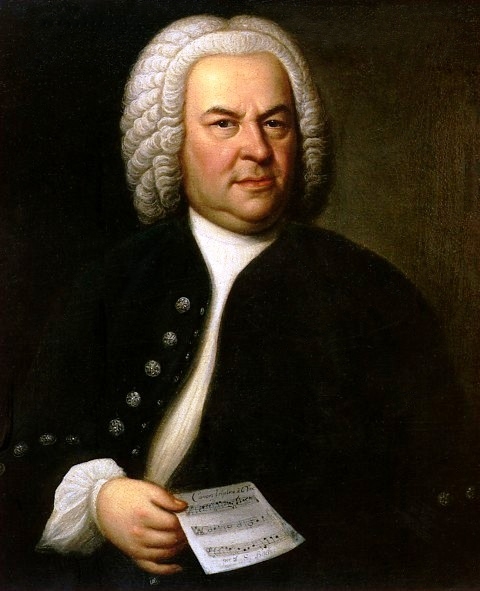
jsbBlind and restricted to his deathbed, Johann Sebastian Bach asked a fellow organist to play one of his own hymns. Bach then did what any brilliant composer would have done.

No, he did not criticize his colleague for the way he interpreted it musically. Bach, in his final hours, revised his own composition, making a number of musical improvements.

And the genius did not rest there, he retitled the work and modified its strains in a manner which perfectly addressed his circumstances. Anticipating his imminent encounter with his Creator, he changed the name to Vor deinen Thron tret’ ich hiermit (Before Your Throne I Now Appear). The first and last verses of the hymn are as follows.

Before your throne I now appear,

O God, and beg you humbly

Turn not your gracious face

From me, a poor sinner.

Confer on me a blessed end,

On the last day waken me Lord,

That I may see you eternally:

Amen, amen, hear me.

As a Lutheran, Bach was well acquainted with his sinful nature and utter dependence on the grace of God. He was a serious student of the Bible, and his annotated edition of Luther’s translation is held in the collection of Concordia Seminary. (Two of the three volumes are currently on loan to Leipzig.)

The medical missionary, Albert Schweitzer, was a renowned Bach scholar before he left a promising career in music performance to pursue medicine. Schweitzer wrote:

At heart Bach was neither pietistic nor orthodox: he was a mystic thinker. Mysticism was the living spring from which sprang his piety. There are certain chorales and certain cantatas which make us feel more than elsewhere that the master has poured into them his soul. These are precisely the mystical chorales and cantatas.

Like all the mystics, Bach, one may say, was obsessed by religious pessimism. This robust and healthy man, who lived surrounded by the affection of a great family, this man who was embodied energy and activity, who even had a pronounced taste for the frankly burlesque, felt at the bottom of his soul an intense desire, a Sehnsucht, for eternal rest. (Albert Schweitzer, The Life and Character of Bach).

During his lifetime, Bach’s international renown arose from his performance skills. It was nearly a century later that the gifted Felix Mendelssohn reintroduced Bach’s Saint Matthew Passion and the world grew to admire Bach as the brilliant composer he was. Referring to his partnership with a playwright in the effort, Mendelssohn said, “To think that it took an actor and a Jew’s son to revive the greatest Christian music for the world!”

Bach remains quite popular, although not everyone shares an appreciation of organ music. In 1956, C.S. Lewis provided insight into his own preferences in the following correspondence.

Concerning hymn singing and organ playing: if they have been helpful and edified anyone, then the fact that they set my teeth on edge is infinitely unimportant. One must first distinguish the effect which music has on people like me who are musically illiterate and get only the emotional effect, and that which it has on real musical scholars who perceive the structure and get an intellectual satisfaction as well.

Either of these effects is, I think, ambivalent from the religious point of view: i.e. each can be a preparation for or even a medium for meeting God but can also be a distraction and impediment.

In that respect music is not different from a good many other things, human relations, landscape, poetry, philosophy. The most relevant one is wine which can be used sacramentally or for getting drunk or neutrally. I think every natural thing which is not in itself sinful can become the servant of the spiritual life, but none is automatically so

When it is not, it becomes either just trivial (as music is to millions of people) or a dangerous idol. The emotional effect of music may be not only a distraction (to some people at some times) but a delusion: i.e. feeling certain emotions in church they mistake them for religious emotions when they may be wholly natural.

That means that even genuinely religious emotion is only a servant. No soul is saved by having it or damned by lacking it. The love we are commanded to have for God and our neighbour is a state of the will, not of the affections (though if they ever also play their part so much the better).

So that the test of music or religion or even visions if one has them is always the same– do they make one more obedient, more God-centred, and neighbour-centred and less self-centred? ‘Though I speak with the tongues of Bach and Palestrina and have not charity etc.’!

Fortunately, even the “musically illiterate” can be blessed by the anointed ministry of Bach. Lewis is correct that musical brilliance, without a gracious component, is empty. Fortunately, in the case of J.S. Bach we encounter a man who truly lived by the words he appended to much of his music: Soli Deo Gloria, to Glory to God Alone.

_____

You can listen to Bach’s music for this chorale here. This performance is from the church in Leipzig where Bach himself performed.

Easter, Updike & Lewis

updikeHappy Easter Monday. Even if you do not believe Jesus has risen from the dead, I sincerely hope you are experiencing a special season of hope and peace.

For Christians, however, the bodily resurrection of Jesus is not an optional doctrine.

The Scriptures affirm the truth that, “. . . if Christ has not been raised, then our preaching is in vain and your faith is in vain. . . . if Christ has not been raised, your faith is futile and you are still in your sins. Then those also who have fallen asleep in Christ have perished. If in Christ we have hope in this life only, we are of all people most to be pitied” (1 Corinthians 15:14-19, ESV).

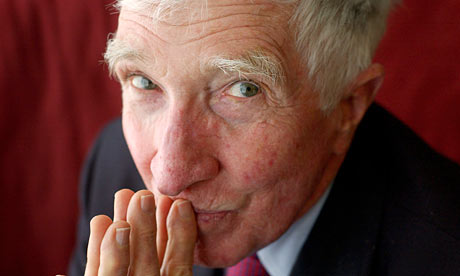
John Updike (1932-2009) recognized this truth and wrote an oft-quoted poem about it.*

“Seven Stanzas at Easter”

Make no mistake: if he rose at all

It was as His body;

If the cell’s dissolution did not reverse, the molecule reknit,

The amino acids rekindle,

The Church will fall.

It was not as the flowers,

Each soft spring recurrent;

It was not as His Spirit in the mouths and fuddled eyes of the

Eleven apostles;

It was as His flesh; ours.

The same hinged thumbs and toes

The same valved heart

That—pierced—died, withered, paused, and then regathered

Out of enduring Might

New strength to enclose.

Let us not mock God with metaphor,

Analogy, sidestepping, transcendence,

Making of the event a parable, a sign painted in the faded

Credulity of earlier ages:

Let us walk through the door.

The stone is rolled back, not papier-mache,

Not a stone in a story,

But the vast rock of materiality that in the slow grinding of

Time will eclipse for each of us

The wide light of day.

And if we have an angel at the tomb,

Make it a real angel,

Weighty with Max Planck’s quanta, vivid with hair, opaque in

The dawn light, robed in real linen

Spun on a definite loom.

Let us not seek to make it less monstrous,

For our own convenience, our own sense of beauty,

Lest, awakened in one unthinkable hour, we are embarrassed

By the miracle,

And crushed by remonstrance.

Updike & Lewis

Poetry and faith were not the only interests shared by Updike and C.S. Lewis. Both men were literary critics, as well as authors in their own right. Updike’s description of his approach to criticism echoes many of the same principles displayed by Lewis.

1. Try to understand what the author wished to do, and do not blame him for not achieving what he did not attempt.

2. Give enough direct quotation—at least one extended passage—of the book’s prose so the review’s reader can form his own impression, can get his own taste.

3. Confirm your description of the book with quotation from the book, if only phrase-long, rather than proceeding by fuzzy précis.

4. Go easy on plot summary, and do not give away the ending.

5. If the book is judged deficient, cite a successful example along the same lines, from the author’s œuvre or elsewhere. Try to understand the failure. Sure it’s his and not yours?**

Updike wrote, “I read C.S. Lewis for comfort and pleasure,” praise that has been included in advertising campaigns. A fuller account of his appreciation for Lewis’ work comes in the following passage, from Conversations with John Updike.

The provableness of God is a subject Updike may have mused upon during the many Sunday mornings he has spent in church. Updike is a lifelong churchgoer. He was raised a Lutheran, became a Congregationalist during his first marriage, and has recently joined the Episcopal church.

“I don’t see anything else around really addressing, for me, one’s basic sense of dread and strangeness other than the Christian church,” he said. “I’ve written maybe all too much about religion here and there. But there have been times when I read a lot of theology. The year I spent in England [after graduation from Harvard] I was very nervous and frightened, standing more or less on the threshold of my adult life and career, if any.

“One of the ways I assuaged my anxiety was to read a lot of G.K. Chesterton and C.S. Lewis, some Kierkegaard, and when I moved to New England, I read a lot of Karl Barth. My intensive theology reading extends from about the age of 22 to, say, 30. I get great pleasure out of reading theology.”

Reading Theology

Updike was correct. Contemplating holy matters can certainly be pleasurable. That is true even when we are chewing on complex subjects, difficult to digest. After all, “everyone who lives on milk is unskilled in the word of righteousness, since he is a child. But solid food is for the mature, for those who have their powers of discernment trained by constant practice to distinguish good from evil” Hebrews 5:13-14, ESV).

The resurrection of Jesus may be one of these truths not simple for all to believe. I pray for those who find this a challenge. But, God forbid that any of us should reject the most significant event in human history, “Lest, awakened in one unthinkable hour, we are embarrassed by the miracle, and crushed by remonstrance.”

_____

* For the interesting story of how this poem won first place in a competition at his church, you can read his pastor’s recollections here.

** Updike’s list concludes with these words: “To these concrete five might be added a vaguer sixth, having to do with maintaining a chemical purity in the reaction between product and appraiser. Do not accept for review a book you are predisposed to dislike, or committed by friendship to like. Do not imagine yourself a caretaker of any tradition, an enforcer of any party standards, a warrior in any ideological battle, a corrections officer of any kind. Never, never . . . try to put the author ‘in his place,’ making of him a pawn in a contest with other reviewers. Review the book, not the reputation. Submit to whatever spell, weak or strong, is being cast. Better to praise and share than blame and ban. The communion between reviewer and his public is based upon the presumption of certain possible joys of reading, and all our discriminations should curve toward that end.”

Pacifism as an Enemy of Peace 

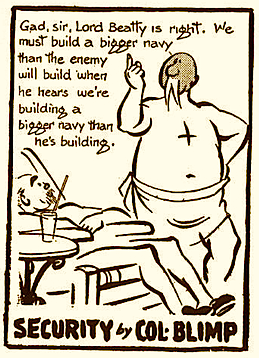
blimp 01The literary careers of C.S. Lewis and George Orwell overlapped in some interesting ways.* Today we will consider a rather odd British personality mentioned by each of them in wartime essays, Colonel Blimp.

Colonel Blimp was a cartoon figure, inspired by a conversation between two military officers who were arguing that “cavalry” officers should continue to wear spurs even when they migrated into tanks.**

At one time the cartoon was so popular that Lewis wrote:

It may well be that the future historian, asked to point to the most characteristic expression of the English temper in the period between the two wars, will reply without hesitation, “Colonel Blimp.” (“Blimpophobia”).

The good colonel echoes similar foolish notions as he blusters about in a caricature of pompous military commanders. Blimp is retired, but harangues all within earshot about the wisest course for the nation.

Orwell wrote derisively of the military and imperialistic middle class, that he called “the Blimps.” He drew the label from the “colonel with his bull neck and diminutive brain, like a dinosaur.” (“The Lion and the Unicorn”).***

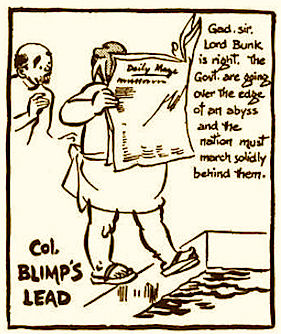
blimp 02The cartoon above illustrates how Colonel Blimp is certain he has the solution to winning the arms race. The frame to the right shows that he believes his wisdom extends beyond the military to politics in general.

Timely Advice from C.S. Lewis

In “Blimpophobia,” Lewis offers advice which proves apropos for our modern age. Today, as fanatical barbarians seek to destroy civilization, enlightened nations and individuals must be vigilant.

One dimension of that vigilance involves walking the fine line between unbridled nationalism and self-absorbed pacifism. When he wrote, Lewis was worried about the anti-war sentiment that threatened to undermine Britain’s response to the Nazis.

Lewis, a wounded combat veteran of the Great War, recognized the truth of the Colonel Blimp caricature. He said something veterans recognize even more clearly than civilians. There is an overabundance of preening and stupidity in the military.

The infection of a whole people with Blimpophobia would have been impossible but for one fact—the fact that seven out of every ten men who served in the last war, emerged from it hating the regular army much more than they hated the Germans. How mild and intermittent was our dislike of “Jerry” compared with our settled detestation of the Brass Hat, the Adjutant, the Sergeant-Major, the regular Sister, and the hospital Matron!

Now that I know more (both about hatred and about the army) I look back with horror on my own state of mind at the moment when I was demobilized. I am afraid I regarded a Brass Hat and a Military Policeman as creatures quite outside the human family.

Still, he said we cannot allow that sad truth to cause us to deny the requirement to maintain a strong defense. “A nation convulsed with Blimpophobia will refuse to take necessary precautions and will therefore encourage her enemies to attack her.”

C.S. Lewis warned his countrymen of the dangers military-phobia during the Second World War. And—among the war-weary nations of the free world battling jihadism—we are wise to heed his wise words today.

The future of civilization depends on the answer to the question, “Can a democracy be persuaded to remain armed in peacetime?” If the answer to that question is No, then democracy will be destroyed in the end. But “to remain armed” here means “to remain effectively armed”. A strong navy, a strong air force, and a reasonable army are the essentials. If they cannot be had without conscription, then conscription must be endured. (C.S. Lewis, “Blimpophobia”).

_____

* In “A Literary Phobia,” I compared some advice they offered to writers. The counsel in question sounds similar on the surface, but actually differs. In “Orwellian Advice,” I contrast the two authors in much greater detail.

** Blimp’s creator, David Low, resided in London but was actually a New Zealander.

*** You can read Orwell’s 1941 essay, “The Lion and the Unicorn,” here.

Autobiographical Lies

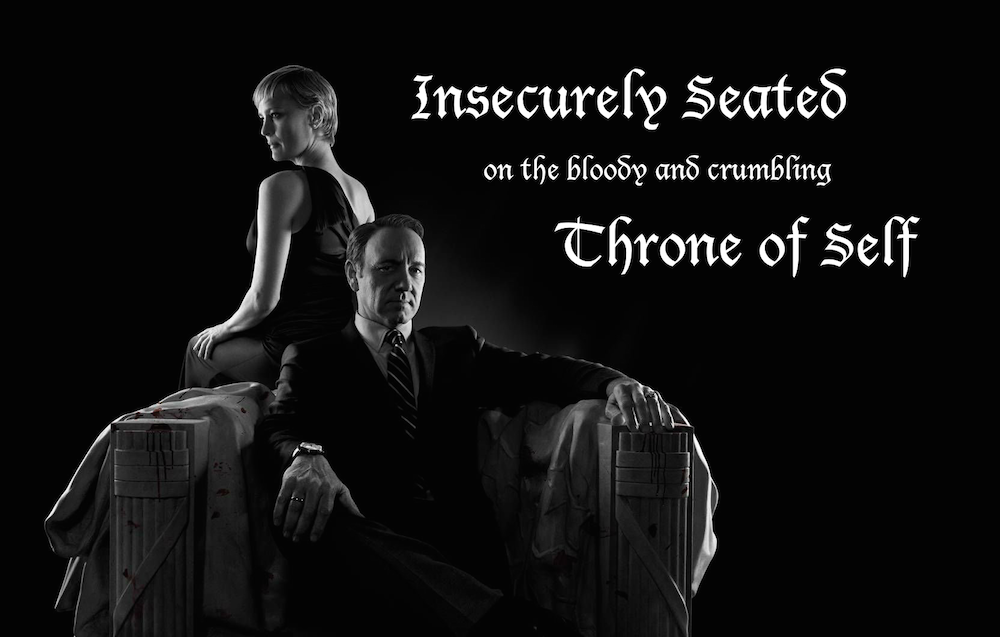
cardsWatching the series House of Cards is not a “guilty pleasure.” It is often a painful exercise in examining just how corrupting, dehumanizing and (ultimately) damning political power can be. The depth of the viewers’ discomfort is a tribute to the perfectly pitched acting and writing.

It’s set in Washington D.C., and I am afraid it is more accurate portrait of that dark political environ than anyone but Mephistopheles could imagine.

Political corruption is not an American problem. It’s a human condition. Sadly, the perversions of power are replicated in capitals around the globe.

House of Cards examines the rise of a particularly evil pair, President Francis Underwood and his wife Claire.* They will stop at nothing—literally, nothing—to sate their shared hunger for power.

President Underwood is so self-consumed that few viewers will identify with his dead soul. On the other hand, he is in many ways an attractive, witty and “charismatic” man. This, of course, is the whitewash over the sepulcher that has allowed his rise to the heights of human dominance.

Despite his moral decay, there are elements of his behavior with which many can relate. I am not referring to his devotion to his wife, which appears noble but is actually a twisted symbiosis.

One way we see how a human being with the potential for true greatness has fallen to such depths comes in small sins. The ones that many of us commit without wasting a “second thought.” Such compromises often lead, as we know from personal experience, to greater transgressions.

Too often, our fall begins with a lie. We see a glimmer of this in the following scene.** The president has enlisted a popular writer to pen his “autobiography.” The author chooses to open the book with a dramatic story about Underwood’s courage and willingness to risk all for a cause.

He relates a story from the president’s youth in South Carolina. He stunned his peers by his commitment to swim all the way out to the famous Fort Sumter, at the mouth of Charleston Harbor. He did not make it the first time, and needed to be rescued by the Coast Guard. However, he tried and tried again, until he defeated the tides and waves, and rose triumphant on the island’s shore.

After the writer reads the stirring account to the president, in a dramatic aside,*** Underwood says to the audience:

I never tried to swim to Fort Sumter. Thomas probably knows I made it up. But he wrote it anyway because he understands the greater truth. Imagination is its own form of courage.

This passage is powerful. It not only displays the impulse for self-aggrandizement to which many powerful people are disposed. It also seeks to justify that compromise with integrity, by transforming the very flaw into a virtue! “Imagination is its own form of courage.” True, but given the context, repugnant.

And that sort of perversion, which had to have seemed a discordant rationale when he originally voiced it, becomes a rule for his life.

I can make up any lie that serves my purpose, because the very act of creating that new “truth” is heroic in itself. In essence, the ends (my accumulation of power), will forever justify the means.

C.S. Lewis on the Lies We Make Our Truths

One of Lewis’ lesser read theological books is The Problem of Pain. The book offers Lewis’ insights into why a loving God would allow suffering. One intriguing feature of the text is its chapter on the suffering of animals, which reveals the breadth of Lewis’ concern as well as his affection for what we now call “other species.”

The following passages suggest that when we tell ourselves the lie—that existence is ultimately about us—we are destined for disappointment. This is the tragedy being staged before our lives in the television series we have been discussing. It can be summarized in the scriptural maxim familiar even to those who never read a Bible: “For what will it profit a man if he gains the whole world and forfeits his soul?” (Matthew 16:26, ESV).

[Humanity] fell. Someone or something whispered that they could become as gods—that they could cease directing their lives to their Creator and taking all their delights as uncovenanted mercies, as ‘accidents’ (in the logical sense) which arose in the course of a life directed not to those delights but to the adoration of God.

As a young man wants a regular allowance from his father which he can count on as his own, within which he makes his own plans (and rightly, for his father is after all a fellow creature), so they desired to be on their own, to take care for their own future, to plan for pleasure and for security, to have a meum [personal possession] from which, no doubt, they would pay some reasonable tribute to God in the way of time, attention, and love, but which, nevertheless, was theirs not His. They wanted, as we say, to ‘call their souls their own.’

But that means to live a lie, for our souls are not, in fact, our own.

They wanted some corner in the universe of which they could say to God, ‘This is our business, not yours.’ But there is no such corner. They wanted to be nouns, but they were, and eternally must be, mere adjectives.

. . .

I have begun with the conception of Hell as a positive retributive punishment inflicted by God because that is the form in which the doctrine is most repellent, and I wished to tackle the strongest objection. But, of course, though Our Lord often speaks of Hell as a sentence inflicted by a tribunal, He also says elsewhere that the judgement consists in the very fact that men prefer darkness to light, and that not He, but His ‘word,’ judges men.

We are therefore at liberty—since the two conceptions, in the long run, mean the same thing—to think of this bad man’s perdition not as a sentence imposed on him but as the mere fact of being what he is. The characteristic of lost souls is ‘their rejection of everything that is not simply themselves.’

Our imaginary egoist has tried to turn everything he meets into a province or appendage of the self. The taste for the other, that is, the very capacity for enjoying good, is quenched in him except in so far as his body still draws him into some rudimentary contact with an outer world. Death removes this last contact. He has his wish—to lie wholly in the self and to make the best of what he finds there. And what he finds there is Hell.

Lewis’ description of his “imaginary egoist” ably fits the fictional President Underwood and his First Lady. Their lives are consumed by self. The fiction derives its power from the reality. The Underwoods are not simple cartoons. They reveal the life choices of real people in our world.

Men and women who have clawed their way onto the throne in their lives, find in the end, that it crumbles beneath them. Only a miracle can rescue them from their terrible chosen destinies . . . and gloriously, that redeeming miracle awaits their cry for mercy, so long as they have breath.

______

* Kevin Spacey and Robin Wright play their tragic characters so well that both have won Golden Globe awards and a variety of other accolades.

** From “Chapter 34,” season three, episode four.

*** An “aside” is a device where a character speaks directly to the audience, revealing some private thought or knowledge. It can easily be overused, but is quite finely tuned in this series. The writers of House of Cards are definitely talented.

Professor Bob Dylan

dylanCan you imagine having singer Bob Dylan as your high school history teacher?

According to a recent interview,* it could have happened.

Still actively touring in his seventies and considered an American musical icon. I was stunned to hear what he said about another path his life may have taken. The interviewer posted the remark this way:

Bob Dylan: His True Calling

“If I had to do it all over again, I’d be a schoolteacher—probably teach Roman history or theology.”

I didn’t realize he and I had so much in common! When I did my undergrad studies in history, I took every Roman history course the University of Washington offered. As for theology . . . well, having become a pastor, my interest in the study of God’s revelation of himself to the world is a given.

Can you imagine Dylan lecturing on apotheosis in the early empire? [Apotheosis is the elevation of a person to godhood, and was a formal event after the death of some emperors. The emperors themselves knew it was a farce, of course. Seneca wrote that emperor Vespasian, on his deathbed, actually said, “Alas, I think I’m becoming a God.”]

Bob Dylan’s interest in spiritual matters is genuine. He has high praise in the interview for Billy Graham. “This guy was rock ‘n’ roll personified. He filled football stadiums before Mick Jagger did.”

In 1979, Dylan released the first of three “Christian” albums, “Slow Train Coming.” It has a number of great pieces, and I listen to the album at least once a month. One song, “Gotta Serve Somebody,” won him the Grammy that year for “Best Male Vocalist.” It’s lyrics are sobering, and everyone should hear it at least once.

And, Speaking of C.S. Lewis

Well, we weren’t actually. But, here at Mere Inkling we usually do.

These two men bear some obvious parallels. They are masters of words. Poets extraordinaire. Lewis and Dylan both possess enviable creative imaginations. Each has accumulated a vast legacy in their work, which will continue to inspire for many generations to come.

I also learned this on the internet—they share the same Myers-Briggs personality type. At least, this site claims they are both INFPs. (I’m an ENTJ myself, a common personality aggregate for pastors.)

And, they had at least one more thing in common. They knew that in this life, there is no such thing as spiritual neutrality. When we ultimately stand before the throne of our Creator, it will not suffice to say, “Well, I didn’t do anything truly evil.”

In a moment we will listen to Dylan’s ballad about the choice before us. First, though, consider how Lewis uses the imagery of the war engulfing the world in the 1940s to describe this truth.

Why is God landing in this enemy-occupied world in disguise and starting a sort of secret society to undermine the devil? Why is He not landing in force, invading it? Is it that He is not strong enough? Well, Christians think He is going to land in force; we do not know when. But we can guess why He is delaying. He wants to give us the chance of joining His side freely. I do not suppose you and I would have thought much of a Frenchman who waited till the Allies were marching into Germany and then announced he was on our side.

God will invade. But I wonder whether people who ask God to interfere openly and directly in our world quite realize what it will be like when He does. When that happens, it is the end of the world.

When the author walks on to the stage the play is over. God is going to invade, all right: but what is the good of saying you are on His side then, when you see the whole natural universe melting away like a dream and something else—something it never entered your head to conceive—comes crashing in; something so beautiful to some of us and so terrible to others that none of us will have any choice left? For this time it will be God without disguise; something so overwhelming that it will strike either irresistible love or irresistible horror into every creature.

It will be too late then to choose your side. There is no use saying you choose to lie down when it has become impossible to stand up. That will not be the time for choosing; it will be the time when we discover which side we really have chosen, whether we realized it before or not. Now, today, this moment, is our chance to choose the right side. God is holding back to give us that chance. It will not last forever. We must take it or leave it. (Mere Christianity).

Now, as promised, “Gotta Serve Somebody.”

_____

*You can read the entire interview in the current issue of AARP The Magazine, available here.