C.S. Lewis & Iran’s Nuclear Program

Connecting C.S. Lewis to the pursuit of nuclear weapons by Iran’s mullahs admittedly sounds like a protracted stretch. Yet the current conflict between Iran and Israel does have one astonishing element that does link the great Oxbridge professor with the conflict.

If you’re familiar with Lewis’ writings, you might logically assume the connection relates to his writing on nuclear weapons. After all, in 1948 he wrote an essay entitled “On Living in an Atomic Age.” The matter is even more acute since we moved from the era of relatively minuscule A-bombs into a time when humanity’s H-bombs, employing fusion rather than mere fission, are thousands of times more deadly.

Lewis discusses some interesting philosophical (and theological) questions in his article. He begins by placing the question within the context of our inherent physical mortality. He writes, “do not let us begin by exaggerating the novelty of our situation.”

Believe me, dear sir or madam, you and all whom you love were already sentenced to death before the atomic bomb was invented: and quite a high percentage of us were going to die in unpleasant ways. . . .

It is perfectly ridiculous to go about whimpering and drawing long faces because the scientists have added one more chance of painful and premature death to a world which already bristled with such chances and in which death itself was not a chance at all, but a certainty.

Don’t let the stoic beginning of his thoughts deter you from reading the essay itself, because C.S. Lewis does not leave us despairing. On the contrary, he offers hope and practical advice for maximizing the meaning of our lives. 

Although C.S. Lewis lived into the beginning of the MAD (Mutually Assured Destruction) era, he chose not to inject himself into political subjects, lest it detract from his advocacy for the simple Gospel.

Nevertheless, the brief note “C.S. Lewis and Nuclear Weapons,”penned forty years ago by a “peace activist” pastor, conjectures on what the author’s opinion may have been. It is thought-provoking, especially in mentioning a possible link between nuclear destruction and the “deplorable word” referred to in The Chronicles of Narnia. 

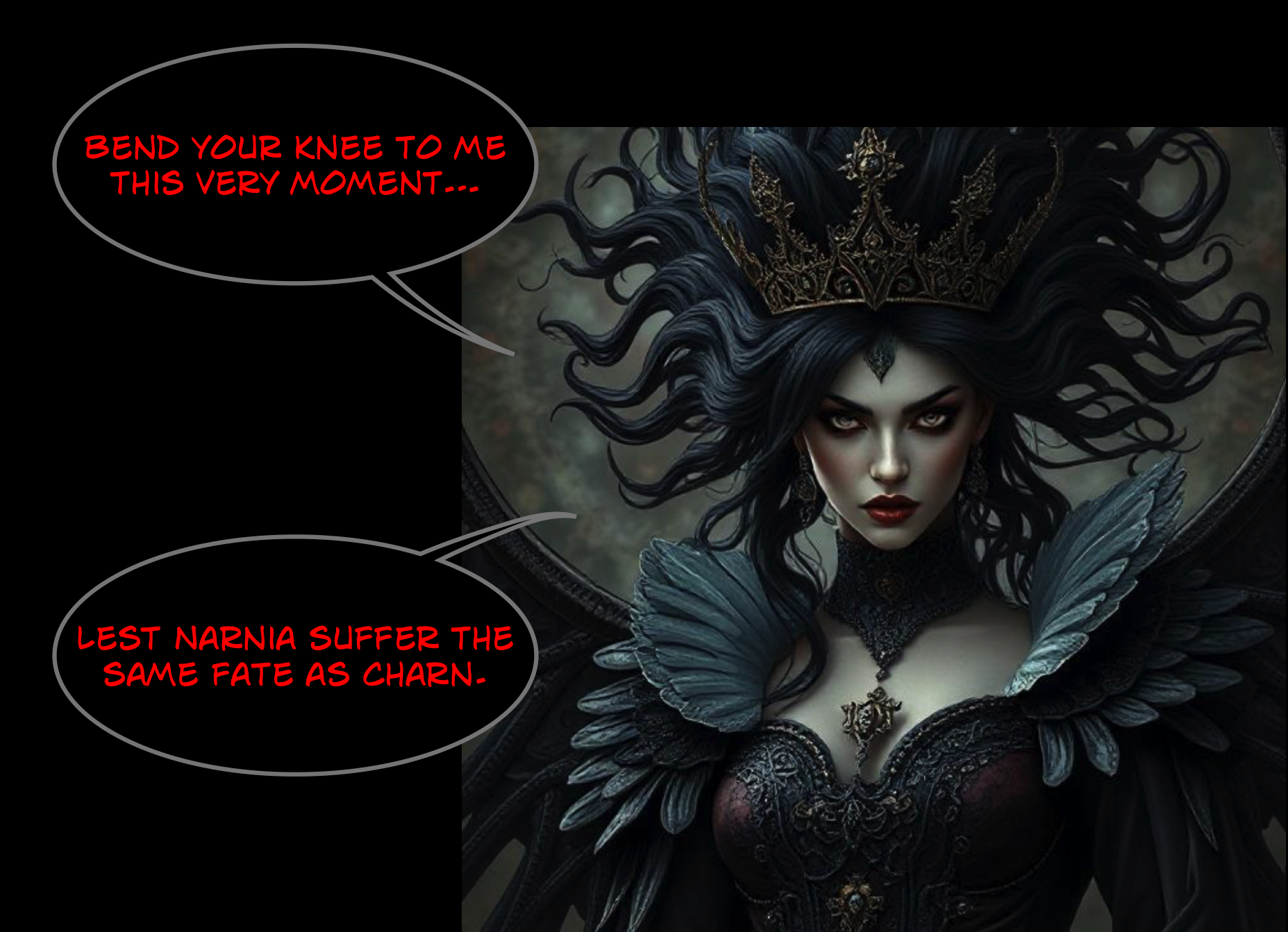
In The Magician’s Nephew, Lewis’ child protagonists encounter a witch queen on the devasted world of Charn. Queen Jadis, when denied the power to rule over the planet, chose to invoke a curse that destroyed every living thing other than herself. “Then I spoke the Deplorable Word. A moment later I was the only living thing beneath the sun.”

While Lewis does not elaborate on the nature of the destructive nature of this most deplorable of powers, Aslan does offer the following caution near the end of the novel.

It is not certain that some wicked one of your race will not find out a secret as evil as the Deplorable Word and use it to destroy all living things. And soon, very soon, before you are an old man and an old woman, great nations in your world will be ruled by tyrants who care no more for joy and justice and mercy than the Empress Jadis. Let your world beware.

So, what does this have to do with Iran & Israel?

Frankly, I find the connection to be especially odd. As you may know, military entities have a propensity to apply nicknames or euphemisms to various things, such as their weapon systems.

This is true for military campaigns or discrete operations. For example, the United States has employed labels like Operation Linebacker (in Vietnam) and Operation Crossroads (for 1946 nuclear weapons tests).

Sadly, Operation Enduring Freedom (in which I personally took part) did not live up to its name. Under the Taliban, Afghanistan has degenerated once again into a primitive morass which abuses its women and children.

A number of distinct operations have taken place during the current war between Iran (and its proxies) and Israel. Operation Rising Lion is Israel’s nomenclature for the various elements of their direct attack on Iran. One independent Jewish news site points out how Benjamin Netanyahu foreshadowed the campaign in May when he said, “the verse in the Tanach that most fits with an existential war? That’s our war – a war of existence . . . A people that rises like a lion, leaps up like the king of beasts.”

Every Israeli military operation has a name, and the Iran attack is now called Am K’lavi, or “a people like a lion” – the exact wording Netanyahu used six weeks ago. English-language publications now refer to the operation as “Rising Lion.”

While this is quite interesting, it is the name assigned to one of the subsidiary operations encompassed by Rising Lion which possesses a genuinely shocking designation.

One initial focus of Israel’s campaign was to eliminate the leading scientists leading Iran’s efforts to pursue a nuclear arsenal. They named this particular facet Operation Narnia.

When I first saw that, I immediately thought I must have misread the title. But no, they actually chose Narnia as the name for the assassinations. At that point I thought they might be referring to some other Narnia. Alas, it doesn’t appear they were alluding to the medieval Italian city whose name inspired C.S. Lewis.

The reason for choosing Narnia as the operation’s title was apparently an intentional reference to the amazing world where so many of us met the awesome and compassionate Aslan. In “‘Operation Narnia:’ How Israeli Intelligence Targeted Key Iranian Nuclear Scientists,” we read:

Israel kicked off Operation “Rising Lion” last Friday, launching a sweeping military assault that dealt a major blow to Iran’s leadership and nuclear infrastructure. . . .

In a surprising detail, the Jerusalem Post reports, the component of the mission aimed at Iran’s nuclear scientists was codenamed “Narnia” by Israeli forces – a reference to the fantasy realm, underscoring how bold and unlikely such a strike might have seemed before it was executed.

Another intriguing rationale for entitling the Operation after C.S. Lewis’ creation is even more provocative. The Substack blog Wardrobe Door proposes a supernatural consideration for the choice of “Narnia.”

The [Jerusalem] Post says the name “reflects the operation’s improbable nature, like something out of a fantasy tale rather than a real-world event.” One could also imagine it involved deep espionage tactics that may have had soldiers sneaking in areas as if through a magical wardrobe.

Whatever tactics may have been used in Operation Narnia, it is intriguing to consider how the power of C.S. Lewis’ vision has spread across national boundaries. May all people heed Lewis’ witness to humanity’s Savior, for surely,

God cannot give us a happiness and peace apart from Himself, because it is not there. There is no such thing (Mere Christianity).
Gathering Palms & Preparing for War

The Christian church has just celebrated Palm Sunday, and I recalled one of my favorite memories in preparing for the journey through Holy Week.

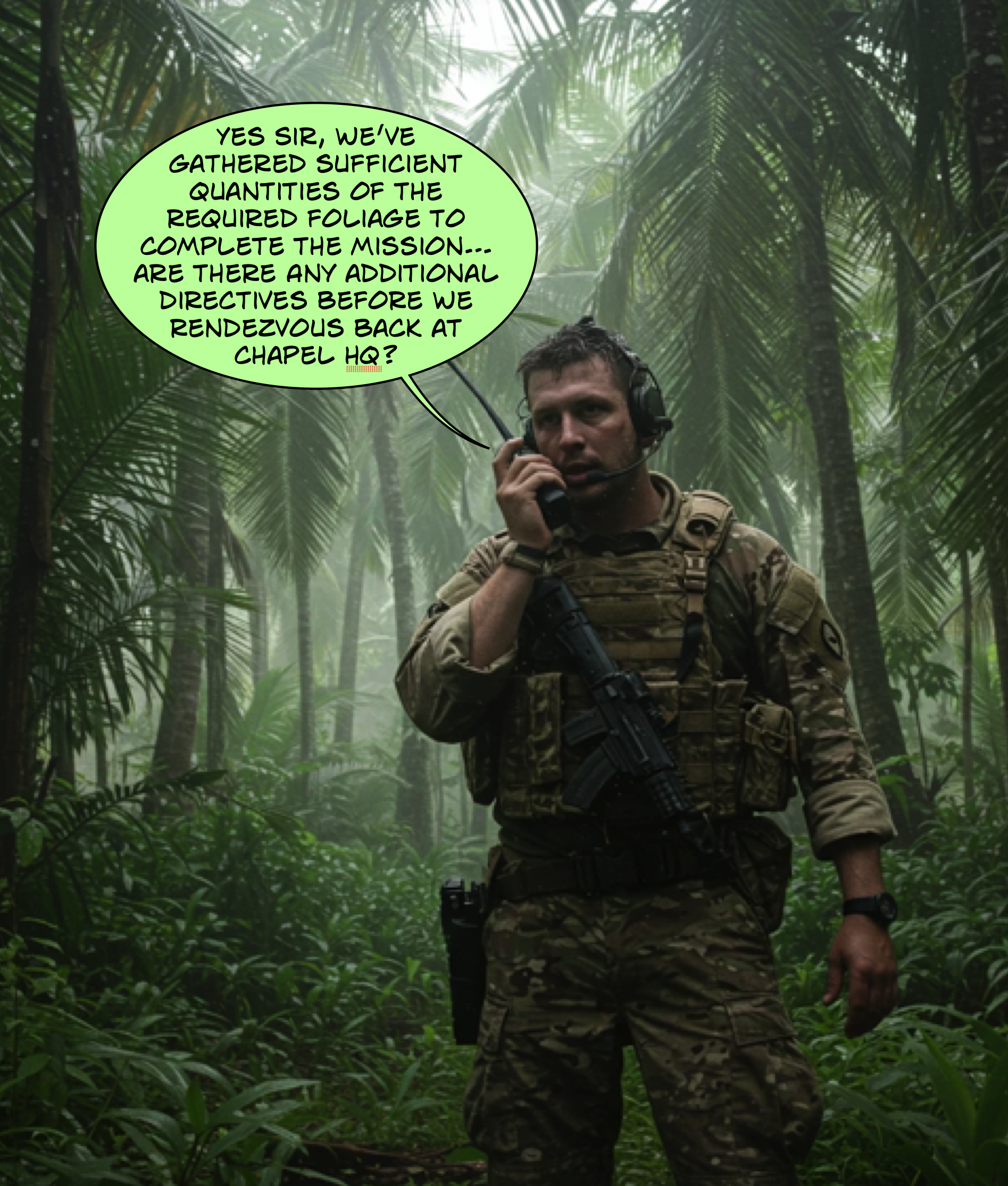
When I was stationed in Guam a few years ago (in the nineties), I enjoyed the annual tradition of gathering all of the palms to decorate the chapel and provide for worshippers in our very own jungle. Each year the chaplains and chaplain assistants, our whole team, would spend half a day gathering leaves that would put to shame any stateside palms.

Taking place in a tropical jungle, the event was sweaty, but fun. Good fellowship and even some seasonal early-Easter music. Fortunately, this didn’t take place during the typhoon season, as when the island was smashed by Super Typhoon Paka during our residency.

Jungles are fascinating places. Because the word possesses some rather ominous and even threatening overtones, a number of years ago they were rechristened “rainforests.” Even though most are tropical, there are temperate rainforests, such as in the Olympic National Forest, whose mountains I admire daily from our backyard.

C.S. Lewis alluded to the negative connotation of jungles in his study of “Vivisection,” with its repudiation of animal cruelty.

In justifying cruelty to animals we put ourselves also on the animal level. We choose the jungle and must abide by our choice.

A Modern Use for Jungles

In recent years, the jungles of Guam have been put to a military use. Unsurprisingly, soldiers and their Marine, Navy and Air Force cousins, must be prepared to do their jobs in a wide range of environments. That results in the existence of a variety of training settings, tuned to the specific needs of particular career fields.

For example, I served as the Wing Chaplain at Fairchild AFB where the USAF trains its pilots and aircrew members how to survive when they find themselves in unfriendly settings. Survival, Evasion, Resistance and Escape (SERE) training saves lives.

Anyway, not long ago the Air Force established a Jungle Agile Combat Employment (JACE) Course in, of all places, Guam.

This new course took knowledge from the U.S. Marine Corps Jungle Warfare Training Center and the Lightning Academy in Hawaii and tweaked it for non-combatant career fields to be prepared under the USAF’s Agile Combat Employment (ACE) concept.

This is part of America’s shift in focus to the threats in the Pacific theater. China has never renounced, and constantly proclaims, its intent to force the Republic of China (Taiwan) into their fascist empire. Of course, the fate of Hong Kong reveals just how unbenevolent the so-called People’s Republic is when it comes to maintaining any semblance of democratic freedoms. 

C.S. Lewis, of course, had much to say about the tragedies of fascism and war. However, that is not the focus of this reflection. Instead, the theme of this post reflects two thoughts. 

The less important idea, to which I have paradoxically devoted the most space, is the value of memories. Guam occupies a very special place in my family’s history, in part because all three of our kids were there during their teens. Lifechanging events occurred there.

And it was the wonderful people, military friends and wonderful Chamorro residents that made the most lasting impressions. Remembering the harvesting of palms, and recently learning about the jungle training course turned my thoughts back to that Micronesian paradise.

What’s Truly Vital

The infinitely more important message in this post is to acknowledge the holiest of seasons in which we find ourselves. Beginning with Palm Sunday’s celebration of the joy experienced by God’s people as they welcomed their Messiah into Jerusalem, we have the opportunity now to also join together with Jesus and our brothers and sisters in the faith as we:
~ commemorate the institution of the Lord’s Supper on Maundy Thursday,
~ contemplate the despair of the disciples as they stood at the foot of the cross as Jesus breathed his last mortal breath on Good Friday, and
~ celebrate in awe and wonder how our Savior rose from the grave and encouraged his disciples before ascending to Heaven and resuming his place at the right hand of God the Father. 

Christ’s atoning death, and his glorious resurrection, give us hope in the depths of our despair. And his promised return ensures us that there truly will come a day when we need never again prepare for war – or ever taste the pain of death.

We do well to heed C.S. Lewis’ encouragement to his friend Don Giovanni Calabria in 1948, when the priest was distraught over the troubles transpiring around the world.

Tomorrow [Easter] we shall celebrate the glorious Resurrection of Christ. I shall be remembering you in the Holy Communion. Away with tears and fears and troubles!

United in wedlock with the eternal Godhead Itself, our nature ascends into the Heaven of Heaven. So it would be impious to call ourselves “miserable.”

On the contrary, Man is a creature whom the Angels – were they capable of envy – would envy. Let us lift up our hearts! At some future time perhaps even these things it will be a joy to recall.

Following C.S. Lewis’ Military Example

Like his friend J.R.R. Tolkien, and many of the British men of their generation, C.S. Lewis served in the grim battlefields of the First World War. (However, since Lewis was actually Irish, he could not be drafted, and instead volunteered to serve.)

In recent years a number of books have appeared related to the military service of the Inklings. In A Hobbit, a Wardrobe, and a Great War, the author introduces his discussion with a succinct summary.

For a generation of men and women, [WWI] brought the end of innocence – and the end of faith. Yet for two extraordinary authors and friends, J.R.R. Tolkien and C.S. Lewis, the Great War deepened their spiritual quest. Both men served as soldiers on the Western Front, survived the trenches, and used the experience of that conflict to shape their Christian imagination. . . .

By the time of the Armistice, more than nine million soldiers lay dead and roughly thirty-seven million wounded. On average, there were about 6,046 men killed every day of the war, a war that lasted 1,566 days. In Great Britain, almost six million men—a quarter of Britain’s adult male population – passed through the ranks of the army. About one in eight perished. Tolkien and Lewis might easily have been among their number.

In 1939, a correspondent inquired if Lewis was going to reassume his commission in the army for the new conflict, and he responded with sentiments I have heard voiced by a number of other combat veterans.

No, I haven’t joined the Territorials. I am too old. It would be hypocrisy to say that I regret this. My memories of the last war haunted my dreams for years.

C.S. Lewis proceeded to graphically explain the cost of serving under such pressure. 

Military service, to be plain, includes the threat of every temporal evil: pain and death which is what we fear from sickness: isolation from those we love which is what we fear from exile: toil under arbitrary masters, injustice and humiliation, which is what we fear from slavery: hunger, thirst, cold and exposure which is what we fear from poverty.

I’m not a pacifist. If it’s got to be, it’s got to be. But the flesh is weak and selfish and I think death would be much better than to live through another war.

A new announcement from the United States’ Department of Defense brought Lewis’ situation to mind. It appears that due to a number of factors – not least of which the emphasis on Diversity, Equity and Inclusion,* which (imo) has discouraged veterans from encouraging their children to serve in the armed forces – some services are repeatedly falling short of their recruiting goals. 

In light of the fact that the world is inarguably growing more dangerous – the Doomsday Clock is set at “90 seconds to midnight” – it is alarming that we are unable to fully staff our shrunken military.

Just today my sixteen year old grandson expressed concerns about the resumption of a draft. I could not muster a persuasive argument that it won’t happen. Ironically, the last time the U.S. involuntarily conscripted troops was 1972, the year I turned eighteen. Oh, in the process of including a link to the Selective Service Sytem, I was surprised to learn that a “Medical Draft is in Standby Mode.” 

It is designed to be implemented in connection with a national mobilization in an emergency, and then only if Congress and the President approve the plan and pass and sign legislation to enact it. . . .

[The plan will] provide a fair and equitable draft of doctors, nurses, medical technicians and those with certain other health care skills if, in some future emergency, the military’s existing medical capability proved insufficient and there is a shortage of volunteers. . . .

[If implemented, the plan will] begin a mass registration of male and female health care workers between the ages of 20 and 45. . . . HCPDS [the innocuously named Health Care Personnel Delivery System] would provide medical personnel from a pool of 3.4 million doctors, nurses, specialists and allied health professionals in more than 60 fields of medicine.

No Draft Yet

Since we are not currently at war, the specter of a draft remains ephemeral. Still, the shortage of volunteers has led to a variety of initiatives, such as lowering service qualification standards. These efforts have proven inadequate, resulting in the aforementioned announcement.

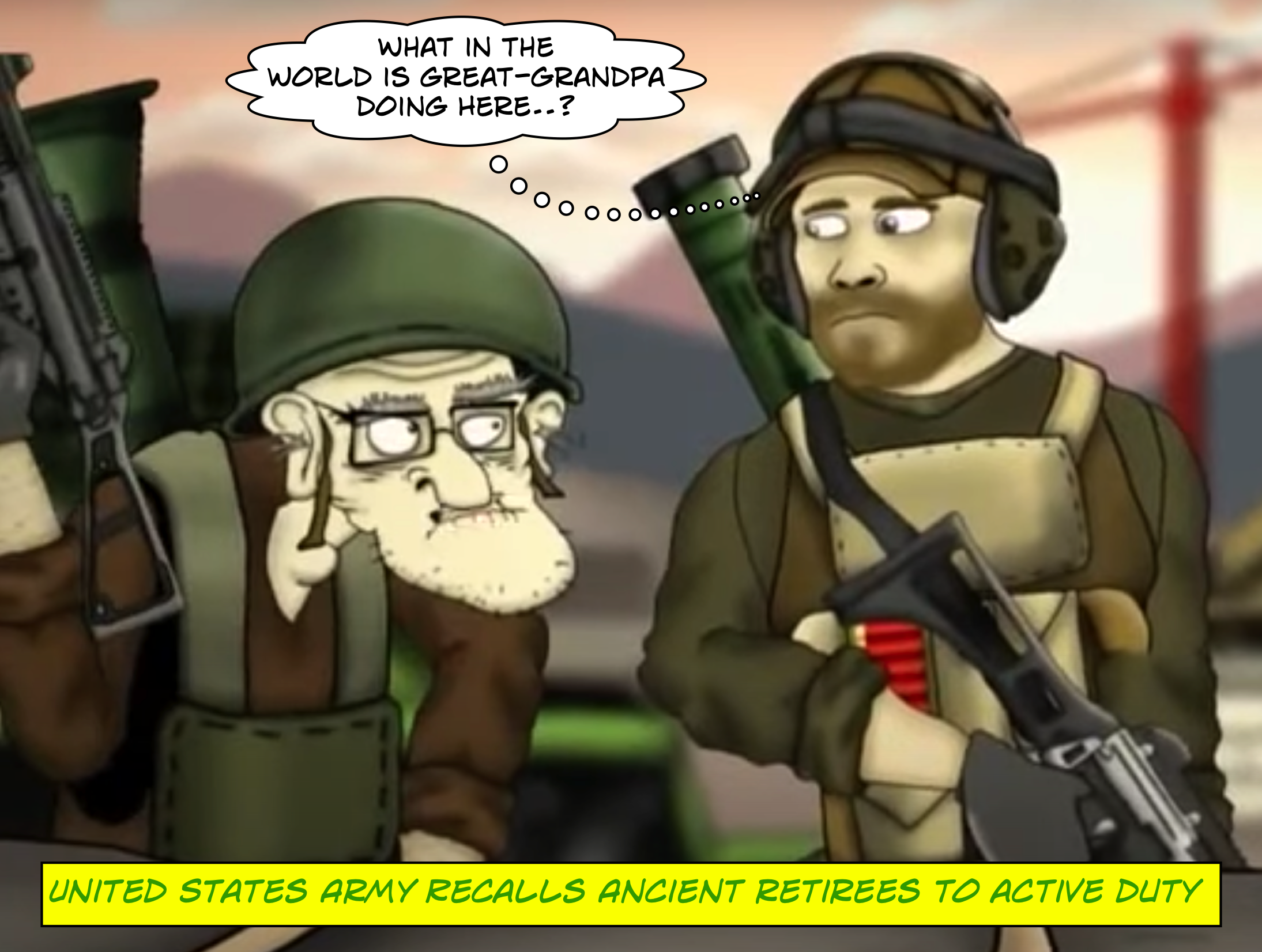
Both the Army and the Air Force have begun Retiree Recalls. Yes, that is just what it sounds like. People who have actually retired from the armed forces, normally after 20+ years of active duty, are being recalled to serve again. 

When I heard this news I was stunned. It is legally possible for the military to recall former members via a tiered process, but the first thing that came to my mind was my favorite high school teacher. He had served in Viet Nam as a draftee and finished his enlistment. He once told me that he felt safe, having survived, because now he was in the same call-up status as a “pregnant nun.” (Rather hyperbolic, but comforting to him.)

Fortunately, the current recalls are all voluntary. Only retirees whose personal circumstances make the offer appealing, will respond. As the Air Force Times reports, “Regret retiring? Here’s your shot at a second chance in the Air Force.”

I suspect that even vets who enjoyed their military service will be inclined to consider redonning the uniform as “too much of a good thing.” And if they witnessed the bloody horrors of war, as seen by C.S. Lewis, returning to the ranks would be even less tempting.

Since I, myself, have no desire to resume the demands of military life, I haven’t researched the age requirements for the Air Force recall program. Like Lewis, “I am too old.” 

But amazingly, depending on individual factors, the Army is willing to recall retired volunteers up to the age of seventy. That’s not a typo. As someone reaching that very milestone this summer, I can’t imagine returning to work side-by-side with troops half a century younger than me. 

Now, I pray for peace, knowing that being prepared for war is one way to increase that likelihood. So, I hope the military can throw off some of its political shackles and return to its necessary focus.

Furthermore, like C.S. Lewis, I have a pragmatic view of the effects of war. In “Learning in War-Time,” Lewis summarized the effects of military service during a war. As always, his insights are profound.

What does war do to death? It certainly does not make it more frequent: 100 per cent of us die, and the percentage cannot be increased. . . . Does it increase our chances of painful death? I doubt it. . . .

Does it decrease our chances of dying at peace with God? I cannot believe it. If active service does not persuade a man to prepare for death, what conceivable concatenation of circumstances would?


* This reference is to the convoluted and inequitable DEI philosophy and program(s) being mandated today. In truth, most people value diversity, and all people of goodwill believe in the importance of equity and inclusion. Along with Martin Luther King, Jr., they long for a day when people are not “judged by the color of their skin, but by the content of their character.”

What is Courage?

We live in an age where our courage matters more than ever. With social, cultural and international relationships all in terrible disarray, facing the future is not for the timid.

Courage is essential for living a life of integrity. Without it, we bend and fold whenever the pressure grows too great. Some people even go so far as to compromise their conscience.

In The Screwtape Letters, C.S. Lewis described how it is only when courage is required, that a person’s true values come into focus.

Courage is not simply one of the virtues, but the form of every virtue at the testing point, which means, at the point of highest reality.

A chastity or honesty or mercy which yields to danger will be chaste or honest or merciful only on conditions. Pilate was merciful till it became risky.

Samuel Johnson, an eighteenth century English writer, was highly esteemed by C.S. Lewis. His words on this subject foreshadow Lewis’ own thoughts. “Courage,” according to Johnson, “is the greatest of all virtues, because if you haven’t courage, you may not have an opportunity to use any of the others.”

Two millennia earlier, an influential Greek philosopher described this same truth. Aristotle, who did not look to the Greek pantheon for inspiration, also deduced that courage is a necessary attribute for the virtuous.

You will never do anything in this world without courage. It is the greatest quality of the mind next to honor.

Examining Ourselves

As a boy, I used to imagine myself playing heroic roles. These often involved rescuing innocent people from barbarians or tyrants, often in ancient settings. As a man I shed those imaginations and pondered realities. In the military, I witnessed courage up close, and I became persuaded that Mark Twain was correct when he declared “Courage is resistance to fear, mastery of fear, not absence of fear.”

True courage is not found in the cloying display of heroics, especially when arising from an ignorance of genuine danger. Neither is simple risk-taking an evidence of courage, since it may merely be the mark of an adrenaline junkie

I haven’t personally been confronted with many situations which required physical courage, and when I have, I’ve been tempted to feel a little like I was “pretending.” But then I recall that truly courageous men and women also need to overcome their fear.

And, I honestly suspect that even those who have done the most selfless and courageous things possible, also recognized their limits. They ventured forth because they were truly courageous, not because they lacked fear. This is precisely what happened in a garden on Jerusalem’s Mount of Olives called Gethsemane.

Although encounters with physical dangers have been rare, my courage has been tested numerous times in the service of maintaining my integrity. I can recall a number of academic, professional, and personal occasions where standing for truth came at a very real cost. And, who knows how many times to which we are oblivious, that enemies have wished (and worked) us ill, because we did not surrender to their coercive manipulations.

Happy are those – I am sure Lewis, Johnson, Aristotle and Twain, would agree – who do not compromise their convictions. It appears that courage is a matter of character, not of the moment.

Two uplifting insights provide a fitting end to our meditation on this subject. While the courageous sometimes feel like they stand alone, Billy Graham reminds us of an encouraging fact.

Courage is contagious. When a brave man [or woman] takes a stand, the spines of others are often stiffened.

And, C.S. Lewis’ dear friend J.R.R. Tolkien provides us with another keen observation. In The Fellowship of the Rings, an elf named Gildor protects the hobbits at the outset of their journey, and observes, “courage is found in unlikely places.” Indeed, it is.

It may even be found in us.

A More Peaceful Time

It seems like a dream, when I recall a college course I took where Jews and Muslims peacefully discussed the turbulent history of the Middle East. And how we discussed that sad story in a cordial, and even sympathetic, manner.

The contrast between that day and 2023 – when people cannot even agree that tiny infants should not suffer for the sins of their parents – is mind-bending.

We assume that all people desire peace. Would that it were so. In his essay “First and Second Things,” C.S. Lewis offers a timely insight.

As far as peace (which is one ingredient in our idea of civilization) is concerned, I think many would now agree that a foreign policy dominated by desire for peace is one of the many roads that lead to war.

I was an undergrad at the University of Washington in the mid-1970s, when I saw a graduate level course with a fascinating title: “Wars that have Shaped the History of the Middle East.” My high school friend and I “begged” the professor to allow us into the class. He cautioned us that he would have the same requirements for us as he did for everyone else; there would be no mercy extended if we failed to meet the syllabus’ demands.

“No problem,” we said . . . although, being young procrastinators, at the end of the quarter we foolishly required a couple of all-nighters to complete our comprehensive term papers.

We, both Christians, were the only undergraduates in the small class. Our professor was Jewish, as were two of the students. One of these, was Israeli. He was, in fact, a veteran of the recent Yom Kippur War, during which he had served as the commander of a tank. I don’t recall which front on which he fought, but when you look at a map of Israel, it’s clear that every part of that small nation is a potential combat zone.

The remaining members of the class consisted of three Muslim students. One was American and a second was Iranian (back when the Shah was still in power). The third Islamic member of the class taught at a Seattle community college. He was Palestinian. And not merely Palestinian – his family was displaced during the 1948 Arab-Israeli War, which is referred to by the Israelis as the War of Independence.

You can imagine that with a group like that, opinions were deeply entrenched. Yet, although the preexisting opinions were indeed fixed, the individuals were not obstinate. Conversations were civil. Disagreements were conducted with reason rather than emotion. And, most surprisingly of all, we were able to socialize together at the end of the course.

It was a different world, apparently. It’s challenging to conceive of partisans today being capable of treating others with such respect. The last half century has marked a steep decline in the humanity of humanity.

Anti-Semitism is a Curse

It is strange to ponder how we’ve come to define antisemitism, confining it to anti-Jewish sentiment. After all, the word Semite refers to all people who speak a Semitic language, including Arabs.

Etymologically, Semite “comes via Latin from Greek Sēm ‘Shem,’ son of Noah in the Bible, from whom these people were traditionally supposed to be descended.”

If you are interested in an excellent article titled “C.S. Lewis’s Anti-Anti-Semitism in The Great Divorce,” simply follow the link embedded here.

Israel’s Wars

There has been no shortage of blood shed on the land the Romans called Judea and Arabia Petraea. And the history of the past seventy-five years have been violent indeed. For a description of all of the wars and military operations involving Israel, see this website.

We students each had to select one of the Middle Eastern regional wars to research in depth. We also had to make a detailed presentation and lead the discussion based on general readings completed by everyone.

As soon as I saw that requirement in the syllabus, my mind was mired in confusion over which of Israel’s wars would be the least controversial. Fortunately, as I read further I discovered that the purview of the course did not begin with the end of the Palestine Mandate, which was administered by Britain. Due to the influence of the Ottoman Empire, which had overshadowed the region until the end of the First World War, the professor elected to begin the course with the relatively nonconfrontational consideration of the Crimean War. I was the first student to raise my hand and voice my preference.

During the Palestine Mandate, C.S. Lewis had a number of former students serving in the Levant. In a 1940 letter to his brother Warnie, he describes a pleasant visit from one of these who went on to serve in a political capacity throughout the region for several more decades. This statesman refers to a fellow student who would go on to teach at East Anglia University.

I had a visit one night last week from Pirie-Gordon back from leave from Palestine, where (and in Egypt and Turkey) he says everything is “as good as gold.” The last riot was quelled by the cavalry regiment in which Rivière serves . . . In fact as P.G. said “I raised the riot and Rivière quelled it.”

I wonder how the members of the class would relate to one another if we were reunited for a discussion of what has transpired since 1975. With members of the American government at each other’s throats on our nation’s response to Hamas’ war, I doubt our discussions would be as respectful as they were back in the twentieth century. Still, conversations – even painful ones – need to happen if people are ever to get along with one another. That’s true not only for nations, but also for neighbors, and families.

I recommend two things to move us in the right direction. Honest communication, where we do a lot of listening. And prayer. The fact we do so poorly with the first, makes the second all that more essential.

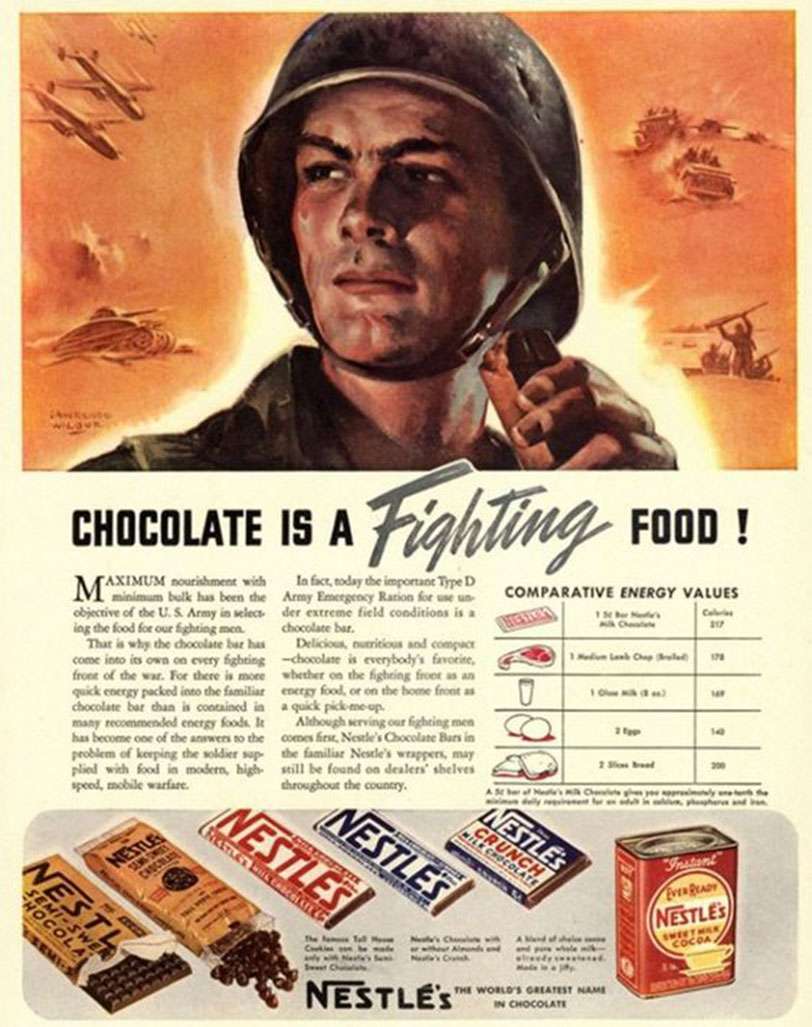
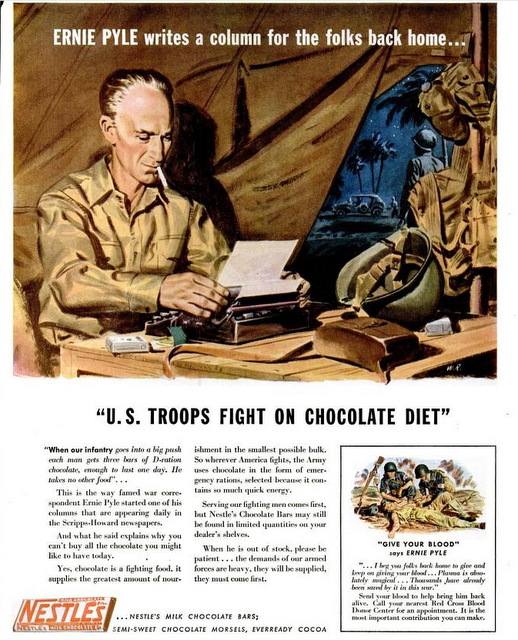
Chocolate Fuels Armies

“An army marches on its stomach.”* Military leaders have long recognized that it is difficult to arouse soldiers weakened by deprivation. Sadly, though, even a king of Israel could be foolish enough to ignore that and order his soldiers to fast before a battle.

While logisticians rarely receive the accolades of their peers who serve directly in combat, they have always been vital members of successful military ventures.

While they are concerned with securing and transporting all requirements, such as ammunition and medical supplies, there is a single necessary requirement for all campaigns. Without sustenance, soldiers will desert the flag and even the most steadfast will fall.

Nutritional value is the first priority. Palatability has historically been a distant afterthought. This has given rise to innumerable jokes made by veterans about the “combat rations” provided to them. While these “menus” have vastly improved in recent years, they remain fodder for much humor.

And even the most delicious food choices become monotonous when they are limited to a small range. In 2002, I visited a remote military detachment supplied with adequate pallets of Meals Ready to Eat, but begging for variety. They had hundreds of meals available, but only two or three different meal options! Civilians, in contrast, can readily purchase a far wider range of entrees.

During the Second World War, the United States invested major efforts in making the combat meals more appealing. Various candies found their way into K-rations, in addition to necessities like toilet paper and cigarettes. In a comprehensive overview of the history of rations, the U.S. Army Quartermaster Foundation points to the main reason for complaint during WWII.

Like other unpopular items, misuse was a contributing factor to the waning popularity of the K ration. Although designed to be used for a period of two or three days only, the ration occasionally subsisted troops for weeks on end. . . . Continued use reduced the acceptability and diminished the value of the ration.

Adding confectionaries to rations made the meals more welcome. Chocolate was always a favorite, but the initial American versions left much to be desired.

My research was, in fact, prompted by a recent post on “Chocolate in WWII” in Pacific Paratrooper. (It is one of the very best military blogs on the internet.) They describe how the military approached a major American confectioner with a simple list of requirements (the last one is best appreciated by older veterans).

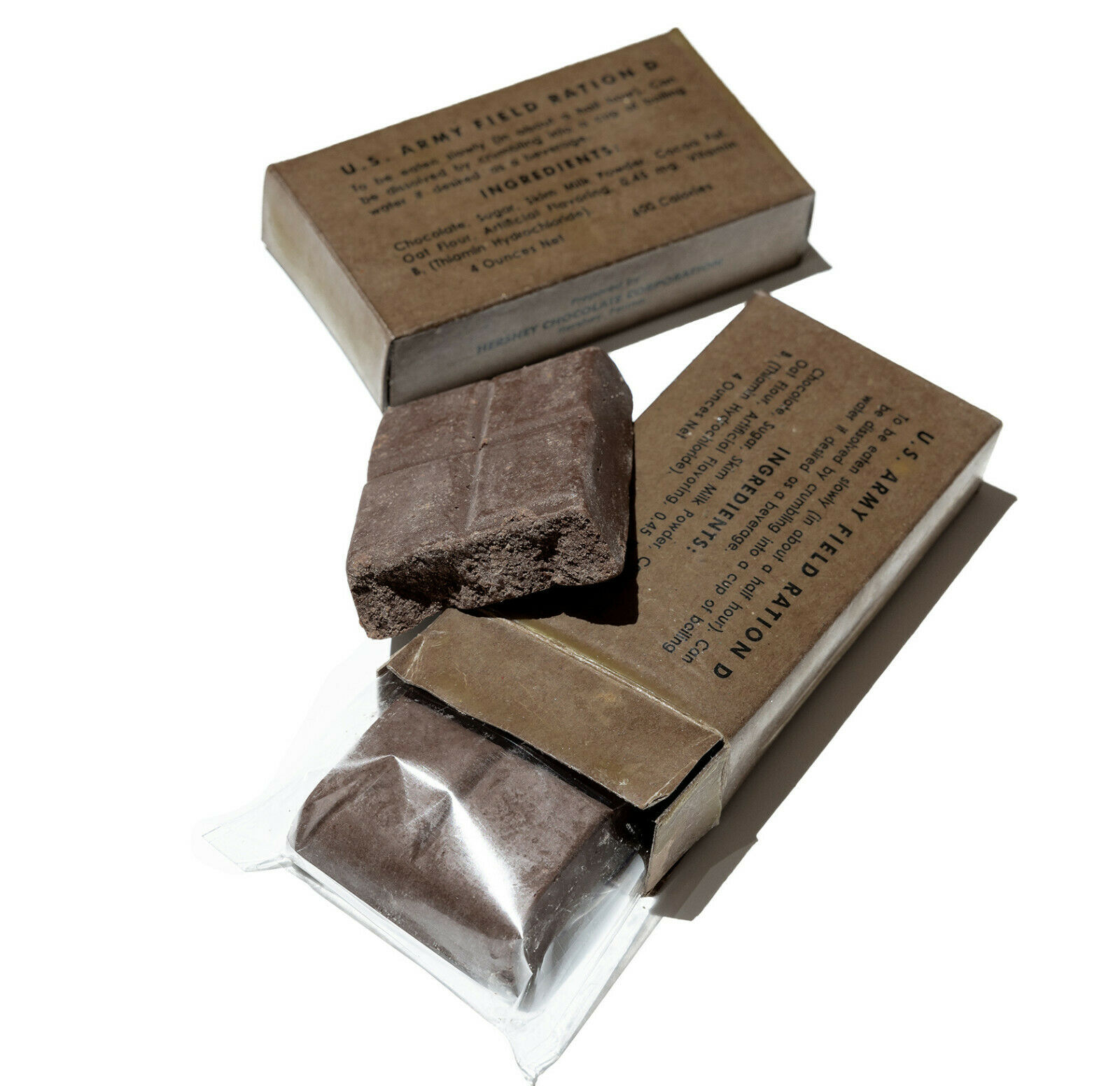
The Hershey Chocolate company was approached back in 1937 about creating a specially designed bar just for U.S. Army emergency rations. According to Hershey’s chief chemist, Sam Hinkle, the U.S. government had just four requests about their new chocolate bars: (1) they had to weigh 4 ounces; (2) be high in energy; (3) withstand high temperatures; (4) “taste a little better than a boiled potato.”

Sadly, many “who tried it said they would rather have eaten the boiled potato.” Well, it was the thought that counted, right?

There is a legend that during the war a German officer was confronted with American desserts and determined that the abundant resources of the United States signaled doom for the Nazi cause. The story likely has a fictional origin.

In the 1965 film Battle of the Bulge, Wehrmacht Colonel Hessler, shows his commanding general a treasure confiscated from American soldiers.

Hessler: “General, before you go, may I show you something?”

General: “What is it?”

Hessler: “A chocolate cake.”

Kohler: “Well?”

Hessler: “It was taken from a captured American private. It’s still fresh. If you will look at the wrapping, general, you will see it comes from Boston.”

Kohler: “And?”

Hessler: “General, do you realize what this means? It means that the Americans have fuel and planes to fly cake across the Atlantic Ocean. They have no conception of defeat.”

C.S. Lewis & Rations

Military rations during the First World War were more primitive than those provided twenty years later. One difference for the British is that they were granted a half gill of rum (or a pint of porter) each day.

This alcohol distribution was at the discretion of the commanding general, which meant that it was not available in the trenches. This was in the spirit of the American “General Order Number 1,” which typically applies to alcohol, and sometimes prohibits its presence throughout an entire theater. (I can personally attest to the ability of some elements, such as Special Ops, to circumvent such restrictions.)

C.S. Lewis wrote with some frequency about the rationing endured by the British public, during and after the world wars.⁑

Unfortunately, I’ve only uncovered one Lewisian reference to his own experience with military cuisine. In a 1917 letter to his father, he reveals that meals were not always appealing, even during training, prior to deploying to the war zone.

First of all came the week at Warwick, which was a nightmare. I was billeted with five others in the house of an undertaker and memorial sculptor. We had three beds between six of us, there was of course no bath, and the feeding was execrable.

The little back yard full of tomb stones, which we christened ‘the quadrangle,’ was infinitely preferable to the tiny dining room with its horse hair sofa and family photos.

When all six of us sat down to meals there together, there was scarcely room to eat, let alone swing the traditional cat round. Altogether it was a memorable experience.

A Hobbit, a Wardrobe, and a Great War describes how WWI affected C.S. Lewis and J.R.R. Tolkien. After relating a passage following Miraz’s defeat of Caspian’s force, when the momentarily defeated were “a gloomy company that huddled under the dripping trees to eat their scanty supper,” the author observes:

The military blunders, the fruitless acts of bravery, the bone-chilling rain, the meager rations: there were many days and nights just like these along the Western Front. Imaginary beasts aside, such scenes could have been lifted from the journal of any front-line soldier.

Like Tolkien, though, Lewis includes these images not for their own sake, but to provide the matrix for the moral and spiritual development of his characters . . .

Rations in Ukraine

Although the eyes of the world are riveted today on the war in Ukraine, there are currently 110 armed conflicts being monitored by the Geneva Academy. However, since Ukraine is in the news daily, it is worth noting both modern armies are employing military rations.

Apparently, Ukrainian troops have great Meals Ready to Eat (MREs). “Most importantly, when making, eating, or even talking about the food, the men seem to be genuinely happy.” The MRE link in this paragraph contains the details, including the note that “among the contents, you’ll find a small packet of dried apricots and a dark chocolate bar.”

There is also a vendor on ebay who sells what are purported to be captured Russian supplies, including a confiscated chocolate bar. The candy appears to be conventionally purchased, but could be part of an illicit chocolate conspiracy finding its way to the Russians from Latvia. “The Russian confectionery company ‘Pobeda’ ПОБЕДА has been producing chocolates, truffles, waffles and other types of sweets for more than six years in Ventspils, via a Latvian subsidiary.”

A month ago in Russia, “Pobeda” received thanks from an organization called the “Battle Brotherhood” for the fact that since the beginning of the Ukrainian war, the company has sent at least 15 tonnes of its products to Russian soldiers.

Chocolate does indeed appear to fuel armies. For a fascinating article on how chocolate can also be used to promote propaganda, check out this Ukrainian site.

Russian propaganda continues to dehumanize Ukrainians with the help of outright fakes.

Another “proof” of our apparent bloodthirstiness was the image of a chocolate bar with a remarkable name “Death of Alyoshka.” A portrait of a boy in a helmet with a mourning ribbon is placed on the wrapper of the confectionery. Propagandists claim that Ukrainians wish Russian children dead.

Become an MRE Connoisseur

If you are curious about the contents of various international MREs that are available for purchase by civilians, visit MREmountain, which began “in 2017 when people discovered the hobby of trying army rations.”

Most veterans, I suspect, would find the “hobby” of eating military rations rather peculiar. But then again, you can check out the French options, which the site labels “The best MRE in the world.” Only there, I imagine, could one discover “meals not found in any other MRE like Kebob Meatballs, Duck Confit, Deer Pate, Wild Boar.”

And, of course, France’s 24-hour ration also includes chocolat müesli, chocolate biscuits, five snack bars (at least one of which is pure chocolate), and a hot cacao packet. Yummy. It appears that les Français also consider chocolate to be a staple of modern soldiers.


* This quotation has been attributed to Napoleon and Frederick the Great. Whatever its modern origin, it is obvious starvation and its frequent companion, disease, have crippled as many armies as blade and shot.

⁑ “Mock Goose and Other Dishes of the War-Rations Diet” offers some interesting thoughts on this subject.

The Church at War

Why would Christian Scriptures commend people for waging war? War, after all, is nearly universally condemned – even as it remains a relentless curse in various corners of our world.

One young pastor was “charged” with a duty that belongs, by biblical extension, to all believers. “This charge I entrust to you [that] you may wage the good warfare, holding faith and a good conscience” (1 Timothy 1).

The reason followers of Jesus are encouraged to actively train for and engage in war is because our enemies are not other human beings. We discussed this fact in our last conversation, as we considered the theological concept of the Church Militant.

To call the Body of Christ “militant” is misleading to those who don’t understand spiritual warfare, the fact that “we do not wrestle against flesh and blood, but against . . . the cosmic powers over this present darkness . . .” (Ephesians 6).

Unfortunately, because all of us are imperfect (i.e. fallen), Christians can sometimes fail to distinguish between our true enemies and those who witlessly follow their banner. For an excellent discussion of this, from a Roman Catholic perspective, I recommend you read “The Church Militant or the Church Belligerent?

Another worthwhile read is “G.K. Chesterton and the March of the Church Militant.” There, Joseph Pearce shares Chesterton’s vivid description about how Gothic cathedrals visualize the martial aspect of the Christian Church.

The truth about Gothic [architecture] is, first, that it is alive, and second, that it is on the march. It is the Church Militant; it is the only fighting architecture.

All its spires are spears at rest; and all its stones are stones asleep in a catapult. In that instant of illusion, I could hear the arches clash like swords as they crossed each other. The might and numberless columns seemed to go swinging by like the huge feet of imperial elephants.

The graven foliage wreathed and blew like banners going into battle; the silence was deafening with all the mingled noises of a military march; the great bell shook down, as the organ shook up its thunder.

The thirsty-throated gargoyles shouted like trumpets from all the roofs and pinnacles as they passed; and from the lectern in the core of the cathedral the eagle of the awful evangelist crashed his wings of brass (“The Architect of Spears”).

As a master of words and wit, Chesterton’s writing rarely disappoints. You can download a free copy of The Man Who was Chesterton, which includes this essay, from Internet Archive.

C.S. Lewis did more to equip us for spiritual warfare with The Screwtape Letters than a thousand clergy with a hundred thousand sermons. As one Baptist theologian summed it up in an article about spiritual warfare:

On the subject of spiritual warfare, Lewis is a helpful guide. I’ll remember what he taught: There is an enemy. He seeks my destruction. And this is war.

There is a brilliant quote about this supernatural confrontation, ascribed (apparently in error) to the historical Martin Luther.

If I profess, with the loudest voice and the clearest exposition, every portion of the truth of God except precisely that little point which the world and the devil are at that moment attacking, I am not confessing Christ, however boldly I may be professing Christianity.

Where the battle rages the loyalty of the soldier is proved; and to be steady on all the battle-field besides is mere flight and disgrace to him if he flinches at that one point.

C.S. Lewis echoes this sentiment in The Magician’s Nephew. When Aslan questions the humble man whom he would crown the first King of Narnia, he poses a query which reveals the man’s courage and humility.

“And if enemies came against the land (for enemies will arise) and there was war, would you be the first in the charge and the last in the retreat?”

“Well, sir,” said the Cabby very slowly, “a chap don’t exactly know till he’s been tried. I dare say I might turn out ever such a soft ’un. Never did no fighting except with my fists. I’d try – that is, I ’ope I’d try – to do my bit.”

“Then,” said Aslan, “you will have done all that a King should do.”

If anyone would follow Christ, neutrality is not an option. Though some temporary retreats are inevitable, in God’s strength, we are empowered to continue our (in reality, the Lord’s) advance.

The battlelines are drawn, and they are real. As C.S. Lewis proclaimed in “Christianity and Culture” – “There is no neutral ground in the universe. Every square inch, every split second is claimed by God, and counterclaimed by Satan.”


The image above, “Livonian Sword Brother” (a member of a military monastic order) was created by JLazarusEB and is used here in compliance with the Creative Commons CC BY-NC-ND 3.0 License.

Thoughts on the Church Militant

C.S. Lewis understood better than most the spiritual warfare that rages, unseen for the most part, around all human beings.

And, as veterans of the bloody trenches of the First World War, Lewis and his good friend J.R.R. Tolkien had learned more than they desired about the tactics and sheer violence of combat.

Many of those wartime lessons translated directly into a spiritual context. However, I recently realized how poorly the concept of immobile trenches relates to our challenge to take up our crosses and follow our Savior.

You see, the Christian life is many things, but there is one thing discipleship never is – static. As theologian Tilemann Heshusius (1527-1588) wrote: “Christian soldiers always either advance or retreat.”

In battle there is nearly always an ebb and a flow, as forces advance on one front and temporarily shift back on another. In his essay “The World’s Last Night,” C.S. Lewis observes “In battle men save their lives sometimes by advancing and sometimes by retreating.” The same is true for the Christian life in general. We are either advancing, or falling back. Our relationship with God is not stagnant.

The New Testament includes many military metaphors and allusions, intended to equip us for victory in our spiritual battles.

The Apostle Paul refers to believers as “fellow soldiers.” In a letter to a young pastor, he extols the model of the soldier, who keeps his focus on the mission.

Share in suffering as a good soldier of Christ Jesus. No soldier gets entangled in civilian pursuits, since his aim is to please the one who enlisted him.

Then there is the familiar passage which uses the image of the “whole armor of God” to describe in detail how Christians are to be prepared for faithful service. You can read the entire passage here.

These military accoutrements are necessary because “we do not wrestle against flesh and blood, but against the rulers, against the authorities, against the cosmic powers over this present darkness, against the spiritual forces of evil in the heavenly places” (Ephesians 6:12).

This is the reason one aspect of the Christian Church’s nature has been described as the “Church Militant.” This describes the Church battling evil while awaiting Christ’s return, for the Final Judgment, when it will become the “Church Triumphant.” The former is the context for familiar hymns such as “Onward Christian Soldiers,” composed by a prolific Anglican priest in the nineteenth century.

Onward, Christian soldiers,
   marching as to war,
With the cross of Jesus
   going on before!

Christ, the royal Master,
leads against the foe;
Forward into battle,
see his banner go!
     . . .

At the sign of triumph
   Satan’s host doth flee;
On, then, Christian soldiers,
   on to victory!

Hell’s foundations quiver
   at the shout of praise;
Brothers, lift your voices,
   loud your anthems raise.

The WWI trenches are the archetype of static, immobile frontlines. Disease festered, and morale decayed like the muck sucking at the soldiers’ boots. As recognized by sixteenth century theologians and C.S. Lewis alike, wars are rarely won simply by maintaining a defensive position. Movement is an essential element of warfare.

Hopefully more of that movement consists of advances against the enemy, than retreats. But we will consider that aspect of spiritual war in our next post.

Until Then

Those interested in learning more about military strategy, particularly as explored by another veteran of the War to End All Wars, Sir B.H. Liddell Hart,* like Lewis and Tolkien, returned home to Britain from the front lines, as a casualty. (Britannica states more than a third of the British forces became casualties, in contrast to 76% of Russians, 73% of French, and 8% of Americans.)

Liddell Hart’s wisdom extends beyond the battlefield itself.

The downfall of civilized states tends to come not from the direct assaults of foes, but from internal decay combined with the consequences of exhaustion in war (“The Objective in War,” a lecture delivered in 1952 to the United States Naval War College).


* Sir Basil Henry Liddell Hart (1895-1970) was a military historian and theoretician. A number of his works are in the public domain and available for free download from Internet Archives. These include A Greater than Napoleon, Scipio Africanus and Why Don’t We Learn from History?

Keeping the Peace, Finn Style

The war in Ukraine trudges on, but the world has become safer with the imminent expansion of the North Atlantic Treaty Organization (NATO).

Recognizing the expansionist aspirations of Dictator Putin’s Russia, Sweden and Finland have decided to request formal admission to the peacekeeping alliance. Their reception has tentatively been approved, although just today another dictator, Recep Tayyip Erdogan of Turkey is threatening to “freeze” them out if they don’t support his efforts to suppress Kurdish independence.

I have my own experiences with NATO. Foremost among them was the small part I played in helping bring about the Intermediate-Range Nuclear Forces Treaty. (I even served as one of the “escort officers” for a Soviet verification team when it visited RAF Greenham Common.)

I mentioned the treaty on Mere Inkling and lauded its success.

The great thing about NATO’s cruise missiles is that they were deployed to bring the Soviet Union to the negotiating table, where the Intermediate Nuclear Forces Treaty led to the elimination of all such munitions from Europe!

Alas, this monumental treaty has expired.

It is a casualty of Russian Federation dreams to restore the Soviet Union’s former borders in Europe. Combined with the “defection” of the former Warsaw Pact nations, it is easy to understand why a suspicious Russia postures so aggressively.

Which, of course, encourages the democratic nations to draw closer in mutual defense.

How are the Finns Celebrating

Finns are different.

Not quite what you would expect. Many people – certainly most Americans, the ones who are not totally geographically ignorant – mistakenly think Finland is a Scandinavian country. Not quite. True, they are a Nordic nation, but Nordic Perspective offers an insightful discussion, replete with great maps, on the subject.

Being a Nordic people, it comes as no surprise many Finns are welcoming their entry into NATO with a beer. In fact, a brewing company named “Olaf” has opted to use the French acronym for NATO – OTAN – as a play on words. “The beer’s name is a play on the Finnish expression ‘Otan olutta,’ which means ‘I’ll have a beer…’”

Good for them. (So long as they remember to drink in moderation.)

Now, this OTAN-business raises a question in my mind. Is it merely a coincidence, or might the French have a passive aggression purpose in mind with this heteropalindrome?

After all, the headquarters of NATO had to be moved from Paris to Belgium when Charles de Gaulle withdrew from the military alliance.

Wondering about French subliminal messages got me thinking about C.S. Lewis’ thoughts on the subject. Lewis loved all people, but was no one’s fool. He understood many of the influences exerted upon culture are destructive. Decadent societies (e.g. pre-war Berlin) sow seeds that ultimately bear tragic fruit.

As the Second World War was just beginning, and Lewis’ brother Warnie had safely returned home after the Dunkirk evacuation, Lewis mentioned France in one of his 1940 letters to his veteran brother. It is quite entertaining, as long one is not an über-Francophile.

I am also working on a book sent me to review, Le Mystere de la Poesie*by a professor at Dijon, of which my feeling is “If this is typical of modern France, nothing that has happened in the last three months surprises me” – such a mess of Dadaists, Surrealists, nonsense, blasphemy and decadence, as I could hardly have conceived possible.

But one ought to have known for, now that I come to think of it, all the beastliest traits of our intelligentsia have come to them from France.

Well, that’s enough of that. It’s time to pop the tab on an OTAN and toast the NATO, and its expanding protection of world democracies.


* Volume two of The Collected Letters of C.S. Lewis has a footnote reading “This work cannot be traced.” I believe the likely object of Lewis’ disdain may have been written by André Vovard and published in 1951 in Paris and Montreal by Fides.

Ukrainian War Poetry

In the heat of war, bullets are not the only weapons piercing the air. Words too are wielded as weapons. And some of those martial messages take the form of poetry.

C.S. Lewis thought and wrote much about poetry. In his monumental study, English Literature in the Sixteenth Century, he offers this curious insight. “Great subjects do not make great poems; usually, indeed, the reverse.”

Certainly, countless refrains have been penned about historical events and noteworthy personages. But the poetry that seems to speak directly to the emotions is typically unencumbered by dramatic or political reference.

That does not mean poetry and conflict do not possess an intimate bond. One of the tragedies of the First World War was, in fact, that so many promising young poets were cut down in their youth. These brief biographical notes introduce readers to several of them.

C.S. Lewis was a veteran of the grim trench warfare himself. Although most “professional poets” don’t consider his work praiseworthy, I do. I once wrote a post on the subject and included a poem which includes the following stanza.

Long leagues on either hand the trenches spread
And all is still; now even this gross line
Drinks in the frosty silences divine
The pale, green moon is riding overhead.

Voices of Ukraine

The current conflict raging in Europe carries echoes of the past century. Among those reverberations we hear war-inspired lyrics. Some seek to stir patriotic passions. Others consider the universal grief spawned by scenes of mangled mortality.

Five years ago, a collection of poetry entitled Words for War: New Poems from Ukraine was published. It chronicled the Euromaidan Revolution, also called the “Revolution of Dignity,” which possesses direct links to today’s war, and preceded Russia’s annexation of Crimea.

Borys Humenyuk fought during that revolution, and appears to be in uniform today, as well. Presumably he will write more about today’s war, once Russia has been repelled and Ukraine’s sovereignty has been reaffirmed. In the meantime, he is likely reexperiencing the moment he captured in these words almost ten years ago.

When you shoot
Even when it’s at night and you don’t see the enemy’s face
Even when night hides the enemy from you and you from the enemy
And embraces each of you as her own
You smell like gunpowder
Your hands, face, hair, clothing, shoes —
No matter how much you wash them —
    smell of gunpowder
They smell of war
You smell of war
You and war are one.

It is poignant how the suffering birthed by war is also capable of giving voice to such moving sentiments.

Would that war should end. The loss of such heartrending words would be small price to pay.


After publishing this column, I received correspondence from Ukrainian poet, Vyacheslav Konoval, inviting me to share one of his poems. I offer the following, which I found particularly poignant. And I encourage you to visit Slava’s personal website at All Poetry.

Dog Day

Staggering, a drop of dew falls from the green grass,
fog, and even acrid smog, covers the ground,
the cylinder was torn on all sides, so it was gas.

Ragged camouflage with holes,
the Red Sea swallows the corpses
Are they in the field, cartridges without controls?

The tire blazed, moaned and tire finished,
here is the hostility, aggressive appetite has not diminished,
the enemy turned into fertilizer.

A stray dog ​​howls,
recites prayers with a hoarse voice,
stares at the torn soldier’s jaws,
the enemies have made their choice.