The Bible’s Songbook

psalmistI experienced an embarrassing moment many years ago while taking a broadcasting media course at seminary. I had used a passage from the Psalms as the basis for an assigned devotional, and when the professors (from several different seminary faculties) critiqued it, a distinguished professor dismissively pointed out that I had mispronounced the word “psalm” itself!

I had foolishly pronounced the “l” sound in the word (the way I’d always heard it pronounced). I don’t know whether any of the other students were as ignorant as I, but no one denied that the condescending correction was correct.

The first thing I did upon returning home was grab my dictionary to see if the doctor of theology was right. It turned out, of course, that he was right with how to pronounce the word [i.e. sahm] . . . but he was definitely wrong about how to properly correct a student.

On a more positive note, the Psalms are the foundation and epitome of worship music for Jews and Christians alike. One could read a Psalm each day and since there are one hundred and fifty, when you returned to the first psalm five months after beginning, it would be utterly fresh.

C.S. Lewis enjoyed the Psalms. The following passage comes from a letter written in 1940.

My enjoyment of the Psalms has been greatly increased lately. The point has been made before, but let me make it again: what an admirable thing it is in the divine economy that the sacred literature of the world should have been entrusted to a people whose poetry, depending largely on parallelism, should remain poetry in any language you translate it into.

And glorious poetry it is. The beauty of the songs extends far beyond the family “Lord is my shepherd . . .” And yet, it would be impossible to comprehend the number of grieving souls that have been comforted with the words “Even though I walk through the valley of the shadow of death, I will fear no evil, for you are with me; your rod and your staff, they comfort me.”

Most Christian traditions greatly value the Psalms, and many include them as a portion of the regular service or liturgy. And individuals who include them in the personal devotions are never disappointed.

C.S. Lewis included them in his prayer and devotion. In fact, he enjoyed the Psalms so much that in 1958 he wrote a book entitled Reflections on the Psalms. There he proclaims, “The most valuable thing the Psalms do for me is to express that same delight in God which made David dance.”

The Church has added an immense repertoire to the Psalms during the past two millennia, but they will never be replaced. In fact, many inspired songs owe a major debt to the Psalms themselves. This includes the Odes of Solomon, the first (post-Psalms) Christian hymnal (composed circa 100 A.D.).

Speaking of the Odes, I wrote a thesis on them many years ago, and have been considering writing a book about these treasures. Perhaps I’ll share more about them in the future.

_____

The lovely window pictured above is from a church in Fringford, England. David was likely a bit younger when most of the psalms he composed were written.

Boot Camp Religion

drill instructorShould pastors be more like cheerleaders, or drill instructors? That’s an interesting question recently posed by the president of World Vision United States.

While flying to Saint Louis, I brought along several magazines I hadn’t had an opportunity to read. (The opportunity to read for an extended period is about the only thing I still enjoy about long distance travel.)

One of the magazines included a review of Unfinished: Believing is Only the Beginning by Richard Stearns.

It included an interesting comparison which intrigued both as a pastor and a military chaplain.

The great commandments of Scripture have now become just great suggestions, offered like fortune cookies, to take with us or leave behind in the pews. Jesus said, “If anyone would come after me, he must deny himself and take up his cross daily and follow me” (Luke 9:23). If churches are going to lead a revolution to change the world, then our pastors need to act and speak less like spiritual cheerleaders and more like drill sergeants.

It’s a valid question. But, the truth is that we are talking about a spectrum, not an either/or dichotomy. A pastor should never be a mere cheerleader. Nor should a minister ever be a simple drill sergeant.

Being a pastor is much more complex than either of those labels. Far better to use the metaphor of shepherd.

The author’s point is well made though. In our current “feel good” age, with its divinization of the notion of self esteem, many clergy seem to think their primary role is to “encourage” the saints. They forget that we should be encouraging them to do something. Something, perhaps, like running a race.*

That’s actually the theme of the book—Christian discipleship. Following Christ more closely each day, as we correspondingly come to more and more resemble our Father.

Disciples are not expected to just “talk the talk” of obedience; they are to “walk the walk.” Studying the blueprint in Scripture means that we follow its instructions. It requires that we obey what Scripture teaches. Anyone seeking to truly know God’s calling on his or her life must be serious about obedience. Do we really think that God is going to give a critical kingdom assignment to someone who hasn’t been faithful in day-to-day obedience to his commands?

There’s even a passing C.S. Lewis reference in Unfinished, albeit not a particularly flattering one. The author doesn’t actually speak ill of the Oxford don, but he does criticize the way that some preachers tend to “proof text” their message with pertinent quotations. (I avoid taking personal umbrage at the criticism, since the point Stearns is making is quite valid.)

Far too many Sunday sermons bat around theological ideas like badminton birdies for half an hour. They quote a few verses of Scripture, tell a few stories, throw in a line or two from C.S. Lewis or Dietrich Bonhoeffer, but never challenge the congregation to change anything in their lives.

The sermon is offered like a piece of gum for congregants to chew on for half an hour, but as soon as they get to the parking lot, most will spit it out. The job of the church is not merely to explain the truth but, rather, to use the truth to bring about life change.

I’ve never been accused of preaching chewing gum sermons myself, but I know exactly what he is alluding to.

Unfinished doesn’t actually object to quoting Lewis, just to a shallow, formulaic approach to sermon preparation. The book, in fact, includes several Lewisian citations of its own, referencing no fewer than four of his works.

As a fellow writer and theologian who loves quoting C.S. Lewis, I’ll forgo pointing out the irony.

_____

* The role of the coach, as in training athletes for their competition, is a useful image. Note 1 Corinthians 9:24-25, “Do you not know that in a race all the runners run, but only one receives the prize? So run that you may obtain it. Every athlete exercises self-control in all things. They do it to receive a perishable wreath, but we an imperishable.”

Also, Hebrews 12:1-2, “Therefore, since we are surrounded by so great a cloud of witnesses, let us also lay aside every weight, and sin which clings so closely, and let us run with endurance the race that is set before us, looking to Jesus, the founder and perfecter of our faith, who for the joy that was set before him endured the cross, despising the shame, and is seated at the right hand of the throne of God.”

Writing Life Scripts

ben hurI was shaped by the heroic religious films of the 1950s and 60s. The powerful messages of epic movies like Ben Hur, Quo Vadis and The Robe planted within my young Christian heart an awareness of nobility and radical self-sacrifice.

About twenty years ago, I spent a year doing graduate work in education. One of my Educational Psychology classes was taught by a professor who was a devotee of Transactional Analysis. I don’t recall too much about TA, aside from one of its principles that resonated with me.

It’s a concept called Life Scripts. Without going into great detail, it is an often subconscious notion of how we “think” our lives will or should play out. It’s adjusted throughout our lives, but the basic theme is established when we are quite young.*

A recent article says “script is broadly understood as a series of decisions, formed as coping strategies in childhood, which continue to shape the life course outside of awareness.”**

It was only as an adult that I realized just how significant an impression these virtuous stories made on me. I recalled the countless times I lay in bed at night rehearsing the story of The Robe. I was the unbelieving Roman soldier, converted by the gentle witness of the wrongfully persecuted Christians.*** Ultimately, I took my stand with them, defending them and voluntarily laying down my life for Christ.

That same plot line still echoes through my mind and soul.

I consider myself blessed to have been exposed to such positive influences while my self identity was being shaped. And I pray for children today whose parents allow them to be exposed (at terribly vulnerable ages!) to violent, fearful and morally ambiguous influences.

Those precious minds and hearts are scarred by the vulgarity and immorality that are endemic in modern cinema, television and music. May God have mercy on them.

C.S. Lewis lived during the era when the virtuous dramas such as those named above were at the peak of their influence.

In a diary entry from the mid-1920s, he mentions Quo Vadis in passing. He is describing his weekend schedule.

Saturday 22 April: Got up about 6.30 and did the same jobs as yesterday. Was settled to work by 9.5 o’clock and put in an excellent morning . . . Sheila Gonner—jolly child—came to tea. Dorothy is to come back tomorrow: so we shall no longer be servantless. At her request I lent her my crib to Tacitus’ History for her sister Rose— I wonder what makes her imagine that she would like it? Possibly early Christian novels of the Quo Vadis type. Worked again after tea, and from supper till ten o’clock, finishing Herodotus. The last few pages of the IXth Book I now read for the first time, having got tired of it on my first reading . . .

I find this diary passage intriguing, in the way that Lewis posits a reader’s potential interest in classical literature as arising from their exposure to ancient Rome via contemporary novels. That’s precisely where my own lifelong fascination with the Roman empire was born.

If you’ve never seen these three movies, I commend them to you. I would also encourage you to consider reading one or all of the novels. They are available for free download in various digital formats.

Quo Vadis

Ben Hur

The Robe

_____

* I’m a pastor and historian, not a psychologist, so I don’t pretend to understand all of the implications. Because of that, I don’t endorse TA as a fully valid theory. What’s more, in our fallen world it’s obvious that many early “life scripts” can be based on wounds inflicted on neglected or abused children. In such cases, particularly where the scripts are destructive, we are not “destined” to live out a tragedy. By the grace of God, even the saddest of stories can be redeemed and “rewritten” into tales of hope and wonder.

** From “Script or Scripture?” by Jo Stuthridge in Life Scripts edited by Richard Erskine (Karnac Books, 2010).

*** It didn’t hurt that the main Christian disciple in the film was the lovely and chaste Diana, played by the British actress Jean Simmons. But that’s another story, and it’s important to note that these life scripts are pre-pubescent creations, so they are motivated by much deeper impulses than hormones. As the previously footnoted quotation referred to them, they are fundamentally “coping strategies” for survival in the calm (or frequently turbulent) world in which children find themselves.

Unimpressive Clergy

sheeps clothingI recently read something alarming. Apparently pastors merit little respect nowadays.

I guess that didn’t surprise me, but it did sadden me, that the once respected “profession” of the ministry has fallen so far in the public’s esteem.

Christianity Today, a fine magazine, reported a Pew Research poll that inquired as to whether people believed that “pastors contribute ‘a lot’ to the well-being of society.”

37% of adults agreed

52% of weekly churchgoers agreed

I’m not surprised only a third of the general American population agrees with that notion . . . but I’m amazed that only half of the people who actually attend religious services concur with the statement.

Only half of the people who go to church think pastors do anything worthwhile!

Perhaps they’re like most people who think so little of members of Congress. They like their own representatives and senators (readily reelecting them), but hold the rest of Congress in disdain.

Students of poll-taking recognize the results depend on a wide range of factors. Most significant is precisely how the question is posed. I suppose the phrasing “a lot” to rate magnitude of the clergy’s contribution could account for some of the negative responses.

Still, it’s logical that most of the people who disagreed with the premise, really do possess a low opinion of clergy. In the wake of child abuse scandals and those infrequent but well publicized cases where ministers commit outrageous crimes, it should come as no surprise.

I suppose it wouldn’t bother me quite so much that clergy were held in low regard, if I wasn’t a pastor myself.

But, as I was ruminating over this gloomy fact, it dawned on me that I actually share the less than glowing opinion of many of the poll’s respondents. I too don’t think that highly of many of the so-called ministers out there either. Especially the self-ordained ones or those pseudo-clergy who just buy a diploma off the internet. (The latter group really irritates me, since I belong to a denomination that requires four full years of seminary education prior to ordination.)

Not that education is all that significant in evaluating ministries. Many highly dedicated and productive ministers never attended seminary at all. And, on the reverse side of the coin, many people who have highly advanced theological degrees are self-aggrandizing hypocrites.

I’m reminded of one of my favorite passages from C.S. Lewis’ allegory about the separation between heaven and hell. In The Great Divorce he relates a conversation involving a lost soul who was a highly regarded theologian while he was alive.

Lewis calls him the “episcopal ghost,” but that’s not a reference to his denomination, merely his ostentatious persona and the fact that he attained the lofty office of “bishop.” Unfortunately, I’ve met more than one person during my life who greatly resembles the misguided theologian in the story.

I enjoy this particular literary encounter so much that I wrote an article about it for a C.S. Lewis journal some years ago.*

If you’ve never read The Great Divorce, you’re missing out on a real gem. It is one of the very few books I have ever read in a single sitting. Once I began it, I couldn’t put it down. (I know that’s a cliche, but in this case it’s literally true.)

The passage I find so provocative appears below. (I didn’t have the heart to edit it, since some readers will want to follow the entire conversation.) After rereading it, I’m beginning to wonder why anyone in Pew’s poll considered clergy praiseworthy.

To understand the dialog, allow me to set the stage. In this fictional work, various “ghosts” (insubstantial souls of those who died without a relationship to Christ) are met at the outskirts of heaven by “bright people” (redeemed, truly real human beings) with whom they were acquainted during their mortal lives. The redeemed individuals attempt to persuade the lost to desire in some small way to draw close to God, so that they might continue a journey drawing closer to his grace.

In this scenario, the two men were both liberal theologians, but one of them, before he died, came to believe that what the Scriptures teach was actually true.

_____

* “Confused Clerics,” The Lamp-Post 18.1 (March 1994): 15-22.

One Sad Pastor

‘My dear boy, I’m delighted to see you,’ [the Ghost] was saying to the Spirit, who was naked and almost blindingly white.** ‘I was talking to your poor father the other day and wondering where you were.’

‘You didn’t bring him?’ said the other.

‘Well, no. He lives a long way from the bus, and, to be quite frank, he’s been getting a little eccentric lately. A little difficult. Losing his grip. He never was prepared to make any great efforts, you know. If you remember, he used to go to sleep when you and I got talking seriously! Ah, Dick, I shall never forget some of our talks. I expect you’ve changed your views a bit since then. You became rather narrow-minded towards the end of your life: but no doubt you’ve broadened out again.’

‘How do you mean?’

‘Well, it’s obvious by now, isn’t it, that you weren’t quite right. Why, my dear boy, you were coming to believe in a literal Heaven and Hell!’

‘But wasn’t I right?’

‘Oh, in a spiritual sense, to be sure. I still believe in them in that way. I am still, my dear boy, looking for the Kingdom. But nothing superstitious or mythological…’

‘Excuse me. Where do you imagine you’ve been?’

‘Ah, I see. You mean that the grey town with its continual hope of morning (we must all live by hope, must we not?), with its field for indefinite progress, is, in a sense, Heaven, if only we have eyes to see it? That is a beautiful idea.’

‘I didn’t mean that at all. Is it possible you don’t know where you’ve been?’

‘Now that you mention it, I don’t think we ever do give it a name. What do you call it?’

‘We call it Hell.’

‘There is no need to be profane, my dear boy. I may not be very orthodox, in your sense of that word, but I do feel that these matters ought to be discussed simply, and seriously, and reverently.’

‘Discuss Hell reverently? I meant what I said. You have been in Hell: though if you don’t go back you may call it Purgatory.’

‘Go on, my dear boy, go on. That is so like you. No doubt you’ll tell me why, on your view, I was sent there. I’m not angry.’

‘But don’t you know? You went there because you are an apostate.’

‘Are you serious, Dick?’

‘Perfectly.’

‘This is worse than I expected. Do you really think people are penalised for their honest opinions? Even assuming, for the sake of argument, that those opinions were mistaken.’

‘Do you really think there are no sins of intellect?’

‘There are indeed, Dick. There is hide-bound prejudice, and intellectual dishonesty, and timidity, and stagnation. But honest opinions fearlessly followed—they are not sins.’

‘I know we used to talk that way. I did it too until the end of my life when I became what you call narrow. It all turns on what are honest opinions.’

‘Mine certainly were. They were not only honest but heroic. I asserted them fearlessly. When the doctrine of the Resurrection ceased to commend itself to the critical faculties which God had given me, I openly rejected it. I preached my famous sermon. I defied the whole chapter. I took every risk.’

‘What risk? What was at all likely to come of it except what actually came—popularity, sales for your books, invitations, and finally a bishopric?’

‘Dick, this is unworthy of you. What are you suggesting?’

‘Friend, I am not suggesting at all. You see, I know now. Let us be frank. Our opinions were not honestly come by. We simply found ourselves in contact with a certain current of ideas and plunged into it because it seemed modern and successful. At College, you know, we just started automatically writing the kind of essays that got good marks and saying the kind of things that won applause. When, in our whole lives, did we honestly face, in solitude, the one question on which all turned: whether after all the Supernatural might not in fact occur? When did we put up one moment’s real resistance to the loss of our faith?’

‘If this is meant to be a sketch of the genesis of liberal theology in general, I reply that it is a mere libel. Do you suggest that men like…’

‘I have nothing to do with any generality. Nor with any man but you and me. Oh, as you love your own soul, remember. You know that you and I were playing with loaded dice. We didn’t want the other to be true. We were afraid of crude salvationism, afraid of a breach with the spirit of
the age, afraid of ridicule, afraid (above all) of real spiritual fears and hopes.’

‘I’m far from denying that young men may make mistakes. They may well be influenced by current fashions of thought. But it’s not a question of how the opinions are formed. The point is that they were my honest opinions, sincerely expressed.’

‘Of course. Having allowed oneself to drift, unresisting, unpraying, accepting every half-conscious solicitation from our desires, we reached a point where we no longer believed the Faith. Just in the same way, a jealous man, drifting and unresisting, reaches a point at which he believes lies about his best friend: a drunkard reaches a point at which (for the moment) he actually believes that another glass will do him no harm. The beliefs are sincere in the sense that they do occur as psychological events in the man’s mind. If that’s what you mean by sincerity they are sincere, and so were ours. But errors which are sincere in that sense are not innocent.’

‘You’ll be justifying the Inquisition in a moment!’

‘Why? Because the Middle Ages erred in one direction, does it follow that there is no error in the opposite direction?’

‘Well, this is extremely interesting,’ said the Episcopal Ghost. ‘It’s a point of view. Certainly, it’s a point of view. In the meantime…’

‘There is no meantime,’ replied the other. ‘All that is over. We are not playing now. I have been talking of the past (your past and mine) only in order that you may turn from it forever. One wrench and the tooth will be out. You can begin as if nothing had ever gone wrong. White as snow. It’s all true, you know. He is in me, for you, with that power. And—I have come a long journey to meet you. You have seen Hell: you are in sight of Heaven. Will you, even now, repent and believe?’

‘I’m not sure that I’ve got the exact point you are trying to make,’ said the Ghost.

‘I am not trying to make any point,’ said the Spirit. ‘I am telling you to repent and believe.’

‘But my dear boy, I believe already. We may
not be perfectly agreed, but you have completely misjudged me if you do not realise that my religion is a very real and a very precious thing to me.’

‘Very well,’ said the other, as if changing his plan. ‘Will you believe in me?’

‘In what sense?’

‘Will you come with me to the mountains? It will hurt at first, until your feet are hardened. Reality is harsh to the feet of shadows. But will you come?’

‘Well, that is a plan. I am perfectly ready to consider it. Of course I should require some assurances…I should want a guarantee that you are taking me to a place where I shall find a wider sphere of usefulness—and scope for the talents that God has given me—and an atmosphere of free inquiry—in short, all that one means by civilisation and—er—the spiritual life.’

‘No,’ said the other. ‘I can promise you none of these things. No sphere of usefulness: you are not needed there at all. No scope for your talents: only forgiveness for having perverted them. No atmosphere of inquiry, for I will bring you to the land not of questions but of answers, and you shall see the face of God.’

‘Ah, but we must all interpret those beautiful words in our own way! For me there is no such thing as a final answer. The free wind of inquiry must always continue to blow through the mind, must it not? “Prove all things”…to travel hopefully is better than to arrive.’

‘If that were true, and known to be true, how could anyone travel hopefully? There would be nothing to hope for.’

‘But you must feel yourself that there is something stifling about the idea of finality? Stagnation, my dear boy, what is more soul-destroying than stagnation?’

‘You think that, because hitherto you have experienced truth only with the abstract intellect. I will bring you where you can taste it like honey and be embraced by it as by a bridegroom. Your thirst shall be quenched.’

‘Well, really, you know, I am not aware of a thirst for some ready-made truth which puts an end to intellectual activity in the way you seem to be describing. Will it leave me the free play of Mind, Dick? I must insist on that, you know.’

‘Free, as a man is free to drink while he is drinking. He is not free still to be dry.’

The Ghost seemed to think for a moment. ‘I can make nothing of that idea,’ it said.

‘Listen!’ said the White Spirit. ‘Once you were a child. Once you knew what inquiry was for. There was a time when you asked questions because you wanted answers, and were glad when you had found them. Become that child again: even now.’

‘Ah, but when I became a man I put away childish things.’

‘You have gone far wrong. Thirst was made for water; inquiry for truth. What you now call the free play of inquiry has neither more nor less to do with the ends for which intelligence was given you than masturbation has to do with marriage.’

‘If we cannot be reverent, there is at least no need to be obscene. The suggestion that I should return at my age to the mere factual inquisitiveness of boyhood strikes me as preposterous. In any case, that question-and-answer conception of thought only applies to matters of fact. Religious and speculative questions are surely on a different level.’

‘We know nothing of religion here: we think only of Christ. We know nothing of speculation. Come and see. I will bring you to Eternal Fact, the Father of all other fact-hood.’

‘I should object very strongly to describing God as a “fact”. The Supreme Value would surely be a less inadequate description. It is hardly…’

‘Do you not even believe that He exists?’

‘Exists? What does Existence mean? You will keep on implying some sort of static, ready-made reality which is, so to speak, “there”, and to which our minds have simply to conform. These great mysteries cannot be approached in that way. If there were such a thing (there is no need to interrupt, my dear boy) quite frankly, I should not be interested in it. It would be of no religious significance. God, for me, is something purely spiritual. The spirit of sweetness and light and tolerance—and, er, service, Dick, service. We mustn’t forget that, you know.’

‘If the thirst of the Reason is really dead…,’ said the Spirit, and then stopped as though pondering. Then suddenly he said, ‘Can you, at least, still desire happiness?’

‘Happiness, my dear Dick,’ said the Ghost placidly, ‘happiness, as you will come to see when you are older, lies in the path of duty. Which reminds me…Bless my soul, I’d nearly forgotten. Of course I can’t come with you. I have to be back next Friday to read a paper. We have a little Theological Society down there. Oh yes! there is plenty of intellectual life. Not of a very high quality, perhaps. One notices a certain lack of grip—a certain confusion of mind. That is where I can be of some use to them. There are even regrettable jealousies…I don’t know why, but tempers seem less controlled than they used to be. Still, one mustn’t expect too much of human nature. I feel I can do a great work among them. But you’ve never asked me what my paper is about! I’m taking the text about growing up to the measure of the stature of Christ and working out an idea which I feel sure you’ll be interested in. I’m going to point out how people always forget that Jesus (here the Ghost bowed) was a comparatively young man when he died. He would have outgrown some of his earlier views, you know, if he’d lived. As he might have done, with a little more tact and patience. I am going to ask my audience to consider what his mature views would have been. A profoundly interesting question. What a different Christianity we might have had if only the Founder had reached his full stature! I shall end up by pointing out how this deepens the significance of the Crucifixion. One feels for the first time what a disaster it was: what a tragic waste… so much promise cut short. Oh, must you be going? Well, so must I. Goodbye, my dear boy. It has been a great pleasure. Most stimulating and provocative. Goodbye, goodbye, goodbye.’

The Ghost nodded its head and beamed on the Spirit with a bright clerical smile—or with the best approach to it which such unsubstantial lips could manage—and then turned away humming softly to itself ‘City of God, how broad and far.’

_____

** Lewis’ use of the nakedness metaphor here is obviously an allusion to the creation of Adam and Eve who, while in a sinless state, required no clothing. It is in no way lewd. Rather, it is an image of purity.


The Anguish of Suicide

suicideI was present at the scene of a suicide last night.

In my capacity as a volunteer chaplain with a local law enforcement agency, I was riding with a police officer. We were the initial first responders to arrive.

At the end of a rather uneventful shift, we received an urgent call to respond to a shooting. Naturally, I can’t reveal any details about the event beyond mentioning it involved a firearm. It was probably terribly similar to how you would imagine it to be.

To see a life so sadly cast aside is too sad for words. Contemplating the days ahead for those who loved the deceased is sobering. Their lives will never be the same, and that is the universal legacy bequeathed to family and friends by those who end their own lives. God have mercy on them.

C.S. Lewis understood how despair could drive a person to contemplate this irreversible choice. In a letter to a deeply grieving husband who had lost his wife, Lewis relates how suicide would never provide a genuine resolution to the pain caused by the loss.

One way or another the thing [romantic love] had to die. Perpetual springtime is not allowed. You were not cutting the wood of life according to the grain. There are various possible ways in which it could have died though both the parties went on living.

You have been treated with a severe mercy. You have been brought to see (how true & how very frequent this is!) that you were jealous of God. So from us you have been led back to us and God; it remains to go on to God and us.

She was further on than you [in Christian faith], and she can help you more where she now is than she could have done on earth.*

You must go on. That is one of the many reasons why suicide is out of the question. (Another is the absence of any ground for believing that death by that route would reunite you with her. Why should it? You might be digging an eternally unbridgeable chasm. Disobedience is not the way to get nearer to the obedient.)

There’s no other man, in such affliction as yours, to whom I’d dare write so plainly. And that, if you can believe me, is the strongest proof of my belief in you and love for you. To fools and weaklings one writes soft things. (A Severe Mercy by Sheldon Vanauken)

Vanauken, the recipient of the letter, had this response to Lewis’ challenging words: “After this severe and splendid letter, I loved Lewis like a brother. A brother and father combined.”

He continued by explaining how the letter had dispelled any consideration of suicide. “If I had been tempted at all to break my promise to Davy [his wife] about following her by [his] own act, the temptation vanished after one horrified look at Lewis’s ‘eternally unbridgeable chasm.’”

It will take some time for me to “process” my experience last evening. But, having seen death in the past, I found it less traumatic than many others would have.

And, of course, I never knew the person who chose to no longer breathe . . . or smile . . . or dream. I only became “acquainted” with them as I spoke to their spouse in the hours that followed. Sadly, because of a tragic choice, in this world they are merely a memory now.

Naturally, to those who knew and loved them, the vacuum created by their passing cannot be completely filled. Moreover, the wounds caused by the grim nature of their death by choice, will leave permanent scars.

The fact is that during the course of their lives, many people—quite possibly the majority of human beings—consider the possibility that suicide could end the pain they feel. But we must tirelessly remind them, and ourselves, that suicide is a permanent “solution” to temporary circumstances.**

_____

* Lewis is referring to the concept that the saints (i.e. all believers) currently in the presence of the Lord may have the ability to intercede on behalf of those of us who are still “living.” The best way for Protestants to understand this may be by considering this line of thought: (1) we don’t hesitate to ask our sisters and brothers in Christ to pray for us, (2) we believe that God has already given eternal life to his disciples (meaning that even the departed remain alive), thus (3) it is not illogical that children of God now in his presence would be able to intercede for us in heaven.

Traditional Protestant reticence with this understanding is based in the concept most clearly espoused in I Timothy 2:5. Lewis, of course, was a Protestant himself, but Anglicans are among the minority of Protestants who affirm this practice.

** This is not to belittle the intense agony caused by chronic emotional suffering, but I believe there is a path that leads not to death, but to healing and life. If you have suicidal feelings, I strongly encourage you to seek out a skilled Christian counselor. (Not all clergy possess the necessary training, or the faith itself, to provide an adequate lifeline in these situations.)

If you’re unable to find a pastor in your local area, you can contact me at chaplainstroud at mereinkling dot com and I will attempt to get you in touch with a compassionate minister in your local community.

Mensa & C.S. Lewis

crossword puzzleSeveral decades ago, I worked with a Roman Catholic priest, who just happened to be a member of Mensa.

We were good friends, a relationship reinforced by the fact that our bigoted boss thought that both our eternal destinies were in definite jeopardy . . . Pete’s because he was “Catholic,” and mine because Lutherans are “almost Catholic.”

Well, Pete and I got along quite well, although there were two issues we never could resolve. The first was that he smoked large, smelly stogies. Yes, this was long enough ago that you were still allowed to smoke in government buildings.

Even when the rest of the staff successfully begged him to stop parading the halls with his billowing cigars, my friend continued to fill his own office with clouds that would billow out whenever the door was opened.* I had great sympathy for the lungs of the Roman Catholic laity who entered his smoking lounge for counseling.

Aside from the tobacco, there was only a single matter we really disagreed on.

As I mentioned above, Father Pete was a member of Mensa. That’s commendable, in itself. The problem is that he always left his Mensa magazines lying (alone) on the coffee table in the center of his office. He would only smile in a patronizing way when I would (repeatedly) warn him that there could be only two consequences of such brazen self-aggrandizement.

“The first,” I said, “is that they won’t know what Mensa is . . .  and your braggadocio is wasted. The second is worse. They might know what the magazine represents and think to themselves, my, our priest is rather full of himself.” **

At any rate, I have no misconception that I could pass Mensa’s muster. My brain, adequate as it is, simply doesn’t work the way that I guess those of genius’ do. A perfect example of that truth was displayed just a few moments ago, as I read through a few pages of a 2010 Mensa Puzzle Calendar I found among my father’s papers.

I have no doubt that some of you will easily solve this puzzle, but I have to be honest—I missed answering it by a mile.

What do all the words below have in common?

Environment

Bedcovers

Responsibility

Outsource

Confederacy

Slugfest

Jihad

Nunavut

I actually had to look one of the words up. It turns out that “bedcovers” means a bedspread, or anything else one uses to cover a bed. No, seriously, I re-learned that Nunavut is a territory in northern Canada, but I imagine all of you knew that.

Okay, have you taken the time to try to determine what the words have in common? Easy, right?

It turns out that each of them contains a three-letter sequence of adjacent letters in the alphabet, going in reverse. For example, the gfe in “slugfest.”

I doubt I would have been able to figure it out, even if I understood the question, but I must admit my utter ignorance in not even reading the question properly!

I was so enamored by this eclectic collection of words—superficial links between the three combative terms leapt out at me—that I was distracted by seeking bonds between the meanings of the words, rather than in the words themselves. (And, I suspect that may be precisely what those inscrutable devils at Mensa Headquarters intended for simpletons like me.)

Alas, it will take a few days for my bruised ego to rebound. Fortunately, since my memory isn’t as keen as it used to be, I may forget all about this humiliation before the week is out.

C.S. Lewis was a brilliant man. I believe he was a genius. I imagine he could have solved this word puzzle with three-quarters of his mind occupied by higher matters, like watching a wary hedgehog scurry between bushes.

Lewis recognized that our minds are, in fact, a gift from God, to be exercised and celebrated. But, at the same time, he knew better than most the dangers of seeking ultimate meaning in mental pursuits that erect nearly impervious walls to God’s gracious revelation of his love in his only begotten Son.

In The Weight of Glory Lewis explains how those Christians who are blessed with exceptional intelligence owe a duty to their sisters and brothers in the faith. (This, of course, has nothing to do with the subject of holiness or spiritual maturity; there is little or no correlation between piety and intellect.) What he says is, however, worthy of our reflection.

If all the world were Christian, it might not matter if all the world were uneducated. But, as it is, a cultural life will exist outside the Church whether it exists inside or not. To be ignorant and simple now—not to be able to meet enemies on their own ground—would be to throw down our weapons, and to betray our uneducated brethren who have, under God, no defence but us against the intellectual attacks of the heathen.

Good philosophy must exist, if for no other reason, because bad philosophy needs to be answered. The cool intellect must work not only against cool intellect on the other side, but against the muddy heathen mysticisms which deny intellect altogether. Most of all, perhaps, we need intimate knowledge of the past. Not that the past has any magic about it, but because we cannot study the future, and yet need something to set against the present, to remind us that the basic assumptions have been quite different in different periods and that much which seems certain to the uneducated is merely temporary fashion.

A man who has lived in many places is not likely to be deceived by the local errors of his native village: the scholar has lived in many times and is therefore in some degree immune from the great cataract of nonsense that pours from the press and the microphone of his own age. The learned life then is, for some, a duty.

So, let this be a reminder to those of you who qualify for membership in the aforementioned society, but still love Jesus despite your vast intellects. After all, as Jesus once said, from “everyone to whom much was given . . . much will be required” (Luke 12:48, ESV).

_____

* I must confess this is a slight exaggeration, lest I be held accountable for breaking the eighth commandment (or the ninth, if you are Jewish or a Christian of the Reformed persuasion).

** This might not be a verbatim account of the way I said it, although I’m pretty confident that I did use the word “braggadocio.”

Stephen King Echoes C.S. Lewis

csl and kingAuthor Stephen King surprised quite a few fans during a recent PBS interview when he expressed his belief in the universe’s intelligent design. In nature and the cosmos, like theist C.S. Lewis before him, he views a creation so complex and wondrous that he thinks it makes more sense to believe in a divine power than to dismiss faith.

During the interview, King said,

I choose to believe it, yeah. I think that . . . there’s no downside to that, and the downside—if you say, well, OK, I don’t believe in God, there’s no evidence of God—then you’re missing the stars in the sky, and you’re missing the sunrises and sunsets, and you’re missing the fact that bees pollinate all these crops and keep us alive and the way that everything seems to work together at the same time.

In an essay, “Christianity and Culture,” C.S. Lewis alludes to the “Theist” phase of his own life. He points out how limiting a faith that recognizes God only abstractly, in his handiwork, can be.

There is an easy transition from Theism to Pantheism; but there is also a blessed transition in the other direction. For some souls I believe, for my own I remember, Wordsworthian contemplation can be the first and lowest form of recognition that there is something outside ourselves which demands reverence.

To return to Pantheistic errors about the nature of this something would, for a Christian, be very bad. But once again, for “the man coming up from below” the Wordsworthian experience is an advance. Even if he goes no further he has escaped the worst arrogance of materialism: if he goes on he will be converted.

King is, of course, far from what one would properly call a “person of faith.”** Still, it may be that he is presently moving in a positive direction. The following words reveal his yearning for hope, criticism of institutional religion, and his as yet unanswered questions about why God allows suffering in our world.

It’s certainly a subject that’s interested me, and I think it interests me more the older that I get. And I think we’d all like to believe that after we shuffle off this mortal coil, that there’s going to be something on the other side because for most of us, I know for me, life is so rich, so colorful and sensual and full of good things, things to read, things to eat, things to watch, places to go, new experiences, that I don’t want to think that you just go to darkness. . . .

But as far as God and church and religion and . . . that sort of thing, I kind of always felt that organized religion was just basically a theological insurance scam where they’re saying if you spend time with us, guess what, you’re going to live forever, you’re going to go to some other plain where you’re going to be so happy, you’ll just be happy all the time, which is also kind of a scary idea to me. . . .

Everything is sort of built in a way that to me suggests intelligent design. But at the same time there’s a lot of things in life where you say to yourself, well, if this is God’s plan, it’s very peculiar. And you have to wonder about that guy’s personality, the big guy’s personality. . . . What I’m saying now is I choose to believe in God, but I have serious doubts.

For many intelligent people, like C.S. Lewis and Stephen King, coming to faith cannot be severed from their reason. They desire to make sense of the world. Some, sadly, determine that human beings perish forever with their final breath. With that worldview, using King’s words, “you just go to darkness.”

Fortunately many others—brilliant and simple people alike, for God shows no partiality—possess true wisdom and heed the words of Jesus, that he is the way, the truth and the life. Both of these writers experienced an ineffective exposure to the church when they were young. Unfortunately, it served as more of an inoculation than a foundation.

Eventually C.S. Lewis followed that path from theism to Christianity. It’s not impossible that Stephen King may, as well.

_____

* A full transcript of the PBS interview is available here.

** In the interview, King “commends” the entertainment value of enthusiastic, emotionally-charged preaching, while disparaging his own mainline upbringing.

I went to a Methodist church for years as a kid, and Methodist youth fellowship on Thursday nights, and it was all pretty – you know, think of a bottle of soda with the cap off for 24 hours. There weren’t very many bubbles left in that stuff by then. It was pretty – it was Yankee religion, Terry, and there’s really not much in the world that’s any more boring than that. They tell you that you’re going to go to hell, and you’re half-asleep.

New Beauty Each Day

fawnI woke this morning to a scene from Disney.

Looking out the window, with my coffee perking in the background, God blessed me with fabulous scene. A pregnant doe, lying on the ground to rest her weary legs, was peacefully grazing on our lawn. (Echoes of gentle Faline.)

As if that vision were not spectacular enough, a few yards to her side a small bunny hopped about, nibbling on the same grass. (We seeded our lawn with clover to provide a welcoming meal for just such visitors.) The rabbit was alone, although we watched it frolic with its siblings just the other day. (Might they be the children of carefree Thumper?)

Completing the scene were a bevy robins and sparrows. They hopped around the pair, in a wonderful display of original nature’s harmony, which will one day be restored.

The wolf shall dwell with the lamb,

   and the leopard shall lie down with the young goat,

and the calf and the lion and the fattened calf together;

   and a little child shall lead them.

The cow and the bear shall graze;

   their young shall lie down together;

   and the lion shall eat straw like the ox.

                     Isaiah 11:6-7, ESV

The Creator of Narnia understood the essence of this peace as well as anyone. C.S. Lewis revealed that just as nature was created at peace, so too the new creation would mark a restoration of that purity. As Lewis writes in Miracles, Nature “is to be redeemed. The ‘vanity’ to
which she was subjected was her disease, not her essence. She will be cured, but cured in character: not tamed (Heaven forbid) . . .”

For the present time, however, we must be content to appreciate brief glimpses of that promise . . . just as I am now, as I write. (Yes, the doe is still resting mere feet from my window.)

Precious moments like this are something to be savored. A sweet foretaste of the feast to come.

_____

The full context of Lewis’ words from Miracles follows. In this passage he warns us not to worship what is created, but only its Creator.

You must have tasted, however briefly, the pure water from beyond the world before you can be distinctly conscious of the hot, salty tang of Nature’s current. To treat her as God, or as Everything, is to lose the whole pith and pleasure of her. Come out, look back, and then you will see . . . this astonishing cataract of bears, babies, and bananas: this immoderate deluge of atoms, orchids, oranges, cancers, canaries, fleas, gases, tornadoes and toads.

How could you ever have thought that this was the ultimate reality? How could you ever have thought that it was merely a stage-set for the moral drama of men and women? She is herself. Offer her neither worship nor contempt. Meet her and know her. If we are immortal, and if she is doomed (as the scientists tell us) to run down and die, we shall miss this half-shy and half-flamboyant creature, this ogress, this hoyden, this incorrigible fairy, this dumb witch.

But the theologians tell us that she, like ourselves, is to be redeemed. The “vanity” to which she was subjected was her disease, not her essence. She will be cured, but cured in character: not tamed (Heaven forbid) nor sterilised. We shall still be able to recognise our old enemy, friend, play-fellow and foster-mother, so perfected as to be not less, but more, herself. And that will be a merry meeting.

Honor Your Parents . . . Or Else!

parentsThere are a variety of reasons for expressing affection and care for one’s parents. Many feel gratitude for the sacrifices their parents made while providing for them. Others treasure memories of never doubting their parents’ love for them. Some enjoyed less idyllic childhoods, but honor their parents out of a sense of duty.

C.S. Lewis described the last type of family in The Four Loves. Rather than giving cause for their children to appreciate them, some parents raise obstacles to their affections.

We hear a great deal about the rudeness of the rising generation. I am an oldster myself and might be expected to take the oldsters’ side, but in fact I have been far more impressed by the bad manners of parents to children than by those of children to parents.

Who has not been the embarrassed guest at family meals where the father or mother treated their grown-up offspring with an incivility which, offered to any other young people, would simply have terminated the acquaintance?

Dogmatic assertions of matters which the children understand and their elders don’t, ruthless interruptions, flat contradictions, ridicule of things the young take seriously—sometimes of their religion—insulting references to their friends, all provide an easy answer to the question “Why are they always out? Why do they like every house better than their home?” Who does not prefer civility to barbarism?

Yes, there are several reasons for honoring our parents, even when they have not “earned” that respect. And now we can add another incentive to do so—because you might be sued in court if you do not honor them! While this statute has not arrived in the Western world, it is a relatively new law in the world’s most populous nation.

The recently revised law requires that adult children visit their parents “often” . . . without defining the specific frequency. Apparently, too many children have become preoccupied with their own concerns. (Shades of Harry Chapin’s “Cats in the Cradle.”)

Traditional Chinese culture is renowned for the value it places on revering elders in general, and parents specifically. In the Analects of the philosopher Confucius, an entire section is devoted to “filial piety.”

58. Confucius said: “When at home, a young man should serve his parents; when away from home, he should be respectful to his elders. He should always be earnest and truthful, express love to all, and follow men of virtue. Then, if he has the time and energy, he should study literature and the arts.” [1.6]

71. Confucius said: “When your father is alive, obey him. When your father has passed on, live as he did. If you do so for [at least] three years after your father’s death, then you are a true son.” [1.11]

72. Tzu Lu asked about the meaning of filial piety. Confucius said: “Nowadays filial piety means being able to support your parents. But we support even our horses and dogs. Without respect, what’s the difference between the two kinds of support?” [2.7]

73. Tzu Hsia asked about filial piety. Confucius said: “What matters is the expression you show on your face. ‘Filial piety’ doesn’t mean merely doing physical tasks for your parents, or merely providing them with food and wine.” [2.8]

74. Confucius said: “In serving your parents, you may disagree with them from time to time and seek to correct them gently. But if they will not go along with you, you must continue to respect and serve them without complaining.” [4.18]

75. Confucius said: “Never ignore your parents’ ages, which are both a source of joy (because they are still living) and a source of anxiety (because their deaths are coming nearer).” [4.21]

The Judeo-Christian tradition, of course, also demands respect for one’s parents. “Honor your father and your mother, that your days may be long in the land that the Lord your God is giving you (Exodus 20:12, ESV). And from the Letter to the Church in Ephesus: “Children, obey your parents in the Lord, for this is right. ‘Honor your father and mother’ (this is the first commandment with a promise), “that it may go well with you and that you may live long in the land.”

It is challenging to discern what it means to honor a parent who does not merit gratitude. Indeed, destructive (abusive) parents may well disqualify themselves from receiving honor, since they tacitly reject the very essence of what it means to be a mother or father.

Aside from these extreme cases, where only a biological relationship exists, we must be honest. None of our parents are perfect. But then the corollary is also true—none of their children are, either. It is in these common, shaded cases where our own character is tested.

C.S. Lewis lost his mother at a young age. His father remained distant, and sent his sons to distant boarding schools. During the First World War, Lewis was severely wounded and shipped from the front lines to a London hospital where he recuperated. While a patient he wrote the following to his father in Ireland.

Wherever I am I know that you will come and see me. You know I have some difficulty in talking of the greatest things; it is the fault of our generation and of the English schools. But at least you will believe that I was never before so eager to cling to every bit of our old home life and to see you.

I know I have often been far from what I should be in my relation to you, and have undervalued an affection and generosity which an experience of “other people’s parents” has shown me in a new light. But, please God, I shall do better in the future. Come and see me, I am homesick, that is the long and the short of it.

Sadly, Lewis’ father did not make the trip to visit his son at the hospital. Such is the nature of real life relationships . . . and such is the reason why honoring our parents sometimes needs to assume the form of a law, or even a Commandment.

May it not be so in your family. If your parents still live, I pray God will grant you great joy in honoring them. And, if you have children, I pray that the Lord will fill them with well-deserved affection for you.

_____

If you have never heard the song “Cats in the Cradle,” you owe it to yourself to ponder its powerful message today. You can view it here.

Not to be Missed

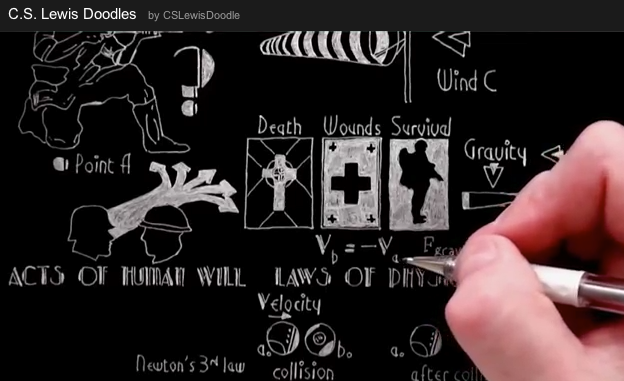
csl doodlesA recent post at the wonderful C.S. Lewis Minute blog introduced me to an amazing new way to experience the brilliance of the great author. I want to pass on the information so that you too can enjoy it.

The site is called “C.S. Lewis Doodles,” and it is the creation of a Kiwi (New Zealander) named Kalman Kingsley.

Kingsley uses a skillful artistic presentation of the clearly read original essays, to give Lewis’ words a particularly engaging and comprehensible air. It is, in a sense, C.S. Lewis “updated” to contemporary media.

Lewis himself alluded to the value of different types of media in communicating. In “Studies in Words” he says, “Language exists to communicate . . . Some things it communicates so badly that we never attempt to communicate them by words if any other medium is available.” Of course, in this case Lewis’ words are profound—in and of themselves. However, the addition of the illustrations serves to highlight and amplify his message.

Lewis, after all, passed away nearly sixty years ago, when most homes still owned black and white televisions. Technology has advanced light years since then, and transposing Lewis’ timeless wisdom to new formats such as this is an important work worthy of the talents of innovative men and women.

C.S. Lewis Doodles is available here, but don’t head there until you finish reading this Mere Inkling post.

The YouTube “Channel” offers three essays:

“The Grand Miracle” (from a sermon about the Incarnation preached in 1945)

“The Laws of Nature” (a 1945 consideration of the interplay between Nature and prayer)

“On ‘Sexual’ Morality” (a 1963 essay entitled “We have No ‘Right to Happiness’”)

All three of these essays are found in the collection published as God in the Dock. (For Americans the last word in that title refers not to a marina, but to a courtroom.)

Because each presentation covers an entire essay, they range in length from eight to ten minutes. Nevertheless, they are so well presented that they will certainly hold your interest.

I believe Lewis would have enjoyed this presentation of his work. Had he been an artist and had access to this technology, he may have experimented with it himself. As he wrote to Arthur Greeves in 1933, his book Pilgrim’s Regress is “going to be decorated by a map on the end leaf which I had great fun in drawing the sketch for.”

You can hear (and view) Lewis’ thoughts on “the Laws of Nature,” by clicking on the image below.

_____

C.S. Lewis Minute is a website every true Lewis fan should be following. You can read the column I referred to—and subscribe to the blog—here.