Vampire Poetry

vpoetryI was afraid to read it. I had just listened to the poem during an online newscast, and it included it so many jarring and disturbing images that I thought I must have misheard it.

Then again, it was written by a successful Hollywood star, so it certainly must be worthy of publication.

So, motivated by two impulses, I sought out the text. My first reason was that I did not wish to misjudge the writer, based on my shallow initial impression. The second was that I really did want to discover if it was as odd as I perceived it to be.

It is from the heart and pen of Kristen Stewart, who played the leading role in the Twilight series. It is described as a “love poem,” which is helpful to know in advance . . . since that might not be how one might inadvisably approach it.

I reared digital moonlight

You read its clock, scrawled neon across that black

Kismetly . . . ubiquitously crest fallen

Thrown down to strafe your foothills

. . . I’ll suck the bones pretty.

Your nature perforated the abrasive organ pumps

Spray painted everything known to man,

Stream rushed through and all out into

Something Whilst the crackling stare down sun snuck

Through our windows boarded up

He hit your flint face and it sparked.

And I bellowed and you parked

We reached Marfa.

One honest day up on this freedom pole

Devils not done digging

He’s speaking in tongues all along the pan handle

And this pining erosion is getting dust in

My eyes

And I’m drunk on your morsels

And so I look down the line

Your every twitch hand drum salute

Salutes mine . . .

Overwhelming. I was actually tempted to use the word “pretentious,” until I read the following note about the magazine interview during which she shared the verse.

Before reading the poem, Kristen told the mag, “I don’t want to sound so f—ing utterly pretentious…but after I write something, I go, ‘Holy f—, that’s crazy.’ It’s the same thing with acting: If I do a good scene, I’m always like, ‘Whoa, that’s really dope.’”

After seeing that comment, with its sadly limited vocabulary, I can picture her composing her poetry dictionary and thesaurus in hand.

The poem’s significance takes a moment to sink into one’s mind . . . even if our brains are not clouded by being drunk on someone’s morsels. The poem is, in fact, so rich in meaning that it required two distinct titles: “Freedom Pole” and “My Heart is a Wiffle Ball.”

I dabble in poetry, but don’t consider myself a poet. So, I’m probably not the one to judge.

I would be curious to know what the newest addition to the Poet’s Corner at Westminster Abbey would think of Stewart’s work. C.S. Lewis wrote poetry himself, of course, although he is much better known for his other literary contributions.

In English Literature in the Sixteenth Century, Lewis describes the poetry of Samuel Daniel. “Though Daniel’s poetry is often uninspired, sometimes obscure, and not seldom simply bad, he has two strong claims on our respect.” I wonder if Lewis’ gracious nature might lead him to discern two strengths in Stewart’s poetic corpus.

In contrast to the previous evaluation, Lewis considered the poetry of Dante Alighieri to be masterful. In Studies in Medieval and Renaissance Literature, Lewis writes:

I think Dante’s poetry, on the whole, the greatest of all the poetry I have read: yet when it is at its highest pitch of excellence, I hardly feel that Dante has very much to do. . . . I draw the conclusion that the highest reach of the whole poetic art turns out to be a kind of abdication, and is attained when the whole image of the world the poet sees has entered so deeply into his mind that henceforth he has only to get himself out of the way, to let the seas roll and the mountains shake their leaves or the light shine and the spheres revolve, and all this will be poetry, not things you write poetry about.

Dare I confess that after Dante even Shakespeare seems to me a little factitious? It almost sounds as if he were “just making it up.” But one cannot feel that about Dante even when one has stopped reading him.

That’s the sort of verse that poets should always strive for—“the highest reach of the whole poetic art [which] turns out to be a kind of abdication.” Word dabblers such as myself are unlikely to ever attain such a lofty goal.

It may be that Stewart has kismetly attained these heights. But then again, perhaps she still has a little farther to travel before she reaches Marfa.


Following Your Heart

trust your heartI read a lot. That’s no surprise, and it’s true of most readers of Mere Inkling. We read a lot.

It is not easy to resist the temptation to pass on many more of the profound insights I encounter on my literary meanderings. I am encouraged there are so many brilliant people in the world who understand what it means live life with integrity and influence in this new millennium.

I want to share a comment taken from a recent interview with Steven James.* He has authored more than thirty books, and won a number of awards. Since most of my reading is nonfiction, I confess I’m not familiar with his writings, but based on the interview I am quite intrigued about his work.

James was asked: “Are non-Christian books and movies more often either manic or depressant?”

That’s a nicely provocative question. There are certainly many examples that could justify either response. In his response, James identifies one of the lies that has come to dominate Western thinking—that there is no ultimate, objective truth.

Building upon that underlying premise, we see the inevitable consequence. Today’s governing philosophy has become one of personal freedom and choice. Nothing (certainly not a nonexistent agreement on right and wrong) can stem the resultant  moral and ethical chaos.

“To thine own self be true,” reads one of Shakespeare’s best recalled lines. Its power arises from the fact it resonates with our deepest desires. Don’t impose your standards on me, our flesh cries out, I will be the master of my own destiny. Of course we wouldn’t want to be untrue to our own conscience. The part that is so often left out here, is the need to pursue truth (Truth).

The Book of Proverbs includes the following maxim: “Every way of a man is right in his own eyes . . .” (We prefer to dispense with the second part of the wisdom saying: “. . . but the Lord weighs the heart.”)

What, you may be wondering, was James’ response to the interview question. Trust me, it was worth the wait.

Some movies and books say life is just terrible now: Slit your wrists. Disney on the other hand is: Follow your dreams and everything will be wonderful in the end. This whole idea of follow your heart—that’s not Christian either. Rapists follow their hearts. Pedophiles are true to themselves.

Nazis pursued their dreams. The Bible says that the heart’s deceitful above all things. Why would you want to follow something deceitful? We believe you should follow something greater than your heart, that you need Someone else to inform your dreams. We turn to God.

Point made. Nihilistic films aside, even the sentimental, idealistic, “positive” types of entertainment are fundamentally flawed. Neither reflects reality. And, while the poisoned fruit of the former may be more apparent in its corruption than the latter, the produce of unrealistic optimism is also tainted.

C.S. Lewis describes the untrustworthiness of personal desires, consciences and hearts.

“If our heart condemn us, God is greater than our heart.” And equally, if our heart flatter us, God is greater than our heart.

I sometimes pray not for self-knowledge in general but for just so much self-knowledge at the moment as I can bear and use at the moment; the little daily dose. Have we any reason to suppose that total self-knowledge, if it were given us, would be for our good?

Children and fools, we are told, should never look at half-done work; and we are not yet, I trust, even half-done. You and I wouldn’t at all stages, think it wise to tell a pupil exactly what we thought of his quality. It is much more important that he should know what to do next. . . . The unfinished picture would so like to jump off the easel and have a look at itself! (Letters to Malcolm).

This isn’t all bad news, of course. As Lewis says, we are freed from depending on our hearts—the emotions of the moment—for our understanding. We no longer need to be “tossed about by the waves” of circumstance.

In the scriptural passage Lewis cites, we are reminded that “God is greater than our hearts.” He alone deserves to be the “Someone else” who “informs our dreams” and reveals to us reality. And, the wonderful result is that when we listen to God, we learn just how deeply he loves us.

_____

* The interview was entitled “Truth Teller,” and appears in the 14 December 2013 issue of World magazine.

Free C.S. Lewis Book

bookshelvesC.S. Lewis has encouraged innumerable prominent individuals in their own faith and writing journeys. I know of no others who offer at no cost a book about his influence.

John Piper is a pleasant exception to that. In a moment I’ll provide the link where you can download a free copy of Alive to Wonder: Celebrating the Influence of C.S. Lewis.

The volume includes a number of extended excerpts from Piper’s fifty-plus books . . . passages where Lewis’ imprint is particularly vivid. For example:

The synthesis of mind and heart was embodied in C.S. Lewis. Lewis became for me in my college days what Jonathan Edwards became in my seminary days. He was a “romantic rationalist”—that was the name of a small book about Lewis that got me very excited because it summed up what I thought I was (which may be very akin to “pastor-scholar”). Lewis has had a tremendous influence on me in several ways.

Lewis embodied the fact that rigorous, precise, penetrating logic is not inimical to deep, soul-stirring feeling and vivid, lively—even playful—imagination. He combined what almost everybody today assumes are mutually exclusive terms: rationalism and poetry, cool logic and warm feeling, disciplined prose and free imagination. In shattering these old stereotypes, he freed me to think hard and to write poetry, to argue for the resurrection and to compose hymns to Christ, to smash an argument and to hug a friend, to demand a definition and to use a metaphor.

The author is chancellor of Bethlehem College & Seminary. It was founded by Bethlehem Baptist Church in Minneapolis, where Piper served as pastor for several decades.

The writer’s desiringGod website actually offers free PDF copies of many of his books and articles, even though most remain in print and available for regular purchase.

As delightful as Alive to Wonder is, most students of Lewis will find the materials from the 2013 desiringGod National Conference even more welcome. This year’s theme was “The Romantic Rationalist: God, Life, and Imagination in the Work of C.S. Lewis.”

Piper’s website includes ten keynote presentations plus an informative panel discussion, all of which are available for download in audio files. Best of all, the lineup of speakers is first-class, featuring a number of familiar names.

And, since we’re on the subject of “free books,” allow me to share another interesting website.

Forgotten Books offers approximately a million volumes, to which “subscribers” have unlimited access. What sets them apart from other “public domain aggregates,” is that they (unlike books.google.com) provide a searchable text, in a variety of epub formats.

For those who are not interested in purchasing a subscription, they offer a Free Book of the Day option in which you receive the link to one of their texts which is good for twenty-four hours.

I recently used it to add Pure English: A Treatise on Words and Phrases, or Practical Lessons in the Use of Language to my kindle library. I find the reading of dated literary books to be:

Entertaining

Educational

and, occasionally, even

Inspiring

Here are a few sample passages from Pure English. The first sounds remarkably contemporary:

The abuse to which the English language is so generally subjected must be a source of sincere regret to all who appreciate its beauties. Ours is an age of progress and civilization, and it ought to be remembered that language, is also progressive.

In a section entitled “Objectionable and Obsolete Words” we read:

Banister is a common barbarism. The proper word is baluster, or balustrade.

— Noted. In the future I will alternate between baluster and balustrade.

“Disremember,” often employed in the sense of do not remember, although given in Webster, is condemned by the critics as a low vulgarism.

— Apparently so vulgar as to have fallen out of usage completely.

Hence, authoress and poetess are superfluous. So, also, are such words as conductress, directress, inspectress, waitress, etc., all of which have recently come into current use. Perhaps the next edition of our dictionaries will, if the custom continues, be enriched by the addition of such words as writeress, officeress, carpenteress, manageress, secretaryess, treasureress, singeress, walkeress, talkeress, etc.

— How did “waitress” survive, especially in the wake of such witty sarcasm?

It is questionable taste to call a coffin a casket. The pleasing name applicable to a case for jewels does not lessen the dread of death and burial.

— I hadn’t known before the sentiment behind the adoption of the word “casket,” since it’s become so thoroughly associated with this usage that was apparently at one time novel.

If you are interested in the books I’ve mentioned above, you You can download a free copy of Alive to Wonder here, and you can sign up for the free book of the day here.

Shut Up He Explained

LardnerMy wife and I love that phrase, and we often recall it when we encounter particularly over-strained (or “broken”) grammar. When I encountered it as the title of a book, I was unaware of its original source.

This is where I reveal that I wasn’t an American Lit major in college. (Well, regular readers probably figured that out long ago.)

I had never heard of Ring Lardner until today. (If you don’t recognize his name either, you needn’t feel embarrassed . . . he died eighty years ago.)

Lardner was a well regarded humorist who considered himself a sports writer. One of his satires was entitled The Young Immigrunts. It was a parody of a popular English book, The Young Visitors, which was allegedly written by a young girl.

The Young Immigrunts is fictitiously ascribed to Lardner’s son, Ringgold Wilmer Lardner, Jr. His son was only four, at the time. Later he would become a successful screenwriter, winning an Academy Award for the film M*A*S*H. He also wrote prolifically for the television series.

Perhaps Lardner Junior is best remembered as one of the Communist writers blacklisted in Hollywood. But we need not go into that, since his father was merely using his young son as a surrogate author for the work.

The book takes the form of the ramblings of a child, and its quaintness will appeal to many readers. You can download a copy of it here.

It’s not my own preferred genre, so I won’t be reading it in its entirety, but in small doses, I find it rather entertaining.

A little later who should come out on the porch and set themselfs ner us but the bride and glum [pictured above].

Oh I said to myself I hope they will talk so as I can hear them as I have always wandered what newlyweds talk about on their way to Niagara Falls and soon my wishs was realized.

Some night said the young glum are you warm enough.

I am perfectly comfertible replid the fare bride tho her looks belid her words what time do we arrive in Buffalo.

9 oclock said the lordly glum are you warm enough.

I am perfectly comfertible replid the fare bride what time do we arive in Buffalo.

9 oclock said the lordly glum I am afrade it is too cold for you out here.

Well maybe it is replid the fare bride and without farther adieu they went in the spacius parlers.

I wander will he be arsking her 8 years from now is she warm enough said my mother with a faint grimace.

The weather may change before then replid my father.

Are you warm enough said my father after a slite pause.

No was my mothers catchy reply.

And now the phrase that always makes me smile.

The lease said about my and my fathers trip from the Bureau of Manhattan to our new home the soonest mended. In some way ether I or he got balled up on the grand concorpse and next thing you know we was thretning to swoop down on Pittsfield.

Are you lost daddy I arsked tenderly.

Shut up he explained.

I am curious as to whether or not C.S. Lewis was acquainted with Lardner’s work. It doesn’t quite conform to his literary tastes, but Lewis was so widely read that I think it’s possible he was at least acquainted with who he was.

My research on the matter did produce an interesting juxtaposition between the two authors. I discovered it in a book by Sherwood Wirt, perhaps the last reporter to interview C.S. Lewis (for Decision magazine, of which he was editor). I was privileged to know “Woody,” so I enjoyed finding that he mentioned both men in his book I Don’t Know what Old is, But Old is Older than Me.

With twentieth century fiction we have to be quite selective. In limiting my comments to the American scene, I will pass by many of the great names of fiction — Henry James, Stephen Crane, Edith Wharton, Jack London, Theodore Dreiser, Ring Lardner, William Faulkner, Sherwood Anderson, Sinclair Lewis, Scott Fitzgerald, Ernest Hemingway, James Baldwin, John Steinbeck, Vladimir Nabokov, Norman Mailer, and Truman Capote.

While most of these are excellent writers, I doubt whether they have much to say to today’s older readers that would make life more pleasant, more interesting, or more fruitful in the closing stretches of life’s journey. Nor do I think that these authors have anything worthwhile to say about what lies beyond death. We might better spend our reading hours riding off into the sunset with Louis L’Amour or Zane Grey, rather than punish ourselves with a ghastly tale like In Cold Blood.

We old boys and girls have been around a long time. We know what the world is like. We know sleaze when we see it, and we don’t need contemporary authors to embellish it or explain it to us.

The reading tastes of the American public have been corrupted almost beyond redemption by blasphemy, vulgarity, and scatology, all for the sake of increased book sales to prurient minds. There are, however, many twentieth-century American novels worth reading, such as Margaret Mitchell’s Gone With the Wind, Thornton Wilder’s The Bridge of San Luis Rey, Harper Lee’s To Kill a Mockingbird, Tom Clancy’s The Hunt for Red October, the Savannah quartet of Eugenia Price, and the Sebastian series of James L. Johnson, to name only a few.

Earlier in the century the Christian novels of Lloyd C. Douglas—The Magnificent Obsession, The Robe, and The Big Fisherman—inspired thousands of readers young and old, but no American has since matched his popular appeal.

The demand for detective fiction continues unabated, and no one needs my advice to read Agatha Christie. I would, therefore, limit my remarks to a reference to two British creations, G.K. Chesterton’s Father Brown and Dorothy Sayers’ Lord Peter Wimsey, since both are written from Christian backgrounds. My two favorite Wimsey stories are Busman’s Honeymoon and The Nine Tailors.

In contrast there is a wealth of devotional literature that makes wonderful reading for older people. One can start with the sermons of D.L. Moody, Charles Spurgeon, Samuel P. Jones, Joseph Parker, and T. DeWitt Talmage of the nineteenth century. The early twentieth century gave us Andrew Murray, Ole Hallesby, P.T. Forsyth, and Oswald Chambers, whose writings are hard to surpass. Amy Carmichael’s poetry and prose written in India, have blessed millions of readers. More contemporary are the writings of C.S. Lewis and A.W. Tozer, which carry seeds of greatness.

The passage above comes from the book’s chapter on “Reading.” If you would like to see more, the entire book (although published as recently as 1992) is legally available for your review online.

“Shut up he explained” may not be proper English, but literature doesn’t need to be proper to be entertaining. And even though Lardner is no longer a familiar name, perhaps his writings are worth visiting.

For the moment, knowing the context of this delightful phrase makes the words all the more entertaining to me. After all, like many others, my dad often “explained” the same thing to me!

Whose “Best Books” List?

reading awardsMost readers recognize significant differences exist between British and American literature.

Not only do our literary tastes often differ, there are more than a few differences in the English we use . . . for example, whether we include our punctuation inside, or outside, of “quotation marks.”

With that caveat, it’s interesting to ponder the 2008 list of favorite books in the United Kingdom, as reported in The Telegraph. I’m unsure right now whether there’s a more recent list, but it would probably remain fairly stable a lustrum later. (It would, however, be interesting to see how Rowling’s works rank in fifty or seventy years. Not to mention Pullman’s Gnostic series.)

In their balanced compendium of passages from C.S. Lewis’ works, Martindale and Root point out the transitory nature of literary fads.

A book that is number one on the New York Times Best-seller List for several weeks may be all but forgotten a decade later. Popularity in a moment of history does not guarantee that a book will endure beyond its own time. C. S. Lewis once observed that, like fashions, the more up-to-date a book is, the sooner it is out of date.

One of the peculiarities of the list is that only a single book by any particular author was allowed in the top twenty-one titles.

I read somewhere that the average reader had only read an “average” of six of the books. I’m not sure how that is calculated, since I know a fair number who have not read—if they’re being honest—a single book in the survey (those assigned for coursework included).

And, now that I’ve made that seemingly judgmental statement, I need to be particularly truthful in my own list. That means I can’t check off a title because I saw the movie or read the Classics Illustrated edition . . . even though I think it would be fair to get partial credit for either of those options.*

I’ll reproduce the entire British classics canon in a moment, but since everyone will get distracted while they read it (assessing which titles they themselves have read), I’ll share my brief list first.

I’m not too embarrassed by its brevity, since 80% of my reading is nonfiction, and the list is decidedly not that. Also, I can honestly say that there are another ten or so titles here that I have begun to read, without being sufficiently interested to finish.

The truth is that just as less than a quarter of my reading is devoted to fiction, most of that focuses on my favorite genre, alternative history. And, for some reason unknown to me, none of those titles made the list!

Here is my humble account of British must-reads that I have actually finished.

 1) The Lord of the Rings (Ranked #2).

 2) The Bible** (#6)

 3) Nineteen Eighty-Four (#8).

 4) Catch 22 (#13).

 5) The Hobbit (#16).

 6) The Great Gatsby (#22).

 7) The Chronicles of Narnia (#33).

 8) The Lion, the Witch and the Wardrobe (#36)

 — Isn’t that a tad redundant (in the American, not the British, sense)?

 9) Winnie the Pooh (#40).

10) Animal Farm (#41).

11) Lord of the Flies (#49).

12) Dune (#52).

13) Brave New World (#58).

14) Moby Dick (#70).

15) Dracula (#72).

16) A Christmas Carol (#81).

17) Charlotte’s Web (#87).

18) Heart of Darkness (#91).

Interesting—I thought it would be shorter. Their presence on this short list, by the way, doesn’t indicate my recommendation of all of these. Some were assigned reading. I’ve also read some of Shakespeare and Sherlock Holmes, of course, but neither in their entirety.***

The full list follows. Enjoy going through it yourself to see how you stack up. And, don’t be intimidated if the books you favor keep you too busy to read what others deem the most significant.

_____

* Just joking. I would never consider seeing a movie as the equivalent of reading a book; some of them bear little resemblance to their source. That acknowledged, sometimes the cinematic adaptations are better than the books.

** I know it only has a single Author, but shouldn’t this count as 66 books?

*** My lovely wife, who I sometimes compel to proofread for me, could not resist mentioning that she was able to check off many more titles on this list than I did. I chalk that up to her sharp intelligence (valedictorian, 4.0 in college and grad school, etc.), general perfectionism, speed-reading skills, tolerance for boring literature, and “compulsive” personality. All of that, plus her consuming love of reading.

Here’s the British list.

1 Pride and Prejudice – Jane Austen

2 The Lord of the Rings – JRR Tolkien

3 Jane Eyre – Charlotte Bronte

4 Harry Potter series – JK Rowling

5 To Kill a Mockingbird – Harper Lee

6 The Bible

7 Wuthering Heights – Emily Bronte

8 Nineteen Eighty Four – George Orwell

9 His Dark Materials – Philip Pullman

10 Great Expectations – Charles Dickens

11 Little Women – Louisa M Alcott

12 Tess of the D’Urbervilles – Thomas Hardy

13 Catch 22 – Joseph Heller

14 Complete Works of Shakespeare

15 Rebecca – Daphne Du Maurier

16 The Hobbit – JRR Tolkien

17 Birdsong – Sebastian Faulks

18 Catcher in the Rye – JD Salinger

19 The Time Traveller’s Wife – Audrey Niffenegger

20 Middlemarch – George Eliot

21 Gone With The Wind – Margaret Mitchell

22 The Great Gatsby – F Scott Fitzgerald

23 Bleak House – Charles Dickens

24 War and Peace – Leo Tolstoy

25 The Hitch Hiker’s Guide to the Galaxy – Douglas Adams

26 Brideshead Revisited – Evelyn Waugh

27 Crime and Punishment – Fyodor Dostoyevsky

28 Grapes of Wrath – John Steinbeck

29 Alice in Wonderland – Lewis Carroll

30 The Wind in the Willows – Kenneth Grahame

31 Anna Karenina – Leo Tolstoy

32 David Copperfield – Charles Dickens

33 Chronicles of Narnia – CS Lewis

34 Emma – Jane Austen

35 Persuasion – Jane Austen

36 The Lion, The Witch and The Wardrobe – CS Lewis

37 The Kite Runner – Khaled Hosseini

38 Captain Corelli’s Mandolin – Louis De Bernieres

39 Memoirs of a Geisha – Arthur Golden

40 Winnie the Pooh – AA Milne

41 Animal Farm – George Orwell

42 The Da Vinci Code – Dan Brown

43 One Hundred Years of Solitude – Gabriel Garcia Marquez

44 A Prayer for Owen Meaney – John Irving

45 The Woman in White – Wilkie Collins

46 Anne of Green Gables – LM Montgomery

47 Far From The Madding Crowd – Thomas Hardy

48 The Handmaid’s Tale – Margaret Atwood

49 Lord of the Flies – William Golding

50 Atonement – Ian McEwan

51 Life of Pi – Yann Martel

52 Dune – Frank Herbert

53 Cold Comfort Farm – Stella Gibbons

54 Sense and Sensibility – Jane Austen

55 A Suitable Boy – Vikram Seth

56 The Shadow of the Wind – Carlos Ruiz Zafon

57 A Tale Of Two Cities – Charles Dickens

58 Brave New World – Aldous Huxley

59 The Curious Incident of the Dog in the Night-time – Mark Haddon

60 Love In The Time Of Cholera – Gabriel Garcia Marquez

61 Of Mice and Men – John Steinbeck

62 Lolita – Vladimir Nabokov

63 The Secret History – Donna Tartt

64 The Lovely Bones – Alice Sebold

65 Count of Monte Cristo – Alexandre Dumas

66 On The Road – Jack Kerouac

67 Jude the Obscure – Thomas Hardy

68 Bridget Jones’s Diary – Helen Fielding

69 Midnight’s Children – Salman Rushdie

70 Moby Dick – Herman Melville

71 Oliver Twist – Charles Dickens

72 Dracula – Bram Stoker

73 The Secret Garden – Frances Hodgson Burnett

74 Notes From A Small Island – Bill Bryson

75 Ulysses – James Joyce

76 The Bell Jar – Sylvia Plath

77 Swallows and Amazons – Arthur Ransome

78 Germinal – Emile Zola

79 Vanity Fair – William Makepeace Thackeray

80 Possession – AS Byatt

81 A Christmas Carol – Charles Dickens

82 Cloud Atlas – David Mitchell

83 The Color Purple – Alice Walker

84 The Remains of the Day – Kazuo Ishiguro

85 Madame Bovary – Gustave Flaubert

86 A Fine Balance – Rohinton Mistry

87 Charlotte’s Web – EB White

88 The Five People You Meet In Heaven – Mitch Alborn

89 Adventures of Sherlock Holmes – Sir Arthur Conan Doyle

90 The Faraway Tree Collection – Enid Blyton

91 Heart of Darkness – Joseph Conrad

92 The Little Prince – Antoine De Saint-Exupery

93 The Wasp Factory – Iain Banks

94 Watership Down – Richard Adams

95 A Confederacy of Dunces – John Kennedy Toole

96 A Town Like Alice – Nevil Shute

97 The Three Musketeers – Alexandre Dumas

98 Hamlet – William Shakespeare

99 Charlie and the Chocolate Factory – Roald Dahl

100 Les Miserables – Victor Hugo

What Children Read

young readerI recently reread C.S. Lewis’ brief essay, “On Juvenile Tastes.” In it he ponders two basic questions.

First, what do children prefer to read? And second, why do they evidence that preference?

Lewis set the stage by discussing the state of children’s literature in 1958, which was of course, more than half a century ago. Nevertheless, like most of Lewis’ observations, there is much that is timeless about his argument.

Not long ago I saw in some periodical the statement that “Children are a distinct race”. Something like this seems to be assumed today by many who write, and still more who criticise, what are called children’s books or ‘juveniles’. Children are regarded as being at any rate a distinct literary species, and the production of books that cater for their supposedly odd and alien taste has become an industry; almost a heavy one.

It seems little has changed during the intervening decades. If anything, this concept has become much more deeply entrenched. No one can doubt that the publication of “juvenile” literature has expanded dramatically. (To maintain the entrenchment allusion, we might say it has “exploded.”)

Lewis, however, does not accept the notion that children have unique—in his picturesque words “odd and alien”—literary interests. His first argument is that their preferences are by no means monolithic.

This theory does not seem to me to be borne out by the facts. For one thing, there is no literary taste common to all children. We find among them all the same types as among ourselves. Many of them, like many of us, never read when they can find any other entertainment. Some of them choose quiet, realistic, “slice-of-life” books . . . Some like fantasies and marvels . . . Some care for little but books of information, and so do some adults. Some of them, like some of us, are omnivorous. Silly children prefer success stories about school life as silly adults like success stories about grown-up life.

So, in Lewis’ opinion, we witness great difference in the tastes of children, as well as adults. He attributes changing literary emphases to human nature, rather than chronological considerations. The difference enters with children’s focus on enjoying literature, which provides them immunity to literary fads.

Surely it would be less arrogant, and truer to the evidence, to say that the peculiarity of child readers is that they are not peculiar. It is we who are peculiar. Fashions in literary taste come and go among the adults, and every period has its own shibboleths. These, when good, do not improve the taste of children, and, when bad, do not corrupt it; for children read only to enjoy.

Of course their limited vocabulary and general ignorance make some books unintelligible to them. But apart from that, juvenile taste is simply human taste, going on from age to age, silly with a universal silliness or wise with a universal wisdom, regardless of modes, movements, and literary revolutions.

Lewis’ critique of the publishing arena follows. Since these literary phases fade in and out, it is here where contemporary literary critics may fairly evaluate things differently.

This has one curious result. When the literary Establishment—the approved canon of taste—is so extremely jejune and narrow as it is today, much has to be addressed in the first instance to children if it is to get printed at all. Those who have a story to tell must appeal to the audience that still cares for storytelling.

The literary world of today is little interested in the narrative art as such; it is preoccupied with technical novelties and with ‘ideas’, by which it means not literary, but social or psychological, ideas. The ideas (in the literary sense) on which Miss Norton’s The Borrowers or Mr. White’s Mistress Masham’s Repose are built would not need to be embodied in “juveniles” at most periods.

Lewis ends his essay by contrasting two disparate approaches to the production of so-called children’s literature. I suspect the two general categories still hold true for most. However, having only dabbled in writing for children, I’m by no means an authority on the subject. As for the creator of Narnia . . . I’m persuaded he possesses the credibility to speak with some modest influence.

It follows that there are now two very different sorts of “writers for children”. The wrong sort believe that children are “a distinct race”. They carefully “make up” the tastes of these odd creatures—like an anthropologist observing the habits of a savage tribe—or even the tastes of a clearly defined age-group within a particular social class within the “distinct race”. They dish up not what they like themselves but what that race is supposed to like. Educational and moral, as well as commercial, motives may come in.

The right sort work from the common, universally human, ground they share with the children, and indeed with countless adults. They label their books ‘For Children’ because children are the only market now recognised for the books they, anyway, want to write.

Right or wrong, like Lewis I cast my lot with those who write for children from their shared humanity with them. After all, they may be slightly less mature than most grown-ups, but they are not truly “alien” (even if they occasionally behave that way).

Orwellian Advice

cls orwellThe title of this post is slightly misleading. In truth, it does contains advice from Eric Arthur Blair (1903-1950) whose pen name was George Orwell. However, because of the impact of his two dystopian classics, Nineteen Eighty-Four and Animal Farm, the author’s name has actually become a true English adjective . . . one that might suggest I’m alluding to futuristic or totalitarian matters.

Or·well·i·an [awr-wel-ee-uhn] means something that resembles his literary work, especially as described in the aforementioned novel and novella. (Within the Christian literary community, “Lewisian” is common shorthand for referring to C.S. Lewis . . . but that word is unlikely to ever find its way into standard dictionaries.)

Despite the enormous (and eternal) differences between Orwell and Lewis, they did have something significant in common. More about that in a moment.

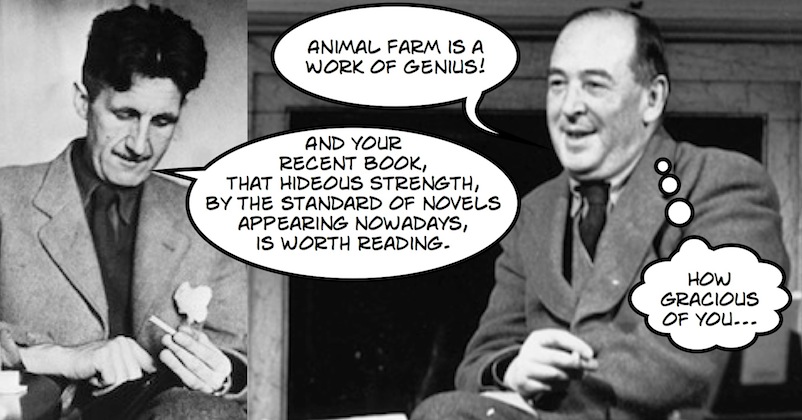
As the graphic I created above reveals (from actual quotations), Lewis had a better opinion of Orwell’s work than vice versa. Orwell disliked Lewis and resented the fact that he was popular among many common people. He particularly disliked Lewis’ traditional (evangelical) Christianity. In his review of That Hideous Strength, Orwell dismissed the biblically based supernatural as a version of “magic.”

Much is made of the fact that the scientists are actually in touch with evil spirits, although this fact is known only to the inmost circle. Mr. Lewis appears to believe in the existence of such spirits, and of benevolent ones as well. He is entitled to his beliefs, but they weaken his story . . .

Orwell was one of those “professing” Christians who is accurately labeled a hypocrite. He was a communing member of the Church of England, and advocated a Judeo-Christian moral code, but did not believe in an afterlife. The following letter, written to Eleanor Jaques in 1932, reveals his hypocrisy.

It seems rather mean to go to HC [Holy Communion] when one doesn’t believe, but I have passed myself off for pious & there is nothing for it but to keep up with the deception.

In a comment to my last post, a good friend of Mere Inkling, Brenton Dickieson at A Pilgrim in Narnia, reminded me of a thought-provoking essay on English written by Orwell. His essay, “Politics and the English Language,” addresses a number of problems with the language. He considers dying metaphors, verbal false limbs, pretentious diction, and meaningless words.

A Similarity in the Two Writers’ Advice

Orwell’s goal is “the scrapping of every word or idiom which has outworn its usefulness. It has nothing to do with correct grammar and syntax, which are of no importance so long as one makes one’s meaning clear, or with the avoidance of Americanisms, or with having what is called a ‘good prose style.’”  [As irritating as I imagine most Europeans find Americanisms!] Writers of fiction will enjoy the way Orwell explains the challenge of “showing, not telling.”

What is above all needed is to let the meaning choose the word, and not the other way around. In prose, the worst thing one can do with words is surrender to them. When you think of a concrete object, you think wordlessly, and then, if you want to describe the thing you have been visualizing you probably hunt about until you find the exact words that seem to fit it.

When you think of something abstract you are more inclined to use words from the start, and unless you make a conscious effort to prevent it, the existing dialect will come rushing in and do the job for you, at the expense of blurring or even changing your meaning. Probably it is better to put off using words as long as possible and get one’s meaning as clear as one can through pictures and sensations. Afterward one can choose—not simply accept—the phrases that will best cover the meaning, and then switch round and decide what impressions one’s words are likely to make on another person.

This last effort of the mind cuts out all stale or mixed images, all prefabricated phrases, needless repetitions, and humbug and vagueness generally. But one can often be in doubt about the effect of a word or a phrase, and one needs rules that one can rely on when instinct fails. I think the following rules will cover most cases:

1. Never use a metaphor, simile, or other figure of speech which you are used to seeing in print.

2. Never use a long word where a short one will do.

3. If it is possible to cut a word out, always cut it out.

4. Never use the passive where you can use the active.

5. Never use a foreign phrase, a scientific word, or a jargon word if you can think of an everyday English equivalent.

6. Break any of these rules sooner than say anything outright barbarous.

These rules sound elementary, and so they are, but they demand a deep change of attitude in anyone who has grown used to writing in the style now fashionable.

Students of Lewis will note in the final passage the parallel with advice he provided to a correspondent in 1956. Although the context is different—Orwell’s is a formal essay and Lewis’ a casual correspondence written to a child, the similarities are significant. Lewis would have been familiar with Orwell’s essay, composed a decade before his letter, but the resemblance between their words is better attributed to shared literary philosophies and the self-evident nature of the principles. Lewis identified five important considerations when writing.

1. Always try to use language so as to make quite clear what you mean and make sure [your] sentence couldn’t mean anything else.

2. Always prefer the plain, direct word to the long, vague one. Don’t implement promises, but keep them.

3. Never use abstract nouns when concrete ones will do. If you mean “More people died” don’t say “Mortality rose.”

4. Don’t use adjectives which merely tell us how you want us to feel about the things you are describing. I mean, instead of telling us a thing was “terrible,” describe it so that we’ll be terrified. Don’t say it was “delightful;” make us say “delightful” when we’ve read the description. You see, all those words (horrifying, wonderful, hideous, exquisite) are only like saying to your readers, “Please, will you do my job for me?”

5. Don’t use words too big for the subject. Don’t say “infinitely” when you mean “very;” otherwise you’ll have no word left when you want to talk about something really infinite.

Whatever the two authors thought about the other, they certainly shared some similar views on the subject of effective writing. And, I think we can assume with confidence that Lewis would concur with Orwell’s final rule. Under no circumstances should we resort to barbarity! For, as Lewis wrote in The Four Loves, “Who does not prefer civility to barbarism?”

____

If you are interested in reading Orwell’s “Politics and the English Language” in its entirety, you can find it here.

Literature is the Lifeblood

BonnevilleAs an American, I find there is something distinctive about British programs. When my family lived in the United Kingdom we enjoyed access to all the offerings of the BBC and the commercial network or two that existed twenty-two years ago.

Returning to the States, we had to become content with viewing the occasional British import, mostly through the auspices of PBS. Since I watch far less television than I used to, I haven’t seen one of the current offerings that’s become quite popular.

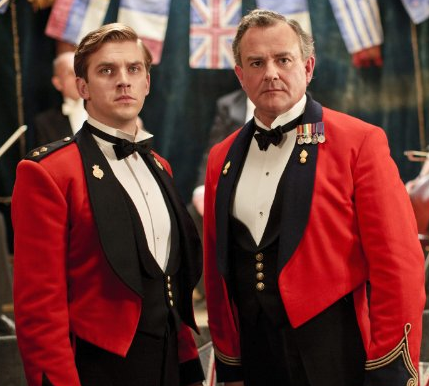
Downton Abbey is essentially a soap opera which examines the lives of a noble family, and the myriad servants who attend to their needs. Contrasting their culturally different lifestyles is doubtless quite intriguing.

The reason I’m mentioning a program I’ve never seen, is because I read an interview with one of its co-stars, Hugh Bonneville. His response to the question “Did you make a New Year’s resolution?” was wonderful.

I’ve had the same resolutions for about 20 years, which is to read The Complete Works of Charles Dickens, and I’m only on about book number three. I’m a terrible reader, which is a great shame because literature is the lifeblood of everything, really, in terms of inspiration and nourishment of the soul.

C.S. Lewis often speaks about the value of reading the “classics.” One benefit he describes in “The Reading of Old Books,” is that they provide us with a grounded perspective in a rapidly shifting world. “Every age has its own outlook. It is specially good at seeing certain truths and specially liable to make certain mistakes. We all, therefore, need the books that will correct the characteristic mistakes of our own period. And that means the old books.”

Lewis apparently enjoyed Dickens. Below are a couple of passages where he refers to him in very good company. In his essay “Sir Walter Scott,” he writes:

. . . there are two things of which I feel certain. One is, that if we do overvalue art, then art itself will be the greatest sufferer; when second things are put first, they are corrupted. The other is that, even if we of all generations have first valued art aright, yet there will certainly be loss as well as gain. We shall lose the fine careless, prodigal artists. For, if not all art, yet some art, flows best from men who treat their work as a kind of play. I at any rate cannot conceive how the exuberance, the elbow-room, the heart-easing quality of Dickens, or Chaucer, or Cervantes, could co-exist with that self-probing literary conscience we find in [Walter Horatio] Pater or Henry James.

And, again, in  Studies in Medieval and Renaissance Literature he praises Edmund Spenser’s The Faerie Princess, saying:

From the time of its publication down to about 1914 it was everyone’s poem—the book in which many and many a boy first discovered that he liked poetry; a book which spoke at once, like Homer or Shakespeare or Dickens, to every reader’s imagination.

Ironically, Lewis’ own writings have become classics, to which many of us return over and over. And, even though a month has passed since the traditional day for making New Year resolutions, I can’t think of a better one than planning to read the “complete works” of C.S. Lewis himself.

Skillful Turns of Phrase

frank burnsEveryone loves an exquisite turn of phrase. Those of us who dabble in writing are particularly susceptible to their numinous power.

I’ve been doing some research on the Father Mulcahy character from M*A*S*H. William Christopher transformed the fictional character from a caricature of military chaplaincy, into a compassionate and respected representative of the Holy. During my research, I’ve been reviewing episodes of the series in which he was featured.

In “Alcoholics Unanimous,” which originally aired in 1974, Mulcahy has been tasked with delivering a lecture on temperance. In an interesting twist he wears full clerical garb and prepares what is essentially a sermon. Since the lecture is a “mandatory formation,” the mess tent (which doubles as the chapel) is filled to capacity.

Sitting in the front row are the hypocritical Majors Burns and Houlihan. (For those unfamiliar with the show, they constantly call for the most rigid of military standards, even as they are all the while breaking the military’s Uniform Code that prohibits adultery.) Major Houlihan’s nickname, in fact, is “Hotlips.”

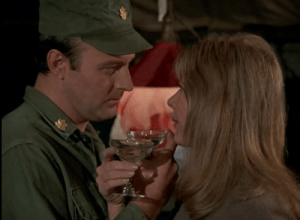
In the aforementioned episode they have a delightful little exchange that illustrates through its witty banter the skill of the Hollywood writers at their best. As the hospital’s temporary commander, Burns has banned all alcohol and mandated attendance at the lecture. The tent is filled to its limits as Houlihan turns adoring towards her paramour and says:

Houlihan: Frank, what a turnout!

Burns: Lemmings must be directed to the sea.

Houlihan: You’re magic with a phrase!

It requires skill to create a well-crafted turn of phrase. Well, even a fool like Frank Burns can stumble across a clever phrase, but only a master can repeatedly coax them from their ethereal realms.

C.S. Lewis was just such a master. His works abound with profound and captivating language. And he recognized it in the works of others. In “Dante’s Similes,” in Studies in Medieval and Renaissance Literature, he wrote:

[Dante] is the most translatable of the poets—not, probably, that he entrusts less wealth than others to the music of the words and the nuance of the phrase but that he entrusts more than others to the “plain sense.”

In The Four Loves, Lewis reveals just how impoverished much of our language is . . . even when it relates to the most inspiring of matters. Describing the difference between carnal “love” and genuine love, he shows that even impoverished phrases can begin to grasp the truth behind the dynamics of affection and commitment.

We must do the works of Eros when Eros is not present. This all good lovers know, though those who are not reflective or articulate must be able to express it only in a few conventional phrases about “taking the rough along with the smooth,” not “expecting too much,” having “a little common sense,” and the like. And all good Christian lovers know that this programme, modest as it sounds, will not be carried out except by humility, charity and divine grace; that it is indeed the whole Christian life seen from one particular angle.

Surely those who are more articulate can more expressively communicate our love for our spouse. Yet, even in so-called matters of the heart, we frequently utter phrases that are utterly mundane.

The History of the Phrase “Turn of Phrase”

One online dictionary uses these definitions:

a turn of phrase

1. a way of saying something “Significant other,” meaning “partner,” now that’s an interesting turn of phrase.

2. the ability to express yourself well She has a nice turn of phrase which should serve her well in journalism.

The Phrase Finder website provides excellent information about numerous phrases. And, in discussing this idiomatic phrase about phrases, they do not disappoint.

So, a phrase was a style of speaking or writing, and style meant beauty of expression. We can now interpret a fine “turn of phrase” as analogous to a skillfully crafted piece of wood turned on a lathe. John Dryden referred to the “turning” of words in this sense in The Satires of Decimus Junius Juvenalis, 1693: “Had I time, I cou’d enlarge on the Beautiful Turns of Words and Thoughts; which are as requisite in this, as in Heroique Poetry.”

Check out their entire article about turns of phrase at the link above. And, may your own writing be filled with impressive verbal ballets, replete with inspiring leaps and unforgettable pirouettes.

Generalizations (& Those Who Criticize Them)

“That’s the worst of girls,” said Edmund to Peter and the Dwarf. “They never can carry a map in their heads.”

“That’s because our heads have something inside them,” said Lucy. (C.S. Lewis, Prince Caspian).

It seems that if an author wishes to alienate vast swaths of readers today, they need do no more than “generalize.” Thus, C.S. Lewis has received unjust criticism due to some passages such as this.

To make a judgment such as Edmund’s leaves unmentioned the implied fact that there are, indeed, many useful things that are manifestly present in the heads of girls. But this example of difficulty in reading maps refers to a common perception . . . and if you’ve never heard it voiced before you read it here, you have led a shockingly sheltered life.

No one believes that there are no women capable of defeating even well-trained men in rigorous navigational competitions. Likewise, I have no doubt there are many gifted female cartographers. But please reseal the tar barrel and restuff the pillows; Lewis’ use of this dialog is not intended to be offensive!

I long for the days when a reader gave the writer the proverbial “benefit of the doubt.” A time when our assumption was that they meant something other than the meaning which offended us . . . or, at least, that they intended no malice.

I can’t speak for the rest of the world, but in most of the United States, such days of literary curtesy are long behind us. Today we often read things with an eye to finding the “problem” (ignorance, prejudice, or political viewpoint foreign to our own).

My wife and I attempted to raise our children with critical minds. (Critical in the best sense of the word.) We taught them that there are absolute truths. We informed them that, while people are entitled to hold to all sorts of notions and beliefs, that fact does not make the contending concepts “true.”

At the same time, we did our best to teach our children to respect others. To recognize that all human beings are created in the image of God. To understand that not even the basest man or woman is beyond redemption and restoration.

One practical element of this education in basic virtues took the shape of an adage we taught our kids. I’m sure others have advised this throughout history, and that many have voiced it far more eloquently, but we simply said: Judge everyone and everything by their best cases, rather than their worst.

In practice, this would mean that when a teenager compliments his dad on his wisdom, the dad does not immediately assume his prodigy is attempting to manipulate him. Now, further conversation and “investigation” may certainly prove that manipulation is indeed the goal, but it should not be the very first suspicion of the father.

As a pastor, one of your greatest challenges (and joys) comes in the pulpit. One major difficulty is discussing some extremely complex subjects in a relatively brief period of time. Pastors sometimes lapse into a sort of theological shorthand—which can be confusing or troubling to those unfamiliar with the underlying presuppositions. Taken out of context, individual statements may sound strange, or even heterodox.

I have always encouraged the members of my congregations and (especially) visitors to specifically ask me about what was meant by any statement or phrase that left them uneasy. It is no exaggeration to say that 98% of the time, that has cleared the air in and of itself, as I’ve had an opportunity to elaborate and clarify. (Of course, the other 2% of the occasions constitute a second pastoral “joy.”)

It saddens me when I hear people berate C.S. Lewis for a handful of passages that critics deem to be misogynistic or racist. They fail to extend toward him the goodwill he strove to offer to others. Most of these very few passages can simply be explained by the age in which he lived. It is disingenuous to judge by today’s standards someone who died a half century ago.

Like Lewis’ peers (and, in fact, all human beings), on occasion Lewis himself generalized. Let those who have never done the same cast the first stone. I confess that I’m guilty of it. In fact, returning to the quotation with which we began, I could most definitely echo Edmund’s words in reference to my wife. Ironically, they would be utterly inaccurate in reference to my daughter. For many years she was my “official navigator” as our family often drove across country (relying upon those seven foot by seven foot paper maps that are nearly impossible to refold.)

So, in my own nuclear family I’m batting .500 in terms of the accuracy of this generalization. The next generation may decide. Four of my six grandchildren are girls, and since the oldest girl just turned five, it’s about time to set them out in the woods with a map and a compass to see how they do!