C.S. Lewis and Martin Luther on Suicide

shakespearean-suicideAre all who commit suicide damned? Some would claim this is true. I, however, agree with Martin Luther and C.S. Lewis that God’s mercy is capable of rescuing even these. Suicide invariably leaves in its wake more sorrow than it heals.

Even the irreligious Mark Twain recognized this. In 1889 he wrote to a friend: “I do see that there is an argument against suicide: the grief of the worshipers left behind, the awful famine in their hearts, these are too costly terms for the release.”

I share with Lewis and Luther the belief that suicide can be forgiven. Our position is based on our personal understanding of the counsel in God’s word, as viewed through the lens of the Incarnate Word himself. As a personal conviction, not based on clear biblical guidance yea or nay, it is not a concept that should be formally taught.

There a second reason why this interpretation should not be actively promoted. It may encourage the premature ending of human life. The fact is that many, perhaps most, people contemplate suicide at some point in their life. But nearly all choose instead to live—some because of their fear of damnation. Prevented from killing themselves due to this fear, the critical moment passes, and they learn suicidal impulses are a transitory curse. Some seek help from others, which is even better.

In other words, when people are especially vulnerable to such thoughts, the last thing they need to hear is that suicide offers a ticket from the trials of this life to the bliss of heaven. On the contrary, if they can be discouraged from choosing the irreversible course during these moments of deep confusion and suffering, they can survive to experience restoration and renewed hope.

Many potential suicides press on and end up living lives filled with joy, contentment and meaning.

Martin Luther put it this way.

I don’t share the opinion that suicides are certainly to be damned. My reason is that they do not wish to kill themselves but are overcome by the power of the devil.

They are like a man who is murdered in the woods by a robber.

However, this ought not be taught to the common people, lest Satan be given an opportunity to cause slaughter, and I recommend that the popular custom be strictly adhered to according to which it [the suicide’s corpse] is not carried over the threshold, etc.

Such persons do not die by free choice or by law, but our Lord God will dispatch them as he executes a person through a robber. Magistrates should treat them quite strictly, although it is not plain that their souls are damned.

However, they are examples by which our Lord God wishes to show that the devil is powerful and also that we should be diligent in prayer. But for these examples, we would not fear God. Hence he must teach us in this way.

C.S. Lewis understood this dilemma as well. In a 1955 letter to Sheldon Vanauken, who had lost his wife and was drowning in grief, Lewis even appealed to the church’s traditional teaching on the subject to quash in advance any contemplation of suicide.

[Jean] was further on [more spiritually mature] than you, and she can help you more where she now is than she could have done on earth. You must go on.

That is one of the many reasons why suicide is out of the question. (Another is the absence of any ground for believing that death by that route would reunite you with her. Why should it? You might be digging an eternally unbridgeable chasm. Disobedience is not the way to get nearer to the obedient.)

There’s no other man, in such affliction as yours, to whom I’d dare write so plainly. And that, if you can believe me, is the strongest proof of my belief in you and love for you. To fools and weaklings one writes soft things.

In our world, which appears to value life less each day, Lewis proclaimed the mere Christian commitment to the value of every life. Historian Richard Weikart addresses this in “C.S. Lewis and the Death of Humanity, or Heeding C.S. Lewis’s Warnings against Dehumanizing Ideologies.”

Many Christians recognize that we are living in a “culture of death,” where—especially in intellectual circles—there is easy acceptance of abortion and increasing support for physician-assisted suicide, infanticide, and euthanasia. While many Christians make cogent arguments against such practices—as they should—we seem to be losing ground.

This is because our society is embracing secular philosophies and ideologies, many of which deny that the cosmos has any purpose, meaning, or significance. Once the cosmos is stripped of value, humanity is not far behind, especially since most secularists have also rejected any objective morality.

When C.S. Lewis cautioned about the dangers of dehumanizing secular ideologies in The Abolition of Man and his science fiction novel That Hideous Strength, many Christians took notice. But, on the whole, the intellectual world paid little heed, careening further down the fateful road against which Lewis warned. Lewis’s critique is still a powerful antidote to the degrading vision of humanity being foisted on us by intellectuals in many institutions of higher learning.

We Christians are not immune to the genuine power of some of these arguments. For example, as a military chaplain I determined many years ago to one day write an article about the complexity of “Euthanasia on the Battlefield.” We do not serve Christ well by ignoring complex subjects or dismissing the reasoning of our “adversaries” without giving their points genuine consideration.

The ultimate barrier comes in the fact that our worldviews ultimately collide. Secularism and other religious philosophies are irreconcilable with the teachings of the One who said, “I am the way, and the truth, and the life” (John 14:6).

In The Problem of Pain, C.S. Lewis notes that suicide has been regarded in some philosophies as a virtuous path. Not so, in Christianity.

If pain sometimes shatters the creature’s false self-sufficiency, yet in supreme ‘Trial’ or ‘Sacrifice’ it teaches him the self-sufficiency which really ought to be his—the ‘strength, which, if Heaven gave it, may be called his own:’ for then, in the absence of all merely natural motives and supports, he acts in that strength, and that alone, which God confers upon him through his subjected will.

Human will becomes truly creative and truly our own when it is wholly God’s, and this is one of the many senses in which he that loses his soul shall find it. . . . When we act from ourselves alone—that is, from God in ourselves—we are collaborators in, or live instruments of, creation: and that is why such an act undoes with ‘backward mutters of dissevering power’ the uncreative spell which Adam laid upon his species.

Hence as suicide is the typical expression of the stoic spirit, and battle of the warrior spirit, martyrdom always remains the supreme enacting and perfection of Christianity.

This great action has been initiated for us, done on our behalf, exemplified for our imitation, and inconceivably communicated to all believers, by Christ on Calvary. There the degree of accepted Death reaches the utmost bounds of the imaginable and perhaps goes beyond them; not only all natural supports, but the presence of the very Father to whom the sacrifice is made deserts the victim, and surrender to God does not falter though God ‘forsakes’ it.

Whenever you encounter someone overshadowed by the dark cloud of despair and death, speak to them life. Dispel the lies of suicide. Confront the Enemy, so that Satan would not be “given an opportunity to cause slaughter.” As Luther also said in the context quoted above:

It is very certain that, as to all persons who have hanged themselves, or killed themselves in any other way, ’tis the devil who has put the cord round their necks, or the knife to their throats.

Graphic and true. I choose not to participate in Satan’s murderous purposes by promoting suicide, and I encourage you to join me.

_____

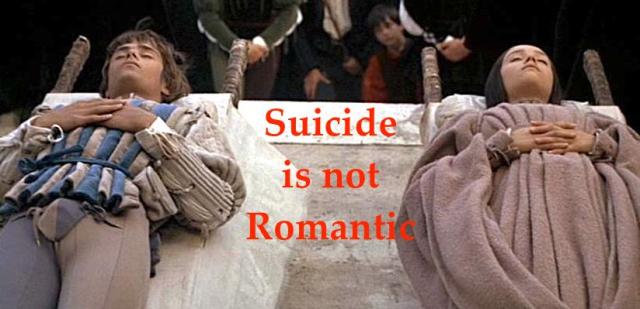
The photo above comes from one of the many renditions of Romeo and Juliet.

Timing the Reformation

wristwatch

I had an entrepreneurial epiphany on how to get rich during the 500th anniversary of the Reformation, and since I’m not an entrepreneur, I’m passing the idea on gratis, to readers of Mere Inkling.

Inspired by the shocking success of the Playmobil Martin Luther—their fastest-selling item ever—I wondered what other commemorative items might result in a windfall for investors.

The insight struck like the lightning bolt that dropped Luther to his knees and sent him off to the monastery.

Since this celebration hearkens back to the beginning of the Reformation . . . back to the day when the 95 Theses were nailed to the door of the Castle Church in Wittenberg . . . it dawned on me that we so indebted to what happened that moment that we are, in a true sense, living on Wittenberg time.

What better item to remind us of the significance of this than to turn to expert horologists* and design a Wittenberg Watch? Ideally it would be permanently linked to Wittenberg time. The wearer would also benefit from learning more about time zones and mathematics, trying to sort out the local time, especially when traveling.

More about the details in a moment.

C.S. Lewis and the Importance of Time

The nature and passage of time was of great importance to C.S. Lewis. He devoted an entire chapter to the subject in Mere Christianity. In “Time and Beyond Time,” he explores how God acts within history, but is not subject to time’s constraints.

If you picture Time as a straight line along which we have to travel, then you must picture God as the whole page on which the line is drawn. We come to the parts of the line one by one: we have to leave A behind before we get to B, and cannot reach C until we leave B behind. God, from above or outside or all round, contains the whole line, and sees it all.

Lewis then proceeds to explain his understanding by saying this “idea has helped me a good deal. If it does not help you, leave it alone. It is a ‘Christian idea’ in the sense that great and wise Christians have held it and there is nothing in it contrary to Christianity. But it is not in the Bible or any of the creeds. You can be a perfectly good Christian without accepting it, or indeed without thinking of the matter at all.”

Another difficulty we get if we believe God to be in time is this. Everyone who believes in God at all believes that He knows what you and I are going to do tomorrow. But if He knows I am going to do so-and-so, how can I be free to do otherwise?

Well, here once again, the difficulty comes from thinking that God is progressing along the Time-line like us: the only difference being that He can see ahead and we cannot. Well, if that were true, if God foresaw our acts, it would be very hard to understand how we could be free not to do them.

But suppose God is outside and above the Time-line. In that case, what we call “tomorrow” is visible to Him in just the same way as what we call “today.” All the days are “Now” for Him. He does not remember you doing things yesterday; He simply sees you doing them, because, though you have lost yesterday, He has not. He does not “foresee” you doing things tomorrow; He simply sees you doing them: because, though tomorrow is not yet there for you, it is for Him.

You never supposed that your actions at this moment were any less free because God knows what you are doing. Well, He knows your tomorrow’s actions in just the same way—because He is already in tomorrow and can simply watch you.

In a sense, He does not know your action till you have done it: but then the moment at which you have done it is already “Now” for Him.

Since God was/is witness to that day in Wittenberg, just as he knows our tomorrows today, we see his placing of creation within the linear progression of history is intentional. It does not restrict our Lord in any way, but it enables us to comprehend our existence. And thus, we are compelled to mark the passage of time.

What Might the Wittenberg Watch be Like?

Something elegant and tasteful, yet modest and unobtrusive. A watch like the one pictured above. It’s produced by Swisstime and has the added benefit that it is part of their “Rebellion” line, which means that Roman Catholics shouldn’t be excluded from the market. The only minor drawback is the price, $930,000.

It seems to me that a wise businessperson could undercut that by thirty or forty thousand, and only need to sell two or three watches to retire in comfort.

An alternative to this timepiece, for the less prosperous, would be to get a regular Timex or Casio and just set the time to that of Wittenberg! That’s the key anyway—the Wittenberg Watch measures the hour based on the time there in hallowed birthplace of the Reformation. (For those who like details, that would be the Central European Time Zone, UTC/GMT +1.)

An astute investor will recognize that the Wittenberg Watch concept easily translates for an ecumenical audience. One easily imagines other editions for various denominations.

Aldersgate Watch for Methodists (Greenwich Mean, GMT)

Azuza Street Timepiece for Pentecostals (Pacific Standard, UTC/GMT -9)

Canterbury Timepiece for Anglicans (Greenwich Mean, GMT)

Geneva Timepiece for Calvinists (Central European, UTC/GMT +1)

Edinburgh Edition for Presbyterians (Greenwich Mean, GMT)

Hollywood Timepiece for Televangelists** (Pacific Standard, UTC/GMT -9)

London Chronometer for Quakers (Greenwich Mean, GMT)

Münster Timepiece for Anabaptists (Central European, UTC/GMT +1)

Rome Timepiece for Roman Catholics (Central European, UTC/GMT +1)

Anyone who desires can feel free to run with this idea. I relinquish all rights to the concept of religious timepieces.

As for now, I’ve been rethinking the idea altogether. I’ve decided it’s best for me to reset my own watch to Jerusalem time.

_____

* Horology relates to the science of measuring time and making timepieces. (Yes, I had to look it up also, even though I remembered enough Latin to know hora means hour.)

** It’s quite possible that televangelists already own the Rebellion Reb 5 Diamond timepiece pictured above, however, the members of their digital congregations may be in the market for something more modest.

Christmas Interruptions

qaraqoshA bomb has driven worshipers from their churches and homes on Christmas. Ironically, this did not transpire in lands where war currently rages. Instead, it was a British bomb intended to end German lives.

Perhaps you’ve already seen the story?

The weapon was huge, nearly two tons in weight, and it’s explosion would have been no less lethal today than when it was originally dropped.

The bomb, known as a blockbuster, was the largest of its kind dropped by the RAF during aerial attacks on Germany in the second world war. It weighs 1.8 tonnes and, if exploded, could damage all buildings within a one-mile radius.

As I have worshipped and reflected during this Christmas season, the story of this bomb has continued to intrude on my thoughts.

On that first Christmas night a group of shepherds heard music that has now echoed for millennia.

Suddenly a great company of the heavenly host appeared with the angel, praising God and saying, “Glory to God in the highest heaven, and on earth peace to those on whom his favor rests.”

God’s call to peace on earth and his desire for good will among his children—gifts already given to the world in the birth of Jesus—cannot be negated by the weapons of man.

As C.S. Lewis wrote, “Once in our world, a stable had something in it that was bigger than our whole world” (The Last Battle).

Still, in this moment, when this long forgotten and deeply buried blockbuster bomb can disrupt the traditional Christmas schedule, we see a vivid contrast between the good God desires for us and the ill we too often bear for one another?

A Warzone Witness to the Celebration of Christ’s Nativity

The entire world is aware of the genocide of Christians and Yazidis being conducted in the Middle East by Jihadists. This Christmas, however, marked a moment of encouragement.

Two years after being driven from their city by the Islamic State, Christians were able to return to the recently liberated city of Qaraqosh to worship God.

The church structure had been desecrated, but the presence of God among his gathered people, has reconsecrated it.

Christianity in northern Iraq dates back to the first century AD. The number of Christians fell sharply during the violence which followed the 2003 overthrow of Saddam Hussein, and the Islamic State takeover of Mosul two years ago purged the city of Christians for the first time in two millennia. (Reuters)

Despite the hatred some people hold for others, and the violence they inflict, it is encouraging to recognize that no power in this world can defeat the miracle that transpired on that first Christmas Day.

C.S. Lewis & Alcohol

chaliceWe children of alcoholics often have a difficult time determining the proper place for alcohol in our lives. Because we’ve seen the damage its abuse can cause, some are tempted to condemn it all together.

At the same time, like the abused child who is likelier to grow up becoming an abuser himself, as a group we are vulnerable to misusing alcohol ourselves.

The church’s attitude towards “drink” does not always help. Many denominations overlook the fact that it is drunkenness that the Scriptures condemn, and extend the prohibition to all drink that contains alcohol.

They are like the exegete who transforms the warning about the “love of money” being the root of sin into a rejection of all mediums of exchange beyond barter itself.* They overlook the attitude towards the object, and make the object itself the objectionable thing. Thus, money becomes the problem.

In the case of alcohol, it is no longer inappropriate or damaging use that is condemned, it is the drinking of anything containing alcohol that is reasoned to be sinful. Moving the bar in this fashion is simple legalism.

But this column isn’t about legalism. I don’t have an axe to grind. And, as the saying goes, some of my best friends (and family members) abstain from all drink. Similarly, I rarely drink myself. My point is not that wariness about alcohol’s dangers may be wise, but pushing God’s cautions to the degree where we call sin that which is not, is wrong in and of itself.

The solution does not come in the form of devising a pasteurization process so we can improve on the first eighteen centuries of Christian worship and now enjoy “Dr. Welch’s Unfermented Wine” for holy communion.

At the other extreme, there are some religious communities that celebrate their freedom in the gospel to degrees that may invoke Romans 14:21. There is something uncomely, perhaps even sinful, in a church celebrating this liberty. (And I write this as a pastor in a denomination that frequently takes note of the arrival of Oktoberfest.)

Neither prohibiting what God has deemed lawful, nor uncritically embracing secular festivities is the right course. The proper solution to the question of how drinking can or should fit into our lives is found by looking at the Scriptures themselves.

The Biblical Christian View on Alcohol

The Scriptures could not be clearer on the use of alcohol. Unless God has directed an individual to a particular course (or vow) in their personal life, the general rule is this: in moderation, treated as a beverage without the goal of intoxication, drinks containing alcohol are okay.

I know that some churches teach otherwise, but from the Bible itself it is clear that merely drinking a glass of wine or beer is not a sin. It is drinking to excess, that is sinful.

C.S. Lewis provides an extremely clear explanation of this distinction in Mere Christianity. He explains how the principle of temperance is applicable to many aspects of our lives.

Temperance is, unfortunately, one of those words that has changed its meaning. It now usually means teetotalism. But in the days when the second Cardinal virtue was christened ‘Temperance,’ it meant nothing of the sort.

Temperance referred not specially to drink, but to all pleasures; and it meant not abstaining, but going the right length and no further.

It is a mistake to think that Christians ought all to be teetotallers; Mohammedanism, not Christianity, is the teetotal religion. Of course it may be the duty of a particular Christian, or of any Christian, at a particular time, to abstain from strong drink, either because he is the sort of man who cannot drink at all without drinking too much, or because he is with people who are inclined to drunkenness and must not encourage them by drinking himself.

But the whole point is that he is abstaining, for a good reason, from something which he does not condemn and which he likes to see other people enjoying.

One of the marks of a certain type of bad man is that he cannot give up a thing himself without wanting every one else to give it up.

That is not the Christian way.

An individual Christian may see fit to give up all sorts of things for special reasons—marriage, or meat, or beer, or the cinema; but the moment he starts saying the things are bad in themselves, or looking down his nose at other people who do use them, he has taken the wrong turning.

One great piece of mischief has been done by the modern restriction of the word Temperance to the question of drink. It helps people to forget that you can be just as intemperate about lots of other things. A man who makes his golf or his motor-bicycle the centre of his life, or a woman who devotes all her thoughts to clothes or bridge or her dog, is being just as ‘intemperate’ as someone who gets drunk every evening.

Of course, it does not show on the outside so easily: bridge-mania or golf-mania do not make you fall down in the middle of the road. But God is not deceived by externals.

If he were alive today, Lewis could easily add sports-mania and social media-mania to his list of excesses that voraciously consume a person.

The fact that C.S. Lewis could enjoy a pint of beer with his friends becomes a stumbling block to some who would otherwise benefit from reading his work. Likewise, some readers of Mere Inkling may consider this post an endorsement of drinking.

That could not be farther from the truth. We children of alcoholics are acutely aware of the pain and chaos caused by its abuse.

On the contrary, these words are written to caution my brothers and sisters in Christ about a potentially more destructive sin, legalism.

Fortunately, the simple solution to both problems is an unfiltered, honest reading of God’s word.

_____

* This is an exaggeration, of course. Few, if any, reject all coin and currency, even if they misquote 1 Timothy 6:10 in alleging “money is the root of many evils.”

** “It is good not to eat meat or drink wine or do anything that causes your brother to stumble” (Romans 14:21).

Devastated by Criticism

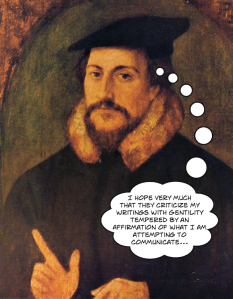
calvin-criticismHow do you feel when others criticize something you’ve written? Do you just want to tear your work up and start all over again? If you do, you have something in common with J.R.R. Tolkien, creator of Lord of the Rings. And he is not the only great writer with whom you share this hypersensitive trait.

Tolkien’s inability to accept constructive criticism is no secret; it is frequently noted in biographies.

Few people enjoy receiving criticism, and we are often suspicious of the mental health of those who do. Yet many writers actively seek out constructive criticism in order to sharpen their skills and improve their work.

That is a major reason for the existence of writers’ groups which pop up in varying expressions wherever serious writers live. While another benefit of such communities is the simple encouragement that comes from gathering with others who share your passion, it is the critical examination of each other’s manuscripts which provides the clearest concrete benefit. It’s no accident many such literary meetings are actually called critique groups.

Tolkien was a member of one of the most famous such fellowships that ever existed, the Inklings. It was in that setting where he first shared the stories of hobbits and elves who would make such a profound impact on Western literature. He said it was primarily through the encouragement of the Inklings—specifically his good friend, C.S. Lewis—that these amazing stories were ever published.

You see, Tolkien had a terrible and frequently fatal flaw . . . When his writing was criticized, he felt compelled to toss it aside and begin anew. Many other writers have been afflicted with this curse, and not all of them had a C.S. Lewis to rescue their words from the dust bin.

I have shared in the past Lewis’ description of his friend’s handicap.

No one ever influenced Tolkien—you might as well try to influence a bander-snatch. We listened to his work, but could affect it only by encouragement. He has only two reactions to criticism; either he begins the whole work over again from the beginning or else takes no notice at all.

Criticism of the Constructive Variety

As I said a moment ago, no one really craves criticism, and yet most serious writers actively solicit it. As I write this very column, it is with the intention of sharing it tomorrow with my friends in my own writing circles.

When you read it, it will likely have changed, probably in subtle, enriching ways. You can gauge the benefit of mutual critiquing by the amount and the quality of the criticism which is shared. And, should you feel violated, rebuke defensiveness and remind yourself that even the greats, like Tolkien and Lewis, gained from the comments and suggestions of their friends.

I recently learned of another individual who struggled with receiving criticism. It was John Calvin, the father of Reformed theology. Belonging to the Lutheran branch of the church universal, my readings in Reformed history have been limited. However, I’m currently reading two similarly titled books* and I discovered something that may be commonly known to Reformed clergy but was news to me.

He often tended to express his disappointment in extravagant terms. When he encountered an obstacle, his reaction was stark: he would burn his manuscript, never write again, never publish anything again. His decision to write was motivated by external factors: a request by his circle of friends and colleagues, or as the result of his emotional reaction to an event or a work that he read. . . . (John Calvin and the Printed Book)

The good news though is Calvin did not allow these obstacles to have the final say. Instead, he turned to those he trusted and sought their counsel.

Indeed, his extreme sensitivity meant that he needed to have the emotional support of close friends. As a Reformer and specifically as an author, Calvin never worked in isolation even though he was the dominant figure in his setting. While he was confident of the quality of his writings, Calvin still had no hesitation in submitting them to his colleagues before publication. (Ibid.)

Not that Calvin always welcomed suggestions. There was one particular Reformer to whom he sent some of his work whose “commend from Zurich were too numerous and detailed. Hence Calvin stopped sending his manuscripts to Bullinger prior to printing, although he maintained cordial relations with the Zurich Reformer.” I can almost read Calvin’s mind at the time: I asked for your suggestions, not a complete rewrite of the manuscript.

So, it appears those of us who feel discomfort at the sting of criticism—even when we request it—stand in good company. So don’t ever let that temporary pain discourage you from continuing to write.

____

* A 2005 volume is called John Calvin and the Printed Book, while a 2015 collection of essays is called Calvin and the Book.

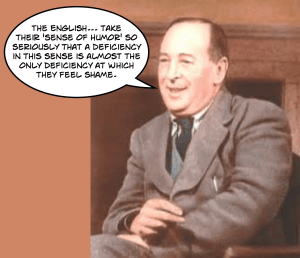
C.S. Lewis & Humor – a 100% Politics Free Post

csl-humorHumor is an essential element of human existence. C.S. Lewis recognized that our very nature was molded to incorporate joy and laughter.

In a great article on the subject, “The Role of Laughter in the Christian Life,” Terry Lindvall introduces the subject with the story of an early Christian monk who wrote this truth.

In the fourth century, a monk named Evagrius identified key temptations against living the Christian life. He named eight of them, and they became the eight deadly sins. Now we know that Pope Gregory the Great reduced them to seven to fit them in with the symbolic biblical number.

But unfortunately the sin that Gregory conflated into sloth was the sin of sadness. Sadness in the face of God’s grace and mercy was a denial of faith and hope.

But it isn’t the vice that concerns me. It is its corresponding virtue, what Evagrius identified as the blessing of hilaritas as essential to Christian living, even if you were an ascetic monk and especially if you are a lawyer or accountant.

Amen. We can all, whatever our vocation, do with an extra dose of hilaritas. After all, it’s good for your health.

I highly commend Lindvall’s entertaining article, which you can read online here or download as a pdf here.

It is filled with references to C.S. Lewis, as one would expect from the author of Surprised by Laughter: The Comic World of C.S. Lewis.

One particularly beneficial section of the article is his discussion of the four types of laughter mentioned by Screwtape in his epistles.

If you don’t have access to your copy of The Screwtape Letters, the following quotation will provide the context for Lindvall’s remarks.

Because Screwtape is a devil, viewing God as the “Enemy,” his viewpoint is reversed. Keep that in mind as you read.

I divide the causes of human laughter into Joy, Fun, the Joke Proper, and Flippancy. You will see the first among friends and lovers reunited on the eve of a holiday. Among adults some pretext in the way of Jokes is usually provided, but the facility with which the smallest witticisms produce laughter at such a time shows that they are not the real cause. What that real cause is we do not know.

Something like it is expressed in much of that detestable art which the humans call Music, and something like it occurs in Heaven—a meaningless acceleration in the rhythm of celestial experience, quite opaque to us. Laughter of this kind does us no good and should always be discouraged. Besides, the phenomenon is of itself disgusting and a direct insult to the realism, dignity, and austerity of Hell . . .

But flippancy is the best of all. In the first place it is very economical. Only a clever human can make a real Joke about virtue, or indeed about anything else; any of them can be trained to talk as if virtue were funny.

Among flippant people the Joke is always assumed to have been made. No one actually makes it; but every serious subject is discussed in a manner which implies that they have already found a ridiculous side to it. If prolonged, the habit of Flippancy builds up around a man the finest armour-plating against the Enemy that I know, and it is quite free from the dangers inherent in the other sources of laughter.

It is a thousand miles away from joy: it deadens, instead of sharpening, the intellect; and it excites no affection between those who practise it,

So, a wise person will savor joy and fun, along with jokes proper that are offered in good taste. But they will remain wary of flippancy, from which more ill than good usually flows.

Have a joy-filled life.

The Urgent Need for Chivalry

chivalryWith all the nations of the world engaged in power struggles—or cowering behind the protection of their more courageous allies—C.S. Lewis’ essay on “The Necessity of Chivalry” demands our attention.

Yes, the very word “chivalry” reeks of a bygone era that has been superseded and relegated to history books. But those who consider the concept outdated impoverish their lives and quite possibly contribute to the violent spirit of our age.

Warfare is not an abstract concept to the millions—yes, millions—of people who are surrounded by vicious threats every hour. Britain itself was in this position when Lewis penned these words during the Battle of Britain.

As he wrote, three days before Winston Churchill’s most famous speech, Lewis commended those same few to whom so many owed so much. It was 1940, and Germany’s advance had yet to be halted. Ultimate victory in the world conflagration would remain uncertain for years.

It is in this milieu, but not only for this context, that Lewis challenges us to combine the chivalrous values of meekness and ferocity.

Lewis argues that in the chivalrous “knight,” true humility and the capacity for great (but moral) violence are merged. The result is not a schizophrenic warrior, but a noble defender of what is good.

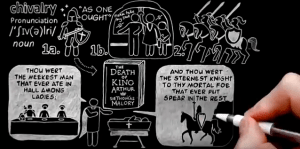
Indeed, even apart from wartime, it is vital that society has heroes to protect sheep from wolves. In a moment I will share with you a brief video featuring an amazing artistic rendering of this essay on chivalry.*

In the essay, Lewis’ examples span Western history. He uses Launcelot as the archetype of the chivalrous man. And he offers the hope and evidence that chivalry is not extinct. A veteran of the previous war, he wrote at the outset of the Second World War:

Launcelot is not yet irrecoverable. To some of us this war brought a glorious surprise in the discovery that after twenty years of cynicism and cocktails the heroic virtues were still unimpaired in the younger generation and ready for exercise the moment they were called upon. Yet with this “sternness” there is much “meekness;” from all I hear, the young pilots in the R.A.F. (to whom we owe our life from hour to hour) are not less, but more, urbane and modest than the 1915 model. (“The Necessity of Chivalry”)

And accordingly, in our own day there are many serving in uniform who exemplify the same virtues. Would, though, that all who bear arms could be described thusly.

Some who are reading these words may regard chivalry as a “sexist” concept. It is not. Certainly no more than courage, strength and virtue could be deemed such. The fact that Lewis’ historical examples of society’s defenders are men simply reflects history.

In the seventy-five years since he wrote, it has become evident that women too can easily embody both meekness and unyielding courage. One need look no further than the ranks of the military and law enforcement to see this borne out.

Chivalry for the Civilian

It would be a tragic mistake to think that chivalry is only required during war. It is a vital, daily necessity of all social life. And the increasing incivility of the world suggests its erosion. (Many attribute this in part to the anonymity of the internet, which allows bullies to savage others anonymously and without mercy.)

This is what Lewis was saying when he described Launcelot as being “not a compromise or happy mean between ferocity and meekness; he is fierce to the nth and meek to the nth.”

After all, it is not the bland or “lukewarm” person who makes this world a better place. It is upon chivalrous men and women that the majority of the vulnerable must ever rely.

Each of us needs to be willing to examine our own lives for the union of these two traits: courage that does not surrender to what is wrong, and meekness that is gentle, calm and patient with others.

These are the values that we need to promote in our communities, media and schools. Because what we instill in receptive minds is precisely that which will take root. To use more contemporary terms, the “programming” these young minds are subject to will directly influence the behaviors that they “output.”

Let us do all we are capable of, to be, and to raise up, what is chivalrous. After all, despite all of the utopian promises of those who believe humanity is capable of purifying itself, the evidence shows otherwise. As Lewis said,

There was, to be sure, a rumour in the last century that wolves would gradually become extinct by some natural process; but this seems to have been an exaggeration.

Enjoy this fine presentation of  “The Necessity of Chivalry.”

_____

* This video is a creation of CSLewisDoodle, about which I have written before. (Their name may sound quaint, but the expertise with which they visualize Lewis’ words is astounding.)

Tolkien, Lewis & Barth on Myth

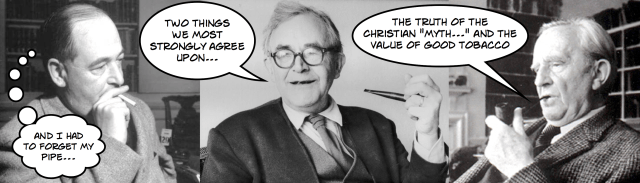
barthOne wonders what sort of fireworks might have erupted if J.R.R. Tolkien and C.S. Lewis had spent an evening with theologian Karl Barth. Although their lives overlapped, and all three were Christian academics, it is questionable how much they would have agreed upon.

And yet, there were several subjects where I think they would have enjoyed firm consensus.

Tolkien (1892-1973) was a devout Roman Catholic. Lewis (1898-1963) was a committed “low church” Anglican. Barth (1886-1968) was a Reformed theologian who rejected the liberalism that had become dominant in European academies. All three thus believed in the reality of the Christian gospel of salvation through Jesus Christ.

All three men hated war, and the two Brits had served in the trenches of WWI. All opposed Nazism and Barth was the primary author of the Barmen Declaration which challenged the Christian faith of all who supported the Nazi government.

And we’ll consider another shared attribute in just a moment.

First, though, we need to acknowledge that presumably the Inklings never met the Swiss clergyman. Their circles did not overlap. I have not been able to uncover any evidence of Tolkien referring to Barth, or of Barth mentioning either of the Inklings.

Lewis did, however mention Barth in his prolific correspondence. From his exposure to Barth it’s clear he did not share the opinion of Pope Pius XII that he was “the greatest theologian since Thomas Aquinas.” Heady praise . . . especially coming from a Roman Catholic.

In a 1940 letter to his brother Warren, Lewis reacted against what he perceived as legalism in some quarters of Protestantism that was alien to his understanding of the liberty of the Christian.

I am afraid the truth is . . . that the world, as it is now becoming and has partly become, is simply too much for people of the old square-rigged type like you and me. I don’t understand its economics, or its politics, or . . . Even its theology—for that is a most distressing discovery I have been making these last two terms as I have been getting to know more and more of the Christian element in Oxford.

Did you fondly believe—as I did—that where you got among Christians, there, at least, you would escape (as behind a wall from a keen wind) from the horrible ferocity and grimness of modern thought.

Not a bit of it. I blundered into it all, imagining that I was the upholder of the old, stern doctrines against modern quasi-Christian slush: only to find that my ‘sternness’ was their ‘slush.’ They’ve all been reading a dreadful man called Karl Barth, who seems the right opposite number to Karl Marx. ‘Under judgment’ is their great expression.

They all talk like Covenanters or Old Testament prophets. They don’t think human reason or human conscience of any value at all: they maintain, as stoutly as Calvin, that there’s no reason why God’s dealings should appear just (let alone, merciful) to us: and they maintain the doctrine that all our righteousness is filthy rags with a fierceness and sincerity which is like a blow in the face.

Sometimes the results are refreshing: as when Canon Raven (whom you and Dyson and I sat under at Ely) is sharply told in a review in Theology that ‘it is high time persons of this sort learned that the enjoyment of a chair of theology at Cambridge does not carry with it a right to criticise the Word of God’—that’s the kind of rap on the knuckles which has not been delivered for a hundred years!

Comparing Their Thoughts on the Nature of Myth

Many readers of Mere Inkling will know Tolkien and Lewis were deeply influenced by the significance of myth. They were also, in the creation of Middle Earth and Narnia, active in the act of mythopoeia, creating imaginary lands whose stories convey profound meaning.

But, despite the fact their literary products are fictional, that does not mean that all myth is “untrue,” in the sense of being unhistorical. Myth, for these great thinkers, is something far more complex and wonderful.

Without going into depth on this involved subject, I offer here the familiar story of how Lewis’ epiphany about true myth was key to his conversion.

I was by now too experienced in literary criticism to regard the Gospels as myths. They had not the mythical taste. And yet the very matter which they set down in their artless, historical fashion . . . was precisely the matter of the great myths. If ever a myth had become fact, had been incarnated, it would be just like this. And nothing else in all literature was just like this.

Myths were like it in one way. Histories were like it in another. But nothing was simply like it.

And no person was like the Person it depicted; as real, as recognizable, through all that depth of time, as Plato’s Socrates . . . yet also numinous, lit by a light from beyond the world, a god.

But if a god—we are no longer polytheists—then not a god, but God. Here and here only in all time the myth must have become fact; the Word, flesh; God, Man. This is not “a religion,” nor “a philosophy.” It is the summing up and actuality of them all. (Surprised by Joy)

This epiphany took place in 1931, during an all-night discussion (it lasted until 4:00 am) with Tolkien, and other Inkling, Hugo Dyson. Here’s how Lewis related the moment to his lifelong friend, Arthur Greeves.

It was really a memorable talk. We began (in Addison’s walk just after dinner) on metaphor and myth–interrupted by a rush of wind which came so suddenly on the still, warm evening and sent so many leaves pattering down that we thought it was raining.

We all held our breath, the other two appreciating the ecstasy of such a thing almost as you would. We continued (in my room) on Christianity: a good long satisfying talk in which I learned a lot . . .

A month later he elaborated on how the insights gained that evening were gestating in his mind and heart.

Now what Dyson and Tolkien showed me was this: that if I met the idea of sacrifice in a Pagan story I didn’t mind it at all: again, that if I met the idea of a god sacrificing himself to himself (cf. the quotation opposite the title page of Dymer) I liked it very much and was mysteriously moved by it: again, that the idea of the dying and reviving god (Balder, Adonis, Bacchus) similarly moved me provided I met it anywhere except in the Gospels.

The reason was that in Pagan stories I was prepared to feel the myth as profound and suggestive of meanings beyond my grasp even tho’ I could not say in cold prose ‘what it meant.’

Now the story of Christ is simply a true myth: a myth working on us in the same way as the others, but with this tremendous difference that it really happened: and one must be content to accept it in the same way, remembering that it is God’s myth where the others are men’s myths: i.e. the Pagan stories are God expressing Himself through the minds of poets, using such images as He found there, while Christianity is God expressing Himself through what we call ‘real things.’

Therefore it is true, not in the sense of being a ‘description’ of God (that no finite mind could take in) but in the sense of being the way in which God chooses to (or can) appear to our faculties. The ‘doctrines’ we get out of the true myth are of course less true: they are translations into our concepts and ideas of that which God has already expressed in a language more adequate, namely the actual incarnation, crucifixion, and resurrection.

Does this amount to a belief in Christianity? At any rate I am now certain (a) That this Christian story is to be approached, in a sense, as I approach the other myths. (b) That it is the most important and full of meaning. I am also nearly certain that it really happened.

In a different setting, Barth argued for the very same truth. His context was a theological environment greatly influenced by the liberal doctrines of Rudolf Bultmann, who dismissively regarded anything miraculous in the Scriptures as primitive and ignorant thinking.

The Christian Church confesses that [what the world calls] “myth” is history itself. She recognizes herself by this myth, she recognizes her life, her true reality. She is the witness of witnesses, she recognizes through the Holy Spirit that this is the one really interesting story.

Then she turns back the historians’ weapon: She says to them: What you call “myth,” that is history! She will also add: What you call history, that is a myth! A myth, a made-up history, that fancies the fate of man as depending on his earthly vicissitudes, a myth, a made-up history, that confuses the immediate success of a cause with its truth, and so on.

The only true history is the history of Christ, in which the Church participates, and which is already the secret reality of all history, since it is history itself. (The Faith of the Church)

Now, there’s an argument the Inklings could truly have appreciated.

A Bonus, for Fans of Dietrich Bonhoeffer

Barth was not the only Christian seminary professor who rejected the heresies of Bultmann, who sought to “demythologize” the Scriptures. Dietrich Bonhoeffer, a fellow German, repudiated Bultmann’s rejection of the supernatural in God’s Word. In a recent book, Taking Hold of the Real, Barry Harvey writes:

In a prison letter [Bonhoeffer] criticizes Rudolf Bultmann for excising the “mythological” elements in an attempt to reduce Christianity to its “essence.” “My view,” he writes, “is that the full content, including the ‘mythological’ concepts, must remain—the New Testament is not a mythological dressing up of a universal truth, but this mythology (resurrection and so forth) is the thing itself.”

Bonhoeffer thus acknowledges that describing a way of seeing the world as mythic thus does not summarily dismiss it either as deceptive or as an archaic and feeble attempt at doing “science.” Indeed, a truthful description of the world and especially of human existence ultimately requires mythic form.

The tales that women and men have fashioned and passed down through the centuries to discern the overall sense and significance of their existence are “never just ‘lies,’” says Tolkien, as “there is always something of the truth in them.”

Tolkien, C.S. Lewis and Music

albumHave you ever written something that inspired a musician to compose new music? J.R.R. Tolkien hoped to do so one day, and had he lived to hear the scores of the Lord of the Rings trilogy created by Howard Shore, he would have been in awe.

I was reading Tolkien’s correspondence last week and came across a fascinating letter he wrote to a musician who was requesting permission to write a serious composition based on The Hobbit.

This would have been quite different than the quaint “Ballad of Bilbo Baggins,” made famous by Leonard Nimoy. (I wish their choreographer had read the book, so we could have been spared the tiny T-Rex arms sported during the chorus by the dancers.)

Anyway, returning to more serious musical ventures, in 1964 Tolkien received a request for permission to write a “Hobbit Overture.” It came from British composer Carey Blyton (1932-2002) who would become best known for his song “Bananas in Pyjamas.”

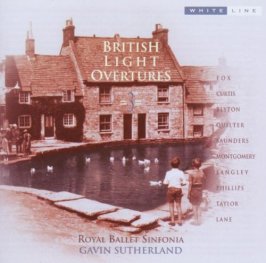
Tolkien’s response to the composer’s query is fascinating, on several levels. First, he is gracious in extending his permission, without any restrictions. And, in 1967 Blyton did compose “The Hobbit” Overture, opus 52a. It appears on the CD, British Light Overtures 3.

Secondly, he shares his unspoken desire that his work might someday inspire music. Then he makes a curious comment about the illustrations of Pauline Baynes, which would similarly grace the work of C.S. Lewis.

After that, Tolkien describes his own, musically impoverished, upbringing. Finally he expresses his deep appreciation for good music, despite his lack of knowledge on the subject.

And Tolkien accomplishes all of this in just a handful of sentences!

You certainly have my permission to compose any work that you wished based on The Hobbit. . . . . As an author I am honoured to hear that I have inspired a composer. I have long hoped to do so, and hoped also that I might perhaps find the result intelligible to me, or feel that it was akin to my own inspiration—as much as are, say, some (but not all) of Pauline Baynes’ illustrations. . . . .

I have little musical knowledge. Though I come of a musical family, owing to defects of education and opportunity as an orphan, such music as was in me was submerged (until I married a musician), or transformed into linguistic terms. Music gives me great pleasure and sometimes inspiration, but I remain in the position in reverse of one who likes to read or hear poetry but knows little of its technique or tradition, or of linguistic structure.

It is common for people of sincere Christian devotion, such as Tolkien and Lewis, to express an appreciation for the divine capacity of music to touch the human spirit.

luteMartin Luther, for example, wrote much about music. “Music is God’s greatest gift,” he proclaimed. He was not only a composer of hymns, but also an acceptable player of the lute, which he used to accompany his children during their family devotions.
Music is deeply intertwined with the heart of Christian worship.

C.S. Lewis on the Subject of Music

One of the modest challenges in contrasting fellow Inklings J.R.R. Tolkien and C.S. Lewis results from the significantly different natures of their literary corpora. While they both wrote fantasy, though of a vastly different magnitude, Lewis’ vocation as one of Christianity’s chief modern apologists necessitated that he defend the faith in diverse contexts. Thus, he wrote numerous essays and a number of texts addressing a wide range of considerations that his friend Tolkien never discussed in print.

Because of this distinction, it is relatively simple to discover what Lewis thought about the nature and powers of music. Typical of the man’s practical orientation, Lewis appears little interested in the abstract attributes of music. What interests him is its confluence with human existence. The following profound insight comes from his essay “On Church Music.”

There are two musical situations on which I think we can be confident that a blessing rests. One is where a priest or an organist, himself a man of trained and delicate taste, humbly and charitably sacrifices his own (aesthetically right) desires and gives the people humbler and coarser fare than he would wish, in a belief (even, as it may be, the erroneous belief) that he can thus bring them to God. The other is where the stupid and unmusical layman humbly and patiently, and above all silently, listens to music which he cannot, or cannot fully, appreciate, in the belief that it somehow glorifies God, and that if it does not edify him this must be his own defect.

Neither such a High Brow nor such a Low Brow can be far out of the way. To both, Church Music will have been a means of grace; not the music they have liked, but the music they have disliked. They have both offered, sacrificed, their taste in the fullest sense.

But where the opposite situation arises, where the musician is filled with the pride of skill or the virus of emulation and looks with contempt on the unappreciative congregation, or where the unmusical, complacently entrenched in their own ignorance and conservatism, look with the restless and resentful hostility of an inferiority complex on all who would try to improve their taste—there, we may be sure, all that both offer is unblessed and the spirit that moves them is not the Holy Ghost.

This discussion about church music is particularly interesting due to Lewis’ personal dislike for much of the music used in worship, which I’ve written about before.

Lewis described his own church music pilgrimage in “Answers to Questions on Christianity.”

My own experience is that when I first became a Christian, about fourteen years ago, I thought that I could do it on my own, by retiring to my rooms and reading theology, and I wouldn’t go to the churches . . .

If there is anything in the teaching of the New Testament which is in the nature of a command, it is that you are obliged to take the Sacrament [holy communion], and you can’t do it without going to Church. I disliked very much their hymns, which I considered to be fifth-rate poems set to sixth-rate music. But as I went on I saw the great merit of it.

I came up against different people of quite different outlooks and different education, and then gradually my conceit just began peeling off. I realized that the hymns (which were just sixth-rate music) were, nevertheless, being sung with devotion and benefit by an old saint in elastic-side boots in the opposite pew, and then you realize that you aren’t fit to clean those boots. It gets you out of your solitary conceit.

In “The Weight of Glory,” Lewis addresses this notion that we must look beyond the music itself, to assess its influence on our humanity.

The books or the music in which we thought the beauty was located will betray us if we trust to them; it was not in them, it only came through them, and what came through them was longing. These things—the beauty, the memory of our own past—are good images of what we really desire; but if they are mistaken for the thing itself they turn into dumb idols, breaking the hearts of their worshippers.

For they are not the thing itself; they are only the scent of a flower we have not found, the echo of a tune we have not heard, news from a country we have never yet visited.

Lewis recognized the deep influence and mystery with which music communicates and inspires. It is no accident that Narnia’s creation itself comes through Aslan’s song.

The Lion was pacing to and fro about that empty land and singing his new song. It was softer and more lilting than the song by which he had called up the stars and the sun; a gentle, rippling music. And as he walked and sang the valley grew green with grass. It spread out from the Lion like a pool.

It ran up the sides of the little hills like a wave. In a few minutes it was creeping up the lower slopes of the distant mountains, making that young world every moment softer.

Returning to “On Church Music,” Lewis expands on the importance of our intentions as we approach music.

It seems to me that we must define rather carefully the way, or ways, in which music can glorify God. There is . . . a sense in which all natural agents, even inanimate ones, glorify God continually by revealing the powers He has given them. . . . An excellently performed piece of music, as natural operation which reveals in a very high degree the peculiar powers given to man, will thus always glorify God whatever the intention of the performers may be. But that is a kind of glorifying which we share with the ‘dragons and great deeps,’ with the ‘frost and snows.’

What is looked for in us, as men, is another kind of glorifying, which depends on intention. How easy or how hard it may be for a whole choir to preserve that intention through all the discussions and decisions, all the corrections and the disappointments, all the temptations to pride, rivalry and ambition, which precede the performance of a great work, I (naturally) do not know. But it is on the intention that all depends.

When it succeeds, I think the performers are the most enviable of men; privileged while mortals to honor God like angels and, for a few golden moments, to see spirit and flesh, delight and labour, skill and worship, the natural and the supernatural, all fused into that unity they would have had before the Fall. . . .

We must beware of the naïve idea that our music can ‘please’ God as it would please a cultivated human hearer. That is like thinking, under the old Law, that He really needed the blood of bulls and goats. To which an answer came, ‘mine are the cattle upon a thousand hills,’ and ‘if I am hungry, I will not tell thee.’ If God (in that sense) wanted music, He would not tell us. For all our offerings, whether of music or martyrdom, are like the intrinsically worthless present of a child, which a father values indeed, but values only for the intention.

At the outset of this column I declared Tolkien would have been “in awe” of the musical score written to accompany the Lord of the Rings movies. Lewis too, I believe, would have been impressed by the scores composed for the three Chronicles of Narnia films made thus far. We owe a debt of gratitude to three composers: Howard Shore,* Harry Gregson-Williams,** and David Arnold***.

An Historical Postscript

In the spirit of Lewis and Tolkien, who appreciated the importance of music, we’ll close now with another engaging quotation from the wry pen of Doctor Martin Luther.

I wish all lovers of the unshackled art of music grace and peace from God the Father and from our Lord Jesus Christ! I truly desire that all Christians would love and regard as worthy the lovely gift of music, which is a precious, worthy, and costly treasure given to mankind by God.

The riches of music are so excellent and so precious that words fail me whenever I attempt to discuss and describe them…. In summa, next to the Word of God, the noble art of music is the greatest treasure in the world.

A person who gives this some thought and yet does not regard music as a marvelous creation of God, must be a clodhopper indeed and does not deserve to be called a human being; he should be permitted to hear nothing but the braying of asses and the grunting of hogs.

_____

* Howard Shore has nearly a hundred credits as a composer, conductor and orchestrator on the Internet Movie Database (IMDb). In addition to the Tolkien cinema projects, he has also worked on a number of other very successful films and ninety-six episodes of Saturday Night Live. Shore won three Oscars for his work on Lord of the Rings.

** Harry Gregson-Williams has nearly a hundred credits on the IMDb, including a number of box office successes, a variety of popular video games, and several productions in the Shrek series. He won awards for his work on the Chronicles of Narnia series and another of my favorite films, Kingdom of Heaven.

*** David Arnold, wrote the score for the third Narnia film, The Chronicles of Narnia: The Voyage of the Dawn Treader. He has seventy-three credits listed on IMDb, ranging from this year’s Independence Day: Resurgence, all the way back to a BBC made for tv picture entitled Mr. Stink.

Sharia Law Versus Democracy

chaldean

“Liberal and democratic principles are worth nothing here [in Iraq]. Islam does not say that all men are equal.” (Amal Nona). You cannot state the truth more concisely than that.

Nona is a Chaldean Catholic archbishop who “doesn’t have a diocese anymore. He doesn’t have a church. ISIS destroyed all that, and his people are scattered. But he’s not afraid to speak forthrightly, even when ISIS was at his doorstep.” (“Happy Warriors”)

The Chaldean Catholic Church is no stranger to persecution. They are descendants of the Assyrians who maintained the faith through the Muslim conquest up until today. They are a courageous people, but that is not the subject I wish to address here.

As the archbishop alludes, the reason that Western nations have been utterly unsuccessful in transplanting democracy to countries with Islamic majority populations is that democracy is alien to their worldview.

To the literalist Muslim (i.e. those who accept the words of the Quran at face value), it’s ludicrous to claim that Christians are equal to followers of Islam. Even without appealing to detailed Sharia law, the simple notion that infidels should possess the same rights as the followers of Allah is foolish, or worse. They are dhimmi—second class citizens, at best and actively persecuted and martyred, at worse.

This is the default setting for Islamic nations. Just look at Turkey and Egypt, two nations with actual democratic governments. The terrorist Muslim Brotherhood continues to exert destructive influences in both, and Turkey’s president, Recep Tayyip Erdoğan has used the excuse of the recent coup attempt to further destroy the vestiges of democracy (e.g. free speech) which he has long been undermining. Egypt is currently enjoying a respite after removing Mohamed Morsi, a man with a similar, anti-democratic agenda.

Retired military analyst Ralph Peters recently penned a frightening (and I believe accurate) appraisal of where Erdoğan will take his nation.

The ragtag ISIS caliphate is merely the forerunner of the more ambitious caliphate to come. It’s coming in Turkey.

The immense and destructive crackdown underway in Turkey now, with at least 10,000 Turks taken into custody and as many as 100,000 others dismissed from their positions—not only soldiers, but judges, civil servants, police and academics—isn’t an end-game. It’s a beginning. . . .

Erdoğan didn’t need a reason for this pre-planned purge. He had his reasons and his lists of names. He needed an excuse. The failed coup was a gift.

Now we’re witnesses to the destruction of Turkey’s secular society and the forced-march reversion to religious regimentation and obscurantism, to intolerance and oppressive fundamentalism. This is the triumph of mosque over modernity, not of the rule of law, but of its supersession.

Professors have been forbidden to leave the country. The government demanded the resignation of all the deans of higher-level schools and universities. Book-banning is on the way, and book-burning wouldn’t surprise me in the least.

To those of us in the West, including numerous Muslim immigrants who have recognized the universal benefits of freedom of conscience and equal rights, the historic interpretations of government based on the Quran seem disconcerting. Part of the reason they seem unfathomable, is because we do not take the time to study them. Nor do we listen to the voices of minority populations who have been long subjugated and deprived of what we deem basic human rights.

Archbishop Nona, and others like him, need to be heeded. His warning about the challenge of translating democratic principles, points to the proper beginning place: education. It is no accident that the Muslim countries with the highest educations and most moderate (i.e. non-fundamentalist) adherents replicate democratic freedoms most consistently.

I consider the best course for promoting peace to be educating all people, and encouraging freedom of conscience, especially when it comes to religion and speech. And I recognize that the statement with which we began remains a vital fact that must be recognized at the outset of that effort. The following observation appeared in an article last year.

The lust for power corrupts religion, just as the quest for piety is vulnerable to hubris. As Cengiz Erdoğan, a CHP [minority political party] member who runs a car repair workshop, put it to me: “He’s power-hungry and he’s dedicated to the Islamist way.” Or, as C.S. Lewis once warned: “Of all bad men, religious bad men are the worst.”

The principles guiding Democracies and Republics arose in the Western world. There they found fertile soil. Yet even here in the West, we see on a daily basis that democracy is fragile. Tolkien and Lewis scholar, Joseph Laconte, wrote an “optimistic” essay about the 2015 elections in Turkey. Erdoğan had been prevented from achieving an absolute majority.

The danger, at least for the moment, has been averted. . . . [Some Turks fear] Erdoğan’s early reformist talk was a mere façade for his hardcore Islamism.

That may be reason enough to cheer Turkey’s election results: they offer the hope that corrupted religion will find it harder to derail the nation’s experiment in democratic self-government. More than hope, of course, will be needed. For if secular authoritarianism has left the stage in Turkey, its religious counterpart is waiting hungrily in the wings.

Unfortunately, what political minorities in Turkey feared, is now coming to fruition, with a vengeance.

A Positive Postscript from the Chaldeans

Christianity rejects the notion that any person possesses greater worth than another. In the Christian world there are no castes . . . there are no dhimmi.

Each and every life is precious. In fact, the Good Shepherd is not content to keep the faithful ninety-nine under his protection, he leaves them to go out in search of the one—the individual one—that has strayed.

Chaldean Christians have some of the most ancient roots in Christian history. Despite the fact that most the Assyrian Christians have been driven from their ancestral homes, and are unlikely to ever be allowed to return, they have retained their hope. That is because they do not place their faith in humanity or their own strength. The following description of Archbishop Nona comes from another article.

I’d even go so far as to say that before me is a happy man. Indeed, he tells me: “We were always a minority. We always knew it was not important what we have but what we do. The Lord shows us how it is important to be happy in all situations.”

He emphasizes that the Christian has no other identity than as a Christian. The Gospel is what you want to conform your life to, he says. “For us, we want to practice our identity. We are not another identity. Our identity is to live like Jesus Christ.”

There is no other life, he says, for a Christian. Christ becomes everything, and so there is no life without Christ. “I think all our problems lie in this point: that in our life, sometimes we forget to live like Jesus. It’s not theology, it’s reality.”

It is not difficult to hear echoes of C.S. Lewis in his words. And these come not from a mutual acquaintance between the two . . . rather from a common acquaintance with the Messiah.

In the end, it’s not about theology, philosophies or human political institutions. It’s about a Redeemer.

_____

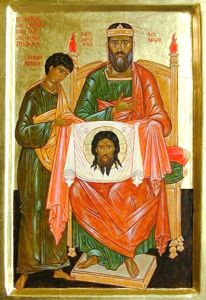
The icon above is of Saint Addai (Thaddeus of Edessa). He was a missionary to Mesopotamia, and contributed to the Divine Liturgy used by much of the Eastern Church. The image portrays Addai presenting the Mandylion to King Abgar of Edessa.