Facebook the Discourager

facebookIt turns out networking on the dominant digital community, Facebook, may have a gloomy downside. A recent study of young adults found that the more time they spent on Facebook, the sadder they became. (A link to the peer-reviewed study appears below.)

The researchers ominously warn, “On the surface, Facebook provides an invaluable resource for fulfilling the basic human need for social connection. Rather than enhancing well-being, however, these findings suggest that Facebook may undermine it.”

Most readers of Mere Inkling possess social networking accounts. In light of that fact, we will have a gut reaction to this allegation, invariably based upon our own experience.

Some will assume, I don’t get depressed reading posts on Facebook, so that study must be wrong.

Others may think, I can see how everyone’s reports on their achievements could discourage a friend whose life isn’t progressing nearly as well. In fact, some of us may have read about the accomplishments of our peers and felt a nagging pang that we don’t quite measure up.

To be fair, the problem doesn’t lie with Facebook per se, it’s a consequence of the human condition. No matter how self-confident a person appears, there is a seed of insecurity within each of us. Christians would trace it back to humanity’s fall, but whatever its source, we innately recognize that we are not the true masters of our own destiny.

Even if we make every choice afforded us correctly, there are accidents, diseases, whims of genetic imperfection and assorted other things that remind us of our vulnerabilities.

It is not actually our insecurity that creates the dynamic where Facebook can become a great discourager. The cause is more insidious than a mere awareness of our own dependency.

The reason we are saddened by the success and happiness of others—even those we love—is due to envy. That’s an ugly word, and it’s not something we want to foster in our lives. In fact, whenever it rears its head, we strive to crush it with our heel.

The truth is that most of us subconsciously experience this feeling far more often than we are aware. It could, for example, be as simple as longing for a sporty new car or muscular new truck like the one that just passed us on the road . . . or wishing that our makeup accented our features or our clothes flattered our bodies as nicely as someone we passed on the sidewalk.

Envy can be especially evident at events like high school class reunions. As the decades pass, it becomes simpler to contrast the (external) accomplishments of classmates who once shared seemingly equal opportunities.

You can find envy everywhere, even (God forbid) in churches. That’s why James included the following in his letter to the Church.

My brothers, show no partiality as you hold the faith in our Lord Jesus Christ, the Lord of glory. For if a man wearing a gold ring and fine clothing comes into your assembly, and a poor man in shabby clothing also comes in, and if you pay attention to the one who wears the fine clothing and say, “You sit here in a good place,” while you say to the poor man, “You stand over there,” or, “Sit down at my feet,” have you not then made distinctions among yourselves and become judges with evil thoughts?

Listen, my beloved brothers, has not God chosen those who are poor in the world to be rich in faith and heirs of the kingdom, which he has promised to those who love him? But you have dishonored the poor man. (James 2:1-7, ESV).

In an essay entitled “Democratic Education,” C.S. Lewis noted, “Envy is insatiable. The more you concede to it the more it will demand.” Lewis also included it in his description of the damned.

We must picture Hell as a state where everyone is perpetually concerned about his own dignity and advancement, where everyone has a grievance, and where everyone lives the deadly serious passions of envy, self-importance, and resentment. (The Screwtape Letters).

Facebook doesn’t cause us to envy, it merely offers us the frequent opportunity to hear about the joys of others and wish we experienced the same. (Far be it from us to ponder the fact that our acquaintances seldom write about their own disappointments, insecurities, or worries.)

There’s really only one way to reduce the influence of envy in our lives. It comes from understanding how truly precious—how intensely loved—we are, by our Creator. When we understand that he loved each of us so deeply that he was willing to allow his only begotten Son to die in our place . . . only then can we comprehend that we need envy nothing.

Confident in that merciful love, the murderer Paul of Tarsus was able to rest in God’s forgiveness and write:

I have learned in whatever situation I am to be content. I know how to be brought low, and I know how to abound. In any and every circumstance, I have learned the secret of facing plenty and hunger, abundance and need. I can do all things through him who strengthens me. (Philippians 4:11b-13).

_____

The study, “Facebook Use Predicts Declines in Subjective Well-Being in Young Adults,” is available through the Public Library of Science here.

Boot Camp Religion

drill instructorShould pastors be more like cheerleaders, or drill instructors? That’s an interesting question recently posed by the president of World Vision United States.

While flying to Saint Louis, I brought along several magazines I hadn’t had an opportunity to read. (The opportunity to read for an extended period is about the only thing I still enjoy about long distance travel.)

One of the magazines included a review of Unfinished: Believing is Only the Beginning by Richard Stearns.

It included an interesting comparison which intrigued both as a pastor and a military chaplain.

The great commandments of Scripture have now become just great suggestions, offered like fortune cookies, to take with us or leave behind in the pews. Jesus said, “If anyone would come after me, he must deny himself and take up his cross daily and follow me” (Luke 9:23). If churches are going to lead a revolution to change the world, then our pastors need to act and speak less like spiritual cheerleaders and more like drill sergeants.

It’s a valid question. But, the truth is that we are talking about a spectrum, not an either/or dichotomy. A pastor should never be a mere cheerleader. Nor should a minister ever be a simple drill sergeant.

Being a pastor is much more complex than either of those labels. Far better to use the metaphor of shepherd.

The author’s point is well made though. In our current “feel good” age, with its divinization of the notion of self esteem, many clergy seem to think their primary role is to “encourage” the saints. They forget that we should be encouraging them to do something. Something, perhaps, like running a race.*

That’s actually the theme of the book—Christian discipleship. Following Christ more closely each day, as we correspondingly come to more and more resemble our Father.

Disciples are not expected to just “talk the talk” of obedience; they are to “walk the walk.” Studying the blueprint in Scripture means that we follow its instructions. It requires that we obey what Scripture teaches. Anyone seeking to truly know God’s calling on his or her life must be serious about obedience. Do we really think that God is going to give a critical kingdom assignment to someone who hasn’t been faithful in day-to-day obedience to his commands?

There’s even a passing C.S. Lewis reference in Unfinished, albeit not a particularly flattering one. The author doesn’t actually speak ill of the Oxford don, but he does criticize the way that some preachers tend to “proof text” their message with pertinent quotations. (I avoid taking personal umbrage at the criticism, since the point Stearns is making is quite valid.)

Far too many Sunday sermons bat around theological ideas like badminton birdies for half an hour. They quote a few verses of Scripture, tell a few stories, throw in a line or two from C.S. Lewis or Dietrich Bonhoeffer, but never challenge the congregation to change anything in their lives.

The sermon is offered like a piece of gum for congregants to chew on for half an hour, but as soon as they get to the parking lot, most will spit it out. The job of the church is not merely to explain the truth but, rather, to use the truth to bring about life change.

I’ve never been accused of preaching chewing gum sermons myself, but I know exactly what he is alluding to.

Unfinished doesn’t actually object to quoting Lewis, just to a shallow, formulaic approach to sermon preparation. The book, in fact, includes several Lewisian citations of its own, referencing no fewer than four of his works.

As a fellow writer and theologian who loves quoting C.S. Lewis, I’ll forgo pointing out the irony.

_____

* The role of the coach, as in training athletes for their competition, is a useful image. Note 1 Corinthians 9:24-25, “Do you not know that in a race all the runners run, but only one receives the prize? So run that you may obtain it. Every athlete exercises self-control in all things. They do it to receive a perishable wreath, but we an imperishable.”

Also, Hebrews 12:1-2, “Therefore, since we are surrounded by so great a cloud of witnesses, let us also lay aside every weight, and sin which clings so closely, and let us run with endurance the race that is set before us, looking to Jesus, the founder and perfecter of our faith, who for the joy that was set before him endured the cross, despising the shame, and is seated at the right hand of the throne of God.”

Writing Life Scripts

ben hurI was shaped by the heroic religious films of the 1950s and 60s. The powerful messages of epic movies like Ben Hur, Quo Vadis and The Robe planted within my young Christian heart an awareness of nobility and radical self-sacrifice.

About twenty years ago, I spent a year doing graduate work in education. One of my Educational Psychology classes was taught by a professor who was a devotee of Transactional Analysis. I don’t recall too much about TA, aside from one of its principles that resonated with me.

It’s a concept called Life Scripts. Without going into great detail, it is an often subconscious notion of how we “think” our lives will or should play out. It’s adjusted throughout our lives, but the basic theme is established when we are quite young.*

A recent article says “script is broadly understood as a series of decisions, formed as coping strategies in childhood, which continue to shape the life course outside of awareness.”**

It was only as an adult that I realized just how significant an impression these virtuous stories made on me. I recalled the countless times I lay in bed at night rehearsing the story of The Robe. I was the unbelieving Roman soldier, converted by the gentle witness of the wrongfully persecuted Christians.*** Ultimately, I took my stand with them, defending them and voluntarily laying down my life for Christ.

That same plot line still echoes through my mind and soul.

I consider myself blessed to have been exposed to such positive influences while my self identity was being shaped. And I pray for children today whose parents allow them to be exposed (at terribly vulnerable ages!) to violent, fearful and morally ambiguous influences.

Those precious minds and hearts are scarred by the vulgarity and immorality that are endemic in modern cinema, television and music. May God have mercy on them.

C.S. Lewis lived during the era when the virtuous dramas such as those named above were at the peak of their influence.

In a diary entry from the mid-1920s, he mentions Quo Vadis in passing. He is describing his weekend schedule.

Saturday 22 April: Got up about 6.30 and did the same jobs as yesterday. Was settled to work by 9.5 o’clock and put in an excellent morning . . . Sheila Gonner—jolly child—came to tea. Dorothy is to come back tomorrow: so we shall no longer be servantless. At her request I lent her my crib to Tacitus’ History for her sister Rose— I wonder what makes her imagine that she would like it? Possibly early Christian novels of the Quo Vadis type. Worked again after tea, and from supper till ten o’clock, finishing Herodotus. The last few pages of the IXth Book I now read for the first time, having got tired of it on my first reading . . .

I find this diary passage intriguing, in the way that Lewis posits a reader’s potential interest in classical literature as arising from their exposure to ancient Rome via contemporary novels. That’s precisely where my own lifelong fascination with the Roman empire was born.

If you’ve never seen these three movies, I commend them to you. I would also encourage you to consider reading one or all of the novels. They are available for free download in various digital formats.

Quo Vadis

Ben Hur

The Robe

_____

* I’m a pastor and historian, not a psychologist, so I don’t pretend to understand all of the implications. Because of that, I don’t endorse TA as a fully valid theory. What’s more, in our fallen world it’s obvious that many early “life scripts” can be based on wounds inflicted on neglected or abused children. In such cases, particularly where the scripts are destructive, we are not “destined” to live out a tragedy. By the grace of God, even the saddest of stories can be redeemed and “rewritten” into tales of hope and wonder.

** From “Script or Scripture?” by Jo Stuthridge in Life Scripts edited by Richard Erskine (Karnac Books, 2010).

*** It didn’t hurt that the main Christian disciple in the film was the lovely and chaste Diana, played by the British actress Jean Simmons. But that’s another story, and it’s important to note that these life scripts are pre-pubescent creations, so they are motivated by much deeper impulses than hormones. As the previously footnoted quotation referred to them, they are fundamentally “coping strategies” for survival in the calm (or frequently turbulent) world in which children find themselves.

Unimpressive Clergy

sheeps clothingI recently read something alarming. Apparently pastors merit little respect nowadays.

I guess that didn’t surprise me, but it did sadden me, that the once respected “profession” of the ministry has fallen so far in the public’s esteem.

Christianity Today, a fine magazine, reported a Pew Research poll that inquired as to whether people believed that “pastors contribute ‘a lot’ to the well-being of society.”

37% of adults agreed

52% of weekly churchgoers agreed

I’m not surprised only a third of the general American population agrees with that notion . . . but I’m amazed that only half of the people who actually attend religious services concur with the statement.

Only half of the people who go to church think pastors do anything worthwhile!

Perhaps they’re like most people who think so little of members of Congress. They like their own representatives and senators (readily reelecting them), but hold the rest of Congress in disdain.

Students of poll-taking recognize the results depend on a wide range of factors. Most significant is precisely how the question is posed. I suppose the phrasing “a lot” to rate magnitude of the clergy’s contribution could account for some of the negative responses.

Still, it’s logical that most of the people who disagreed with the premise, really do possess a low opinion of clergy. In the wake of child abuse scandals and those infrequent but well publicized cases where ministers commit outrageous crimes, it should come as no surprise.

I suppose it wouldn’t bother me quite so much that clergy were held in low regard, if I wasn’t a pastor myself.

But, as I was ruminating over this gloomy fact, it dawned on me that I actually share the less than glowing opinion of many of the poll’s respondents. I too don’t think that highly of many of the so-called ministers out there either. Especially the self-ordained ones or those pseudo-clergy who just buy a diploma off the internet. (The latter group really irritates me, since I belong to a denomination that requires four full years of seminary education prior to ordination.)

Not that education is all that significant in evaluating ministries. Many highly dedicated and productive ministers never attended seminary at all. And, on the reverse side of the coin, many people who have highly advanced theological degrees are self-aggrandizing hypocrites.

I’m reminded of one of my favorite passages from C.S. Lewis’ allegory about the separation between heaven and hell. In The Great Divorce he relates a conversation involving a lost soul who was a highly regarded theologian while he was alive.

Lewis calls him the “episcopal ghost,” but that’s not a reference to his denomination, merely his ostentatious persona and the fact that he attained the lofty office of “bishop.” Unfortunately, I’ve met more than one person during my life who greatly resembles the misguided theologian in the story.

I enjoy this particular literary encounter so much that I wrote an article about it for a C.S. Lewis journal some years ago.*

If you’ve never read The Great Divorce, you’re missing out on a real gem. It is one of the very few books I have ever read in a single sitting. Once I began it, I couldn’t put it down. (I know that’s a cliche, but in this case it’s literally true.)

The passage I find so provocative appears below. (I didn’t have the heart to edit it, since some readers will want to follow the entire conversation.) After rereading it, I’m beginning to wonder why anyone in Pew’s poll considered clergy praiseworthy.

To understand the dialog, allow me to set the stage. In this fictional work, various “ghosts” (insubstantial souls of those who died without a relationship to Christ) are met at the outskirts of heaven by “bright people” (redeemed, truly real human beings) with whom they were acquainted during their mortal lives. The redeemed individuals attempt to persuade the lost to desire in some small way to draw close to God, so that they might continue a journey drawing closer to his grace.

In this scenario, the two men were both liberal theologians, but one of them, before he died, came to believe that what the Scriptures teach was actually true.

_____

* “Confused Clerics,” The Lamp-Post 18.1 (March 1994): 15-22.

One Sad Pastor

‘My dear boy, I’m delighted to see you,’ [the Ghost] was saying to the Spirit, who was naked and almost blindingly white.** ‘I was talking to your poor father the other day and wondering where you were.’

‘You didn’t bring him?’ said the other.

‘Well, no. He lives a long way from the bus, and, to be quite frank, he’s been getting a little eccentric lately. A little difficult. Losing his grip. He never was prepared to make any great efforts, you know. If you remember, he used to go to sleep when you and I got talking seriously! Ah, Dick, I shall never forget some of our talks. I expect you’ve changed your views a bit since then. You became rather narrow-minded towards the end of your life: but no doubt you’ve broadened out again.’

‘How do you mean?’

‘Well, it’s obvious by now, isn’t it, that you weren’t quite right. Why, my dear boy, you were coming to believe in a literal Heaven and Hell!’

‘But wasn’t I right?’

‘Oh, in a spiritual sense, to be sure. I still believe in them in that way. I am still, my dear boy, looking for the Kingdom. But nothing superstitious or mythological…’

‘Excuse me. Where do you imagine you’ve been?’

‘Ah, I see. You mean that the grey town with its continual hope of morning (we must all live by hope, must we not?), with its field for indefinite progress, is, in a sense, Heaven, if only we have eyes to see it? That is a beautiful idea.’

‘I didn’t mean that at all. Is it possible you don’t know where you’ve been?’

‘Now that you mention it, I don’t think we ever do give it a name. What do you call it?’

‘We call it Hell.’

‘There is no need to be profane, my dear boy. I may not be very orthodox, in your sense of that word, but I do feel that these matters ought to be discussed simply, and seriously, and reverently.’

‘Discuss Hell reverently? I meant what I said. You have been in Hell: though if you don’t go back you may call it Purgatory.’

‘Go on, my dear boy, go on. That is so like you. No doubt you’ll tell me why, on your view, I was sent there. I’m not angry.’

‘But don’t you know? You went there because you are an apostate.’

‘Are you serious, Dick?’

‘Perfectly.’

‘This is worse than I expected. Do you really think people are penalised for their honest opinions? Even assuming, for the sake of argument, that those opinions were mistaken.’

‘Do you really think there are no sins of intellect?’

‘There are indeed, Dick. There is hide-bound prejudice, and intellectual dishonesty, and timidity, and stagnation. But honest opinions fearlessly followed—they are not sins.’

‘I know we used to talk that way. I did it too until the end of my life when I became what you call narrow. It all turns on what are honest opinions.’

‘Mine certainly were. They were not only honest but heroic. I asserted them fearlessly. When the doctrine of the Resurrection ceased to commend itself to the critical faculties which God had given me, I openly rejected it. I preached my famous sermon. I defied the whole chapter. I took every risk.’

‘What risk? What was at all likely to come of it except what actually came—popularity, sales for your books, invitations, and finally a bishopric?’

‘Dick, this is unworthy of you. What are you suggesting?’

‘Friend, I am not suggesting at all. You see, I know now. Let us be frank. Our opinions were not honestly come by. We simply found ourselves in contact with a certain current of ideas and plunged into it because it seemed modern and successful. At College, you know, we just started automatically writing the kind of essays that got good marks and saying the kind of things that won applause. When, in our whole lives, did we honestly face, in solitude, the one question on which all turned: whether after all the Supernatural might not in fact occur? When did we put up one moment’s real resistance to the loss of our faith?’

‘If this is meant to be a sketch of the genesis of liberal theology in general, I reply that it is a mere libel. Do you suggest that men like…’

‘I have nothing to do with any generality. Nor with any man but you and me. Oh, as you love your own soul, remember. You know that you and I were playing with loaded dice. We didn’t want the other to be true. We were afraid of crude salvationism, afraid of a breach with the spirit of
the age, afraid of ridicule, afraid (above all) of real spiritual fears and hopes.’

‘I’m far from denying that young men may make mistakes. They may well be influenced by current fashions of thought. But it’s not a question of how the opinions are formed. The point is that they were my honest opinions, sincerely expressed.’

‘Of course. Having allowed oneself to drift, unresisting, unpraying, accepting every half-conscious solicitation from our desires, we reached a point where we no longer believed the Faith. Just in the same way, a jealous man, drifting and unresisting, reaches a point at which he believes lies about his best friend: a drunkard reaches a point at which (for the moment) he actually believes that another glass will do him no harm. The beliefs are sincere in the sense that they do occur as psychological events in the man’s mind. If that’s what you mean by sincerity they are sincere, and so were ours. But errors which are sincere in that sense are not innocent.’

‘You’ll be justifying the Inquisition in a moment!’

‘Why? Because the Middle Ages erred in one direction, does it follow that there is no error in the opposite direction?’

‘Well, this is extremely interesting,’ said the Episcopal Ghost. ‘It’s a point of view. Certainly, it’s a point of view. In the meantime…’

‘There is no meantime,’ replied the other. ‘All that is over. We are not playing now. I have been talking of the past (your past and mine) only in order that you may turn from it forever. One wrench and the tooth will be out. You can begin as if nothing had ever gone wrong. White as snow. It’s all true, you know. He is in me, for you, with that power. And—I have come a long journey to meet you. You have seen Hell: you are in sight of Heaven. Will you, even now, repent and believe?’

‘I’m not sure that I’ve got the exact point you are trying to make,’ said the Ghost.

‘I am not trying to make any point,’ said the Spirit. ‘I am telling you to repent and believe.’

‘But my dear boy, I believe already. We may
not be perfectly agreed, but you have completely misjudged me if you do not realise that my religion is a very real and a very precious thing to me.’

‘Very well,’ said the other, as if changing his plan. ‘Will you believe in me?’

‘In what sense?’

‘Will you come with me to the mountains? It will hurt at first, until your feet are hardened. Reality is harsh to the feet of shadows. But will you come?’

‘Well, that is a plan. I am perfectly ready to consider it. Of course I should require some assurances…I should want a guarantee that you are taking me to a place where I shall find a wider sphere of usefulness—and scope for the talents that God has given me—and an atmosphere of free inquiry—in short, all that one means by civilisation and—er—the spiritual life.’

‘No,’ said the other. ‘I can promise you none of these things. No sphere of usefulness: you are not needed there at all. No scope for your talents: only forgiveness for having perverted them. No atmosphere of inquiry, for I will bring you to the land not of questions but of answers, and you shall see the face of God.’

‘Ah, but we must all interpret those beautiful words in our own way! For me there is no such thing as a final answer. The free wind of inquiry must always continue to blow through the mind, must it not? “Prove all things”…to travel hopefully is better than to arrive.’

‘If that were true, and known to be true, how could anyone travel hopefully? There would be nothing to hope for.’

‘But you must feel yourself that there is something stifling about the idea of finality? Stagnation, my dear boy, what is more soul-destroying than stagnation?’

‘You think that, because hitherto you have experienced truth only with the abstract intellect. I will bring you where you can taste it like honey and be embraced by it as by a bridegroom. Your thirst shall be quenched.’

‘Well, really, you know, I am not aware of a thirst for some ready-made truth which puts an end to intellectual activity in the way you seem to be describing. Will it leave me the free play of Mind, Dick? I must insist on that, you know.’

‘Free, as a man is free to drink while he is drinking. He is not free still to be dry.’

The Ghost seemed to think for a moment. ‘I can make nothing of that idea,’ it said.

‘Listen!’ said the White Spirit. ‘Once you were a child. Once you knew what inquiry was for. There was a time when you asked questions because you wanted answers, and were glad when you had found them. Become that child again: even now.’

‘Ah, but when I became a man I put away childish things.’

‘You have gone far wrong. Thirst was made for water; inquiry for truth. What you now call the free play of inquiry has neither more nor less to do with the ends for which intelligence was given you than masturbation has to do with marriage.’

‘If we cannot be reverent, there is at least no need to be obscene. The suggestion that I should return at my age to the mere factual inquisitiveness of boyhood strikes me as preposterous. In any case, that question-and-answer conception of thought only applies to matters of fact. Religious and speculative questions are surely on a different level.’

‘We know nothing of religion here: we think only of Christ. We know nothing of speculation. Come and see. I will bring you to Eternal Fact, the Father of all other fact-hood.’

‘I should object very strongly to describing God as a “fact”. The Supreme Value would surely be a less inadequate description. It is hardly…’

‘Do you not even believe that He exists?’

‘Exists? What does Existence mean? You will keep on implying some sort of static, ready-made reality which is, so to speak, “there”, and to which our minds have simply to conform. These great mysteries cannot be approached in that way. If there were such a thing (there is no need to interrupt, my dear boy) quite frankly, I should not be interested in it. It would be of no religious significance. God, for me, is something purely spiritual. The spirit of sweetness and light and tolerance—and, er, service, Dick, service. We mustn’t forget that, you know.’

‘If the thirst of the Reason is really dead…,’ said the Spirit, and then stopped as though pondering. Then suddenly he said, ‘Can you, at least, still desire happiness?’

‘Happiness, my dear Dick,’ said the Ghost placidly, ‘happiness, as you will come to see when you are older, lies in the path of duty. Which reminds me…Bless my soul, I’d nearly forgotten. Of course I can’t come with you. I have to be back next Friday to read a paper. We have a little Theological Society down there. Oh yes! there is plenty of intellectual life. Not of a very high quality, perhaps. One notices a certain lack of grip—a certain confusion of mind. That is where I can be of some use to them. There are even regrettable jealousies…I don’t know why, but tempers seem less controlled than they used to be. Still, one mustn’t expect too much of human nature. I feel I can do a great work among them. But you’ve never asked me what my paper is about! I’m taking the text about growing up to the measure of the stature of Christ and working out an idea which I feel sure you’ll be interested in. I’m going to point out how people always forget that Jesus (here the Ghost bowed) was a comparatively young man when he died. He would have outgrown some of his earlier views, you know, if he’d lived. As he might have done, with a little more tact and patience. I am going to ask my audience to consider what his mature views would have been. A profoundly interesting question. What a different Christianity we might have had if only the Founder had reached his full stature! I shall end up by pointing out how this deepens the significance of the Crucifixion. One feels for the first time what a disaster it was: what a tragic waste… so much promise cut short. Oh, must you be going? Well, so must I. Goodbye, my dear boy. It has been a great pleasure. Most stimulating and provocative. Goodbye, goodbye, goodbye.’

The Ghost nodded its head and beamed on the Spirit with a bright clerical smile—or with the best approach to it which such unsubstantial lips could manage—and then turned away humming softly to itself ‘City of God, how broad and far.’

_____

** Lewis’ use of the nakedness metaphor here is obviously an allusion to the creation of Adam and Eve who, while in a sinless state, required no clothing. It is in no way lewd. Rather, it is an image of purity.

Claiming Divine Inspiration

inspirationSome Christian writers face a terrifying dilemma. They think God has inspired their work. That may be true. But then they proceed a step further and assume that “if God has given these words to me, they can’t be changed.”

The inference, of course, is that the message is essentially inspired in the same sense as Christians normally view the Holy Scriptures themselves. They become, in a word, inviolate.

It’s almost as though the author has appropriated the words of the Apostle John, who in his Revelation was inspired to write:

I warn everyone who hears the words of the prophecy of this book: if anyone adds to them, God will add to him the plagues described in this book, and if anyone takes away from the words of the book of this prophecy, God will take away his share in the tree of life and in the holy city, which are described in this book. (Revelation 22:18-19, ESV).

Naturally, this mindset can cause a bit of a problem when it rears its head in a writing critique group. I’ve witnessed it more times than I can recall, having been a member of such groups on several continents.

I’ve learned to be extremely cautious in how I attempt to explain to the person that while they may rightly feel that their work is inspired by their faith, it doesn’t necessarily follow that it remains in an unblemished condition . . . as it was received by our imperfect human senses, processed by our imperfect minds, and put into words via our imperfect skills and finite vocabulary.

No matter how gently this is said, most of these individuals don’t last long in writers groups. They drop out when others offer suggestions on how to improve their work, seemingly stunned that everyone else doesn’t simply fall prostrate in adoration at their words. It’s quite sad.

That’s why it was so refreshing to read the following in the preface to J. Budziszewski’s What We Can’t Not Know, which I highly recommend.

It seems to me that every writer should end with gratitude to the one who was in the beginning, and whose very name is Word. A reviewer—a friendly one—once remarked that it seemed strange to see that sort of thanks in a book, as though the author were claiming divine inspiration. Of course, for whatever is amiss in these pages (and there will be much), the blame is mine. But permit me to be grateful if anything in them is true.

I love this paragraph. In part, because I share his sentiments. It echoes my own words, spoken at my military retirement, “attribute to me all of the failings and disappointments in my work, and to God any positive or healing results that followed my ministry.”

This worldview proclaims Soli Deo Gloria,* and simultaneously acknowledges that I am not God. It is good for writers to occasionally be reminded of that fact.

It should come as no surprise that our friend C.S. Lewis offers worthwhile insight into inspiration. In his essay, “The Vision of John Bunyan,” he considers that writer’s comments about how the classic Pilgrim’s Progress came to be.

Lewis begins with a quotation, and offers his own wise insights, with which I will close.

For having now my Method by the end;

Still as I pull’d, it came.

It came. I doubt if we shall ever know more of the process called “inspiration” than those two monosyllables tell us.

Perhaps we may hazard a guess as to why it came at just that moment. My own guess is that the scheme of a journey with adventures suddenly reunited two things in Bunyan’s mind which had hitherto lain far apart.

One was his present and lifelong preoccupation with the spiritual life. The other, far further away and longer ago, left behind (he had supposed) in childhood, was his delight in old wives’ tales and such last remnants of chivalric romance as he had found in chap-books. The one fitted the other like a glove. Now, as never before, the whole man was engaged.

_____

* Glory to God alone or all glory be to God.

Shut Up He Explained

LardnerMy wife and I love that phrase, and we often recall it when we encounter particularly over-strained (or “broken”) grammar. When I encountered it as the title of a book, I was unaware of its original source.

This is where I reveal that I wasn’t an American Lit major in college. (Well, regular readers probably figured that out long ago.)

I had never heard of Ring Lardner until today. (If you don’t recognize his name either, you needn’t feel embarrassed . . . he died eighty years ago.)

Lardner was a well regarded humorist who considered himself a sports writer. One of his satires was entitled The Young Immigrunts. It was a parody of a popular English book, The Young Visitors, which was allegedly written by a young girl.

The Young Immigrunts is fictitiously ascribed to Lardner’s son, Ringgold Wilmer Lardner, Jr. His son was only four, at the time. Later he would become a successful screenwriter, winning an Academy Award for the film M*A*S*H. He also wrote prolifically for the television series.

Perhaps Lardner Junior is best remembered as one of the Communist writers blacklisted in Hollywood. But we need not go into that, since his father was merely using his young son as a surrogate author for the work.

The book takes the form of the ramblings of a child, and its quaintness will appeal to many readers. You can download a copy of it here.

It’s not my own preferred genre, so I won’t be reading it in its entirety, but in small doses, I find it rather entertaining.

A little later who should come out on the porch and set themselfs ner us but the bride and glum [pictured above].

Oh I said to myself I hope they will talk so as I can hear them as I have always wandered what newlyweds talk about on their way to Niagara Falls and soon my wishs was realized.

Some night said the young glum are you warm enough.

I am perfectly comfertible replid the fare bride tho her looks belid her words what time do we arrive in Buffalo.

9 oclock said the lordly glum are you warm enough.

I am perfectly comfertible replid the fare bride what time do we arive in Buffalo.

9 oclock said the lordly glum I am afrade it is too cold for you out here.

Well maybe it is replid the fare bride and without farther adieu they went in the spacius parlers.

I wander will he be arsking her 8 years from now is she warm enough said my mother with a faint grimace.

The weather may change before then replid my father.

Are you warm enough said my father after a slite pause.

No was my mothers catchy reply.

And now the phrase that always makes me smile.

The lease said about my and my fathers trip from the Bureau of Manhattan to our new home the soonest mended. In some way ether I or he got balled up on the grand concorpse and next thing you know we was thretning to swoop down on Pittsfield.

Are you lost daddy I arsked tenderly.

Shut up he explained.

I am curious as to whether or not C.S. Lewis was acquainted with Lardner’s work. It doesn’t quite conform to his literary tastes, but Lewis was so widely read that I think it’s possible he was at least acquainted with who he was.

My research on the matter did produce an interesting juxtaposition between the two authors. I discovered it in a book by Sherwood Wirt, perhaps the last reporter to interview C.S. Lewis (for Decision magazine, of which he was editor). I was privileged to know “Woody,” so I enjoyed finding that he mentioned both men in his book I Don’t Know what Old is, But Old is Older than Me.

With twentieth century fiction we have to be quite selective. In limiting my comments to the American scene, I will pass by many of the great names of fiction — Henry James, Stephen Crane, Edith Wharton, Jack London, Theodore Dreiser, Ring Lardner, William Faulkner, Sherwood Anderson, Sinclair Lewis, Scott Fitzgerald, Ernest Hemingway, James Baldwin, John Steinbeck, Vladimir Nabokov, Norman Mailer, and Truman Capote.

While most of these are excellent writers, I doubt whether they have much to say to today’s older readers that would make life more pleasant, more interesting, or more fruitful in the closing stretches of life’s journey. Nor do I think that these authors have anything worthwhile to say about what lies beyond death. We might better spend our reading hours riding off into the sunset with Louis L’Amour or Zane Grey, rather than punish ourselves with a ghastly tale like In Cold Blood.

We old boys and girls have been around a long time. We know what the world is like. We know sleaze when we see it, and we don’t need contemporary authors to embellish it or explain it to us.

The reading tastes of the American public have been corrupted almost beyond redemption by blasphemy, vulgarity, and scatology, all for the sake of increased book sales to prurient minds. There are, however, many twentieth-century American novels worth reading, such as Margaret Mitchell’s Gone With the Wind, Thornton Wilder’s The Bridge of San Luis Rey, Harper Lee’s To Kill a Mockingbird, Tom Clancy’s The Hunt for Red October, the Savannah quartet of Eugenia Price, and the Sebastian series of James L. Johnson, to name only a few.

Earlier in the century the Christian novels of Lloyd C. Douglas—The Magnificent Obsession, The Robe, and The Big Fisherman—inspired thousands of readers young and old, but no American has since matched his popular appeal.

The demand for detective fiction continues unabated, and no one needs my advice to read Agatha Christie. I would, therefore, limit my remarks to a reference to two British creations, G.K. Chesterton’s Father Brown and Dorothy Sayers’ Lord Peter Wimsey, since both are written from Christian backgrounds. My two favorite Wimsey stories are Busman’s Honeymoon and The Nine Tailors.

In contrast there is a wealth of devotional literature that makes wonderful reading for older people. One can start with the sermons of D.L. Moody, Charles Spurgeon, Samuel P. Jones, Joseph Parker, and T. DeWitt Talmage of the nineteenth century. The early twentieth century gave us Andrew Murray, Ole Hallesby, P.T. Forsyth, and Oswald Chambers, whose writings are hard to surpass. Amy Carmichael’s poetry and prose written in India, have blessed millions of readers. More contemporary are the writings of C.S. Lewis and A.W. Tozer, which carry seeds of greatness.

The passage above comes from the book’s chapter on “Reading.” If you would like to see more, the entire book (although published as recently as 1992) is legally available for your review online.

“Shut up he explained” may not be proper English, but literature doesn’t need to be proper to be entertaining. And even though Lardner is no longer a familiar name, perhaps his writings are worth visiting.

For the moment, knowing the context of this delightful phrase makes the words all the more entertaining to me. After all, like many others, my dad often “explained” the same thing to me!

C.S. Lewis Shrugged

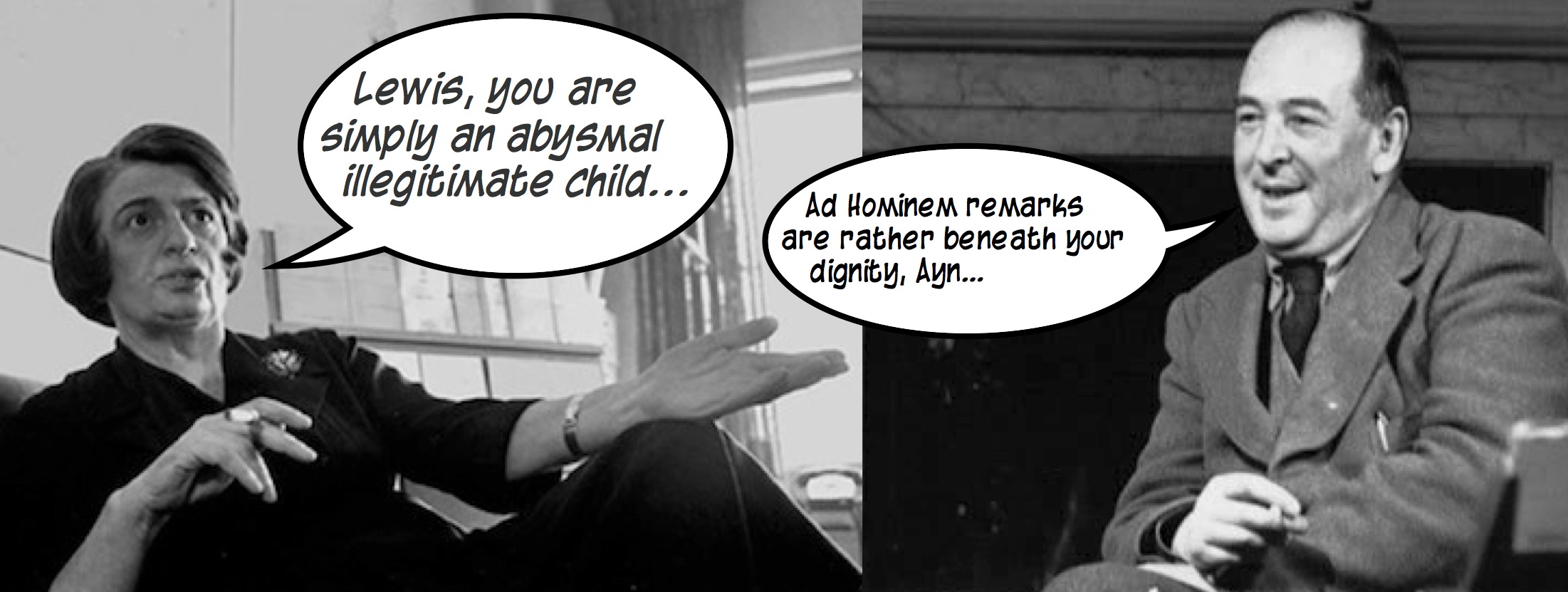
csl & randI just watched another documentary about the controversial Ayn Rand, who wrote Atlas Shrugged. The program, “Ayn Rand & the Prophecy of Atlas Shrugged,” claimed that book is the number one selling hardcover in history (following the Bible, of course).

Although I haven’t read it, I witness it’s growing influence as it becomes more frequently referenced in political discussions. It is a favorite (sometimes even referred to as the “gospel”) of Libertarians.

Rand was a Soviet refugee, and much of what she anticipated, has come to pass. Unbridled government regulations, she predicted, would strangle creativity and production. The welfare state would collapse upon itself as it eroded the incentive to work. In her call for less government interference and oversight, she echoes the concerns of growing numbers of Americans on both the left and the right.

This reflects a reversal of her argument’s reception when it was published. In 1957, the dystopian novel apparently did not receive a single positive review. After William F. Buckley published a scathingly negative review, she never spoke to him again.*

And that raises one of the problems with Rand’s work. In actuality, this flaw is a failing common to all literature. It is difficult to separate what is written from its author. This is especially true when the person who wields the pen possesses a unique or outlandish personality. This was certainly the case with Rand. One of her primary goals was to be provocative.

The title of this column was inspired by a recent post I read entitled, “Ayn Rand Really, Really hated C.S. Lewis.” You can read it at First Things.

In the article, Matthew Schmitz provides excerpts of Rand’s underlining and marginalia (notes) in her copy of Lewis’ Abolition of Man. His opening paragraph says it all, though. [Warning: Those offended by rude language should skip the next paragraph.]

Ayn Rand was no fan of C.S. Lewis. She called the famous apologist an “abysmal bastard,” a “monstrosity,” a “cheap, awful, miserable, touchy, social-meta­physical mediocrity,” a “pickpocket of concepts,” and a “God-damn, beaten mystic.” (I suspect Lewis would have particularly relished the last of these.)

Lewis’ indomitable spirit, as hinted at in Schmitz’ parenthetical comment, is precisely what inspired the title of my post.

So, why am I discussing Rand’s work at all, if she so despised Lewis? Well, because I want to explore just why she was so offended by his philosophy.

There is great irony present here. While Rand devotees and serious Christians would share many fears about oppressive governments . . . they are ill-suited allies.

Despite this commonality, the basic reasons for distrusting secular institutions, and more expressly, their solutions to the problem are diametrically opposed.

For Lewis, the atheist turned Christian apologist, hope comes only from God, not from a laissez faire government. While most Christians do not believe in the “coerced compassion” of unlimited taxation to support people unwilling** to work, we utterly disagree with Rand’s elevation of selfishness as virtue.

And that last phrase is not hyperbole. Rand actually wrote a book entitled The Virtue of Selfishness. She viewed altruism as inherently illogical, and thus, essentially immoral.

So, it’s no surprise she disliked Lewis. He had been delivered from a self-centered worldview, and recognized that we have been created by a loving Father for a grand, and eternal purpose.

In the Christian worldview, selfishness provides evidence of our corruption by the Fall. Our disobedience—our selfish desire to have things our way—is at the root of humanity’s problems.

Altruism, giving of oneself for the welfare of another without anticipation of benefit, is—for the disciple of Jesus—a genuine virtue.

We’ll end this brief discussion of a complex subject with a passage from C.S. Lewis. It is a discussion of altruism (in the context of Moral Law) drawn from Mere Christianity. One can only imagine what Ayn Rand would write in the margins, but I’ll take my stand with Lewis.

Some of the letters I have had show that a good many people find it difficult to understand just what this Law of Human Nature, or Moral Law, or Rule of Decent Behaviour is. For example, some people wrote to me saying, “Isn’t what you call the Moral Law simply our herd instinct and hasn’t it been developed just like all our other instincts?”

Now I do not deny that we may have a herd instinct: but that is not what I mean by the Moral Law. We all know what it feels like to be prompted by instinct—by mother love, or sexual instinct, or the instinct for food. It means that you feel a strong want or desire to act in a certain way. And, of course, we sometimes do feel just that sort of desire to help another person: and no doubt that desire is due to the herd instinct. But feeling a desire to help is quite different from feeling that you ought to help whether you want to or not.

Supposing you hear a cry for help from a man in danger. You will probably feel two desires—one a desire to give help (due to your herd instinct), the other a desire to keep out of danger (due to the instinct for self-preservation).

But you will find inside you, in addition to these two impulses, a third thing which tells you that you ought to follow the impulse to help, and suppress the impulse to run away.

Now this thing that judges between two instincts, that decides which should be encouraged, cannot itself be either of them. You might as well say that the sheet of music which tells you, at a given moment, to play one note on the piano and not another, is itself one of the notes on the keyboard. The Moral Law tells us the tune we have to play: our instincts are merely the keys.

Another way of seeing that the Moral Law is not simply one of our instincts is this. If two instincts are in conflict, and there is nothing in a creature’s mind except those two instincts, obviously the stronger of the two must win. But at those moments when we are most conscious of the Moral Law, it usually seems to be telling us to side with the weaker of the two impulses. You probably want to be safe much more than you want to help the man who is drowning: but the Moral Law tells you to help him all the same.

And surely it often tells us to try to make the right impulse stronger than it naturally is? I mean, we often feel it our duty to stimulate the herd instinct, by waking up our imaginations and arousing our pity and so on, so as to get up enough steam for doing the right thing. But clearly we are not acting from instinct when we set about making an instinct stronger than it is. The thing that says to you, “Your herd instinct is asleep. Wake it up,” cannot itself be the herd instinct. The thing that tells you which note on the piano needs to be played louder cannot itself be that note.

_____

* “Big Sister is Watching You,” written by a former atheist Soviet spy turned Quaker capitalist, is available online here.

** By “unwilling,” I am referring to people capable of supporting themselves, but consciously choosing to live off of the produce of others. While some Christians feel morally compelled to support even these, most would follow the guidance found in II Thessalonians 3:

As for other matters, brothers and sisters, pray for us that the message of the Lord may spread rapidly and be honored, just as it was with you. And pray that we may be delivered from wicked and evil people, for not everyone has faith. . . . May the Lord direct your hearts into God’s love and Christ’s perseverance. . . .

In the name of the Lord Jesus Christ, we command you, brothers and sisters, to keep away from every believer who is idle and disruptive and does not live according to the teaching you received from us. For you yourselves know how you ought to follow our example. We were not idle when we were with you, nor did we eat anyone’s food without paying for it.

On the contrary, we worked night and day, laboring and toiling so that we would not be a burden to any of you. We did this, not because we do not have the right to such help, but in order to offer ourselves as a model for you to imitate.

For even when we were with you, we gave you this rule: “The one who is unwilling to work shall not eat.” We hear that some among you are idle and disruptive. They are not busy; they are busybodies. Such people we command and urge in the Lord Jesus Christ to settle down and earn the food they eat.

Is Slowing Down Possible?

snailEons ago, when I was attending college, I suffered from that common plague—a chronic lack of time.

Between my studies, my job and romancing my future wife, I never had enough hours in the day.

So I did what everyone in that situation does . . . I worked harder. It didn’t solve my dilemma and probably worsened my exhaustion.

During that indescribably busy season of my life God spoke to me through a song. It was recorded by an early “contemporary” Christian group called “Love Song.” At the end of this column you can listen to a recording of the song “Slow Down,” by Chuck Girard. (Don’t skip to it now though, since the link won’t work unless you read the entire post.)

It sounds a bit dated now, forty years after it was composed, but it still conveys a powerful calming message. I hadn’t heard it for years until I just uncovered it for this column, but listening to it today has stilled my sense of urgency as I rush to complete this post before our four grandkids arrive for a weekend visit, in just an hour.

The importance of slowing down and resting is never far from my consciousness, since I am always overextended. Like many of you, I find it extremely difficult to say “no,” so I end up committed to more things than I feel I’m able to do well.

This week I received word of another song, which is what actually inspired me to write on this subject. It’s by a delightful young artist and is much peppier than Girard’s more prayerful message. I believe you’ll enjoy watching the music video below (after you finish reading, of course).

In light of this human need for being reminded to rest, I wondered where C.S. Lewis lamented his own overburdened state. His courtesy in responding to all correspondence is legendary. In addition to teaching, writing, corresponding and (near the end of his life) husbanding, Lewis was far busier than I am.

So, I explored some of Lewis’ words. (That’s never “work,” by the way, since it never fails to reinvigorate me, just like physical rest.) I found the following passage delivers a brilliant insight into why many of us are so compelled to work—work—work.

In the following passage, from a 1930 letter, Lewis relates how our drive to succeed can be linked to our personal ambitions. He couches the discussion in the context of his own desire for renown as a writer. And, Lewis declares, it is only when those misdirected impulses are quelled that we can truly find rest and peace.

From the age of sixteen onwards I had one single ambition [to succeed as a writer], from which I never wavered, in the prosecution of which I spent every ounce I could, on which I really & deliberately staked my whole contentment: and I recognise myself as having unmistakably failed in it. . . .

The side of me which longs, not to write, for no one can stop us doing that, but to be approved as a writer, is not the side of us that is really worth much. And depend upon it, unless God has abandoned us, he will find means to cauterise that side somehow or other. If we can take the pain well and truly now, and by it forever get over the wish to be distinguished beyond our fellows, well: if not we shall get it again in some other form.

And honestly, the being cured, with all the pain, has pleasure too: one creeps home, tired and bruised, into a state of mind that is really restful, when all one’s ambitions have been given up. Then one can really
for the first time say “Thy Kingdom come:” for in that Kingdom there will be no pre-eminences and a man must have reached the stage of not caring two straws about his own status before he can enter it.

Think how difficult that would be if one succeeded as a writer: how bitter this necessary purgation at the age of sixty, when literary success had made your whole life and you had then got to begin to go through the stage of seeing it all as dust and ashes. Perhaps God has been specially kind to us in forcing us to get over it at the beginning.

At all events, whether we like it or not, we have got to take the shock. As you know so well, we have got to die. Cry, kick, swear, we may: only like Lilith to come in the end and die far more painfully and later. . . . I would have given almost anything—I shudder to think what I would have given if I had been allowed—to be a successful writer. . . . I am writing as I do simply & solely because I think the only thing for you to do is absolutely to kill the part of you that wants success.

Powerful words to ponder. Now, without further delay, the aforementioned songs. Profound lyrics in both. Listen to them in either order, keeping in mind that Myla Smith’s is energetic and Chuck Girard’s is meditative. Enjoy . . . and slow down!

“Slow Down” by Myla Smith

“Slow Down” by Chuck Girard

Mensa & C.S. Lewis

crossword puzzleSeveral decades ago, I worked with a Roman Catholic priest, who just happened to be a member of Mensa.

We were good friends, a relationship reinforced by the fact that our bigoted boss thought that both our eternal destinies were in definite jeopardy . . . Pete’s because he was “Catholic,” and mine because Lutherans are “almost Catholic.”

Well, Pete and I got along quite well, although there were two issues we never could resolve. The first was that he smoked large, smelly stogies. Yes, this was long enough ago that you were still allowed to smoke in government buildings.

Even when the rest of the staff successfully begged him to stop parading the halls with his billowing cigars, my friend continued to fill his own office with clouds that would billow out whenever the door was opened.* I had great sympathy for the lungs of the Roman Catholic laity who entered his smoking lounge for counseling.

Aside from the tobacco, there was only a single matter we really disagreed on.

As I mentioned above, Father Pete was a member of Mensa. That’s commendable, in itself. The problem is that he always left his Mensa magazines lying (alone) on the coffee table in the center of his office. He would only smile in a patronizing way when I would (repeatedly) warn him that there could be only two consequences of such brazen self-aggrandizement.

“The first,” I said, “is that they won’t know what Mensa is . . .  and your braggadocio is wasted. The second is worse. They might know what the magazine represents and think to themselves, my, our priest is rather full of himself.” **

At any rate, I have no misconception that I could pass Mensa’s muster. My brain, adequate as it is, simply doesn’t work the way that I guess those of genius’ do. A perfect example of that truth was displayed just a few moments ago, as I read through a few pages of a 2010 Mensa Puzzle Calendar I found among my father’s papers.

I have no doubt that some of you will easily solve this puzzle, but I have to be honest—I missed answering it by a mile.

What do all the words below have in common?

Environment

Bedcovers

Responsibility

Outsource

Confederacy

Slugfest

Jihad

Nunavut

I actually had to look one of the words up. It turns out that “bedcovers” means a bedspread, or anything else one uses to cover a bed. No, seriously, I re-learned that Nunavut is a territory in northern Canada, but I imagine all of you knew that.

Okay, have you taken the time to try to determine what the words have in common? Easy, right?

It turns out that each of them contains a three-letter sequence of adjacent letters in the alphabet, going in reverse. For example, the gfe in “slugfest.”

I doubt I would have been able to figure it out, even if I understood the question, but I must admit my utter ignorance in not even reading the question properly!

I was so enamored by this eclectic collection of words—superficial links between the three combative terms leapt out at me—that I was distracted by seeking bonds between the meanings of the words, rather than in the words themselves. (And, I suspect that may be precisely what those inscrutable devils at Mensa Headquarters intended for simpletons like me.)

Alas, it will take a few days for my bruised ego to rebound. Fortunately, since my memory isn’t as keen as it used to be, I may forget all about this humiliation before the week is out.

C.S. Lewis was a brilliant man. I believe he was a genius. I imagine he could have solved this word puzzle with three-quarters of his mind occupied by higher matters, like watching a wary hedgehog scurry between bushes.

Lewis recognized that our minds are, in fact, a gift from God, to be exercised and celebrated. But, at the same time, he knew better than most the dangers of seeking ultimate meaning in mental pursuits that erect nearly impervious walls to God’s gracious revelation of his love in his only begotten Son.

In The Weight of Glory Lewis explains how those Christians who are blessed with exceptional intelligence owe a duty to their sisters and brothers in the faith. (This, of course, has nothing to do with the subject of holiness or spiritual maturity; there is little or no correlation between piety and intellect.) What he says is, however, worthy of our reflection.

If all the world were Christian, it might not matter if all the world were uneducated. But, as it is, a cultural life will exist outside the Church whether it exists inside or not. To be ignorant and simple now—not to be able to meet enemies on their own ground—would be to throw down our weapons, and to betray our uneducated brethren who have, under God, no defence but us against the intellectual attacks of the heathen.

Good philosophy must exist, if for no other reason, because bad philosophy needs to be answered. The cool intellect must work not only against cool intellect on the other side, but against the muddy heathen mysticisms which deny intellect altogether. Most of all, perhaps, we need intimate knowledge of the past. Not that the past has any magic about it, but because we cannot study the future, and yet need something to set against the present, to remind us that the basic assumptions have been quite different in different periods and that much which seems certain to the uneducated is merely temporary fashion.

A man who has lived in many places is not likely to be deceived by the local errors of his native village: the scholar has lived in many times and is therefore in some degree immune from the great cataract of nonsense that pours from the press and the microphone of his own age. The learned life then is, for some, a duty.

So, let this be a reminder to those of you who qualify for membership in the aforementioned society, but still love Jesus despite your vast intellects. After all, as Jesus once said, from “everyone to whom much was given . . . much will be required” (Luke 12:48, ESV).

_____

* I must confess this is a slight exaggeration, lest I be held accountable for breaking the eighth commandment (or the ninth, if you are Jewish or a Christian of the Reformed persuasion).

** This might not be a verbatim account of the way I said it, although I’m pretty confident that I did use the word “braggadocio.”

A Song Joined Our Family

lyricLast night a new member joined our family. Her name is musical. We didn’t choose it; her previous family did. But we think it fits and she’ll live up to it.

Her name is Lyric.

We adopted Lyric through the agency of DRAW Rescue.

The picture above shows black and white Lyric at her first meeting with her new sister, Foxy. (We didn’t name Foxy either; she joined our family when we “rescued” her from a California shelter six years ago.)

The two girls are getting along quite well their first full day together, but those of you with more than one pet know that it takes a little bit of time to sort things out when a new member joins the family.

Lyric is our third consecutive rescue pet. Although she’s younger than the others who came to us in the past, adopting a rescue dog isn’t the same thing as getting a puppy. You don’t enjoy the same cuddly acceptance. Many rescued dogs are quite wary of human beings—especially men.

It takes time and patience to bond. To let them know that they’re safe and they are now in their “forever home.” Some, like Lyric, benefit from interim stays with gracious foster parents. But their move to your home is still just part of their unstable life until the day when they “forget” about all the previous transitions and just know they are home.

C.S. Lewis talks about this longing for a home in Till We Have Faces. Psyche is describing her desire to find that place where she truly belongs.

Somewhere else there must be more of it. Everything seemed to be saying, Psyche come! But I couldn’t (not yet) come and I didn’t know where I was to come to. It almost hurt me. I felt like a bird in a cage when the other birds of its kind are flying home. . . .”

The sweetest thing in all my life has been the longing— to reach the Mountain, to find the place where all the beauty came from . . . my country, the place where I ought to have been born. Do you think it all meant nothing, all the longing? The longing for home? For indeed it now feels not like going, but like going back.”

Although the myth he’s retelling in this book has nothing to do with adopting pets, the following passage also relates (by dramatic extension) to the situation of “rescued” animals who join you with a legacy of previous relationships (not all of them good).

“Where shall we ever be safe if we’re not safe here? This is my home, Maia. And you won’t understand the wonder and glory of my adventure unless you listen to the bad part.

If you are in a position to share your home with a pet, I probably don’t need to tell you there are many, very many of them who need homes today. If you’re up to the extra challenge of adopting a rescued animal who comes with often unknown “baggage,” just contact one of your local rescue agencies.

These organizations are almost always run by volunteers who are motivated solely by their compassion for these innocent creatures who can no longer be cared for by their owners or—more tragically, have been discarded by those who should have cared for them. (Some, of course, are strays who were never in a human family.) I’m proud to say my nephew and his wife provide a foster home for rescued dogs in Seattle.

Whatever their background . . . the “bad part” of their story, you can be instrumental in “rehabilitating” them. And, trust me, they will reward you with more love than you could ever imagine.

Now, even if you’re not prepared to take in one of these lovely creatures, you can still help. Your local rescue organizations and shelters welcome any contributions you make—either in kind or in cash. You can check your phonebook for local rescues. Or, check out one of these websites which can connect you to many of these groups.

Adopt a Pet

Petfinder

Rescue Me (Dogs)

This column turned into more than I intended it to be. Originally I set out to simply celebrate Lyric’s entrance to our family. Now I realize that her blessing just may encourage the adoption of another cat or dog. And that would be a wonderful thing indeed.

In closing, let’s consider another passage from C.S. Lewis, the creator of Narnia. In a letter he wrote in 1955, he mentions the importance of home.

As Dr. [Samuel] Johnson said, “To be happy at home is the end of all human endeavour.” (1st to be happy to prepare for being happy in our own real home hereafter; 2nd in the meantime to be happy in our houses.)

These words remind us that the happiness we know in our earthly homes is only a foretaste of the joy we can know when we ultimately take our place in the eternal home prepared for us by our Creator.

Perhaps on that day we’ll be welcomed not only by our loved ones who have preceded us, but also by the pets we have loved during this mortal life. That would certainly be a magnificent thing . . . but that’s a discussion for another day.