Slippery Crimes

willeIn the hierarchy of criminals within the penitentiary system, murderers are feared, crime lords respected, and pedophiles despised. Where, one wonders, did the butter forgers rank?

Alongside Machine Gun Kelly, and my namesake, the Birdman of Alcatraz, the Pen at Leavenworth housed violators of the Oleomargarine Act of 1886. Notorious, they were not.

Take a look at Chuck Wille’s mug shot above. I wonder what bank robbers and car thieves thought of his dandy mustache.

wirthJoe Wirth, pictured to the right, looks more like a vaudeville comedian than a hardened criminal. I can easily imagine naive people being duped by someone who appeared as unthreatening as Wirth.
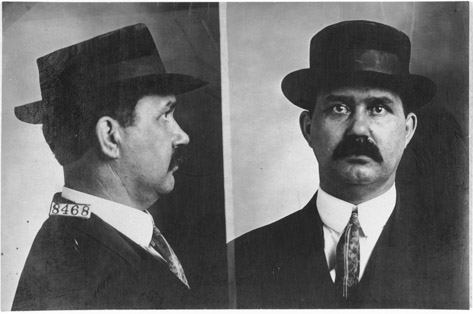
mcmonigleJohn McMonigle, prisoner 8468, was not deterred by his stint in prison. He was sent to Leavenworth twice, due to an encore violation of the oleomargarine law.

The word oleomargarine probably sounds alien to most young people. They know what margarine is—well, some of them do—but the oleo part likely sounds more like a cookie than a butter substitute.

Oleomargarine was made from beef fat. A chemical compound of olein and margarine. Olein is “a colorless to yellowish, oily, water-insoluble liquid, C57 H104 O6.” How appetizing!

Most people today opt for margarine made from refined vegetable oils, but even today animal “by-products” can find their way into margarine products.

I recall growing up when oleo was still part of the American lexicon. My mother used it as a sort of synonym for margarine. That faded as I grew, but persisted long enough for me to vividly remember it.

Washington State was one of those with a strong dairy industry. Such locations drew clear demarcations between butter and its “substitutes.” The dairy organizations vigorously challenged the “unnatural” competition.

The primary battle line was whether or not oleo could colored to make it appear more like the food it was replacing. You see, in its natural state it doesn’t look nearly as tasty as when a yellow coloring was kneaded into it.

Congress taxed the invention differently. Ten cents a pound for the yellow version, but only .25 cents (1/4 of a cent) per pound for the raw version. Amazingly, this tax did not end until 1951. Homemakers would color their own oleomargarine to get their unsuspecting children to eat the stuff.

Nowadays, some people prefer margarine to butter. And, even when it was inferior to current standards, if butter was unavailable, most people would be delighted to have access to the alternative.

Meanwhile, at the beginning of the twentieth century, 32 states—with strong dairy lobbies—banned the coloring of margarine by businesses.

Naturally, where there is a law, there will be lawbreakers. Presumably private citizens were able to continue camouflaging the material in the secrecy of their own homes. The three criminals on this page violated the Oleomargarine Act. And they paid for their illicit marketeering.

C.S. Lewis & Margarine

Regular readers of Mere Inkling may be wondering how in the world this subject connects with the Oxford don.

Lewis wrote a wonderful essay, entitled “Religion: Reality or Substitute?” You can find it in the Christian Reflections collection, edited by Walter Hooper.

The message of the essay is that we cannot completely trust our own experiences. Some people, he says, are inclined to think that the spiritual realm is a sort of “substitute” for reality, rather than real itself. Among the vibrant illustrations he provides for this is the following.

‘Substitutes’ suggest wartime feeding. Well, there too I have an example. During the last war, as at present, we had to eat margarine instead of butter. When I began doing so I couldn’t tell the difference between them. For the first week or so, I would have said, ‘You may call the margarine a substitute if you like, but it is actually just as good as the real thing.’ But by the end of the war I could never again have mistaken one for the other and I never wanted to see margarine again.

This is different from the previous examples because here I started knowing which, in fact, was the substitute. But the point is that mere immediate taste did not at first confirm this bit of knowledge. It was only after long experience that the margarine revealed itself to my senses as the inferior.

Lewis’ essay argues that “There is nothing we cannot be made to believe or disbelieve,” so it is necessary that we place our truth (faith) in something more reliable than our own impressions.

Lewis is right. Just as there have been secular criminals who sought to profit off of the misrepresentation of oleomargarine, there are religious hypocrites and vermin who desire to deceive people about divine truths.

The deepest purpose of all things dark, is to draw people away from the Light. Evil seeks to substitute the lie for the Truth. It has been this way ever since our first parents resided in the Garden.

Whether one prefers butter or margarine, is left to individual taste, and of little consequence. However, whether we choose to consign ourselves to death, when freely offered Life, is something of eternal consequence.

_____

The criminal masterminds cited here are identified further at the National Archives page subtitled, “Crimes against Butter.”




Fleeting Fame

fameIt’s likely that the names of 98.6% of authors who top the bestseller charts today will be unremembered a century from now.

This weekend I posted the latest issue of Curtana: Sword of Mercy, a journal I edit about military chaplains. (If you are interested in checking it out, you can download a free copy here.)

The current issue includes an interesting article about two chaplains from Vermont who served during the War of 1812. (For international readers, that was the war following the winning of America’s independence when they British got their revenge—they captured our national capital and burned the capitol.)

In the biographical portion of the article, the author included a final summary of the life of one of the chaplains. Solomon Aiken (1758-1833) left his civilian pulpit to serve soldiers and sailors.

Aiken was quite prominent in his day. Not only was he a well known preacher and writer, he actually served as a member of Vermont’s legislature. Yet, I doubt that even Vermonters would recognize his name today.

Here is the quotation from a nineteenth century tribute published after his passing.

Mr. Aiken enjoyed uncommon health and vigor. He never took a particle of medicine, or lost a relish for food, until his final and brief sickness—a pleurisy fever. He possessed peculiar power as a logician, and was very popular as a preacher. He was kind-hearted and benevolent, almost to a fault. But it is chiefly as a political writer that Mr. Aiken is remembered. He was sent as a representative for two years, by the town of Dracut. He published several sermons and pamphlets, chiefly upon political themes, which excited much attention in their season.

The words that seized my attention were the conclusion, “. . . which excited much attention in their season.”

“In their season . . .” That season must have been brief, since the history was written just twenty years after Aiken’s death. By then his works had either withered or, more optimistically, gone to seed. In either case, their day was passed.

Translating that to our modern era, where things become obsolete almost as soon as they are envisioned, it would imply that our “season” of fame or reputation will last little more than a handful of months. And that, of course, assumes that a person actually achieves some level of renown.

Fame is fleeting. It has always been so, and the good Reverend Aiken is simply another example of that truth.

Thank God (literally) that there is more to life than notoriety.

C.S. Lewis is one of the 1.4% whose fame lasts. His has not diminished; it continues to grow. Just a year ago, on the fiftieth anniversary of his death, he was honored by having a plaque dedicated in Poet’s Corner in Westminster Abbey.

Lewis never sought fame, as the following discussion from his essay “The Weight of Glory” clearly reveals.

I turn next to the idea of glory. There is no getting away from the fact that this idea is very prominent in the New Testament and in early Christian writings. Salvation is constantly associated with palms, crowns, white robes, thrones, and splendour like the sun and stars. All this makes no immediate appeal to me at all, and in that respect I fancy I am a typical modern.

Glory suggests two ideas to me, of which one seems wicked and the other ridiculous. Either glory means to me fame, or it means luminosity. As for the first, since to be famous means to be better known than other people, the desire for fame appears to me as a competitive passion and therefore of hell rather than heaven. As for the second, who wishes to become a kind of living electric light bulb?

When I began to look into this matter I was stocked to find such different Christians as Milton, Johnson and Thomas Aquinas taking heavenly glory quite frankly in the sense of fame or good report. But not fame conferred by our fellow creatures—fame with God, approval or (I might say) “appreciation’ by God.

And then, when I had thought it over, I saw that this view was scriptural; nothing can eliminate from the parable the divine accolade, “Well done, thou good and faithful servant.” With that, a good deal of what I had been thinking all my life fell down like a house of cards.

This exceptional work merits consideration not only by people of faith. It invites all honest readers to gaze within themselves at their deepest yearnings.

Another passage from C.S. Lewis that relates strongly to the subject at hand comes from The Great Divorce. You can read the entire passage here, but the heart of it is this. Lewis views a simple woman, presently in heaven, receiving magnificent praise and celebration. He naturally assumes she must have been some well known saint.

He is, however, informed that she lived an obscure life, despite the fact that she touched countless nondescript people and animals with her compassion. Lewis’ heavenly guide is rather surprised that the Oxford professor has overlooked a simple truth:

Fame in heaven “and fame on Earth are two quite different things.”

Only the second will last.

Oxymoronic Misunderstanding

guardian angelOxymoron is a great word. Too bad so few people understand what it means.

In America, at least, nine times out of ten you will hear it misused. Most folks seem to think it means a “contradiction in terms.”

One common example is “military intelligence.” Perhaps I am sensitive to it, being a veteran, but I would enjoy never again hearing people guffaw at that term.

In actuality, the oxymoron is a much more sophisticated rhetorical device.

An oxymoron is the combination of two incongruous words or images to create a unique effect. Often it hints of irony. For example, “she was a poor little rich girl.”

Further examples suggest complex circumstances. “Cruel kindness” and “making haste slowly,” are quite intriguing. The context would provide greater illumination, but these phrases suggest a painful treatment given in love . . . and urgency, tempered by caution.

Another example, apropos for an age in which zombies have become so popular, is the phrase “living death.” Reanimated corpses aside, this oxymoron is extremely powerful.

It evokes the sense of a person’s life having become deathlike in some way. Perhaps it is physical, emotional, psychological or spiritual. In any case, drawing together life and death in this epigram is provocative.

In his most vulnerable work, A Grief Observed, C.S. Lewis describes humanity itself as an oxymoron. Most certainly, he uses the word appropriately.

Sometimes, Lord, one is tempted to say that if you wanted us to behave like the lilies of the field you might have given us an organization more like theirs. But that, I suppose, is just your grand experiment. Or no; not an experiment, for you have no need to find things out. Rather, your grand enterprise. To make an organism which is also a spirit; to make that terrible oxymoron, a ‘spiritual animal.’

Lewis’ point is well taken. That the Creator of the cosmos would make flesh bound human beings with a spiritual nature that allows him to describe as made in his own image, is incomprehensible.

Animals are animals. That is what modern secularists argue that we are. Yet it is evident to the vast majority of humans throughout all times and cultures, that we are unlike beasts. For we possess a spirit. And we are, accordingly, that unique thing among all beings—a spiritual animal.

So peculiar are we in the universe that even the angels themselves—spirits, never “animals”—are curious about the nature of our redemption. As Peter writes in his first epistle:

Concerning this salvation, the prophets who prophesied about the grace that was to be yours searched and inquired carefully, inquiring what person or time the Spirit of Christ in them was indicating when he predicted the sufferings of Christ and the subsequent glories.

It was revealed to them that they were serving not themselves but you, in the things that have now been announced to you through those who preached the good news to you by the Holy Spirit sent from heaven, things into which angels long to look.

From one oxymoron to another, I hope that this new year brings you many blessings. Most especially, I pray that if you have not already experienced this wondrous miracle which amazes even the angels of heaven . . . that you would come to know God’s love.

The World’s End

christ arisenMany years ago, while attending seminary, I was invited to preach at a Pentecostal congregation in my home town. One of the conversations I had that day taught me more about the importance of sound biblical preaching than every homiletics course I ever took (combined).

Lutherans, I must admit, are not big advocates of “end times” concerns. The reasons for this are far too complicated to address in a brief column now. Ironically, however, although we confess our confidence that Jesus “will come again to judge the living and the dead” every week, we seldom talk about the details of that arrival.

At the aforementioned service, I did preach on the second coming of the Messiah. And, to distill it down to a single message, I suggested that the Scriptures teach us to live in a sort of tension. We should live with a conscious awareness and urgency that the parousia could happen at any moment . . . and, prepare for the future as though the return of Christ (and subsequent new creation) will not take place for another thousand years.

Shortly after the service ended, a woman approached me and shared how she “wished she could have heard that sermon thirty years earlier.” She related how different her life would have been.

She said in her youth she had longed to attend college, but she never did . . . because she knew Jesus would return before she graduated.

When she and her husband bought a home, she wished the property had some fruit trees, but she never planted any . . . because she knew Jesus would return before they bore fruit.

Saddest of all, she told me that when her children were born, she never raised them to become mature adults . . . because she knew Jesus would return before they grew into the men and women they became.

Nearly forty years later I am more convinced than ever that living with the “tension” I described is the proper course of disciples of Jesus.

So, how does this work out in reality?

While a few of us know people who become so preoccupied with the end of the world that their lives go askew, it’s the other error to which most of us are prone. We tend to think that the return of Christ bears little or no connection to the age in which we live.

We are so preoccupied with our present responsibilities and dreams that we invest precious little time in contemplating how these things will matter in the scope of eternity.

I highly recommend to you a recent article on this subject that will remedy this dilemma. Andrée Seu Peterson, a gifted writer I have commended before at Mere Inkling, reminds us all of the fact that Jesus’ second coming may be just around the corner. Andrée writes:

Who would have thought that after centuries of modernity, beheading would once again be a means of persecuting the people of God? Does it not send a chill up our spine to read all about it in Revelation 20:4 even as we hear about it on CNN? “Then I saw thrones, and seated on them were those to whom the authority to judge was committed. Also I saw the souls of those who had been beheaded for the testimony of Jesus.”

C.S. Lewis famously described two errors people fall into when considering the occult. Either we get caught up in unhealthy expressions of the supernatural, or we dismiss the reality of demons and their destructive agenda altogether.

I believe humanity’s impulsive nature makes us vulnerable to the same extremes when it comes to the final days of the world we call home.

I strongly encourage you to read Peterson’s article here, as a timely reminder that you were created for far more wonderful and amazing things than we can ever know in this life. Even the best this world offers is but a hint and a foretaste of what awaits those who trust in God.

Misplaced Trust

trustingWhy do some nurses kill? Most people attracted to the nursing profession possess deep reservoirs of compassion for others. And yet, every once in a while we read about a nurse intentionally taking the life of a patient.

Today’s case comes from Italy, where a forty-two year old nurse is under investigation for thirty-eight possible cases of murder. And we are not talking about the ending of a life that some would term euthanasia.

Poggiali did not overdose them to end their suffering. She did it simply because they irritated her. She, or their relatives, bothered her.

One troubling aspect of the case could only happen today. Authorities have actually found a photograph on her phone where she is standing beside a deceased patient giving a “thumbs up” sign. (The article didn’t indicate whether this was a sickening “selfie,” or if there is another person at the hospital with a similarly demented sense of humor.

When people we implicitly trust violate our faith in them, it is jarring. We struggle to comprehend things when . . .

Medical professionals intentionally cause injury . . .

Clergy behave immorally, particularly when they attempt to justify it from the pulpit . . .

Police victimize rather than protect . . .

Teachers care more about themselves than their students . . .

Soldiers display cowardice rather than courage . . .

There is some good news here. It is precisely because these breaches of our expectations are the rare exception, that we are shocked by them. For the most part, people entrusted by the public with authority or power honor that trust.

(Let’s exclude, for our discussion here, the case of politicians, where that supposition would be hotly debated. As Lewis in his essay “Equality” wrote, “Mankind is so fallen that no man can be trusted with unchecked power over his fellows.”)

Our trust in people who occupy special positions goes so far as to be illogical. For example, we tend to think of actors or actresses as possessing the traits of various characters they have portrayed.

We laugh at the joke, “I’m not a doctor, but I play one on TV.” Yet, we’re still tempted to ask the person how we can best deal with our persistent cough or chronic rash.

We think of television cops as believing in law and order, but if we seriously considered the matter, we would recognize just how foolish that is. They are no more, or less, likely than anyone else in Hollywood to be law abiding.

An ongoing scandal reveals just how disorienting it can be to have our illusions shattered. It is the case of Stephen Collins. In the popular Seventh Heaven series, he played the ideal father. A pastor, no less. We mourn for the lives he has injured, and we subconsciously grieve our own disillusionment.

The solution to the problem is not in ceasing to trust others. Life from that perch would result in paranoia and alienation.

No, I think that it still makes sense to trust—within limits. I am willing to extend my trust to someone in a respected profession who I have just met. That is based on the profession’s self-policing of standards.* Most require minimal education and competence standards, and have mechanisms for decertifying those who violate professional ethics.

Still, when time allows, the best advice is probably to “trust and verify.” The time I take to verify whether the person’s credentials or claims are true corresponds to the importance of what I’m entrusting to them. I would leave my car with a mechanic far sooner than I would entrust my child to a babysitter.

Returning to the case with which we began, we assume that a hospital is one of the safest places to be. And, even in light of the latest tragedy, this remains true.

For every one nurse tempted to end a complainer’s life early, there are a hundred thousand** who are striving to prolong the lives of their charges.

Trusting should not only be viewed as something we extend to others. Each of us would do well to ponder for a few moments just how trustworthy we are. This is especially true for those of us in privileged or respected professions. However, it is no exaggeration to say that the measure of any woman or man is determined by the degree to which they have earned the trust of others.

Lewis writes about the nature of trust, as it relates to friendship. It doesn’t relate to trust imbued in societal roles, but rather in the trust that exists where a relationship is already present. Still, he expertly describes the interplay between mind and heart, when it comes to trust. And this explains, in part, why the betrayal of our trust causes us so much anguish, in mind and soul.

To love involves trusting the beloved beyond the evidence, even against much evidence. No man is our friend who believes in our good intentions only when they are proved. No man is our friend who will not be very slow to accept evidence against them. Such confidence, between one man and another, is in fact almost universally praised as a moral beauty, not blamed as a logical error. And the suspicious man is blamed for a meanness of character, not admired for the excellence of his logic. (“On Obstinacy in Belief”).

_____

* The fact that some “professions” don’t have any mandatory requirements or standards, means that I remain wary when I meet people sporting those titles. For example, in America it’s possible to “ordain” oneself (or buy a meaningless diploma or certificate online). Thus, when someone tells me they are a minister, I am eager to learn more (about their education, congregation, accountability, etc.). There are far too many hucksters out there to take a person’s word for it that they are a genuine minister of God.

** Perhaps a slight exaggeration, but I’d like to continue believing that the ratio is something wonderful like that, 1:100,000. Then again, if I think of it literally, in terms of how many are “tempted” to expedite the passing of an inconsiderate and ungrateful patient, I imagine the numbers might be rather less encouraging.

A Symbol of Death & Life

nن – Arabic letter nun (n)

You may never have seen this symbol or, if you did, its foreign context may not have impressed it on your mind.

This Arabic letter is now being used to mark people for persecution and death. Yet, at the very same moment, this same symbol is also being transformed into an emblem that stands for courage and life.

The Islamic State has martyred or enslaved many Christians. Survivors have had all of their property stolen from them and been marked for death if they do not reject Christ and embrace the Muslim religion.

They have gone throughout the neighborhoods of their new conquests and placed this mark, the nun, on homes to mark them for evacuation or death. The “N” stands for “Nazarene,” referring to Jesus’ home town.

With the passage of time, we will likely see once again the truth proclaimed by Tertullian, that the blood of the martyrs is the seed of the church. In the meantime, everyone of good will (Christian, Jew, Muslim, Agnostic alike) should rally to the support of the suffering.

We do not yet know the magnitude of the atrocities committed by ISIS/ISIL. Like Nazi concentration camps, the complete story will not be revealed until the sites of the horror are liberated from their vile control. And, like the Mogen David (Star of David) which marked its bearers as Jews, the nun marks its bearers as Christians and targets of militant Islam.

C.S. Lewis recognized the horror of Nazism early on. In 1933 he wrote about the cruelty, and stupidity of Hitler’s attack on Judaism.

Did you see that [Hitler] said “The Jews have made no contribution to human culture and in crushing them I am doing the will of the Lord.” Now as the whole idea of the “Will of the Lord” is precisely what the world owes to the Jews, the blaspheming tyrant has just fixed his absurdity for all to see in a single sentence, and shown that he is as contemptible for his stupidity as he is detestable for his cruelty.

One can only imagine what Lewis would write about the leaders of Islamofascism today.

There are a number of organizations that support Christians currently experiencing violent persecution. None, however, approaches this work from the same perspective of Voice of the Martyrs. I wholeheartedly commend their labors to you.

They are currently offering shirts emblazoned with the letter nun. They are even more important as a witnessing tool, than as a fundraiser. Please read more about them here and share the link with your friends. Also, please take a few minutes to explore their website once you are there.

To boldly state “I am N” is to identify with the oppressed. It is to show the world you understand that each disciple of Jesus must be prepared to take up his or her own cross. Dying for one’s faith in Jesus is not a myth; it is a daily reality.

The ن symbol, intended as a mark of derision, humiliation and rejection, has assumed a new meaning. It has become a mark of hope, courage, and deliverance.

What the persecutors in Iraq and Syria intended to be a label of death has been transformed by the Holy Spirit and the faithfulness of Christians into a symbol of life.

Bill Cosby & Me

cosby[Do not read this post without also reading “Bill Cosby Redux,” which was written two months later.]

One of the finest compliments my wife ever paid me was saying, “You remind me of Bill Cosby.”

She tells me that’s one of the reasons she married me thirty-eight years ago. And she also says it’s still true today.

I owe a lot to Bill Cosby. He has modeled (for several generations now), how humor highlights the most precious aspects of our human lives. He also showed us how a real man works hard to accomplish his goals, and keeps the promises he makes.

And now, approaching the winter of his life, Cosby continues to inspire.

My wife and I have always wanted to see him perform. This summer that dream came true.

He offered the audience two full hours of good natured (healthy) laughter with an ample dose of self-introspection as well.

Cosby began his performance (at one of our Washington State fairgrounds) by commenting on our lovely weather. He noted that every other time he had spoken outdoors that it had poured. He suggested that there was something demented about Washingtonians wanting to watch entertainers on stage being drenched while they are handling microphone and other electrical devices.

I refer to Cosby’s presentation as a “performance,” but it was far more than that. It is no exaggeration to say that it was like being invited to an intimate family gathering. One where everyone has gathered around—and the audience was filled with people of all ages—to hear their witty patriarch weave delightful stories about their shared past and mysteries of life.

Bill Cosby embodies the truth spoken by C.S. Lewis in The Screwtape Letters: “Humour is . . . the all-consoling and . . . the all-excusing, grace of life.” Cosby is, in a sense, an ambassador of humor. Or, even, a physician of humor, whose words carry the power to heal.

In mere minutes he made us all, albeit temporarily, his family. (Another reason for me to be proud my wife likens me to this gifted story-teller.)

I’ve always liked Cosby. I was introduced to him on a vinyl album my family had. We probably owned several, over the years, but this one was his debut album, recorded live in 1963.

As a young Christian, I was particularly captivated by his three sketches about Noah. (If you’ve never heard the routine, check out my note at the bottom of this column.) Only today, in the fall season of my own life, does it dawn on me just how profound an effect his comedy had on me.

I believe that was the first time I became aware that matters of faith could be funny. Not diminished by ridicule, but uplifted by laughter. It was okay to enjoy discussing serious matters, by highlighting some of their humorous aspects.

In a world where so many of faith’s spokespersons were dour and humorless, seeds of mirth were planted in my life. Thank you, Bill.

Those seeds have born fruit. They have never undermined my recognition of the authority and trustworthiness of the Scriptures. But, at the same time, they have opened my eyes to the warmth and wonder of the Creator who spoke the cosmos into existence.

Cosby engaged us with an exploration of humanity’s creation, and moved on into a delightful conversation about the differences between men and women. He spoke about his beloved Camille and his children in ways the entire audience connected to. His deep affection for his family resonates even as he uses them as a comedic foil (actually, the majority of his humor is self-deprecating).

Here’s a simple truth. A winsome witness to the faith, who can laugh with one of America’s finest humorists about their beliefs, will win far more “converts” than someone who does not know the joy that comes from being God’s child.

For those unfamiliar with Bill Cosby, allow me to offer a note about only a few of his many accomplishments.

He served for four years as a hospital corpsman in the United States Navy.

He attended Temple University on a track scholarship, where he also played fullback on the football team.

He has an earned doctorate (not the “honorary” type that adorns many public figures). Doctor Cosby earned his Doctor of Education degree in 1976 from the University of Massachusetts Amherst.

On the amazing espionage series, I Spy, Cosby became the first African-American to co-star in a dramatic series. (I remember being riveted to the show, identifying more with Cosby’s thoughtful portrayal than with the shallower, flashier persona of Robert Culp.) Apparently, many recognized Cosby’s acting prowess—he won three consecutive Emmy Awards during the show’s run.

Cosby’s acting prowess was proven repeatedly through television accomplishments, most notably The Cosby Show, which overwhelmed its competition.

He is a gifted musician and has recorded a dozen music albums.

He is also a skilled writer, and has written a dozen books.

He is a genuine family man, whose devotion to his wife, children and grandchildren is unquestioned. He also has gracefully born the pain of losing his only son quite tragically.

He has courageously confronted some of the serious issues facing the poor in the world’s most prosperous nation. He has put his talents and treasures where his words are, seeking to reinforce the value of education in communities where far too many condemn themselves to poverty by dropping out of school.

Bill Cosby is an amazing man. He is a person to be respected, and heeded.

I can think of no better compliment from the woman I love than hearing that I remind her of him.

_____

In the picture above, Cosby is wearing his Presidential Medal of Freedom, awarded to him in 2002.

If you’ve never heard Cosby’s account of God’s conversation with Noah, your life is incomplete. Fortunately, you can remedy that sad situation by viewing a brief version of it here.

If you’re interested in a brief survey of Cosby’s impact, this clip provides an excellent introduction.

Loving Prostitutes

comfort womenI love prostitutes.

It’s true.

Although I have never in my life “physically” loved one, I possess great compassion for them.

Sharing physical intimacy with a prostitute would have nothing to do with “love,” anyway.

My empathy for prostitutes grew significantly during the year I spent stationed with the United States Air Force in South Korea during the 1980s.

My love for them has just been reignited by an article I read about the plight of aged Korean prostitutes who are being evicted from their hovels so that developers can profit. These women, ostracized by their own society and discarded by their pimps and the soldiers, sailors and airmen who abused them, have nowhere to go.

Americans have a perverse understanding of prostitution. Calling it a “victimless crime” is incomprehensible. For every one American call girl living in comfort and able to choose her “clients,” there are probably five thousand who are beaten daily, and driven to an early (often welcome) death.

No woman, at least none with a healthy mind, wants to sell their body and forfeit their future.

The gifted author and professor, C.S. Lewis, recognized this fact.

Prostitutes are in no danger of finding their present life so satisfactory that they cannot turn to God: the proud, the avaricious, the self-righteous, are in that danger (The Problem of Pain).

I love prostitutes because God has granted me the vision to see them as he does. Jesus spoke with true love (agape love) to one unloved and physically used woman he met at a well. You can read the story here.

She had been passed from one man to another and no longer had any options. Her current partner had not even bothered to marry her. She was not unlike the poor prostitutes of South Korea.

Jesus looked into this woman’s scarred soul and offered her forgiveness, healing and peace.

South Korea is prosperous today. It was not always so. During the Second World War, and the Japanese occupation, thousands of woman were enslaved as “comfort women.” The Korean government provides these victims with special compensation. Not so the post-war “comfort women” who serviced the country’s allies.

They did not have a choice either. Which is one reason C.S. Lewis writes, “a cold, self-righteous prig who goes regularly to church may be far nearer to hell than a prostitute.” (Mere Christianity).

And now they languish. Others, working in bars and “clubs” near bases today, are in their “prime.” It won’t last. This will be their destiny as well.

Because I love prostitutes, I pray that they might be liberated from their bondage. And, I also pray, that if they remain trapped in their current plight, that their souls might be free . . . that they might encounter the Messiah who can offer them “a spring of water welling up to eternal life” (John 4:14).

The article I read, and linked to above, ends with a potent yet tragic image.

Jang Young-mi, 67, who was orphaned as a girl and worked in a military camptown for nearly two decades, lives with three mangy dogs. A bite from one of them left the long white scar on her hand, but she refuses to abandon the offending animal.

Dogs too, are often outcasts in many societies. The irony is not lost that in Korea a dog is as likely to be devoured, as it is to be embraced and protected.

_____

The WWII image of so-called “comfort women” is of Indonesian women. It is estimated that the Imperial Japanese Army enslaved a quarter of a million women in Asia to serve in this cruel and vile manner. Due to the large number of victims, many still live today, still hoping for an official apology for their suffering.

Any Name But That

jesus nameThis week I read one of the clearest descriptions of the gospel I have ever heard. It appeared in an article written by the most (how do I put this mildly?) daunting professor I have encountered in my Doctor of Ministry studies. “Intimidating” would also work . . .

But his brilliance and rapid fire delivery of thought-provoking concepts is not the reason for me mentioning him here. It is his ability to cut through the confusion, and express simply the essence of the good news, the Christian hope, the gospel.

I’m not pandering to him, mind you, because my grade for his systematics course was filed long ago. It is simply that Joel Biermann said extremely succinctly, something that I have always attempted to emphasize in my own ministry.

The Gospel is the good news, but it is not just any good news. The Gospel is a word of liberation and encouragement, but it is not just any word of liberation and encouragement. The Gospel is a wonderful event and a joyful experience, but it is not just any wonderful event and joyful experience.

In other words, when it comes to defining the Gospel, it is vitally important that we move past vague ideas or general notions and grab hold of the central thing. The central thing is Jesus.

This is a truth too many fail to understand. Sadly, this is true for some “inside” the Church as well as outside of its doors.

Goodness is good. Generosity is wonderful. Encouragement is precious. Courage is noble. Love is (almost) divine.

Yet none of these are the Gospel. The Gospel is Jesus. In him the world discovers every good thing from the hand of God the Father, our Creator.

Jesus is indispensable. Without his holy name, the “faith” would simply be a praiseworthy “religion.” Without Jesus, it could instruct how to live, but it could not redeem.

It is precisely this point—the name of Jesus—that makes the Gospel objectionable to some. “Care for the sick,” some say, “just don’t mention that name.” On other lips we hear “The Church does lots of things that benefit the community, but please don’t mention that name that offends people.”

They arrested the apostles and put them in the public prison. But during the night an angel of the Lord opened the prison doors and brought them out, and said, “Go and stand in the temple and speak to the people all the words of this Life. . . .”

And someone came and told [the High Priest], “Look! The men whom you put in prison are standing in the temple and teaching the people. . . .”

And the high priest questioned them, saying, “We strictly charged you not to teach in this name, yet here you have filled Jerusalem with your teaching, and you intend to bring this man’s blood upon us.”

But Peter and the apostles answered, “We must obey God rather than men. The God of our fathers raised Jesus, whom you killed by hanging him on a tree. God exalted him at his right hand as Leader and Savior, to give repentance to Israel and forgiveness of sins. And we are witnesses to these things, and so is the Holy Spirit, whom God has given to those who obey him.” (Acts of the Apostles, chapter five).

C.S. Lewis knew quite well that Christianity is all about Jesus. Without him, the person Jesus the Christ, whatever passes for the “Church” would merely be a noisy gong. Lots of “religious” talk would remain . . . but the Gospel would be absent.

“What are we to make of Christ?” There is no question of what we can make of Him, it is entirely a question of what He intends to make of us. You must accept or reject the story. The things He says are very different from what any other teacher has said. Others say, “This is the truth about the Universe. This is the way you ought to go,” but He says, “I am the Truth, and the Way, and the Life.” He says, “No man can reach absolute reality, except through Me. Try to retain your own life and you will be inevitably ruined. Give yourself away and you will be saved. . . .”

“Come to Me everyone who is carrying a heavy load, I will set that right. Your sins, all of them, are wiped out, I can do that. I am Re-birth, I am Life.” (1950 essay, “What Are We to Make of Jesus Christ?”).

In the same way as the apostles, C.S. Lewis, my seminary professor, and all of those who have entrusted themselves to the grace of God in Christ, know the name of Jesus is not optional. In fact, it is all about the name.

For it is Jesus, and him alone, who is the alpha, omega and the whole of the Gospel.

Volcano Hurricane

volcanoVolcano hurricane. An epic disaster film! No sharks, but copious amounts of lava flung by gale force winds across the globe. And all from the mind of a six year old boy.

Imaginations are great. They are one of the most precious gifts of God (which makes it all the more tragic when the human imagination is diverted towards carnal ends).

The minds of young boys, thankfully, have yet to turn to such lamentable matters. Their innocence shields them from the worst of human corruption. They, instead, are consumed with thoughts of spiders and other things that creep out girls . . . and especially their moms.

Our almost-seven-year-old grandson was here for the weekend with his family. We had a wonderful time. We had actually found the ideal book to include as part of his birthday celebration: How to Convince Your Parents You Can Care for a Pet Tarantula. Perfect.

Young male imaginations seem to revolve around things that shock—and also things that gross others out.

Our kids have trained their own children well. For example, they always excuse themselves when they experience flatulence. It’s a natural experience, of course, and as we mature, adults learn to ignore potentially embarrassing moments related to it. That’s part of becoming “civilized.”

Six year olds . . . not so much. Our grandson properly excuses himself, but he typically does so in the midst of enthusiastic laughter. It’s as though he relishes just how uncultured the moment seems.

During this particular visit, he leaped into my lap in a semi-ninja attack. As we wrestled, there was a minor explosion. Not quite volcanic, but close enough. He apologized, amidst great hilarity. “Sorry about my little gas,” he added.

And here’s where I made the mistake. I reinforced his innate boyhood grossness by saying, “little! . . . that sounded like it was a buffalo!”

Not quite the right thing to say, since it simply encouraged the precocious guy. But what I can say . . . time may change a boy into a man, but in most of us . . . somewhere deep in the recesses of our psyches . . . that boyhood irreverence lingers.

Not that I enjoy the crass “body humor” that pervades so much comedy (on tv and film). I steadfastly avoid it. It insults my mind and viewing it constitutes a total waste of time. Still, with my grandson wrapped in my arms, laughing away, it all seemed so genuine and innocently funny.

Of course, I recognize one needed to be there—and probably to also be related by bloodline to the participants—to find any humor in the moment. But it certainly seemed funny to us.

C.S. Lewis and Children

I was thinking about that moment as I sat down to write this post. I intended to focus on the amazing imaginations of children, and my grandson’s current preoccupation with gigantic volcanoes.

But whim or muse redirected the column. In the end, it turns out to be a reflection on the simple pleasure that we adults experience when we interact with kids. Especially when they are children who are precious to us.

I wish that C.S. Lewis had been able to experience that joy. He wasn’t. His awkwardness with children is well known. Most attribute it to the early passing of his mother, and the emotional distance his father maintained from his sons.

In a 1935 letter he wrote to a close friend, “I theoretically hold that one ought to like children, but am shy with them in practice.”

In The Abolition of Man he was even more forthcoming, sharing that, “I myself do not enjoy the society of small children: . . . I recognize this as a defect in myself.”

So, Lewis recognized his discomfort with children as a shortcoming. It was something he wished could be dispelled. Unfortunately, we can’t simply wish (or pray) away our ingrained personality traits. We’re lucky if we can tame them or reshape them.

We work hard to strengthen our positive traits and the wise deny nourishment to their weaker qualities. People often use the analogy of wearing off one’s rough edges, and that’s an apt image.

Lewis’ reticence with children makes his creation of Narnia all the more wondrous. The Chronicles of Narnia have captivated the hearts and imaginations of innumerable children, and adults alike. Certainly Lewis was correct when he wrote the following in “On Stories.”

No book is really worth reading at the age of ten which is not equally (and often far more) worth reading at the age of fifty—except, of course, books of information. The only imaginative works we ought to grow out of are those which it would have been better not to have read at all.

With his marriage, late in life, Lewis became a step-father. He did the very best he could, but was conscious of just how ill-equipped he was to raise Douglas and David. Both became successful men. Doug shares his parents’ love of Christ, and helps direct the course of various Lewisian projects today.

Allow me to close with another evidence of the greatness of C.S. Lewis. He was able to rise far above his innate uneasiness with children. In fact, his fabled correspondence included many children who had written to him seeking his attention. In 1951 he wrote to one of them, saying:

I am glad you all liked The Lion. A number of mothers, and still more, schoolmistresses, have decided that it is likely to frighten children, so it is not selling very well. But the real children like it, and I am astonished how some very young ones seem to understand it. I think it frightens some adults, but v[ery] few children.

Lewis did not disappoint the many children who wrote to him during those terribly busy years. Nor do his writings disappoint us today. Unlike the transience of youthful volcano hurricanes, Lewis’ legacy will forever remain alive in the imaginations of child and adult alike.