Avoid Living in Fear

nuclear blast

Nuclear war. It’s an extremely unpleasant subject, and its grim specter still haunts the world. Oddly, though—even as we anticipate the day when Iran’s lunatic Mullah’s develop them and North Korea’s deranged generals learn how to deliver them—the world is in a sort of “nuclear hiatus” at this very moment.

The Mutual Assured Destruction apparently worked, as the former Soviet Union and the United States decided against nuclear suicide. At the present moment the three world powers show little appetite for total war, so today’s children don’t have to learn the Civil Defense precautions that kept an earlier generation safe.

I was one of those young Americans indoctrinated in the sophisticated “duck and cover” method of nuclear blast survival. This video provides a nostalgic look at the paramilitary training we received. (A link to the full training film appears below.)

C.S. Lewis lived during the height of nuclear paranoia. Yet he retained his composed Northern Irish demeanor as he reflected on the threat. In an essay entitled “On Living in an Atomic Age” he wisely advised:

If we are all going to be destroyed by an atomic bomb, let that bomb when it comes find us doing sensible and human things—praying, working, teaching, reading, listening to music, bathing the children, playing tennis, chatting to our friends over a pint and a game of darts—not huddled together like frightened sheep and thinking about bombs. They may break our bodies (any microbe can do that) but they need not dominate our minds.

In his essay “Is Progress Possible,” Lewis addresses those who used the uncertainty of the future as an excuse for making irresponsible life choices. His words ring just as true today, when so many youth turn to nihilism and self-destructive behaviors.

As a Christian I take it for granted that human history will some day end; and I am offering Omniscience no advice as to the best date for that consummation. I am more concerned by what the Bomb is doing already. One meets young people who make the threat of it a reason for poisoning every pleasure and evading every duty in the present. Didn’t they know that, Bomb or no Bomb, all men die (many in horrible ways)? There’s no good moping and sulking about it.

If only remaining safe in this fallen world was as simple as dropping to the ground and sheltering one’s head. It isn’t, of course, but we need not live our lives under the shadow of fear.

Returning to “On Living in an Atomic Age,” Lewis adroitly places the entire menace—and all perils to human life—in their proper perspective. It may not be the most comforting words we will ever read, but they are certainly true.

In one way we think a great deal too much of the atomic bomb. “How are we to live in an atomic age?” I am tempted to reply: “Why, as you would have lived in the sixteenth century when the plague visited London almost every year, or as you would have lived in a Viking age when raiders from Scandinavia might land and cut your throat any night; or indeed, as you are already living in an age of cancer, an age of syphilis, an age of paralysis, an age of air raids, an age of railway accidents, an age of motor accidents.”

In other words, do not let us begin by exaggerating the novelty of our situation. Believe me, dear sir or madam, you and all whom you love were already sentenced to death before the atomic bomb was invented: and quite a high percentage of us were going to die in unpleasant ways. We had, indeed, one very great advantage over our ancestors—anaesthetics; but we have that still. It is perfectly ridiculous to go about whimpering and drawing long faces because the scientists have added one more chance of painful and premature death to a world which already bristled with such chances and in which death itself was not a chance at all, but a certainty.

_____

You can watch the entire “Stop and Drop” Civil Defense Video here.

Knowing Our ABCs

Most readers are familiar with the amazing story of Jeanne D’ Arc (Joan of Arc). She was a French peasant who received visions which proved accurate. She foresaw victory for a humbled nation which had not experienced a major military victory for an entire generation.

Jeanne led the army of the Dauphin (the heir to France’s throne who would reign as Charles VII) to unimaginable victories. She was seriously wounded but inspired her troops with her swift return to battle. She counseled, and prayed for mercy, but recognized England could only be repulsed from French shores by force.

Tragically, she was captured and the English, following a sham trial, judged her guilty of heresy. Jeanne was only nineteen when she perished in flames in an English blaze. Just twenty-five years later, a special court convened by the Pope found her “not guilty” of the crime, and proceeded to declare her a martyr. She was canonized in 1920, nearly five centuries after her brief but brilliant life.

Recently, while reading more about her life I was reminded of something startling she said during her first “inquisition.” When she originally presented herself to the Dauphin, no one could believe a modest young farm girl could be France’s rescuer. A commission of inquiry, comprised of a number of senior clergy, offered the Dauphin a “favorable presumption” that she might, indeed, have divine sanction.

During that “trial,” she was vigorously questioned. The following account comes from Medieval History by Israel Smith Clare.

It is very interesting to see how she evaded the difficulties, overcame the objections, and quietly set aside the learned cavils of the doctors by the simplicity and directness of her replies. They first asked her what signs she could show them to prove her mission. She answered: “I have not come to Poitiers to show a sign. Give me some men-at-arms and lead me to Orleans, and I will then show you signs. The sign I am to give is to raise the siege of Orleans.” One of the [theological] doctors responded thus: “But if God wished to deliver the city he could do it without soldiers.” Jeanne replied: “The soldiers will fight, and God will give them the victory.” Brother Seguin of Limousin asked her, in his provincial dialect, in what idiom her angels spoke. She answered: “In a better idiom than yours.” Said he, somewhat angrily: “Do you believe in God?” Jeanne replied: “I have more faith in God than you have.” The sharp man was thus silenced.

Still the doctors proceeded with their examinations, asking repeated questions and suggesting many learned difficulties. Said Jeanne: “Why do you ask me all these things? I do not know even my A, B, C; but I have come, by God’s command, to raise the siege of Orleans and crown the king.” Having nothing more to say, the doctors finally decided in the maiden’s favor, to which they were somewhat influenced by the great reverence which she inspired among the people of Poitiers by her holiness and piety . . .

Jeanne’s final comment which stands out. The fact that she was illiterate was, to her, no disgrace. She was confident God had chosen her to accomplish the historic events which surely followed.

We live in an era where nearly all adults in the industrialized world are literate. Even in less privileged lands, literacy rates hover around fifty percent.

We—especially those of us who love words and write—tend to look down on those who are not as eloquent as we consider ourselves to be. A woman like Jeanne reminds us that one need not be educated to be truly eloquent. She put the ecclesiastical patricians in their proper place. And rubbed their proverbial noses in it, when she emphasized her illiteracy. Devout, courageous, humble . . . and sarcastic toward condescending clerics—I’m eager to one day meet her!

While knowing one’s ABCs bears little correlation to personal virtue or merit, literacy is essentially a good thing. How impoverished our lives would be if books were sealed to us and we could not be transported to novel places and new epiphanies in their pages.

C.S. Lewis shared this awareness that illiteracy was something that could bar some from experiencing life’s most important treasures. In The Pilgrim’s Regress, he draws a wonderful picture of the relationship between the image and the word. In this allegory, the Landlord represents God.

“. . . The Landlord has circulated other things besides the Rules. What use are Rules to people who cannot read?”

“But nearly everyone can.”

“No one is born able to read: so that the starting point for all of us must be a picture and not the Rules. And there are more than you suppose who are illiterate all their lives, or who, at the best, never learn to read well.”

“And for those people the pictures are the right thing?”

“I would not quite say that. The pictures alone are dangerous, and the Rules alone are dangerous. That is why the best thing of all is to find Mother Kirk at the beginning, and to live from infancy with a third thing which is neither the Rules nor the pictures and which was brought into the country by the Landlord’s Son. That, I say, is the best: never to have known the quarrel between the Rules and the pictures. But it very rarely happens. The Enemy’s agents are everywhere at work, spreading illiteracy in one district and blinding men to the pictures in another. . . . As often as men become Pagans again, the Landlord again sends them pictures and stirs up sweet desire and so leads them back to Mother Kirk even as he led the actual Pagans long ago. There is, indeed, no other way.”

“. . . The Landlord succeeded in getting a lot of
messages through.”

“. . . These pictures woke desire.”

“. . . And then the Pagans made mistakes. They would keep on trying to get the same picture again: and if it didn’t come, they would make copies of it for themselves. Or even if it did come they would try to get out of it not desire but satisfaction.”

Elsewhere, in the essay “Some Thoughts” in God in the Dock, Lewis expressly (and correctly) declares literacy itself as one of the things for which Europe should be grateful to the Church.

[One looking at] Christian activities which are, in a sense directed toward this present world . . . would find that this religion had, as a mere matter of historical fact, been the agent which preserved such secular civilisation as survived the fall of the Roman Empire; that to it Europe owes the salvation, in those perilous ages, of civilised agriculture, architecture, laws, and literacy itself. He would find that this same religion has always been healing the sick and caring for the poor; that it has, more than any other, blessed marriage; and that arts and philosophy tend to flourish in its neighbourhood.

Fatherhood as Modeled by Two Historical Giants

Thanksgiving is a very special holiday. In truth, it’s a “holy-day” for all those who offer their thanks to a benevolent God.

Like all holidays, it can be good or bad, depending on the way it is perceived by each individual, and the unique circumstances in which they find themselves. Most of us are thankful, for example, for our loving families. And, even if we can’t be together at these special times, we draw warmth and strength from their love. Tragically, others have been victimized by those who should have protected them, and “family” in their eyes is not something to be thankful for at all.

I was not a perfect son. I strove to be a better father. And, now that I’m blessed with seven grandchildren, I’m trying to be the best grandfather I can be

Many years ago, shortly after having our first child, I gave myself a Father’s Day gift. (That’s not a typo. I purchased for myself a modest plaque with a priceless message.) It reads: “the greatest gift a man can ever give his children is to love their mother.”

I displayed this proverb in my office through the years, as a reminder to myself and others of this profound truth. It’s easy to love one’s spouse as a newlywed in the hot flush of youth. It’s also easy, I’m learning, to love my wife in the snug and warm autumn of life. For many, however, the trials and tribulations that are a natural part of all relationships appear insurmountable. Between the newlywed and maturelywed days, it’s not all easy. While our hormones still surge and familiarity breeds corrosive contempt, we may take for granted the person we once vowed to cherish above all others.

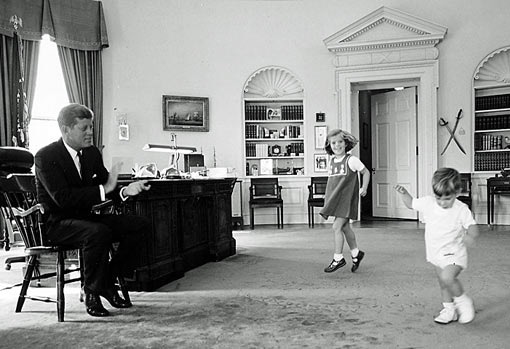
The desire to be a decent father greatly amplifies the importance of being a devoted husband. Knowing this made my reading of a recent article quite painful. I had known for years that President John F. Kennedy was rather promiscuous. Yet a recent article in The Atlantic reveals just how debauched the man was. The article, if you have the stomach for it, praises the strength of his wife Jackie, and is available online here.

It describes just a few of his disease spawning liaisons, and noted that he often traveled with one of his so-called secretaries, should there be “any trouble scaring up local talent.” One imagines the dirtiness felt by the Secret Service agents tasked with protecting him during his sordid escapades in the White House pool. The saddest tale for me was his deflowering of a sophomore intern from Wheaton “right there on his wife’s bed.” I won’t sully you with any more accounts.

When I read the article, it nearly made me sick. He was a vile husband. I recalled the numerous famous pictures of him playing with his children—the doting father, one would think. Yet, in reality, just because he was such a malignant husband, he was also an appalling father. To mistreat his wife so badly, was to dishonor his children as well.

The image that came to me as I looked again at the pictures of Kennedy’s glorious Camelot brought to mind Jesus’ words about whitewashed sepulchers “which outwardly appear beautiful, but within are full of dead people’s bones and all uncleanness.” (Matthew 23:26-28, ESV). The verse which follows could be JFK’s epitaph: “So you also outwardly appear righteous to others, but within you are full of hypocrisy and lawlessness.”

A More Godly Alternative

C.S. Lewis experienced neither the normal, nor ideal, form of fatherhood. While he loved and respected his own father, theirs was not a close relationship. And then, at the end of his life, the death of his beloved Joy caused him to transition from the already tentative role of stepfather into the fullest demands of single parenthood. Lewis loved his two sons. He was the best father he knew how to be.

Despite being ill equipped, he did the honorable and right thing—he could do no other. He provided for all the physical needs of his sons, and did his best to meet their emotional needs as well. In Lenten Lands, his son Douglas Gresham describes how painful it was to be at The Kilns following his mother’s passing.

In cowardice and self-pity, I deserted the home and the two men whose company and loving support had for so long been all that had preserved my sanity. When at home from school, I was rarely at home. I know now that I could have done far more than I did to help both Jack and Warnie to bear the burdens which were their lot, but with the blind selfishness which is characteristic of egocentric teen-aged boys, I was too wrapped up in myself to spare time for others.

Strangely, Jack and I had, through these difficult years, become very close, and I think that he understood quite well the reasons for my reluctance to be a part of The Kilns at that time. At first, after Mother’s death, with almost unbelievably naïve complacency, I never doubted that The Kilns and Jack would always be there for as long as I needed them. Then, when it began to dawn on me that there was an increasing likelihood of Jack being snatched away, and with him The Kilns, I reacted by rejecting The Kilns entirely and by not daring to love Jack any more than I already irrevocably did.

For his part, Lewis comprehended just how important understanding fatherhood was. In his tribute George MacDonald: An Anthology, he says this about his mentor:

An almost perfect relationship with his father was the earthly root of all his wisdom. From his own father, he said, he first learned that Fatherhood must be at the core of the universe. He was thus prepared in an unusual way to teach that religion in which the relation of Father and Son is of all relations the most central.

Lewis concurred with MacDonald that “Fatherhood must be at the core of the universe.” And, if this is indeed true, our emulation of it in this life possesses even more importance than I ever imagined.

Humor & Health

I had to have blood drawn today for an upcoming physical exam. It’s not one of my favorite things to do, but I consciously try not to allow my feelings to negatively affect the caregivers who provide these essential procedures for our wellbeing. (Trust me, dentists especially are sorely in need of our appreciation.) I often try to add a little smile to their day employing a touch of light humor.

Today, for example, I was repeating a blood test I had already accomplished earlier this week. When the corpsman (Naval hospital) asked which arm I said, “you better take it out of my left arm . . . they weren’t happy with the numbers in the sample they got from my right.”

Now, a modest joke like that won’t make it into any comedians’ monologues, but it did inspire a chuckle from the four of us in the lab at that moment.

It reminded me of getting my flu shot last year and having my choice of four different corpsmen to administer it. Each had a waiting line. I could only imagine what it was like to be puncturing one anonymous arm after another for eight hours. Most “victims” silent, but many grimacing and some feeling compelled to describe to you just how much they hate shots.

Three of the corpsmen were normal sized human beings. But the fourth was a behemoth. The seams of his uniform were near to bursting due to his extraordinary musculature. I doubt he was on steroids, but his massive figure could have fit into the offensive line of any team in the NFL. And, for some mysterious reason, his waiting line was the shortest.

When I approached him to receive my vaccination, I ventured (in a voice loud enough for his companions to hear): “I chose you because you look like you’re gentle.” Everyone got a laugh out of that, and I felt pleased at having momentarily brightened their day.

My kids are always wary when I make comments like this. They recognize that every time we open our mouths, it’s a gamble. We can achieve our goal, and elicit someone’s precious smile . . . or we can make a fool of ourselves.

As a grandfather, I have the added “protection” of not having too much expected of me, in the wittiness department. By the grace of God, I’m still in possession of the bulk of my mental capacities. I imagine that, should I live long enough, most of my attempts at humor may grow rather lame. But, if there remains any cultural respect for our elders, even these attempts will be recognized for what they are—goodwill. And, as such, there are those from whom they will still elicit a smile.

We should not be afraid of humor, especially in its most humble and intimate forms. Woven amidst the threads of our daily conversations, it enriches life.

C.S. Lewis recognized this quite well. In The Magician’s Nephew, which recounts the creation of Narnia, Aslan says to the newly anointed animals: “Laugh and fear not, creatures. Now that you are no longer dumb and witless, you need not always be grave. For jokes as well as justice come in with speech.”

Lewis notes something in Reflections on the Psalms that I too have found to be true. “A little comic relief in a discussion does no harm, however serious the topic may be. (In my own experience the funniest things have occurred in the gravest and most sincere conversations.)”

Because of this, it’s not uncommon when we sit with those who have lost a loved one, to find that the conversation often drifts towards those happy and humorous moments that were shared with the departed. I’ve heard much healing laughter in the still sorrowing presence of the grieving. And, whether the words or thoughts evoke bold laughter or simple smiles, I tend to consider them a good thing indeed.

Avoiding Fantasy Clichés

We’re all familiar with that classic paradigm of suspenseful introductions: “It was a dark and stormy night.” While this is not intrinsically poor writing, it has been parroted and ridiculed for so long as a lightweight cliché, that the author’s name has become a byword for writing “purple prose.”

In the same way, there are certain plotlines or story devices that are overused, particularly in genre literature. For example, J.R.R. Tolkien’s genius in creating Middle Earth cannot be exaggerated. Yet, since his epic, dwarves, elves and orcs innumerable have been written about in chronicles ad nauseum by lesser poets. Many of Tolkien’s inventions seem rather tired when repeated by contemporary writers for the hundredth time. (Hundred thousandth time, if you count fan fiction.)

This literary dilemma has led to the creation of “The Fantasy Novelist’s Exam,” designed to be taken by aspiring authors before submitting their manuscripts for publication. (The link for the exam will be found below.)

The purpose of the test is to determine how derivative your storytelling is. If you use too many of the listed elements, you are in danger of composing a parody rather than a masterpiece. Some of the questions posed in the exam are astute, many are glib, and most are humorous. Here’s a sampling, with my responses (speculative, of course, since I haven’t written any fantasy proper).

Is your main character the heir to the throne but doesn’t know it?

How about an anonymous member of minor nobility?

Do inns in your book exist solely so your main characters can have brawl?

I never visit bars, but isn’t hosting altercations a primary purpose of all drinking establishments?

Do you think you know how feudalism worked but really don’t?

Ah, a conundrum. If I know I don’t really know . . .

Do any of your female characters exist solely to be captured and rescued?

You mean they have another role they can perform? (Wait, I’m just joking!)

Do you think that “mead” is just a fancy name for “beer?”

My Viking ancestors would never forgive me if I did!

Do you think horses can gallop all day long without rest?

I wasn’t raised on a ranch, but I’m not that stupid.

Is this the first book in a planned trilogy?

Whoops.

As you see, the questions are fun to read, but there’s one that bothered me a bit. Well, not the question itself. It’s innocent enough. But it alludes to a particular scene in The Lord of the Rings films which I find stunning—in the original sense of the word. It strikes me viscerally, almost leaving me breathless.

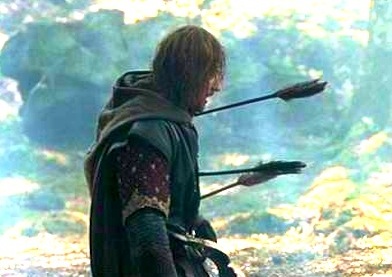
Do you really think it frequently takes more than one arrow in the chest to kill a man?

Generally, no . . . but if that hero is Boromir, most certainly!

The Death of Boromir

One of the most moving scenes in The Lord of the Rings involves the death of Boromir as he sacrifices his life in a futile battle to allow the hobbits time to escape the Uruk-hai. It’s impact is magnified by the fact that it immediately follows Boromir’s near-betrayal, under the corrupting influence of the Ring.

The irony is that this spectacular scene is not described in detail in Tolkien’s book. It is a tribute to director Peter Jackson’s cinematic brilliance. This is the original telling:

Even as [Aragorn] gazed his quick ears caught sounds in the woodlands below, on the west side of the River. He stiffened. There were cries, and among them, to his horror, he could distinguish the harsh voices of Orcs. Then suddenly with a deep-throated call a great horn blew, and the blasts of it smote the hills and echoed in the hollows, rising in a mighty shout above the roaring of the falls.

“The horn of Boromir!” he cried. “He is in need!” He sprang down the steps and away, leaping down the path. “Alas! An ill fate is on me this day, and all that I do goes amiss. Where is Sam?”

As he ran the cries came louder, but fainter now and desperately the horn was blowing. Fierce and shrill rose the yells of the Orcs, and suddenly the horn-calls ceased. Aragorn raced down the last slope, but before he could reach the hill’s foot, the sounds died away; and as he turned to the left and ran towards them they retreated, until at last he could hear them no more. Drawing his bright sword and crying Elendil! Elendil! he crashed through the trees.

A mile, maybe, from Parth Galen in a little glade not far from the lake he found Boromir. He was sitting with his back to a great tree, as if he was resting. But Aragorn saw that he was pierced with many black-feathered arrows; his sword was still in his hand, but it was broken near the hilt; his horn cloven in two was at his side. Many Orcs lay slain, piled all about him and at his feet.

Aragorn knelt beside him. Boromir opened his eyes and strove to speak. At last slow words came. “I tried to take the Ring from Frodo” he said. “I am sorry. I have paid.” His glance strayed to his fallen enemies; twenty at least lay there. “They have gone: the Halflings: the Orcs have taken them. I think they are not dead. Orcs bound them.” He paused and his eyes closed wearily. After a moment he spoke again. “Farewell, Aragorn! Go to Minas Tirith and save my people! I have failed.”

“No!” said Aragorn, taking his hand and kissing his brow. “You have conquered. Few have gained such a victory. Be at peace! Minas Tirith shall not fall!” Boromir smiled.

“Which way did they go? Was Frodo there?” said Aragorn.

But Boromir did not speak again.

“Alas!” said Aragorn. “Thus passes the heir of Denethor, Lord of the Tower of Guard! This is a bitter end. Now the Company is all in ruin. It is I that have failed. Vain was Gandalf’s trust in me. What shall I do now? Boromir has laid it on me to go to Minas Tirith, and my heart desires it; but where are the Ring and the Bearer? How shall I find them and save the Quest from disaster?”

He knelt for a while, bent with weeping, still clasping Boromir’s hand. So it was that Legolas and Gimli found him. (Lord of the Rings, Book III Chapter 1).

So, we understand that while a single arrow might slay a common warrior, it could well take a quiver full to lay low a champion such as this.

___

If you would like to review “The Fantasy Novelist’s Exam,” simply follow this link.

C.S. Lewis’ Beloved Dogs

When the internet throws unsolicited information at me, I do my best to ignore it. Yesterday I failed to duck at the right moment and Wikipedia suggested to me a “featured article” I found irresistible. It featured the earliest reference to a named dog—Abuwtiyuw—who died more than four thousand years ago and was buried in Giza in accordance with the wishes of the unknown pharaoh he guarded.

He was almost certainly a Tesem (“hunting dog”), an ancient breed resembling modern greyhounds. (Curiously, a 2004 DNA study found greyhounds are more closely related to herding breeds.)

We contemporary dog lovers understand how a pharaoh could love one of his canine companions enough to have him mummified and buried in an elaborate ceremony. In the image above, our border collie mix is juxtaposed to a hieroglyph tesem. If you’re interested in the subject, you might enjoy one of my February blogs entitled “Pets in Heaven.”

C.S. Lewis was also a dog lover. Pastor Bruce Johnson wrote a delightful article about eight of his dogs, entitled “All My Dogs Before Me.” You can read the brief but thorough article here.

Johnson walks us from Jacksie (who provided Lewis with his “adopted” name of Jack) to the friendly Ricky who was ever “anxious to be friendly.” In between, the author’s family included Tim, Pat, Mr. Papworth, Troddles, Bruce and Susie. Lewis spoke fondly of all of them, with the exception of Bruce, who possessed a predilection for barking through the night and was terribly spoiled by Mrs. Moore.

I also recommend a fine post about one of Lewis’ dogs which appeared on A Pilgrim in Narnia. It’s entitled “The Society of Tim.” The author of the blog is Brenton Dickieson, a Canadian professor and Lewisian scholar.

A Multiplicity of Polls

Here in the United States, our presidential election season is nearing its end. This is something people on both sides of the political spectrum are anticipating with joy. It’s been a grim process, grimmer than usual. The nation’s financial woes appear to have ramped up the vitriol. Christian values, especially, are maligned by many candidates and the partisan press that ingenuously professes objectivity. Yes, it will be a relief when it ends.

One of the features of modern elections that continues to grow in importance is polling. Scores of different pollsters—with widely varying results—compete for the public’s attention. Some of it is quite interesting, but the dizzying whirlwind of contradictory results creates confusion about their accuracy.

That, however, doesn’t slow their multiplication. Polling as we know it today is a fairly recent invention. It was 1958, when George Gallup gathered all of his nascent polling operations into a single organization. Gallup founded the American Institute of Public Opinion, the precursor of The Gallup Organization, in 1935. Gallup has maintained its reputation for integrity by refusing to accept any funding from political parties or candidates. Today, the company conducts opinion polls in more than 140 countries around the world.

As I was pondering the surplus of polls, I grew curious as to whether or not C.S. Lewis had ever commented on their like. I’m no expert on British politics, but I imagine they had occasional surveys, projections or prognostications. C.S. Lewis and his works have been the subject of innumerable contemporary polls . . . but did the Oxford don ever discuss such matters?

Desiring to avoid superficial attachments that might prove distracting to his literary goals, Lewis maintained a distance from political issues. It was for this reason he declined the well-deserved honor of becoming a “Commander of the British Empire.”

Lewis’ thoughts about politics reflect those of all who have grown tired of empty promises and venomous threats related to the election of “the opposition.” He would have longed, like many of us, for a reasonable and respectful conversation about charting the best course for his country.

Lewis longed for peace, in the spirit of Paul’s exhortation in his epistle to the young pastor, Timothy: “I urge that supplications, prayers, intercessions, and thanksgivings be made for all people, for kings and all who are in high positions, that we may lead a peaceful and quiet life, godly and dignified in every way.” (I Timothy 2:1-2, ESV).

In that spirit he wrote to his brother Warnie in 1940 about the tragedy of living in an epic era, wracked by not one, but two global conflicts.

Lord! How I loathe great issues! ‘Dynamic’ I think is one of the words invented by this age which sums up what it likes and I abominate. Could one start a Stagnation Party—which at General Elections would boast that during its term of office no event of the least importance had taken place? (Maundy Thursday, 21 March 1940).

Lewis’ collected Poems include the following delightful reflection on political campaigning.

Lines During a General Election

Their threats are terrible enough, but we could bear

All that; it is their promises that bring despair.

If beauty, that anomaly, is left us still,

The cause lies in their poverty, not in their will.

If they had power (‘amenities are bunk’), conceive

How their insatiate gadgetry by this would leave

No green, nor growth, nor quietude, no sap at all

In England from The Land’s-End to the Roman Wall.

Think of their roads—broad as the road to Hell—by now

Murdering a million acres that demand the plough,

. . .

And all our coasts one Camp till not the tiniest wave

Stole from the beach unburdened with its festal scum

Of cigarette-ends, orange-peel, and chewing-gum.

Nor would one island’s rape suffice. Their visions are

Global; they mean the desecration of a Star;

Their happiest fancies dwell upon a time when Earth,

Flickering with sky-signs, gibbering with mechanic mirth,

One huge celestial charabanc [tour bus], will stink and roll

Through patient heaven, subtopianized from pole to pole.

As I mentioned above, there are an abundance of polls about Lewis and his writings. It’s fitting to close this post with a related discussion from the introduction to The Quotable C.S. Lewis.

A quick survey of the Encyclopedia Britannica’s great books of the Western world reveals that an average of approximately three authors per century have been included in that august collection. This being so, what authors from this century will be read in the next? Of course, we can no more than guess; only time will tell. If votes are going to be cast, however, the name C. S. Lewis ought at least to be on the ballot.

The influence of his pen can hardly be overestimated. One observer noted that Lewis “is read with enormous affection and loyalty by a wide and diversified audience today. . . . In fact, more of his books are sold today than those of any other Christian writer in history.” Indeed, with over sixty of his books in print, Lewis has for many in this century become the dominant exponent and champion of thoughtful Christianity. Lewis wrote on a wide variety of subjects in many literary forms.

These words were written during the twentieth century. A decade into the new century they ring just as true. Lewis’ contributions to literature and faith are passing the test of time. And I suspect that will remain true at the close of this century, whether polls anticipate it or not.

Those of you with extra time on your hands may wish to participate in Mere Inkling’s nonscientific poll, below.

Theological Training

I’m proud I graduated from a well-respected seminary. And I’m proud of following that Master of Divinity degree with an advanced Master of Theology degree in Patristics. And that’s precisely the problem . . . I’m proud.

As a Christian, I recognize that pride is one of the most destructive and insidious sins. As a pastor and chaplain, I have seen all too frequently how pride expressly targets members of the clergy. Our vulnerability to the temptation to be proud is one of the common chinks in the armor of the ordained.

C.S. Lewis recognized this fact. In A Severe Mercy, he wrote:

I think there is a great deal to be said for having one’s deepest spiritual interest distinct from one’s ordinary duty as a student or professional man. St. Paul’s job was tent-making. When the two coincide I shd. have thought there was a danger lest the natural interest in one’s job and the pleasures of gratified ambition might be mistaken for spiritual progress and spiritual consolation; and I think clergymen sometimes fall into this trap. . . .

In fact, the change [to a Christian ministry] might do good or harm. I’ve always been glad myself that Theology is not the thing I earn my living by. On the whole, I’d advise you to get on with your tent-making. The performance of a duty will probably teach you quite as much about God as academic Theology wd. do. Mind, I’m not certain: but that is the view I incline to.

Lewis understood that “advancement” in ecclesiastical contexts can mask the inner heart and be mistaken as a form of holiness when it is in actuality vanity. I was reminded of this weakness in clerical armor recently, when I read a tribute to a Chinese Christian whose name is little known beyond his homeland. Dr. Sun Yi-yin, known in America as “Freddie Sun,” died in August at the age of 76. A professor of Geology, he lost his faculty position for failing to deny Christ.

Like thousands of other Christians living under the atheist regime, he was imprisoned for his work in establishing churches and Bible schools. He raised the funds to start no fewer than 154 of these training centers, and was key to the equipping of approximately 60,000 underground pastors and teachers. The “underground” Church in China is distinguished from the government-controlled “Three-Self Patriotic Movement.”

For his labors, Sun endured a decade in a Chinese labor camp. (His wife, Dorothy Chang, was also imprisoned. Rather than reducing his faith, during his sojourn in the harshest of conditions, Sun experienced a personal revival and his zeal increased.

His story is amazing, but here is the aspect that hit the mark in the center of my conscience. In his autobiography, The Man in the Fiery Furnace, Sun described his imprisonment as his “seminary” experience: “Instead of learning homiletics, hermeneutics, Greek, and Hebrew, I was being taught the greater lessons of obedience, submission, forgiveness, love, endurance, and patience.”

Now, I am grateful that God has preserved me from the “fiery furnace,” but I do long to experience the fruit of the spirit that Sun so richly harvested in prison. While not dismissing the importance of the classical subjects of homiletics and hermeneutics, as the Apostle says, “If I speak in the tongues of men and of angels, but have not love, I am a noisy gong or a clanging cymbal. And if I have prophetic powers, and understand all mysteries and all knowledge, and if I have all faith, so as to remove mountains, but have not love, I am nothing. If I give away all I have, and if I deliver up my body to be burned, but have not love, I gain nothing.” (I Corinthians 13:1-3, ESV).

In The Problem of Pain, Lewis’ treatise on suffering, he addresses how God can redeem terrible things such as unjust punishments. For those desiring to understand how an omnipotent God can allow evil to occur, Lewis’ presentation is quite helpful. And, the life example of Dr. Sun provides a superb example of its validity.

I advance six propositions necessary to complete our account of human suffering which do not arise out of one another and must therefore be given in an arbitrary order. 1. There is a paradox about tribulation in Christianity. Blessed are the poor, but by ‘judgement’ (i.e., social justice) and alms we are to remove poverty wherever possible. Blessed are we when persecuted, but we may avoid persecution by flying from city to city, and may pray to be spared it, as Our Lord prayed in Gethsemane.

But if suffering is good, ought it not to be pursued rather than avoided? I answer that suffering is not good in itself. What is good in any painful experience is, for the sufferer, his submission to the will of God, and, for the spectators, the compassion aroused and the acts of mercy to which it leads. In the fallen and partially redeemed universe we may distinguish (1) the simple good descending from God, (2) the simple evil produced by rebellious creatures, and (3) the exploitation of that evil by God for His redemptive purpose, which produces (4) the complex good to which accepted suffering and repented sin contribute.

Now the fact that God can make complex good out of simple evil does not excuse—though by mercy it may save—those who do the simple evil. And this distinction is central. Offences must come, but woe to those by whom they come; sins do cause grace to abound, but we must not make that an excuse for continuing to sin. The crucifixion itself is the best, as well as the worst, of all historical events, but the role of Judas remains simply evil.

I thank God for the life and testimony of Sun. I pray God will reap an abundance of believers in China, and elsewhere, due to his faithfulness. And I thank God for using Sun’s words to cause me to stop in the midst of my busy activities and take the time to examine my own heart and motives.

Vivacious Vocabularies

One reason I love reading C.S. Lewis arises from his adroit use of the English language. His vocabulary is immense. It is pleasant to run into words one seldom encounters on the drab byways of modern journalism and tangled thoroughfares of contemporary “social media.”

Consider the following example. I was exploring The Allegory of Love when I read this: “There is nothing in literature which does not, in some degree, percolate into life.”

What a delightful verb! It evokes for me recollections of my youth when my parents would refer to our coffee pot as the percolator. Simultaneously, it reminds me of more recent—less happy—usages: “I’m sorry, but inadequate soil percolation means you’ll have to install a far more expensive septic system than normally required.”

It’s discouraging when you consider the sad state of modern vocabularies. I read somewhere that people typically only use about 10% of the words they know. So a common vocabulary of 5,000 spoken words would mean they know (i.e. can recognize written or audible forms of) about 50,000 words. Shakespeare used 29,000 words in his plays and sonnets, suggesting an expansive vocabulary. Likewise, brilliant authors like C.S. Lewis would boast a praiseworthy mental dictionary.

I am sometimes curious about my own vocabulary. I consciously attempt—in conversation as well as writing—to utilize at least 15% of the words I know. After all, the English language is so rich, it’s criminal to limit ourselves to pedestrian words. It’s like having all the ingredients for a delicious feast available to us and settling for slapping together a peanut butter sandwich.

I also love the precision that comes from using the exact word that suits the occasion. For example, in a thriller it matters greatly how the hero’s nemesis inflicts injury. A skilled writer would never say “Professor Moriarty cut Holmes.” Instead, we would learn that he slashed . . . stabbed . . . sliced . . . scarred . . . carved . . . or perhaps he merely nicked the detective. Likewise, we would probably know the type of weapon he was using. It would not be a mere “knife.” It might be a saber . . . a dagger . . . a pocketknife . . . scalpel . . . carving knife . . . or perhaps even a bayonet.

Lewis addressed this richness in vocabulary in an essay on “Transposition” which appears in The Weight of Glory.

If the richer system is to be represented in the poorer at all, this can only be by giving each element in the poorer system more than one meaning. The transposition of the richer into the poorer must, so to speak, be algebraical, not arithmetical. If you are to translate from a language which has a large vocabulary into a language that has a small vocabulary, then you must be allowed to use several words in more than one sense. If you are to write a language with twenty-two vowel sounds in an alphabet with only five vowel characters than you must be allowed to give each of those five characters more than one value. If you are making a piano version of a piece originally scored for an orchestra, then the same piano notes which represent flutes in one passage must also represent violins in another.

It is wonderful to be fortunate enough to speak a language with a diverse vocabulary. English is such a tongue. Now, if we could just simplify its complexities and purge its irregularities, we would enjoy the best of all linguistic worlds.

Wasp Wars

This fall I’ve entered into combat with some of fallen nature’s most ferocious and merciless creatures. Thus far, they are winning the war.

A couple months ago my castle (i.e. home) was invaded by a ruthless tribe of wasps or hornets (the latter is a subset of the species, as are yellow jackets, so they are all members of a single horrific animal family).

They found a small, un-caulked opening into our attic . . . strategically placed just above our front door. I’m sure they had thousands of alternative bastions in the forest that surrounds our house but, being wasps, they knew this was the precise location from which they could wreak the most violent havoc.

The initial fray was brief. I sprayed copious amounts of wasp insecticide into the crevice, in the hope of encouraging them to nest elsewhere. It appeared to act as an attractant. After it failed and added more recruits to their number, I donned armor and climbed a ladder after dusk when they had settled in for the night, and noiselessly attempted to close the space with insect-proof sealant.

Alas, their sentinels were vigilant. They swarmed me, and pushed me off of the ladder causing me to land on my back and crash my head on the ground. Unfortunately, my long sleeved armor did not include a concussion proof helmet. Like a craven coward I lifted my bruised body from the rocky ground (nope, we haven’t planted a lawn yet) . . . and I ran for my life. All the while I was thanking God that I was only standing on the third rung.

Aside from my bruises, they had only inflicted a single piercing wound—on my index finger. Of course, being predators, wasps carry a very nasty venom, and for the next week it failed to heal as the poison festered, despite diligent attention from my corpsman-wife.

I’m waiting patiently for winter now, when they are partially dormant and “hibernating.” When the queen wakes up in the spring, she’ll find herself sealed in a crypt. (At least, that’s what I’m hoping.)

Wasps in Narnia

C.S. Lewis, being a lover of the outdoors, was well acquainted with the hazard posed by wasps. In The Chronicles of Narnia,

When the Pevensie children are drawn back to Narnia for a second time, it is a jarring and initially frightening experience. As we read in Prince Caspian:

It was an empty, sleepy, country station and there was hardly anyone on the platform except themselves. Suddenly Lucy gave a sharp little cry, like someone who has been stung by a wasp. “What’s up, Lu?” said Edmund—and then suddenly broke off and made a noise like “Ow!”

“What on earth—” began Peter, and then he too suddenly changed what he had been going to say. Instead, he said, “Susan, let go! What are you doing? Where are you dragging me to?”

“I’m not touching you,” said Susan. “Someone is pulling me. Oh—oh—oh—stop it!” Everyone noticed that all the others’ faces had gone very white.

“I felt just the same,” said Edmund in a breathless voice. “As if I were being dragged along. A most frightful pulling—ugh! It’s beginning again.”

“Me too,” said Lucy. “Oh, I can’t bear it.”

“Look sharp!” shouted Edmund. “All catch hands and keep together. This is magic—I can tell by the feeling. Quick!”

“Yes,” said Susan. “Hold hands. Oh, I do wish it would stop—oh!” Next moment the luggage, the seat, the platform, and the station had completely vanished.

The four children, holding hands and panting, found themselves standing in a woody place—such a woody place that branches were sticking into them and there was hardly room to move. They all rubbed their eyes and took a deep breath. “Oh, Peter!” exclaimed Lucy. “Do you think we can possibly have got back to Narnia?”

Later, Edmund offers some wise advice in The Voyage of the Dawn Treader. He alludes to the deceptive natural and inherent ninja skills possessed by the killers.

“We must all show great constancy,” Caspian was saying. “A dragon has just flown over the tree-tops and lighted on the beach. Yes, I am afraid it is between us and the ship. And arrows are no use against dragons. And they’re not at all afraid of fire.”

“With your Majesty’s leave—” began Reepicheep.

“No, Reepicheep,” said the King very firmly, “you are not to attempt a single combat with it. And unless you promise to obey me in this matter I’ll have you tied up. We must just keep close watch and, as soon as it is light, go down to the beach and give it battle. . . .”

“Perhaps it will go away,” said Lucy.

“It’ll be worse if it does,” said Edmund, “because then we shan’t know where it is. If there’s a wasp in the room I like to be able to see it.”

Back to My Own Campaign

Just as I became resigned to my strategy with the vicious intruders, I became aware of a second army of insect brigands. This multitude had invaded the crawlspace under my home, through some weakness in the screens guarding my ventilation openings.

Noting that I would not require a ladder to engage them in combat I foolishly thought, oh how you will rue the day you trespassed in my domain!

I purchased a new screen to cover the entire opening, but their guards remained vigilant even during the night and before I could even begin the project, they swarmed and had me fleeing across our back lawn (yes, we do have some grass). Running recklessly in the dark I naturally stumbled and still bear some significant bruises. These would be bad enough, but two of the villains stabbed me with their poisonous stingers before I secured myself in the house.

With the aid of my faithful border collie, I discovered an infiltrator who insidiously snuck into the castle proper clinging to my pants. I immediately dropped my leggings and proceeded to stomp on them for several minutes. I was thorough, walking repeatedly over every part of the crumpled clothing. Naturally, he survived. I did manage to rewrap him in the trousers and see to his demise.

I am reconsidering my strategy now, and leaning towards placing commercial wasp traps directly outside the vent when the vermin reawaken in the spring. I’m also contemplating periodically banging a hammer near their hidden nest to disturb their rest during their hibernation. I haven’t determined yet whether this would be effective, as it is when interrogating terrorists, or whether it would simply be sadistic.

Trying to learn their weaknesses (they don’t have any) I did learn one reason why wasps are so aggressive and merciless. They are almost all female! While queens alone reproduce, and they keep a few males handy for their sole role of mating and dying, the rest of the army consists of “asexual female workers.” These perform community duties such as building the hive, gathering food, feeding the young, and protecting the colony!

Now, lest I be unfairly accused of misogyny, let me make clear that it is not their “feminine” nature that makes them violent. Rather, it is a corruption of their natural maternal instincts which cause them to guard their nest so belligerently that all rationally minded people desire their utter annihilation.

And, Once Again, to Narnia

The final book in the Chronicles has been my favorite ever since I first read the series forty years ago. I gained an even greater appreciation for The Last Battle when I read this description of the heavenly Narnia into which all of Aslan’s faithful were ushered.

Tirian had thought—or he would have thought if he had time to think at all—that they were inside a little thatched stable, about twelve feet long and six feet wide. In reality they stood on grass, the deep blue sky was overhead, and the air which blew gently on their faces was that of a day in early summer. Not far away from them rose a grove of trees, thickly leaved, but under every leaf there peeped out the gold or faint yellow or purple or glowing red of fruits such as no one has seen in our world. The fruit made Tirian feel that it must be autumn but there was something in the feel of the air that told him it could not be later than June.

They all moved toward the trees. Everyone raised his hand to pick the fruit he best liked the look of, and then everyone paused for a second. This fruit was so beautiful that each felt “It can’t be meant for me . . . surely we’re not allowed to pluck it.”

“It’s all right,” said Peter. “I know what we’re all thinking. But I’m sure, quite sure, we needn’t. I’ve a feeling we’ve got to the country where everything is allowed.”

“Here goes, then!” said Eustace. And they all began to eat. What was the fruit like? Unfortunately no one can describe a taste. All I can say is that, compared with those fruits, the freshest grapefruit you’ve ever eaten was dull, and the juiciest orange was dry, and the most melting pear was hard and woody, and the sweetest wild strawberry was sour. And there were no seeds or stones, and no wasps.

Despite our repeated failings, the victory will ultimately be won by our divine Champion!