Damnable Typos & the Bible

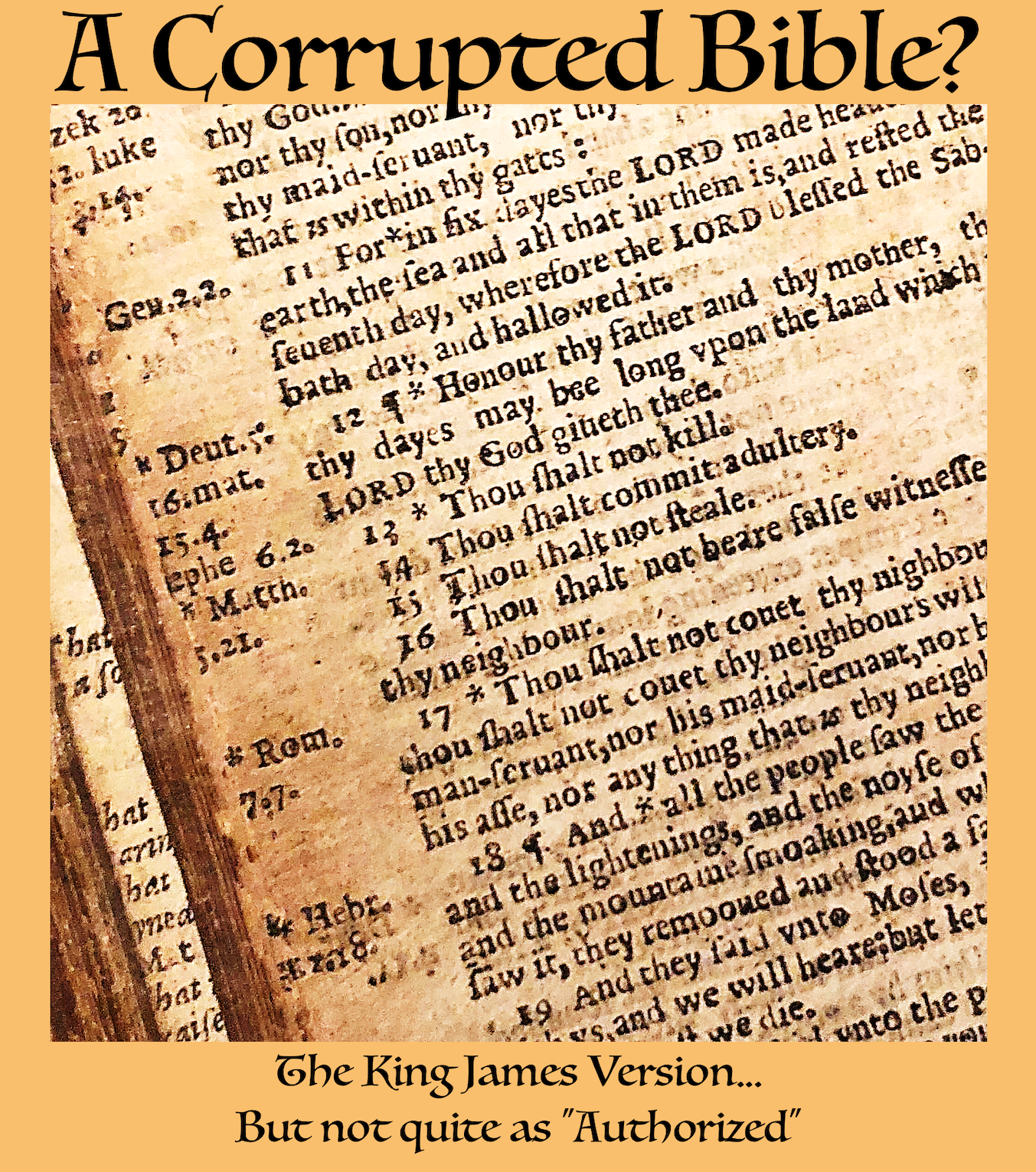
While the title of this post will be shocking to some, it’s far less scandalous than the typographical error discussed below. Due to two misprints appearing in a 1641 edition of the King James Bible (KJV), the publication has been labeled the “Wicked Bible.”

Translating the Scriptures is a necessary, and demanding, task. The early editions of the KJV (which was preceded by the Wycliffe Bible) reveal how vulnerable the words themselves were to being altered during the typesetting process.

I’ve written about this subject a number of times during the past decade, and even devoted a column to “C.S. Lewis’ School of Translation,” which is about something even more important than merely translating words. There I quote one of the great author’s deepest hopes.

What I want is to be the founder of a school of ‘translation . . .’ Where are my successors? (correspondence, 7 October 1945).

Returning to the seventeenth century book with its unfortunate errors, we witness an example of how even a solid translation can be derailed by careless (or malevolent) typesetters.

The magnitude of the mistake discovered in this particular edition caused its suppression, and most copies were destroyed. While some still exist in private hands, only fifteen remain in public collections. One of these made its way to New Zealand before being identified in 2018.

A Truly Scandalous Misprint

It would be one thing if a printer accidently dropped the final “e” from “breathe,” leaving the word “breath.” Even substituting an errant “w” for the “b,” would create an alternate word that would greatly muddle a passage . . . but still not appear remotely “wicked.” 

However, a 1631 mistake in an English Bible literally turned a passage – one of the Ten Commandments, no less – on its head. Rather than reading “Thou shalt not commit adultery,” this edition declares, “Thou shalt commit adultery” (Exodus 20:14).

The consequences of this disaster were significant, particularly for His Majesty’s official printers. In Cyprianus Anglicanus by royalist priest Peter Heylyn (1599-1662), we learn the details. (You can download a free facsimile of the volume which includes many other fascinating facts.) The passage related to the misbegotten tome reads as follows:

His Majesties Printers, at or about this time [1632], had committed a scandalous mistake in our English Bibles, by leaving out the word Not in the Seventh Commandment.

His Majesty being made acquainted with it by the Bishop of London, Order was given for calling the Printers into the High-Commission where upon the Evidence of the Fact, the whole Impression was called in, and the Printers deeply fined, as they justly merited.

Reports of Cases in the Courts of Star Chamber and High Commission, penned by Samuel Rawson Gardiner in 1886, includes a detailed account of the court’s findings. (Due to their uniqueness, I have transposed the full account, as found in two sections, as a footnote below.) One passage describes a second “gross error.”

. . . showed the two grossest errors, vizt. “Shalt commit adultery” and “great asse:” for “shalt not commit adultery” and “greatnesse…”

The second of these blunders occurs in Deuteronomy 5:24, which properly reads “Behold, the Lord our God hath shewed us his glory and his greatness.” (It should be noted that the word asse would most commonly be associated with donkeys.)

The magnitude of these mistakes can only be understood when one recognizes how reverentially the Scriptures were regarded at this time. C.S. Lewis would suggest that during an age when the Bible has been relegated to historic literature, it is difficult for us to comprehend the seriousness of this matter.

It is very generally implied that those who have rejected its theological pretensions nevertheless continue to enjoy it as a treasure house of English prose. It may be so. There may be people who, not having been forced upon familiarity with it by believing parents, have yet been drawn to it by its literary charms and remained as constant readers.

But I never happen to meet them. Perhaps it is because I live in the provinces. But I cannot help suspecting, if I may make an Irish bull, that those who read the Bible as literature do not read the Bible. (“The Literary Impact of the Authorised Version”).

In “Challenges in Printing Early English Bibles,” you can read about other Bibles featuring noteworthy mistakes. In two, “peacemakers” become “placemakers,” and “murmurers” are transformed into “murderers.” Another example, in the very first edition of the KJV, finds Jesus’ ancestor Ruth referred to by the male pronoun, due to the accidental dropping of an “s.”

More troubling is another early KJV Bible where “the text of Psalm 14 [reads], “The fool hath said in his heart there is a God,” rather than “The fool hath said in his heart there is no God.”

Worst of all, in terms of blasphemous connotations, would likely be the so-called “Judas Bible.”

In the 1609 Geneva Bible, the typesetters mistakenly replaced Jesus’s name with that of Judas. John 6:67 reads: “From that time many of his disciples went back, and walked no more with him. Then said Judas unto the twelve, Will ye also go away?”

Fortunately, modern editions of the Jewish and Christian Scriptures undergo thorough proofreading, so this sort of error is rare today. Still, typos will persist as long as the remotest possibility of error exists.

Those among us who have sought to have our writing published by traditional publishers may relate to the example with which we end. C.S. Lewis and J.R.R. Tolkien and even Mark Twain faced challenges working with some of their editors and publishers.

With all of the printing mishaps in the early English Bible, it is only appropriate that one of the editions was called “The Printers Bible.”

This text, published in about 1702, takes its name from a typesetting error found in Psalm 119, which should have read “Princes have per­secuted me without a cause” but was mistakenly printed as “Printers have persecuted me.”


Full references from Reports of Cases in the Courts of Star Chamber and High Commission by Samuel Rawson Gardiner (1886).

Mr Barker the printer. There is a cause begunne against him for false printeing of the Bible in divers places of it, in the Edition of 1631, vizt., in the 20 of Exod[us], “Thou shalt committ adultery”; and in the fifte of Deut[eronomy] “The Lord has shewed his glory, and his great asse”; and for divers other faults; and that they had printed it in very bad paper. And the Bishop of London showed that this would undoe the trade, and was a most dishonorable thing; that they of the church of Rome are soe carefull, that not a word or letter is to be found amisse in their Ladie’s Psalter and other superstitious books; and that we should not be soe carefull in printinge the sacred Scriptures; and that they in Holland, at Amsterdam, had gott up an English presse, and had printed the Bible in better paper, and with a better letter, and can undersell us 18d. in a Bible. Mr Barker and his partners endeavored in partt to excuse themselves, and had advocates to speake for them, and were willing to submitt, and promised to amend their faults; but the Court would not remitt their offense, but the cause was ordered to goe on.

The Printers having answered move the Court to passe by their oversight being the fault of the workmen but the King’s Advocate desired they might make their defense legally and the cause to go onto hearing: and that he might have liberty to put in additional articles against them. The Bishop of London would have the Church sett upright in her reputacion, that we are as carefull in printeing the Bible as they are of their Jesus’ psalter : and whereas the Printers say this is stirred up by the malice of one man against them; The Bishop saith he stirred not till the Bible was sould into his house, bought by his footman: and he saith the printinge is soe bbad and the paper too that, if it be not mended shortlie, they wilbe put downe by those of Amsterdam and their trade spoyled, and showed for the two grossest errors, vizt. “Shalt commit adultery” and “great asse:” for “shalt not commit adultery” and “greatnesse…” The Arch Bishop of Canterbury saith, that the Printers that print for his Matie have a very profitable place, and therefore should be more carefull. I knew the tyme when greater care was had about printeing, the Bibles especiallie, good compositors and the best correctors were gotten being grave and learned men, and the paper and letter rare and faire every way of the best; but now the paper is naught, the composers boyes, and the correctors unlearned: There is a farmer and he makes the benefit, and careth for nothing about it. They heretofore spent their whole time in printeing, but these looke to gaine, gaine, gaine, then they are not to be commended: Well, let them looke to it: and let the cause proceed, saith the ArchBishop. London. “There was a great deale of doo between you of this Citty and those of Cambridge heretofore about the priviledge of printeing the Bible and psalms which they of Cambridge claymed; then the Bible was exactlie printed, now you have forced the Cambridg printer to an agreement, now noe bible is right printed.

[It appears this volume itself would have benefited from having more diligent “correctors.” Perhaps most curiously, two spellings of the word printing – “printinge” and “printeing” – appear in this publication.]
Learning Languages

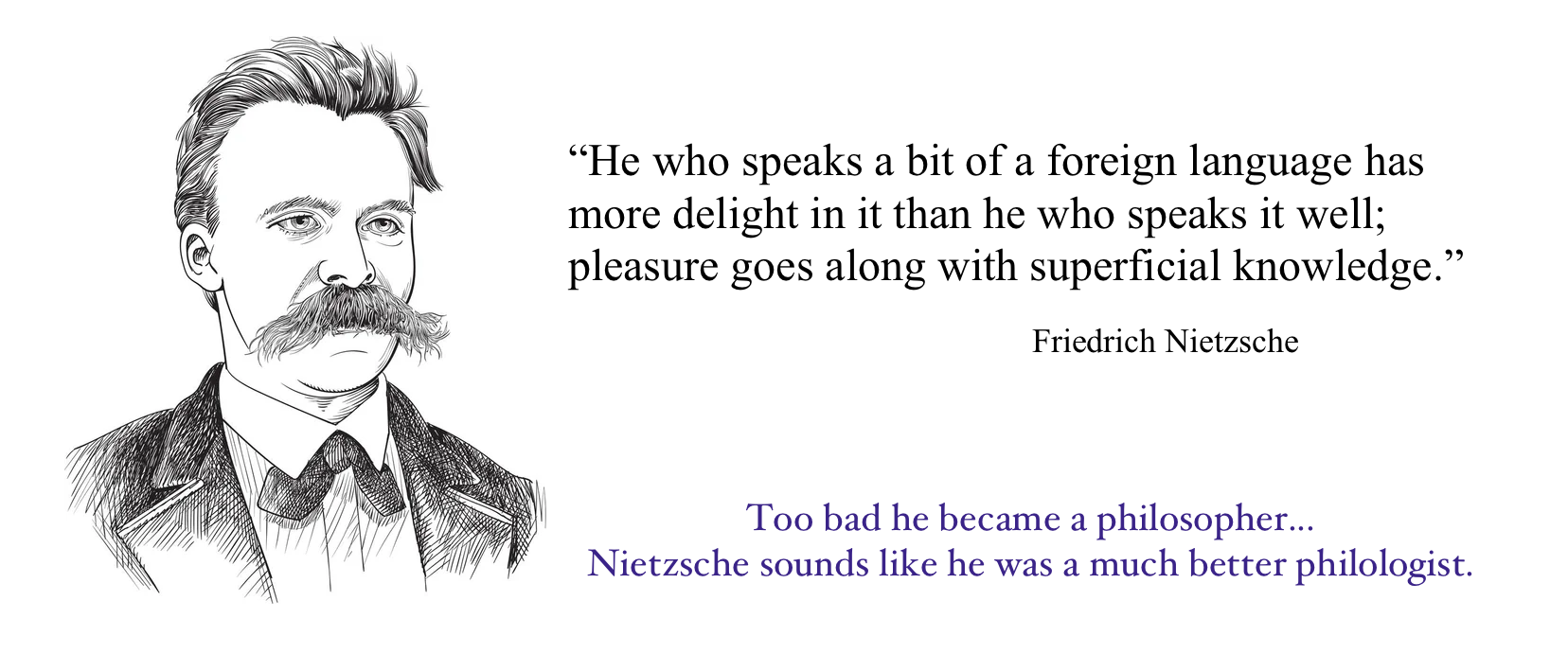
C.S. Lewis possessed a gift for languages. Although he was not a philologist like his friend J.R.R. Tolkien, Lewis was well educated and read and spoke a variety of languages.

In fact, when he and his wife played Scrabble, they allowed for the use of words from any language! For the record, though, he does confess to a German professor that his grasp of that tongue is “wretched.”

The only bona fide genius I’ve known was a classmate at the University of Washington. While I was struggling with classical Greek, in preparation for seminary, at the age of 23 Bruce already possessed four master’s degrees and was closing in on his PhD in Linguistics. He spoke fifteen languages, but could read nineteen.

Of course, that is still a small portion of the 7,168 languages Ethnologue tells us are in use today.

This enormous number – which doesn’t include unknown languages spoken among untouched people groups – accounts for the fact that thousands of Christians are laboring now in groups such as Lutheran Bible Translators to make the Scriptures available to all people.

Sometimes this involves creating a written language itself, where only an oral version exists. The largest such organization, Wycliffe Global Alliance, reports that “Bible translation is currently happening in 2,846 languages in 157 countries.”

While the Bible’s translation is certainly of utmost importance, it is wonderful to know that other valuable literature is also made available to readers who could not decipher the language in which it was originally composed. 

Lewis, in fact, was a translator in his own right. Beyond the literal translation of works from one tongue to another, Lewis also functioned as a “translator” of complex concepts and eternal truths. I once described this as C.S. Lewis’ bilingualism.

How many extremely intelligent and well educated people do you know . . . who can actually communicate with those of us possessing normal human intelligence? That talent is a rarity.

And it is precisely what makes C.S. Lewis such an unusual man. He was brilliant. Yet he could communicate with the common person – even the child – just as easily as he conversed with his fellow university dons.

C.S. Lewis mastered a number of modern languages, but it was his study of historic languages that especially inspired him. Icelandic, with its similarity to Old Norse, is one example about which I have written. 

. . . J.R.R. Tolkien and his friend C.S. Lewis established a group called Kolbitár which was devoted to reading Icelandic and Norse sagas. The word itself means “coal biter” and refers to those in a harsh environment drawing so close to the fire’s warmth they can almost bite the coals.

Another example is Old English. Along with Middle English, birthed by the Norman Conquest, these were essential elements of his training as one of the preeminent English scholars of Oxford and Cambridge. And these languages were not merely dusty relics. I encourage the curious to read “C.S. Lewis’s Unpublished Letter in Old English,” which appeared in the journal VII.

In 1926 C.S. Lewis wrote his friend Nevill Coghill a letter in Old English, a language also known as Anglo-Saxon. Unreadable for most current readers of Lewis, it understandably does not appear in his three-volume Collected Letters.

In the essay, George Musacchio provides an illuminating outline of Lewis’ diverse expertise with languages, both “foreign and domestic.” Lewis began the letter to his friend with the following salutation.

“Leowis ceorl hateð gretan Coghill eoorl luflice ond freondlice.”
Which translates as: “Lewis the churl bids to greet Coghill the earl.”

Is English Really that Difficult to Learn?

English is reputed to be one of the most challenging languages to learn. (More on this in a moment.) For example, the simple sentence which follows consists of a mere seven words, but holds seven different meanings, dependent upon which word is emphasized.

“I never said she stole my money.”

This example comes from an article entitled “English is Hard, But Can Be Understood Through Tough Thorough Thought Though.”

Rosetta Stone answers the question of how hard it is to learn English by saying “it depends on your first language.” 

In addition to the fact that “spelling is a poor indicator of pronunciation,” English possesses numerous “specific rules,” and complements this burden with the fact that “some rules have lots of exceptions.” The complexity is due to the language’s history, which also gave rise to its mammoth vocabulary.

English has a lot of words—Webster’s English Dictionary includes approximately 470,000 entries, and it’s estimated that the broader English vocabulary may include around a million words. . . .

English has such a broad vocabulary because it’s a blend of several different root languages. While English is a West Germanic language in its sounds and grammar, much of the vocabulary also stems from Romance languages, such as Latin, Italian, Spanish, and Portuguese.

One result of combining these various root languages is that the English vocabulary includes a ton of synonyms . . . And unfortunately, most of these synonyms aren’t fully interchangeable, so the exact word you choose does have an impact on the overall meaning.

It turns out English doesn’t even rank in the top three most difficult languages for the speakers of the five largest language groups. The ranked listings do include, however, Arabic, Japanese, Russian, and Mandarin.

So, let’s reverse the question for a moment. Which languages are the most difficult for a native English speaker to learn? Unbabel lists ten. Fortunately, only one of them is on my wish list.

Babbel Magazine has an article approaching that question from the opposite end. Which language is easiest for English speakers to learn.

This may come as a surprise, but we have ranked Norwegian as the easiest language to learn for English speakers. Norwegian is a member of the Germanic family of languages — just like English! This means the languages share quite a bit of vocabulary, such as the seasons vinter and sommer (we’ll let you figure out those translations).

Another selling point for Norwegian: the grammar is pretty straightforward, with only one form of each verb per tense. And the word order closely mimics English. For example, “Can you help me?” translates to Kan du hjelpe meg? — the words are in the same order in both languages, so mastering sentence structure is a breeze!

Finally, you’ll have a lot more leeway with pronunciation when learning Norwegian. That’s because there are a vast array of different accents in Norway and, therefore, more than one “correct way” to pronounce words.

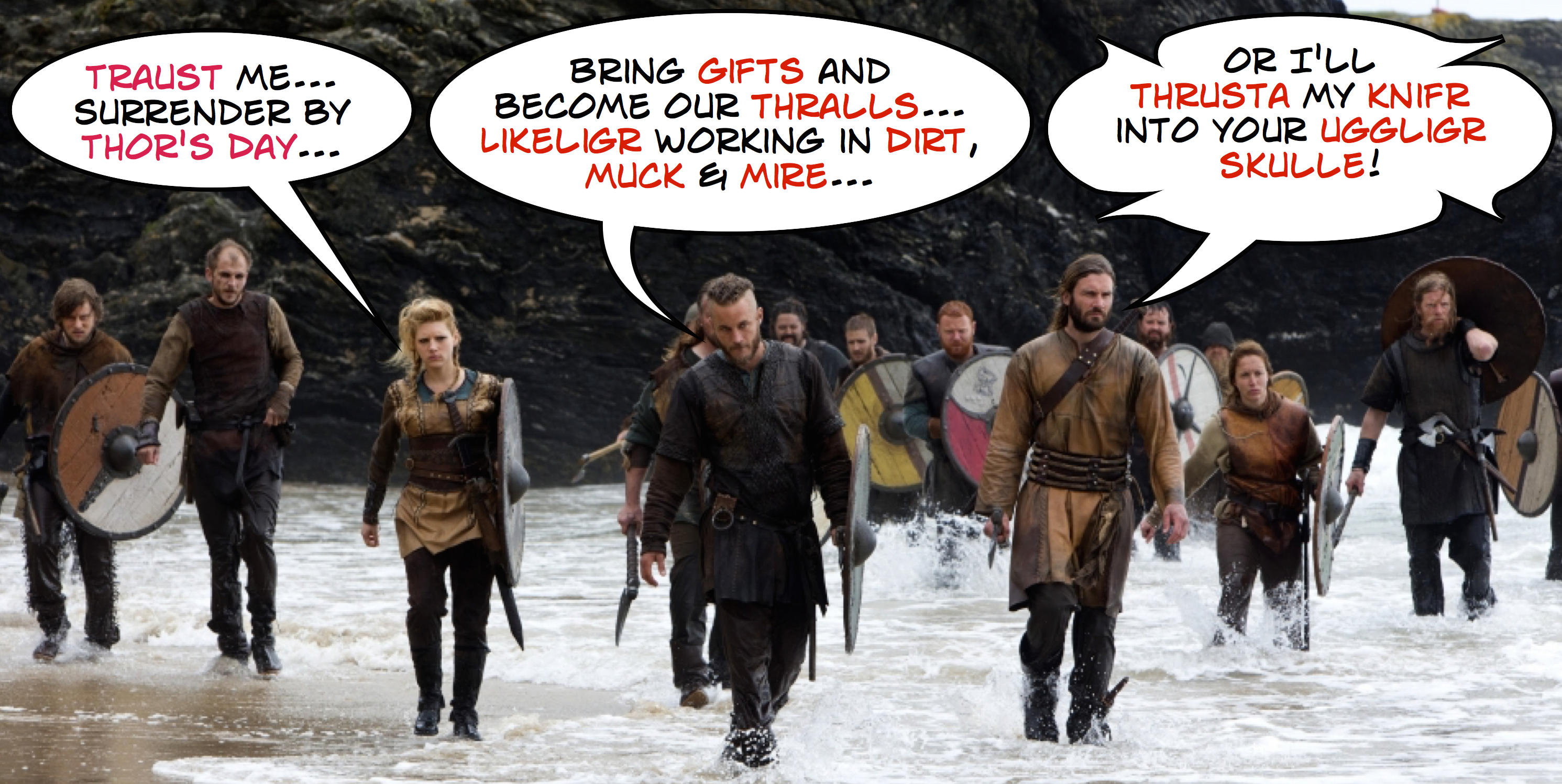
An article I wrote seven years ago hints at that same conclusion. I made this informative, and mildly threatening, illustration for “Norse Linguistic Invasion.”

Oxford Royale Academy lists several reasons why English is especially challenging to new students. The following issue of “irregularities” also plagues countless native speakers.

One of the hardest things about English is that although there are rules, there are lots of exceptions to those rules – so just when you think you’ve got to [come to] grips with a rule, something comes along to shatter what you thought you knew by contradicting it.

A good example is the rule for remembering whether a word is spelt “ie” or “ei:” “I before E except after C.” Thus “believe” and “receipt.”

But this is English – it’s not as simple as that. What about “science?” Or “weird?” Or “seize?”

There are loads of irregular verbs, too, such as “fought”, which is the past tense of “fight”, while the past tense of “light” is “lit.” So learning English isn’t just a question of learning the rules – it’s about learning the many exceptions to the rules.

The numerous exceptions make it difficult to apply existing knowledge and use the same principle with a new word, so it’s harder to make quick progress.

And even some of the normative “rules” are difficult to grasp. One example is that there’s a very specific order that adjectives must be listed ahead of a noun. According to Rosetta Stone,

The adjective order is: quantity, opinion, size, age, shape, color, origin/material, qualifier, and then noun. For example, “I love my big old yellow dog.” Saying these adjectives in any other order, like “I love my yellow old big dog,” will sound wrong, even when otherwise the sentences are exactly the same and communicate the same thing. Keeping rules like this in mind can be tricky, and it takes a lot of practice to get it right.

Adjective order is seldom considered, in part because it’s not considered good writing to string too many such words together. But apparently there are right and wrong ways to organize any such list.

Royal Order of Adjectives

Most students aren’t taught about adjective order in school and instead learn it through listening and reading. In English, the rules regarding adjective order are more specific than they are in other languages; that is why saying adjectives in a specific order sounds “right,” and deviating from that order makes a statement sound “wrong,” even if it’s otherwise grammatically perfect.

And, since we’re talking about English, even this Royal Order of Adjectives rule has exceptions

The hierarchy is not absolute, and there is some wiggle room among the “fact” categories – size, age, and so on – in the middle.

Native speakers are often delighted when they learn about this law and discover how flawlessly they apply it. It even went viral in 2016 . . . The tweet attached a paragraph by etymologist Mark Forsyth . . . giving an example that uses all the categories according to the OSASCOMP hierarchy: “a lovely little old rectangular green French silver whittling knife.”

I do not ever recall being taught (or reading on my own) about the “Royal Order of Adjectives.” Nevertheless, I don’t feel too embarrassed at acknowledging my previous ignorance, since even Lewis himself was comfortable in expressing gratitude for being introduced to new words. For example, when he thanked Dorothy Sayers for enlarging his vocabulary with her work on Dante.

So, is English all that challenging? Well, C.S. Lewis did his part to make it less daunting, joining a public debate in Britain, with an unexpected argument. Discussing English’s previously noted problem with inconsistencies and confusion in spelling, the don offered a simple solution.

In a column on Lewis and the history of words, I included an extended passage from a letter Lewis wrote challenging a contemporary British effort to “reform” spelling. Surprisingly, he argued against the necessity for uniformity in spelling. After explaining why our language functions as it does, he advocates:

As things are, surely Liberty is the simple and inexpensive ‘Reform’ we need? This would save children and teachers thousands of hours’ work.

Surely all but the most diehard grammarians would be sympathetic to his argument.

Next week I plan to write about another linguistic matter closely associated with the Inklings – the creation of new words and languages.

Sanctified Languages

petrusOne major difference between Christianity and Islam is their view of language. For the Muslim, Arabic is the language by which the Quran is to be known. For the Christian, there is a great impulse to translate the Scriptures into every tongue in the world.

In Islamic worship, the Quran is properly recited only in Arabic, whether the individual understands Arabic or not. This is similar to the way that most Hindus chant mantras in ancient Sanskrit.

A parallel can be drawn with the medieval practice in the Western branches of Christianity where Latin continued to be used for worship, even after it lost its role as the shared language.

The fact, however, that the Bible had even been translated into Latin was due to the Christian desire to make God’s word accessible to all people. Jerome, an early Christian theologian, became a linguistic scholar with the goal of translating the Vulgate, into the common language of his day.

It would have been a great shock to him, and to Pope Damasus I who commissioned his effort, to see the Latin so ingrained in the church’s usage that their heirs in leadership lost sight of the desire to bring the Lord’s words directly to the people so that all could understand them.

One of the great successes of the Reformation was the successful translation and distribution of the Scriptures into the vernacular of various language groups. Martin Luther’s translation, in fact, standardized the German language which had evolved into several different dialects.

Coincidentally, Lutherans have remained at the forefront of Bible translation, and Lutheran Bible Translators continue that vital work today. They currently have twenty-two Bible translations in process. LBT works in conjunction with Wycliffe Bible Translators, which is an even larger organization.

C.S. Lewis delivered a lecture at the University of London entitled “The Literary Impact of The Authorised Version.” In one portion he addressed the influence of the King James translation on the English language. While not nearly so pronounced as Luther’s on German, it is measurable.

The history of the Authorised Version has been told so often that I will not attempt to re-tell it, and its beauties praised so lavishly that I will not praise them. Instead, I will proceed at once to its influence as an English book. I shall attempt to define that influence, for I think there has been misunderstanding about it and even a little exaggeration.

Lewis’ argument is that the Bible has a profound influence on English literature, the particular translation, less so.

Ideally, all Christians would understand Hebrew and Greek, and be able to read the Scriptures in their original languages. However, there is no stigma in reading a translation. In fact, there are small pockets of people who do not understand the history of the Bible who believe that one particular translation (i.e. the King James Version) is the only authoritative text.

Sadly, I once saw an advertisement in a newspaper inviting worshipers that read: “Are you tired of people changing the Authorized Version of God’s Word with Greek and other languages? If so, come and join us at . . .”

Fortunately, the vast majority of Jesus’ disciples celebrate the translation of God’s word of life into every language spoken today.

Meanwhile, memorization of the Quran in Arabic (even when that is not the reciter’s actual language) remains highly regarded in Islam. Arabic has been regarded as so holy, in fact, that there was great reluctance to contaminate the Quran by using a printing press.

During the Ottoman Empire, until 1729, printing anything in Arabic was a crime. Somewhat ironically, the first printing utilizing Arabic movable type was done by Pope Julius II in the first decade of the sixteenth century. It was created for the benefit of Christians living in Arabic lands.

To provide a powerful illustration of a Christian validation of the authentic inspiration and power of God’s words—in any language—we turn once again to the German reformer.

Since it becomes Christians then to make good use of the Holy Scriptures as their one and only book and it is a sin and a shame not to know our own book or to understand the speech and words of our God, it is a still greater sin and loss that we do not study languages, especially in these days when God is offering and giving us men and books and every facility and inducement to this study, and desires his Bible to be an open book. . . .

In proportion then as we value the gospel, let us zealously hold to the languages. For it was not without purpose that God caused his Scriptures to be set down in these two languages alone—the Old Testament in Hebrew, the New in Greek. Now if God did not despise them but chose them above all others for his word, then we too ought to honor them above all others. St. Paul declared it to be the peculiar glory and distinction of Hebrew that God’s word was given in that language, when he said in Romans 3, “What advantage or profit have those who are circumcised? Much indeed. To begin with, God’s speech is entrusted to them. . . .”

Similarly, the Greek language too may be called sacred, because it was chosen above all others as the language in which the New Testament was to be written, and because by it other languages too have been sanctified as it spilled over into them like a fountain through the medium of translation. (Martin Luther, “To the Councilmen of Germany”).

_____

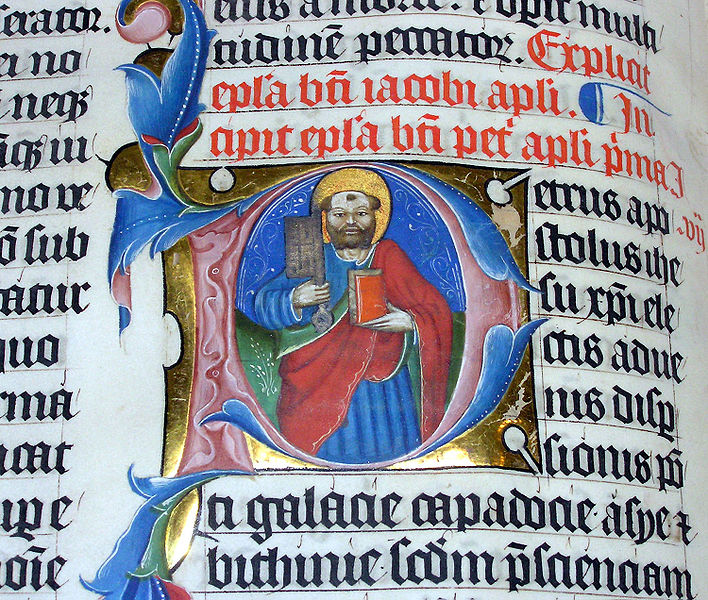
The image above is an illuminated “P” which begins the name Petrus (Peter). The manuscript is displayed in Malmesbury Abbey in England, but was originally transcribed in Belgium circa 1400.