
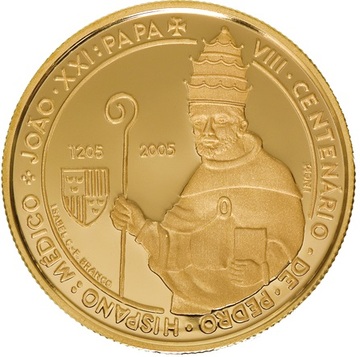
A few days ago marked the anniversary of the 1277 death of Pope John XXI. I knew nothing about this particular Pontiff, but the mention I read described his passing due to the collapse of the ceiling of his residence. That piqued my interest, but the following forced me to spend some time researching to learn more: “The name was a mistake – there was never a John XX.”
One of the very few email lists I’ve never regretted signing up for is “Today in Christian History” produced by Christianity Today.
Each day it provides brief notes about several historical events that happened on that particular day. Most of the notes describe historically watershed incidents. Others are simply curious, though they were naturally momentous to those involved.
The opening of this post offers an example from the latter category. Unlike the reign of Pope Francis, who ascended a decade ago and has indicated he has no intention of “retiring” before death (as did his humble predecessor Benedict XVI), the unfortunate John XXI sat on the papal throne for a mere nine months.
Despite this brief reign, there are several interesting things about Pedro Julião. (I’ll save the one I regard as most important for last.)
First of all, John XXI was Portuguese. Hailing from the Iberian Peninsula, he represents no less than 50% of the popes who came from Portugal. The first, Damasus I (305-84), came from the Roman province of Lusitania, which included a portion of Spain in addition to modern Portugal.
One paradox of the Papacy is that the Pope is the Bishop of the diocese of Rome, presiding over a physical geographic locale, while he is simultaneously the Bishop of the “Holy See,” meaning that he serves as the episcopal head of the entire international Roman Catholic communion.
Due to the physical location of the Roman Patriarchate, it is unsurprising that a majority of the individuals who have followed Saint Peter as Pontiff have been Italian. World Population Review says 217 of the 266 Popes have been from Italy. “A distant second is France, which has had a total of 16 popes.”
J.R.R. Tolkien was a truly devout Roman Catholic, but C.S. Lewis recognized that the church headquartered in Rome was merely one part of the Body of Christ whose unity he argued was founded in an understanding of the Mere Christianity Lewis propounded. Much to Tolkien’s chagrin, his good friend Lewis never converted to Roman Catholicism.
Roman Catholics still seek C.S. Lewis’ imprimatur. One prominent Roman Catholic apologist, Joe Heschmeyer, has a personal blog delightfully titled Shameless Popery. (I highly respect truth in advertising like his website exhibits.) In “C.S. Lewis’ Surprising Argument for the Papacy,” he argues that Lewis’ argument for a traditional view of marriage offers support to the rationale for papal authority.
Unlike some Protestants, C.S. Lewis was not tempted to construct a strawman out of the papacy. In an interesting passage from his monumental history of English Literature in the Sixteenth Century, he emphasizes the shared legacy of Roman Catholicism and robust Protestantism.
To be sure, there are standards by which the early Protestants could be called “puritanical;” they held adultery, fornication, and perversion for deadly sins. But then so did the Pope. If that is puritanism, all Christendom was then puritanical together.
In much the same way that C.S. might argue that “all Christendom” shared not only a common moral awareness, but also a mutual understanding of God’s self-revealed Triune nature.
In addition to being a rare specimen as a Portuguese Pope, John XXI studied medicine and is thought to have been a noteworthy pharmacologist. In fact, the apartment in the papal palace in Viterbo which collapsed on him was constructed so he would have a quiet place in which to pursue his medical studies.
Second, as already mentioned, another peculiar thing about John XXI, is the choice of his papal name. There never was a Pope John XX. One would imagine the church bureaucracy would keep accurate records of these sorts of things. Even more strangely, there is more than one explanation for why Pedro Julião became John XXI at his consecration.
According to Brittanica “Marianus Scotus and other 11th-century historians mistakenly believed that there had been a pope named John between antipope Boniface VII and the true John XV.” Consequently, “they mistakenly numbered the real popes John XV to XIX as John XVI to XX” requiring that they subsequently be “renumbered XV to XIX.” Yet, for some reason, “John XXI and John XXII continue to bear numbers that they themselves formally adopted on the assumption that there had indeed been 20 Johns before them.”
As a result, the title John XX presumably remains available for any future Bishop of Rome who might wish to further confuse the matter. We may have to wait until the Parousia to learn the full facts in this convoluted matter.
A third distinctive of John XXI is that he rescinded a very common sense decree established by his predecessor Gregory X, only two years prior to John’s ascension. (Actually, Adrian V was elected pope between the two, but Ottobuono de’ Fieschi died shortly after his election, before he could even be ordained to the priesthood. (There must be another interesting tale there.)
Returning to the story of the rescinded canon . . . Apparently there was a long papal vacancy (nearly three years) before Gregory X was elected. To avoid such predicaments in the future, at the Second Council of Lyon Gregory pushed for this sensible rule: if the new pope is not elected in a reasonable time frame, encouragement would be provided to the conclave by having their episcopal meals and other rewards gradually diminish!
The entire, fascinating “constitution” is available at Eternal World Television Network. Here is the essence:
We learn from the past how heavy are the losses sustained by the Roman church in a long vacancy, how perilous it is . . . We intend in no way to detract from [previous rules primarily instituted by Pope Alexander III], but to supply by the present constitution what experience has shown to be missing.
If, which God forbid, within three days after the cardinals have entered the said conclave, the church has not been provided with a shepherd, they are to be content for the next five days, every day both at dinner and supper, with one dish only. If these days also pass without the election of a pope, henceforth only bread, wine and water are to be served to the cardinals until they do provide a pope.
While the election is in process, the cardinals are to receive nothing from the papal treasury, nor any other revenue coming from whatever source to the church while the see is vacant.
For some unrevealed reason, John XXI revoked this rule, and it was back to business as usual. The decision to do so was one of John’s few official acts.
C.S. Lewis, Once Again
One reason Christians of all denominational traditions find much to appreciate in C.S. Lewis comes from the fact he was much more interested in edifying believers than tearing them down. He preferred to promote Christian unity over division.
One of his close friends, with whom he carried on a long term correspondence was a Benedictine monk named Bede Griffiths. Ironically, while Griffiths became renowned for his embrace of elements of Hindu spirituality, the priest appeared less tolerant of C.S. Lewis’ Protestant doctrines. In a letter from 1936, Lewis’ frustration on that score comes through loud and clear.
One of the most important differences between us is our estimate of the importance of the differences. You, in your charity, are anxious to convert me: but I am not in the least anxious to convert you.
You think my specifically Protestant beliefs a tissue of damnable errors: I think your specifically Catholic beliefs a mass of comparatively harmless human tradition which may be fatal to certain souls under special conditions, but which I think suitable for you. . . .
As well – who wants to debate with a man who begins by saying that no argument can possibly move him? Talk sense, man! With other Catholics I find no difficulty in deriving much edification from religious talk on the common ground: but you refuse to show any interest except in differences.
These words were written (1) privately, to a friend, (2) in the form of an extemporaneous letter, and (3) tinged with the frustration of returning to a familiar “debate” with a recalcitrant disputant.
Fortunately, however, we possess an essay written by Lewis on the same subject which was composed in the opposite context. It was intentionally composed for a general audience, written in C.S. Lewis’ natural painstakingly logical and clear literary voice, and composed in his conciliatory spirit with a focus on affirming what is shared and illuminating – but not dwelling upon – differences.
In 1944 C.S. Lewis penned an essay entitled “Christian Reunion.” Sadly, it was never completed for publication during his lifetime. This brief work reveals his deeper thoughts on interdenominational distinctives, and the overriding unity Christians possess through our relationship in Jesus Christ. It is written primarily to a Roman Catholic audience, in a respectful and genuinely compassionate tone.
A Pilgrim in Narnia has provided the universal (“catholic” with a small “c”) Church a great service in reproducing the full text of the essay here.
Dr. Dickieson also provides a concise and helpful introduction. I offer only a selection from Lewis’ essay here, as befits the nature of our current discussion.
I know no way of bridging this gulf [between the major Christian traditions]. Nor do I think it the business of the private layman to offer much advice on bridge-building to his betters. My only function as a Christian writer is to preach “mere Christianity” not ad clerum [to the clergy] but ad populum [to the people].
Any success that has been given me has, I believe, been due to my strict observance of those limits. By attempting to do otherwise I should only add one more recruit (and a very ill qualified recruit) to the ranks of the controversialists. After that I should be no more use to anyone.
When therefore we find a certain heavenly unity existing between really devout persons of differing creeds – a mutual understanding and even a power of mutual edification which each may lack towards a lukewarm member of his own denomination – we must ascribe this to the work of Christ . . .
Ultimately, C.S. Lewis’ reservations about Roman Catholicism rested where they do for most thinking Christians who belong to other denominations. Its focus can be distilled down to a “disagreement about the seat and nature of doctrinal Authority.” Although he does not expressly state the conviction here that Scripture supersedes the ultimate weight of a single opinion, say of someone such as Pope John XXI, that is the concern.
We will end with C.S. Lewis’ astute analysis of the two parts of the Christian family as they view one another across the proverbial Tiber. In doing so, I offer the fruits of my own recent theological quest. Precipitated by a contemporarily trivial event during the thirteenth century, it culminated in another deep draught from the wisdom of C.S. Lewis.
The difficulty that remains . . . is our disagreement about the seat and nature of doctrinal Authority. The real reason, I take it, why you cannot be in communion with us is not your disagreement with this or that particular Protestant doctrine, so much as the absence of any real “Doctrine,” in your sense of the word, at all.
It is, you feel, like asking a man to say he agrees not with a speaker but with a debating society.
And the real reason why I cannot be in communion with you is not my disagreement with this or that Roman doctrine, but that to accept your Church means, not to accept a given body of doctrine, but to accept in advance any doctrine your Church hereafter produces. It is like being asked to agree not only to what a man has said but to what he’s going to say.
Postscript
As an illustration of the C.S. Lewis’ point about authority resting in the current “successor of Peter,” consider the decisions rendered by Gregory X and John XXI about papal enclaves. It seems to me that the first admonition about not indulging those in attendance was wiser than the subsequent decision to restore the earlier policies. But then, that may simply be due to the fact that I’m a Protestant. Unless the rules have been revised since John’s passing, I assume most Roman Catholics would agree that he was led by the Holy Spirit in reversing the decree of the Second Council of Lyon.
 Mere Inkling Press