New Beauty Each Day

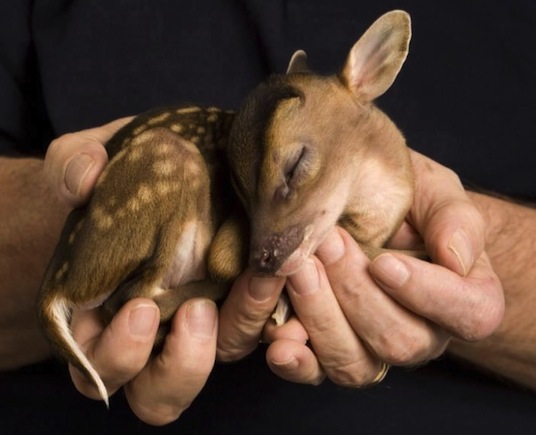
fawnI woke this morning to a scene from Disney.

Looking out the window, with my coffee perking in the background, God blessed me with fabulous scene. A pregnant doe, lying on the ground to rest her weary legs, was peacefully grazing on our lawn. (Echoes of gentle Faline.)

As if that vision were not spectacular enough, a few yards to her side a small bunny hopped about, nibbling on the same grass. (We seeded our lawn with clover to provide a welcoming meal for just such visitors.) The rabbit was alone, although we watched it frolic with its siblings just the other day. (Might they be the children of carefree Thumper?)

Completing the scene were a bevy robins and sparrows. They hopped around the pair, in a wonderful display of original nature’s harmony, which will one day be restored.

The wolf shall dwell with the lamb,

   and the leopard shall lie down with the young goat,

and the calf and the lion and the fattened calf together;

   and a little child shall lead them.

The cow and the bear shall graze;

   their young shall lie down together;

   and the lion shall eat straw like the ox.

                     Isaiah 11:6-7, ESV

The Creator of Narnia understood the essence of this peace as well as anyone. C.S. Lewis revealed that just as nature was created at peace, so too the new creation would mark a restoration of that purity. As Lewis writes in Miracles, Nature “is to be redeemed. The ‘vanity’ to
which she was subjected was her disease, not her essence. She will be cured, but cured in character: not tamed (Heaven forbid) . . .”

For the present time, however, we must be content to appreciate brief glimpses of that promise . . . just as I am now, as I write. (Yes, the doe is still resting mere feet from my window.)

Precious moments like this are something to be savored. A sweet foretaste of the feast to come.

_____

The full context of Lewis’ words from Miracles follows. In this passage he warns us not to worship what is created, but only its Creator.

You must have tasted, however briefly, the pure water from beyond the world before you can be distinctly conscious of the hot, salty tang of Nature’s current. To treat her as God, or as Everything, is to lose the whole pith and pleasure of her. Come out, look back, and then you will see . . . this astonishing cataract of bears, babies, and bananas: this immoderate deluge of atoms, orchids, oranges, cancers, canaries, fleas, gases, tornadoes and toads.

How could you ever have thought that this was the ultimate reality? How could you ever have thought that it was merely a stage-set for the moral drama of men and women? She is herself. Offer her neither worship nor contempt. Meet her and know her. If we are immortal, and if she is doomed (as the scientists tell us) to run down and die, we shall miss this half-shy and half-flamboyant creature, this ogress, this hoyden, this incorrigible fairy, this dumb witch.

But the theologians tell us that she, like ourselves, is to be redeemed. The “vanity” to which she was subjected was her disease, not her essence. She will be cured, but cured in character: not tamed (Heaven forbid) nor sterilised. We shall still be able to recognise our old enemy, friend, play-fellow and foster-mother, so perfected as to be not less, but more, herself. And that will be a merry meeting.

Crimes Against Animals

ferretYou may already have seen this picture which has spread like wildfire across the internet. I’m ashamed to say I shared the common initial response to the story—laughter at the foolishness of consumers looking for bargains. Fortunately, as I learned more of the facts of the deeper crime committed here became apparent, and the humor was displaced by sympathy.

So, just what does this image show? Apparently in Argentina, some criminals have devised a very profitable type of deception. They sell cute toy poodles at a fraction of typical prices.

The only problem with this transaction, is that when owners take their puppies in for vaccinations, the veterinarians have to break the news to them that what they really purchased is not a poodle . . . but a ferret.

How in the world could someone confuse the two, you doubtless wonder. After all, one is Canis lupus familiaris (canine) and the other is Mustela putorius furo (weasel)!

The thieves go to extremes to camouflage their crime. In addition to grooming their fur in similar ways, apparently they abbreviate the poor creatures lives by loading them with steroids as soon as they are born. This adds bulk to disguise the slinky build of these crepuscular mammals that are closely related to polecats. [Don’t feel bad, I had to look up “crepuscular” myself; it refers to animals most active during dawn and twilight hours.]

From the photo you can see the “subtle” differences. I suppose the vendor could explain some of them away with comments like “the muzzle of really young puppies always looks slightly pointed, until they mature.”

While I despise theft, I can chuckle at the thought of someone’s jaw dropping at the news of how they were duped—but I do not regard as at all humorous the suffering inflicted on those innocent creatures.

I don’t own one of the estimated 800,000 domestic ferrets that are part of American families. That doesn’t prevent me, though, from being angered by the cruelty of man toward a species with which humanity has enjoyed a cooperative relationship since before the days of Caesar Augustus. (Augustus shipped ferrets to the Balearic Islands to control a rabbit infestation in 6 BC.)

Some readers might consider my concern for mere weasels as misguided. I believe they are wrong. As C.S. Lewis wrote to a correspondent in 1956:

I think God wants us to love Him more, not to love creatures (even animals) less. We love everything in one way too much (i.e. at the expense of our love for Him) but in another way we love everything too little. No person, animal, flower, or even pebble, has ever been loved too much—i.e. more than every one of God’s works deserves.

It should come as no surprise that the creator of Narnia gave much thought to humanity’s relationship with the other creatures with which the Lord has populated our world. God in the Dock includes his fine essay on “Vivisection.”

After weighing the arguments for and against experimentation on animals, Lewis suggests that our justifications for doing so are often dehumanizing.

The reason why we do not dare [to strongly object to experimentation on higher life forms in the animal kingdom] is that the other side has in fact won. And though cruelty even to beasts is an important matter, their victory is symptomatic of matters more important still.

The victory of vivisection marks a great advance in the triumph of ruthless, non-moral utilitarianism over the old world of ethical law; a triumph in which we, as well as animals, are already the victims, and of which Dachau and Hiroshima mark the more recent achievements. In justifying cruelty to animals we put ourselves also on the animal level. We choose the jungle and must abide by our choice.

I pray that the Argentinean authorities are able to dismantle this abominable trade. And I also hope they will not only prosecute the perpetrators of the crime for theft . . . but for the far more morally corrupt crime of cruelty to animals as well.

Our Common Tongue

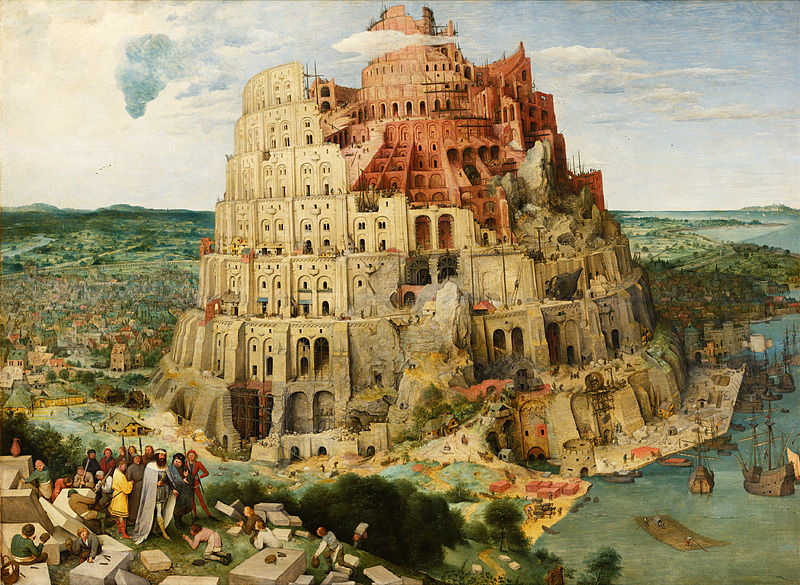
Bruegel BabelThe ancestors of Europeans and Asians spoke a common language 15,000 years ago, as the ice age was ending.

That “discovery” sounds remarkably familiar to those acquainted with an ancient story about a colossal edifice erected in the ancient past. The Hebrews preserved a record of the achievement in the eleventh chapter of the book of Genesis. At the time of the tower’s construction, all of humanity consisted of “one people [sharing] one language.”

The argument for just such a common language is made in a detailed study published this week in the Proceedings of the National Academy of Sciences. After finishing this column, you may wish to read the original journal article, which is available here.

The mechanics of the study will be of great interest to all logophiles (word lovers).

Using sophisticated statistical analysis, the researchers identified 23 different words that have remained recognizable for fifteen millennia. These “ultraconserved” words include some of the fundamental building blocks of basic communication. They include: not, mother, man (i.e. male), we, this, hand, old, fire, ashes and (rather oddly) worm.

The study identifies “proto-words” that underlie common terms in extremely diverse languages. It is no accident that these universal words are the ones that are the most concrete, frequent and essential for human communication.

The Languages of the World Etymological Database, part of the Tower of Babel project . . . records reconstructed proto-words for language families from around the world. Proto-words are hypotheses as to the form of the word used by the common ancestor or proto-language of a given language family to denote a given meaning.

These words are reconstructed by first identifying cognate words among the languages of a given family and then, because cognate words derive from a common ancestral word, working back in time to reconstruct the probable features of that shared ancestral form.

J.R.R. Tolkien was a brilliant linguist, and his abiding love of languages provided the impulse for the creation (and intricate history) of all of Middle Earth.

C.S. Lewis was one of the twentieth centuries greatest writers. He was also a scholar—one with an outstanding grasp of literature. Lewis acknowledged that words describing immediate, touchable concerns can be distinct and firm, just like the realities they connote. However, when language moves farther from such elements, it invariably grows more abstract.

All language, except about objects of sense, is metaphorical through and through. To call God a “Force” (that is, something like a wind or a dynamo) is as metaphorical as to call Him a Father or a King. On such matters we can make our language more polysyllabic and duller: we cannot make it more literal. The difficulty is not peculiar to theologians. Scientists, poets, psychoanalysts, and metaphysicians are all in the same boat. (God in the Dock, “Horrid Red Things”).

The linguistic study described here notes that frequency of usage exerts a stabilizing influence on words. Whereas less common (and more abstract) vocabulary “evolves” more rapidly.

A rule-of-thumb emerges that words used more than around once per 1,000 in everyday speech evolve slowly enough to have a high chance of being judged cognate among more than two of the language families; this might equate to around 16 uses per day per speaker of these high-frequency words.

Throughout history various languages have vied with one another for precedence. In the Mediterranean world Greek, for a season, and then Latin for another, were the “universal” tongues. The phrase lingua franca (literally, the “Frankish language”) has now come to refer to any language that is extensively used as a common bridge between speakers of different tongues.

Such languages, of course, enhance communication. That is not to suggest, however, that the development of these “dominant” languages is without critics. It seems, for example, that France was delighted in their language serving for many years as a standard for international diplomacy. Today however, France continues to staunchly resist the advances of English. (In 1994 the initial version of the Toubon Law overreached in requiring the extensive use of French in nearly all contexts. You can read about some implications for international businesses here.)

Even C.S. Lewis regretted some of the negative influences of American English on the mother tongue. In his book Studies in Words, he mourns:

I have an idea of what is good and bad language. . . . Language is an instrument for communication. The language which can with the greatest ease make the finest and most numerous distinctions of meaning is the best. It is better to have like and love than to have aimer for both.

It was better to have the older English distinction between “I haven’t got indigestion” (I am not suffering from it at the moment) and “I don’t have indigestion” (I am not a dyspeptic) than to level both, as America has now taught most Englishmen to do, under “I don’t have.”

It remains to be seen whether any single language will come to truly dominate the world scene. Being able to communicate freely across all political borders sounds like a noble goal. It is ironic that should that day ever arrive it will mark a return to how things once began.

_____

The painting reproduced above was painted circa 1563 by the Flemish artist Pieter Bruegel the Elder.

Monastic Fonts

A with CrossRecent subscribers to Mere Inkling won’t know this, but some months ago I confessed to suffering an addiction. Like many others who love to write, I am a fontaholic.

That refers, of course, to being obsessed with discovering new and exotic font families.

For many months I’ve kept my compulsion in check, but I was recently caught off guard when I stumbled upon some alluring typefaces I had never encountered before.

I was particularly vulnerable to their charm due to my interest in medieval history. In fact, I was researching the coloration of illuminated manuscripts when I encountered them.

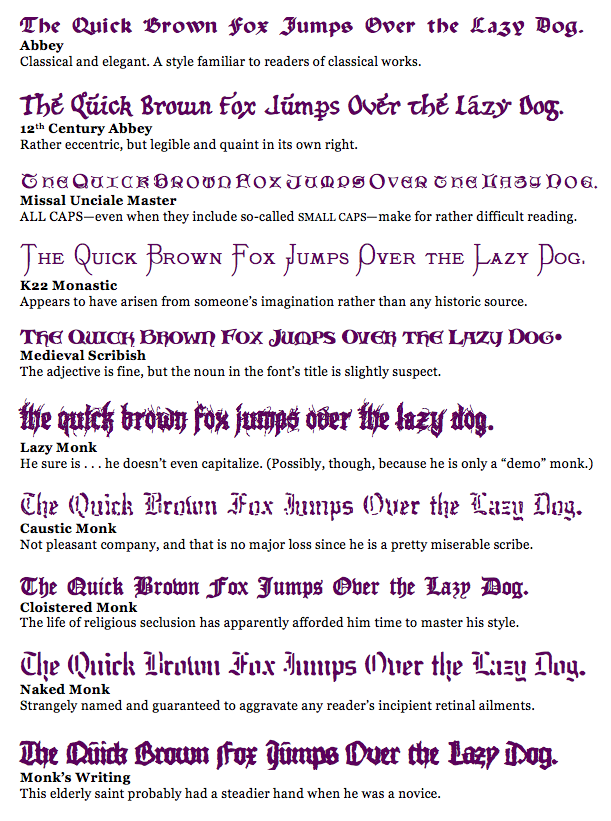
In case you share my weakness—or, even if you are merely curious—I offer examples of the novel fonts I was “forced” to add to my collection. And, you need not worry, since (if you are so inclined) you can download all of them for free at this site.

Each of the fonts below has some “monastic” connection. Obviously, some would be more useful than others, and a couple of them are admittedly quite peculiar. However, even the strangest of pens may be suitable for some applications.

Before contrasting some of these typefaces, it’s worth mentioning that you can also download a “Narnia” font—based on the letters used in the Hollywood version of C.S. Lewis’ classics.

And now, without further introduction, the fonts themselves . . .

medieval fonts

Saintly Newspaper Clippings

stfrancisMy brother, sister and I have nearly finished the somber task of going through my father’s possessions. We distributed many items to various family members, but the local charities have probably benefited most, as we cleared out the three bedroom home.

Sadly, my mother died nearly twenty years ago. My sister inherited her cedar chest, but had left it in our father’s house. As she prepared to take it home, we discovered some interesting items, including forty pictures my father had sent home during his 1967-68 tour in Vietnam.

We also found a Bible my mother had used when she attended studies. She was born in the generation which would never dare to highlight passages or scribble in the margins. Thus, the Bible bears no evidence it ever belonged to her . . . aside from some inspiring bookmarks, and a few newspaper clippings she had found meaningful.

One of the quotations that I too found particularly edifying, came from the pen of a Roman Catholic priest named Francis de Sales:

Do not look forward to what might happen tomorrow; the same everlasting Father who cares for you today will take care of you tomorrow and every day. Either He will shield you from suffering or he will give you the unfailing strength to bear it. Be at peace, then, and put aside all anxious thoughts and imaginations.

Francis was a post-Reformation Bishop of Geneva who was noted for his gentle approach toward religious divisions—in an era when such moderation was extremely rare. He is known for writings on spiritual growth (in Roman Catholic parlance, “spiritual formation”).

Although I have not read it, his book Introduction to the Devout Life comes highly recommended, and is available for free download here. I suspect even agnostics could enjoy it for its historical value.

By all accounts, Francis led a chaste and humble life, much like his namesake, Francis of Assisi. (Both men were canonized by their Church.)

Speaking of the first St. Francis, I have always wondered why no Pope ever honored his legacy by assuming his name. I suppose this is because his most prominent characteristics are not those most Popes seek to emulate. The assumption of Francis’ name by the new Pope, I believe, bodes well for his papacy. If he follows in the footsteps of Francis of Assisi, he cannot stray too far afield.

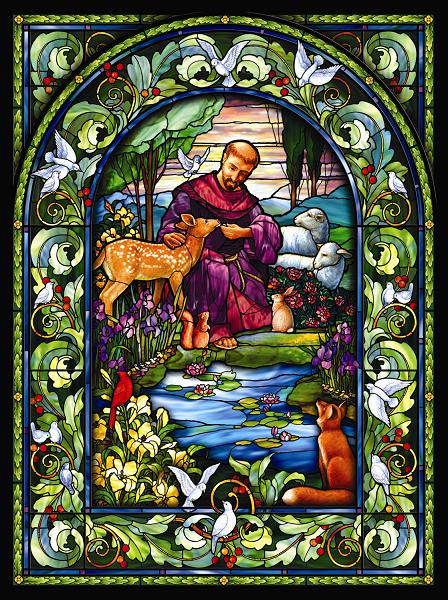
C.S. Lewis appreciated the thirteenth-century saint who began life as a self-indulged soldier and ended it living under a strict vow of poverty. Francis’ celebrated affection for animals—he is considered their “patron saint”—could not help but endear the monk to the creator of Narnia. Each year, many Christians participate in Roman Catholic and Anglican ceremonies for the blessing of animals on Saint Francis’ feast day.

In The Four Loves, Lewis discusses the nature of our physical body. He notes that there are several competing perspectives about our corporeal constitution, with the extremes either demeaning or glorifying humanity’s material nature. Lewis suggests that a metaphor created by Saint Francis provides a more biblical view.

Man has held three views of his body. First there is that of those ascetic Pagans who called it the prison or the “tomb” of the soul, and of Christians like Fisher to whom it was a “sack of dung,” food for worms, filthy, shameful, a source of nothing but temptation to bad men and humiliation to good ones. Then there are the Neo-Pagans (they seldom know Greek), the nudists and the sufferers from Dark Gods, to whom the body is glorious.

But thirdly we have the view which St. Francis expressed by calling his body “Brother Ass.” All three may be—I am not sure—defensible; but give me St. Francis for my money. Ass is exquisitely right because no one in his senses can either revere or hate a donkey. It is a useful, sturdy, lazy, obstinate, patient, lovable and infuriating beast; deserving now the stick and now a carrot; both pathetically and absurdly beautiful. So the body. There’s no living with it till we recognise that one of its functions in our lives is to play the part of buffoon.

Yes, I have to live for a while yet in this donkey of a shell, which illustrates daily the wisdom of the Apostle Paul who wrote that the spirit is willing but the flesh is weak . . . and short-sighted . . . and lazy . . . and stubborn . . .

This body, my flesh, argues that I should spend my day worrying about tomorrow. But the Holy Spirit speaks a more hopeful word. A promise. As God inspired Francis de Sales to eloquently proclaim: “Do not look forward to what might happen tomorrow; the same everlasting Father who cares for you today will take care of you tomorrow and every day.”

Echoes of Narnia

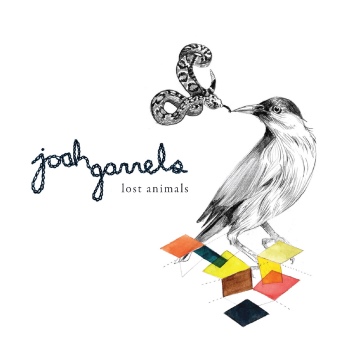
garrelsI just met an amazing new artist. Well, not literally.

I met him, figuratively speaking, through his innovative music. And, although he is “new” to me, he’s been recording for more than a decade. His name is Josh Garrels, and in a moment, I’ll introduce you to two examples of his lyrical poetry.

The reason I first checked out his work was because I received word that he is giving away his music! Amazing, isn’t it? Right now you can download any of his albums for free. However . . . oh, there’s a string attached, you’re thinking . . . he is requesting that you make a donation to aid the suffering in the war-ravaged Democratic Republic of the Congo. So there’s really no string at all, since it’s merely a suggestion, and the gift would be tax deductible anyway. The albums are free. Garrels doesn’t want a penny from us. But he does want us to consider aiding the 70 million struggling people of the Congo.

Despite the Congo being the eleventh largest country in the world, few Westerners follow the terrible news flowing from the wounded nation. For the next two weeks, one hundred percent of the “tips” received for Garrels’ albums will go to World Relief—for their work saving precious lives and bringing peace to the hopeless.

In listening to some of Garrels’ music, I was reminded of the versatility of C.S. Lewis, who wrote so skillfully in so many different genres. I’m not sure how to describe Garrels’ songs; perhaps they defy categorization. It’s not the music I typically listen to . . . but the depth of his lyrics have won me over. Consider the following two songs. I’ll share the lyrics here, and then offer links to each of them below. I encourage you to read the words first and then listen to the music.

“Slip Away”

Hold on, before I slip away

The flames gone dark, I am afraid

How strong is flesh and blood

I cannot can take back what I’ve done

To you, my sweetest friend

I betrayed you, I walked away again

Hold on, before I slip away

The flame’s gone dark, I am afraid

How strong is flesh and blood

I cannot take back what I’ve done

To you, my sweetest friend

I betrayed you, I walked away again

Now all that’s left, is what might have been

Please forgive me, before we reach the end

Please forgive me, before we reach the end

And—for a delightful tale composed in the spirit of Narnia, be sure to listen to “Rabbit and the Bear.” Much of its imagery is shared with the homeland of the Chronicles of Narnia, but it’s clearly the Bible that provides both “composers” with their strongest inspiration.

“Rabbit & the Bear”

Run, run so fast

Over fields and grass

At last, at last

We escaped from the trap

With the rabbit and the bear

And the sparrows of the air

Come one, come all

The hunter is gone

And this is our chance

To crawl under the wire

Through the darkest wood

On up to the mountain of fire

Where everything is free

In the light of the sun

Where every creature sings

Oh Lord, you rescued us all

Don’t listen to the snake

For he lies and he takes

Your hope, your faith

Away from you

But when the lion comes around

With his claw and his crown

Follow, follow

His every move

After you’ve listened to these two pieces, I encourage you to visit this site and download his albums—for free. And, if you feel so inclined, I add my voice to Garrels’ in encouraging you to support World Vision’s vital work in the Congo.

Beware of Zoolatry

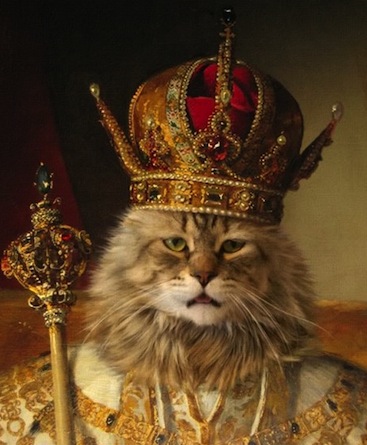
royal catWhen my wife and I dated, I praised her beautiful cat when I visited her home. The cat maintained that imperial posture and attitude that is common in virtually all felines. And that came as no surprise, since she was an Egyptian Mau, one of the most ancient of breeds. She passed on long decades ago, but her haughty, regal bearing is etched in my memory.

I thought of her today when I read the following in the December issue of First Things, in the executive editor’s column.

Wandering around the American Kennel Club’s big “Meet the Breeds” event with my two youngest children recently, I saw a big banner in the cat section proclaiming that a particular breed had been considered a god by an ancient civilization. Of course, our understanding of the genuine religious impulses of ancient religions has increased, but still, one of the gifts the Jewish people have brought the world is that no one who knows about the God of Abraham, Isaac, and Jacob is the least bit tempted to worship cats.

I mean, would you want to worship a murderous narcissistic psychopath? This is not an image of God to make anyone happy. If you’re going to worship an animal, why not the Border Collie, frantically eager to please, or the loving, soulful-eyed Lab? Or the alert and protective German Shepherd? Or the indomitable Saint Bernard? Or the classic loyal and even-tempered mutt?

I don’t intend to offend any cat lovers by repeating this observation—my son has an affectionate tabby he rescued as a kitten while a senior in high school, that’s welcome in our home anytime. Still, as an unrepentant dog person, and “papa” to a rescued border collie, the words above brought a smile to me.

C.S. Lewis painted a graphic image of one animal-headed deity. It was Tash, the god of the Calormenes. In The Last Battle, we see that in Narnia, the reality behind the lifeless image can be most terribly revealed.

In the shadow of the trees on the far side of the clearing something was moving. It was gliding very slowly Northward. At a first glance you might have mistaken it for smoke, for it was grey and you could see things through it. But the deathly smell was not the smell of smoke. Also, this thing kept its shape instead of billowing and curling as smoke would have done. It was roughly the shape of a man but it had the head of a bird; some bird of prey with a cruel, curved beak. It had four arms which it held high above its head, stretching them out Northward as if it wanted to snatch all Narnia in its grip; and its fingers—all twenty of them—were curved like its beak and had long, pointed, bird-like claws instead of nails. It floated on the grass instead of walking, and the grass seemed to wither beneath it. . . .

The others watched it for perhaps a minute, until it streamed away into the thicker trees on their right and disappeared. Then the sun came out again, and the birds once more began to sing. Everyone started breathing properly again and moved. They had all been still as statues while it was in sight. “What was it?” said Eustace in a whisper. “I have seen it once before,” said Tirian. “But that time it was carved in stone and overlaid with gold and had solid diamonds for eyes. It was when I was no older than thou, and had gone as a guest to The Tisroc’s court in Tashbaan. He took me into the great temple of Tash. There I saw it, carved above the altar.”

“Then that—that thing—was Tash?” said Eustace.

In our world, idolatry has certainly evolved since it’s pantheistic and zoolatrous beginnings. Today we are tempted by material indulgences and corruptions aplenty. While few of us impute divinity to animals or objects of stone or wood, we don’t have to look far to find something we deem worthy of adoration.

Our favorite idol is neither beast nor mammon. It is ourselves. As C.S. Lewis wrote in The Problem of Pain:

This act of self-will on the part of the creature, which constitutes an utter falseness to its true creaturely position, is the only sin that can be conceived as the Fall. For the difficulty about the first sin is that it must be very heinous, or its consequences would not be so terrible, and yet it must be something which a being free from the temptations of fallen man could conceivably have committed. The turning from God to self fulfils both conditions. It is a sin possible even to Paradisal man, because the mere existence of a self—the mere fact that we call it “me”—includes, from the first, the danger of self-idolatry. Since I am I, I must make an act of self-surrender, however small or however easy, in living to God rather than to myself. This is, if you like, the “weak spot” in the very nature of creation, the risk which God apparently thinks worth taking.

Now, this is a sin to which I frequently find myself succumbing. I far too often think first about my own desires and appetites . . . only later (if ever) becoming concerned with the needs of my neighbor.

No, it’s neither cat nor dog that needs to be evicted from the throne in my soul reserved for my Creator—it’s me.

Humor & Health

I had to have blood drawn today for an upcoming physical exam. It’s not one of my favorite things to do, but I consciously try not to allow my feelings to negatively affect the caregivers who provide these essential procedures for our wellbeing. (Trust me, dentists especially are sorely in need of our appreciation.) I often try to add a little smile to their day employing a touch of light humor.

Today, for example, I was repeating a blood test I had already accomplished earlier this week. When the corpsman (Naval hospital) asked which arm I said, “you better take it out of my left arm . . . they weren’t happy with the numbers in the sample they got from my right.”

Now, a modest joke like that won’t make it into any comedians’ monologues, but it did inspire a chuckle from the four of us in the lab at that moment.

It reminded me of getting my flu shot last year and having my choice of four different corpsmen to administer it. Each had a waiting line. I could only imagine what it was like to be puncturing one anonymous arm after another for eight hours. Most “victims” silent, but many grimacing and some feeling compelled to describe to you just how much they hate shots.

Three of the corpsmen were normal sized human beings. But the fourth was a behemoth. The seams of his uniform were near to bursting due to his extraordinary musculature. I doubt he was on steroids, but his massive figure could have fit into the offensive line of any team in the NFL. And, for some mysterious reason, his waiting line was the shortest.

When I approached him to receive my vaccination, I ventured (in a voice loud enough for his companions to hear): “I chose you because you look like you’re gentle.” Everyone got a laugh out of that, and I felt pleased at having momentarily brightened their day.

My kids are always wary when I make comments like this. They recognize that every time we open our mouths, it’s a gamble. We can achieve our goal, and elicit someone’s precious smile . . . or we can make a fool of ourselves.

As a grandfather, I have the added “protection” of not having too much expected of me, in the wittiness department. By the grace of God, I’m still in possession of the bulk of my mental capacities. I imagine that, should I live long enough, most of my attempts at humor may grow rather lame. But, if there remains any cultural respect for our elders, even these attempts will be recognized for what they are—goodwill. And, as such, there are those from whom they will still elicit a smile.

We should not be afraid of humor, especially in its most humble and intimate forms. Woven amidst the threads of our daily conversations, it enriches life.

C.S. Lewis recognized this quite well. In The Magician’s Nephew, which recounts the creation of Narnia, Aslan says to the newly anointed animals: “Laugh and fear not, creatures. Now that you are no longer dumb and witless, you need not always be grave. For jokes as well as justice come in with speech.”

Lewis notes something in Reflections on the Psalms that I too have found to be true. “A little comic relief in a discussion does no harm, however serious the topic may be. (In my own experience the funniest things have occurred in the gravest and most sincere conversations.)”

Because of this, it’s not uncommon when we sit with those who have lost a loved one, to find that the conversation often drifts towards those happy and humorous moments that were shared with the departed. I’ve heard much healing laughter in the still sorrowing presence of the grieving. And, whether the words or thoughts evoke bold laughter or simple smiles, I tend to consider them a good thing indeed.

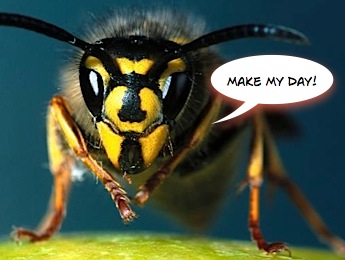
Wasp Wars

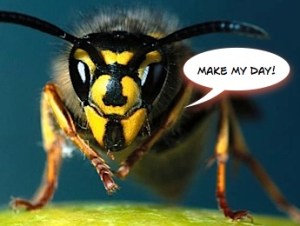
This fall I’ve entered into combat with some of fallen nature’s most ferocious and merciless creatures. Thus far, they are winning the war.

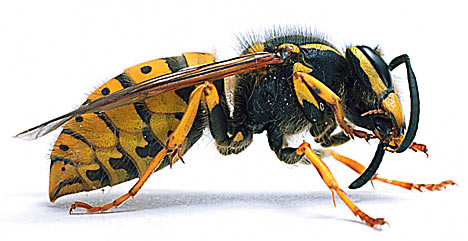
A couple months ago my castle (i.e. home) was invaded by a ruthless tribe of wasps or hornets (the latter is a subset of the species, as are yellow jackets, so they are all members of a single horrific animal family).

They found a small, un-caulked opening into our attic . . . strategically placed just above our front door. I’m sure they had thousands of alternative bastions in the forest that surrounds our house but, being wasps, they knew this was the precise location from which they could wreak the most violent havoc.

The initial fray was brief. I sprayed copious amounts of wasp insecticide into the crevice, in the hope of encouraging them to nest elsewhere. It appeared to act as an attractant. After it failed and added more recruits to their number, I donned armor and climbed a ladder after dusk when they had settled in for the night, and noiselessly attempted to close the space with insect-proof sealant.

Alas, their sentinels were vigilant. They swarmed me, and pushed me off of the ladder causing me to land on my back and crash my head on the ground. Unfortunately, my long sleeved armor did not include a concussion proof helmet. Like a craven coward I lifted my bruised body from the rocky ground (nope, we haven’t planted a lawn yet) . . . and I ran for my life. All the while I was thanking God that I was only standing on the third rung.

Aside from my bruises, they had only inflicted a single piercing wound—on my index finger. Of course, being predators, wasps carry a very nasty venom, and for the next week it failed to heal as the poison festered, despite diligent attention from my corpsman-wife.

I’m waiting patiently for winter now, when they are partially dormant and “hibernating.” When the queen wakes up in the spring, she’ll find herself sealed in a crypt. (At least, that’s what I’m hoping.)

Wasps in Narnia

C.S. Lewis, being a lover of the outdoors, was well acquainted with the hazard posed by wasps. In The Chronicles of Narnia,

When the Pevensie children are drawn back to Narnia for a second time, it is a jarring and initially frightening experience. As we read in Prince Caspian:

It was an empty, sleepy, country station and there was hardly anyone on the platform except themselves. Suddenly Lucy gave a sharp little cry, like someone who has been stung by a wasp. “What’s up, Lu?” said Edmund—and then suddenly broke off and made a noise like “Ow!”

“What on earth—” began Peter, and then he too suddenly changed what he had been going to say. Instead, he said, “Susan, let go! What are you doing? Where are you dragging me to?”

“I’m not touching you,” said Susan. “Someone is pulling me. Oh—oh—oh—stop it!” Everyone noticed that all the others’ faces had gone very white.

“I felt just the same,” said Edmund in a breathless voice. “As if I were being dragged along. A most frightful pulling—ugh! It’s beginning again.”

“Me too,” said Lucy. “Oh, I can’t bear it.”

“Look sharp!” shouted Edmund. “All catch hands and keep together. This is magic—I can tell by the feeling. Quick!”

“Yes,” said Susan. “Hold hands. Oh, I do wish it would stop—oh!” Next moment the luggage, the seat, the platform, and the station had completely vanished.

The four children, holding hands and panting, found themselves standing in a woody place—such a woody place that branches were sticking into them and there was hardly room to move. They all rubbed their eyes and took a deep breath. “Oh, Peter!” exclaimed Lucy. “Do you think we can possibly have got back to Narnia?”

Later, Edmund offers some wise advice in The Voyage of the Dawn Treader. He alludes to the deceptive natural and inherent ninja skills possessed by the killers.

“We must all show great constancy,” Caspian was saying. “A dragon has just flown over the tree-tops and lighted on the beach. Yes, I am afraid it is between us and the ship. And arrows are no use against dragons. And they’re not at all afraid of fire.”

“With your Majesty’s leave—” began Reepicheep.

“No, Reepicheep,” said the King very firmly, “you are not to attempt a single combat with it. And unless you promise to obey me in this matter I’ll have you tied up. We must just keep close watch and, as soon as it is light, go down to the beach and give it battle. . . .”

“Perhaps it will go away,” said Lucy.

“It’ll be worse if it does,” said Edmund, “because then we shan’t know where it is. If there’s a wasp in the room I like to be able to see it.”

Back to My Own Campaign

Just as I became resigned to my strategy with the vicious intruders, I became aware of a second army of insect brigands. This multitude had invaded the crawlspace under my home, through some weakness in the screens guarding my ventilation openings.

Noting that I would not require a ladder to engage them in combat I foolishly thought, oh how you will rue the day you trespassed in my domain!

I purchased a new screen to cover the entire opening, but their guards remained vigilant even during the night and before I could even begin the project, they swarmed and had me fleeing across our back lawn (yes, we do have some grass). Running recklessly in the dark I naturally stumbled and still bear some significant bruises. These would be bad enough, but two of the villains stabbed me with their poisonous stingers before I secured myself in the house.

With the aid of my faithful border collie, I discovered an infiltrator who insidiously snuck into the castle proper clinging to my pants. I immediately dropped my leggings and proceeded to stomp on them for several minutes. I was thorough, walking repeatedly over every part of the crumpled clothing. Naturally, he survived. I did manage to rewrap him in the trousers and see to his demise.

I am reconsidering my strategy now, and leaning towards placing commercial wasp traps directly outside the vent when the vermin reawaken in the spring. I’m also contemplating periodically banging a hammer near their hidden nest to disturb their rest during their hibernation. I haven’t determined yet whether this would be effective, as it is when interrogating terrorists, or whether it would simply be sadistic.

Trying to learn their weaknesses (they don’t have any) I did learn one reason why wasps are so aggressive and merciless. They are almost all female! While queens alone reproduce, and they keep a few males handy for their sole role of mating and dying, the rest of the army consists of “asexual female workers.” These perform community duties such as building the hive, gathering food, feeding the young, and protecting the colony!

Now, lest I be unfairly accused of misogyny, let me make clear that it is not their “feminine” nature that makes them violent. Rather, it is a corruption of their natural maternal instincts which cause them to guard their nest so belligerently that all rationally minded people desire their utter annihilation.

And, Once Again, to Narnia

The final book in the Chronicles has been my favorite ever since I first read the series forty years ago. I gained an even greater appreciation for The Last Battle when I read this description of the heavenly Narnia into which all of Aslan’s faithful were ushered.

Tirian had thought—or he would have thought if he had time to think at all—that they were inside a little thatched stable, about twelve feet long and six feet wide. In reality they stood on grass, the deep blue sky was overhead, and the air which blew gently on their faces was that of a day in early summer. Not far away from them rose a grove of trees, thickly leaved, but under every leaf there peeped out the gold or faint yellow or purple or glowing red of fruits such as no one has seen in our world. The fruit made Tirian feel that it must be autumn but there was something in the feel of the air that told him it could not be later than June.

They all moved toward the trees. Everyone raised his hand to pick the fruit he best liked the look of, and then everyone paused for a second. This fruit was so beautiful that each felt “It can’t be meant for me . . . surely we’re not allowed to pluck it.”

“It’s all right,” said Peter. “I know what we’re all thinking. But I’m sure, quite sure, we needn’t. I’ve a feeling we’ve got to the country where everything is allowed.”

“Here goes, then!” said Eustace. And they all began to eat. What was the fruit like? Unfortunately no one can describe a taste. All I can say is that, compared with those fruits, the freshest grapefruit you’ve ever eaten was dull, and the juiciest orange was dry, and the most melting pear was hard and woody, and the sweetest wild strawberry was sour. And there were no seeds or stones, and no wasps.

Despite our repeated failings, the victory will ultimately be won by our divine Champion!
Creation Story Similarities

I love being welcomed into other cultures by individuals who are proud of their heritage and eager to share it. Yesterday I attended a gathering of pastors at a church in Neah Bay, Washington, which lies in the far northwest corner of the “Lower Forty-Eight” United States.

Neah Bay is the largest community on the Makah Indian Reservation. A visit to the outstanding Makah Museum taught me many things. The unfortunate burial of the Makah village of Ozette preserved numerous artifacts that teach us about “pre-contact” Native American tribal life. A 1750 mudslide covered ten long houses and that tragedy has been redeemed in a small way by providing the modern Makah nation with a wealth of knowledge about its ancestors.

As a dog lover, I was fascinated by the fact that the Makah bred a special type of dog that was sheered for its “wool.” This, of course, was due to the absence of sheep, goats, llamas and the like. These particular canines were kept on an island to prevent their interbreeding with camp dogs. Unfortunately, their breed is no longer known, although I am curious as to whether it could be established from studying remains, assuming the tribe still knows which island was used as their refuge.

The news that intrigued me most was that, in Makah mythology, at the time of their creation, all of the animals could speak. Now, it will not surprise any readers to know this reminded me of another creation tale. My thoughts immediately leapt to the story of Narnia’s creation, which C.S. Lewis describes in The Magician’s Nephew.

[Aslan] was going to and fro among the animals. And every now and then he would go up to two of them (always two at a time) and touch their noses with his. He would touch two beavers among all the beavers, two leopards among all the leopards, one stag and one deer among all the deer, and leave the rest. . . . the creatures whom he had touched came and stood in a wide circle around him. . . . The Lion, whose eyes never blinked, stared at the animals as hard as if he was going to burn them up with his mere stare. And gradually a change came over them. The smaller ones—the rabbits, moles, and such-like—grew a good deal larger. The very big ones—you noticed it most with the elephants—grew a little smaller. Many animals sat up on their hind legs. Most put their heads on one side as if they were trying very hard to understand.

The Lion opened his mouth, but no sound came from it; he was breathing out, a long, warm breath; it seemed to sway all the beasts as the wind sways a line of trees. Far overhead from beyond the veil of blue sky which hid them the stars sang again; a pure, cold, difficult music. Then there came a swift flash like fire (but it burnt nobody) either from the sky or from the Lion itself, and every drop of blood tingled in the children’s bodies, and the deepest, wildest voice they had ever heard was saying: “Narnia, Narnia, awake. Love. Think. Speak. Be walking trees. Be talking beasts. Be divine waters.”

In the Makah creation story, the two brothers of the sun and moon changed preexisting material into the people and creatures we know today. Here is the brief account of their labors. It is interesting to note that both accounts impute personhood to the trees, as well as the animals.

When the world was very young, there were no people on the earth. There were no birds or animals, either. There was nothing but grass and sand and creatures that were neither animals nor people but had some of the traits of people and some of the traits of animals.

Then the two brothers of the Sun and the Moon came to the earth. Their names were Ho-ho-e-ap-bess, which means “the Two-Men-Who-Changed-Things.” They came to make the earth ready for a new race of people, the Indians. The Two-Men-Who-Changed-Things called all the creatures to them. Some they changed to animals and birds. Some they changed to trees and smaller plants.

Among them was a bad thief. He was always stealing food from creatures who were fishermen and hunters. The Two-Men-Who- Changed-Things transformed him into Seal. They shortened his arms and tied his legs so that only his feet could move. Then they threw Seal into the Ocean and said to him, “Now you will have to catch your own fish if you are to have anything to eat.”

One of the creatures was a great fisherman. He was always on the rocks or was wading with his long fishing spear. He kept it ready to thrust into some fish. He always wore a little cape, round and white over his shoulders. The Two-Men-Who-Changed-Things transformed him into Great Blue Heron. The cape became the white feathers around the neck of Great Blue Heron. The long fishing spear became his sharp pointed bill.

Another creature was both a fisherman and a thief. He had stolen a necklace of shells. The Two-Men-Who-Changed-Things transformed him into Kingfisher. The necklace of shells was turned into a ring of feathers around Kingfisher’s neck. He is still a fisherman. He watches the water, and when he sees a fish, he dives headfirst with a splash into the water.

Two creatures had huge appetites. They devoured everything they could find. The Two-Men-Who-Changed-Things transformed one of them into Raven. They transformed his wife into Crow. Both Raven and Crow were given strong beaks so that they could tear their food. Raven croaks “Cr-r-ruck!” and Crow answers with a loud “Cah! Cah!”

The Two-Men-Who-Changed-Things called Bluejay’s son to them and asked, “Which do you wish to be—a bird or a fish?”

“I don’t want to be either,” he answered.

“Then we will transform you into Mink. You will live on land. You will eat the fish you can catch from the water or can pick up on the shore.”

Then the Two-Men-Who-Changed-Things remembered that the new people would need wood for many things.

They called one of the creatures to them and said “The Indians will want tough wood to make bows with. They will want tough wood to make wedges with, so that they can split logs. You are tough and strong. We will change you into the yew tree.”

They called some little creatures to them. “The new people will need many slender, straight shoots for arrows. You will be the arrowwood. You will be white with many blossoms in early summer.”

They called a big, fat creature to them. “The Indians will need big trunks with soft wood so that they can make canoes. You will be the cedar trees. The Indians will make many things from your bark and from your roots.”

The Two-Men-Who-Changed-Things knew that the Indians would need wood for fuel. So they called an old creature to them. “You are old, and your heart is dry. You will make good kindling, for your grease has turned hard and will make pitch. You will be the spruce tree. When you grow old, you will always make dry wood that will be good for fires.”

To another creature they said, “You shall be the hemlock. Your bark will be good for tanning hides. Your branches will be used in the sweat lodges.”

A creature with a cross temper they changed into a crab apple tree, saying, “You shall always bear sour fruit.”

Another creature they changed into the wild cherry tree, so that the new people would have fruit and could use the cherry bark for medicine.

A thin, tough creature they changed into the alder tree, so that the new people would have hard wood for their canoe paddles.

Thus the Two-Men-Who-Changed-Things got the world ready for the new people who were to come. They made the world as it was when the Indians lived in it.