Dogs & Rescues

When we add an un-homed dog to our family, who is the true “rescuer?” In the States, we call many of our agencies placing orphaned pets “rescue centers.” But I believe most of us who have welcomed such creatures into our homes feel less pride in doing what’s noble, than we do appreciation for what these loving animals bring into our lives.

Long ago, I learned that the best way to tell about a person’s true character and compassion is to observe how they treat animals.

 Nothing I’ve witnessed in the past decades has caused me to question that conviction.

Recently I saw a quote attributed to Abraham Lincoln which expresses the same sentiment. 

While the attribution of these words to America’s sixteenth president may be questioned, they are certainly consistent with his regard for dogs . . . and, as the quotation declared, cats as well.

Four of our most recent six dogs have been rescues. All but one has been a border collie.

The latest girl who joined our family, just last year, was promoted on a Border Collie Rescue page. She appeared to be a young mix with, of all things, a dalmatian.

When we traveled to meet her, we immediately suspected she lacked any border collie DNA, but we (and our older border collie) connected with her that day and she came home with us. A year later, we’re certain she’s just, as our vet assessed, a mutt – but that’s fine with us. The picture at the top of this page shows her resting on her adoptive mom’s lap. (Many of her black spots have spread since we first got her when she resembled the victims of Cruella de Vil.)

I’ve written in the past about how C.S. Lewis loved dogs. It’s no surprise, of course, that a good-natured man of faith like Lewis would love animals.

J.R.R. Tolkien also loved dogs. They are featured in a number of his books, and a canine named Rover featured as the protagonist of his 1925 children’s story, Roverandom.

A Caution

Pay attention to how people treat animals. It is a clue to their psyche and a window into their soul. 

While some people are indifferent to animals, which is normal, there are those who treat them with cold disregard or animosity. The message of “The Link Between Cruelty to Animals and Violence Toward Humans” confirms what we all recognize intuitively.

People who hurt animals don’t stop with animals. There is an established link between cruelty to animals and violence toward humans . . .

This link makes it critically important that cruelty toward animals be taken seriously by law enforcement, and by society at large. This is for the sake of the animals themselves, and for people who are also at risk. . . .

Ample research backs up the finding that there is a direct link between acts of cruelty to animals and violence toward humans. This includes child abuse, domestic violence, elder abuse and other violent behavior.

There are good people, and bad people. Fortunately, in the case of the treatment of pets, the former outnumber the latter. One day, when Earth is made new and restored to its initial goodness, all life will once again be in harmony. As we hear in Psalm 148 and Revelation 5,

Praise the Lord from the earth,
    you great sea creatures and all deeps,
fire and hail, snow and mist,
    stormy wind fulfilling his word!
Mountains and all hills,
    fruit trees and all cedars!
Beasts and all livestock,
    creeping things and flying birds!

And I heard every creature in heaven and on earth and under the earth and in the sea, and all that is in them, saying, “To him who sits on the throne and to the Lamb
be blessing and honor and glory and might forever and ever!”

Until that day, let us each act with compassion toward the creatures that enrich our lives, particularly those who trust us to protect their welfare.

A Closing Thought

Sometimes the word “rescue” applies literally. More than one lonely and clinically depressed person has stopped contemplating the ending of their life when a gentle support animal brought light to their dark world. 

Then there is the recent case of Buford, a ranch dog who found a two-year-old boy lost in a desert wilderness and remained with him overnight until he could lead him safely home.

As for who rescues whom, count me in the camp of those who believe the gift is mutual.

Anxiety & Nighttime

Everyone experiences some anxiety, but it is only considered a “disorder” when it negatively affects one’s quality of life. Sadly, that level has been reached by nearly twenty percent of Americans.

An estimated 19.1% of U.S. adults had an anxiety disorder in the past year. Past year prevalence of any anxiety disorder was higher for females (23.4%) than for males (14.3%). An estimated 31.1% of U.S. adults experience any anxiety disorder at some time in their lives (National Institute of Mental Health).

As one specialist puts it, “there’s a very strong, well-documented bidirectional link between sleep and mental health issues like anxiety.” And it can become a vicious cycle: “If you have poor sleep, you’re at greater risk of a mental health issue. And if you have a mental health condition like anxiety, you’re more likely to develop a sleep disorder.”

Those “disorder” figures are only for anxiety passing a problematic threshold. Feeling some anxiety is a normal part of life, even for Christians. (Fortunately, however, we have an Intercessor who alleviates anxiety in our fallen lives.)

Do not be anxious about anything, but in everything by prayer and supplication with thanksgiving let your requests be made known to God. And the peace of God, which surpasses all understanding, will guard your hearts and your minds in Christ Jesus (Philippians 4:6-7).

The universality of experiencing anxiety is evidenced by the etymology of the word itself. The Latin anxius simply means troubled or worried (i.e. anxious). 

In his classic Letters to Malcolm: Chiefly on Prayer, C.S. Lewis addresses the negativity associated with being anxious, that actually worsens the problem.

Some people feel guilty about their anxieties and regard them as a defect of faith. I don’t agree at all. They are afflictions, not sins. Like all afflictions, they are, if we can so take them, our share in the Passion of Christ.

So, if most of us admit to experiencing some worry, the question posed by a recent article in TIME is whether the anxiety peaks at night. While not universal, “research has long suggested that, for many people, anxiety symptoms spike and mental health otherwise suffers at night.” While the piece cited several reasons, it left out two causes I consider self-evident.

The article points to studies about how substance abuse and suicidal behavior rise “after midnight,” and how “the racing thoughts that plague many anxiety sufferers are at their worst in the evening.” While I didn’t read the linked research, these statements are simply descriptive of the problem.

As for identified causes, the studies point to our diminished ability to “regulate emotions” as we tire. The issue of isolation is noted as a second factor, since “the rest of the world is asleep.” Further, the lack of daytime distractions may set the stage for “runaway anxiety” as we ponder the “what ifs” of the future. Another logical finding is that anxiety builds as we sleep poorly because we are worrying, which makes us prone to becoming even more anxious.

So What are the Uncited Factors?

First, it seems to me that the darkness of night itself is a major consideration. Since primordial times, night was foreboding. Sharpened wooden or stone-tipped weapons offered little enough defense when we could see predators (beast or human). Our ability to make fires and light candles ignited trifling circles of light that barely penetrated the shadows.

The uncertainty about what lurks in those shadows remains with us today. Just consider how quickly chaos can arise when there are power outages and the “protection” offered by light instantly evaporates.

Related to this is the simple fact that bad things (like crimes), increase during darkness. While many unlawful acts certainly occur during daylight hours, many of the most violent and heinous crimes, such as rape, occur after the sun sets. You can compare many variables at this website

It is simply common sense to recognize we are more vulnerable to violent attack when darkness masks attackers’ identities. The Book of Job vividly describes this lawless predilection.

There are those who rebel against the light,
    are not acquainted with its ways,
    and do not stay in its paths.
The murderer rises before it is light,
    that he may kill the poor and needy,
    in the night he is like a thief.
The eye of the adulterer also waits for the twilight,
    saying, ‘No eye will see me;’
    he veils his face.
In the dark they dig through houses;
    by day they shut themselves up;
    they do not know the light.
For deep darkness is morning to all of them;
for they are friends with the terrors of deep darkness (Job 24:13-17).

While the increased criminal behavior during darkness may have been omitted due to the tacit acknowledgment that it is a factor, my second observation was quite possibly overlooked due to ignorance or prejudice.

The Spiritual Consideration

I am convinced there is a spiritual component to our wariness related to darkness. Even those secularists dismissive of this reality would likely recognize this as a common perception. After all, it is no accident that stories (ancient and modern) depict wicked gatherings and malevolent supernatural events as taking place primarily at night.

The Scriptures discuss this Light/Dark dichotomy extensively. One of the clearest examples comes in the explanation for why sinful people choose to reject the coming of Christ.

In the beginning was the Word, and the Word was with God, and the Word was God. . . . In him was life, and the life was the light of men. The light shines in the darkness, and the darkness has not overcome it. . . .

[Jesus said] “For God so loved the world, that he gave his only Son, that whoever believes in him should not perish but have eternal life. For God did not send his Son into the world to condemn the world, but in order that the world might be saved through him. Whoever believes in him is not condemned . . . the light has come into the world, and people loved the darkness rather than the light because their works were evil.

For everyone who does wicked things hates the light and does not come to the light, lest his works should be exposed. But whoever does what is true comes to the light, so that it may be clearly seen that his works have been carried out in God” (John 1–3, selected verses).

Because darkness helps mask unsavory behavior, author Dave Jenkins advises people to be vigilant regarding their own temptations. He shares his personal story attesting to his contention that “night time for many men and women is danger time.”

This certainly is not God’s desire for any of us. As “The Godliness of a Good Night’s Sleep” concludes, “sleep, it seems, is no fallen necessity, nor merely a fleshly temptation, but a divine gift.”

In The Screwtape Letters, C.S. Lewis’ brilliant exploration of diabolic strategies, the senior demon advises his protégé, how to rob humanity of this blessing.

There is nothing like suspense and anxiety for barricading a human’s mind against the Enemy. He wants men to be concerned with what they do; our business is to keep them thinking about what will happen to them.

But fortunately, humanity’s first Enemy does not have the final say in the matter.

Even During the Darkest Night

We need never be alone nor despair in the night. In fact, even the trials posed by anxiety can become a pathway to a more intimate reliance and relationship with God.

Perhaps most famously, this concept has been associated in Christian circles with “Dark Night of the Soul,” a poem written by Saint John of the Cross in the sixteenth century. In an upcoming post, we will consider John’s life and the controversial actions which followed his death.

C.S. Lewis & Medicine

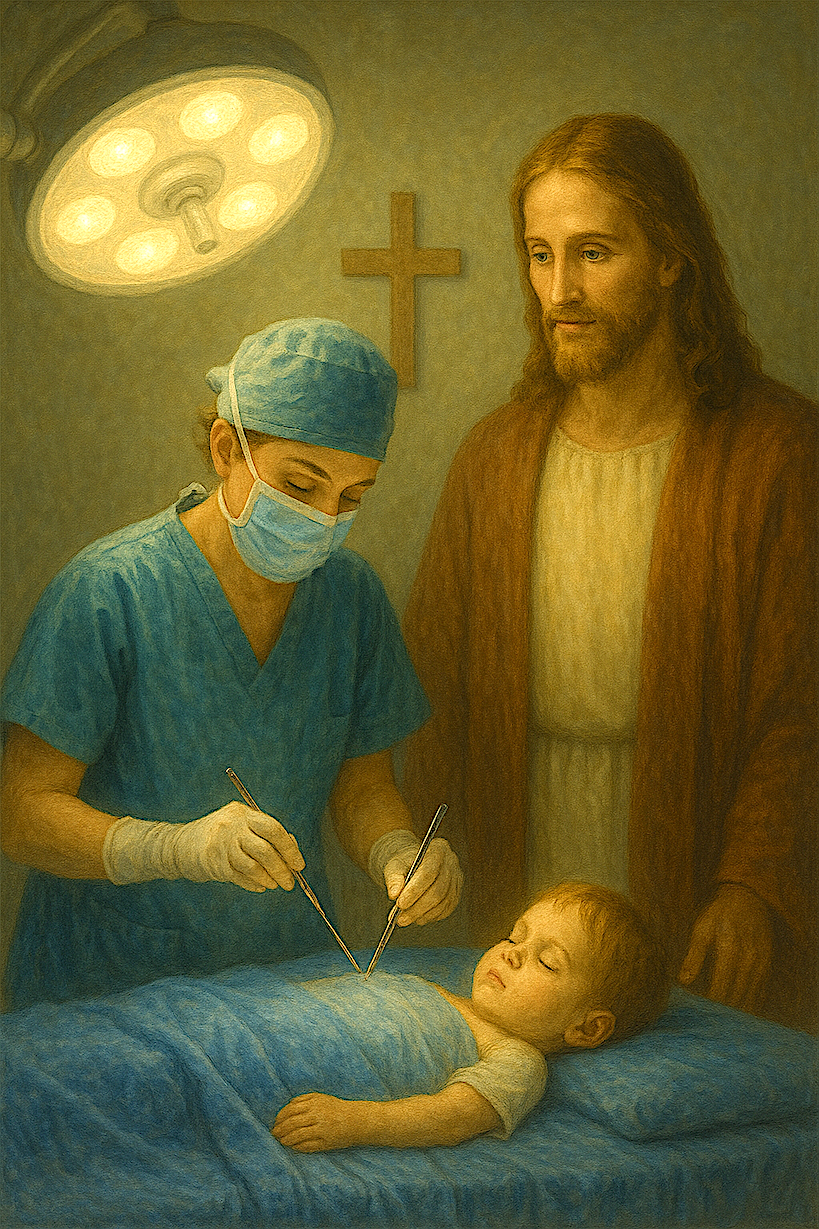
[I originally penned this post in 2020, but delayed its publication due to failing in my attempt to secure permission to receive this perfect illustration. Five years later, AI allowed me to create the image shown above. Since the message remains pertinent, I’m offering my thoughts on this subject today.]

Medicines are precious. Right now we are seeing the release of the first antiviral drugs devised to protect us from the covid plague. The trials have been positive, and now the caregivers on the frontlines are receiving these protective injections.

Unfortunately, some so-called medicines are not effective. They can even be harmful. That’s the case with “patent medicines” hawked by shysters lying about their results. Originally the term was positive. According to one museum, “patent medicines originally referred to medications whose ingredients had been granted government protection for exclusivity.”

Sadly, though, “the recipes of most 19th century patent medicines were not officially patented. Most producers (often small family operations) used ingredients quite similar to their competitors—vegetable extracts laced with ample doses of alcohol.

In a previous post, I shared Lewis’ view of God’s role in healing.

In his essay entitled “Miracles,” C.S. Lewis described during World War II the Christian viewpoint that God is the author of healing. After discussing the natural order of creation, he argues that God is at work in restoring the health of the those who are ailing.

In 1962, Lewis commiserated with a correspondent complaining about the number of pills she needed to take. He acknowledges the problem, and then points to a very positive corollary.

Yes, and one gets bored with the medicines too–besides always wondering ‘Did I remember to take them after breakfast?’ and then wondering whether the risk of missing a dose or the risk of an over dose is the worst!

Yes, one gets sick of pills. But thank God we don’t live in the age of horrible medicines such as our grandparents had to swallow.

In A Grief Observed, Lewis used an illustration of physical pain to explore the emotional pain caused by his sorrow at his wife’s passing.

I once read the sentence “I lay awake all night with a toothache, thinking about the toothache and about lying awake.” That’s true to life. Part of every misery is, so to speak, the misery’s shadow or reflection: the fact that you don’t merely suffer but have to keep on thinking about the fact that you suffer. I not only live each endless day in grief, but live each day thinking about living each day in grief.

In some ways, psychological suffering is particularly painful. The mentally ill have historically been ostracized. For all of the neurological discoveries that have been made in recent years, the human brain remains a mystery.

Fortunately, medical science has experienced some success formulating medicines that are helpful in treating mental disorders. One problem, however, is that (like nearly all meds) psychological formulas occasionally produce extreme side effects.

C.S. Lewis’ primary experience of psychological suffering came through grief. Tweaking Optimism, a great blog, has gathered a number of Lewis’ thoughts on mental anguish. One passage he cites from The Problem of Pain aptly contrasts physical and mental suffering.

Mental pain is less dramatic than physical pain, but it is more common and frequently more difficult to bear. The common attempt to conceal mental pain increases the burden: it is easier to say “My tooth is aching” than to say “My heart is broken.”

In the same book, Lewis lifts up the truth about suffering. In cases where no cure can bring relief, he beautifully describes various ways to survive journeying through the valley.

When pain is to be born, a little courage helps more than much knowledge, a little human sympathy more than much courage, and the least tincture of the love of God more than all.

C.S. Lewis’ Prescription for Christians Today

We live in an uncertain and turbulent time. Only God knows how long this world will last, but he has promised to deliver from death and hell those who call on his name. Thus, Jesus’ followers need not live in dread or despair.

We live with hope, and look forward with enthusiasm to our Lord’s return. It is to that glorious day, the Parousia, that Lewis refers in his essay “The World’s Last Night.”

The doctrine of the Second Coming, then, is not to be rejected because it conflicts with our favorite modern mythology. It is, for that very reason, to be the more valued and made more frequently the subject of meditation. It is the medicine our condition especially needs.

An Entertaining Tolkien “Game”

The inspiration for this revisitation of Lewis’ thoughts about medicine came from a fun website I recently encountered. Some creative soul noticed the similarity between two dissimilar matters—antidepressant medications and residents of Middle Earth.

The game offers 24 words, and you are challenged to identify the group into which it falls. Is it the name of a pharmaceutical, or is it one of the characters created by J.R.R. Tolkien? One name is a giveaway, but you may find many of the others rather difficult to discern.

Kudos to anyone who gets over twenty correct. (I almost did . . . well, if sixteen is close.) Have fun, and learn something, at the very same time!

Antidepressants or Tolkien Character?

C.S. Lewis as a Weaver of Words

If you like to expand your vocabulary while opening up your mind with profound insights, search no farther than C.S. Lewis.

The celebrated Oxbridge professor possessed a great respect for words. Like his friend J.R.R. Tolkien, he believed they should never be summarily detached from the history which imbues them with meaning. In “Studies in Words,” he describes the poverty of such an approach.

I am sometimes told that there are people who want a study of literature wholly free from philology; that is, from the love and knowledge of words. Perhaps no such people exist. If they do, they are either crying for the moon or else resolving on a lifetime of persistent and carefully guarded delusion.

If we read an old poem with insufficient regard for change in the overtones, and even the dictionary meanings, of words since its date – if, in fact, we are content with whatever effect the words accidentally produce in our modern minds – then of course we do not read the poem the old writer intended. What we get may still be, in our opinion, a poem; but it will be our poem, not his. If we call this tout court [too short or shallow] “reading” the old poet, we are deceiving ourselves. If we reject as “mere philology” every attempt to restore for us his real poem, we are safeguarding the deceit.

Of course any man is entitled to say he prefers the poems he makes for himself out of his mistranslations to the poems the writers intended. I have no quarrel with him. He need have none with me. Each to his taste.

If you too are a logophile, a lover of words, there’s no need to hide it. Well, with a single exception. Like everyone else, I find it off-putting when I run into people who learn complex new words simply with the goal of using them in order to “impress” others.

It amazes me how some individuals who consider themselves quite intelligent, and wish to advertise their brilliance, fail to comprehend that ostentatious speech elicits the opposite impression. [Don’t mistake my writing style where I intentionally use the fullest range of our shared vocabulary – which I believe enriches our reading and minds – with the vanity I’m describing. The latter insults readers when self-important posers attempt to intimidate others with words that are unlikely to be known by their audience.]

If you would like to read a satirical piece I wrote ridiculing this tactic, you can download “Mastering Inkling Erudition” at academia.edu. It appeared in CSL, published by the New York C.S. Lewis Society and is subtitled “Sounding Like an Expert Without Accumulating Multiple Ph.D.s.”

C.S. Lewis, of course, possessed no such pretentions. At least none I am aware of after his conversion to Christianity. His use of language is rich and satisfying. It is also instructive. I’ve lost count of the number of words to which Lewis introduced me. 

One of my favorites, though I have never dared to use it, is “bathetic.” Upon reading this note from Merriam-Webster, I suspect you too may find it applicable to much that passes for contemporary literature.

When English speakers turned apathy into apathetic in the late 17th century, using the suffix -etic to turn the noun into the adjective, they were inspired by pathetic, the adjectival form of pathos, from Greek pathētikos.

People also applied that bit of linguistic transformation to coin bathetic. English speakers added the suffix -etic to bathos, the Greek word for “depth,” which in English has come to mean “triteness” or “excessive sentimentalism.” The result: the ideal adjective for the incredibly commonplace or the overly sentimental.

The word appears in The Abolition of Man, in which C.S. Lewis critiques the poor practices of some current authors of educational resources. I will italicize the specific text, but provide the full context because of its own merits.

[They] quote a silly advertisement of a pleasure cruise and proceed to inoculate their pupils against the sort of writing it exhibits. The advertisement tells us that those who buy tickets for this cruise will go ‘across the Western Ocean where Drake of Devon sailed,’ ‘adventuring after the treasures of the Indies,’ and bringing home themselves also a ‘treasure’ of ‘golden hours’ and ‘glowing colours.’

It is a bad bit of writing, of course: a venal and bathetic exploitation of those emotions of awe and pleasure which men feel in visiting places that have striking associations with history or legend. If [they] were to stick to their last and teach their readers (as they promised to do) the art of English composition, it was their business to put this advertisement side by side with passages from great writers in which the very emotion is well expressed, and then show where the difference lies.

They might have used Johnson’s famous passage from the Western Islands, which concludes: ‘That man is little to be envied, whose patriotism would not gain force upon the plain of Marathon, or whose piety would not grow warmer among the ruins of Iona.’ They might have taken that place in The Prelude where Wordsworth describes how the antiquity of London first descended on his mind with ‘Weight and power, Power growing under weight.’

A lesson which had laid such literature beside the advertisement and really discriminated the good from the bad would have been a lesson worth teaching. There would have been some blood and sap in it – the trees of knowledge and of life growing together. It would also have had the merit of being a lesson in literature . . .

And a Double Bonus: A New Word & a Psychological Disorder

A newly forged word is referred to as a neologism, and they can be fascinating. Modern technology has caused their number to explode. Some –  think “crowdsourcing” or “app” – are now ubiquitous.

Word lovers sometimes invent words. These, of course, rarely if ever find their way into public discourse. Take this example from a letter a young C.S. Lewis penned to his friend Arthur Greeves in 1916.

I know quite well that feeling of something strange and wonderful that ought to happen, and wish I could think like you that this hope will someday be fulfilled. . . . Perhaps indeed the chance of a change into some world of Terreauty (a word I’ve coined to mean terror and beauty) is in reality in some allegorical way daily offered to us if we had the courage to take it.

One final caution. If you do decide to become a neologist, run your ideas by people you trust. I just discovered the American Psychological Association has linked one expression of the practice to serious mental disorders!

neologism (updated on 04/19/2018)
n. a newly coined word or expression. In a neurological or psychopathological context, neologisms, whose origins and meanings are usually nonsensical and unrecognizable (e.g., klipno for watch), are typically associated with aphasia or schizophrenia. – neologistic adj.

C.S. Lewis & Summertime

What’s your favorite season of the year? My preference is Autumn, with Spring a close second.

In the United States, Spring comes out on top. Actually, it is the preference in forty (80%) of the states. Probably due to its northern latitude, “the most popular season in the Northeast is Summer.” Unsurprisingly, Winter is the least favorite across the board, although a few hardy souls disagree. “Alaska and Vermont are the only two states that say winter is the most wonderful time of the year.”

Some years ago, Gallup published the result of polls on the subject, which are also analyzed by the ages of respondents.

Americans aged 18 to 29 are the group least likely to prefer spring (24%), while those 65 and older are most likely to prefer it (53%). Younger Americans are much more likely to prefer summer than are those in older age groups, and, in fact, summer is the top choice among this age group. [Editor: I wonder if that has anything to do with the traditional academic calendar?]

Everyone is aware of how the seasons (through length of daylight, etc.) affect our moods. In a 1914 letter to his father in Ireland, C.S. Lewis offers a curious description of the “magnificent summer” he was enjoying in England.

My mental picture of home is disturbed to a certain extent by your mention of a fire. Here, we are in the middle of a magnificent summer: day succeeds day with the same cloudless sky and parched earth, and the nights are hot and comfortless. But on the whole, fine weather is agreeable, and has, I think, a certain effect on the spirits.

At the end of September, he wrote again about the extended summer he was experiencing. It doesn’t sound like the opinion of someone whose seasonal preference was summer. “I suppose the winter has closed in at home by this time: but we are still having quite summer weather here – which I rather resent.” Sometimes, it seems, seasons do overstay their welcome.

The following year, C.S. Lewis again lamented summer’s length. In mid-November he complained to his father.

The weather here is a perfect joke, warmer than July, bright sunshine and gentle breezes. Personally I have had quite enough summer, and should not be sorry to bid it goodbye, though Kirk persistently denounces this as a most unnatural state of mind.

A year later, in 1916, Lewis’ distaste for excessive heat is seen in an October letter to his friend Arthur Greeves. One reason for this was C.S. Lewis’ passion for hiking through the countryside.

The beastly summer is at last over here, and good old Autumn colours & smells and temperatures have come back. Thanks to this we had a most glorious walk on Saturday: it was a fine cool, windy day & we set out after lunch . . .

In a poem entitled “The Day with a White Mark,” Lewis opens with vivid imagery and the notion that mood is normally related to environment and circumstances.

All day I have been tossed and whirled in a preposterous happiness:
Was it an elf in the blood? or a bird in the brain? or even part
Of the cloudily crested, fifty-league-long, loud uplifted wave
Of a journeying angel’s transit roaring over and through my heart?
My garden’s spoiled, my holidays are cancelled, the omens harden;
The plann’d and unplann’d miseries deepen; the knots draw tight.
Reason kept telling me all day my mood was out of season.
It was, too. In the dark ahead the breakers only are white.

One website offers generalized thoughts about “what your favorite season” reveals about you. For example, it says of those who share my preference:

“Delicious autumn! My very soul is wedded to it, and if I were a bird I would fly about the earth seeking the successive autumns,” George Eliot (aka Mary Ann Evans) once wrote of her affection for the fall season.

While parts of the world tend to think of spring as the season of renewal, fall is also a very good time for a fresh start. The vibrant orange colors and cooler weather of autumn appeal to your constant desire for change. The upcoming holidays inspire many to reflect back on the year that was and make plans for the year to come.

A study in England went so far as to link birth months to the frequencies of several psychiatric conditions. If it is correct, your likelihood of suffering from recurrent depressive disorder, bipolar affective disorder and even schizophrenia varies according to your birth month.

Summer does provide a welcome time for vacations and events that would be difficult to wedge into the “busier” seasons of the year. For example, it’s not too late to register for the 2022 C.S. Lewis Summer Institute. The theme is “Surprised by Love: Cultivating Intellectual Hospitality in an Age of Uncertainty.” It is slated for 28 July – 5 August 5, 2022 in Oxford.

C.S. Lewis’ Favorite Season

Last year, the United Kingdom’s National Trust* conducted a poll which determined summer (30%) as the favorite season for Brits. Curiously, for young adults, summer tied with the second overall favorite, autumn.

After autumn colour, Britons’ favourite things about the [autumn] season are spending time in nature – running, walking or cycling (13 per cent) and the weather – cold crisp days, Indian summer, or stormy days (12 per cent).

So what exactly was C.S. Lewis’ favorite season. At the end of his life he wrote the following. As he so often did, he used a familiar subject to make a profound comment about life.

Yes, autumn is really the best of the seasons; and I’m not sure that old age isn’t the best part of life. But of course, like autumn, it doesn’t last.

But then, isn’t it the flow of the seasons that makes each so welcome in turn? Charles Dickens offered just such an observation in a quote which offers a fitting end to our reflections today.

Nature gives to every time and season unique beauty; from morning to night, as  from the cradle to the grave, it’s just a succession of changes so soft and comfortable that we hardly notice the progress.


* The National Trust helps conserve sites of historic and natural significance in England, Wales, and Northern Ireland. Scotland has its own National Trust for Scotland, devoted to the same purposes.

Lewis’ good friend J.R.R. Tolkien also enjoyed autumn. In a post several years ago I shared a portion of a letter to his son where he says, “I have the autumn wanderlust upon me, and would fain be off with a knapsack on my back and no particular destination . . .” Sounds like something someone in Middle Earth might say – although, certainly not a hobbit!

C.S. Lewis as a Stepfather

Step-parenting well can be a challenge. In many cases it brings great joy to both parent and child. But in some unfortunate cases, parenting the biological child of another can seem nearly impossible.

If you needed another reason to respect C.S. Lewis—and I recognize most readers of Mere Inkling don’t—consider the case of his stepsons. I’ll refer you in a moment to an informative column by Jonathon Van Maren, but first, some background.

C.S. Lewis was a confirmed bachelor. He anticipated living out his senior years in the fraternal company of his brother and close friends. God, however, had other plans. His marriage to Joy Davidman is familiar, in part because of the 1993 film, Shadowlands.

Curiously, the film itself raised a question in my mind that has not been satisfactorily answered until now. Where is David Gresham? Joy had two sons Lewis helped raise. Only David is portrayed in the film. At the time I attributed the absence to cinematic convenience. After all, since the son(s) were not the primary focus of the drama, one could easily suffice for the pair.

Some years later I corresponded (too briefly) with Doug Gresham, who has admirably championed the legacy of his stepfather’s faith and work. When I asked about his brother, Doug shared that he had elected to follow Judaism, and chosen not to be directly involved in the workings of C.S. Lewis Co. Ltd. and associated projects.

Now, following David’s death, Doug is free to share with us another insight into the patience and compassion of C.S. Lewis. The great author did not flinch from the duty he had accepted when he married Joy and brought his bride, and her children, into his home. Doug has previously written about their family in his wonderful book, Lenten Lands. He describes the adjustments.

We became a family. It didn’t happen all at once, but slowly and surely Jack and Warnie and I were building some sort of relationship. I could never claim to have been anywhere near as important to Jack [Lewis] as he was to me, but I really do believe that I did become important to him. In addition, I began to understand a little about Jack and began to be able to see the enormous wealth of compassion in him.

The marriage was too brief, lasting from March 1957* until Joy’s death in July 1960. After that, Lewis was diligent in establishing the best future for his sons. Douglas’ life has been a testimony to that commitment. David’s sadly, was not.

The Curse of Psychosis

Schizophrenia is an ugly affliction. Psychotic episodes, where a person is unable to discern between reality and illusion, can create chaos. While modern medications are helpful, in severe cases, long term hospitalization may be required. In David’s case, his life ended several years ago in just such an institution, in Switzerland. 

While schizophrenia often first manifests between the late teens and early thirties, in some cases its onset begins earlier. Such was the case in the Davidman family. And it was during these turbulent years that Lewis did his best to protect and nurture his new sons. Doug relates a shocking example of how his elder brother “was continually trying to get rid of me.” From the aforementioned column:

“I came out of the kitchen [at The Kilns] one afternoon, for example. . . As I walked out the brick arch doorway, there was a splash, and I was covered in gasoline. My brother was standing there trying to strike a match to throw at me.

I kicked his wrist so hard I nearly broke it. The matches went flying, and I took off.” Douglas told me that this sort of thing was not uncommon. “It was a difficult childhood for me,” he said. “Jack tried his very hardest for David all the time. He tried to help in every way he could—he was kind and gentle and wonderful with him.”

Those of us whose families have been scarred by the scourge of schizophrenia understand how one’s compassion and patience can be tested to their limits. C.S. Lewis passed that test. He neither surrendered to the challenge, nor shirked the burden he had willingly assumed.

After reading “C.S. Lewis and His Stepsons” at First Things, my respect for the man continues to grow. I suspect that yours will, as well.


* Their true marriage took place while Joy was hospitalized on 21 March 1957. Lewis had entered into a civil marriage with Joy a year earlier, to allow her to remain in the United Kingdom.

Consider Planting a Tree

treebeard & groot

Not only do trees cleanse the air we breathe, there’s more evidence they contribute to our mental health as well.

An article entitled “Greener Childhood Associated with Happier Adulthood,” describes research from Denmark’s Aarhus University discovering that “growing up near vegetations is associated with an up to 55 percent lower risk of mental health disorders in adulthood.” An American researcher commented on the findings.

“The scale of this study is quite something,” says Kelly Lambert, a neuroscientist at the University of Richmond who studies the psychological effects of natural spaces. Smaller studies have hinted that lack of green space increases the risk of mood disorders and schizophrenia and can even affect cognitive development.

In a rapidly urbanizing world, this data is particularly troubling. Most of us must live “where the work is,” and our children sometimes grow up in places where trees are few and far between (and I wouldn’t really count Joshua “trees” which are Monocotyledons, and not true trees).*

This research confirms my own, personal experience. I have always found lush greenery energizing. I used to attribute this association with family—while growing up in a USMC family, we would try to make an annual trip “home” to Puget Sound. The nearer we got to my grandparents, the greener the Puget Sound terrain grew.

In my affection for trees, I am akin to the Inklings. Much has been written about J.R.R. Tolkien’s description of the forests of Middle Earth. The terrible damage to the Fangorn forest done by the army of Saruman is one of the tragedies of The Lord of the Rings.

C.S. Lewis and his friends enjoyed walking trips. Much of the countryside they covered in these treks was adorned by healthy copses, but they do not appear to have ventured into any deep forests.

In a 1953 letter to a correspondent who was attempting to lure Lewis to visit America, he paints a clear picture of what he finds alluring.

How wrong you are when you think that streamlined planes and trains would attract me to America. What I want to see there is yourself and 3 or 4 other good friends, after New England, the Rip Van Winkle Mts., Nantucket, the Huckleberry Finn country, the Rockies, Yellowstone Park, and a sub-Arctic winter.

And I should never come if I couldn’t manage to come by sea instead of air: preferably on a cargo boat that took weeks on the voyage.

I’m a rustic animal and a maritime animal: no good at great cities, big hotels, or all that. But this is becoming egotistical. And here comes my first pupil of the morning.

All blessings, and love to all. Yours, C.S. Lewis

I’d love to see a bear, a snow-shoe, and a real forest.

Lewis wrote a fascinating poem about the spiritual price of deforestation.

The Future of Forestry

How will the legend of the age of trees
Feel, when the last tree falls in England?

When the concrete spreads and the town conquers
The country’s heart; when contraceptive
Tarmac’s laid where farm has faded,
Tramline flows where slept a hamlet,
And shop-fronts, blazing without a stop from
Dover to [Cape] Wrath, have glazed us over?

Simplest tales will then bewilder
The questioning children, “What was a chestnut?
Say what it means to climb a Beanstalk,
Tell me, grandfather, what an elm is.
What was Autumn? They never taught us.”

Then, told by teachers how once from mould
Came growing creatures of lower nature
Able to live and die, though neither
Beast nor man, and around them wreathing
Excellent clothing, breathing sunlight –
Half understanding, their ill-acquainted
Fancy will tint their wonder-paintings
Trees as men walking, wood-romances
Of goblins stalking in silky green,
Of milk-sheen froth upon the lace of hawthorn’s
Collar, pallor in the face of birchgirl.

So shall a homeless time, though dimly
Catch from afar (for soul is watchfull)
A sight of tree-delighted Eden.

Plant a Tree

In “The Arbor of God,” the physician who founded Blessed Earth poses a thoughtful question: “Trees are everywhere in Scripture. Why have they gone missing from Christian theology?”

I’ve always loved trees. I love their look, their shade, the sound of wind in their leaves, and the taste of every fruit they produce. As a grade-schooler, I first planted trees with my father and grandfather. I’ve been planning them ever since. . . .

But a dozen years ago, when I offered to plant trees at our church, one of the pastors told me I had the theology of a tree-hugger.

This was not meant as a compliment.

There is a possibly apocryphal statement credited to Martin Luther during the Reformation. In a spirit of faith and commendable actions for Christians, Luther said, “If I knew the world was to end tomorrow, I would still plant an apple tree today.”

As I gaze out the window now, at the four blossoming apple trees we planted just three years ago, I’m inspired to plant some more trees. This year, I think, it will be some bushes and plants that provide year-round nectar for the hummingbirds that grace our woodlands. Even the anticipation of planting them brings me joy.


* Joshua trees, such as those which surrounded our home at Edwards AFB, are actually “flowering plants.” As such, they do have green growth and even fruit. So, in a generous spirit, I’ll credit them with 50% of the positive effect on mental health that a maple or fir might offer.

C.S. Lewis and Reality

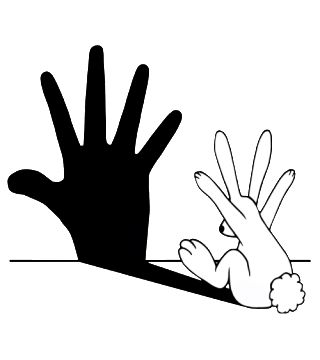
Rabbit-Hand-Shadow.jpg

In this increasingly relativistic cauldron we call “the world,” chaos is fueled by the concept that everyone is entitled to determine their own reality.

It all depends on one’s perspective.

“Perception is reality,” is a common sentiment. More clearly said, “an individual’s perception is their personal reality.” In other words, the way that a person thinks things are, is reality as far as they are concerned.

Changing a person’s perception of reality is no easy thing. Nor should it be (in most cases).

People base their thinking on a variety of approaches. Those who are more analytical are terribly frustrated by others who base their views of reality on their emotions, or what they “want” to be true.

Nowhere do I find this more striking then when people who have nary a religious thought in their daily lives gather together for a funeral. At least 66% of what one hears, for example “he’s looking down on us now,” is based on nothing other than wishful thinking or irrational notions.

C.S. Lewis described how reason is the crucial mechanism for understanding. In his book Miracles, he makes the following argument.

All possible knowledge, then, depends on the validity of reasoning. If the feeling of certainty which we express by words like must be and therefore and since is a real perception of how things outside our own minds really “must” be, well and good.

But if this certainty is merely a feeling in our own minds and not a genuine insight into realities beyond them—if it merely represents the way our minds happen to work—then we can have no knowledge. Unless human reasoning is valid no science can be true.

Mental Illness and Perception

One particularly fascinating aspect of the perception and reality question comes in the case of some mentally ill individuals. Schizophrenia, for instance, frequently involves delusions or hallucinations that are indistinguishable from reality (in the mind of the sufferer).

A well person may find it implausible to accept that a person could genuinely believe impossible things were true. Meanwhile, from the perspective of the deluded, it may make all the sense in the world that they are the only person alive who recognizes how things truly are.

Decades ago I spent several months in a psychiatric ward. (Not as a patient, as a clinical pastoral education student.) I had many conversations with a delightful resident who had been institutionalized because he was utterly convinced that he was one of Jesus’ apostles.

Thanks to the proper medications, he knew that to be illusory, and he was optimistic that he would soon be released to begin his studies to become a mental health worker. One reason for his confidence that he was truly getting better was because his previous hospitalization came when he became certain that he was one of the Old Testament patriarchs.

From his point of view, the increasing chronological proximity between his delusions and reality indicated he was almost well.

Some of these people do become healthy enough to recognize that their perception of reality is askew. These are the few who continue to take their meds so they can function as the majority of us perceive to be “normal.”

Many psychotic individuals, of course, only take their prescriptions under duress and when they are not monitored, cease to take them because they either (1) already feel better, so they obviously don’t need them, or (2) prefer chaos to the side effects such as lethargy.

Truth is Not Based on Perspective

Truth, in the ultimate or alethiological sense, is not relative. It doesn’t shift due to the distortions of individual perception. It remains the same yesterday, today and tomorrow.

Now, since what we human beings regard as truth does shift (e.g. shape of the Earth), ultimate truth must come from a source other than mortal minds, transient philosophies or momentary scientific theories.

Christians believe they have found that source in God’s self-revelation, the Judeo Christian Scriptures. In fact, Christians believe that their Savior, Jesus the Messiah, was the embodiment of truth. We believe he was speaking the eternal truth when he said “I am the way, and the truth, and the life.”

C.S. Lewis was quite candid about the truthfulness of the scriptural testimony being the necessary cornerstone for faith. In dialogue with atheists and agnostics, he wisely points out that the conversation must address this essential question.

One of the great difficulties is to keep before the audience’s mind the question of Truth. They always think you are recommending Christianity not because it is true but because it is good. . . .

One must keep on pointing out that Christianity is a statement which, if false, is of no importance, and if true, of infinite importance. The one thing it cannot be is moderately important. (“Christian Apologetics”)

In a world that wants to relegate Jesus to the status of some great teacher or prophet, it is vital to say that if he was lying when he said “the Father and I are one,” Christianity should be dismissed altogether.

_____

For those who enjoy challenges:

hand shadows