A Caveat about Caveats

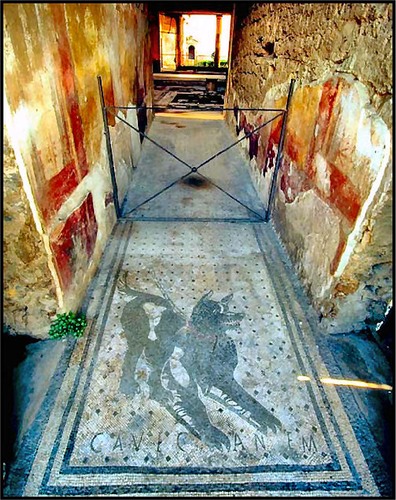
cave canemA caveat, most readers will know, is a warning. One of my favorite usages comes from ancient Rome, where many villa owners procured guard dogs to protect their property. Cave Canem–beware of the dog–became a common motif for entryway mosaics.

One of the most familiar caveats is caveat emptor—buyer beware. Not only is this warning well known, it is absolutely true. Without an express warranty, you may have little hope recouping your loss when something you purchase fails.

Caveats, however, need not infer that the subjects they refer to are dangerous.

For example, the guard dog may well be an affectionate “member of the family,” who warms up quickly, even to strangers who have been invited into the home. Likewise, the new car I’m contemplating purchasing may be ideal for me. Fairly priced, economical to drive, and not so dated in appearance that it shouts, “yes, I’m a grandpa.”

Caveats don’t mean “stay away.” They merely advise us all to think before we act. (And, as universal rules go, this is a very good one.) Caveats, and good parenting, remind us to read the “fine print” before signing anything.

I want to encourage all readers of Mere Inkling to use their God-given intelligence to evaluate what you read on these pages. In the same way, I hope you will all apply your God-instilled conscience to measure my words.

In light of this sincere desire, I encourage you to read the gentle caveats offered below.

General Caveats for Readers

What should readers of Mere Inkling keep in mind as they peruse these posts? First of all, there are a number of general considerations—applicable to everything each of us reads and hears.

1.  Understand the perspective of the writer. What are the assumptions and worldview of the person who wrote the piece? It can be hazardous to simply assume that a writer shares your own values—or even definitions. Many people would be shocked at the diversity of definitions for a word like “church” that roam the internet.

2.  Ensure we read what we think we did. By this I mean that we should reread sections that we find confusing or offensive. It may be we have misread what the author intended. (This is especially true when a writer seeks to play with the English language, and uses phrasing unfamiliar to our ear.) In cases where we have normally enjoyed the writing, but now find ourselves bothered by something, it is always good to ask the writer to clarify what they meant. More often than not, I’ve found this opportunity to elaborate dispels the problem.

3.  Reject the myth that anything you read is absolutely objective. Objectivity, except for mathematics, is essentially impossible. Our education, values, experiences and mood all affect the words we write. The best we can hope for in what we read—something Mere Inkling strives for—is personal honesty and fairness.

Mere Inkling Caveats

1.  Mere Inkling’s author is a fallen human being. By definition, that means that I am imperfect. Not all-knowing, nor always gracious. Imperfect though I am, I try my best to speak here in a forthright, considerate, modestly entertaining and, most importantly, a truthful way. When I fall short of that, feel free to write to me about it.

2.  I am a Christian. I certainly don’t apologize for this. Nor do I apologize for the wish of all disciples of Jesus that everyone might know the joy, forgiveness and peace that comes from abiding in the Vine (a metaphor for Jesus, as described in John 15).

3.  Your host at Mere Inkling is an evangelical Christian. This is a hazy adjective, often used in mutually contradictory ways. I apply it here to myself in the context of holding fast to the basic Christian truths, including the aforementioned desire of God that all people might come to him through his only begotten Son.

4.  I am a catholic Christian. Not a Roman Catholic (with a capital C), but catholic in the word’s creedal sense—a member of the one universal Church. As a catholic Christian, I subscribe to the ecumenical creeds, agreed upon as the fundamental doctrines of the faith during its earliest years. These include the Triune nature of God, the Incarnation miracle, and the atonement. Like my mentor, C.S. Lewis, here at Mere Inkling we focus on “Mere Christianity,” the common core of the faith. I consistently attempt to qualify my words on subjects where there is not a clear consensus.

Each of us has his individual emphasis: each holds, in addition to the Faith, many opinions which seem to him to be consistent with it and true and important. And so perhaps they are. But as apologists it is not our business to defend them. We are defending Christianity; not “my religion.” When we mention our personal opinions we must always make quite clear the difference between them and the Faith itself. (C.S. Lewis, “Christian Apologetics”).

5.  I am a Lutheran Christian. Again, I do not apologize. Lutherans understand we are only a small part of the “one holy catholic and apostolic faith.” Each denomination (indeed, each individual) possesses a distinctive interpretation of the Christian faith. We are free, of course, to associate with that community we believe follows God’s leading most faithfully. (It is a given that no community is without flaw, since no human being is.) I have written more on this aspect of my identity in the next point, and on the “Mercy” tab you will find at the top of the page.

6.  I am an evangelical Lutheran Christian. This is not a formal category, but means that I subscribe to historic Lutheranism as it has been taught and held since the Reformation, rather than some of the current expressions of “religion” that may be labeled Lutheran. In essence, this can be summarized in the “solas” of Lutheran doctrine.

Sola Scripture – Scripture Alone meaning that the Bible, the Jewish and Christian Scriptures, are the ultimate authority for determining true faith.

Sola Gratia – Grace Alone meaning salvation is an unearned gift of God, given not because we have earned it.

Sola Fides – Faith Alone meaning that God’s grace is apprehended not through wisdom, good works, or any means other than a simple trust in the promise. Ironically, this faith itself is also a gift of God.

7.  I am a pastor. While pastors with seminary educations do study Greek, Hebrew, Theology and assorted other subjects, we are not the same as what most people mean by the word “theologians.” Pastoral Theology is distinct from Systematic Theology. The former focuses on practical ministry to individuals, while the latter is most concerned with abstract matters. While I also possess a second graduate degree, my Master of Theology degree (much different than an M.A. in theology) was earned in the study of Early Church History. My concern remained the work of God among everyday human beings, rather than scholastic philosophy.

8.  While I never intentionally write anything with the goal of offending any reader, I recognize it is impossible to avoid all offense. (Even the least controversial prose is capable of offending.)

Allow me to illustrate how simple truths can elicit dramatically different responses, with two simple declarations.

God loves all people. This is true, and inoffensive. Most people today, and all orthodox (biblical) Christians would agree with the statement.

Not all people will go to heaven. This too is true. However, it provokes great outcries from many quarters, including some religious organizations that arise out of the Judeo-Christian tradition. Jesus himself offered “hard sayings” that elicited grumbling. John’s Gospel records a powerful account of this, occurring immediately after the Feeding of the Five Thousand.

When many of his disciples heard it, they said, “This is a hard saying; who can listen to it?” But Jesus, knowing in himself that his disciples were grumbling about this, said to them, “Do you take offense at this? . . . The words that I have spoken to you are spirit and life. But there are some of you who do not believe.” . . . “This is why I told you that no one can come to me unless it is granted him by the Father.” After this many of his disciples turned back and no longer walked with him.

C.S. Lewis referred to the alienating nature of some truths when he wrote the essay, “Cross-Examination.”

I believe that there are many accommodating preachers, and too many practitioners in the church who are not believers. Jesus Christ did not say “Go into all the world and tell the world that it is quite right.” The Gospel is something completely different. In fact, it is directly opposed to the world.

9.  I am an American. Again, no apologies. I applaud much of what this nation has valued and shared during its history. I regret many of the mistakes the United States has made, and continues to make. I recognize how fortunate I have been to live in a nation with access to educational and medical resources not available to all. I genuinely appreciate other cultures and have been privileged to live in Europe, Asia and the Pacific. The right I treasure most—and one I pray will be extended to all people—is freedom of religion.

10.  I welcome offline correspondence. I recognize many people are reluctant to post a comment on a blog, which is visible to the public. I also realize that some readers would appreciate privately offering a comment or posing a question. I welcome this, and encourage you to use the form below to write to me. I will respond from my personal email account and we can discuss sensitive matters in greater depth. I must say in advance, however, that I do not have the leisure time to aid with any research. Similarly, while I am happy to offer general pastoral advice, only a fool or con artist would presume to conduct serious counseling or therapy via email. (You need a local pastor or counselor for that.) That said, I do enjoy spirited and honest discourse, so d feel free to contact me.

Go back

Your message has been sent

Warning
Warning
Warning
Warning
Warning

Warning.

_____

The picture at the top of the page comes from the entryway to the “House of the Tragic Poet” in Pompeii.

Any Name But That

jesus nameThis week I read one of the clearest descriptions of the gospel I have ever heard. It appeared in an article written by the most (how do I put this mildly?) daunting professor I have encountered in my Doctor of Ministry studies. “Intimidating” would also work . . .

But his brilliance and rapid fire delivery of thought-provoking concepts is not the reason for me mentioning him here. It is his ability to cut through the confusion, and express simply the essence of the good news, the Christian hope, the gospel.

I’m not pandering to him, mind you, because my grade for his systematics course was filed long ago. It is simply that Joel Biermann said extremely succinctly, something that I have always attempted to emphasize in my own ministry.

The Gospel is the good news, but it is not just any good news. The Gospel is a word of liberation and encouragement, but it is not just any word of liberation and encouragement. The Gospel is a wonderful event and a joyful experience, but it is not just any wonderful event and joyful experience.

In other words, when it comes to defining the Gospel, it is vitally important that we move past vague ideas or general notions and grab hold of the central thing. The central thing is Jesus.

This is a truth too many fail to understand. Sadly, this is true for some “inside” the Church as well as outside of its doors.

Goodness is good. Generosity is wonderful. Encouragement is precious. Courage is noble. Love is (almost) divine.

Yet none of these are the Gospel. The Gospel is Jesus. In him the world discovers every good thing from the hand of God the Father, our Creator.

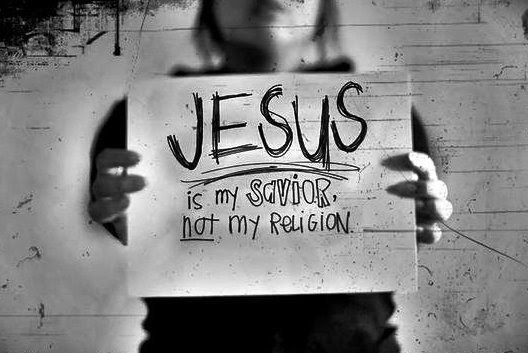
Jesus is indispensable. Without his holy name, the “faith” would simply be a praiseworthy “religion.” Without Jesus, it could instruct how to live, but it could not redeem.

It is precisely this point—the name of Jesus—that makes the Gospel objectionable to some. “Care for the sick,” some say, “just don’t mention that name.” On other lips we hear “The Church does lots of things that benefit the community, but please don’t mention that name that offends people.”

They arrested the apostles and put them in the public prison. But during the night an angel of the Lord opened the prison doors and brought them out, and said, “Go and stand in the temple and speak to the people all the words of this Life. . . .”

And someone came and told [the High Priest], “Look! The men whom you put in prison are standing in the temple and teaching the people. . . .”

And the high priest questioned them, saying, “We strictly charged you not to teach in this name, yet here you have filled Jerusalem with your teaching, and you intend to bring this man’s blood upon us.”

But Peter and the apostles answered, “We must obey God rather than men. The God of our fathers raised Jesus, whom you killed by hanging him on a tree. God exalted him at his right hand as Leader and Savior, to give repentance to Israel and forgiveness of sins. And we are witnesses to these things, and so is the Holy Spirit, whom God has given to those who obey him.” (Acts of the Apostles, chapter five).

C.S. Lewis knew quite well that Christianity is all about Jesus. Without him, the person Jesus the Christ, whatever passes for the “Church” would merely be a noisy gong. Lots of “religious” talk would remain . . . but the Gospel would be absent.

“What are we to make of Christ?” There is no question of what we can make of Him, it is entirely a question of what He intends to make of us. You must accept or reject the story. The things He says are very different from what any other teacher has said. Others say, “This is the truth about the Universe. This is the way you ought to go,” but He says, “I am the Truth, and the Way, and the Life.” He says, “No man can reach absolute reality, except through Me. Try to retain your own life and you will be inevitably ruined. Give yourself away and you will be saved. . . .”

“Come to Me everyone who is carrying a heavy load, I will set that right. Your sins, all of them, are wiped out, I can do that. I am Re-birth, I am Life.” (1950 essay, “What Are We to Make of Jesus Christ?”).

In the same way as the apostles, C.S. Lewis, my seminary professor, and all of those who have entrusted themselves to the grace of God in Christ, know the name of Jesus is not optional. In fact, it is all about the name.

For it is Jesus, and him alone, who is the alpha, omega and the whole of the Gospel.

Who Should We Trust?

staffordshire cross“You can trust me, I’m a pastor.” When I was ordained thirty-three years ago, that might have been sufficient to persuade many people to give me the benefit of the doubt. Not so today.

The latest Gallup poll records the continuing decline of our trust in “clergy.” Relentless negative press (much of it recording genuinely criminal and repellent behaviors) has taken its toll. Today only 47% of Americans trust ministers (of all faiths).

The good news, if you can consider it that, is that clergy still rank as the seventh most trusted group (out of twenty-two vocations considered).

But it remains quite pitiful. And quite understandable. Even being a pastor, there are many people considered clergy who I would not trust. First of all, anyone who purchased their “ordination” over the internet, and has the audacity to pretend to be a minister. I see a credibility gap there. (I would not include those who buy one of the fake diplomas as a “joke” to be untrustworthy . . . only those who pass themselves off as a “real minister.”)

I could go on, but my purpose here is not to trash clergy, since more than enough people already devote themselves to that purpose.

I am curious just who, in our increasingly uncertain and selfish world, we should trust.

I personally am in a rather envious position. I don’t have to rely on hoping people will trust me because I’m a pastor. I am also a sworn officer of the law. Albeit, I merely serve as a volunteer chaplain with my local county Sheriff’s Office, but we honestly do swear an oath to uphold the law, and we proudly wear regular uniforms, complete with our own chaplain badges (stars).

The thing about being in law enforcement is that I can benefit from the fact that it is the sixth most respected institution. So that carries me across the halfway mark all the way to the 54% trustworthiness milestone. I guess that’s fair, since I too place a higher trust in the integrity and professionalism of the average deputy or officer than I do in the average minister.

But, as I already said, I’m in a rather unique position, in that I also qualify for an even more respected category, that of a military officer. The 69% level of trust for military officers ties that of doctors and is only 1% below grade school teachers and pharmacists. So, I guess that if I want to instill confidence in my integrity, I’d best tell people that I’m a (retired) Air Force officer, and not that I am a member of the First Estate.

Trust is important. It’s a key commodity in any relationship, and absolutely essential for intimate relationships such as those shared within a family. Trust takes a great deal of time to build, and it can be shattered in just a moment. Its fragility is the primary reason why it must be treasured and guarded.

Trusted are those who never give others a cause to doubt them. My wife and I made a promise to our children that we would never lie to them. Never. We explained there would be times when we could not tell them something, or where we could only reveal a portion of the facts about a matter . . . but we promised them that whatever we did tell them would be the absolute truth insofar as we were aware.

Because of our honesty with them, our children (all adults now, of course), have been amazingly honest with us the whole of their lives. They trust us. We trust them. And none of us take that amazing gift for granted.

In Surprised by Joy, C.S. Lewis describes his introduction to J.R.R. Tolkien. Although the two would become lifelong friends, there were obstacles that needed to be overcome. One, described by Lewis, was that Tolkien belonged to not one, but two, categories of people who Lewis had been taught to regard as suspect. He was an atheist at the time, but it wasn’t simply Tolkien’s deep faith in Christ that gave him pause.

When I began teaching for the English Faculty, I made two other friends, both Christians (these queer people seemed now to pop up on every side) who were later to give me much help in getting over the last stile. They were H.V.V. Dyson (then of Reading) and J.R.R. Tolkien.

Friendship with the latter marked the breakdown of two old prejudices. At my first coming into the world I had been (implicitly) warned never to trust a Papist, and at my first coming into the English Faculty (explicitly) never to trust a philologist. Tolkien was both.

I’m not sure where philologists ranked on Gallup’s recent poll, but I am quite sure they did not include questions about different denominations or faith groups. Before ending these thoughts I suppose I should share with you the most trusted group in the survey—nurses. Eighty-two percent of Americans trust nurses. And I too would agree with that.

The matter of who we can safely trust is of great importance. In fact, it could be argued that it is the most important question in our lives.

Ultimately, even when we assure one another we will only speak the truth . . . even then we disappoint one another. Being human, we are finite, imperfect. We cannot always be there, even for those we love. Sometimes we fail to live up to our own standards and our promises dispel like a vapor in the wind.

Johnny Cash recorded a powerful song before he died. He had lived a rough and tumble life, and had found peace in a relationship with Christ. That peace, however, did not cure all of the ills or heal all of the scars he had experienced, and his profound familiarity with this world inspired the gritty lyrics of “Hurt.”

I wear this crown of thorns

Upon my liar’s chair

Full of broken thoughts

I cannot repair

Beneath the stains of time

The feelings disappear

You are someone else

I am still right here

What have I become

My sweetest friend

Everyone I know goes away

In the end

And you could have it all

My empire of dirt

I will let you down

I will make you hurt

In a moment, I’ll share a link to his performance of this moving song. But first, the answer to the question with which we began.

Who, exactly, should we trust? Johnny Cash learned the answer to that question, and so did C.S. Lewis. I trust the same Person that they did—someone who will never disappoint. Someone who cannot lie, since he himself is the Truth. As Paul wrote in 2 Timothy 2:

Remember Jesus Christ, risen from the dead, the offspring of David . . . I endure everything for the sake of the elect, that they also may obtain the salvation that is in Christ Jesus with eternal glory. The saying is trustworthy, for:

If we have died with him, we will also live with him;

if we endure, we will also reign with him . . .

if we are faithless, he remains faithful—

for he cannot deny himself.

_____

If you wish to watch the video of Johnny Cash’s musical epitaph, you can see it here.

The pectoral cross show above is part of the Staffordshire Hoard, which is the largest collection of Anglo-Saxon metalwork ever found. It dates from the 7th or 8th century.

Writing Life Scripts

ben hurI was shaped by the heroic religious films of the 1950s and 60s. The powerful messages of epic movies like Ben Hur, Quo Vadis and The Robe planted within my young Christian heart an awareness of nobility and radical self-sacrifice.

About twenty years ago, I spent a year doing graduate work in education. One of my Educational Psychology classes was taught by a professor who was a devotee of Transactional Analysis. I don’t recall too much about TA, aside from one of its principles that resonated with me.

It’s a concept called Life Scripts. Without going into great detail, it is an often subconscious notion of how we “think” our lives will or should play out. It’s adjusted throughout our lives, but the basic theme is established when we are quite young.*

A recent article says “script is broadly understood as a series of decisions, formed as coping strategies in childhood, which continue to shape the life course outside of awareness.”**

It was only as an adult that I realized just how significant an impression these virtuous stories made on me. I recalled the countless times I lay in bed at night rehearsing the story of The Robe. I was the unbelieving Roman soldier, converted by the gentle witness of the wrongfully persecuted Christians.*** Ultimately, I took my stand with them, defending them and voluntarily laying down my life for Christ.

That same plot line still echoes through my mind and soul.

I consider myself blessed to have been exposed to such positive influences while my self identity was being shaped. And I pray for children today whose parents allow them to be exposed (at terribly vulnerable ages!) to violent, fearful and morally ambiguous influences.

Those precious minds and hearts are scarred by the vulgarity and immorality that are endemic in modern cinema, television and music. May God have mercy on them.

C.S. Lewis lived during the era when the virtuous dramas such as those named above were at the peak of their influence.

In a diary entry from the mid-1920s, he mentions Quo Vadis in passing. He is describing his weekend schedule.

Saturday 22 April: Got up about 6.30 and did the same jobs as yesterday. Was settled to work by 9.5 o’clock and put in an excellent morning . . . Sheila Gonner—jolly child—came to tea. Dorothy is to come back tomorrow: so we shall no longer be servantless. At her request I lent her my crib to Tacitus’ History for her sister Rose— I wonder what makes her imagine that she would like it? Possibly early Christian novels of the Quo Vadis type. Worked again after tea, and from supper till ten o’clock, finishing Herodotus. The last few pages of the IXth Book I now read for the first time, having got tired of it on my first reading . . .

I find this diary passage intriguing, in the way that Lewis posits a reader’s potential interest in classical literature as arising from their exposure to ancient Rome via contemporary novels. That’s precisely where my own lifelong fascination with the Roman empire was born.

If you’ve never seen these three movies, I commend them to you. I would also encourage you to consider reading one or all of the novels. They are available for free download in various digital formats.

Quo Vadis

Ben Hur

The Robe

_____

* I’m a pastor and historian, not a psychologist, so I don’t pretend to understand all of the implications. Because of that, I don’t endorse TA as a fully valid theory. What’s more, in our fallen world it’s obvious that many early “life scripts” can be based on wounds inflicted on neglected or abused children. In such cases, particularly where the scripts are destructive, we are not “destined” to live out a tragedy. By the grace of God, even the saddest of stories can be redeemed and “rewritten” into tales of hope and wonder.

** From “Script or Scripture?” by Jo Stuthridge in Life Scripts edited by Richard Erskine (Karnac Books, 2010).

*** It didn’t hurt that the main Christian disciple in the film was the lovely and chaste Diana, played by the British actress Jean Simmons. But that’s another story, and it’s important to note that these life scripts are pre-pubescent creations, so they are motivated by much deeper impulses than hormones. As the previously footnoted quotation referred to them, they are fundamentally “coping strategies” for survival in the calm (or frequently turbulent) world in which children find themselves.

Stephen King Echoes C.S. Lewis

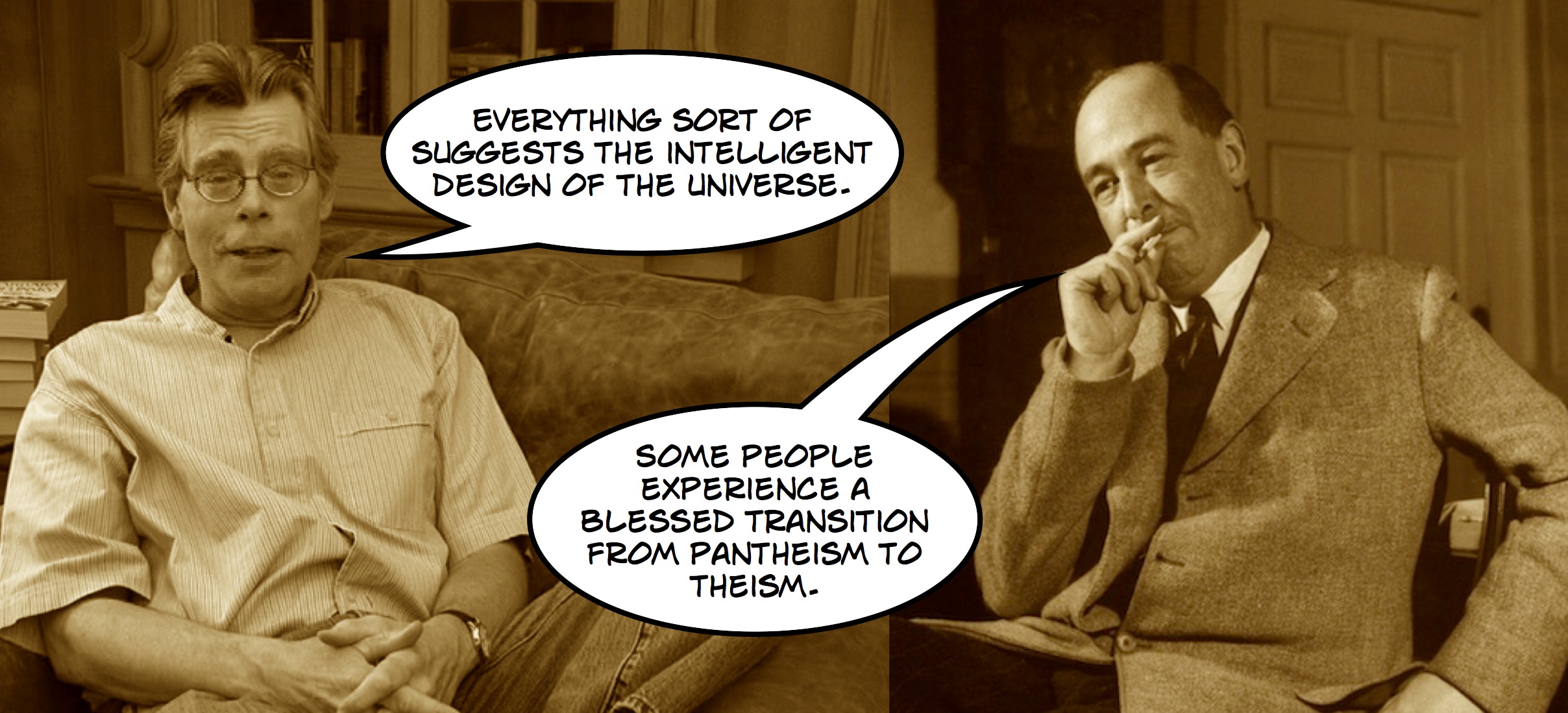
csl and kingAuthor Stephen King surprised quite a few fans during a recent PBS interview when he expressed his belief in the universe’s intelligent design. In nature and the cosmos, like theist C.S. Lewis before him, he views a creation so complex and wondrous that he thinks it makes more sense to believe in a divine power than to dismiss faith.

During the interview, King said,

I choose to believe it, yeah. I think that . . . there’s no downside to that, and the downside—if you say, well, OK, I don’t believe in God, there’s no evidence of God—then you’re missing the stars in the sky, and you’re missing the sunrises and sunsets, and you’re missing the fact that bees pollinate all these crops and keep us alive and the way that everything seems to work together at the same time.

In an essay, “Christianity and Culture,” C.S. Lewis alludes to the “Theist” phase of his own life. He points out how limiting a faith that recognizes God only abstractly, in his handiwork, can be.

There is an easy transition from Theism to Pantheism; but there is also a blessed transition in the other direction. For some souls I believe, for my own I remember, Wordsworthian contemplation can be the first and lowest form of recognition that there is something outside ourselves which demands reverence.

To return to Pantheistic errors about the nature of this something would, for a Christian, be very bad. But once again, for “the man coming up from below” the Wordsworthian experience is an advance. Even if he goes no further he has escaped the worst arrogance of materialism: if he goes on he will be converted.

King is, of course, far from what one would properly call a “person of faith.”** Still, it may be that he is presently moving in a positive direction. The following words reveal his yearning for hope, criticism of institutional religion, and his as yet unanswered questions about why God allows suffering in our world.

It’s certainly a subject that’s interested me, and I think it interests me more the older that I get. And I think we’d all like to believe that after we shuffle off this mortal coil, that there’s going to be something on the other side because for most of us, I know for me, life is so rich, so colorful and sensual and full of good things, things to read, things to eat, things to watch, places to go, new experiences, that I don’t want to think that you just go to darkness. . . .

But as far as God and church and religion and . . . that sort of thing, I kind of always felt that organized religion was just basically a theological insurance scam where they’re saying if you spend time with us, guess what, you’re going to live forever, you’re going to go to some other plain where you’re going to be so happy, you’ll just be happy all the time, which is also kind of a scary idea to me. . . .

Everything is sort of built in a way that to me suggests intelligent design. But at the same time there’s a lot of things in life where you say to yourself, well, if this is God’s plan, it’s very peculiar. And you have to wonder about that guy’s personality, the big guy’s personality. . . . What I’m saying now is I choose to believe in God, but I have serious doubts.

For many intelligent people, like C.S. Lewis and Stephen King, coming to faith cannot be severed from their reason. They desire to make sense of the world. Some, sadly, determine that human beings perish forever with their final breath. With that worldview, using King’s words, “you just go to darkness.”

Fortunately many others—brilliant and simple people alike, for God shows no partiality—possess true wisdom and heed the words of Jesus, that he is the way, the truth and the life. Both of these writers experienced an ineffective exposure to the church when they were young. Unfortunately, it served as more of an inoculation than a foundation.

Eventually C.S. Lewis followed that path from theism to Christianity. It’s not impossible that Stephen King may, as well.

_____

* A full transcript of the PBS interview is available here.

** In the interview, King “commends” the entertainment value of enthusiastic, emotionally-charged preaching, while disparaging his own mainline upbringing.

I went to a Methodist church for years as a kid, and Methodist youth fellowship on Thursday nights, and it was all pretty – you know, think of a bottle of soda with the cap off for 24 hours. There weren’t very many bubbles left in that stuff by then. It was pretty – it was Yankee religion, Terry, and there’s really not much in the world that’s any more boring than that. They tell you that you’re going to go to hell, and you’re half-asleep.

Books C.S. Lewis Loved

csl booksThose of us who admire C.S. Lewis respect his words on many subjects, not least of which would include literary matters. He was, after all, both a gifted writer and a professor teaching related subjects at two of the world’s most prestigious universities.

In 1962 The Christian Century asked him to list the ten titles most influential in his professional and philosophical life. (Most of these are available as free downloads on the internet.)

1. Phantastes by George MacDonald

2. The Everlasting Man by G. K. Chesterton.

3. The Aeneid by Virgil

4. The Temple by George Herbert

5. The Prelude by William Wordsworth

6. The Idea of the Holy by Rudolf Otto

7. The Consolation of Philosophy by Boethius

8. Life of Samuel Johnson by James Boswell

9. Descent into Hell by Charles Williams

10. Theism and Humanism by Arthur James Balfour

The following year Lewis was interviewed by Sherwood Wirt, longtime editor of Decision magazine. (Decision is published by the Billy Graham Evangelistic Association, and you can learn more about the publication here.)

During his interview, Wirt focused on spiritual rather than professional benefits from books Lewis had found beneficial.

Sherwood Wirt: What Christian writers have helped you?

C.S. Lewis: The contemporary book that has helped me the most is Chesterton’s The Everlasting Man. Others are Edwyn Bevan’s book, Symbolism and Belief, and Rudolf Otto’s The Idea of the Holy, and the plays of Dorothy Sayers.

Fortunately all of these titles are readily available for those who would like to explore works that influenced Lewis’ conversion and Christian growth. Let’s briefly consider them in the order Lewis cited them.

Gilbert Keith Chesterton (1874-1936) was a prolific English writer. Just how prolific, one might ask. Well, he wrote approximately eighty books, hundreds of poems, hundreds of short stories and about 4,000 essays. His works continue to inspire many today, and merit contemporary reading.

Chesterton shared many of the same values as Lewis, and preferred calling himself an “orthodox” Christian rather than adhering to denominational labels. (In this he foreshadows Lewis’ invaluable emphasis on “mere” Christianity.)

The Everlasting Man was published in 1925 and ponders the universal significance of Jesus Christ. It was composed in reaction to The Outline of History, in which H.G. Wells paints Jesus as just one more political agitator in a political backwater of the Roman empire. Honestly, he does describe him as being remarkable, but mostly in terms of having a charismatic persona.

Lewis said that Chesterton’s Everlasting Man “baptised” his intellect, which is no small expression of praise.

You can purchase The Everlasting Man through normal channels or download a free text format version at this site. If you enjoy listening to audiobooks, you can obtain a free audio copy of the volume here.

Edwyn Robert Bevan (1870-1943) was an English philosopher and historian who specialized in the Hellenistic world.

In Symbolism and Belief, based on a series of lectures presented in 1933-34, Bevan discusses major religious symbols and metaphors. He illustrates how figurative language is best capable of describing spiritual truth. He argues that the greater precision offered by philosophical terminology is actually counterproductive in this quest.

The volume offers insight into the rationality of religious faith, although it concludes with his conviction that it ultimately boils down to a genuine encounter with God—“what actually causes anyone to believe in God is direct perception of the Divine.”

Symbolism and Belief is available for free download in a variety of formats at this site.

Rudolf Otto (1869-1937) was a German Lutheran theologian. He spent most of his ministry teaching at one of the most prominent seminaries in the world, the University of Marburg Divinity School.

In The Idea of the Holy Otto espoused the concept that the things of God were “numinous.” He defined this as a “non-rational, non-sensory experience or feeling whose primary and immediate object is outside the self.” The word itself was derived from the Latin numen which refers to divine power.

Otto explains how the numinous is a mystery (mysterium) that is simultaneously terrifying (tremendum) and fascinating (fascinans). C.S. Lewis found the notion of the numinous particularly useful in his book, The Problem of Pain.

The Idea of the Holy: an Inquiry into the Non-rational Factor in the Idea of the Divine and Its Relation to the Rational is available in multiple formats here.

Dorothy Leigh Sayers (1893-1957) was a personal friend of C.S. Lewis. In a 1963 letter he wrote: “She was the first person of importance whoever wrote me a fan letter. I liked her, originally, because she liked me; later, for the extraordinary zest and edge of her conversation—as I like a high wind. She was a friend, not an ally.”

Sayers was an extremely successful English writer. Her versatility allowed her renown to grow as a poet, playwright, essayist and as a writer of popular detective mysteries. She was also a classicist, and regarded her translation of Dante’s Divine Comedy as her finest work.

Fortunately, four of her plays are available in a collection available here. They include “The Zeal of Thy House,” “The Devil to Pay,” “He That Should Come,” and “The Just Vengeance.” And, although you can’t download the file, if you would like to stream the recording, an audio version of her famous “The Man Born to be King” is available here.

Seeking the Living

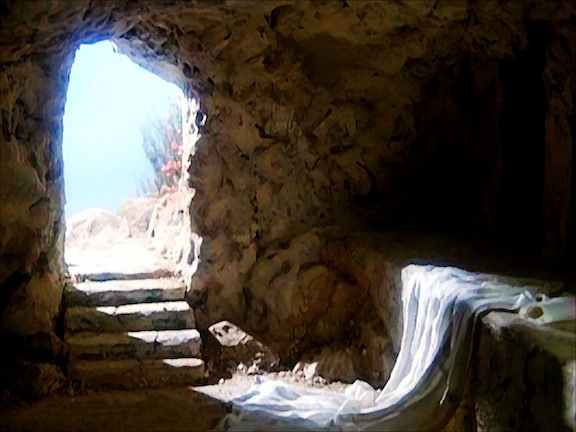
tombOne of the readings at our celebration of the Resurrection, this Easter morning, came from the Gospel according to Saint Luke. It included the powerful words of the angels waiting beside the empty tomb. To Mary Magdalene and the other women who had arrived to complete the ceremonial preparations for Jesus’ burial, they said: “Why do you seek the living among the dead?”

That’s precisely what separates Christianity from every other religious faith; for two millennia, Jesus’ disciples have followed a resurrected and living Lord.

This is what non-Christians are ultimately unable to fathom. Christianity is far more than the adoption of a particular lifestyle. It is infinitely more than a cognitive acquiescence a set of doctrines. It is nothing less than a dynamic, living relationship with our Creator through his only begotten Son.

Many regard Jesus as a great teacher from an ancient epoch—whose words are worthy of preserving. This is a good thing . . . but it’s not Christianity.

Many consider Jesus the model of a noble life—and strive to emulate his compassion and humility. This too is a good thing . . . but it’s not Christianity.

Many regard Jesus as an object of superstition—and they spout religious jargon while living hypocritical lives utterly devoted to their carnal appetites. This is not a good thing . . . and it’s most certainly not Christianity.

C.S. Lewis refers to this inherent inability to “persuade” an unbeliever to see beyond Christianity as a creedal profession or even a simple lifestyle and comprehend it as a relationship.

Our opponents, then, have a perfect right to dispute with us about the grounds of our original assent. But they must not accuse us of sheer insanity if, after the assent has been given, our adherence to it is no longer proportioned to every fluctuation of the apparent evidence. They cannot of course be expected to know on what assurance feeds, and how it revives and is always rising from its ashes.

They cannot be expected to see how the quality of the object which we think we are beginning to know by acquaintance drives us to the view that if this were a delusion then we should have to say that the universe had produced no real thing of comparable value and that all explanations of the delusion seemed somehow less important than the thing explained.

That is knowledge we cannot communicate. But they can see how the assent, of necessity, moves us from the logic of speculative thought into what might perhaps be called the logic of personal relations. What would, up till then, have been variations simply of opinion become variations of conduct by a person to a Person. Credere Deum esse turns into Credere in Deum. And Deum here is this God, the increasingly knowable Lord. (C.S. Lewis, “On Obstinacy in Belief”).

Ultimately, inviting others to share the joy and peace that we disciples of Jesus know—undeserving as all of us are—is not about persuasion. It is about introducing them to Jesus.

It’s about echoing the words of the angels in that Judean cemetery. “Don’t seek Jesus among the dead. He is risen and living, and he offers eternal life to all who call upon his name.”

It’s Still Christmas

nativity iconMerry Christmas!

One of the sad things about living in a secular nation is that people understand very little about the real meaning of Christmas. For example, many people take their trees down on 26 December, mistakenly thinking Christmas is “over.” In reality, the Christian celebration of the Nativity of Jesus only begins on Christmas Day!

The commercial world celebrates the season of Advent and deceptively calls it “Christmas.” These weeks, which should mark a spiritual preparation akin to Lent, are instead transformed into a frantic race to accumulate the perfect gifts to show others just how much we value each of them. And, since we love our family and close friends, there is a constant temptation to be far more extravagant in our gift giving than we can afford.

Returning to the season of Christmas, in which we find ourselves this day . . . we discover a brief occasion to focus our spiritual reflections on the singular Christmas miracle, the Incarnation. God becoming a human being. The Word through whom all things were created, becoming a mortal like the sons of Adam and daughters of Eve fashioned in his own likeness.

Christmas is, indeed, a glorious season.

C.S. Lewis had many insights into the Incarnation miracle. It is most certainly worthy of our serious attention. If it did not actually happen, Jesus should be dismissed altogether, for he claimed to be one with our heavenly Father. However, as Lewis declared in Miracles, “If the thing happened, it was the central event in the history of the Earth.”

One of the great literary treasures of the world is a precious book written before the year Anno Domini 318. Athanasius of Alexandria wrote a treatise called “On the Incarnation,” which makes great reading and is readily available online. A fairly modern translation was written by Sister Penelope Lawson, an Anglican nun.

Sister Penelope prevailed upon C.S. Lewis to write an introduction to her translation, in which he said, “This is a good translation of a very great book.” The full volume, complete with Lewis’ outstanding preface, is available. Here is just one of his gems:

Every age has its own outlook. It is specially good at seeing certain truths and specially liable to make certain mistakes. We all, therefore, need the books that will correct the characteristic mistakes of our own period. And that means the old books. All contemporary writers share to some extent the contemporary outlook—even those, like myself, who seem most opposed to it. Nothing strikes me more when I read the controversies of past ages than the fact that both sides were usually assuming without question a good deal which we should now absolutely deny. They thought that they were as completely opposed as two sides could be, but in fact they were all the time secretly united—united with each other and against earlier and later ages—by a great mass of common assumptions.

Still, as wonderful as Lewis’ introductory comments are, the greatest treasures here are the bishop’s teachings about Jesus. To whet your appetite, taste the following wisdom from Athanasius’ own introduction to his work:

You must understand why it is that the Word of the Father, so great and so high, has been made manifest in bodily form. He has not assumed a body as proper to His own nature, far from it, for as the Word He is without body. He has been manifested in a human body for this reason only, out of the love and goodness of His Father, for the salvation of us men. We will begin, then, with the creation of the world and with God its Maker, for the first fact that you must grasp is this: the renewal of creation has been wrought by the Self-same Word Who made it in the beginning. There is thus no inconsistency between creation and salvation for the One Father has employed the same Agent for both works, effecting the salvation of the world through the same Word Who made it in the beginning.

You can read the entire work at this site. Have a blessed Christmas season!

On Death’s Specter

Death is an unpleasant subject. And the knowledge that each of us is destined to face our own, has the potential to overshadow the countless joys this life offers.

Virtually everyone reading this has lost a loved one to death . . . and some reading this may have been informed by doctors that their own days may be limited. If you find yourself counting down in years, months, or weeks, may God strengthen you and pour upon you an overflowing portion of his divine peace. The Scriptures refer to God’s peace in circumstances of great personal trial as a “peace which passes understanding.” And that is precisely what I pray he provides for you.

Those of us who are Christians find ourselves in a bit of a tension. We believe in Jesus’ resurrection, and his promise to raise us to new life as well. So, in that sense death is a defeated “enemy.” It no longer has the final word. In fact, passing through the portal of death actually allows us to enter into the presence of the Lord! Nevertheless, we dread the prospect of dying. Too seldom do people pass peacefully in their sleep.

C.S. Lewis experienced an illness which brought him near to death. Yet he recovered . . . with mixed feelings. Five weeks before his death he wrote to his friend Arthur Greeves:

Tho’ I am by no means unhappy I can’t help feeling it was rather a pity I did revive in July. I mean, having been glided so painlessly up to the Gate it seems hard to have it shut in one’s face and know that the whole process must some day be gone thro’ again, and perhaps far less pleasantly! Poor Lazarus! But God knows best.

The reason we should no longer fear death is because it has no power over those whose sins have been borne by the Messiah. Those who have not experienced this grace may rightfully fear the day of accounting that awaits humanity. Jesus invites all people—even the most sinful and vile people we can imagine—to yield to him and trade their inheritance of death for his righteousness and the gift of eternal life.

That means there is nothing that you have done that is so evil God cannot forgive it. Simply ask him to.

One way this experience of salvation is described in the Bible is as a resurrection. Jesus said to one of his disciples, “I am the resurrection and the life ‘Whoever believes in me, though he die, yet shall he live, and everyone who lives and believes in me shall never die.’” (John 11:25). Jesus is distinguishing between the two deaths. Physical, where this finite body fails . . . and spiritual death, where those who have ignored God’s mercy spend eternity separated from it.

Another aspect of this transformation is found in the fact that through conversion we die to the power of sin over us, and participate (even in this physical life) in Christ’s resurrected life. (Baptism is a “sign” of this, as the immersion is “burial” and rising from the waters is rebirth.) As Paul of Tarsus assures believers: “For if we live, we live to the Lord, and if we die, we die to the Lord. So then, whether we live or whether we die, we are the Lord’s.” (Romans 14:8).

C.S. Lewis bluntly put it this way: “Die before you die. There is no chance after that.” (Till We Have Faces).

Which brings us to the peculiar image above. It comes from some classical text and whenever I’ve encountered it over the years, I’ve always considered it rather odd that the illustrator decided to portray this skeleton in the posture of prayer. It’s actually a bit disconcerting, since death and decay have nothing to do with our Lord who is the way, the truth and the life.

If we haven’t said our prayers in this mortal life, as Lewis reminds us, we will lack the voice and opportunity to do so in the next.

Besides, knowing Christ is not something with benefits only in the next life. Walking through life in his light makes our days here all the more pleasant and joyful. As I look back on my own life I recognize numerous ways in which his hand directed my path. Had I lived for my own selfish appetites the person I would be today would little resemble the Christian me. Thank God that he delivered me from becoming that man.

Agnostic or Atheist: Does It Matter?

I haven’t forgotten. Well, I have forgotten far too many things in recent years, but I didn’t forget my recent “promise” to address the challenging subject of the distinction between agnosticism and atheism. Last week I wrote: “I suspect that the intimately personal nature of God’s love for us is one of the things that moves some people from agnosticism to atheism.”

It’s not my desire to offend anyone with the discussion which follows. After all, God loves the “lost” just as much as he loves those who have surrendered their lives to him. In fact, there’s an amazing passage that hints at how the rescue of one of those who has “strayed” is even more exciting to the hosts of heaven than the faithfulness of his dedicated disciples. (Check out verses 12-14 in chapter 18 of the Gospel according to Matthew . . . and remember what I have said in the past about how eager any of your Christian acquaintances will be to provide you with a copy of the Bible if you don’t already have one.)

Every soul is precious to God. And yet, many don’t recognize that fact. Many worship false gods (religious and secular). Among those who deny the existence of supernatural deities, there are essentially two camps. Agnostics who (technically) do not deny God’s existence, but merely profess that it is unknowable. Thus they personally remain unpersuaded. Atheists, on the alternative hand, are more adamant about denying God’s existence. Some, in fact, make a living by stridently refuting God himself and all things holy.

Intuitively, most people assume agnostics are not quite as distant from faith as are atheists. After all, agnostics are generally more polite and respectful toward those of us who naively cling to such superstitions . . . right? Atheists, by contrast, tend to ridicule those who would worship a God who laid down his very life, and died a human death.

Take, for example, what is arguably the earliest surviving illustration of Christ’s crucifixion. The illustration above was carved on an ancient plaster wall near Palatine Hill.

It’s a bit difficult to discern, but historical consensus sees the graffito as a pagan insult directed towards a Greek Christian. The scribbled inscription reads: “Alexamenos worships [his] god.” The crucified figure on the cross clearly bears the head of a donkey. The Church Father Tertullian wrote in the second century of slanders alleging Christians followed just such a deity.

Would something like this be likelier to come from the mind of an agnostic, or an atheist?

Agnostics would rarely summon the energy to rail against God like this. However, atheists sometimes feel so imposed upon by God’s children that they lash out with invectives.

So, as I noted above, the gut feeling of most observers would be to say vocal atheists are farther from God than their kindred disbelievers. However—I am convinced that is not the case!

Ironically, it is the tepid individual who lacks any serious conviction who is in greater danger of perishing without seeing God. This is due to the fact that agnostics have, as a rule, come to grips with the fact that there may or may not be a God . . . but they are content to proceed through life without caring much either way. To them the issue is rather trivial, in a sense, since they rarely lose sleep over it.

This is not true of the atheist, who recognizes that the matter is of the utmost importance; that’s why he is not content to simply ignore it. If God truly exists—they comprehend in the core of their being—nothing could be of greater significance.

Agnostics typically have an unreasoned impression that if there is a God, he is probably benevolent, and most likely more concerned with other elements of the universe he created than their small life. They echo the thinking of liberal “Deists” who imagined God as a distant “watchmaker” who set creation in motion and then left it forgotten on the shelf. This Great Watchmaker is not threatening. He isn’t angry at us, because he doesn’t even deign to notice us. He remains oblivious to humanity, just as we presumably live out our lives anonymous to him.

Atheists don’t want to believe in God, because of their overwhelming doubt. Simultaneously, they recognize that the stakes of the gamble are enormous. Eternal, in fact. And they resent God for placing them in this difficult predicament. Why can’t he just make his existence undeniably evident? Faith is the leap they are unwilling to take. But, by the same rational premise, the wise among them realize that in opting against theism, they are actually placing their faith in an equally unprovable tenet. And this has a tendency to make some of them mildly cranky.

Which brings us back to my suspicion that “the intimately personal nature of God’s love for us is one of the things that moves some people from agnosticism to atheism.” You see, when someone deeply ponders the mystery of whether there is a Creator, they understand he would never have created a sentient being with this yearning to cleave to him, without possessing a compassion for them in return.

Agnostics walk about like spiritual zombies, pursuing their various interests. Atheists, though, are tormented by the nagging “fear” that a loving God just may exist. Certainly, they do whatever they can to exorcize the notion, and they publicly celebrate their liberation from ancient and medieval superstitions, but unlike their unaffected agnostic relations, they have recognized the enormity of their choice. Oh to be a blissfully ignorant agnostic, the more thoughtful might muse.

Sadly (from their present perspective), the lot of the atheist is to be closer to God than the agnostic. Atheists may rail against their Maker, but the agnostic’s spiritual indifference causes them to drift farther and farther from the Truth.

The Scriptures offer a parallel to this distinction in the description of one of the early Christian churches. Apparently the believer in Laodicea had grown lackadaisical about their faith and lived lives that differed little from their pagan and agnostic neighbors. The Lord’s judgment of them begins: “I know your works: you are neither cold nor hot. Would that you were either cold or hot! So, because you are lukewarm, and neither hot nor cold, I will spit you out of my mouth.”

Strange, it seems to us, that God might prefer a militant atheistic mindset to an aimless agnostic worldview. But the amazing truth is that, in most cases, atheists are closer to the kingdom of God than their disinterested peers.

In Surprised by Joy, C.S. Lewis describes his own pre-Christian disposition. The grandson of an Anglican priest, he had consciously rejected the faith. Yet, as the possibility of its truth grew more real to him as an adult, he reacted against it. He clearly describes his condition as differing from that of the lukewarm agnostics I’ve described above.

Amiable agnostics will talk cheerfully about “man’s search for God.” To me, as I was then, they might as well have talked about the mouse’s search for the cat.

In the same volume he elaborates on the sentiments I’ve been describing.

I was at this time living, like so many Atheists or Antitheists, in a whirl of contradictions. I maintained that God did not exist. I was also very angry with God for not existing. I was equally angry with Him for creating a world.

So, if you consider yourself “angry with God for not existing,” you may be closer to meeting him than you ever imagined. If you do follow C.S. Lewis’ example, heaven will host a more resounding celebration for you than it does for the ninety-nine who have always remained part of his flock. And, if you’re a dispassionate agnostic who is weakly amused by this thought . . . my sincere prayer is that you, my friend, would become either hot or cold!