A Curious Papal Funerary Tradition

Several unique items are buried with modern popes when they die. Most, including their vestments, point to their spiritual role as the Bishop of Rome and patriarch of the Roman Catholic Church. One, however, highlights his secular role as the leader of the world’s smallest independent nation state.

This post is not about Pope Francis’ reign, or the papacy in general. As C.S. Lewis noted in a letter to an American poet, Mary Willis Shelburne, opinions on such matters differ in sometimes unproductive ways. In response to a comment she had written about the passing of Pope John XXIII (1881 – 1963), who had convened the Second Vatican Council, Lewis astutely observed,

God’s purposes are terribly obscure. I am thinking both of your [physical] sufferings and of the removal of such a Pope at such a moment. And the horrid conclusions which some bigots on both sides will probably draw from it.

Rather than discussing the role of the Bishop of Rome, I am considering one specific aspect of the office of the Bishop of Rome – the formalities associated with the funeral and burial/interment of a deceased pope. My focus is further restricted to a single unique facet of that process. This involves the coinage of the Vatican City State issued during their reign.

Despite its status as a nation, Vatican City has declined full membership in the United Nations. This is due to the admirable goal of remaining detached from the official political tentacles associated with having an official vote. Instead, through the Holy See, the papacy’s ecclesiastical office, the Roman Catholic Church maintains a presence and voice in the UN.

Vatican City is one of the few independent states that has not become a member of the United Nations. It does hold permanent observer status, with all the rights of a full member except for having a vote in the General Assembly.

On April 6, 1964, the Holy See became a Permanent Observer Mission to the United Nations and established its Mission in New York City. This was fitting, not only because of the growing involvement of the Holy See in UN deliberations, but above all because the four pillars of the UN as enshrined in its Charter dovetail very well with four main pillars of Catholic Social Teaching . . .

The Holy See enjoys by its own choice the status of Permanent Observer at the United Nations, rather than of a full Member. This is due primarily to the desire of the Holy See to maintain absolute neutrality in specific political problems.

In accordance with tradition, “preparations are also being made for a numismatic commemoration of the Sede Vacante.” The Latin term  means “vacant seat,” and refers to the transitional period between popes. Thus, in addition to the papal coins minted for each pope, special issues are normally released during the interims. However, due to a reorganization of the Vatican’s coinage office, CoinsWeekly reports it remains “uncertain whether a 2-euro commemorative coin” will be produced for this papal interregnum.

NumismaticNews echoes the fact that due to their rarity, Sede Vacante issues rapidly increase in value. Fortunately due to their infrequency, they “ are seldom at the center of a collector’s radar. That’s probably a good thing, as it means we are not losing popes quickly or routinely.”

A number of items are traditionally included in a pope’s casket. Unsurprisingly, these include a miter, crozier, and rosary. They also include coins minted during their reign, reflecting their role as ruler of the Papal State. This last fact surprised me.

So, precisely what is the precedent being set with Pope Francis’ funeral? First, he was not buried in the Vatican, but in a basilica dedicated to St. Mary.

There was another, more significant symbol of the simplicity that characterized his papacy. While popes traditionally have three elaborate caskets nestled inside one another, Francis asked to have only one simple wooden casket with a modest zinc inner lid.

Pope Francis’ 2017 Revision of Vatican Coinage

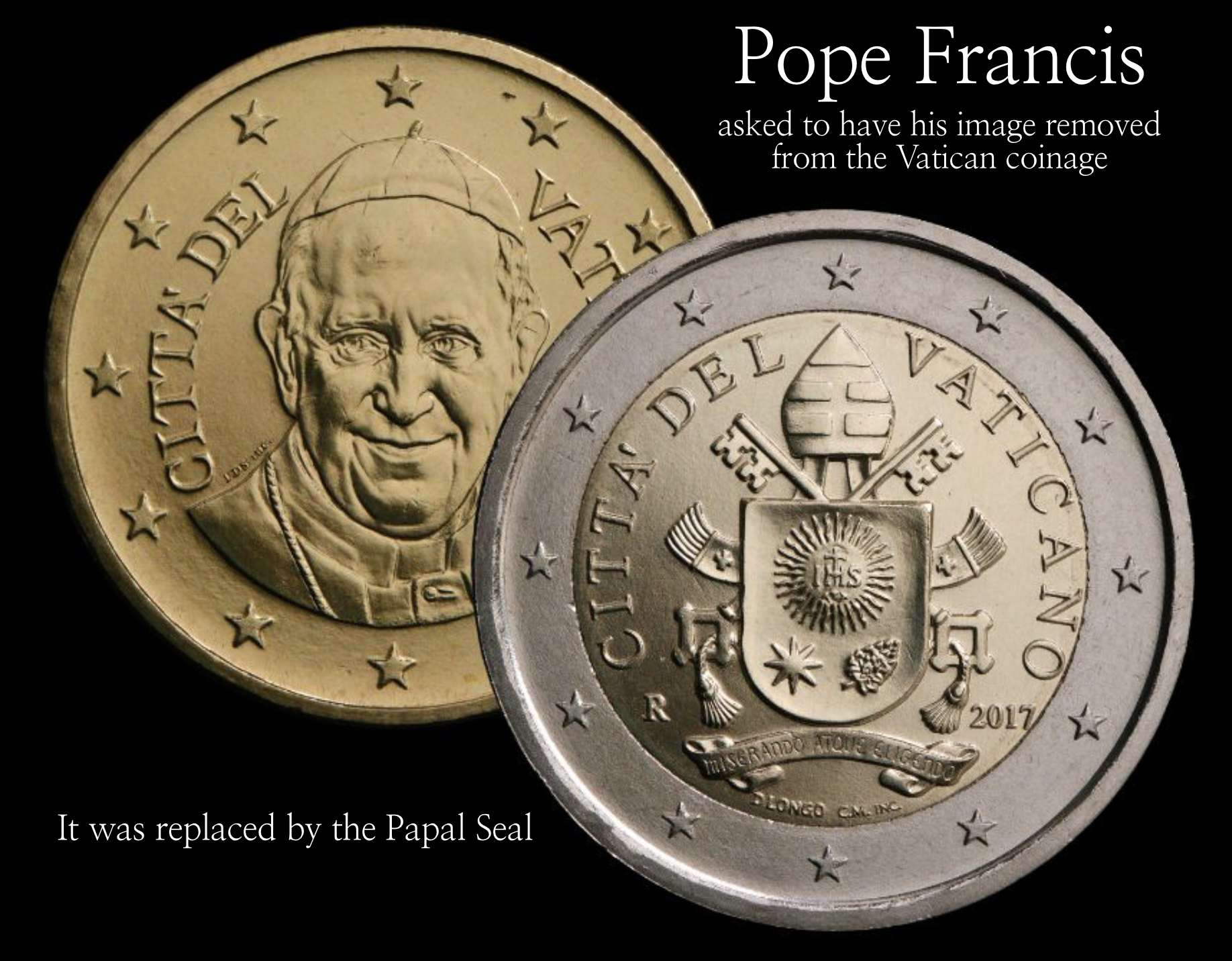
For centuries, the portrait of the current Bishop of Rome graced coins in Rome. That tradition ended with Pope Francis. In 2017, he personally requested that his visage no longer appear on coins. This is commendable, since it was presumably based on Francis’ humility. 

This then, his image has been replaced by the papal coat of arms. Notably, every other country minting euros bears the head of its head of state. It will be interesting to see whether or not Francis’ successor follows his example.

A Brief Note on Protestant Coinage

Although there have been some historical attempts to create governmental structures led by religious leaders besides Roman Catholicism, they have been the rare exception. (The claimed leadership of the Church by sovereigns such as King Henry VIII is another case.) 

In Zurich, Huldrych Zwingli (1484 – 1531) sought to establish a theocracy, and actually perished on the battlefield resisting the Roman Catholic armies of several Swiss cantons. John Calvin (1509 – 1564) pursued similar goals in Geneva, and beyond. Calvin, however, never bore arms in his effort.

Fortunately, the “two kingdoms” theology of Martin Luther became dominant in primarily Protestant realms. It is based on the declaration Jesus made during his trial before Pontius Pilate that “My kingdom is not of this world” (John 19).

For a fascinating discussion of the implications of this theological position, consider “Martin Luther’s Farewell to Arms: The Two Kingdoms and the Rejection of Crusading.”

Turning to numismatics, it is not rare to find religious leaders portrayed on historical coinage. However, these portrayals serve as commemorations of individuals who have made a cultural or ethical contribution to a particular society – not because they sat upon a throne.

For example, Switzerland minted a 20 franc coin with the images of Zwingli and Calvin during the 500th anniversary of the Reformation.

Likewise, in 1965, the Communist government of Czechoslovakia produced a 10 korun coin in honor of the 550th anniversary of the martyrdom of Jan Hus. This particular coin, like many similar pieces, was actually minted as a non-circulating coin, intended for collectors rather than daily commerce.

This leads us to note that most coin-like pieces of metal bearing the likeness of reformers are actually medallions, not coins. As such, the vast majority of the commemoratives have been fashioned by organizations, rather than governments.

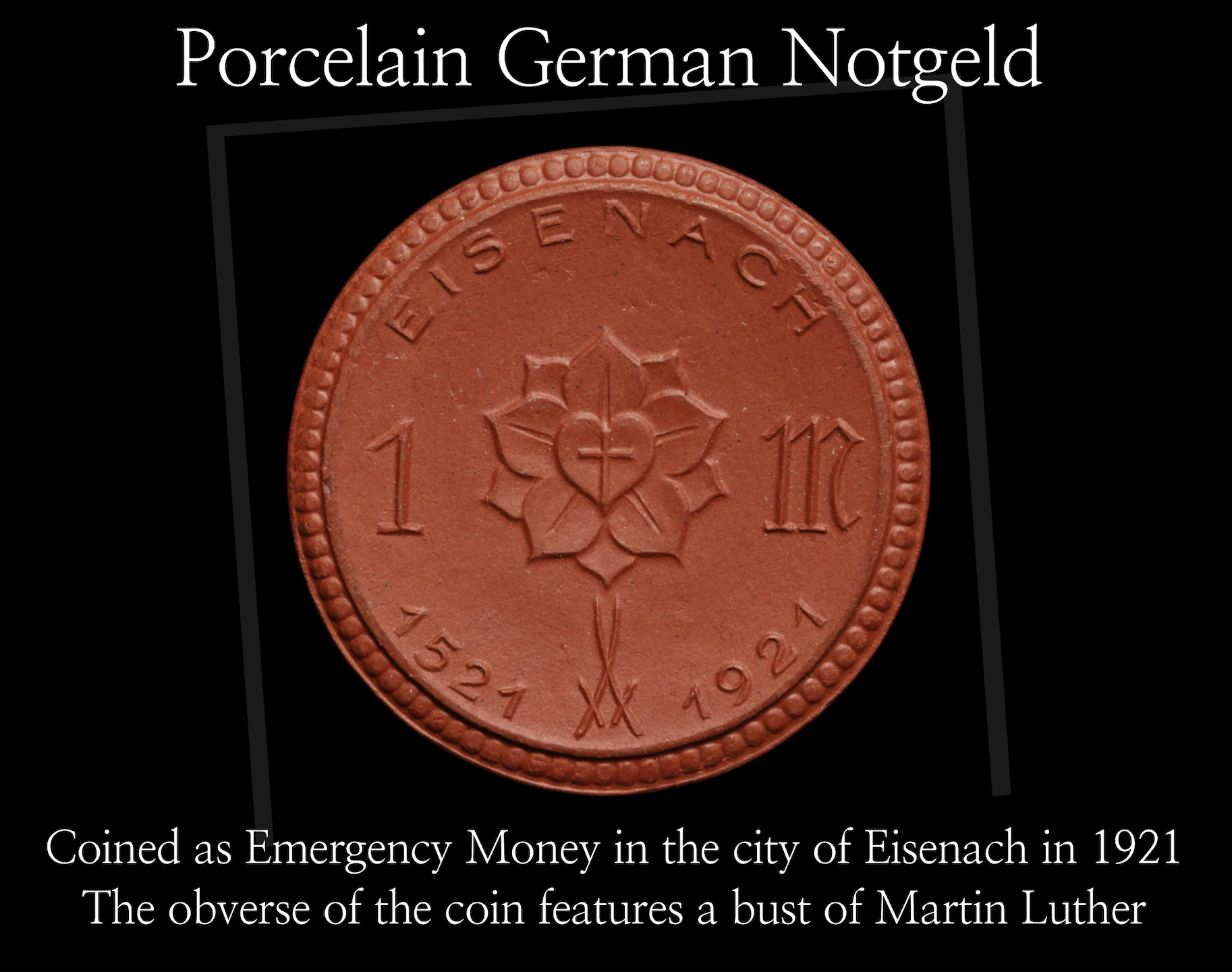
Being an amateur numismatist and a Lutheran pastor myself, I have several related items in my personal collection (none of which were costly, of course . . . since it’s just a hobby). One of my favorite items is a genuine 1 Mark coin minted in Eisenach in Weimar Germany in 1921 (pictured below). What makes it especially unusual is that due to postwar metal shortages, it was actually struck in porcelain!

This emergency coinage and currency was called “Notgeld,” which means “necessity money” because individual cities found it necessary to provide their own money when the Reichsbank succumbed to hyperinflation between the world wars.

The city of Eisenach chose the centennial of Martin Luther’s work because of his historic ties to the city. The Lutherhaus Eisenach cultural center commemorates, among other events, Luther’s early schooldays there, and his stay at Wartburg Castle where he translated the New Testament into German.

Conclusion

In light of Pope Francis’ funeral and the association it has with numismatics, it is a good time to consider how coinage has often carried a religious message. Although this was more frequent in past centuries, it still occurs today. It will be interesting to see just how many nations eventually mint coins in honor of Pope Francis. The Philippines, Samoa and the Cook Islands already have.

And even Narnia, the home of Aslan, minted coins in honor of its heroes, didn’t it?
Narnian Numismatics

I’m a numismatist, and you may be one as well.

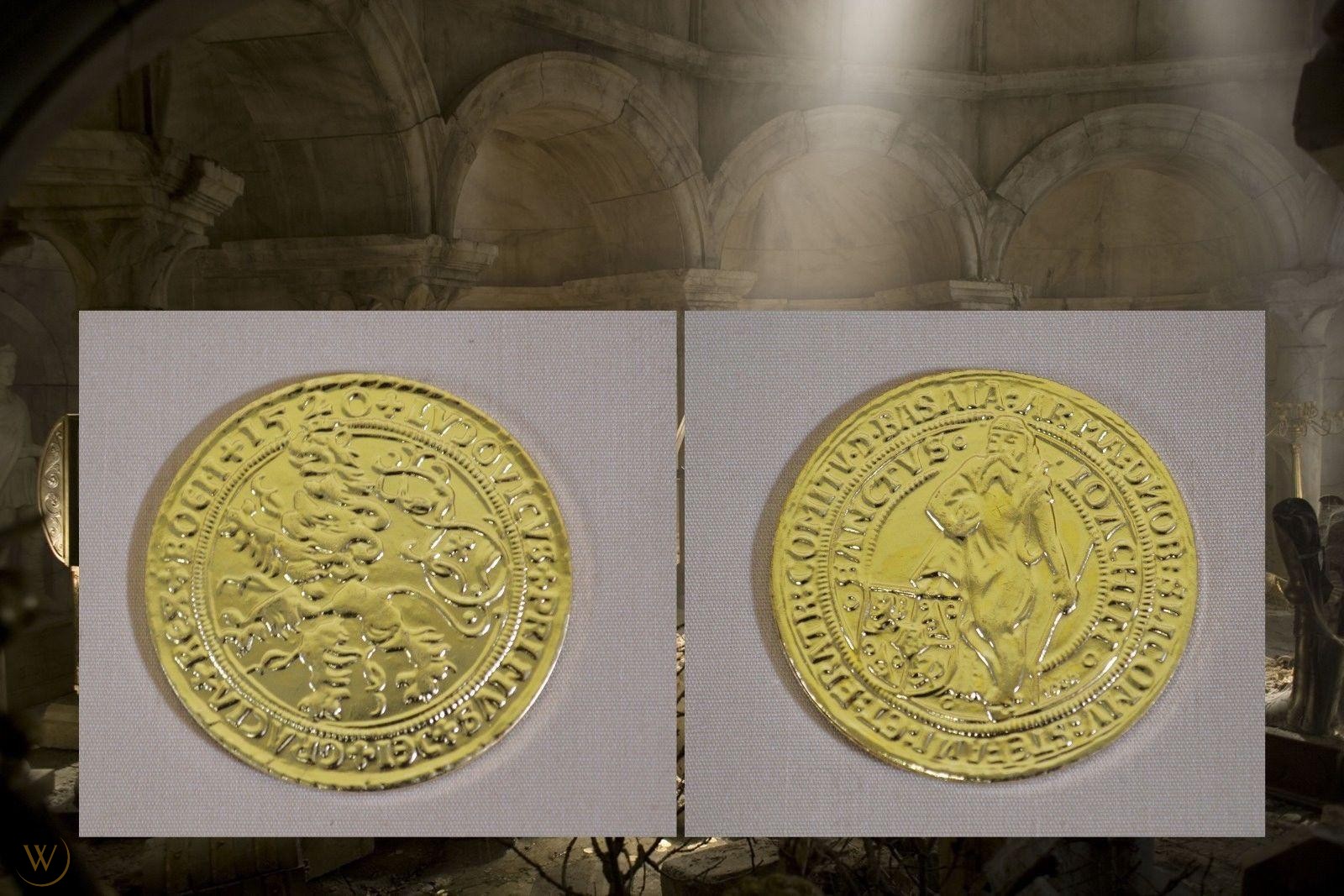
Although I haven’t actively accumulated coins for some years, I do have as a prize piece of my collection a Narnia coin used in the production of Prince Caspian (2008). Technically, since it isn’t a true, earthly coin, it is considered exonumia, but we coin collectors still recognize just how truly special these treasures are.

Speaking of treasures, that is precisely where my Narnian medallion comes from. The treasure chamber scene had a surfeit of the pieces, and some were sold in collectible frames. The obverse and reverse of the coin can be seen above. I’ve actually written about “my precious” piece of Narnia in the past but just this morning I woke up with the word “numismatist” on my mind, crying out for a Mere Inkling post. (More on this in a moment.)

First, those interested in the history of money may wish to skim a few of my other related columns. These include: inflationary currency such as German notgeld and Zimbabwe’s more recent $1,000,000 bills, a comparison of the women in the life of Constantine the Great and the prominent women in the life of C.S. Lewis, and the misspelling of the name of Jesus on a papal medallion.

Coins Have Given Way in My Life, to Words

As I said above, I awoke today with the word “numismatic” fluttering across my thoughts. And it was not alone. It was linked to the wordplay I recently discussed in “Creative Definitions.”

Before pondering where my mental gyrations on the word in question carried me, allow me to share two additional examples I scribbled out on my bedside tablet before rising to brush my teeth and begin the day.

Provocatours: excursions to politically explosive environs where travelers can accurately anticipate their guides will provide an explosively entertaining adventure.

Methics: the ethical perversion which allows people to justify creating pharmaceuticals with the primary function of destroying lives. [See chemistry teacher Walter White on “Breaking Bad.”]

From there my mind jumped to the pecuniary avarice of drug dealers as associated with the word numismatics – and it coined the related word,

Numethmatics: wherein the potential temporal gains associated with drug dealing outweighs the cost to society, oneself and an individual’s soul.

And in relatively rapid sequence came the following.

Flumismatics: when viral contagions disrupt the entire global economy.

Cluemismatics: either the determination of the financial motivations for murder mysteries or the funding required for law enforcement agencies who determine the criminals’ identities.

Numismantics: when economic theory is dominated by traditionally masculine concepts and values (e.g. profit and greed).

Numissmatics: economic theory which is strongly influenced by traditionally feminine values (e.g. charity and compassion).

If the last two culturally antiquated examples haven’t lost you, read on.

Gloomismatics: the prospect for economic survival in light of crushed hopes for the future due to unbridled inflation (e.g. the insanity of some economists and politicians who advocate simply “printing more money” to solve the problem).

Newmismatics: novel currencies and specie that seek to deceive citizens through the pretense that they actually possess some value.

Bluemismatics: the depressive condition elicited when one’s financial holdings inadequately counterbalance one’s debts; historically, applied to cabin boys in sailing days who only realized they would not be fiscally compensated for their services after the ship had left port.

Pneumismatics: pecuniary considerations based on spiritual rather an material considerations.

Numismetrics: the partly scientific, partly fanciful art of exchanging international currencies.

Nufistmatics: the shocking rise of unprovoked blindsided blows to strangers in urban jungles, frequently without any apparent desire to steal property.

Truemismatics: the actual value of monies before economists get involved in the matter.

Gluemismatics: the tight-fisted relationship misers have with their monetary hordes (see Ebenezer Scrooge, or dragons such as described by C.S. Lewis and J.R.R. Tolkien).

Nuclearmismatics: the grim cost calculation involved by world powers when weighing the “benefits” of a possible nuclear conflagration.

There were a couple of other scribblings I was unable to decipher once I was fully awake, but near the end of my meanderings, I came upon,

Zoomismatics: the financial resources required to provide a healthy environment, as close as possible to their natural habitat, for animals residing in zoological parks.

Unsurprisingly, this neologism gave rapid birth to Gnumismatics and Moomismatics . . . well, you get the idea. For the sake of my on sanity, I had to forcibly end the spontaneous exercise.

Returning to Narnia

It is fitting to end this numismatic revelry with a return to the scene for which my coin was minted. As noted earlier, it appeared in Prince Caspian. The Pevensie children have returned to Narnia, and are reawakened to their former life which had become but a dream.

Rediscovering their treasure chamber, in the now-ruins of the castle Cair Paravel (time runs differently in Narnia) is pivotal in their reawakening.

“There’s one thing,” said Lucy. “If this is Cair Paravel there ought to be a door at this end of the dais. In fact we ought to be sitting with our backs against it at this moment. You know – the door that led down to the treasure chamber.”

“I suppose there isn’t a door,” said Peter, getting up. The wall behind them was a mass of ivy.

“We can soon find out,” said Edmund . . .

They worked at the ivy with their hands and with Peter’s pocket-knife till the knife broke. After that they used Edmund’s. Soon the whole place where they had been sitting was covered with ivy; and at last they had the door cleared. “Locked, of course,” said Peter. “But the wood’s all rotten,” said Edmund. “We can pull it to bits in no time . . .

[Descending into the chamber, Peter who is bringing up the rear tells Edmund to count the steps.] “One—two—three,” said Edmund, as he went cautiously down, and so up to sixteen. “And this is the bottom,” he shouted back.

“Then it really must be Cair Paravel,” said Lucy. “There were sixteen.” Nothing more was said till all four were standing in a knot together at the foot of the stairway.

Then Edmund flashed his torch slowly round. “O—o—o—oh!!” said all the children at once. For now all knew that it was indeed the ancient treasure chamber of Cair Paravel where they had once reigned as Kings and Queens of Narnia. There was a kind of path up the middle (as it might be in a greenhouse), and along each side at intervals stood rich suits of armor, like knights guarding the treasures.

In between the suits of armor, and on each side of the path, were shelves covered with precious things – necklaces and arm rings and finger rings and golden bowls and dishes and long tusks of ivory, brooches and coronets and chains of gold, and heaps of unset stones lying piled anyhow as if they were marbles or potatoes – diamonds, rubies, carbuncles, emeralds, topazes, and amethysts. Under the shelves stood great chests of oak strengthened with iron bars and heavily padlocked.

The tale continues, as with each returning memory, the children resumed their stature and confidence as the Kings and Queens of Narnia. Their character, you see, was restored, but they remained only a year older (in Earth age) than they had been when they had previously left the wonderland.

Much to the disappointment of the dwarf Trumpkin. “Well, then – no offense,” said Trumpkin. “But, you know, the King and Trufflehunter and Doctor Cornelius were expecting – well, if you see what I mean, help. To put it in another way, I think they’d been imagining you as great warriors. As it is – we’re awfully fond of children and all that, but just at the moment, in the middle of a war – but I’m sure you understand.”

Lesser children may have filled their pockets with gold coins and diamonds and sought a return to their native land and a life of leisure. Not so these four young heroes. And, due in part to their immunity to avarice, the glory of Narnia is eventually reestablished.

The Value of Money

America exerts a major influence on global financial health. And our current unrestrained printing of new dollars will doubtless have repercussions around the world.

I’m no economist myself, but there seems to be growing concern among professionals of that persuasion that we’re headed for über-inflation. And, if our dollar drops in value the way some people predict . . . well, it seems many nations may be in for the proverbial “rough time of it.”

Shortly after WWII, C.S. Lewis commiserated with an American friend about the effects of inflation on the price of commodities.

I take it that your [comment] indicates not a saturation of the home market, but a shortage of purchasing power due to inflation? That is the situation with which we are faced at the moment; I see that the clothing concessions for instance have not resulted in an increased sale of home market goods.

The stuff is in the shops, but people can’t buy. Though with us the problem is complicated by the inferior quality of so much of the stuff on the home market.

Years later, in 1951, Lewis could still write “war and inflation are still the background of all ordinary conversation over here.”

. . . to which has just been added the railway jam; our new railway organization has succeeded, so far as I can understand, in blocking every goods depot in the country. The trades people are grumbling, and the effect is just becoming apparent to the consumer.

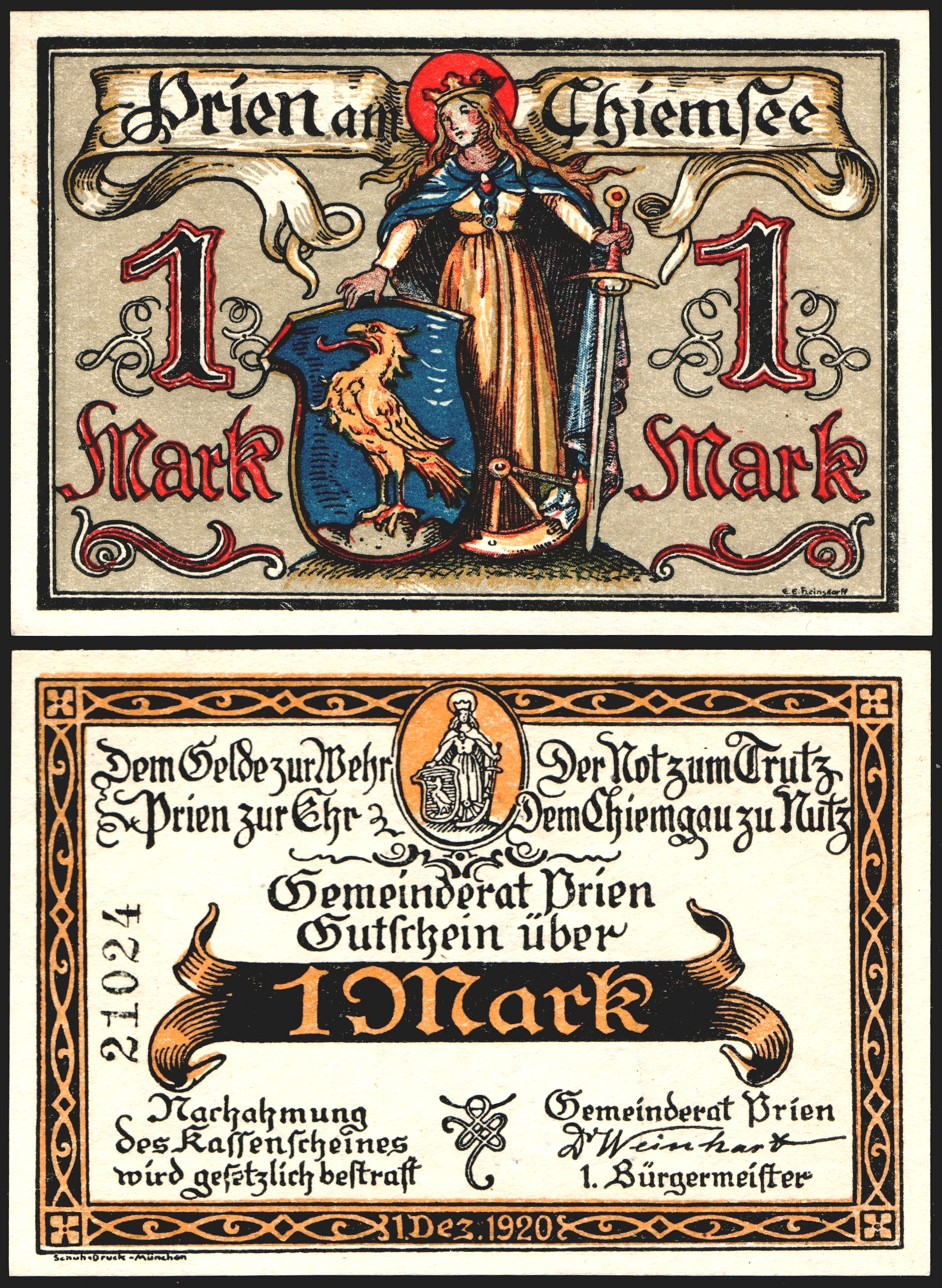
When I was in high school, collecting coins from around the world, I purchased samples of German currency when hyperinflation was destroying their already-shattered economy. These bills were called notgeld, which means “emergency money.”

So much of the worthless paper was printed that you can still purchase genuine pieces for reasonable prices. Many of them are quite interesting, and you can see a variety of examples online.

Some are quite lovely, like this 1 Mark note printed in Prien am Chiemsee in 1920. Lovely indeed, but virtually worthless in terms of its initial value.

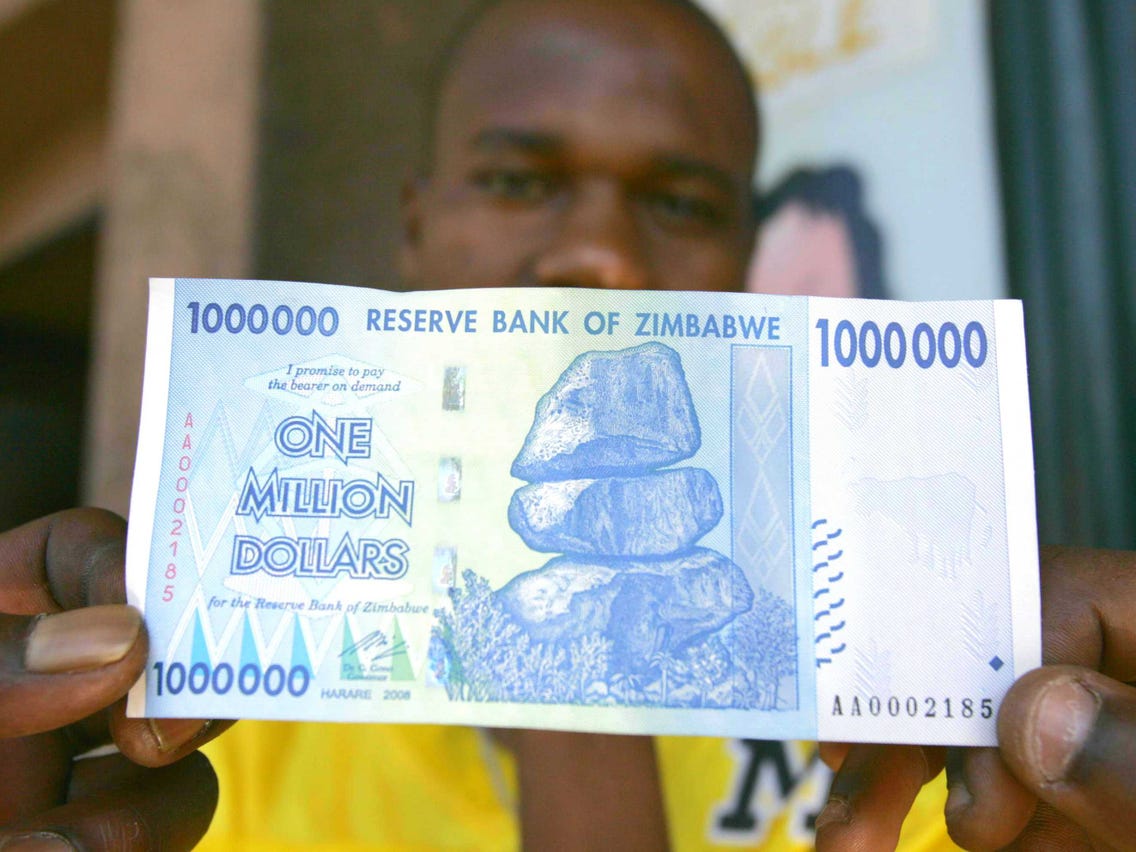
Postwar Germany offers a cautionary example. Similarly, Robert Mugabe’s destruction of Zimbabwe after he gained dictatorial powers shows the danger. You can read about the unbelievable crisis in a variety of places, including this thorough article published in a European economics journal.

You might have thought that the picture at the top of this column was a joke. After all, what country prints a one million dollar bill? Well, Zimbabwe did!

In fact, with an inflation rate of 231,000,000% they ended up printing off one hundred billion dollar bills. That’s not a typo. $100,000,000,000 – you can see one in this Guardian article.

And we won’t even consider the one hundred trillion dollar bill.

Inflation Aside, Is Money Moral?

That’s a false question of course. Morality cannot be attributed to objects. After all, it is not money itself that is “the root of all evil.” It is a fallen human being’s love of possessing wealth that may lead “into ruin and destruction.”

C.S. Lewis expands on this truth, and wisely points out that the danger of idolatry and false security extends beyond money itself.

Christ said ‘Blessed are the poor’ and ‘How hard it is for the rich to enter the Kingdom,’ and no doubt He primarily meant the economically rich and economically poor. But do not His words also apply to another kind of riches and poverty?

One of the dangers of having a lot of money is that you may be quite satisfied with the kinds of happiness money can give and so fail to realise your need for God. If everything seems to come simply by signing cheques, you may forget that you are at every moment totally dependent on God.

Now quite plainly, natural gifts carry with them a similar danger. If you have sound nerves and intelligence and health and popularity and a good upbringing, you are likely to be quite satisfied with your character as it is. ‘Why drag God into it?’ you may ask (Mere Christianity).

C.S. Lewis powerfully portrays this peril in his fiction. In Voyage of the Dawn Treader, a boy named Eustace has surrendered to his lust for treasure and the corruption of his soul becomes quite visible.

He had turned into a dragon while he was asleep. Sleeping on a dragon’s hoard with greedy, dragonish thoughts in his heart, he had become a dragon himself.

You can include me among those who like money. First, for its function – allowing free commerce, in contrast to crippled systems of barter. And, for its intrinsic curiosities – I am, after all, a numismatist.

Still, appreciating the existence of money is a far cry from echoing John D. Rockefeller who said “I believe it is a religious duty to get all the money you can.” (To be fair to the robber baron, his full quote was “I believe it is a religious duty to get all the money you can, fairly and honestly; to keep all you can, and to give away all you can.”)

To gain riches honestly is, of course, not objectionable. But as to reconciling the keeping and the giving away . . . Rockefeller’s logic eludes me.

Bonus Insight

As I noted above, I’m no economist. C.S. Lewis declared the very same statement in Mere Christianity as he explored the concept of usury (loaning money with significant interest charges). His thoughts on the matter speak to the entire subject we have been discussing.

As for the entire section you can find Lewis’ position at an interesting site called Generosity Monk, which “is committed to serving the Church by providing spiritual and strategic guidance to help people understand and practice biblical generosity.”