C.S. Lewis, the Brothers Grimm & Snow White

You may blame the recent cinematic debacle that is Snow White on a declining Film Studio or the Brothers Grimm, but C.S. Lewis is innocent.

That’s not to say the Grimms didn’t have an influence on the great Oxbridge professor, a subject we’ll explore momentarily. But it was the German folk tales published by academics Jacob and Wilhelm Grimm who published the classic fairy tales that Walt Disney mined so effectively. 

They also popularized CinderellaHansel and GretelLittle Red Riding HoodThe Princess and the Frog, and Rapunzel. Disney began the transformation of these tales into visual treasures as early as 1921 when he founded Laugh-O-Gram Studio in Kansas City, Missouri.

In addition to films, over the years Walt gleaned memorable Grimm stories for a multitude of cartoon shorts, including The Brave Little Tailor and The Four Musicians of Bremen.

Obviously, Walt Disney himself respected the source material for the stories and wielded his editorial prerogative in an appropriate manner. Tragically, the same cannot be said for his corporate heirs. Likewise, the Brothers Grimm bear no culpability in this area.

C.S. Lewis, J.R.R. Tolkien & Snow White

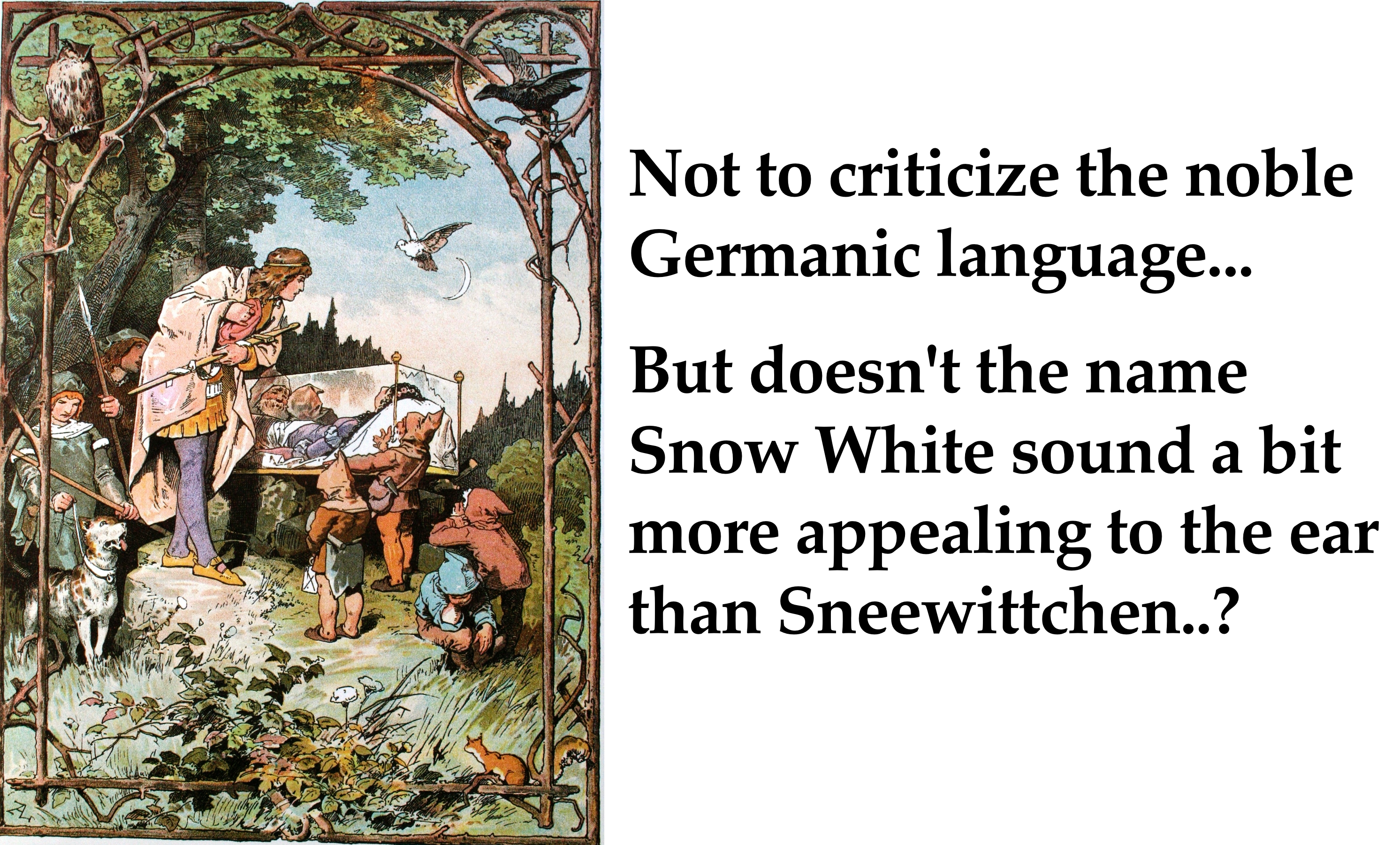
The truth is, although Lewis and Tolkien appreciated literary fairy tales, neither of the preeminent Inklings were enamored with Disney’s animated treatment of the stories. Curiously, the two distinguished dons actually attended the theater together to view the trailblazing novelty that was Snow White.

They were particularly disappointed with the dwarves, seeing just how different they were from the genuine legends about them. Lewis even wrote “Dwarfs ought to be ugly of course, but not in that way.” Atlas Obscura has an entertaining article about their “movie date” and notes some of the elements they also enjoyed in the feature.

In his lectures published as A preface to Paradise lost, C.S. Lewis elaborates on his response to the Disney version of the tale.

That strange blend of genius and vulgarity, the film of Snow-White, will illustrate the point. There was good unorginality in the drawing of the Queen. She was the very archetype of all beautiful, cruel queens: the thing one expected to see, save that it was truer to type than one dared to hope for.

There was bad originality in the bloated, drunken, low-comedy faces of the dwarfs. Neither the earthiness, the avarice, nor the wisdom of true dwarfs was there, but an imbecility of arbitrary invention.

But in the scene where Snow-White wakes in the woods both the right originality and the right unoriginality were used together. The good unoriginality lay in the use of small, delicate animals as comforters, in the true Märchen [fairy tale] style. The good originality lay in letting us at first mistake their eyes for the eyes of monsters.

If you want to read more about the subject, you can do no better than read Joe Christopher’s article on the subject.

For an interesting argument that fellow Brit G.K. Chesterton would have loved Snow White for the very reason that moved the Inklings to criticize it, see “Tolkien and Lewis disliked Snow White. You know who wouldn’t have?

C.S. Lewis & Grimm’s Fairy Tales

Like his friend, J.R.R. Tolkien, C.S. Lewis was a champion of classical fairy tales. Neither was apologetic for it, although Lewis admitted to being shy about it when he was young. In an essay titled “On Three Ways of Writing For Children,” he wrote,

When I was ten, I read fairy tales in secret and would have been ashamed if I had been found doing so. Now that I am fifty I read them openly. When I became a man I put away childish things, including the fear of childishness and the desire to be very grown up.

In a great post called “Old Enough For Fairy Tales: C.S. Lewis’ “The Chronicles of Narnia” the writer describes this distinction to which Lewis alludes.

The Chronicles of Narnia are not children’s stories. They are fairy tales—but that is precisely why they are not children’s stories. If you can’t understand, you haven’t been listening. Go back and read the quote from Lewis’ essay again. Children are not the only audience for fairy tales.

In 1954, C.S. Lewis apologized to a German professor for being unable to understand the nuances of his volume on philosophy. In doing so, he referred to his youthful reading of the Brothers Grimm in their original German (available at Internet Archive).

I look forward to reading the book (when the translation arrives! My German is wretched, and what there is of it belongs chiefly to the libretto of the Ring and Grimm’s Märchen – works whose style and vocabulary you very possibly do not closely follow).

If you are in the mood for reading Grimm’s Fairy tales today, and your German is sadly lacking, Project Gutenberg has just the translation for you . . . as long as you can read English.


Addendum [added 10 April 2025]

The Brothers Grimm were far more than simply folklorists. They were respected professors at the University of Göttingen. They were devout Christians and worked with other prominent Germans. 

Goethe assisted them at a crucial moment in collecting their tales, and the philosopher Friedrich Schleiermacher provided copyediting assistance. Jacob’s work on German mythology had a pronounced influence on the composer Richard Wagner (World Magazine).

They also began compiling the Deutsches Wörterbuch (Germany dictionary) in 1838, with the first volumes published in 1854. It was the first dictionary to include historical usages of each word, preceding the Oxford English Dictionary, which was initiated in 1857 with its first edition published in 1884.


Bonus Trivia: The dwarves were unnamed until their debut on Broadway in 1912. And on that day they were christened Blick, Flick, Glick, Plick, Snick, Whick and Quee.

C.S. Lewis & Cinderella

C.S. Lewis did not write a Cinderella story of his own, but he did refer to one of his books as his “Cinderella,” for a different reason.

The Cinderella folk tale is familiar to many cultures. Like the Ugly Duckling, it celebrates real life occasions where events turn upside down, and the disadvantaged are vindicated.

More than two thousand years ago, the Greeks told the story of Rhodopis, a Greek slave girl whose sandal was snatched by an eagle and dropped into the lap of the Egyptian pharaoh. His search for the lovely foot that graced the footwear culminated in a joyous marriage.

I was thinking about step parenting recently, and how some people care for their own children differently than they treat children brought into the union from a spouse’s previous relationship. The subject arose during my prayers, when I thought to offer thanks to God for the depth of love he has given me for my “step-grandchildren.” It is, as far as I can tell, indistinguishable from the love I hold for my biological grandkids.

Following my prayers, I reflected further on family. And—because it reflects real life in terms of raising children, I thought of the story of Cinderella. In particular, I was wondering whether the “wicked stepsisters” were destined to be cruel simply because they were raised by their “wicked stepmother.”

The answer to that dilemma is obvious. Do bad parents raise bad kids? Sometimes, but thankfully, not always. Do good parents raise good kids? Sometimes, but sadly, not always.

If you remove the outliers—the saints on one side and the sociopaths on the other—kids have a reasonable chance to turn out “okay.” Basically, just because someone’s parents are disreputable, doesn’t mean the kids will grow up to be bums as well.

This comes as no shock to any of us, of course. We are too sophisticated to impute the sins of the parents to their children. But are we really? In truth, we often make judgments based upon things utterly beyond a child’s control. Nationality, social status, physical or mental disability . . . some people default to an unconscious ranking of desirability.

I’m reminded of the rewards of working with orphans and the tragic manner in which even these victims are “ranked” in terms of their perceived worth. So much for viewing the world through carnal eyes.

C.S. Lewis described the way a children’s story can flip things around in a way that reveals truth. In 1947 he described this to an American correspondent.

About stories for children. (a) Don’t the ordinary fairy tales really already contain much of the Spirit, in solution? Does not Cinderella give us exaltavit humiles,* and is not Redemption figured in The Sleeping Beauty? (b) For something a little more explicit, what about Geo. MacDonald’s⁑ The Princess & the Goblins, Curdie & the Princess, The Wise Woman, and The Golden Key?

In a 1943 letter to Sister Penelope, Lewis commented on a manuscript she had sent for his review. He suggests a “longish speech” by Melchizedek would be better presented in a different manner.

He’s got to have the sense of mystery about him. That means, for purposes of these plays, he must sound like a king out of a fairy tale. Actually in this speech he sounds more like a Bampton Lecturer! Represents, condemnation, include, mediator all strike the wrong note. I am referring only to the style: the matter is perfectly right. It is easier, of course, to pick holes than to mend them!

He then offers a note about the power of stories to communicate facts and deeper truths.

If I were trying to do it myself I should make it a speech about the Kings of Salem, not about ‘kingship’ in general—like a special magic in that family. (The Kings of Salem are not ordinary kings. . . .)

On the imaginative level I think the deepest truths enter the mind much better as arbitrary marvels than as universal theorems. Cinderella had to be back at midnight—Psyche must not see Cupid’s face—Adam and Eve must not eat the fruit: how much better these statements are than any philosophical generalities about obedience.

C.S. Lewis’ Personal Cinderella

Each reader of C.S. Lewis has their personal favorite, thoughtfully selected from the rich buffet of his diverse works. While I treasure many of his works, my personal favorite is The Great Divorce. It pleases me that the title also occupied a special place in Lewis’ own estimation.

Lewis described the underappreciated volume as his “Cinderella.” The beauty and nobility were there all of the time, though unrecognized.

Writing in 1954 to his editor, Jocelyn Gibb, he expresses appreciation for two handsomely bound copies of his books. He says, “perhaps these two charming volumes will teach me at last to have for the bodies of my own books the same reverence I have for the bodies of all other books.” In the same letter he writes, “I am always glad to hear of anyone’s taking up that Cinderella, The Great Divorce.”

Kathryn Lindskoog wrote an article about the book, calling the volume “C.S. Lewis’s Divine Comedy.” She begins with a personal anecdote.

C. S. Lewis beamed, then said “It’s my Cinderella.” I had just told him how much I loved The Great Divorce. (If I had been forced to choose one favorite of all his books, that would have been my choice.) He said he didn’t understand why Screwtape Letters got all the attention when The Great Divorce was so much better.

The Screwtape Letters is another of Lewis’ works that continues to impress me for its unique and effective way of illustrating the malevolent mind that shapes so many of the temptations that assail us. But, for sheer pleasure, I too prefer the wisdom, and the witness to heaven’s reality, that shine so brightly in The Great Divorce.

——

* Exaltavit humiles comes from the Magnificat (Luke 1:46-55) and means God “has exalted the humble.”

⁑ Most of MacDonald’s books are available for free download at Google and Kindle.

C.S. Lewis and Times of Crisis

Dark days demand two seemingly contradictory things. Serious reflection and diversion (often in the form of entertainment).

Things are serious. The ultimate toll of the current pandemic remains unknown. Even if we regard ourselves as safe due to age, health and isolation, the simple fact is thousands are dying. Beyond our compassionate concern for those who are suffering, only a fool would fail to reflect on their own mortality during this plague.

Christians, who recently “celebrated” Good Friday are quite conscious of the fact that “we are dust and to dust we shall return” (Genesis 3:19).

Yet this awareness doesn’t leave us in despair, because Easter has come. Our Lord’s resurrection means that for those who trust in him, death does not have the final word.

I pray for those who are overcome by worry during these days. Because dwelling solely on the negative robs life of its present joys, and worsens the impact of the pandemic on individual lives.

Rather than feed your anxiety with troubling reports and thoughts, I urge you to take the opportunity to read, watch a classic program, or play a game. Distracting activities are healthy, as long as they do not displace serious awareness of our circumstances.

Seriously Assessing Our Predicament

Others have written eloquently about Lewis’ response to situations such as that in which we find ourselves today.

For example, the Gospel Coalition offers an excerpt from C.S. Lewis’ 72 year old essay about atomic weapons. They suggest we “just replace ‘atomic bomb’ with ‘coronavirus.’” Lewis’ advice holds up well in our turbulent era.

Annie Holmquist of Intellectual Takeout elaborates on Lewis’ essay. “How C.S. Lewis Would Tell Us to Handle Coronavirus” is well worth a read.

Several weeks ago, the Wade Center (which hosts the Western Hemisphere’s finest Inkling collection) struck the balance I am suggesting. They acknowledged the danger, and offered advice on spending our time well. Their blog included an excellent suggestion in “Those Who Lived to see Such Times: Suggested Readings from the Wade Authors during Times of Uncertainty.” The Wade Center provides links to a number of fine text and audio resources that will offer encouragement from authors who “witnessed both world wars, and . . . lived to see the unsettling days of nuclear weapons.”

Enjoying Life Despite the Danger

Those who are working during this time remain in need of our prayerful support. For the majority of us, however, the cancellation of most of our normal social activities has provided us with an abundance of leisure time. In addition to attacking postponed chores around the house, we should fill some of this interval by enjoying old pleasures and discovering new interests.

Take advantage of treasures such as those mentioned in the Wade Center post. Hundreds—even thousands—of free, public domain books are available online. For those whose preference is visual, there are plenty of free video options, including many vintage television shows you can view on YouTube.

If you’re craving a humorous treat, check out the great satire at The Babylon Bee and The Salty Cee.

A recent article on the former site reveals the sad tale of a boy whose childhood has been ruined by modern online games. It’s entitled, “Boy Discovers Wondrous Land Of Narnia, Leaves Negative Yelp Review.”

Lutherans (and self-confident Christians of other traditions) will enjoy the Lutheran Satire site. For people who don’t object to listening in on a demonic press conference, a fictional Easter interview on their main page is enlightening.

A bit lighter, is this rendition of Saint Patrick explaining the Trinity to the Irish pagans. It will help you sharpen your Christology.

There is a vast, unexplored world of literature out there. I recently read this illuminating post about one of George MacDonald’s fairy tales. MacDonald exerted a great influence on C.S. Lewis. With a curious twist on light and dark, the post also provides a link to a film based on MacDonald’s The Light Princess. I haven’t viewed it yet—but if you have a high tolerance for 1980s BBC productions combining animation and live action, you could be in for a treat.

Where to Begin?

Before exploring some of these links I’ve included, I encourage you to view “The Age of the Coronavirus.” The videographer has done what was suggested in one of the articles mentioned above. He has substituted the virus for the threat of nuclear war in C.S. Lewis’ abbreviated essay.

The video is good enough that you may well desire to share it with others. It can help to know the threats of our day are not unique to history. I suggest that you also include the amazing C.S. Lewis Doodle which offers an illustrated version of the entire essay.

A Better Wig

wigHow important is honesty? When is it okay to fudge on the truth? If the main point is valid, how necessary is it to keep all of the details straight?

I just read a bizarre story that got me thinking about this subject. A director of Senior Services in Rhode Island wanted to promote snow removal assistance for the elderly, and couldn’t rustle up a suitable “Cranston Senior Home Resident” to be featured during a news report.

So, she did the next best thing. She manufactured one.

The only apparent flaw in her plan was forgetting that such facilities also have male residents. So, the bus driver she pressed into the role had to don a wig, makeup and earrings. (Perhaps she just thought that an elderly female would elicit greater sympathy.

At any rate, her nefarious plot was revealed when local television viewers did not fall for the questionable disguise. The coup de grâce, or the punch line as you may read it, came in the pronouncement of the salon owner who prepped the man for his debut.

“I probably would have given him a better wig if I had known.”

You see, the problem wasn’t the misrepresentation. The error was in not doing it persuasively.

I suppose this odd story struck me as timely (even though it apparently occurred this past winter) because we in the United States are currently suffering in the midst of a lengthy presidential primary season. (No comments, please, on whether any of the candidates might benefit from wearing “a better wig.”)

C.S. Lewis & the Subject of Deception

C.S. Lewis thought a great deal about the subjects of truth, and deception. For much of his life, well into adulthood, he was deceived by sirens who denied the reality of a loving God.

One of his accurate observations is that deception must be reasonable to be successful.

Nothing can deceive unless it bears a plausible resemblance to reality. (“An Experiment in Criticism”)

Obviously, the incident above did not pass the plausibility standard.

In the same essay, Lewis declared scenarios that represent imaginary realities as being innocent of deception.

No one can deceive you unless he makes you think he is telling the truth. The un-blushingly romantic has far less power to deceive than the apparently realistic. Admitted fantasy is precisely the kind of literature which never deceives at all. Children are not deceived by fairy-tales; they are often and gravely deceived by school-stories. Adults are not deceived by science-fiction; they can be deceived by the stories in the women’s magazines. (“An Experiment in Criticism”).

We would be inclined today to add “men’s magazines” as an equally disingenuous source. I believe Lewis was referring to the kind of story that manipulates one’s emotions and exaggerates reality to provoke the desired response.

Self-Deception as a Danger

As a Christian, Lewis reflected in great depth on how prone you and I are to deceiving ourselves. Some of this self-deception is not intentional. In correspondence with an American acquaintance he discussed Martin Buber’s book, I and Thou.

What I had not yet thought about was your objection, that he ignores the Me. You are probably right. He might even have said that just as the Thou is deeper than the Me, so the I is deeper than the Me. For I believe self consciousness to be full of deception and that the object I call me and think about (both in my moments of pride and in my moments of humility) is very different from the I who think about it.

I agree with Lewis that we are often unaware of aspects of our own personality. And, unfortunately, we are prone to misperceiving what we do observe. This is not a conscious twisting of the truth to our own benefit, as in proclaiming that we are exceptional and never fail.

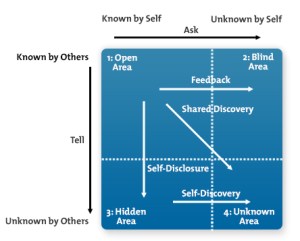
johariThis raises the question of our self-awareness. The Johari Window is a simple resource that illustrates the four aspects of our identity, based on two axes—what is known/unknown and by whom the traits are recognized.

You can see how it works out in this simple diagram. And you can read a brief description of the tool here.

It seems evident that one key to living with integrity and enjoying greater happiness is to be honest in all of our dealings. Honest with others. And honest with ourselves.

It was good to be reminded once again of that vital truth.

_____

Here’s a piece of Lewisian trivia. The collection of essays available in the United States as God in the Dock was originally published in the United Kingdom with the title Undeceptions. Ironically, the British reference in the American version of the title still creates confusion for those who don’t realize “in the dock” refers to a person who is on trial.