Hunting Facts

librariansI’m having a serious problem. One that was shared by C.S. Lewis.

Unfortunately, it has reached its greatest intensity as I am striving to meet the deadline for my doctoral dissertation.

The problem is one that should be simple to remedy, yet I’m crippled by it. The solution is so simple that it is almost embarrassing to admit what it is.

But, confession is good for the soul. (That’s not a biblical verse, by the way, in case you were wondering. Nevertheless, it’s quite true.)

So, here’s my confession. I love to conduct research.

The internet is tailor made for a lifelong student like me; I can follow any avenue that piques my interest from one corner of the world wide web to the other.

And, I do.

That’s the problem, of course. I always over-research the things that I write. And this dissertation is no different. I have so much research—good stuff—to cram into it that I’m dreading hearing back from my advisor . . . who now has the first three chapters in hand.

So, how does this plight resonate with the life of C.S. Lewis? Well, not in the sense of my possessing his brilliant intellect and memory. Lewis had no need of the internet to sort out all of the material he had studied.

Still, the two of us do share one important character trait. He too, was an inveterate collector of information.

In his anthology of George MacDonald’s writings, Lewis confesses his pleasure at conducting research. He says it in this fashion:

“I am a don, and “source-hunting” (Quellen-forschung) is perhaps in my marrow.”

Alas, my marrow is filled with the same unquenchable hunger.

Considering Your Own Writing

It may be that some Mere Inkling readers share this passion for pursuing knowledge for its own sake.

It can certainly be argued that it is an important facet of writing. But there are other aspects of writing, and it is quite natural for different elements of the process to appeal to different individuals.

Perhaps you prefer the initial brainstorming, daydreaming or idea phase of a writing project.

Or, as we have discussed, researching information may be the high point of your writing efforts.

This typically leads to outlining, in various shades of detail. Some writers prefer to proceed without any structure in mind. (This is usually not a good idea when writing nonfiction.) I like outlining. I find establishing a logical structure satisfying work, probably because I’m NTJ.

There are, of course those who honestly love the writing itself, especially when they are in the zone and the creativity is really flowing. Frankly, for me the writing is work. (That doesn’t mean I don’t enjoy the feeling that flashes when you come upon the perfect word or phrase.)

And, although I’m a brutal editor of my own work, and find sharpening an article rewarding work, I must admit I am a little surprised when I encounter a writer who enjoys this phase of the process the most of all.

Then there is sharing or submitting a manuscript for publication. Most writers are a little nervous about this, but some find it exhilarating.

Once someone has published a book, it is now normal for the bulk of responsibility for its promotion to rest upon their own shoulders, as the author. I’m still waiting to meet someone who claims that this is their favorite phase of the writing cycle.

Back Again to the Oxford Don

Lewis’ writing is so enjoyable that I want to close with a longer excerpt from the introduction.

C.S. Lewis’ high regard for MacDonald is well known. This anthology of his work was a tribute to him, in the hopes of introducing many more readers to his work. This book is insightful into the hearts of both men. After all, the editor’s choice of quotations cannot help but reveal much about them too.

In making this collection I was discharging a debt of justice. I have never concealed the fact that I regarded him as my master; indeed I fancy I have never written a book in which I did not quote from him. But it has not seemed to me that those who have received my books kindly take even now sufficient notice of the affiliation.

Honesty drives me to emphasize it. And even if honesty did not— well, I am a don, and “source-hunting” (Quellen-forschung) is perhaps in my marrow. It must be more than thirty years ago that I bought— almost unwillingly, for I had looked at the volume on that bookstall and rejected it on a dozen previous occasions— the Everyman edition of Phantastes. A few hours later I knew that I had crossed a great frontier.

_____

There is no authoritative step-by-step list of the writing process. Some sources call the idea stage “prewriting.” Others break writing down into two parts: “drafting” and “revising.” Some consider editing primarily to be “proofreading,” while you can see from post that I merge the revising and proofreading into what I call “editing.” There are various other structures that are used to describe the writing process. My suggestion is to go with what works for you.

MacDonald’s works are now in the public domain. You can download a free copy of Phantastes here. There is a LibriVox (audio) recording available at the same site.

Metaphysical Poetry (it’s better than it sounds)

quarlesI had to add the parenthetical comment to the title of this column or it would have been dismissed on its surface by readers like me. Although I dabble at poetry myself, I never voluntarily choose that genre for reading. And metaphysics? As a practical pastoral theologian, I have little interest in abstract philosophies.

I have just discovered metaphysical poetry, and it is quite intriguing.

How well read are you? Do you read broadly, deeply, or both? Unfortunately, most of us restrict our reading to a rather narrow scope. This is due to two factors.

First of all is our lack of time. Few enjoy the leisure hours to indulge in the sheer pleasure of reading simply for joy.

A second dilemma arises from the deluge of new books being published every day.

It is tempting to retreat in the spirit of C.S. Lewis to the classics, and not waste our time on a volume until it has proven its worth by remaining in print. Alas, digital technology devastates that metric, since even the most worthless tripe can remain in virtual print indefinitely.

As a semi-retired pastor, I enjoy more time than I did when I was serving full time, but I still limit my reading primarily to theology, history, current events, and anything related to C.S. Lewis. I seldom have time to explore the treasure of literature that is freely available to us.

I recently spent some time doing just that.

I read some writing advice from the pen of Francis Quarles (1592-1644) who is best known for his book Emblems. It is representative of a genre (called “emblem books”) that flourished in Europe during the sixteenth and seventeenth centuries. Here are two enjoyable observations:

If thou desire to make the best advantage of the muses, either by reading, to benefit thy selfe, or by writing, others, keep a peacefull soul in a temperate body: a full belly makes a dull brain; and a turbulent spirit, a distracted judgement: the muses starve in a cook’s shop, and a lawyer’s study. (LXXIX).

If thou intend thy writings for the publique view, lard them not too much with the choice lines of another author, lest thou lose thy own gravy: what thou hast read and digested being delivered in thy owne stile becomes thine: it is more decent to weare a plaine suit of one entire cloth, than a gaudy garment checquered with divers richer fragments. (XCVII).

Lewis was, of course, intimately acquainted with Quarles’ work. Like everyone else, however, he was more influenced by the literary contribution of John Donne (1572-1631). Like Quarles, Donne is considered one of the English “metaphysical poets.”

These writers offered used “conceits,” which were similar to analogies, but compared things that were clearly different from one another. It requires significant skill to convince a reader of the similarities of things that are deeply unlike one another.

In his essay “Dante’s Similes,” Lewis discusses the subject in detail.

It will be easily seen in what sense Dante’s similes are ‘metaphysical.’ The connexion between the two members is real, ontological, intelligible, and the material need not be in itself beautiful or may be even grotesque—as when Time is represented as a tree growing downwards with its roots in a vase which is the Primum Mobile (Paradiso, XXVII, 118). And this certainly connects them, in one way, with what literary critics call ‘Metaphysical’ conceits, meaning the conceits used by Donne and his followers.

But there are only two points of contact—first, the difficult and (at first sight) unpoetical nature of the material, and, secondly, the intellectual rather than emotional connexion between this material and the thing compared with it. The spirit in which they are used is not the same in Donne and in Dante. In Donne, the connexion, though intellectual as in Dante, is as momentary, as incapable of life beyond the immediate context, as the connexions in Homer or Virgil.

It may be true that Donne cannot court a mistress without bringing in scholastic philosophy, law, chemistry, and cosmography. But he has no interest in these things except as toys and does not care in the least what place they have, if any, in the real universe—if, indeed, there is a real universe outside the present emotion. The longer you look at Donne’s comparison of the lovers to the compasses, the less alike they will seem, and the more certain you will become that the innumerable differences between them are a more interesting and fruitful field for thought than the single analogy.

But in the greatest Dantesque similes, the longer you look the greater the likeness becomes and the more fruitful in thoughts that are interesting as long as you live. This, of course, is no disparagement to Donne: a witty love song, whether salacious or saturnine, is not meant to be chewed over like the great Comedy which made its author lean. If I seem to be breaking a butterfly upon a wheel, it is only because I want to avoid a misunderstanding which would hinder our reading both of the great and of the little poet.

Sample Their Works (for free)

If you are able to carve out a few hours of your time to delight in the rich banquet provided by the three writers mentioned above, visit these links to download their books in the digital version of your choice.

Francis Quarles’ Emblems

(This edition is elegantly illustrated!)

The Poems of John Donne

(Volume I)

The Divine Comedy of Dante Alighieri

_____

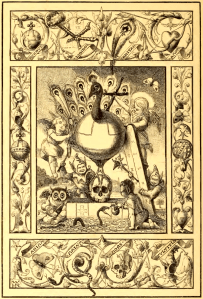
The elaborate image at the top of this column is one of the illustrations found in the copy of Emblems linked to above.

Reading Into an Author’s Work

shakespeareSometimes authors are not quite so brilliant as we think them to be.

It is possible to read into someone’s work ideas, and even profundity, that was not present when they were originally composed.

That’s an odd thought, I will admit. But the truth is that each of us as readers carry with us our own knowledge and personalities.

Imposing those upon a text is a subconscious reality, and it may even be unavoidable. Minimizing our presuppositions is one of the key elements of honest literary criticism.

This is one of the reasons that it is insanity to impose contemporary “political correctness” on writers who lived before such constraints were imposed. Intelligent people recognize that we must read Twain as an iconoclastic nineteenth century author, and Bunyan as a Baptist preacher of the seventeenth.

I just read a letter in which C.S. Lewis describes how this works. He wrote to a Roman Catholic correspondent, a priest, on Christmas Day 1959. In the letter he responds to his friend’s reference to something he had not consciously included in a particular book.

It is a fascinating letter, and even though it is the final portion that pertains to the subject I’ve been discussing, I will share it in whole.

The Kilns, Headington Quarry, Oxford   Christmas Day 1959

I hope my last letter to you did not sound chilling: still less (heaven help us!) as if I were offended by criticism. I think the chief reason why I am less disposed than you for large-scale discussion by letter is the difference of our ages. In youth we conduct (at least I did) long and deep disputations through the post. It is indeed a most valuable part of our education. We put into it quite as much thought and labour as would go to writing a book. But later, when one has become a writer of books, it is hard to keep it up. One can’t fill one’s leisure with the v. same activity which is one’s main work. And in my case not only the mind but the hand needs rest. Penmanship is increasingly laborious, and the results (as you see) increasingly illegible!

If you sometimes read into my books what I did not know I had put there, neither of us need be surprised, for greater readers have doubtless done the same to far greater authors. Shakespeare would, I suspect, read with astonishment what Goethe, Coleridge, Bradley and Wilson Knight have found in him! Perhaps a book ought to have more meanings than the writer intends? But then the writer will not necessarily be the best person with whom to discuss them.

You are in my daily prayers. Will you pray much for me at present? The cancer from which my wife was (as I believe, miraculously) delivered 2½ years ago, when death in a few weeks was predicted, is returning. Can one without presumption ever ask for a second miracle? The prophet turned back the shadow for Hezekiah once: not twice. Lazarus, raised from the dead, presently died again.

Yours

C.S. Lewis

P.S. I never thought of it before, but how Lazarus was sacrificed. To have it all to do over again–bis Stygios innare lacus!

_____

Father Peter Milward, SJ, taught English Literature at Sophia University in Tokyo. He has extensively published on his major subject, and A Challenge to C.S. Lewis (1995), which I just now ordered for my library. A curious title, however, for a student and “fan” of Lewis.

As a Shakespeare scholar, he has persuasively argued that the bard was Roman Catholic. “When the archbishop of Canterbury recently broke his church’s long silence and acknowledged that William Shakespeare was probably a Catholic, it was a moment of quiet satisfaction for Father Peter Milward, the author who began researching this subject a half century ago.” Read the article here.

A Dire Norwegian Crime

pulpitrockActually, the title may be slightly misleading, since we don’t know the nationality of the people who risked their child’s life over a 2,000 foot cliff . . . but the scene of their crime was one of Norway’s amazing natural wonders.

Preikestolen, is known in English as Pulpit Rock. It is a rare geological feature, a pillar of rock thrusting 1,982 feet from the ground, with three sides a sheer drop to the rocks. It stands majestic, adjacent to a picturesque fjord.

It’s lovely to behold. But only a fool would want to walk out on it, right?

I mean, just look at it. Doesn’t anyone else notice the huge fissure that splits the pulpit right in half? As I look at it, I can just imagine it splitting down the middle with the exposed side crashing down like an enormously oversized and exponentially elongated domino . . . but a domino made out of granite exposed for eons to the frigid Nordic winters so when it strikes the earth it will shatter into a million and a half fragments like a sheet of ice. Well, that’s what I see when I look at the pictures.

What I don’t see is a tourist site where I would like to prance out and pose for a photo beside the edge, or pretend to have accidentally fallen off the side.

Nope, not by a long shot.

As one visitor said, “It’s a straight drop. You don’t want to go too close because it’s pretty scary. You’d be pretty much dead if you fall down there.”

Yes, “pretty much.’

Nevertheless, scores of thousands of people every year prove how few cautionary genes they and I share by doing just that. Of course, I do share with C.S. Lewis the conviction that courage is utterly necessary for living a Christian life in an anti-Christian world. Even Screwtape understands that!

Courage is not simply one of the virtues, but the form of every virtue at the testing point, which means, at the point of highest reality. A chastity or honesty or mercy which yields to danger will be chaste or honest or merciful only on conditions. Pilate was merciful till it became risky. (The Screwtape Letters).

But this sort of courage does not necessarily translate into foolhardy risking of one’s fragile body.

Back to Scandinavia

Apparently, Preikestolen is quite a popular spot.

I offer links below to a several videos of crazy stunts people have pulled on the small bluff. Some people apparently also like to go there for picnics. That reminded me of a column I posted about “Rational Fears” related to another frightening dining experience.

Tragically, in 2013 a tourist fell from the precipice while shooting photos. But here is the amazing part of that story: “Local sheriff Odd-Bjørn Næss said it was the first time anyone had accidentally fallen over the edge of Preikestolen.”

Up until I read the sheriff’s statement I had always taken pride in my 50% Norse lineage. One reason was because I considered my ancestors sturdy and honest folk. Yes, I see the sheriff’s “accidentally” disclaimer, and I suspect they do experience a number of suicides . . . but I believe that with all of the foolish behavior transpiring at Preikestolen there must be more fatal accidents . . .

The Crime With Which We Began

Accidents, of course, are not crimes. But this, most certainly is. Some adults, presumably the baby’s parents, put their small child at terrible risk by posing her or him beside the edge of the cliff simply to take some shocking photographs.

Yes, you read that right.

They set their little child, who was crawling at the time, on the brink of a 2,000 foot drop!

cliffchildIf you’re familiar with precious little ones, you know that babies do not always crawl in a straight line. Nor do they always continue moving in the direction you plan for them. Not only that, but they are prone to taking occasional tumbles–perhaps even rolling over onto their side or back. And on this rugged pillar top, mind you, the baby was on an extremely uneven, and possibly slippery, surface.

Simply put, these parents are criminals. In every civilized country I’m aware of, “child endangerment” is a crime. You can read the story about their foolhardy action here, and see the frightening photo from which this small image is cropped. (You can see the original picture and the the accompanying article here.)

Unfortunately, they pixilated the adults’ faces, so they can’t be recognized. Seems to me that they should have allowed them to be identified . . . if not for trial, for public shaming so they would be forced to reflect on the responsibilities one assumes as a parent.

Epilogue

trolltonguePreikestolen is not the only deadly sightseeing destination in Norway. Another goes by the more foreboding name of Trolltunga, Troll’s Tongue. It too has claimed at least one life, and from the photo of the small spit of rock, I can’t imagine why anyone would want to walk out on it.


As promised:

A Base Jumper Who Nearly Dies

Free Hanging Off of the Cliff

Insane Italians Slack Lining

There are more examples of the craziness evoked by the image of Preikestolen, but these are representative. I thank God I don’t feel the slightest envy as I watch people base jumping, free hanging, or slack lining.

I’m content to get my adrenaline rushes from reading a great book.

Governmental Coersion

bookThe title of the book is provocative. And it’s message is sure to offend some. But at the same time, its theme will provide encouragement to those who resist the pressure to conform to the spirit of this age.

You Will be Made to Care is due for release this week. It’s subtitle describes its focus: The War on Faith, Family and Your Freedom to Believe. The authors are evangelical Christians who have also been active in the political realm.

I’ve never offered a formal “book review” on this blog, and this will sound decidedly “Christian,” so fair warning for whether or not you wish to read on.

Like the majority of evangelical Christians in the United States, Erick Erickson and Bill Blankschaen advocate what are commonly called “traditional” values. In essence, that means their position reflects the one that was normative in the country until the past couple of decades.

I must acknowledge up front that in light of my review, I will be offered a signed copy of the book itself. I mention that fact because integrity requires me to do so. At the same time, I assure you that my own integrity would not allow me to offer an insincere recommendation, for any inducement. (Besides, having written book reviews for several military and civilian publications in the past, I am aware of the fact that receiving gratis copies of the texts is not uncommon.)

The initial chapter of the book describes the rapid shift in American moral values during the recent past.

After decades of culture wars, failed leadership in both parties, and almost eight years of a progressive president committed to fundamentally transforming America, there’s a sense that we are no longer slouching toward Gomorrah, as Robert Bork famously put it, but rushing headlong toward inevitable decline.

The authors make a persuasive argument that not only are citizens now pressured to tolerate lifestyles with which they disagree (something we understand is a fact of life in a democracy) . . . they are increasingly being pressured to act affirmatively to support and promote those very alternatives. They will be made to care!

My Personal Experience

I served twenty-four years as an Air Force chaplain, with twenty two of that on active duty. The armed forces are considered a bastion of conservative culture. That’s a good thing when it comes to patriotism (something becoming less common in the general culture). It can have some downsides also, but they are outweighed by the stability that is provided for this community that discharges the most important responsibility of any government, protecting the nation (i.e. the people, and in the case here in the United States, of the Constitution itself which enshrines their rights).

Because the president is the commander in chief, and the executive branch controls the military, it is vulnerable to excessive interference. One form of this comes in “social engineering,” where the political powers impose revisions they deem appropriate, with little or no regard for the utility or ethics of that intervention.

In some cases this is a good thing. The Republican dictate that African-Americans should be allowed to serve in the military was one such triumph. Another came more than eighty years later, when President Truman desegregated the armed forces in 1948.

In 1994, President Clinton implemented a “don’t ask, don’t tell” policy to allow homosexuals to serve in the military. This simply formalized the existing reality. However, in 2011 President Obama removed the ban to public practice of this previously “alternative” lifestyle. But this has not proven adequate for those who would “make others care.”

Through aggressive indoctrination and ruthless suppression of any competing voices, social engineers press forward their goal of eradicating any “traditional” voice on this subject.

And here is where Erickson’s and Blankschaen’s warning becomes most frighteningly accurate. When they have stilled any contrary voices, they notch the pressure up one more degree and say it is no longer sufficient to tolerate a given activity, now you must actively support or even celebrate it.

The pressure is being ratcheted up on chaplains even as you read this. The goal of some would be to purge all evangelicals from the ranks, and replace them with clergy from religious bodies that affirm the new policies. Either that, or dispense with chaplains altogether. After all, to many inquisitors of the new age the very notion of the world having a Creator is itself archaic and regressive.

Do Not Despair

This book would not be worth the read if it merely diagnosed the disease. But the authors also offer a remedy.

Now is not the time for quitting. Now is the time for engaging culture strategically with an understanding of the times in which we live and a reinvigorated faith in God. Now is the time for building up our own faith and intentionally surrounding ourselves with a community that shares our beliefs. These may well be “times that try men’s souls . . . Such times can produce a new generation of heroes because they offer an opportunity for clarity, authentic community, and courageous leadership.

C.S. Lewis, whose words and thoughts frequent the columns here at Mere Inkling, waged a cultural battle during his life. He paid a price for his defense of the Gospel and of traditional values. He was ridiculed for his “simple” faith that trusted the words of Jesus and the Scriptures.

Lewis knew the truth of the Lord’s warning. “If the world hates you, know that it has hated me before it hated you. If you were of the world, the world would love you as its own; but because you are not of the world, but I chose you out of the world, therefore the world hates you. Remember the word that I said to you: ‘A servant is not greater than his master.’ If they persecuted me, they will also persecute you.” (John 15:18-20)

Lewis did not bemoan this fact. Rather than be shunned into silence he championed the truth. This book advises we follow the same course (and even includes a couple of pertinent Lewis quotes). The following sounds like something that Lewis would have written if he were alive today (in either Europe or America).

In addition to supporting live-and-let-live legislation and leaders who demonstrate the courage to stand for your freedom of conscience, there is really something much more basic to Christianity that each of us should do as citizens—love your neighbor. I don’t mean love them in some sort of philosophical or esoteric way, but really and truly connect with the people in the community in which you live and do good to and for them.

Right now the publishers are offering a special incentive to preorder the book. By going to this link, You Will Be Made to Care, you will find details about the bonus materials. It’s quite an eclectic list, including a collection of devotions, a sermon entitled “The Believer in the Public Square,” an audio collection, and a PDF cookbook. (Invite me over if you decide to make some of the cappuccino knots; they look delicious.)

A Final Lewis Thought on Government Oppression

I recently read some correspondence between C.S. Lewis and fellow writer Idrisyn Oliver Evans in 1954. Apparently Evans had taken a government job that involved the oversight of some government publications. Lewis’ fictitious titles are entertaining and insightful.

You inflict, as well as suffering, the punishment of Tantalus in your description of your new job. I can’t imagine what sort of books that library contains. Is it titles like Seven Ways of Spoiling a Landscape, The War Against Agriculture, Amenities are Bunk and Liberty: Its Cause and Cure? But I expect you would commit the sin of Tantalus if you told me.

Liberty: Its Cause and Cure. Brilliant!

Lewis was not able to preserve the letter he received, but we do have a copy of this subsequent letter to his friend. I was taken aback by his comment about the civil service. Lewis must certainly have been writing in the context of governmental bureaucracy and the growth of regulations restricting freedom.

The previous criticism, quoted above, is referred to in passing, but Lewis hastens to note it included a “grain of seriousness.”

The words are sobering, especially for those of us who align with civic institutions. And they provide a fitting close for the review of a book warning about the government’s growing predilection to use its coercive power so that we would all be made to care . . .

There was a grain of seriousness in my rally against the Civil Service. I don’t think you have worse taste or worse hearts than other men. But I do think that the State is increasingly tyrannical and you, inevitably, are among the instruments of that tyranny . . .

Beware of British Cows

cowMad Cow Disease is no laughing matter. Because my family and I resided in the United Kingdom during the early nineties, we have never been eligible to donate blood back home in the States.

Bovine Spongiform Encephalopathy is a truly terrible, and always fatal, affliction. In a grotesque abuse of these docile herbivores, it turns out that the disease was introduced to cattle via mixing contaminated bone and tissue from sheep into their feed. (Whoever came up with that idea should be in prison.)

I seldom think about the possibility of this disease lying dormant in my body’s cells, and each year the likelihood of that being true diminishes. Frankly, since I’ve never heard of any of the Americans stationed there during that period contracting the disease, I consider it nearly certain that it is not present.

Still, just when I’ve finally accepted the notion that British cows are not a threat to me, I come face to face with the fact that they actually are.

Recently, an official report in the United Kingdom revealed that during the past fifteen years, cattle are responsible for the deaths of seventy-four people. Seventy-four!

That means they kill more Brits than sharks! And I doubt that most of those victims were taunting the cattle like the foolish young woman pictured above.

If you’ve never spent much time around cows, you may not realize how large and heavy they are. They can trample or crush people accidentally, and since they are not aggressive by nature, I assume that most of the deaths they are responsible for are just that, accidents.

Best, I suppose, to avoid farms, unless you crave a life of adrenalin-fueled risk on the edge of disaster.

C.S. Lewis reveals how deceptively innocent cattle can appear. In a letter written to a close friend in 1916, he described the calm pastoral setting for his life.

In fact, taking all things round, the world is smiling for me quite pleasantly just at present. The country round here is looking absolutely lovely: not with the stern beauty we like of course: but still, the sunny fields full of buttercups and nice clean cows, the great century old shady trees, and the quaint steeples and tiled roofs of the villages peeping up in their little valleys–all these are nice too, in their humble way.

Lewis should have been more cautious. It seems to me the cleanliness of the cows was a clear evidence they may have been up to no good.

In 1925 Lewis wrote to his father that the deer at Magdalen College were taking the place of the cattle he had left at home.

My external surroundings are beautiful beyond expectation and beyond hope. . . . My big sitting room looks north and from it I see nothing, not even a gable or spire, to remind me that I am in a town. I look down on a stretch of level grass which passes into a grove of immemorial forest trees, at present coloured with autumn red. Over this stray the deer.

They are erratic in their habits. Some mornings when I look out there will be half a dozen chewing the cud just underneath me, and on others there will be none in sight–or one little stag (not much bigger than a calf and looking too slender for the weight of its own antlers) standing still and sending through the fog that queer little bark or hoot which is these beasts’ ‘moo.’ It is a sound that will soon be as familiar to me as the cough of the cows in the field at home, for I hear it day and night.

Lewis obviously possessed a fondness for the cattle that framed his youthful memories. Likewise the deer that meandered through college grounds without fear for their safety.

Having an uncle who was a farmer, I enjoyed some small exposure to gentle, albeit not quite “clean,” cows when a boy. Today I enjoy many a day when deer leisurely cross in front of my study window to munch on some of the thick grass that we planted more for their benefit than our own.

Obviously, I do not hold bovine diseases against the poor cattle. And, at least for the present, I choose to believe that cattle (unlike cats) do not harbor any plans for world domination.

That doesn’t mean, of course, that I’m foolish enough to trust them where I haven’t already planned a potential escape route . . . especially when I’m in the U.K.

_____

Check out this post for another entertaining C.S. Lewis observation about cows!

I’m informed by my lovely wife that “clean cows” are dairy cows that need to be kept clean for hygiene reasons. Makes sense to me, but I still think that it’s an odd adjective to associate with cattle.

Choose Your Adjectives Carefully

adjectivesMark Twain was a fount of wit and wisdom.* I recently encountered this astute maxim attributed to him.

A man’s character may be learned from the adjectives which he habitually uses in conversation.

While the statement rings true, it turns out that Mark Twain is not the person who coined it.

That honor belongs to Henry Theodore Tuckerman (1813-71). The confusion is apparently due to the fact that Twain’s future bride, Olivia Langdon, began compiling a commonplace book while a teenager, in which she included this paraphrase of one of Tuckerman’s observations.

The actual quotation comes from an 1850 volume in which he wrote:

It is amusing to detect character in the vocabulary of each person. The adjectives habitually used, like the inscriptions on a thermometer, indicate the temperament. (The Optimist, “Conversation”)**

C.S. Lewis was not a fan of the excessive use of adjectives, as I have written about in the past.

Don’t use adjectives which merely tell us how you want us to feel about the things you are describing. I mean, instead of telling us a thing was “terrible,” describe it so that we’ll be terrified. Don’t say it was “delightful;” make us say “delightful” when we’ve read the description. You see, all those words (horrifying, wonderful, hideous, exquisite) are only like saying to your readers, “Please, will you do my job for me?”

Despite Lewis’ warning, I have to confess that I love adjectives. When they are creatively chosen, I find them illuminating, provocative and welcome. In fact, the ideal adjective accomplishes Lewis’ goal of conveying an emotion, not simply describing it.

And, as we have been reminded today, adjectives have the additional benefit of giving us glimpses into the personality of the authors themselves. “It is amusing to detect character in the vocabulary of each person. The adjectives habitually used, like the inscriptions on a thermometer, indicate the temperament.”

Meeting a New Author

Researching this subject I encountered an interesting quote from a popular Chilean-American writer, Isabel Allende.

I want to have an epic life. I want to tell my life with big adjectives. I want to forget all the grays in between, and remember the highlights and the dark moments.

While I can understand her desire to live an epic life, and applaud the accompany image of living one’s life with “big adjectives,” I have to say I am a bit disappointed in her choice of adjective itself. “Big” adjectives? “Vast,” “immense,” “deep,” and “complex” are just a handful of the substitutes that might convey different aspects of the concept “big.”

Perhaps she originally penned this in Spanish, and chose just such a “bigger” word? But then again, I assume she would do all of her own translation work. So it could be she was striving for irony? Not having read her work, I cannot say with any confidence.

Still, if I do expose myself to a greater quantity of her “adjectives habitually used” . . . I have no doubt I can gain some insight into her literary temperament.

_____

* If you are curious as to whether Twain was a “fount” or a “font,” check this out.

** You can find more of his wisdom by downloading a free copy of Selections from the Writings of Henry Theodore Tuckerman.

C.S. Lewis & Women

hermeneuticDid C.S. Lewis disrespect women? Some of his detractors make that argument, but two new books reveal just how weak the notion is.

There is a great book review in the herŸ.menenutics column of the current issue of Christianity Today. You can read it here, but please finish reading this post before checking it out.

Readers of Mere Inkling who are only familiar with Lewis through the Chronicles of Narnia or his classic Mere Christianity, may be surprised to learn that there are some who claim he was a misogynist. While they pull decontextualized examples from his works, the essence of their arguments seem to arise from an animosity to Lewis’ Christian worldview.

Even if you do not go on to read either of the books discussed, taking a moment to read the review itself will be worthwhile. For example, they cite one of Lewis’ longtime friendships.

Lewis’s good friend the detective novelist Dorothy L. Sayers once remarked that when it came to women as a whole, “he had a complete blank in his mind.” But this didn’t keep her from liking and corresponding with him, often in the form of cheerful and vigorous argument . . .it was friendships like hers that “blew away Lewis’ assumptions about women,” helping his ideas to change and develop over time.

The first text discussed in the review is Women and C.S. Lewis: What His Life and Literature Reveal for Today’s Culture, edited by Carolyn Curtis and Mary Pomroy Key. The volume has a diverse collection of contributors and portrays the writer honestly. Many of the chapters are written by well respected authors who have written their own works on Lewis.

The book offers no foolish attempt to make a feminist of Lewis. The contributions are thoughtful and nuanced. Lewis’ views were a product of his era and upbringing. Yet, to that stodgy context, he added a Christian appreciation for the all of humanity, male and female, created in the image of God.

The second volume examines the life of the woman who played the most significant role in C.S. Lewis’ life. This is a true biography of Joy Davidman, not restricted to the years she spent with Lewis, who was her second husband. It is no hagiography of this convert from atheism to Christianity. Precisely because of that, it promises to provide valuable insights into the woman, Lewis, and Lewis’ attitudes towards women.

And, great news for those interested in this subject. The Kindle version of Joy: Poet, Seeker, and the Woman Who Captivated C. S. Lewis is currently on sale for only $2.99, a price any student of the Oxford Inkling can scarcely ignore.

If you don’t recall my post several months ago about Lewis and “dating,” you may find it interesting.

I will close now with a quotation from a letter Lewis wrote to a Benedictine monk in 1952. I chose it because it juxtaposes two aspects of his experience with women. The first is based on his daily experience with the discipline of carrying on an excessive correspondence with readers. The second was a remark in passing about Jane Austen which compliments her for both her substance and her strength.

It isn’t chiefly men I am kept in touch with by my huge mail: it is women. The female, happy or unhappy, agreeing or disagreeing, is by nature a much more epistolary animal than the male. . . . I am glad you think J. Austen a sound moralist. I agree. And not platitudinous, but subtle as well as firm.

Just one small example of what the linked book review praises as “his ability to see and appreciate a woman as a whole, multifaceted person.”

2019 Addendum: Last year a new, well-reviewed book was published on this subject: Becoming Mrs. Lewis: The Improbable Love Story of Joy Davidman and C. S. Lewis by Patti Callahan.

Puppies in Heaven

pupWill dogs and other fauna have a place in the new creation? It’s an interesting—and controversial—subject.

I just reread a delightful essay in which the author, an Orthodox theologian, describes a debate he had with a Roman Catholic scholastic on the subject.* I enjoyed the following description of the discussion so much that I had to share it.

I was once told by a young, ardently earnest Thomist . . . you know, one of those manualist neo-paleo-neo-Thomists of the baroque persuasion you run across ever more frequently these days, gathered in the murkier corners of coffee bars around candles in wine bottles, clad in black turtlenecks and berets, sipping espresso . . . this young Thomist told me that not only could my dog not love me (since he lacks a rational nature), but I could not love my dog (something about there needing to be some rational equality between lover and beloved).

Now, while I admitted that I could only presume the former claim to be incorrect . . . I was adamant that I could be absolutely certain of the falsity of the latter. But my friend was not deterred: “Oh, no,” he insisted, “you don’t really love him; you just think you do because of your deep emotional attachment to him.”

Of course. Foolish of me. Leave it to a two-tier Thomist to devise a definition of love that does not actually involve love. If you can believe in pure nature, I suppose you can believe anything.

{More on the question of animals in paradise below . . .}

Debates (civilized variants of arguments) can be fascinating when they are dissected and examined. Theological debates are particularly enthralling.

C.S. Lewis appreciated the value of debate in sharpening one’s position. This approach to learning can be traced back to the Socratic Method, which is based upon asking and answering questions.

In 1941, the Oxford Socratic Club was formed to “follow the argument wherever it led them.” C.S. Lewis was its first president (faculty sponsor), serving until 1955 when he moved to Cambridge University. In the first issue of the Socratic Digest, Lewis wrote:

In any fairly large and talkative community such as a university, there is always the danger that those who think alike should gravitate together into coteries where they will henceforth encounter opposition only in the emasculated form of rumour that the outsiders say thus and thus.

The absent are easily refuted, complacent dogmatism thrives, and differences of opinion are embittered by group hostility. Each group hears not the best, but the worst, that the other groups can say.

Some of the debates conducted by the club were legendary. You can read a fine article about these “University Battles” here.

Returning to the Question of Animals in Heaven

I wrote on this subject several years ago. That post is worth checking out if only for the amazing graphic that graces it.

You can read my own perspective on the question there, if you are interested.

Today I wish to end, instead, with the summary of my kindred spirit, who debated the philosopher.

The final sentence in this next section is priceless.

The occasion of the exchange, incidentally, was a long and rather tediously circular conversation concerning Christian eschatology. My interlocutor was an adherent to a particularly colorless construal of the beatific vision, one that allows for no real participation of animal creation (except eminently, through us) in the final blessedness of the Kingdom; I, by contrast, hope to see puppies in paradise, and persevere in faith principally for that reason.

His sentiment reminds me of C.S. Lewis’ thoughts in Mere Christianity.

I sometimes like to imagine that I can just see how it might apply to other things. I think I can see how the higher animals are in a sense drawn into Man when he loves them and makes them (as he does) much more nearly human than they would otherwise be.

Hart offers another delightfully sarcastic comment about the weight of different authorities the two debaters were citing. And with that observation, we shall end.

On his side, all the arguments were drawn from Thomas and his expositors; on mine, they were drawn from Scripture; naturally, limited to the lesser source of authority, I was at a disadvantage. . . . [arguing] that the biblical imagery of the redeemed state is cosmic in scope and positively teeming with fauna (lions lying down with lambs and such)—that Paul’s vision of salvation in Romans 8 is of the entirety of creation restored and glorified—things of that sort. All in vain, though; nothing I said could rival the dialectical force of his ringing sic Thomas dixit [so Thomas said].

_____

* The author, David Bentley Hart, is not anti-Catholic. In fact, he has taught at several Roman Catholic universities. The article quoted appears here.


Echoes of Christmas

Rosary Basilica LourdesI love greeting people with “Merry Christmas” after the day itself has passed.

Most people are surprised—probably thinking that I slept through the celebration. Many Christians, however, respond with their own best wishes, in recognition that the celebration of Jesus’ nativity marks the beginning of a season of wonder.

The celebration of the Incarnation miracle is far too wondrous to be confined to a single day.

People often ask “how was your Christmas?” By that, most are inquiring as to whether it was enjoyable.

It is a profound question, if one truly reflects upon it.

As a child, I must confess that the quality of my “Christmas” was probably determined to large extent by the presents I received. I don’t remember many of the particular gifts—these many years later—but I do recall the anticipation I felt as we awaited Christmas Day and the glorious unwrapping.

As a parish pastor my perceptions of a “good” Christmas were determined in large part by the number and enthusiasm of the individuals attending the season’s special worship services. (I am not proud, of course, to confess this.)

In later, semi-retired days, I gauge the joy of each Christmas by the time spent with family. To have all the kids and grandkids near is magnificent. To be able to connect with our “extended family” is icing on the cake.

Obviously, I’m not alone in measuring the quality of my “Christmas experience” by the presence of family.

At the close of the First World War, as C.S. Lewis had finished recuperating from his wounds, he longed to be able to return home to Ireland to celebrate with his father and brother. The Armistice had been signed a month earlier, but delays prevented his arrival by December 25th. Nevertheless, he did manage to arrive for the Christmas season, as Warnie recorded in his diary two days later.

A red letter day. We were sitting in the study about eleven o’clock this morning when we saw a cab coming up the avenue. It was Jack! He had been demobilized, thank God. Needless to say there were great doings. He is looking pretty fit . . . In the evening there was bubbly for dinner in honour of the event: the first time I have ever had champagne at home.

Family can be a wonderful thing, although there seem to be an increasing number of people in our day who are a scourge to their families. My heart goes out to those who have lost their loved ones, or who have never experienced familial love in the first place.

These holiday seasons—filled with laughter and champagne for most—can be a barren emotional wasteland for many.

It is good for us all to remember that fact, and remain vigilant to draw the lonely into the light of our family campfires.

The Deep Joy of Christmas

I have said that as a child, I relished the anticipation of my gifts. Later in life I have focused on other matters in assessing whether or not my Christmas has been an exceptional one.

The fact is that the foundation for all of my happiness comes from an awareness of Christmas’ true meaning.

In a word, Emmanuel. God with us.

For me and my family, it simply would not be Christmas if we were not able to gather with our sisters and brothers in Christ to celebrate Jesus’ birth. That said, for believers in some Islamic and Buddhist nations where Christians are not free, the miracle of Christmas rings no less true.

The presence of the Holy Spirit, and the constancy of Christ’s grace are such an indivisible part of my life, that I often take them for granted. And so it is during Christmas.

The gift-giving and family can occupy the forefront of my thoughts. However, it is only because of the life-giving sacrifice of that innocent Child that events in this life possess the potential to have eternal significance.

Jesus came in humility. He came to serve. He came to suffer. He came to offer his own pure life to redeem our imperfect and corrupt lives.

That’s what Christmas is about, and that is why it is too wondrous for its celebration to be relegated to one brief day.