Crimes Against Animals

ferretYou may already have seen this picture which has spread like wildfire across the internet. I’m ashamed to say I shared the common initial response to the story—laughter at the foolishness of consumers looking for bargains. Fortunately, as I learned more of the facts of the deeper crime committed here became apparent, and the humor was displaced by sympathy.

So, just what does this image show? Apparently in Argentina, some criminals have devised a very profitable type of deception. They sell cute toy poodles at a fraction of typical prices.

The only problem with this transaction, is that when owners take their puppies in for vaccinations, the veterinarians have to break the news to them that what they really purchased is not a poodle . . . but a ferret.

How in the world could someone confuse the two, you doubtless wonder. After all, one is Canis lupus familiaris (canine) and the other is Mustela putorius furo (weasel)!

The thieves go to extremes to camouflage their crime. In addition to grooming their fur in similar ways, apparently they abbreviate the poor creatures lives by loading them with steroids as soon as they are born. This adds bulk to disguise the slinky build of these crepuscular mammals that are closely related to polecats. [Don’t feel bad, I had to look up “crepuscular” myself; it refers to animals most active during dawn and twilight hours.]

From the photo you can see the “subtle” differences. I suppose the vendor could explain some of them away with comments like “the muzzle of really young puppies always looks slightly pointed, until they mature.”

While I despise theft, I can chuckle at the thought of someone’s jaw dropping at the news of how they were duped—but I do not regard as at all humorous the suffering inflicted on those innocent creatures.

I don’t own one of the estimated 800,000 domestic ferrets that are part of American families. That doesn’t prevent me, though, from being angered by the cruelty of man toward a species with which humanity has enjoyed a cooperative relationship since before the days of Caesar Augustus. (Augustus shipped ferrets to the Balearic Islands to control a rabbit infestation in 6 BC.)

Some readers might consider my concern for mere weasels as misguided. I believe they are wrong. As C.S. Lewis wrote to a correspondent in 1956:

I think God wants us to love Him more, not to love creatures (even animals) less. We love everything in one way too much (i.e. at the expense of our love for Him) but in another way we love everything too little. No person, animal, flower, or even pebble, has ever been loved too much—i.e. more than every one of God’s works deserves.

It should come as no surprise that the creator of Narnia gave much thought to humanity’s relationship with the other creatures with which the Lord has populated our world. God in the Dock includes his fine essay on “Vivisection.”

After weighing the arguments for and against experimentation on animals, Lewis suggests that our justifications for doing so are often dehumanizing.

The reason why we do not dare [to strongly object to experimentation on higher life forms in the animal kingdom] is that the other side has in fact won. And though cruelty even to beasts is an important matter, their victory is symptomatic of matters more important still.

The victory of vivisection marks a great advance in the triumph of ruthless, non-moral utilitarianism over the old world of ethical law; a triumph in which we, as well as animals, are already the victims, and of which Dachau and Hiroshima mark the more recent achievements. In justifying cruelty to animals we put ourselves also on the animal level. We choose the jungle and must abide by our choice.

I pray that the Argentinean authorities are able to dismantle this abominable trade. And I also hope they will not only prosecute the perpetrators of the crime for theft . . . but for the far more morally corrupt crime of cruelty to animals as well.

Honor Your Parents . . . Or Else!

parentsThere are a variety of reasons for expressing affection and care for one’s parents. Many feel gratitude for the sacrifices their parents made while providing for them. Others treasure memories of never doubting their parents’ love for them. Some enjoyed less idyllic childhoods, but honor their parents out of a sense of duty.

C.S. Lewis described the last type of family in The Four Loves. Rather than giving cause for their children to appreciate them, some parents raise obstacles to their affections.

We hear a great deal about the rudeness of the rising generation. I am an oldster myself and might be expected to take the oldsters’ side, but in fact I have been far more impressed by the bad manners of parents to children than by those of children to parents.

Who has not been the embarrassed guest at family meals where the father or mother treated their grown-up offspring with an incivility which, offered to any other young people, would simply have terminated the acquaintance?

Dogmatic assertions of matters which the children understand and their elders don’t, ruthless interruptions, flat contradictions, ridicule of things the young take seriously—sometimes of their religion—insulting references to their friends, all provide an easy answer to the question “Why are they always out? Why do they like every house better than their home?” Who does not prefer civility to barbarism?

Yes, there are several reasons for honoring our parents, even when they have not “earned” that respect. And now we can add another incentive to do so—because you might be sued in court if you do not honor them! While this statute has not arrived in the Western world, it is a relatively new law in the world’s most populous nation.

The recently revised law requires that adult children visit their parents “often” . . . without defining the specific frequency. Apparently, too many children have become preoccupied with their own concerns. (Shades of Harry Chapin’s “Cats in the Cradle.”)

Traditional Chinese culture is renowned for the value it places on revering elders in general, and parents specifically. In the Analects of the philosopher Confucius, an entire section is devoted to “filial piety.”

58. Confucius said: “When at home, a young man should serve his parents; when away from home, he should be respectful to his elders. He should always be earnest and truthful, express love to all, and follow men of virtue. Then, if he has the time and energy, he should study literature and the arts.” [1.6]

71. Confucius said: “When your father is alive, obey him. When your father has passed on, live as he did. If you do so for [at least] three years after your father’s death, then you are a true son.” [1.11]

72. Tzu Lu asked about the meaning of filial piety. Confucius said: “Nowadays filial piety means being able to support your parents. But we support even our horses and dogs. Without respect, what’s the difference between the two kinds of support?” [2.7]

73. Tzu Hsia asked about filial piety. Confucius said: “What matters is the expression you show on your face. ‘Filial piety’ doesn’t mean merely doing physical tasks for your parents, or merely providing them with food and wine.” [2.8]

74. Confucius said: “In serving your parents, you may disagree with them from time to time and seek to correct them gently. But if they will not go along with you, you must continue to respect and serve them without complaining.” [4.18]

75. Confucius said: “Never ignore your parents’ ages, which are both a source of joy (because they are still living) and a source of anxiety (because their deaths are coming nearer).” [4.21]

The Judeo-Christian tradition, of course, also demands respect for one’s parents. “Honor your father and your mother, that your days may be long in the land that the Lord your God is giving you (Exodus 20:12, ESV). And from the Letter to the Church in Ephesus: “Children, obey your parents in the Lord, for this is right. ‘Honor your father and mother’ (this is the first commandment with a promise), “that it may go well with you and that you may live long in the land.”

It is challenging to discern what it means to honor a parent who does not merit gratitude. Indeed, destructive (abusive) parents may well disqualify themselves from receiving honor, since they tacitly reject the very essence of what it means to be a mother or father.

Aside from these extreme cases, where only a biological relationship exists, we must be honest. None of our parents are perfect. But then the corollary is also true—none of their children are, either. It is in these common, shaded cases where our own character is tested.

C.S. Lewis lost his mother at a young age. His father remained distant, and sent his sons to distant boarding schools. During the First World War, Lewis was severely wounded and shipped from the front lines to a London hospital where he recuperated. While a patient he wrote the following to his father in Ireland.

Wherever I am I know that you will come and see me. You know I have some difficulty in talking of the greatest things; it is the fault of our generation and of the English schools. But at least you will believe that I was never before so eager to cling to every bit of our old home life and to see you.

I know I have often been far from what I should be in my relation to you, and have undervalued an affection and generosity which an experience of “other people’s parents” has shown me in a new light. But, please God, I shall do better in the future. Come and see me, I am homesick, that is the long and the short of it.

Sadly, Lewis’ father did not make the trip to visit his son at the hospital. Such is the nature of real life relationships . . . and such is the reason why honoring our parents sometimes needs to assume the form of a law, or even a Commandment.

May it not be so in your family. If your parents still live, I pray God will grant you great joy in honoring them. And, if you have children, I pray that the Lord will fill them with well-deserved affection for you.

_____

If you have never heard the song “Cats in the Cradle,” you owe it to yourself to ponder its powerful message today. You can view it here.

Not to be Missed

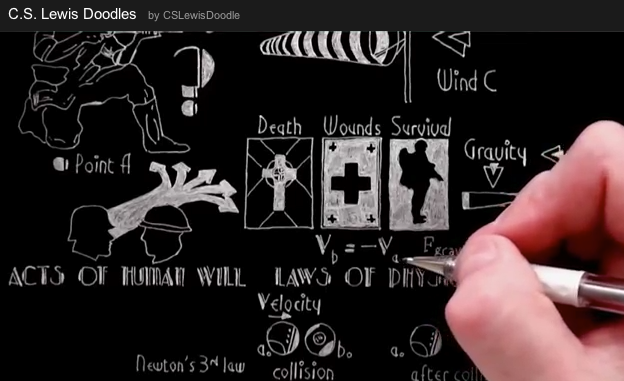
csl doodlesA recent post at the wonderful C.S. Lewis Minute blog introduced me to an amazing new way to experience the brilliance of the great author. I want to pass on the information so that you too can enjoy it.

The site is called “C.S. Lewis Doodles,” and it is the creation of a Kiwi (New Zealander) named Kalman Kingsley.

Kingsley uses a skillful artistic presentation of the clearly read original essays, to give Lewis’ words a particularly engaging and comprehensible air. It is, in a sense, C.S. Lewis “updated” to contemporary media.

Lewis himself alluded to the value of different types of media in communicating. In “Studies in Words” he says, “Language exists to communicate . . . Some things it communicates so badly that we never attempt to communicate them by words if any other medium is available.” Of course, in this case Lewis’ words are profound—in and of themselves. However, the addition of the illustrations serves to highlight and amplify his message.

Lewis, after all, passed away nearly sixty years ago, when most homes still owned black and white televisions. Technology has advanced light years since then, and transposing Lewis’ timeless wisdom to new formats such as this is an important work worthy of the talents of innovative men and women.

C.S. Lewis Doodles is available here, but don’t head there until you finish reading this Mere Inkling post.

The YouTube “Channel” offers three essays:

“The Grand Miracle” (from a sermon about the Incarnation preached in 1945)

“The Laws of Nature” (a 1945 consideration of the interplay between Nature and prayer)

“On ‘Sexual’ Morality” (a 1963 essay entitled “We have No ‘Right to Happiness’”)

All three of these essays are found in the collection published as God in the Dock. (For Americans the last word in that title refers not to a marina, but to a courtroom.)

Because each presentation covers an entire essay, they range in length from eight to ten minutes. Nevertheless, they are so well presented that they will certainly hold your interest.

I believe Lewis would have enjoyed this presentation of his work. Had he been an artist and had access to this technology, he may have experimented with it himself. As he wrote to Arthur Greeves in 1933, his book Pilgrim’s Regress is “going to be decorated by a map on the end leaf which I had great fun in drawing the sketch for.”

You can hear (and view) Lewis’ thoughts on “the Laws of Nature,” by clicking on the image below.

_____

C.S. Lewis Minute is a website every true Lewis fan should be following. You can read the column I referred to—and subscribe to the blog—here.

Our Common Tongue

Bruegel BabelThe ancestors of Europeans and Asians spoke a common language 15,000 years ago, as the ice age was ending.

That “discovery” sounds remarkably familiar to those acquainted with an ancient story about a colossal edifice erected in the ancient past. The Hebrews preserved a record of the achievement in the eleventh chapter of the book of Genesis. At the time of the tower’s construction, all of humanity consisted of “one people [sharing] one language.”

The argument for just such a common language is made in a detailed study published this week in the Proceedings of the National Academy of Sciences. After finishing this column, you may wish to read the original journal article, which is available here.

The mechanics of the study will be of great interest to all logophiles (word lovers).

Using sophisticated statistical analysis, the researchers identified 23 different words that have remained recognizable for fifteen millennia. These “ultraconserved” words include some of the fundamental building blocks of basic communication. They include: not, mother, man (i.e. male), we, this, hand, old, fire, ashes and (rather oddly) worm.

The study identifies “proto-words” that underlie common terms in extremely diverse languages. It is no accident that these universal words are the ones that are the most concrete, frequent and essential for human communication.

The Languages of the World Etymological Database, part of the Tower of Babel project . . . records reconstructed proto-words for language families from around the world. Proto-words are hypotheses as to the form of the word used by the common ancestor or proto-language of a given language family to denote a given meaning.

These words are reconstructed by first identifying cognate words among the languages of a given family and then, because cognate words derive from a common ancestral word, working back in time to reconstruct the probable features of that shared ancestral form.

J.R.R. Tolkien was a brilliant linguist, and his abiding love of languages provided the impulse for the creation (and intricate history) of all of Middle Earth.

C.S. Lewis was one of the twentieth centuries greatest writers. He was also a scholar—one with an outstanding grasp of literature. Lewis acknowledged that words describing immediate, touchable concerns can be distinct and firm, just like the realities they connote. However, when language moves farther from such elements, it invariably grows more abstract.

All language, except about objects of sense, is metaphorical through and through. To call God a “Force” (that is, something like a wind or a dynamo) is as metaphorical as to call Him a Father or a King. On such matters we can make our language more polysyllabic and duller: we cannot make it more literal. The difficulty is not peculiar to theologians. Scientists, poets, psychoanalysts, and metaphysicians are all in the same boat. (God in the Dock, “Horrid Red Things”).

The linguistic study described here notes that frequency of usage exerts a stabilizing influence on words. Whereas less common (and more abstract) vocabulary “evolves” more rapidly.

A rule-of-thumb emerges that words used more than around once per 1,000 in everyday speech evolve slowly enough to have a high chance of being judged cognate among more than two of the language families; this might equate to around 16 uses per day per speaker of these high-frequency words.

Throughout history various languages have vied with one another for precedence. In the Mediterranean world Greek, for a season, and then Latin for another, were the “universal” tongues. The phrase lingua franca (literally, the “Frankish language”) has now come to refer to any language that is extensively used as a common bridge between speakers of different tongues.

Such languages, of course, enhance communication. That is not to suggest, however, that the development of these “dominant” languages is without critics. It seems, for example, that France was delighted in their language serving for many years as a standard for international diplomacy. Today however, France continues to staunchly resist the advances of English. (In 1994 the initial version of the Toubon Law overreached in requiring the extensive use of French in nearly all contexts. You can read about some implications for international businesses here.)

Even C.S. Lewis regretted some of the negative influences of American English on the mother tongue. In his book Studies in Words, he mourns:

I have an idea of what is good and bad language. . . . Language is an instrument for communication. The language which can with the greatest ease make the finest and most numerous distinctions of meaning is the best. It is better to have like and love than to have aimer for both.

It was better to have the older English distinction between “I haven’t got indigestion” (I am not suffering from it at the moment) and “I don’t have indigestion” (I am not a dyspeptic) than to level both, as America has now taught most Englishmen to do, under “I don’t have.”

It remains to be seen whether any single language will come to truly dominate the world scene. Being able to communicate freely across all political borders sounds like a noble goal. It is ironic that should that day ever arrive it will mark a return to how things once began.

_____

The painting reproduced above was painted circa 1563 by the Flemish artist Pieter Bruegel the Elder.

Why War?

bulletsI recently read a profound statement penned by G.K. Chesterton. Although he was not a military veteran himself, he was absolutely on target when he wrote: “The true soldier fights not because he hates what is in front of him, but because he loves what is behind him.”

Terrible things are happening today in Syria. Yesterday, over lunch, I “debated” one of my sons regarding the merits (and drawbacks) of American intervention in that Levantine cauldron.

He believes we can’t “stand by” while the world watches as a civil war rages around another of the world’s mad dictators. I argued the United States isn’t morally responsible to serve as the world’s guardian of peace. And, even if we as a single, fallible, divided people were accountable . . . what about the violence and injustice in so very many other places. Sudan, Myanmar (Burma), the Congo, and scores of other lands cry out for intervention on behalf of the oppressed.

There is an almost unlimited amount of injustice around the globe today. And, looking in the mirror, it’s evident we have problems to resolve right here.

Sending American troops to intervene in foreign civil wars is ugly business. Taking sides against dictators does not always provide a safer and more just world—we need look no further than the so-called Arab Spring to reveal that.

I was proud to serve my nation—and causes I believed in—during the liberation of Kuwait and the retaliation for the September 11 attacks on the United States a decade later.

I am now retired from active duty, and I’ve lived long enough to witness how little positive fruit seems to follow war.

Like C.S. Lewis, I remain persuaded that some evils are so malevolent (Hitler, for example, comes to mind) . . . that they must be confronted. As he wrote in “The Conditions for a Just War,”

If war is ever lawful, then peace is sometimes sinful.

At the same time, however, war is something into which we should never rush. It demands our conscious consideration of the cost and an accurate determination that the blood spilled—include that of noncombatants inevitably caught up in the horror—is a price worth paying.

It is that question which moral men and women must debate and ponder.

“Learning in War-Time” is a brilliant essay included in the collection which goes by the name of Lewis’ speech, “The Weight of Glory.” In the essay, Lewis discusses the seriousness of war. As a combat casualty during the First World War, he vividly understood its nature.

However, as a Christian, Lewis recognized that warfare is not the worst thing that can befall a human being.

What does war do to death? It certainly does not make it more frequent: 100 percent of us die, and the percentage cannot be increased. It puts several deaths earlier, but I hardly suppose that that is what we fear. Certainly when the moment comes, it will make little difference how many years we have behind us.

Does it increase our chances of painful death? I doubt it. As far as I can find out, what we call natural death is usually preceded by suffering, and a battlefield is one of the very few places where one has a reasonable prospect of dying with no pain at all.

Does it decrease our chances of dying at peace with God? I cannot believe it. If active service does not persuade a man to prepare for death, what conceivable concatenation of circumstances would? Yet war does do something to death. It forces us to remember it.

True. To die at enmity with God is a fearful thing. Still, even better than coming to faith during war (Lewis would surely agree), is recognizing God’s love and living a life of peace.

A Literary Phobia

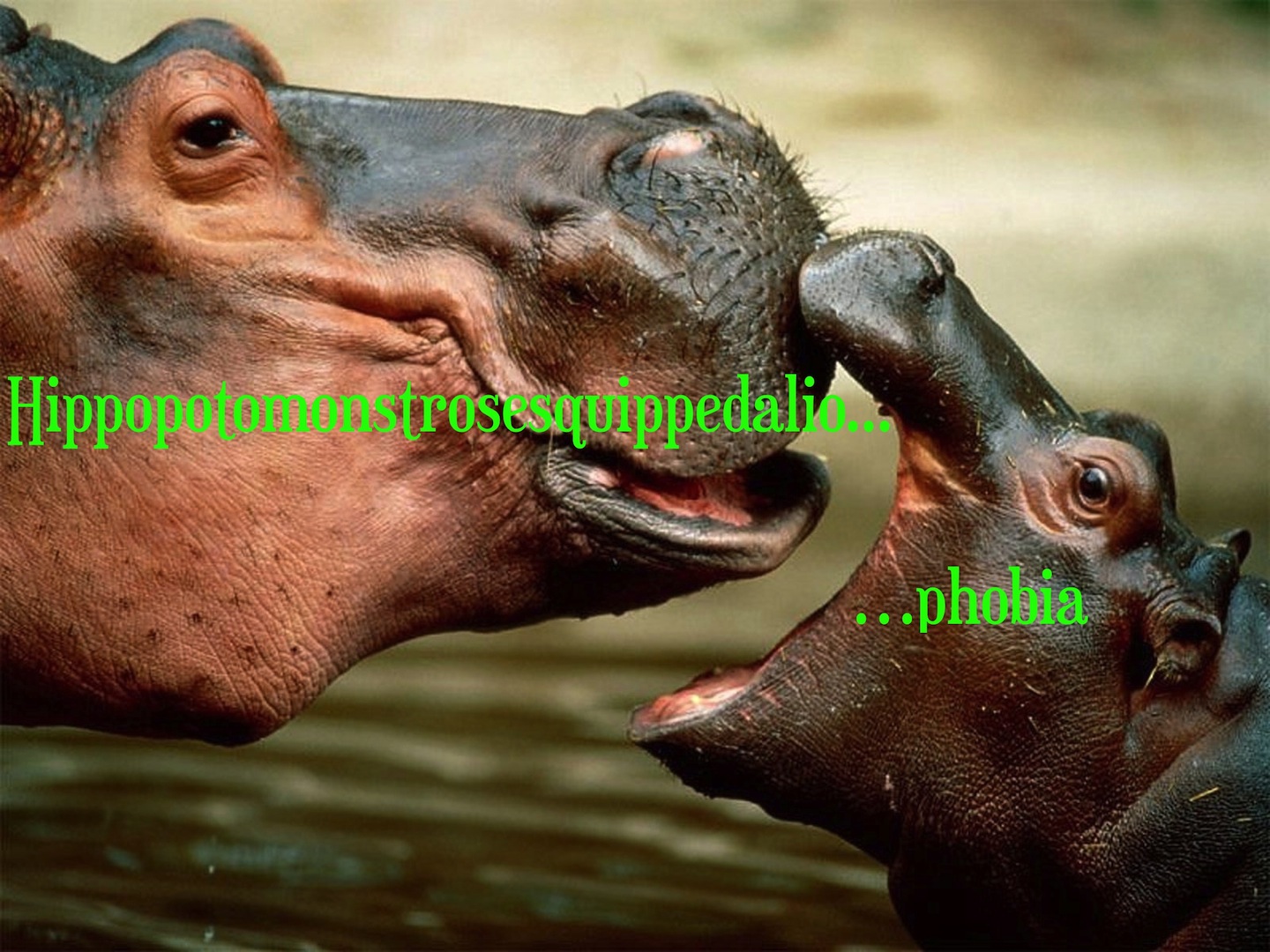
hipposWhat in the world does this protracted word mean?

Hippopotomonstrosesquippedaliophobia

From the suffix, we can assume that it refers to some sort of “fear.” But fear of what? Hippopotami?

No, this lengthy word doesn’t refer to the African “river horses” from which it derives its beginning. This peculiar construction describes nothing other than a fear of long words!

I know people who find long words daunting . . . but none who have admitted to be in fear of them. I myself am a bit intimidated by unfamiliar words that I have to pronounce in front of others. (I recently visited a writing group that caught me off guard with their practice of reading one another’s work out loud. Not only was I the first person expected to begin reading the first article critiqued that morning—it included a number of words from French cuisine with which I was unfamiliar.)

I don’t mind encountering unfamiliar words in a text (that I’m reading privately), especially when the meaning is evident from the context. In fact, I often enjoy the introduction, since it expands my own vocabulary.

The fact his, however, that many very gifted writers warn their readers to avoid lengthy or complicated words.

Just last week I contrasted George Orwell’s writing advice with that of C.S. Lewis. Orwell said,

“Never use a long word when a short one will do.”

C.S. Lewis, included in his short list of advice the encouragement to,

“Always prefer the plain, direct word to the long, vague one.”

While these suggestions may “sound” identical, they are not. Orwell is concerned here with simplicity (rather than brevity, per se). Lewis, though, is advocating clarity.

Lewis does not object at all to using a multisyllabic word. He merely argues that the choice needs to be one that helps communicate rather than confuse. Allow me to share a simple example. Following Lewis’ counsel, one of these sentences would be problematic, while the other would be okay.

Life is all about love.

Experiencing contentment and joy relates directly to one’s ability to offer, and receive, affection from other human beings.

Obviously one sentence is far more complex than the other. However, it’s meaning is quite clear. The simpler, five word sentence is so vague as to allow for any number of interpretations. For example, in addition to the alternative above, it might mean (to its writer):

Without a foundation of self-love, we cannot experience life to its fullest.

     or . . .

At the Final Judgment, it is only our acts of love that will pass intact through the “purifying fire.”

     or . . .

The more people with whom you can “sow your wild oats,” the happier you will be.

The Government Intervenes

Amazing as it may seem, the United States government actually has a website devoted to promoting simple language: plainlanguage.com. It exists to help implement the Plain Writing Act of 2010.

While the effectiveness of the statute is debatable, it’s intention is praiseworthy.

On one page it directs agencies to avoid complex words. Instead of “endeavoring to assist,” writers are told to use “told to help.” While that is absolutely commendable in governmental documents, I prefer a bit more flavor when I’m reading for pleasure.

I strongly encourage anyone suffering from hippopotomonstrosesquippedaliophobia to seek professional help. This is especially true for those who desire to express themselves clearly. We need never fear a lengthy word—as long as we are using the right word!

Hip-Hop Literary Lessons

flocabDo you ever have trouble remembering the key elements of a story? Well, you may not now, since you’ve become an accomplished writer. However, there was once a time when you were just learning about such matters. And that learning might have been far easier than it was if some of today’s teaching resources existed then.

This week I stumbled across a very unusual approach to teaching the fundamental building blocks of stories. You might want to bookmark the page, in case you ever experience difficulty remembering those five pesky elements required for your short fiction, or want to teach a young learner. You need look no further than Flocabulary’s innovative lesson “Five Things.”

The song is less than four minutes long, so go ahead and watch it now, before reading on. (Barring a small typo, it’s quite educational, and their website includes testimonials from teachers affirming how well it connects with young people.) Despite the fact that it’s got a hip-hop beat—not my favorite musical genre—it’s actually quite entertaining . . . and it’s easy to see how well it would connect with today’s younger students.

[Warning: If you watch the following video, you may well be singing along with the chorus before it ends.] Story Elements

Plot, Character, Conflict, Theme,
Setting, yes these are the 5 things
That you’re going to be needing
When you’re reading or writing
A short story that’s mad exciting.

Music is a powerful medium, and when it is harnessed for educational purposes, it can accomplish wonderful things.

Music can be enjoyed for itself . . . its own inherent loveliness.

Music can also be used to communicate holy things. I believe this is the very reason it exists. Divine grace and our response to our Creator’s love are too majestic to be restricted to simple words.

The brilliant African Bishop Augustine of the city of Hippo is cited as saying “he who sings, prays twice.” Many have echoed these words. I have no doubt Augustine believed this, but the more accurate quotation is: “he who sings well prays twice” (bis orat qui bene cantat). Lest those of us with less than professional vocal chords be dismayed, I am confident the “well” here refers here to worshiping God in spirit and truth (John 4:23).

I have no doubt which of these two pleases God more. The most wondrous voice ever created (a gift itself from our Creator) flawlessly navigating three octaves and singing of the cares of this world—or the feeble, cracking, off-key strains of a tone deaf beggar who is praising the Lord for the gift of his daily bread.

C.S. Lewis famously expressed his disaffection for most church hymnody in a 1950 letter where he wrote:

I naturally loathe nearly all hymns; the face and life of the charwoman in the next pew who revels in them, teach me that good taste in poetry or music are not necessary to salvation.

We must forgive Lewis his condescending comment here, which was only meant for a private communication. And, if read in context it can be interpreted almost as a sort of confession. While he disliked the quality of contemporary Anglican hymns, he was acutely aware of how insignificant the matter was in light of the vital importance of  knowing Christ. (His description of the glorification of the modest Sarah Smith in The Great Divorce reveals how well he recognized that the charwoman beside him, despite her musical preferences, could easily dwarf him in holiness and religious courage.)

In a letter written in 1916, Lewis alluded to the wonder of music, and it’s relationship to particular words. “Isn’t it funny the way some combinations of words can give you—almost apart from their meaning—a thrill like music?”

Toward the end of his life, Lewis invested much time in a literary study of Edmund Spenser’s The Faerie Queene. (It was actually published after his death, based upon his notes, as Spenser’s Images of Life. It includes a sparkling description of the book as a musical masterpiece.

A story of this kind is in a way more like a symphony than a novel. Corresponding to the themes of the musical form, the literary form has images, which may be delicious or threatening or cryptic or grotesque, but which are always richly expressive of mood.

The images are in every possible relation of contrast, mutual support, development, variation, half-echo, and the like, just as the musical themes are. But the ostensible connection between them all—what keeps the meddling intellect quiet—is here provided by the fact that they are all happening to someone.

They are all worked into the experience or the world of the characters “whose” story it is. That, no more and no less, is the raison d’étre of characters in the characterless story.

I have no doubt Lewis would have found the video above jarring. Yet, I suspect he would have approved of the fact that the music was creating a bridge to some for whom traditional learning is incomprehensible. He was a traditionalist. In many ways, a medievalist. But he was, above all, a redeemed child of God. And, because of that, he desired the best for his neighbor, his nation, and our world.

That said, I don’t want to hear that any readers of Mere Inkling got it into their heads to put any of C.S. Lewis’ words into hip-hop melodies. Ever!

_____

If you are interested in checking out the official website for Flocabulary, you can view their lesson “Wordplay” (on figurative language). I understand, however, that some of their lessons with political dimensions have been considered superficial.

Books C.S. Lewis Loved

csl booksThose of us who admire C.S. Lewis respect his words on many subjects, not least of which would include literary matters. He was, after all, both a gifted writer and a professor teaching related subjects at two of the world’s most prestigious universities.

In 1962 The Christian Century asked him to list the ten titles most influential in his professional and philosophical life. (Most of these are available as free downloads on the internet.)

1. Phantastes by George MacDonald

2. The Everlasting Man by G. K. Chesterton.

3. The Aeneid by Virgil

4. The Temple by George Herbert

5. The Prelude by William Wordsworth

6. The Idea of the Holy by Rudolf Otto

7. The Consolation of Philosophy by Boethius

8. Life of Samuel Johnson by James Boswell

9. Descent into Hell by Charles Williams

10. Theism and Humanism by Arthur James Balfour

The following year Lewis was interviewed by Sherwood Wirt, longtime editor of Decision magazine. (Decision is published by the Billy Graham Evangelistic Association, and you can learn more about the publication here.)

During his interview, Wirt focused on spiritual rather than professional benefits from books Lewis had found beneficial.

Sherwood Wirt: What Christian writers have helped you?

C.S. Lewis: The contemporary book that has helped me the most is Chesterton’s The Everlasting Man. Others are Edwyn Bevan’s book, Symbolism and Belief, and Rudolf Otto’s The Idea of the Holy, and the plays of Dorothy Sayers.

Fortunately all of these titles are readily available for those who would like to explore works that influenced Lewis’ conversion and Christian growth. Let’s briefly consider them in the order Lewis cited them.

Gilbert Keith Chesterton (1874-1936) was a prolific English writer. Just how prolific, one might ask. Well, he wrote approximately eighty books, hundreds of poems, hundreds of short stories and about 4,000 essays. His works continue to inspire many today, and merit contemporary reading.

Chesterton shared many of the same values as Lewis, and preferred calling himself an “orthodox” Christian rather than adhering to denominational labels. (In this he foreshadows Lewis’ invaluable emphasis on “mere” Christianity.)

The Everlasting Man was published in 1925 and ponders the universal significance of Jesus Christ. It was composed in reaction to The Outline of History, in which H.G. Wells paints Jesus as just one more political agitator in a political backwater of the Roman empire. Honestly, he does describe him as being remarkable, but mostly in terms of having a charismatic persona.

Lewis said that Chesterton’s Everlasting Man “baptised” his intellect, which is no small expression of praise.

You can purchase The Everlasting Man through normal channels or download a free text format version at this site. If you enjoy listening to audiobooks, you can obtain a free audio copy of the volume here.

Edwyn Robert Bevan (1870-1943) was an English philosopher and historian who specialized in the Hellenistic world.

In Symbolism and Belief, based on a series of lectures presented in 1933-34, Bevan discusses major religious symbols and metaphors. He illustrates how figurative language is best capable of describing spiritual truth. He argues that the greater precision offered by philosophical terminology is actually counterproductive in this quest.

The volume offers insight into the rationality of religious faith, although it concludes with his conviction that it ultimately boils down to a genuine encounter with God—“what actually causes anyone to believe in God is direct perception of the Divine.”

Symbolism and Belief is available for free download in a variety of formats at this site.

Rudolf Otto (1869-1937) was a German Lutheran theologian. He spent most of his ministry teaching at one of the most prominent seminaries in the world, the University of Marburg Divinity School.

In The Idea of the Holy Otto espoused the concept that the things of God were “numinous.” He defined this as a “non-rational, non-sensory experience or feeling whose primary and immediate object is outside the self.” The word itself was derived from the Latin numen which refers to divine power.

Otto explains how the numinous is a mystery (mysterium) that is simultaneously terrifying (tremendum) and fascinating (fascinans). C.S. Lewis found the notion of the numinous particularly useful in his book, The Problem of Pain.

The Idea of the Holy: an Inquiry into the Non-rational Factor in the Idea of the Divine and Its Relation to the Rational is available in multiple formats here.

Dorothy Leigh Sayers (1893-1957) was a personal friend of C.S. Lewis. In a 1963 letter he wrote: “She was the first person of importance whoever wrote me a fan letter. I liked her, originally, because she liked me; later, for the extraordinary zest and edge of her conversation—as I like a high wind. She was a friend, not an ally.”

Sayers was an extremely successful English writer. Her versatility allowed her renown to grow as a poet, playwright, essayist and as a writer of popular detective mysteries. She was also a classicist, and regarded her translation of Dante’s Divine Comedy as her finest work.

Fortunately, four of her plays are available in a collection available here. They include “The Zeal of Thy House,” “The Devil to Pay,” “He That Should Come,” and “The Just Vengeance.” And, although you can’t download the file, if you would like to stream the recording, an audio version of her famous “The Man Born to be King” is available here.

Monastic Fonts

A with CrossRecent subscribers to Mere Inkling won’t know this, but some months ago I confessed to suffering an addiction. Like many others who love to write, I am a fontaholic.

That refers, of course, to being obsessed with discovering new and exotic font families.

For many months I’ve kept my compulsion in check, but I was recently caught off guard when I stumbled upon some alluring typefaces I had never encountered before.

I was particularly vulnerable to their charm due to my interest in medieval history. In fact, I was researching the coloration of illuminated manuscripts when I encountered them.

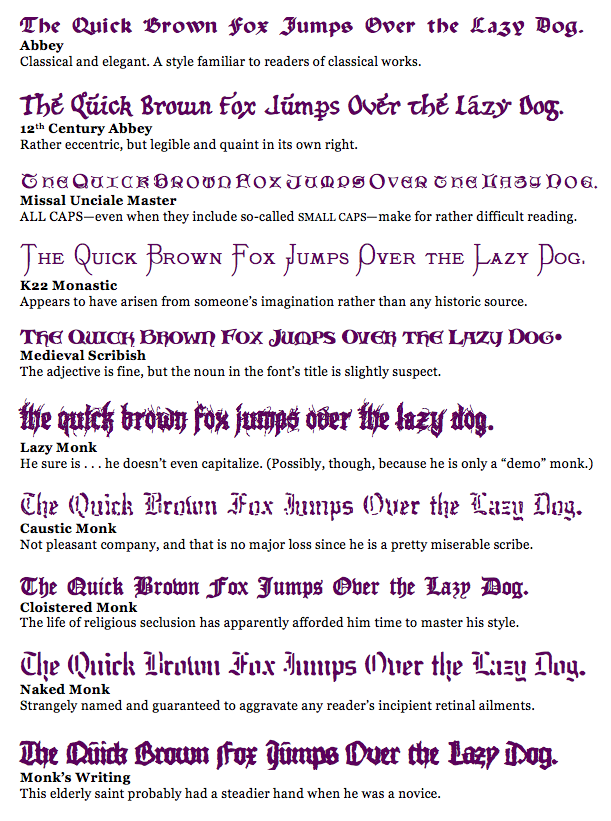
In case you share my weakness—or, even if you are merely curious—I offer examples of the novel fonts I was “forced” to add to my collection. And, you need not worry, since (if you are so inclined) you can download all of them for free at this site.

Each of the fonts below has some “monastic” connection. Obviously, some would be more useful than others, and a couple of them are admittedly quite peculiar. However, even the strangest of pens may be suitable for some applications.

Before contrasting some of these typefaces, it’s worth mentioning that you can also download a “Narnia” font—based on the letters used in the Hollywood version of C.S. Lewis’ classics.

And now, without further introduction, the fonts themselves . . .

medieval fonts

Settling for Less

ammunitionMy wife and I are thrifty people. (Well, in all honesty, she wouldn’t exactly use that word to describe me.) Still, we try to save for the future and spend money sensibly.

We always try to purchase generic products unless we find their quality inferior to the “name brands.” Once I learned that most generics were manufactured in the same plants that produce the more expensive products, that made sense.

Nevertheless, as the illustration suggests, there are some places where it just doesn’t pay to settle for potentially inferior goods. Take, for instance, medical care and your children’s educations. We all want the best we can get. And there’s nothing wrong with that.

No, the “wrong” enters in when we begin to envy those who possess something we think we would like to have. It might be a nicer home, a newer car, or a larger television screen.

Envy is a deceptive thing. It lies to us. It beckons to us, saying, “if only you possessed that one thing . . . then you’d truly be happy.” Envy usually whispers, but it makes up for its lack of volume with its persistence. Once we open the door to our heart and mind, envy suggests—over and over—that if we don’t secure the object we desire, that happiness will elude us.

Envy does more than nag us. It distracts us from all of God’s blessings. With eyes focused on our presumed “needs,” we forfeit the joy that would otherwise flow naturally from contentment with our genuine needs. “Give us this day our daily bread” is not, after all, a request for more of this world’s “treasures.”

Another quality of envy is that it promises what it cannot—due to its very nature—deliver. Envy has a relentless appetite; it is incapable of being appeased. As C.S. Lewis wrote, “Envy is insatiable. The more you concede to it the more it will demand.” (“Democratic Education”).

Envy is so ravenous that it is used by Lewis to illustrate part of the torment of Hell. The following comes from his Preface to The Screwtape Letters.

We must picture Hell as a state where everyone is perpetually concerned about his own dignity and advancement, where everyone has a grievance, and where everyone lives the deadly serious passions of envy, self-importance, and resentment.

It’s probably no accident God included repeated prohibitions against coveting in the Ten Commandments.

In light of the demands levied by envy, I choose to reject it whenever I recognize its whisper. I opt instead for giving thanks for the innumerable blessings I’ve received. And, I ponder the responsibility that comes with God’s generosity . . . not least of which is the duty to remain thrifty, so that I have more of those blessings available to share with others.