Charting Our Life Course

In our last conversation we considered the fact that life is a journey. And during this journey which encompasses our very existence, we follow a variety of paths.

Not all of the paths lead to “happy endings.” I almost wrote “fairy tale endings,” but then I recalled that some old folk tales conclude in a rather grim fashion.

Signposts stand as sentinels at the junctions. “Take this path to self-fulfillment.” “Follow this lane to explore forbidden pleasures.” “This way leads to power.” They offer promises aplenty, but their veracity is not guaranteed. In fact, the more outlandish the claims, the more suspect they become to the wise.

Speaking of wisdom, some of the most powerful words in the Book of Proverbs relate to this notion of choosing paths cautiously. Wisdom and Folly are personified as two women. One offers life-enriching knowledge and insight. The other proffers more carnal and transitory wares.

My son, keep my words


    and treasure up my commandments with you . . .

Say to wisdom, “You are my sister,”


    and call insight your intimate friend,

to keep you from the forbidden woman,


    from the adulteress with her smooth words.

. . . and I have seen among the simple,


    I have perceived among the youths,


    a young man lacking sense,

passing along the street near her corner,


    taking the road to her house . . .

And behold, the woman meets him,


     dressed as a prostitute, wily of heart.

She is loud and wayward;


     her feet do not stay at home;

now in the street, now in the market,


    and at every corner she lies in wait. . . .

I have spread my couch with coverings,


    colored linens from Egyptian linen;

I have perfumed my bed with myrrh,


    aloes, and cinnamon.

Come, let us take our fill of love till morning;


    let us delight ourselves with love.

For my husband is not at home;


    he has gone on a long journey . . .

With much seductive speech she persuades him;


    with her smooth talk she compels him.

All at once he follows her,


    as an ox goes to the slaughter,

or as a stag is caught fast

    till an arrow pierces its liver;

as a bird rushes into a snare;


    he does not know that it will cost him his life.

And now, O sons, listen to me,


    and be attentive to the words of my mouth.

Let not your heart turn aside to her ways;


    do not stray into her paths,

for many a victim has she laid low,


    and all her slain are a mighty throng.

Her house is the way to Sheol,


    going down to the chambers of death.

The power of this proverb is in its truth. I have actually known the seductresses (and seducers) described in these verses. Well, I’ve been acquainted with emanations of both female and male versions of Folly, since they are legion.

Despite the Lies, There is Still Hope

The key to journeying through life with the fewest deadly detours is to rely on a trustworthy guide. A compass, so to speak. A map or handbook that soundly advises which paths to take, and what precipices to avoid.

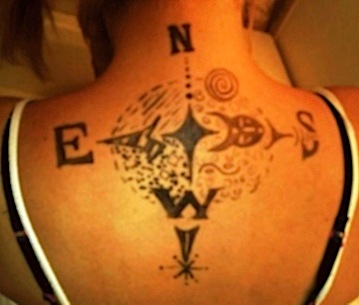
Of course, if we would rather take the risk, we can rely on human ignorance (is West to my right or my left?) . . . or worldly counsel (let us take our fill . . .).

The Bible lays out the safe and proven path. What’s more, our Savior—who calls himself “The Way,”—promises to accompany us on the journey itself.

One of C.S. Lewis’ least read books is entitled The Pilgrim’s Regress. It is modeled on the classic Pilgrim’s Progress, written by John Bunyan in 1678. The Pilgrim’s Regress was Lewis’ first published work of prose fiction. His protagonist goes through a period of disbelief, mirroring Lewis’ own. It is well worth the read, although, perhaps, it is best preceded by a reading of Bunyan’s original work.

Toward the end of his allegory, Lewis brilliantly describes the course of travel for many who sojourn for a season in foreign (unbelieving) realms. The traveler learns that all who earnestly seek the Truth ultimately find it in a single Source. I offer the following passage not as a “spoiler,” but to illustrate the importance of following the right path—and to entice you to consider reading The Pilgrim’s Regress.

“What do you see?” said the Guide.

“They are the very same shape as that summit of the Eastern Mountain which we called the Landlord’s castle when we saw it from Puritania.”

“They are not only the same shape. They are the same.”

“How can that be?” said John with a sinking heart, “for those mountains were in the extreme East, and we have been travelling West ever since we left home.”

“But the world is round,” said the Guide, “and you have come nearly round it. The Island is the Mountains: or, if you will, the Island is the other side of the Mountains, and not, in truth, an Island at all.”

“And how do we go on from here?”

The Guide looked at him as a merciful man looks on an animal he must hurt.

“The way to go on,” he said at last, “is to go back. There are no ships. The only way is to go East again and cross the brook.”

“What must be must be,” said John. “I deserve no better. You meant that I have been wasting my labour all my life, and I have gone half-round the world to reach what Uncle George reached in a mile or so.”

“Who knows what your uncle has reached, except the Landlord? Who knows what you would have reached if you had crossed the brook without ever leaving home? You may be sure the Landlord has brought you the shortest way: though I confess it would look an odd journey on a map.”

Our Eagle Allies

Eagles are majestic creatures. Living in the midst of a large bald eagle nesting area is something my wife and I don’t take for granted. Each year we see scores of the graceful raptors courting and then raising their young right here on Hood Canal.

Hood Canal is actually an 80 kilometer long fjord, which lies just to the east of the Olympic National Forest. It features deep blue waters at the foot of an impressive mountain range.

Eagles make a significant impression on nearly everyone fortunate enough to see them. Even though they are birds of prey, they look extremely noble. In light of that fact, it’s no accident many nations include an eagle as part of their coat of arms or national seal. These include: Albania, Armenia, Austria, Germany, Ghana, Iceland, Indonesia, Iraq, Mexico, Moldova, Montenegro, Nigeria, Panama, Russia, the United States and at least ten additional countries.

Eagles have also figured prominently in literature. For example, both of the preeminent Inklings, J.R.R. Tolkien and C.S. Lewis, featured eagles as heroes in their fictional classics.

Eagles in the Work of C.S. Lewis

Eagles are among those granted speech by Aslan at the dawn of Narnia’s creation. They reward their Creator’s gift by serving faithfully throughout the entire history of the land. Eagles play a role in virtually every battle that occurs in Narnia. They are always on the side of good.

In addition to fighting in the campaign against the White Witch, eagles are responsible for the rescue of Edmund from her camp. When Aslan calls his army to rush toward the climactic battle in The Lion, the Witch and the Wardrobe, he says:

And now! Those who can’t keep up—that is, children, dwarfs, and small animals—must ride on the backs of those who can—that is, lions, centaurs, unicorns, horses, giants and eagles. Those who are good with their noses must come in the front with us lions to smell out where the battle is.

The most noteworthy passages relate to Farsight, who is a prominent eagle during the final days of Narnia. He it is who brings to King Tirian the sad news that Narnia’s capital has fallen.

“Sire,” said the Eagle, “when you have heard my news you will be sorrier of my coming than of the greatest woe that ever befell you.” Tirian’s heart seemed to stop beating at these words, but he set his teeth and said, “Tell on.” “Two sights have I seen,” said Farsight. “One was Cair Paravel filled with dead Narnians and living Calormenes . . . And the other sight, five leagues nearer than Cair Paravel, was Roonwit the Centaur lying dead with a Calormene arrow in his side. I was with him in his last hour and he gave me this message to your Majesty: to remember that all worlds draw to an end and that noble death is a treasure which no one is too poor to buy.” “So,” said the King, after a long silence, “Narnia is no more.” (The Last Battle)

After this sad entrance, and following the “Last Battle,” Farsight is one of the leaders as the victor’s army enters into the foothills of heaven.

. . . the dogs barked, “Faster, faster!” So they ran faster and faster till it was more like flying than running, and even the Eagle overhead was going no faster than they. And they went through winding valley after winding valley and up the steep sides of hills and, faster than ever, down the other side, following the river and sometimes crossing it and skimming across mountain lakes as if they were living speedboats . . . “Further up and further in!” roared the Unicorn, and no one
held back. . . .

Only when they had reached the very top did they slow up; that was because they found themselves facing great golden gates. And for a moment none of them was bold enough to try if the gates would open. . . . “Dare we? Is it right? Can it be meant for us?” But while they were standing thus a great horn, wonderfully loud and sweet, blew from somewhere inside that walled garden and the gates swung open. (The Last Battle)

Eagles in the Work of J.R.R. Tolkien

Similar to Lewis’ distinction between dumb and speaking eagles, Tolkien distinguishes between “common” and Great Eagles. In The Hobbit he writes, “Eagles are not kindly birds. Some are cowardly and cruel. But the ancient race of the northern mountains were the greatest of all birds; they were proud and strong and noble-hearted.”

It is these noble mountain eagles who populate the six books (three volumes) of the Lord of the Rings and Tolkien’s other fiction.

At the end of the First Age, eagles fight alongside the Valar, Elves and Men in the War of Wrath. They especially contend against the dragons of Morgoth as recounted in The Silmarillion. The eagles emerge victorious, destroying most of their enemy during an aerial battle.

Near the end of the Third Age, the eagles from the Misty Mountains rescue Thorin’s troop from goblins and wargs, as related in The Hobbit. Without their aid, the Dwarves, Elves and Humans would likely have met defeat at the Battle of Five Armies.

In The Lord of the Rings (including the cinematic version) the eagles feature prominently. They are even capable of clashing head-to-head with the fearsome Nazgûl-mounted dragons.

And, of course, several of them rescued Frodo Baggins and Samwise Gamgee following the destruction of the One Ring.

Two named eagles should be mentioned. Thorondor was the initial Lord of Eagles and according to The Silmarillion was the “mightiest of all birds that have ever been.”

His descendant Gwaihir is the leader of those who aid Gandalf throughout the events of The Lord of the Rings. Not only does he rescue the wizard from the tower, but he returns him after his “resurrection” which followed the battle with the Balrog.

“Naked I was sent back—for a brief time, until my task is done. And naked I lay upon the mountain-top. . . . I was alone, forgotten, without escape upon the hard horn of the world. . . . And so at the last Gwaihir the Windlord found me again, and he took me up and bore me away. ‘Ever am I fated to be your burden, friend at need,’ I said.”

“A burden you have been,” the Eagle answered, “but not so now. Light as a swan’s feather in my claw you are. The Sun shines through you. Indeed I do not think you need me any more: were I to let you fall, you would float upon the wind.” (The Two Towers)

It may be that for this life we must remain content with seeing only the common and mute eagles that populate this mortal world. But even they, are glorious to behold.

Mastering the Contranym

English is a fascinating language. Certainly not the simplest to learn, but extremely versatile. You might say that among the circus of languages, English is the contortionist. (That analogy might make German the strong man and Romani the fortune teller.  As for the bearded lady . . . I’ll leave that to your personal conjecture.)

I’ve formally studied several other languages, yet I consider myself a master of none. Nevertheless, when it comes to English, I do take some pride in my skills, and would be willing to claim for myself the status of journeyman. Among other credentials I have my “verbal” score on the Graduate Record Exam, which placed me in the 97th percentile.

It goes without saying that C.S. Lewis (along with most of his fellow Inklings) was a Master of English. One of his many insights warned of language’s occasional tendency to confuse rather than illuminate.

Language exists to communicate whatever it can communicate. Some things it communicates so badly that we never attempt to communicate them by words if any other medium is available. (C.S. Lewis, Studies in Words).

As much as I discover about English, I find there is still more to learn. This week I enjoyed thinking about contranyms. It’s uncommon enough a word that you know your spell checker won’t recognize it. One of those words only an English major is expected to know.

We all know, of course, what synonyms and antonyms are. Useful little tools for playful manipulation of language. A contranym is a word that possesses two “contradictory” meanings. For example a “citation” which can be awarded for either good or issued for bad behavior. Or, consider “literally,” which has its literal meaning as well as its recently developed and contradictory definition of “figuratively.” For lovers of words that’s a particularly discomforting contranym, and it literally makes my head explode. (No, seriously, please don’t ever write or say something like that unless it is in the form of dialog you’re composing for a semi-literate character.)

There are many more examples.

“They left for London, without a thought as to the luggage they left at the station.”

“He was certainly bound for jail if they discovered the Internal Revenue agent he had left bound in his basement.”

“He buckled his belt a mere moment before his legs buckled beneath him as he was struck by the errant meteorite.”

“Apparently there are many thoughtless oversights when programs are left to governmental oversight.”

Homophonic contranyms are not spelled alike, but they are pronounced similarly. “My aural test is scheduled tomorrow, immediately before the oral defense of my dissertation.”

There are actually a couple of alternative names for contranyms. They can be called antagonyms or autoantonyms, which only serves to make the hazy water that much murkier.

Our next lesson will feature that amazing category of words that are “polysemy.” (Not really, I think this has been enough linguistic thinking to cover us for at least a week.)

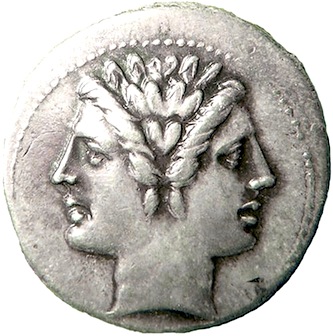
Oh, one final note, for those who were curious about the choice of the image above for this column. Contranyms are also referred to as “Janus words,” in honor of the Roman deity who constantly gazes in two directions. Very fitting.

Lessons Taught by Onions

This column has been written backwards. Not sdrawkcab literally, but in the opposite direction of its natural order. Usually I find something illuminating (most commonly in C.S. Lewis’ work), and then I offer some reflections on that insight. Occasionally, the post’s subject arises from a different source, and in my subsequent thoughts, I consciously consider what Lewis might have thought about the matter.

This is the first time when something utterly bizarre struck me as a valid starting point. And, only later did I find a suitable “proof text” or two from Lewis to validate discussing the odiferous subject at hand.

There’s a show I’ve been enjoying called “Parks and Recreation.” While I can’t recommend it to others, due to the casual portrayal of promiscuity which is endemic to American “entertainment.” Nevertheless, they often have quite witty writing that satirizes the crazy nature of life in our world today. This episode features a political debate between candidates for mayor of a small town.

One of the candidates responds to a question with, “No, I’m not a Vegan. I’m an Onionarian. I only eat onions and onion-based juices.”

I wonder how many other cultures can garb their dietary preferences in the robes of religious faith and devotion? Now, I love an onion more than the average person, but the notion of narrowing our diet down from God’s vast table to a single item just strikes me as a bit humorous (see Acts 10:9f).

As I enjoyed a chuckle, the thought flashed that I might relate this dialog for others who share my peculiar sense of humor . . . and I immediately wondered whether or not a Lewisian connection would be possible. Oh me of little faith. Lewis was so prolific that it doesn’t even require me to stretch.

You see, onions can teach us many lessons.

For example, look at this demonic advice offered by Screwtape to his protégé Wormword. He says Tempters should persuade human beings to care overly about what others think of them. The entire advertising world seems to be established on this principle. And how terribly vulnerable we are to this whisper. But, by the grace of God, it appears some are immune.

The man who truly and disinterestedly enjoys any one thing in the world, for its own sake, and without caring two pence what other people say about it, is by that very fact forearmed against some of our subtlest modes of attack. You should always try to make the patient abandon the people or food or books he really likes in favor of the “best” people, the “right” food, the “important” books. I have known a human defended from strong temptations to social ambition by a still stronger taste for tripe and onions. (C.S. Lewis, Screwtape Letters)

Thus we see that onions can, in some contexts, possess salvific influences. (Well, that might be pushing the lesson just a wee bit . . . but there is an important truth to be found in this epistle.)

Lewis’ arguably most famous discussion of onions is found in his discussion of concentric rings of secrecy, power, intimacy and knowledge described in his 1944 address entitled “The Inner Ring.” Rather than paraphrase his fine argument, I shall allow the following portions of his talk to speak eloquently for themselves.

Badly as I may have described it, I hope you will all have recognized the thing I am describing. Not, of course, that you have been in the Russian Army or perhaps in any army. But you have met the phenomenon of an Inner Ring. You discovered one in your house at school before the end of the first term. And when you had climbed up to somewhere near it by the end of your second year, perhaps you discovered that within the Ring there was a Ring yet more inner, which in its turn was the fringe of the great school Ring to which the house Rings were only satellites. It is even possible that the School Ring was almost in touch with a Masters’ Ring. You were beginning, in fact, to pierce through the skins of the onion. And here, too, at your university-shall I be wrong in assuming that at this very moment, invisible to me, there are several rings-independent systems or concentric rings-present in this room? And I can assure you that in whatever hospital, inn of court, diocese, school, business, or college you arrive after going down, you will find the Rings—what Tolstoy calls the second or unwritten systems. . . .

Of all the passions the passion for the Inner Ring is most skilful in making a man who is not yet a very bad man do very bad things. My second reason is this. The torture allotted to the Danaids in the classical underworld, that of attempting to fill sieves with water, is the symbol not of one vice but of all vices. It is the very mark of a perverse desire that it seeks what is not to be had. The desire to be inside the invisible line illustrates this rule. As long as you are governed by that desire you will never get what you want. You are trying to peel an onion: if you succeed there will be nothing left. Until you conquer the fear of being an outsider, an outsider you will remain. . . .

I must now make a distinction. I am not going to say that the existence of Inner Rings is an evil. It is certainly unavoidable. There must be confidential discussions: and it is not only not a bad thing, it is (in itself) a good thing, that personal friendship should grow up between those who work together. And it is perhaps impossible that the official hierarchy of any organization should quite coincide with its actual workings. If the wisest and most energetic people invariably held the highest posts, it might coincide; since they often do not, there must be people in high positions who are really deadweights and people in lower positions who are more important than their rank and seniority would lead you to suppose. In that way the second, unwritten system is bound to grow up. It is necessary; and perhaps it is not a necessary evil. But the desire which draws us into Inner Rings is another matter. A thing may be morally neutral and yet the desire for that thing may be dangerous.

While I have no doubt a number of other worthwhile onion-lessons are waiting to be found in the Inklings corpus, I would like to close now with my personal favorite. In the following passage, Lewis reverses the analogy, with each peeling away of a layer revealing ever more of reality.

In the closing paragraphs of the final Narnia Chronicle, The Last Battle, Lewis transforms the savory bulb into a metaphor for never ending epiphany.

[Lucy said:] “I see now. This garden is like the stable. It is far bigger inside than it was outside.”

“Of course, Daughter of Eve,” said the Faun. “The further up and the further in you go, the bigger everything gets. The inside is larger than the outside.”

Lucy looked hard at the garden and saw that it was not really a garden but a whole world, with its own rivers and woods and sea and mountains. But they were not strange: she knew them all.

“I see,” she said. “This is still Narnia, and more real and more beautiful than the Narnia down below, just as it was more real and more beautiful than the Narnia outside the stable door! I see . . . world within world, Narnia within Narnia. . . .”

“Yes,” said Mr. Tumnus, “like an onion: except that as you continue to go in and in, each circle is larger than the last.”

What a glorious description. And, like our Lord who elevated the humble mustard seed to literary immortality, Lewis has lifted the modest genus Allium, and secured for it a lasting place in English literature.

Generalizations (& Those Who Criticize Them)

“That’s the worst of girls,” said Edmund to Peter and the Dwarf. “They never can carry a map in their heads.”

“That’s because our heads have something inside them,” said Lucy. (C.S. Lewis, Prince Caspian).

It seems that if an author wishes to alienate vast swaths of readers today, they need do no more than “generalize.” Thus, C.S. Lewis has received unjust criticism due to some passages such as this.

To make a judgment such as Edmund’s leaves unmentioned the implied fact that there are, indeed, many useful things that are manifestly present in the heads of girls. But this example of difficulty in reading maps refers to a common perception . . . and if you’ve never heard it voiced before you read it here, you have led a shockingly sheltered life.

No one believes that there are no women capable of defeating even well-trained men in rigorous navigational competitions. Likewise, I have no doubt there are many gifted female cartographers. But please reseal the tar barrel and restuff the pillows; Lewis’ use of this dialog is not intended to be offensive!

I long for the days when a reader gave the writer the proverbial “benefit of the doubt.” A time when our assumption was that they meant something other than the meaning which offended us . . . or, at least, that they intended no malice.

I can’t speak for the rest of the world, but in most of the United States, such days of literary curtesy are long behind us. Today we often read things with an eye to finding the “problem” (ignorance, prejudice, or political viewpoint foreign to our own).

My wife and I attempted to raise our children with critical minds. (Critical in the best sense of the word.) We taught them that there are absolute truths. We informed them that, while people are entitled to hold to all sorts of notions and beliefs, that fact does not make the contending concepts “true.”

At the same time, we did our best to teach our children to respect others. To recognize that all human beings are created in the image of God. To understand that not even the basest man or woman is beyond redemption and restoration.

One practical element of this education in basic virtues took the shape of an adage we taught our kids. I’m sure others have advised this throughout history, and that many have voiced it far more eloquently, but we simply said: Judge everyone and everything by their best cases, rather than their worst.

In practice, this would mean that when a teenager compliments his dad on his wisdom, the dad does not immediately assume his prodigy is attempting to manipulate him. Now, further conversation and “investigation” may certainly prove that manipulation is indeed the goal, but it should not be the very first suspicion of the father.

As a pastor, one of your greatest challenges (and joys) comes in the pulpit. One major difficulty is discussing some extremely complex subjects in a relatively brief period of time. Pastors sometimes lapse into a sort of theological shorthand—which can be confusing or troubling to those unfamiliar with the underlying presuppositions. Taken out of context, individual statements may sound strange, or even heterodox.

I have always encouraged the members of my congregations and (especially) visitors to specifically ask me about what was meant by any statement or phrase that left them uneasy. It is no exaggeration to say that 98% of the time, that has cleared the air in and of itself, as I’ve had an opportunity to elaborate and clarify. (Of course, the other 2% of the occasions constitute a second pastoral “joy.”)

It saddens me when I hear people berate C.S. Lewis for a handful of passages that critics deem to be misogynistic or racist. They fail to extend toward him the goodwill he strove to offer to others. Most of these very few passages can simply be explained by the age in which he lived. It is disingenuous to judge by today’s standards someone who died a half century ago.

Like Lewis’ peers (and, in fact, all human beings), on occasion Lewis himself generalized. Let those who have never done the same cast the first stone. I confess that I’m guilty of it. In fact, returning to the quotation with which we began, I could most definitely echo Edmund’s words in reference to my wife. Ironically, they would be utterly inaccurate in reference to my daughter. For many years she was my “official navigator” as our family often drove across country (relying upon those seven foot by seven foot paper maps that are nearly impossible to refold.)

So, in my own nuclear family I’m batting .500 in terms of the accuracy of this generalization. The next generation may decide. Four of my six grandchildren are girls, and since the oldest girl just turned five, it’s about time to set them out in the woods with a map and a compass to see how they do!

Writing Awards

It’s good to be appreciated. For a lesson I’m teaching later this week I’ll be using a profound song entitled “Legacy,” which was written and recorded by Nichole Nordeman. I’ll place a link for it at the end of the blog. (Wouldn’t want you to get distracted and not return to this page!)

Nordeman’s anointed words remind us to treasure what is truly important, and to consciously ponder the legacy we desire to leave when we’ve breathed our last. She acknowledges that it’s nice to receive praise, but suggests there is so much more to life. What follows is only a portion of her inspiring ballad.

I don’t mind if you’ve got something nice to say about me

And I enjoy an accolade like the rest

You could take my picture and hang it in a gallery

Of all who’s who and so-n-so’s that used to be the best

At such’n’such . . . it wouldn’t matter much

I won’t lie, it feels alright to see your name in lights

We all need an ‘’Atta boy’ or ‘’Atta girl’

But in the end I’d like to hang my hat on more besides

The temporary trappings of this world

I want to leave a legacy

How will they remember me?

Did I choose to love?

Did I point to You enough

To make a mark on things?

I want to leave an offering

A child of mercy and grace

   who
 blessed your name unapologetically

And leave that kind of legacy

It’s in this context that I mention I’ve been nominated for the Versatile Blogger Award. It’s nice that someone wanted to pat me on the back this way, and I like the title of the award, so I decided to accept it. I guess the confirmation of your acceptance (and the actual awarding of the accolade) happens automatically (but presumably not supernaturally) when you post seven points that illustrate your personal versatility. I’ll do that, momentarily.

The gifted C.S. Lewis was noted for his own versatility. Few other people have excelled in such diverse literary fields. Very few. Lewis was a brilliant author of fiction and nonfiction. He was a preeminent literary historian and critic. Much of his poetry was inspiring, although it never attained the measure he desired for it. He is also one of the most highly regarded Christian apologists of the twentieth century. He had few literary equals. Very few.

While Lewis was the recipient of various awards, and accepted them gracefully, he remained quite modest. (One of his most noteworthy honors came in the Carnegie Award, the United Kingdom’s highest honour for children’s literature.) The desire for accolades didn’t sway Lewis from his course.

Likewise, I’ll remain on my course, and not pursue awards or praise. That said, I am pleased to see so many people enjoying this modest blog. (Thank you all!)

Seven quick things about me:

1. I was Thespian of the Year my senior year in high school.

2. While stationed in the Republic of Korea during the 1988 Olympics I watched the United States fall before the Soviet Union in soccer.

3. Although I never played a musical instrument in high school, I joined the University of Washington Husky Marching Band while in college.

4. First car was a 1961 MGA sports car. I’m not quite as old as that sounds; it was already a classic when I got it. (Sure wish I still had it today.)

5. I wrote a Master’s Thesis on the Odes of Solomon, the first Christian hymnal.

6. I once served on a Christian conference committee with Jim Otto, the greatest center ever to play in the NFL.

7. Speaking of awards, in addition to Air Force and Joint medals, during my military career I also received medals from the United States Army and the United States Navy.

P.S. – I promised a link to a Nichole Nordeman’s ballad “Legacy.” Here it is: Legacy by Nichole Nordeman.

Roman Realism

There are many things about ancient Rome that fascinate me. My love for the era finds its roots in the wonderful books of Rosemary Sutcliff and the spectacular cinematic epics like “Ben Hur” that were released during my childhood.

Over the years I’ve studied the Roman world in great depth. I shifted my numismatic interested to coins of the Constantinian era. (You can still purchase the genuine articles relatively inexpensively. Thanks to the tragic individuals who buried their hoards during troubled times and never returned to recover them.)

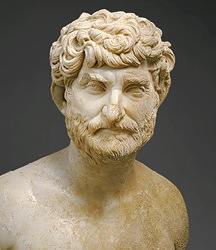
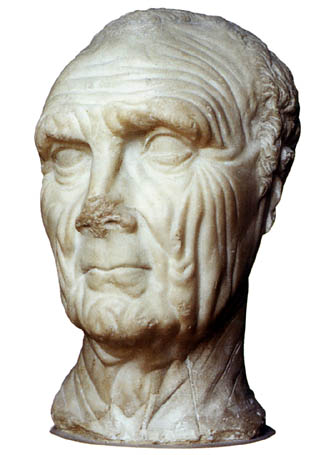
One of my favorite things about the Romans was their realism which manifested itself even in the busts they carved. Unlike the Greeks who strove to idealize everything, the Romans were pragmatic. If the honoree’s face lacked character (or suffered from an excess of the same), then the artist was expected to reflect that fact.

Just look at all the character in the face of the unknown Roman portrayed above. Or, how about this one. So vivid. Imagine just how difficult life must have been for this thirty-two year citizen.* Yes, they did an impressively faithful job portraying the subjects of their artistic studies.

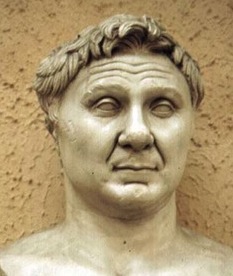
I’m not naïve enough to think that the emperors’ likenesses weren’t “airbrushed” just a tad. But take a look at the image to the left. It was made of an extremely important person, Pompey the Great, and it’s obviously intended to be a true likeness. This image always reminds me of a troubled chaplain assistant who served with me during my isolated tour in Korea. That sergeant’s tussled coiffure witnessed to a nasty hangover. I cannot attribute Pompey’s unruly mane to the same cause.

C.S. Lewis said the first requirement of art is to engage, to connect in some fashion with the interests of the viewer. He wrote this in his essay “Hamlet: The Prince or the Poem,” which he wrote in 1942.

To interest is the first duty of art; no other excellence will even begin to compensate for failure in this, and very serious faults will be covered by this, as by charity.

If I lined up a dozen beautiful and stylized Grecian busts against one wall and the same number of Roman examples against another, I have no doubt which would merit and receive the greatest attention. Idealized portraiture can be appreciated. But realistic likenesses, that celebrate the uniqueness of each human being, these are truly engaging.

Oh, and in closing let me say that I’m just vain enough—should anyone undertake to create a bust of me—to want it crafted in the Greek style, rather than the Roman . . .

* True age unknown . . . but you already knew that, right?

Literary Words

I must confess that I like words. In fact, it’s not excessive to say that I delight in brilliantly witty “turns of phrase” and elegantly painted landscapes that allow me to clearly see what the author is painting with his or her words.

I’ve grown convinced that loving words is a handicap to becoming an excellent writer. Yes, scribblers like me can become adequate or even appreciated writers . . . but to stand in the highest ranks a writer must be willing to ruthlessly slash and slay excess words that impede their perfect vision.

Self-editing is a discipline. It’s something that can be learned and refined through practice. That it forever remains a bit painful for some of us is clear evidence we are overly attached to the words we have put to paper.

C.S. Lewis addressed this general subject in a 1932 letter to his good friend Arthur Greeves. While he was not a slave to the number of words required, he aimed for simplicity and clarity. Lewis wrote:

I think I see, from your criticisms, that you like a much more correct, classical, and elaborate manner than I. I aim chiefly at being idiomatic and racy, basing myself on Malory, Bunyan, and Morris, tho’ without archaisms: and would usually prefer to use ten words, provided they are honest native words and idiomatically ordered, than one “literary word.” To put the thing in a nutshell you want “The man of whom I told you,” and I want “The man I told you of.”

I smiled as I typed Lewis’ remark about “ten words.” He used that to illustrate his willingness to use excessive verbiage to communicate clearly. Brevity was, however, an admirable goal. And brevity is a virtue I’ve seldom been accused of possessing.

In the military, comrades and associates are frequently presenting plaques and remembrances to those who are “rotating” to new assignments. Having served in a dozen different “permanent” assignments, I have boxes full of such memorabilia.

Two of the few I display are genuinely precious. The first is an icon of Saint Athanasius, presented to me by the best “boss” I ever had, an Orthodox priest by the name of John Stefero. The reasons for the personal gift were theological and I accepted it with genuine appreciation and humility.

The second prized gift is a gracefully curved etched glass keepsake featuring the seal of the United States Air Force Chaplain School where I served for three wonderful years. The commandant was speechless as he presented the plaque to me, reading for the first time the inscription that my closest companions had composed for me.

He says in a book what others say in a sentence.

The commandant (later our Chief of Chaplains) was stunned. I was delighted. I led the gathering’s laughter and bellowed, “Yes, and it’s a book well worth reading!”

Jack Lewis may have chided me a bit for the underlying reason for the accolade, but I am confident he would have delighted in the affectionate friendship and esprit de corps with which it was presented.

So much for my shortcomings. For all other writers (including, perhaps, you?) . . . I would recommend following the master’s example, rather than my own.

Exercising Your Creativity

If you work in an “institutional” or office setting, you may be acquainted with the ubiquitous motivational posters that adorn offices from sea to shining sea. (I can’t speak for other countries, but here in the United States, these encouraging slogans can be found in government and private businesses across the land.)

They are so common, in fact, that they have been parodied by a company that offers “The Demotivator’s Collection.” They sell entertaining posters such as:

1. [Image of a sinking ship]

MISTAKES

It could be that the purpose of your life is only to serve as a warning to others.

2. [Image of a salmon leaping up a raging river directly into the mouth of a waiting bear]

AMBITION

The journey of a thousand miles sometimes ends very, very badly.

3. [Image of a fast food carton of french fries]

POTENTIAL

Not everyone gets to be an astronaut when they grow up.

Humor is powerful. I image that many of these demotivational posters adorn the walls of companies that recognize this fact. (You know, the ones with young, dynamic, iconoclastic leaders.)

Here’s one I might even have tempted to hang up in a couple offices where I used to work:

4. [Image of five hands linked together.]

COMMITTEES

Just like teamwork. Only without the work.

I agree with C.S. Lewis about the vital role humor plays in the lives of healthy people. As he wrote in Reflections on the Psalms: “A little comic relief in a discussion does no harm, however serious the topic may be. (In my own experience the funniest things have occurred in the gravest and most sincere conversations.)”

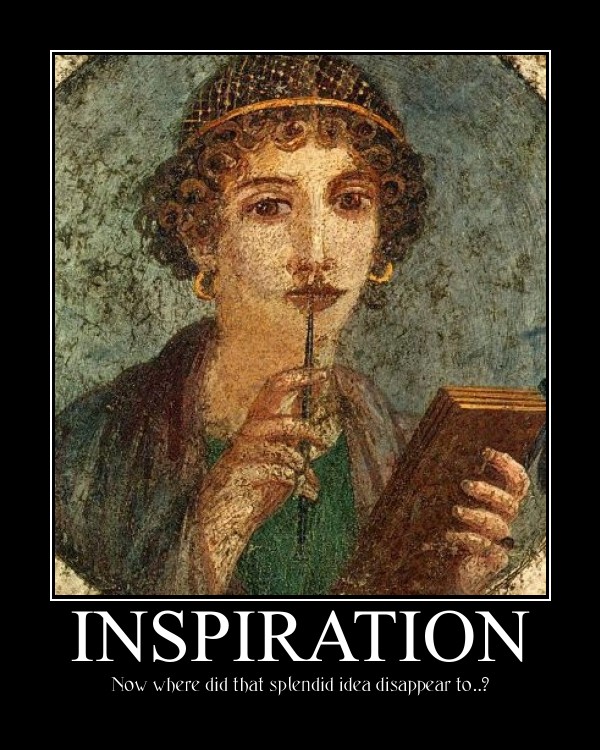
If you feel inspired by the concept of creating thoughtful—or witty—phrases to elaborate on a specific word or brief phrase, you can manufacture these graphics online yourself. Using this free application, you can craft your own (de)motivational posters—just as I did the one displayed above. Yes, that’s my handiwork.

The images you make are yours to download for free. The company needs to turn a profit though, so they offer high quality digital files or posters, for a price. (The free versions are only suitable for smaller applications, like blogs or other websites.)

How’s that for a great way to express your creativity? And it only requires a couple of minutes!

Oh, and if you’re wondering whether my poster about INSPIRATION is a motivator or a demotivator . . . well, I guess that’s in the eye of the beholder.