Orwellian Advice

cls orwellThe title of this post is slightly misleading. In truth, it does contains advice from Eric Arthur Blair (1903-1950) whose pen name was George Orwell. However, because of the impact of his two dystopian classics, Nineteen Eighty-Four and Animal Farm, the author’s name has actually become a true English adjective . . . one that might suggest I’m alluding to futuristic or totalitarian matters.

Or·well·i·an [awr-wel-ee-uhn] means something that resembles his literary work, especially as described in the aforementioned novel and novella. (Within the Christian literary community, “Lewisian” is common shorthand for referring to C.S. Lewis . . . but that word is unlikely to ever find its way into standard dictionaries.)

Despite the enormous (and eternal) differences between Orwell and Lewis, they did have something significant in common. More about that in a moment.

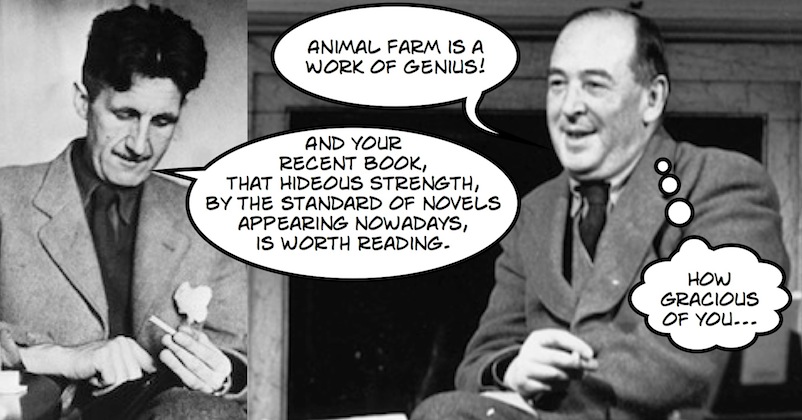
As the graphic I created above reveals (from actual quotations), Lewis had a better opinion of Orwell’s work than vice versa. Orwell disliked Lewis and resented the fact that he was popular among many common people. He particularly disliked Lewis’ traditional (evangelical) Christianity. In his review of That Hideous Strength, Orwell dismissed the biblically based supernatural as a version of “magic.”

Much is made of the fact that the scientists are actually in touch with evil spirits, although this fact is known only to the inmost circle. Mr. Lewis appears to believe in the existence of such spirits, and of benevolent ones as well. He is entitled to his beliefs, but they weaken his story . . .

Orwell was one of those “professing” Christians who is accurately labeled a hypocrite. He was a communing member of the Church of England, and advocated a Judeo-Christian moral code, but did not believe in an afterlife. The following letter, written to Eleanor Jaques in 1932, reveals his hypocrisy.

It seems rather mean to go to HC [Holy Communion] when one doesn’t believe, but I have passed myself off for pious & there is nothing for it but to keep up with the deception.

In a comment to my last post, a good friend of Mere Inkling, Brenton Dickieson at A Pilgrim in Narnia, reminded me of a thought-provoking essay on English written by Orwell. His essay, “Politics and the English Language,” addresses a number of problems with the language. He considers dying metaphors, verbal false limbs, pretentious diction, and meaningless words.

A Similarity in the Two Writers’ Advice

Orwell’s goal is “the scrapping of every word or idiom which has outworn its usefulness. It has nothing to do with correct grammar and syntax, which are of no importance so long as one makes one’s meaning clear, or with the avoidance of Americanisms, or with having what is called a ‘good prose style.’”  [As irritating as I imagine most Europeans find Americanisms!] Writers of fiction will enjoy the way Orwell explains the challenge of “showing, not telling.”

What is above all needed is to let the meaning choose the word, and not the other way around. In prose, the worst thing one can do with words is surrender to them. When you think of a concrete object, you think wordlessly, and then, if you want to describe the thing you have been visualizing you probably hunt about until you find the exact words that seem to fit it.

When you think of something abstract you are more inclined to use words from the start, and unless you make a conscious effort to prevent it, the existing dialect will come rushing in and do the job for you, at the expense of blurring or even changing your meaning. Probably it is better to put off using words as long as possible and get one’s meaning as clear as one can through pictures and sensations. Afterward one can choose—not simply accept—the phrases that will best cover the meaning, and then switch round and decide what impressions one’s words are likely to make on another person.

This last effort of the mind cuts out all stale or mixed images, all prefabricated phrases, needless repetitions, and humbug and vagueness generally. But one can often be in doubt about the effect of a word or a phrase, and one needs rules that one can rely on when instinct fails. I think the following rules will cover most cases:

1. Never use a metaphor, simile, or other figure of speech which you are used to seeing in print.

2. Never use a long word where a short one will do.

3. If it is possible to cut a word out, always cut it out.

4. Never use the passive where you can use the active.

5. Never use a foreign phrase, a scientific word, or a jargon word if you can think of an everyday English equivalent.

6. Break any of these rules sooner than say anything outright barbarous.

These rules sound elementary, and so they are, but they demand a deep change of attitude in anyone who has grown used to writing in the style now fashionable.

Students of Lewis will note in the final passage the parallel with advice he provided to a correspondent in 1956. Although the context is different—Orwell’s is a formal essay and Lewis’ a casual correspondence written to a child, the similarities are significant. Lewis would have been familiar with Orwell’s essay, composed a decade before his letter, but the resemblance between their words is better attributed to shared literary philosophies and the self-evident nature of the principles. Lewis identified five important considerations when writing.

1. Always try to use language so as to make quite clear what you mean and make sure [your] sentence couldn’t mean anything else.

2. Always prefer the plain, direct word to the long, vague one. Don’t implement promises, but keep them.

3. Never use abstract nouns when concrete ones will do. If you mean “More people died” don’t say “Mortality rose.”

4. Don’t use adjectives which merely tell us how you want us to feel about the things you are describing. I mean, instead of telling us a thing was “terrible,” describe it so that we’ll be terrified. Don’t say it was “delightful;” make us say “delightful” when we’ve read the description. You see, all those words (horrifying, wonderful, hideous, exquisite) are only like saying to your readers, “Please, will you do my job for me?”

5. Don’t use words too big for the subject. Don’t say “infinitely” when you mean “very;” otherwise you’ll have no word left when you want to talk about something really infinite.

Whatever the two authors thought about the other, they certainly shared some similar views on the subject of effective writing. And, I think we can assume with confidence that Lewis would concur with Orwell’s final rule. Under no circumstances should we resort to barbarity! For, as Lewis wrote in The Four Loves, “Who does not prefer civility to barbarism?”

____

If you are interested in reading Orwell’s “Politics and the English Language” in its entirety, you can find it here.
Avoid them Like the Plague

cliche bookAvoiding clichés in one’s writing is such oft-repeated advice it’s nearly become a cliché itself.

Many do not make much sense to people approaching a language from a literal perspective. For example, those new to American English may require a bit of explanation to understand that “hit the books” refers to studying rather than literary pugilism.

Some clichés are easily deciphered, especially when read in context. As an admonition to stop obstructing a view, we can understand why someone would say, “You make a better door than a window.”

“Don’t rain on my parade” adequately warns the hearer to avoid dampening the speaker’s special plans or activities.

Folksy adages are common where clichés are concerned. Take “The acorn doesn’t fall far from the tree.” We all know it references a child who shares numerous traits with a parent.

And we have interchangeable versions of the same notion, in case a lazy writer wishes to alternate your redundancies. He/she is a “chip off the old block” means essentially the same thing. And there’s always the classic “like father, like son,” and its corollary “like mother, like daughter.”

“As snug as a bug in a rug” used to be a favorite of my mother, ever applicable as she tucked little ones into their beds. Today, however, with bedbugs plaguing humanity in epidemic proportions, that cuddly image may have lost a touch of its appeal.

Some clichés have clearly outlived any usefulness they may once have possessed. “Too many chiefs, and not enough Indians,” clearly refers to a situation in which everyone is in charge and there no one is able or willing to actually carry out the project. However, few writers would tempt incurring the wrath of readers by using such a dated and rather prejudiced saying.

A cliché, of course, is a typically trite phrase that has lost its element of ingenuity due to overuse. It is something serious writers strive to avoid at all costs. But the final phrase in my previous sentence reveals how difficult it can be to purge these worn out words from our writing. Whenever used, they should be included consciously; writers might utilize them to establish, for example, a comic tone.

Even the gifted C.S. Lewis recognized the threat of clichés worming their way into one’s work. In a 1922 entry in his diary he wrote:

Tried to work at Dymer [his narrative poem] and covered some paper: but I am very dispirited about my work at present—especially as I find it impossible to invent a new opening for the Wild Hunt. The old one is full of clichés and will never do. I have learned too much on the idea of being able to write poetry and if this is a frost I shall be rather stranded . . .

The word cliché itself originated in France, where it was a printing plate or stereotype cast from an original composed of movable type. (The casting freed the movable type for new projects while maintaining the lettering for possible future printings.) The word came to be applied to ready-made phrases. However, the casting of printing plates is one thing. Recycling exhausted phrases ad nauseum is quite another.

Clichés are generally limited to a particular country or culture. Some are restricted to given regions. When outsiders hear or read these phrases, they often make little sense.

Some gain international esteem. More than a century ago Lord Acton described a universal truth of politics that resonates across boundaries. We have all witnessed the truth that “absolute power corrupts absolutely,” but those wise words are not something we should typically parrot in our own writings.

Not knowing the original source of a cliché is common. It is rather tragic, though, when it comes to texts that should be familiar to writers. For example:

“All’s well that ends well” is one of Shakespeare’s best loved maxims. If most Americans were asked whether it came from the pen of the Bard or Benjamin Franklin, we might be sadly disappointed with the results.

“The writing is on the wall” infers the outcome is already determined. But too few recognize this as a reference to a miracle recorded in the Book of Daniel. (If you’re not familiar with it, you can read the story here.)

Some clichés that relate to the art of writing would include the following [with my modest illustrations attached]:

“You can’t judge a book by its cover.”

     Appearances may be misleading.

Someone who appears wonderful when you first meet them may be just like an ebook with a professionally designed cover that contains a poorly scanned reprint replete with typos.

“It’s nothing to write home about.”

     Something that’s boring and not worth retelling.

While the freedom of POD technology has created democracy within the publishing industry, it’s also led to millions of meandering “books” that should “never have seen the light of day.”

A person is “an open book.”

     Someone who readily reveals their personality through word and action.

The type of character skilled authors will wish to introduce in limited quantities, especially if they are writing mysteries.

“Throw the book at him.”

     Give him the maximum possible judicial punishment.

The well-deserved fate of best-selling authors who rest on their laurels and start “phoning in” their sequels.

We turn now to a non-literary but colorful example of an American colloquialism that has spread far from its origins in the swine-breeding communities where it undoubtedly originated. It’s one of my favorite clichés, and it just may have a few good uses left in it, so feel free to include it in your next column or book . . . and no need to cite me as your source:

“You can’t make a silk purse out of a sow’s ear.”

     A task is impossible, given what you have to work with.

The echoing refrain of editors whose clients expect them to transform a few dusty lumps of coal into diamonds.

Possible Valid Uses for Clichés

While it’s safest for writers to avoid them altogether, there are a handful of occasions where they are not utterly inappropriate.

One suitable place for “chesnuts” like these to appear is in dialogue—especially when it’s written for a character a writer desires to portray as rather shallow-thinking.

It’s incorrect to suggest good writers never use clichés in conversation or composition. They do. The difference is that when they do include such tired phrases in their normally witty banter, they do it with a sense of irony.

C.S. Lewis, master of wordplay that he was, illustrated how we can creatively re-imagine or reword a cliché to reinvigorate it. Only the very best minds are up to this task. Yet, when it’s successfully accomplished, it can prove quite entertaining. The following comes from an informal conversation that was recorded before his retirement, preserved in the collection On Stories. Lewis refers in passing to an overly detailed passage in literature that nearly obscured the storyline.

The only trouble is that Golding writes so well. In one of his other novels, The Inheritors, the detail of every sensuous impression, the light on the leaves and so on, was so good that you couldn’t find out what was happening. I’d say it was almost too well done. All these little details you only notice in real life if you’ve got a high temperature. You couldn’t see the wood for the leaves.

Translating the Word

translationsThe science of translation is only partially scientific. It is also an art—with the insight into intuiting the intent of the original author a critical dimension of good translating.

First, of course, the translator must possess a sound grasp of the original language. Second, he or she must know the language into which they are translating the work equally well. With this knowledge, the translator can do an adequate job.

Only with that indefinable intuition mentioned above, is a translator empowered to do justice to a writer’s work when recreating it in a different language.

All translation work is demanding, but those entrusted with transferring documents of faith into new languages face an additional burden. The adherents of various religions typically regard this literature as “inspired,” and therefore to be approached with only the most serious and respectful of intentions.

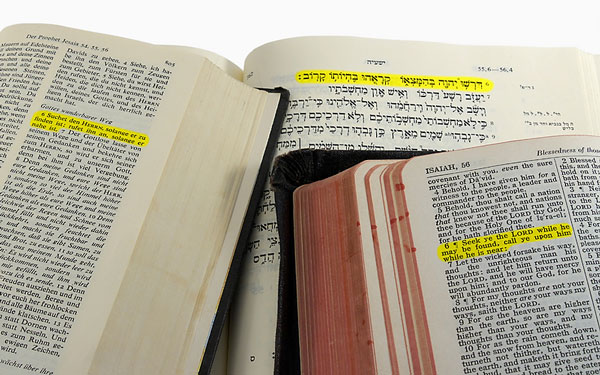
This is certainly true for Christianity. Transferring the Scriptures from Hebrew, Aramaic and Greek into Latin, German and English involved devout theologians who approached the task with reverence as well as skill.

That balance remains a constant these many centuries after the earliest translation efforts. Today the Christian Bible is still being translated into languages where it has never been available before. The Wycliffe Bible Translators community is the largest organization working toward this end, although there are many others, such as the Lutheran Bible Translators, who are laboring in noncompetitive venues.

Wycliffe estimates that 350 million people do not yet have the Bible available in their native language. They have been instrumental in putting God’s Word into 700 different tongues, and with various other organizations are committed to continuing their vital work.

Some of the targeted language groups actually speak dialects of more common tongues. For example, De Nyew Testament is now available for speakers of Gullah. Spoken by the descendants of slaves residing in the South Carolina and Georgia coastlines. It is an English-based creole language featuring numerous African contributions. A comparison of a sample verse will illustrate the differences. The first verse of the Gospel according to John reads:

Fo God mek de wol, de Wod been dey. De Wod been dey wid God, an de Wod been God. Fo God mek de wol, de Wod been dey wid God. Shru dat Wod, God mek ebryting. Ain nottin een de whole wol wa God mek dat been done dout de Wod. (Gullah New Testament).

In the beginning was the Word, and the Word was with God, and the Word was God. The same was in the beginning with God. All things were made by him; and without him was not any thing made that was made. (King James Version).

At the beginning God expressed himself. That personal expression, that word, was with God, and was God, and he existed with God from the beginning. All creation took place through him, and none took place without him. (J.B. Phillips’ New Testament).

Why, you may wonder, have I included the relatively unknown translation by Phillips? Because none other than the brilliant and devout scholar, C.S. Lewis, regarded it highly. Lewis recognized that the archaic usage of the Authorized (King James) Version impeded its use by many people. In fact, in a 1961 letter he wrote: “A modern translation is for most purposes far more useful than the Authorised Version.”

Lewis was one of the readers of Phillips’ initial translation of the Pauline epistles who encouraged him to proceed with the task of translating the entire New Testament. Lewis, in fact, was key in encouraging Geoffrey Bies to publish the new version. Technically, though, calling this text a “translation” is a bit misleading; in many ways it is more honestly labeled a “paraphrase.” Still, it did make the Scriptures more accessible to many younger readers.

Phillips’ New Testament in Modern English is available online at the Christian Classics Library.

C.S. Lewis wrote an entire essay on the subject of translating God’s revelation. It is entitled “Modern Translations of the Bible,” and included in the God in the Dock collection. The following wisdom comes from that source.

The only kind of sanctity that Scripture can lose (or, at least, New Testament scripture) by being modernized is an accidental kind which it never had for its writers or its earliest readers. The New Testament in the original Greek is not a work of literary art: it is not written in a solemn, ecclesiastical language, it is written in the sort of Greek which was spoken over the Eastern Mediterranean after Greek had become an international language and therefore lost its real beauty and subtlety. In it we see Greek used by people who have no real feeling for Greek words because Greek words are not the words they spoke when they were children. It is a sort of “basic” Greek; a language without roots in the soil, a utilitarian, commercial and administrative language.

Does this shock us? It ought not to, except as the Incarnation itself ought to shock us. The same divine humility which decreed that God should become a baby at a peasant-woman’s breast, and later an arrested field-preacher in the hands of the Roman police, decreed also that He should be preached in a vulgar, prosaic and unliterary language. If you can stomach the one, you can stomach the other. The Incarnation is in that sense an irreverent doctrine: Christianity, in that sense, an incurably irreverent religion.

The Anticipation of Publication

autographThe advent of the internet instigated some confusion about what it means to “be published.” That accolade is, of course, the dream of most women and men who write.

To be published—historically speaking—has meant that your words have been:

  1. Deemed worthy of being placed in print (at least, by one editor’s subjective determination).
  2.  Made available in some number of copies to millions, thousands, hundreds, scores, or perhaps dozens of eager readers.

Writing “online” was initially dismissed by the publishing industry (and many writers themselves). “It’s not the same,” they would say. Of course not. Yet they accomplish the same purpose, making writers’ heartfelt messages available for others. And, in short time we have witnessed a publishing revolution in which many of the most vibrant and thought-provoking “periodicals” are primarily (or exclusively) online entities.

So, it is quite appropriate to consider oneself published, I believe, if our work has been included in an online publication.

The arrival of print-on-demand technology (and ebooks) magnified the confusion. Now, it costs very little to become your very own Publishing House, and anyone with a few dollars can see their word in literal print. This has had two major consequences.

  1. Freed from the arbitrary whim of editorial bottlenecks, first-class literary works have been published. Works that formerly would have been returned to their creators with form letters expressing the editors’ regret that they cannot find a place in their exclusive booklist for them.
  2. Material that should would have greatly benefited from thorough editing and rewrites now look for all intents, just like real books that merit reading. Works the afore-insulted editors would formerly have protected the world from.

So, it is quite appropriate to consider oneself published, I believe, even when we have self-published our work—assuming, of course, that our book falls into the first category described above.

And today we have blog boom. Millions of posts and columns. Some creative sprouts withered before they had a chance to bloom. But many exquisite writers sowed rich gardens of wisdom and fancy that continue to be pruned and expanded.

All writers hope to become published. And most would like to one day see their words appreciated by as large an audience as possible. When we have an article or book we’ve written accepted by a recognized periodical or publisher, we experience the joy of anticipation. As we look forward to receiving a copy of the final product, our eagerness is tempered by a bit of anxiety. I mean, anything could happen, right? The publication could even go out of business—and that’s actually happened to me.

C.S. Lewis shared this same sort of expectation as his work neared the presses. And, being C.S. Lewis, he was able to reflect on his own thoughts in a brilliant manner. In 1918, as his first book, a collection of poetry, was being published, he wrote his close friend, Arthur Greeves:

So at last dreams come to pass and I have sat in the sanctum of a publisher discussing my own book (Notice the hideous vulgarity of success already growing in me). Yet—though it is very pleasant—you will understand me when I say that it has not the utter romance which the promise of it had a year ago. Once a dream has become a fact I suppose it loses something. This isn’t affectation: we long & long for a thing and when it comes it turns out to be just a pleasant incident, very much like others.

Like Lewis, most of us find the accomplishment of publishing our work “very pleasant.” Still, it’s seldom if ever the mountaintop experience it flirts at being. Literary Sirens sing “once you are published all your dreams will be realized . . . all who meet you will bow in respect at your wondrous achievement.”

Reality is different. Becoming a “published writer” is something about which we can justifiably be proud. But it doesn’t make us better than anyone else. After all, is not a mechanic who can make an engine purr just as talented as a wordsmith who composes music out of prose?

International Blogging

countries

Who reads blogs? Well, initially, we find just two sources of readers.

  1. Family & Close Friends who we can coerce into reading it, and put on the spot by publicly asking questions related to our recent columns to tighten the screws just a smidge.
  2. Fellow bloggers who search for interesting reads with the ulterior hope that the writers of posts they “like” will make a reciprocal journey to their site.

Expanding beyond those two categories is the challenge. I suspect that most bloggers are resigned to only reaching a relatively small audience. And that’s not necessarily a bad thing. After all, junk mail reaches the boxes of millions, but it is tossed into recycling without a second thought. On the other hand, a blog may only be read by a handful of people, but one or two of them may be wonderfully touched or encouraged through that brief encounter. Junk mail is deleted with a groan. Our posts, in sharp contrast, may elicit a smile, a laugh, or perhaps even an appropriate tear.

I can settle for that.

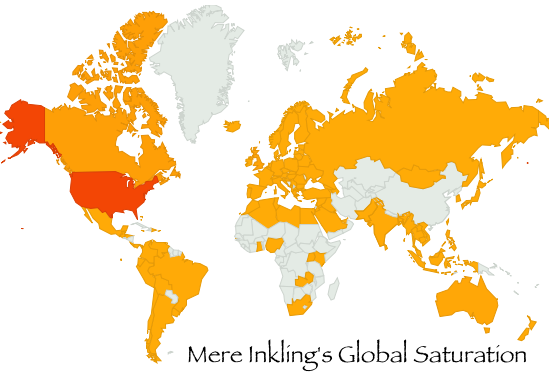
One of the nice things about being part of the WordPress community is the way writers can monitor their site statistics. One fascinating feature is “Views by Country,” which tracks the national origin of visitors to a blog. (Well, not necessarily their ethnic origin, but the country from which they established their online connection with the website.)

Checking out this resource is fantastic for several reasons. First, it’s pleasant as we note visits from locales with which we have a special bond. Republic of Korea, spent a busy year there ministering to those guarding democracy, but still managed to visit many beautiful sites and established many friendships. United Kingdom, got to live there with my family, and visited amazing historic locations too numerous to list. (But, shouldn’t the UK count as three or four countries?) Guam, we got to live there too and enjoy the scenic ocean vistas. (Of course, it’s not a separate country either, being a Territory of the United States.) So what if the word “country” is applied a bit loosely, the sheer breadth of the program’s coverage is impressive.

A second value of the list is that it is educational. You can learn about the existence and/or location of many exotic lands. I’ve had visitors from the Mongolian steppes of the Khans, WWI catalyst Montenegro, freedom-seeking Syria, and the Viking-haunted Faroe Islands.

The third major benefit of visiting the statistics tool is that it can actually reinforce a writer’s sense that someone out there in the vast global unknown is actually interested in their words. I’m amazed, and a mite humbled, to have had visitors to MereInkling from 129 “countries.” Pretty amazing. When I revisit the list every two or three months I see one or two newly reached populations. Yet, as I look at the map, I see many nations remain to be reached. For example, most of the “-stans” and many countries in Africa have yet to feel the warm and liberating glimmer of light MereInkling attempts to deliver.

The Remaining Mystery

I am still plagued by one unanswered question though.

I readily understand why the People’s [misnamed] “Republic” of China has barred MereInkling from internet availability for their billions of prisoners residents.

What perplexes me is why the Kingdom of Denmark has barred access to MereInkling for the subjugated country of Greenland?!? One would think that, in light of their 5 day summer and 360 winter that they would be eager to read something as entertaining as MereInkling. Why has an internet wall been erected to prevent them from doing so? What, we must wonder, is going on behind that impenetrable Ice Curtain?

Yes, for those who think they’ve noted a flaw in my conspiracy theory, I am fully aware that the Faroe Islands are also technically part of the Danish empire. So, why would citizens of Denmark proper and the occupied Faroes be allowed to visit MereInkling while the Greenlanders are left to find enjoyment in measuring the advance and retreat of massive glaciers? The mystery deepens.

As C.S. Lewis wrote in “The Efficacy of Prayer,” in a passage I’ve wrenched completely out of context: “There is a mystery here which, even if I had the power, I might not have the courage to explore.”

Lengthening Good Stories

bayeuxWe’re all familiar with the saying “too much of a good thing.” Because it’s a cliché, most reviewers wisely avoid the phrase, but in reading a fair number of reviews of The Hobbit, I’ve heard this very thought expressed in a number of ways.

Everyone is familiar with Director Peter Jackson’s Oscar-winning trilogy of The Lord of the Rings. Most fans were thrilled when it was announced he would also film J.R.R. Tolkien’s much “smaller” tale of The Hobbit. Some were surprised when they learned he would divide it into two parts. Still, the general sentiment was “the more the better” (another tired phrase). However, when it was ultimately announced that Jackson intended to stretch the modest novel into a trilogy of its own, many fans were incredulous.

There is a tad of irony in transforming Tolkien’s beloved adventure of a hobbit assisting dwarves in a regional quest into an epic to rival the high fantasy of The Lord of the Rings with its conflict enmeshing every corner of Middle Earth.

As I write this column, The Hobbit: An Unexpected Journey is doing well. It is ranked sixth at the box office, and held the number one position for three full weeks, against tough competition.

In order to discover sufficient content to expand the story, Jackson has incorporated a number of Middle Earth tales Tolkien had written about its history in other sources. The primary sourcebook was The Silmarillion, a collection published posthumously by Tolkien’s son Christopher in 1977. Some regard the importing of these elements as a sort of corruption of the simpler story of the single volume. Others welcome the elaboration on the essential story, since the additions are certainly “genuine Tolkien,” and they provide a more elaborate portrayal of Middle Earth.

The reactions to the expansion have been mixed. I don’t have strong feelings either way, but I treasure my time in Middle Earth so highly, that I would likely pitch my tent in the camp of those who approve of the increase. (Not to the point, of course, where I would behead those who objected, as we see on the fragment from the Bayeux Tapestry above.)

In the energetic conversation about the expansion of the saga, people frequently interject the name of the author, and offer suppositions about how he would have reacted. I find this interesting, but somewhat futile. Frankly, there is far too much that we simply don’t know about Middle Earth to authoritatively render Tolkien’s judgment on these things. Yes, we know that he was reluctant to see his work on the screen, but he did sell those rights to his creations. Of course we are aware of his lack of confidence in material originating in the colonies.

In a 1937 letter he writes about a possible publisher in the United States: “As for the illustrations: I am divided between knowledge of my own inability and fear of what American artists (doubtless of admirable skill) might produce.” It is in this same letter that he offers his criticism about a Disneyesque presentation: “It might be advisable, rather than lose the American interest, to let the Americans do as seems good to them—as long as it was possible (I should like to add) to veto anything from or influenced by the Disney studios (for all whose works I have a heartful loathing).”

In an essay entitled “On Criticism,” C.S. Lewis described the limitations of outsiders attempting to discern the intent of authors.

Nearly all reviewers assume that your books were written in the same order in which they were published and all shortly before publication. There was a very good instance of this lately in the reviews of Tolkien’s Lord of the Rings. Most critics assumed (this illustrates a different vice) that it must be a political allegory and a good many thought that the master Ring must “be” the atomic bomb.

Anyone who knew the real history of the composition knew that this was not only erroneous, but impossible; chronologically impossible. Others assumed that the mythology of his romance had grown out of his children’s story The Hobbit. This, again, he and his friends knew to be mainly false. Now of course nobody blames the critics for not knowing these things: how should they? The trouble is that they don’t know they don’t know. A guess leaps into their minds and they write it down without even noticing that it is a guess.

Learning from Lewis, I won’t hazard a guess about Tolkien’s ultimate attitude towards the cinematic portrayals of his works—which will now, I assume, come to carry greater weight in the public psyche than the novels themselves. Well, at least until the current mode of motion pictures becomes obsolete. Then, once again, the words as Tolkien wrote them will reign supreme.

For those who are interested, I created the faux Bayeux Tapestry scrap at the top of the column using a program that allows manipulation of a variety of the hand-stitched images. Then I simply added the text in a simple graphics program. The Historic Tale Construction Kit is available here.

There is also a more sophisticated software interface that I haven’t tried called the “interactive” Bayeux Tapestry.

Skillful Turns of Phrase

frank burnsEveryone loves an exquisite turn of phrase. Those of us who dabble in writing are particularly susceptible to their numinous power.

I’ve been doing some research on the Father Mulcahy character from M*A*S*H. William Christopher transformed the fictional character from a caricature of military chaplaincy, into a compassionate and respected representative of the Holy. During my research, I’ve been reviewing episodes of the series in which he was featured.

In “Alcoholics Unanimous,” which originally aired in 1974, Mulcahy has been tasked with delivering a lecture on temperance. In an interesting twist he wears full clerical garb and prepares what is essentially a sermon. Since the lecture is a “mandatory formation,” the mess tent (which doubles as the chapel) is filled to capacity.

Sitting in the front row are the hypocritical Majors Burns and Houlihan. (For those unfamiliar with the show, they constantly call for the most rigid of military standards, even as they are all the while breaking the military’s Uniform Code that prohibits adultery.) Major Houlihan’s nickname, in fact, is “Hotlips.”

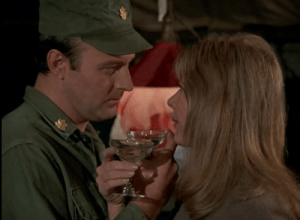
In the aforementioned episode they have a delightful little exchange that illustrates through its witty banter the skill of the Hollywood writers at their best. As the hospital’s temporary commander, Burns has banned all alcohol and mandated attendance at the lecture. The tent is filled to its limits as Houlihan turns adoring towards her paramour and says:

Houlihan: Frank, what a turnout!

Burns: Lemmings must be directed to the sea.

Houlihan: You’re magic with a phrase!

It requires skill to create a well-crafted turn of phrase. Well, even a fool like Frank Burns can stumble across a clever phrase, but only a master can repeatedly coax them from their ethereal realms.

C.S. Lewis was just such a master. His works abound with profound and captivating language. And he recognized it in the works of others. In “Dante’s Similes,” in Studies in Medieval and Renaissance Literature, he wrote:

[Dante] is the most translatable of the poets—not, probably, that he entrusts less wealth than others to the music of the words and the nuance of the phrase but that he entrusts more than others to the “plain sense.”

In The Four Loves, Lewis reveals just how impoverished much of our language is . . . even when it relates to the most inspiring of matters. Describing the difference between carnal “love” and genuine love, he shows that even impoverished phrases can begin to grasp the truth behind the dynamics of affection and commitment.

We must do the works of Eros when Eros is not present. This all good lovers know, though those who are not reflective or articulate must be able to express it only in a few conventional phrases about “taking the rough along with the smooth,” not “expecting too much,” having “a little common sense,” and the like. And all good Christian lovers know that this programme, modest as it sounds, will not be carried out except by humility, charity and divine grace; that it is indeed the whole Christian life seen from one particular angle.

Surely those who are more articulate can more expressively communicate our love for our spouse. Yet, even in so-called matters of the heart, we frequently utter phrases that are utterly mundane.

The History of the Phrase “Turn of Phrase”

One online dictionary uses these definitions:

a turn of phrase

1. a way of saying something “Significant other,” meaning “partner,” now that’s an interesting turn of phrase.

2. the ability to express yourself well She has a nice turn of phrase which should serve her well in journalism.

The Phrase Finder website provides excellent information about numerous phrases. And, in discussing this idiomatic phrase about phrases, they do not disappoint.

So, a phrase was a style of speaking or writing, and style meant beauty of expression. We can now interpret a fine “turn of phrase” as analogous to a skillfully crafted piece of wood turned on a lathe. John Dryden referred to the “turning” of words in this sense in The Satires of Decimus Junius Juvenalis, 1693: “Had I time, I cou’d enlarge on the Beautiful Turns of Words and Thoughts; which are as requisite in this, as in Heroique Poetry.”

Check out their entire article about turns of phrase at the link above. And, may your own writing be filled with impressive verbal ballets, replete with inspiring leaps and unforgettable pirouettes.

It’s Still Christmas

nativity iconMerry Christmas!

One of the sad things about living in a secular nation is that people understand very little about the real meaning of Christmas. For example, many people take their trees down on 26 December, mistakenly thinking Christmas is “over.” In reality, the Christian celebration of the Nativity of Jesus only begins on Christmas Day!

The commercial world celebrates the season of Advent and deceptively calls it “Christmas.” These weeks, which should mark a spiritual preparation akin to Lent, are instead transformed into a frantic race to accumulate the perfect gifts to show others just how much we value each of them. And, since we love our family and close friends, there is a constant temptation to be far more extravagant in our gift giving than we can afford.

Returning to the season of Christmas, in which we find ourselves this day . . . we discover a brief occasion to focus our spiritual reflections on the singular Christmas miracle, the Incarnation. God becoming a human being. The Word through whom all things were created, becoming a mortal like the sons of Adam and daughters of Eve fashioned in his own likeness.

Christmas is, indeed, a glorious season.

C.S. Lewis had many insights into the Incarnation miracle. It is most certainly worthy of our serious attention. If it did not actually happen, Jesus should be dismissed altogether, for he claimed to be one with our heavenly Father. However, as Lewis declared in Miracles, “If the thing happened, it was the central event in the history of the Earth.”

One of the great literary treasures of the world is a precious book written before the year Anno Domini 318. Athanasius of Alexandria wrote a treatise called “On the Incarnation,” which makes great reading and is readily available online. A fairly modern translation was written by Sister Penelope Lawson, an Anglican nun.

Sister Penelope prevailed upon C.S. Lewis to write an introduction to her translation, in which he said, “This is a good translation of a very great book.” The full volume, complete with Lewis’ outstanding preface, is available. Here is just one of his gems:

Every age has its own outlook. It is specially good at seeing certain truths and specially liable to make certain mistakes. We all, therefore, need the books that will correct the characteristic mistakes of our own period. And that means the old books. All contemporary writers share to some extent the contemporary outlook—even those, like myself, who seem most opposed to it. Nothing strikes me more when I read the controversies of past ages than the fact that both sides were usually assuming without question a good deal which we should now absolutely deny. They thought that they were as completely opposed as two sides could be, but in fact they were all the time secretly united—united with each other and against earlier and later ages—by a great mass of common assumptions.

Still, as wonderful as Lewis’ introductory comments are, the greatest treasures here are the bishop’s teachings about Jesus. To whet your appetite, taste the following wisdom from Athanasius’ own introduction to his work:

You must understand why it is that the Word of the Father, so great and so high, has been made manifest in bodily form. He has not assumed a body as proper to His own nature, far from it, for as the Word He is without body. He has been manifested in a human body for this reason only, out of the love and goodness of His Father, for the salvation of us men. We will begin, then, with the creation of the world and with God its Maker, for the first fact that you must grasp is this: the renewal of creation has been wrought by the Self-same Word Who made it in the beginning. There is thus no inconsistency between creation and salvation for the One Father has employed the same Agent for both works, effecting the salvation of the world through the same Word Who made it in the beginning.

You can read the entire work at this site. Have a blessed Christmas season!

Our Personal Libraries

printing lettersWhat a blessing it is to live in an age when even the most modest home can treasure its personal library. Public libraries are a community boon, but because of the printing press, books are no longer restricted to the homes of the wealthy.

Books—or, more properly the reading of books—has a direct correlation to human intelligence, knowledge and (occasionally) even to wisdom itself.

In 1905, at the age of seven, C.S. Lewis moved with his family into a large home in the countryside. It was so spacious, in fact that in his autobiography Surprised by Joy, Lewis says, “to a child it seemed less like a house than a city.”

Lewis proceeds to describe the “mansion,” and its most notable feature . . . the profusion of books.

The New House is almost a major character in my story. I am a product of long corridors, empty sunlit rooms, upstairs indoor silences, attics explored in solitude, distant noises of gurgling cisterns and pipes, and the noise of wind under the tiles.

I am a product . . . of endless books. My father bought all the books he read and never got rid of any of them. There were books in the study, books in the drawing room, books in the cloakroom, books (two deep) in the great bookcase on the landing, books in a bedroom, books piled as high as my shoulder in the cistern attic, books of all kinds reflecting every transient stage of my parents’ interest, books readable and unreadable, books suitable for a child and books most emphatically not. Nothing was forbidden me. In the seemingly endless rainy afternoons I took volume after volume from the shelves. I had always the same certainty of finding a book that was new to me as a man who walks into a field has of finding a new blade of grass.

I’m privileged to own a large library. It’s not a matter of pride. It’s a matter of joy. Like Lewis, and most readers of Mere Inkling, I love books. And, like most bibliophiles, I am fascinated by numerous things related to books.

While attending college I worked for a small publisher. I was able to do a bit of writing, but most of the job involved using an enormous Linotype Phototypesetting machine and pasting up the projects. It was an interesting process, which is now long obsolete.

letterpress

Nevertheless, due to my love for books, reinforced by my own experience as a “printer’s devil,”* I have an affection for items related to publishing. I recently purchased several items from a family business called Type-tiques.

They offer a wide range of reasonably priced letterpress printer’s blocks which look wonderful on bookshelves and literary desktops.**

I also recently accepted an offer for ten free letterpress bookmarks from Peach Farm Studio. You can read about their promotion here. (Since my comment there is still awaiting “moderation,” I’m unsure of the status of the project, but I’ll keep you posted.)

___

* Just a note that, should you be unfamiliar with the term “printer’s devil,” it’s simply trade parlance for the shop’s apprentice or flunkey.

** When my wife proofread this, she asked if I literally meant “literary desktops.” Then she motioned towards my own book-laden desk and queried, “and where will you put them?” Fortunately, I have lots of shelves!

Knowing Our ABCs

Most readers are familiar with the amazing story of Jeanne D’ Arc (Joan of Arc). She was a French peasant who received visions which proved accurate. She foresaw victory for a humbled nation which had not experienced a major military victory for an entire generation.

Jeanne led the army of the Dauphin (the heir to France’s throne who would reign as Charles VII) to unimaginable victories. She was seriously wounded but inspired her troops with her swift return to battle. She counseled, and prayed for mercy, but recognized England could only be repulsed from French shores by force.

Tragically, she was captured and the English, following a sham trial, judged her guilty of heresy. Jeanne was only nineteen when she perished in flames in an English blaze. Just twenty-five years later, a special court convened by the Pope found her “not guilty” of the crime, and proceeded to declare her a martyr. She was canonized in 1920, nearly five centuries after her brief but brilliant life.

Recently, while reading more about her life I was reminded of something startling she said during her first “inquisition.” When she originally presented herself to the Dauphin, no one could believe a modest young farm girl could be France’s rescuer. A commission of inquiry, comprised of a number of senior clergy, offered the Dauphin a “favorable presumption” that she might, indeed, have divine sanction.

During that “trial,” she was vigorously questioned. The following account comes from Medieval History by Israel Smith Clare.

It is very interesting to see how she evaded the difficulties, overcame the objections, and quietly set aside the learned cavils of the doctors by the simplicity and directness of her replies. They first asked her what signs she could show them to prove her mission. She answered: “I have not come to Poitiers to show a sign. Give me some men-at-arms and lead me to Orleans, and I will then show you signs. The sign I am to give is to raise the siege of Orleans.” One of the [theological] doctors responded thus: “But if God wished to deliver the city he could do it without soldiers.” Jeanne replied: “The soldiers will fight, and God will give them the victory.” Brother Seguin of Limousin asked her, in his provincial dialect, in what idiom her angels spoke. She answered: “In a better idiom than yours.” Said he, somewhat angrily: “Do you believe in God?” Jeanne replied: “I have more faith in God than you have.” The sharp man was thus silenced.

Still the doctors proceeded with their examinations, asking repeated questions and suggesting many learned difficulties. Said Jeanne: “Why do you ask me all these things? I do not know even my A, B, C; but I have come, by God’s command, to raise the siege of Orleans and crown the king.” Having nothing more to say, the doctors finally decided in the maiden’s favor, to which they were somewhat influenced by the great reverence which she inspired among the people of Poitiers by her holiness and piety . . .

Jeanne’s final comment which stands out. The fact that she was illiterate was, to her, no disgrace. She was confident God had chosen her to accomplish the historic events which surely followed.

We live in an era where nearly all adults in the industrialized world are literate. Even in less privileged lands, literacy rates hover around fifty percent.

We—especially those of us who love words and write—tend to look down on those who are not as eloquent as we consider ourselves to be. A woman like Jeanne reminds us that one need not be educated to be truly eloquent. She put the ecclesiastical patricians in their proper place. And rubbed their proverbial noses in it, when she emphasized her illiteracy. Devout, courageous, humble . . . and sarcastic toward condescending clerics—I’m eager to one day meet her!

While knowing one’s ABCs bears little correlation to personal virtue or merit, literacy is essentially a good thing. How impoverished our lives would be if books were sealed to us and we could not be transported to novel places and new epiphanies in their pages.

C.S. Lewis shared this awareness that illiteracy was something that could bar some from experiencing life’s most important treasures. In The Pilgrim’s Regress, he draws a wonderful picture of the relationship between the image and the word. In this allegory, the Landlord represents God.

“. . . The Landlord has circulated other things besides the Rules. What use are Rules to people who cannot read?”

“But nearly everyone can.”

“No one is born able to read: so that the starting point for all of us must be a picture and not the Rules. And there are more than you suppose who are illiterate all their lives, or who, at the best, never learn to read well.”

“And for those people the pictures are the right thing?”

“I would not quite say that. The pictures alone are dangerous, and the Rules alone are dangerous. That is why the best thing of all is to find Mother Kirk at the beginning, and to live from infancy with a third thing which is neither the Rules nor the pictures and which was brought into the country by the Landlord’s Son. That, I say, is the best: never to have known the quarrel between the Rules and the pictures. But it very rarely happens. The Enemy’s agents are everywhere at work, spreading illiteracy in one district and blinding men to the pictures in another. . . . As often as men become Pagans again, the Landlord again sends them pictures and stirs up sweet desire and so leads them back to Mother Kirk even as he led the actual Pagans long ago. There is, indeed, no other way.”

“. . . The Landlord succeeded in getting a lot of
messages through.”

“. . . These pictures woke desire.”

“. . . And then the Pagans made mistakes. They would keep on trying to get the same picture again: and if it didn’t come, they would make copies of it for themselves. Or even if it did come they would try to get out of it not desire but satisfaction.”

Elsewhere, in the essay “Some Thoughts” in God in the Dock, Lewis expressly (and correctly) declares literacy itself as one of the things for which Europe should be grateful to the Church.

[One looking at] Christian activities which are, in a sense directed toward this present world . . . would find that this religion had, as a mere matter of historical fact, been the agent which preserved such secular civilisation as survived the fall of the Roman Empire; that to it Europe owes the salvation, in those perilous ages, of civilised agriculture, architecture, laws, and literacy itself. He would find that this same religion has always been healing the sick and caring for the poor; that it has, more than any other, blessed marriage; and that arts and philosophy tend to flourish in its neighbourhood.