Recycling Literature

recycled pageMany subscribers to Mere Inkling share a common trait with C.S. Lewis. Like your humble blogger, you are lovers of books. We don’t need to apologize for it; it’s in our DNA.

We carry that astonishing gene that manifests itself in a passion for the written word. (It’s frequently inherited from a parent who possessed the same ardor.)

If you’re one of this corpus of literary addicts, you just nod your head in agreement whenever you hear Lewis’ oft-quoted, “You can never get a cup of tea large enough or a book long enough to suit me.”

If you love books, if you don’t mind owning copies that others before you have enjoyed, and if you are on a tight budget, you might want to join me in becoming a customer of Better World Books.

[I have no interest in this nonprofit organization other than genuinely commending them to you as a wonderful source of inexpensive books. Most books have been officially removed from library collections . . . and require new homes. The “profits” are directed towards libraries and literacy programs.]

Many of us have enjoyed walking through rows of books on sale in local settings. This is a little like that, except that you can do digital searches and they have tons more titles available. (Literally.)

One of my recent purchases was Latin for the Illiterati. I purchased it the same day I bought The Anchor Book of Latin Quotations (for a secret project I’m working on).

Latin for the Illiterati includes “common phrases and familiar sayings,” that the reader is now able to decipher when encountered in classical literature. References do not have to be ancient to be included. For example, “salus populi suprema lex esto,” which means “the welfare of the people is the supreme law.” (But I didn’t need to translate that for you residents of Missouri, since it’s your own state motto.)

Quick test, which state has this as its motto? “Vox audita perit, litera scripta manet,” which means “the voice that is heard perishes, the letter that is written remains.” Actually, I cheated a bit, I don’t think it is any government’s motto, but it certainly is a truism that will resonate with readers!

C.S. Lewis valued rereading good books. In a 1915 letter, he wrote, “There is something awfully nice about reading a book again, with all the half-unconscious memories it brings back.”

In that same spirit, the following year he wrote to the same friend, “You really lose a lot by never reading books again.”

As I said, he was explicitly referring to revisiting a work already read. Nevertheless, I believe he would agree with the broader sense of his words . . . that it is a sad thing to see a book destined never to be read again.

Whether or not I am correct is irrelevant. The fact is that there are hundreds of thousands of books awaiting new homes. I don’t doubt that many of them “deserve” to be recycled for their raw materials. However, I also believe that the majority of them remain capable of teaching and inspiring. After all, litera scripta manet, right?
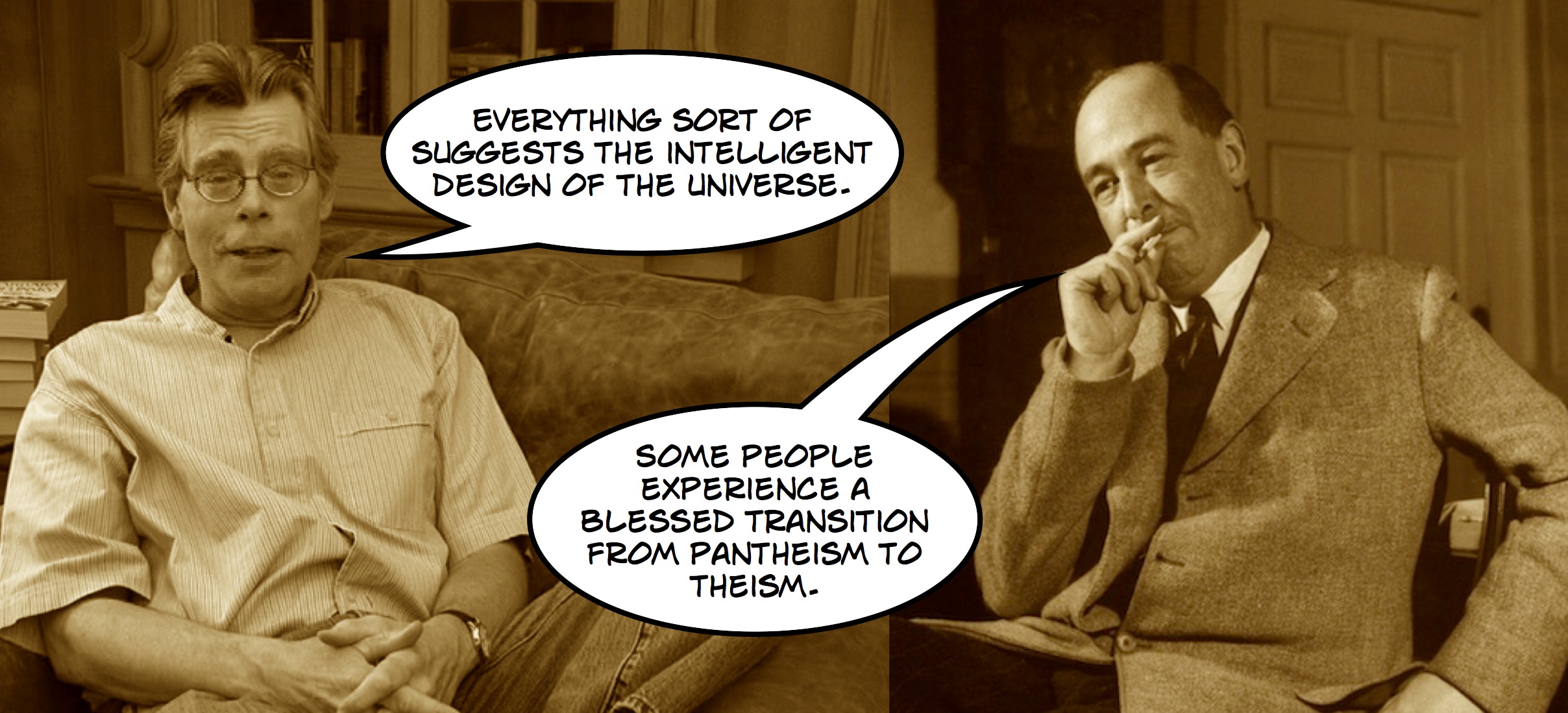
Stephen King Echoes C.S. Lewis

csl and kingAuthor Stephen King surprised quite a few fans during a recent PBS interview when he expressed his belief in the universe’s intelligent design. In nature and the cosmos, like theist C.S. Lewis before him, he views a creation so complex and wondrous that he thinks it makes more sense to believe in a divine power than to dismiss faith.

During the interview, King said,

I choose to believe it, yeah. I think that . . . there’s no downside to that, and the downside—if you say, well, OK, I don’t believe in God, there’s no evidence of God—then you’re missing the stars in the sky, and you’re missing the sunrises and sunsets, and you’re missing the fact that bees pollinate all these crops and keep us alive and the way that everything seems to work together at the same time.

In an essay, “Christianity and Culture,” C.S. Lewis alludes to the “Theist” phase of his own life. He points out how limiting a faith that recognizes God only abstractly, in his handiwork, can be.

There is an easy transition from Theism to Pantheism; but there is also a blessed transition in the other direction. For some souls I believe, for my own I remember, Wordsworthian contemplation can be the first and lowest form of recognition that there is something outside ourselves which demands reverence.

To return to Pantheistic errors about the nature of this something would, for a Christian, be very bad. But once again, for “the man coming up from below” the Wordsworthian experience is an advance. Even if he goes no further he has escaped the worst arrogance of materialism: if he goes on he will be converted.

King is, of course, far from what one would properly call a “person of faith.”** Still, it may be that he is presently moving in a positive direction. The following words reveal his yearning for hope, criticism of institutional religion, and his as yet unanswered questions about why God allows suffering in our world.

It’s certainly a subject that’s interested me, and I think it interests me more the older that I get. And I think we’d all like to believe that after we shuffle off this mortal coil, that there’s going to be something on the other side because for most of us, I know for me, life is so rich, so colorful and sensual and full of good things, things to read, things to eat, things to watch, places to go, new experiences, that I don’t want to think that you just go to darkness. . . .

But as far as God and church and religion and . . . that sort of thing, I kind of always felt that organized religion was just basically a theological insurance scam where they’re saying if you spend time with us, guess what, you’re going to live forever, you’re going to go to some other plain where you’re going to be so happy, you’ll just be happy all the time, which is also kind of a scary idea to me. . . .

Everything is sort of built in a way that to me suggests intelligent design. But at the same time there’s a lot of things in life where you say to yourself, well, if this is God’s plan, it’s very peculiar. And you have to wonder about that guy’s personality, the big guy’s personality. . . . What I’m saying now is I choose to believe in God, but I have serious doubts.

For many intelligent people, like C.S. Lewis and Stephen King, coming to faith cannot be severed from their reason. They desire to make sense of the world. Some, sadly, determine that human beings perish forever with their final breath. With that worldview, using King’s words, “you just go to darkness.”

Fortunately many others—brilliant and simple people alike, for God shows no partiality—possess true wisdom and heed the words of Jesus, that he is the way, the truth and the life. Both of these writers experienced an ineffective exposure to the church when they were young. Unfortunately, it served as more of an inoculation than a foundation.

Eventually C.S. Lewis followed that path from theism to Christianity. It’s not impossible that Stephen King may, as well.

_____

* A full transcript of the PBS interview is available here.

** In the interview, King “commends” the entertainment value of enthusiastic, emotionally-charged preaching, while disparaging his own mainline upbringing.

I went to a Methodist church for years as a kid, and Methodist youth fellowship on Thursday nights, and it was all pretty – you know, think of a bottle of soda with the cap off for 24 hours. There weren’t very many bubbles left in that stuff by then. It was pretty – it was Yankee religion, Terry, and there’s really not much in the world that’s any more boring than that. They tell you that you’re going to go to hell, and you’re half-asleep.

Dangerous Slang

toilet 2When we moved to Alabama, my wife innocently offended some of her young students by using a slang word that in our family simply meant “stuff,” but apparently is used elsewhere for more vulgar purposes.

In a reference to something such as things being in the way, she said the word “crap.” Obviously she was definitely not using it in the Thomas Crapper sense. But some of the Southern kids had never heard it applied in an innocent way, so they naturally assumed she was using it in a crasser sense.

She wasn’t. I grew up with the word meaning “junk, stuff or clutter” with the connotation that they were unwelcome, and “in the way.” My sainted mother—from whose lips I do not ever once recall hearing a vulgar word pass—used the word “crap” often.

And because the source of the word’s usage was so pure and unadulterated (my mom), I mistakenly assumed I fully understood the word’s meaning.

Still, old habits are hard to change, and I find myself occasionally using that very word. And, I must confess, I sometimes even use it as a minor expression of irritation. For example, I just used it in the subject line of an email I sent to some fellow students of ancient Roman history. “Crap, I Just Missed This” was the exact phrase, and the body of the message consisted only of a link to a fascinating conference held in Rome just a few days before I learned about it.

The link was to this site. . . and if you don’t have the time or inclination to check it out, allow me to share the fascinating subject it addressed:

It was sponsored by the Royal Netherlands Institute in Rome, quite a prestigious organization. No fewer than seven scholars who have been excavating Rome’s ancient latrines were slated to speak—I’m eager to learn whether or not their presentations will be published for the benefit of those of us unable to attend.* They generously offered “free seating” to members of the public desiring to attend the historic programme.**

C.S. Lewis apparently respected the Roman Empire enough to take the Roman name of an ancient Italian city for the name of fabled “Narnia.” While I’ve yet to find any references in Lewis’ corpus to Roman plumbing, I found this appraisal of a History of Rome which he noted in his diary (16 March 1924). During an extended country walk with two friends, he dined at an inn and browsed through its public library.

After some time we went on to Stanton Harcourt where we were to lunch. Before we reached it the sun suddenly disappeared and the sky got white and a cold wind sprang up. In the inn parlour we consumed large quantities of bread and cheese and draft cider. Harwood found a delightful book here—a History of Rome “related in conversations by a father to his children with instructive comments”. The children made such comments as “How pleasing is filial piety, Papa!” and “My dear Sir, surely you have been too indulgent in describing the vices of Honorius as weakness.”

One wonders what sort of refined comments the children would have made about the recent conference. Perhaps something like, “Most honored patriarch, it is enlightening to learn just how elaborate was the attention the Romans devoted to the facilities dedicated to their private bodily functions.”

Well, enough about such matters. We have terribly digressed in a post originally intended to serve as a warning about the dangers of using slang. I guess I am just so disappointed about missing the conference that I needed to vent that here.

_____

* One wonders how they were able to adequately address this complex subject in a one-day seminar.

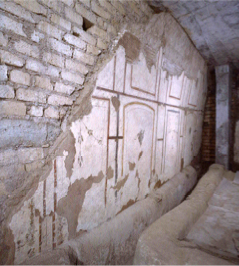
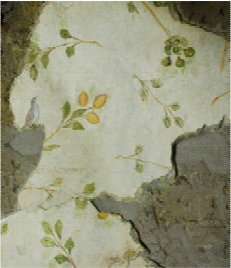
toilet 1** The invitation does not expressly say whether it would consist of individual seats, or in a bench design, similar to that pictured below, from the workshop’s brochure. Speaking of pictures, the one at the top of the column, also from the promotional publication, is a fresco from the ceiling of a toilet on the Palatine. (And we think our bathrooms are fancy!)

Promoting Our Writing

blog promoOne of the common frustrations online writers face is the question: “is anyone out there reading what I write?”

I suspect that’s been the plaintive lament of all authors, since the dawn of written languages. Just as a conversation can’t occur when one of the parties ignores the other, no “communication” takes place when something is written, but never read.

Blogs provide an excellent framework for exploring this phenomenon. Bloggers don’t write merely for themselves. (If they wanted to do that, they’d simply “journal.”) Bloggers long to have others read their words. And the commonest disappointment of new online writers is just how few people actually visit their sites.

Fortunately, communities such as wordpress include features that allow us to track statistics in an accurate manner. Even when visitors fail to comment or formally “like” a post, they still leave digital footprints. I’ve written before about how enjoyable it is to see how frequently your page has been visited by people from all around the world.

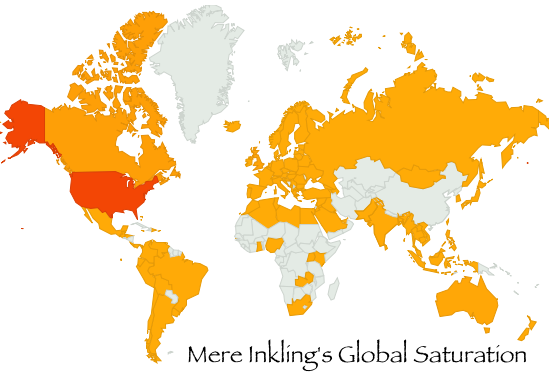
At that time I shared my statistical world map, (directly below). Today I follow it with my current status . . . which reveals that I have finally penetrated the Great Wall and accessed the vast population of the People’s Republic of China! (Of course, I have long suspected the Chinese military of spying on my column, in an effort to glean military secrets about the Inklings’ military service during WWI.)

countries

countries 2

Methods of Increasing Visits to Our Sites

There are a number of concrete ways to expose others to our words. A few appear below. Still, it’s good to remain realistic in our expectations.

I recently read that it’s worthwhile being listed in the Technorati blog directories. As part of the verification process for inclusion there, I need to include in one of my blogs the code RFQE8T2R48RG. (I just hope their verification search engine isn’t confused by the numerous occasions when I’ve used that very same code in my previous blogs.)

As promised, here are a handful of nearly universal recommendations for increasing the number of visitors to our websites.

  • Write on subjects we feel passionate about.
  • Write well.
  • Be as unique as possible (in our personal publishing niche).
  • Encourage people to leave comments.
  • Dialog with the readers who do.
  • Create intriguing titles for our posts.
  • Write regularly (at least weekly, but not hourly).
  • Offer RSS and email subscription options.
  • Visit other blogs & offer encouraging comments.
  • Tell everyone you know to read Mere Inkling.

Truly sorry about that last plug. I’m simply trying extra hard to ensure my words don’t drop into the obsidian darkness of digital anonymity. Blessings in your own efforts to ensure the same!

To Tweet or Not to Tweet

platypusI have a twitter account I’ve never used. I had attended a ministry conference where the featured speaker encouraged all of the pastors to harness the power of this cutting edge technology.

I dutifully returned home, established an account, and realized there were very few things I wanted to say in 140 characters or less. One hundred and forty words . . . now you’re talking. But a mere seven score letters . . . I don’t think so.

I know there are many positive things about brevity. In our hectic world, it’s become an absolute necessity. Still, some things—to be expressed more clearly and (dare I say it, “entertainingly”)—demand more than two and a half sentences.

I was recently reading an article entitled “Tweets Before Twitter,” and it gave me cause to reconsider the prospect of using twitter to share worthwhile ideas. It described “ingenious brevity inspired 150 years ago by telegrams. . . . when people had to pay as much as $1 per Morse-coded word to dispatch a cable overseas, only a robber baron could afford to be loquacious.”

Now, that’s a sobering thought, especially since one of the dollars of that era would likely translate into about $214.17 today (by rough estimate). With that incentive, many telegraphs employed cryptic shorthand similar to the increasingly familiar terminology of the tweetworld.

However, one example they cited was different. It did not rely on learning a new language of contemporary abbreviations. Instead, it appealed to a much older language, Latin. Here’s the example they reported.

Monotremes oviparous, ovum meroblastic.

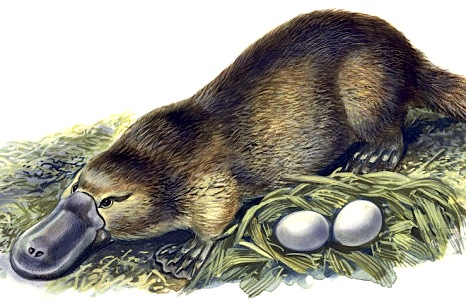
Translation: In the 19th century one of the greatest scientific debates was whether the platypus laid eggs, a fact that zoologist William Hay Caldwell was finally able to confirm in 1884. Here he uses Latin to cable his discovery from Australia to the British Association for the Advancement of Science. Since Latin had words for high-level scientific concepts, Caldwell could condense an entire paper into one brief sentence, letting colleagues know that platypus embryos develop like birds instead of mammals.

If I could remember the Latin I studied back in high school . . . And, if the people I was tweeting could read what I was saying . . . I just might reconsider my decision not to tweet. But I regard that event highly unlikely.

For now I’ll remain more than content to post a couple of times a week to Mere Inkling, in the hopes that a few of my words prove helpful or entertaining.

Finally, although the great unknown of platypus parenting was discovered in 1884, I’ve been pondering another mystery of the Ornithorhynchus anatinus. Why was it, that C.S. Lewis failed to include these wondrous creatures in Narnia? Perhaps it was because their semi-aquatic nature meant they would be of little value in the battles that marked the events recorded in the Chronicles? I have little doubt that despite the absence of their mention, Narnia’s waters teemed with their frolicking duck bills, otter feet and beaver tails.

Not to be Missed

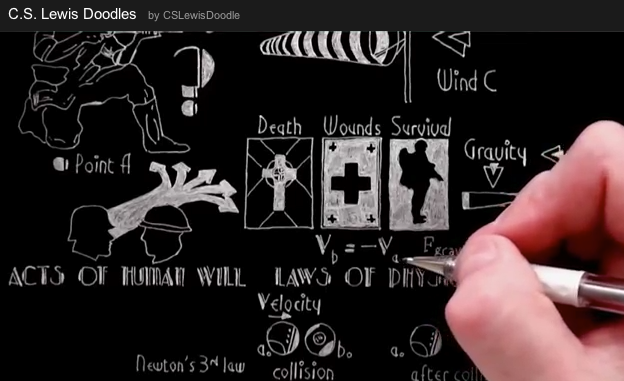
csl doodlesA recent post at the wonderful C.S. Lewis Minute blog introduced me to an amazing new way to experience the brilliance of the great author. I want to pass on the information so that you too can enjoy it.

The site is called “C.S. Lewis Doodles,” and it is the creation of a Kiwi (New Zealander) named Kalman Kingsley.

Kingsley uses a skillful artistic presentation of the clearly read original essays, to give Lewis’ words a particularly engaging and comprehensible air. It is, in a sense, C.S. Lewis “updated” to contemporary media.

Lewis himself alluded to the value of different types of media in communicating. In “Studies in Words” he says, “Language exists to communicate . . . Some things it communicates so badly that we never attempt to communicate them by words if any other medium is available.” Of course, in this case Lewis’ words are profound—in and of themselves. However, the addition of the illustrations serves to highlight and amplify his message.

Lewis, after all, passed away nearly sixty years ago, when most homes still owned black and white televisions. Technology has advanced light years since then, and transposing Lewis’ timeless wisdom to new formats such as this is an important work worthy of the talents of innovative men and women.

C.S. Lewis Doodles is available here, but don’t head there until you finish reading this Mere Inkling post.

The YouTube “Channel” offers three essays:

“The Grand Miracle” (from a sermon about the Incarnation preached in 1945)

“The Laws of Nature” (a 1945 consideration of the interplay between Nature and prayer)

“On ‘Sexual’ Morality” (a 1963 essay entitled “We have No ‘Right to Happiness’”)

All three of these essays are found in the collection published as God in the Dock. (For Americans the last word in that title refers not to a marina, but to a courtroom.)

Because each presentation covers an entire essay, they range in length from eight to ten minutes. Nevertheless, they are so well presented that they will certainly hold your interest.

I believe Lewis would have enjoyed this presentation of his work. Had he been an artist and had access to this technology, he may have experimented with it himself. As he wrote to Arthur Greeves in 1933, his book Pilgrim’s Regress is “going to be decorated by a map on the end leaf which I had great fun in drawing the sketch for.”

You can hear (and view) Lewis’ thoughts on “the Laws of Nature,” by clicking on the image below.

_____

C.S. Lewis Minute is a website every true Lewis fan should be following. You can read the column I referred to—and subscribe to the blog—here.

Our Common Tongue

Bruegel BabelThe ancestors of Europeans and Asians spoke a common language 15,000 years ago, as the ice age was ending.

That “discovery” sounds remarkably familiar to those acquainted with an ancient story about a colossal edifice erected in the ancient past. The Hebrews preserved a record of the achievement in the eleventh chapter of the book of Genesis. At the time of the tower’s construction, all of humanity consisted of “one people [sharing] one language.”

The argument for just such a common language is made in a detailed study published this week in the Proceedings of the National Academy of Sciences. After finishing this column, you may wish to read the original journal article, which is available here.

The mechanics of the study will be of great interest to all logophiles (word lovers).

Using sophisticated statistical analysis, the researchers identified 23 different words that have remained recognizable for fifteen millennia. These “ultraconserved” words include some of the fundamental building blocks of basic communication. They include: not, mother, man (i.e. male), we, this, hand, old, fire, ashes and (rather oddly) worm.

The study identifies “proto-words” that underlie common terms in extremely diverse languages. It is no accident that these universal words are the ones that are the most concrete, frequent and essential for human communication.

The Languages of the World Etymological Database, part of the Tower of Babel project . . . records reconstructed proto-words for language families from around the world. Proto-words are hypotheses as to the form of the word used by the common ancestor or proto-language of a given language family to denote a given meaning.

These words are reconstructed by first identifying cognate words among the languages of a given family and then, because cognate words derive from a common ancestral word, working back in time to reconstruct the probable features of that shared ancestral form.

J.R.R. Tolkien was a brilliant linguist, and his abiding love of languages provided the impulse for the creation (and intricate history) of all of Middle Earth.

C.S. Lewis was one of the twentieth centuries greatest writers. He was also a scholar—one with an outstanding grasp of literature. Lewis acknowledged that words describing immediate, touchable concerns can be distinct and firm, just like the realities they connote. However, when language moves farther from such elements, it invariably grows more abstract.

All language, except about objects of sense, is metaphorical through and through. To call God a “Force” (that is, something like a wind or a dynamo) is as metaphorical as to call Him a Father or a King. On such matters we can make our language more polysyllabic and duller: we cannot make it more literal. The difficulty is not peculiar to theologians. Scientists, poets, psychoanalysts, and metaphysicians are all in the same boat. (God in the Dock, “Horrid Red Things”).

The linguistic study described here notes that frequency of usage exerts a stabilizing influence on words. Whereas less common (and more abstract) vocabulary “evolves” more rapidly.

A rule-of-thumb emerges that words used more than around once per 1,000 in everyday speech evolve slowly enough to have a high chance of being judged cognate among more than two of the language families; this might equate to around 16 uses per day per speaker of these high-frequency words.

Throughout history various languages have vied with one another for precedence. In the Mediterranean world Greek, for a season, and then Latin for another, were the “universal” tongues. The phrase lingua franca (literally, the “Frankish language”) has now come to refer to any language that is extensively used as a common bridge between speakers of different tongues.

Such languages, of course, enhance communication. That is not to suggest, however, that the development of these “dominant” languages is without critics. It seems, for example, that France was delighted in their language serving for many years as a standard for international diplomacy. Today however, France continues to staunchly resist the advances of English. (In 1994 the initial version of the Toubon Law overreached in requiring the extensive use of French in nearly all contexts. You can read about some implications for international businesses here.)

Even C.S. Lewis regretted some of the negative influences of American English on the mother tongue. In his book Studies in Words, he mourns:

I have an idea of what is good and bad language. . . . Language is an instrument for communication. The language which can with the greatest ease make the finest and most numerous distinctions of meaning is the best. It is better to have like and love than to have aimer for both.

It was better to have the older English distinction between “I haven’t got indigestion” (I am not suffering from it at the moment) and “I don’t have indigestion” (I am not a dyspeptic) than to level both, as America has now taught most Englishmen to do, under “I don’t have.”

It remains to be seen whether any single language will come to truly dominate the world scene. Being able to communicate freely across all political borders sounds like a noble goal. It is ironic that should that day ever arrive it will mark a return to how things once began.

_____

The painting reproduced above was painted circa 1563 by the Flemish artist Pieter Bruegel the Elder.

A Literary Phobia

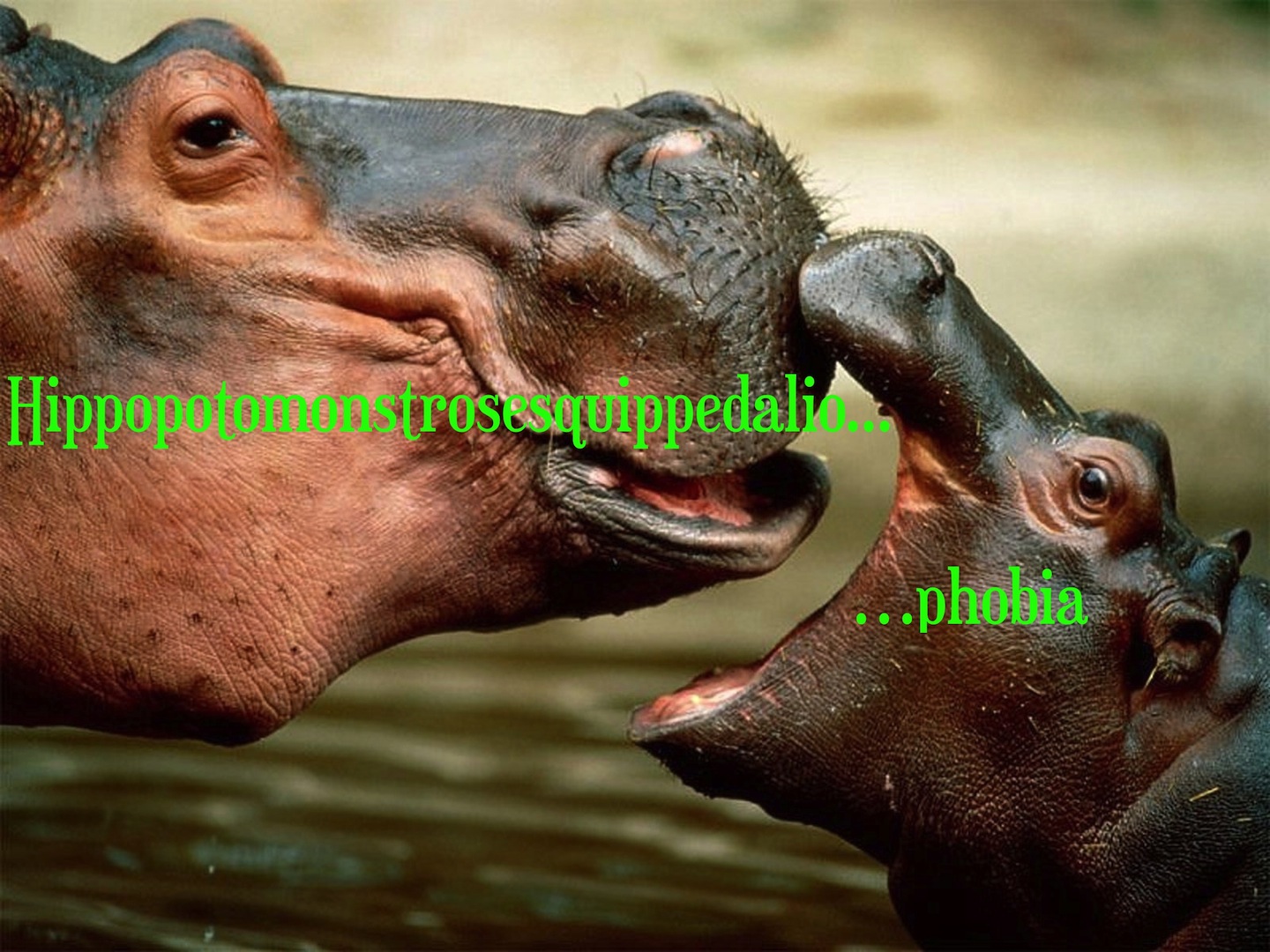
hipposWhat in the world does this protracted word mean?

Hippopotomonstrosesquippedaliophobia

From the suffix, we can assume that it refers to some sort of “fear.” But fear of what? Hippopotami?

No, this lengthy word doesn’t refer to the African “river horses” from which it derives its beginning. This peculiar construction describes nothing other than a fear of long words!

I know people who find long words daunting . . . but none who have admitted to be in fear of them. I myself am a bit intimidated by unfamiliar words that I have to pronounce in front of others. (I recently visited a writing group that caught me off guard with their practice of reading one another’s work out loud. Not only was I the first person expected to begin reading the first article critiqued that morning—it included a number of words from French cuisine with which I was unfamiliar.)

I don’t mind encountering unfamiliar words in a text (that I’m reading privately), especially when the meaning is evident from the context. In fact, I often enjoy the introduction, since it expands my own vocabulary.

The fact his, however, that many very gifted writers warn their readers to avoid lengthy or complicated words.

Just last week I contrasted George Orwell’s writing advice with that of C.S. Lewis. Orwell said,

“Never use a long word when a short one will do.”

C.S. Lewis, included in his short list of advice the encouragement to,

“Always prefer the plain, direct word to the long, vague one.”

While these suggestions may “sound” identical, they are not. Orwell is concerned here with simplicity (rather than brevity, per se). Lewis, though, is advocating clarity.

Lewis does not object at all to using a multisyllabic word. He merely argues that the choice needs to be one that helps communicate rather than confuse. Allow me to share a simple example. Following Lewis’ counsel, one of these sentences would be problematic, while the other would be okay.

Life is all about love.

Experiencing contentment and joy relates directly to one’s ability to offer, and receive, affection from other human beings.

Obviously one sentence is far more complex than the other. However, it’s meaning is quite clear. The simpler, five word sentence is so vague as to allow for any number of interpretations. For example, in addition to the alternative above, it might mean (to its writer):

Without a foundation of self-love, we cannot experience life to its fullest.

     or . . .

At the Final Judgment, it is only our acts of love that will pass intact through the “purifying fire.”

     or . . .

The more people with whom you can “sow your wild oats,” the happier you will be.

The Government Intervenes

Amazing as it may seem, the United States government actually has a website devoted to promoting simple language: plainlanguage.com. It exists to help implement the Plain Writing Act of 2010.

While the effectiveness of the statute is debatable, it’s intention is praiseworthy.

On one page it directs agencies to avoid complex words. Instead of “endeavoring to assist,” writers are told to use “told to help.” While that is absolutely commendable in governmental documents, I prefer a bit more flavor when I’m reading for pleasure.

I strongly encourage anyone suffering from hippopotomonstrosesquippedaliophobia to seek professional help. This is especially true for those who desire to express themselves clearly. We need never fear a lengthy word—as long as we are using the right word!

Hip-Hop Literary Lessons

flocabDo you ever have trouble remembering the key elements of a story? Well, you may not now, since you’ve become an accomplished writer. However, there was once a time when you were just learning about such matters. And that learning might have been far easier than it was if some of today’s teaching resources existed then.

This week I stumbled across a very unusual approach to teaching the fundamental building blocks of stories. You might want to bookmark the page, in case you ever experience difficulty remembering those five pesky elements required for your short fiction, or want to teach a young learner. You need look no further than Flocabulary’s innovative lesson “Five Things.”

The song is less than four minutes long, so go ahead and watch it now, before reading on. (Barring a small typo, it’s quite educational, and their website includes testimonials from teachers affirming how well it connects with young people.) Despite the fact that it’s got a hip-hop beat—not my favorite musical genre—it’s actually quite entertaining . . . and it’s easy to see how well it would connect with today’s younger students.

[Warning: If you watch the following video, you may well be singing along with the chorus before it ends.] Story Elements

Plot, Character, Conflict, Theme,
Setting, yes these are the 5 things
That you’re going to be needing
When you’re reading or writing
A short story that’s mad exciting.

Music is a powerful medium, and when it is harnessed for educational purposes, it can accomplish wonderful things.

Music can be enjoyed for itself . . . its own inherent loveliness.

Music can also be used to communicate holy things. I believe this is the very reason it exists. Divine grace and our response to our Creator’s love are too majestic to be restricted to simple words.

The brilliant African Bishop Augustine of the city of Hippo is cited as saying “he who sings, prays twice.” Many have echoed these words. I have no doubt Augustine believed this, but the more accurate quotation is: “he who sings well prays twice” (bis orat qui bene cantat). Lest those of us with less than professional vocal chords be dismayed, I am confident the “well” here refers here to worshiping God in spirit and truth (John 4:23).

I have no doubt which of these two pleases God more. The most wondrous voice ever created (a gift itself from our Creator) flawlessly navigating three octaves and singing of the cares of this world—or the feeble, cracking, off-key strains of a tone deaf beggar who is praising the Lord for the gift of his daily bread.

C.S. Lewis famously expressed his disaffection for most church hymnody in a 1950 letter where he wrote:

I naturally loathe nearly all hymns; the face and life of the charwoman in the next pew who revels in them, teach me that good taste in poetry or music are not necessary to salvation.

We must forgive Lewis his condescending comment here, which was only meant for a private communication. And, if read in context it can be interpreted almost as a sort of confession. While he disliked the quality of contemporary Anglican hymns, he was acutely aware of how insignificant the matter was in light of the vital importance of  knowing Christ. (His description of the glorification of the modest Sarah Smith in The Great Divorce reveals how well he recognized that the charwoman beside him, despite her musical preferences, could easily dwarf him in holiness and religious courage.)

In a letter written in 1916, Lewis alluded to the wonder of music, and it’s relationship to particular words. “Isn’t it funny the way some combinations of words can give you—almost apart from their meaning—a thrill like music?”

Toward the end of his life, Lewis invested much time in a literary study of Edmund Spenser’s The Faerie Queene. (It was actually published after his death, based upon his notes, as Spenser’s Images of Life. It includes a sparkling description of the book as a musical masterpiece.

A story of this kind is in a way more like a symphony than a novel. Corresponding to the themes of the musical form, the literary form has images, which may be delicious or threatening or cryptic or grotesque, but which are always richly expressive of mood.

The images are in every possible relation of contrast, mutual support, development, variation, half-echo, and the like, just as the musical themes are. But the ostensible connection between them all—what keeps the meddling intellect quiet—is here provided by the fact that they are all happening to someone.

They are all worked into the experience or the world of the characters “whose” story it is. That, no more and no less, is the raison d’étre of characters in the characterless story.

I have no doubt Lewis would have found the video above jarring. Yet, I suspect he would have approved of the fact that the music was creating a bridge to some for whom traditional learning is incomprehensible. He was a traditionalist. In many ways, a medievalist. But he was, above all, a redeemed child of God. And, because of that, he desired the best for his neighbor, his nation, and our world.

That said, I don’t want to hear that any readers of Mere Inkling got it into their heads to put any of C.S. Lewis’ words into hip-hop melodies. Ever!

_____

If you are interested in checking out the official website for Flocabulary, you can view their lesson “Wordplay” (on figurative language). I understand, however, that some of their lessons with political dimensions have been considered superficial.

Monastic Fonts

A with CrossRecent subscribers to Mere Inkling won’t know this, but some months ago I confessed to suffering an addiction. Like many others who love to write, I am a fontaholic.

That refers, of course, to being obsessed with discovering new and exotic font families.

For many months I’ve kept my compulsion in check, but I was recently caught off guard when I stumbled upon some alluring typefaces I had never encountered before.

I was particularly vulnerable to their charm due to my interest in medieval history. In fact, I was researching the coloration of illuminated manuscripts when I encountered them.

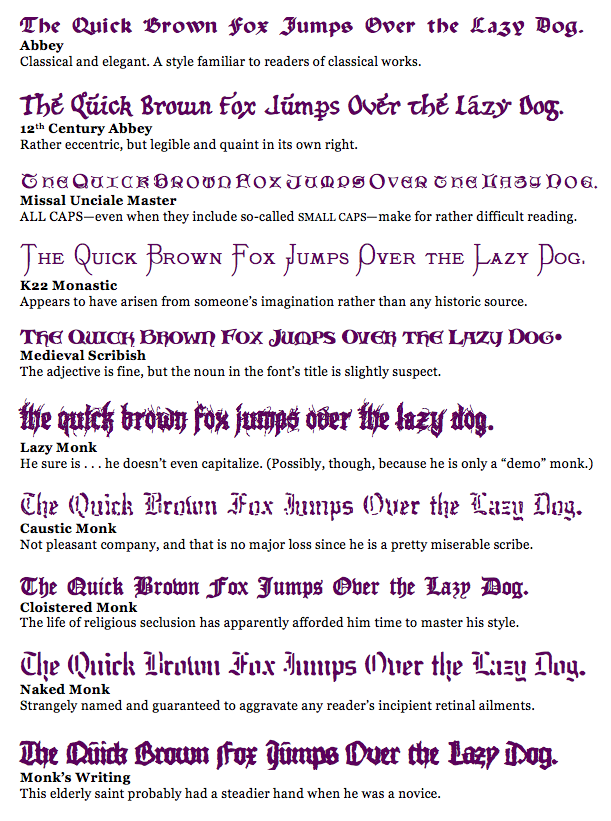
In case you share my weakness—or, even if you are merely curious—I offer examples of the novel fonts I was “forced” to add to my collection. And, you need not worry, since (if you are so inclined) you can download all of them for free at this site.

Each of the fonts below has some “monastic” connection. Obviously, some would be more useful than others, and a couple of them are admittedly quite peculiar. However, even the strangest of pens may be suitable for some applications.

Before contrasting some of these typefaces, it’s worth mentioning that you can also download a “Narnia” font—based on the letters used in the Hollywood version of C.S. Lewis’ classics.

And now, without further introduction, the fonts themselves . . .

medieval fonts