Whose “Best Books” List?

reading awardsMost readers recognize significant differences exist between British and American literature.

Not only do our literary tastes often differ, there are more than a few differences in the English we use . . . for example, whether we include our punctuation inside, or outside, of “quotation marks.”

With that caveat, it’s interesting to ponder the 2008 list of favorite books in the United Kingdom, as reported in The Telegraph. I’m unsure right now whether there’s a more recent list, but it would probably remain fairly stable a lustrum later. (It would, however, be interesting to see how Rowling’s works rank in fifty or seventy years. Not to mention Pullman’s Gnostic series.)

In their balanced compendium of passages from C.S. Lewis’ works, Martindale and Root point out the transitory nature of literary fads.

A book that is number one on the New York Times Best-seller List for several weeks may be all but forgotten a decade later. Popularity in a moment of history does not guarantee that a book will endure beyond its own time. C. S. Lewis once observed that, like fashions, the more up-to-date a book is, the sooner it is out of date.

One of the peculiarities of the list is that only a single book by any particular author was allowed in the top twenty-one titles.

I read somewhere that the average reader had only read an “average” of six of the books. I’m not sure how that is calculated, since I know a fair number who have not read—if they’re being honest—a single book in the survey (those assigned for coursework included).

And, now that I’ve made that seemingly judgmental statement, I need to be particularly truthful in my own list. That means I can’t check off a title because I saw the movie or read the Classics Illustrated edition . . . even though I think it would be fair to get partial credit for either of those options.*

I’ll reproduce the entire British classics canon in a moment, but since everyone will get distracted while they read it (assessing which titles they themselves have read), I’ll share my brief list first.

I’m not too embarrassed by its brevity, since 80% of my reading is nonfiction, and the list is decidedly not that. Also, I can honestly say that there are another ten or so titles here that I have begun to read, without being sufficiently interested to finish.

The truth is that just as less than a quarter of my reading is devoted to fiction, most of that focuses on my favorite genre, alternative history. And, for some reason unknown to me, none of those titles made the list!

Here is my humble account of British must-reads that I have actually finished.

 1) The Lord of the Rings (Ranked #2).

 2) The Bible** (#6)

 3) Nineteen Eighty-Four (#8).

 4) Catch 22 (#13).

 5) The Hobbit (#16).

 6) The Great Gatsby (#22).

 7) The Chronicles of Narnia (#33).

 8) The Lion, the Witch and the Wardrobe (#36)

 — Isn’t that a tad redundant (in the American, not the British, sense)?

 9) Winnie the Pooh (#40).

10) Animal Farm (#41).

11) Lord of the Flies (#49).

12) Dune (#52).

13) Brave New World (#58).

14) Moby Dick (#70).

15) Dracula (#72).

16) A Christmas Carol (#81).

17) Charlotte’s Web (#87).

18) Heart of Darkness (#91).

Interesting—I thought it would be shorter. Their presence on this short list, by the way, doesn’t indicate my recommendation of all of these. Some were assigned reading. I’ve also read some of Shakespeare and Sherlock Holmes, of course, but neither in their entirety.***

The full list follows. Enjoy going through it yourself to see how you stack up. And, don’t be intimidated if the books you favor keep you too busy to read what others deem the most significant.

_____

* Just joking. I would never consider seeing a movie as the equivalent of reading a book; some of them bear little resemblance to their source. That acknowledged, sometimes the cinematic adaptations are better than the books.

** I know it only has a single Author, but shouldn’t this count as 66 books?

*** My lovely wife, who I sometimes compel to proofread for me, could not resist mentioning that she was able to check off many more titles on this list than I did. I chalk that up to her sharp intelligence (valedictorian, 4.0 in college and grad school, etc.), general perfectionism, speed-reading skills, tolerance for boring literature, and “compulsive” personality. All of that, plus her consuming love of reading.

Here’s the British list.

1 Pride and Prejudice – Jane Austen

2 The Lord of the Rings – JRR Tolkien

3 Jane Eyre – Charlotte Bronte

4 Harry Potter series – JK Rowling

5 To Kill a Mockingbird – Harper Lee

6 The Bible

7 Wuthering Heights – Emily Bronte

8 Nineteen Eighty Four – George Orwell

9 His Dark Materials – Philip Pullman

10 Great Expectations – Charles Dickens

11 Little Women – Louisa M Alcott

12 Tess of the D’Urbervilles – Thomas Hardy

13 Catch 22 – Joseph Heller

14 Complete Works of Shakespeare

15 Rebecca – Daphne Du Maurier

16 The Hobbit – JRR Tolkien

17 Birdsong – Sebastian Faulks

18 Catcher in the Rye – JD Salinger

19 The Time Traveller’s Wife – Audrey Niffenegger

20 Middlemarch – George Eliot

21 Gone With The Wind – Margaret Mitchell

22 The Great Gatsby – F Scott Fitzgerald

23 Bleak House – Charles Dickens

24 War and Peace – Leo Tolstoy

25 The Hitch Hiker’s Guide to the Galaxy – Douglas Adams

26 Brideshead Revisited – Evelyn Waugh

27 Crime and Punishment – Fyodor Dostoyevsky

28 Grapes of Wrath – John Steinbeck

29 Alice in Wonderland – Lewis Carroll

30 The Wind in the Willows – Kenneth Grahame

31 Anna Karenina – Leo Tolstoy

32 David Copperfield – Charles Dickens

33 Chronicles of Narnia – CS Lewis

34 Emma – Jane Austen

35 Persuasion – Jane Austen

36 The Lion, The Witch and The Wardrobe – CS Lewis

37 The Kite Runner – Khaled Hosseini

38 Captain Corelli’s Mandolin – Louis De Bernieres

39 Memoirs of a Geisha – Arthur Golden

40 Winnie the Pooh – AA Milne

41 Animal Farm – George Orwell

42 The Da Vinci Code – Dan Brown

43 One Hundred Years of Solitude – Gabriel Garcia Marquez

44 A Prayer for Owen Meaney – John Irving

45 The Woman in White – Wilkie Collins

46 Anne of Green Gables – LM Montgomery

47 Far From The Madding Crowd – Thomas Hardy

48 The Handmaid’s Tale – Margaret Atwood

49 Lord of the Flies – William Golding

50 Atonement – Ian McEwan

51 Life of Pi – Yann Martel

52 Dune – Frank Herbert

53 Cold Comfort Farm – Stella Gibbons

54 Sense and Sensibility – Jane Austen

55 A Suitable Boy – Vikram Seth

56 The Shadow of the Wind – Carlos Ruiz Zafon

57 A Tale Of Two Cities – Charles Dickens

58 Brave New World – Aldous Huxley

59 The Curious Incident of the Dog in the Night-time – Mark Haddon

60 Love In The Time Of Cholera – Gabriel Garcia Marquez

61 Of Mice and Men – John Steinbeck

62 Lolita – Vladimir Nabokov

63 The Secret History – Donna Tartt

64 The Lovely Bones – Alice Sebold

65 Count of Monte Cristo – Alexandre Dumas

66 On The Road – Jack Kerouac

67 Jude the Obscure – Thomas Hardy

68 Bridget Jones’s Diary – Helen Fielding

69 Midnight’s Children – Salman Rushdie

70 Moby Dick – Herman Melville

71 Oliver Twist – Charles Dickens

72 Dracula – Bram Stoker

73 The Secret Garden – Frances Hodgson Burnett

74 Notes From A Small Island – Bill Bryson

75 Ulysses – James Joyce

76 The Bell Jar – Sylvia Plath

77 Swallows and Amazons – Arthur Ransome

78 Germinal – Emile Zola

79 Vanity Fair – William Makepeace Thackeray

80 Possession – AS Byatt

81 A Christmas Carol – Charles Dickens

82 Cloud Atlas – David Mitchell

83 The Color Purple – Alice Walker

84 The Remains of the Day – Kazuo Ishiguro

85 Madame Bovary – Gustave Flaubert

86 A Fine Balance – Rohinton Mistry

87 Charlotte’s Web – EB White

88 The Five People You Meet In Heaven – Mitch Alborn

89 Adventures of Sherlock Holmes – Sir Arthur Conan Doyle

90 The Faraway Tree Collection – Enid Blyton

91 Heart of Darkness – Joseph Conrad

92 The Little Prince – Antoine De Saint-Exupery

93 The Wasp Factory – Iain Banks

94 Watership Down – Richard Adams

95 A Confederacy of Dunces – John Kennedy Toole

96 A Town Like Alice – Nevil Shute

97 The Three Musketeers – Alexandre Dumas

98 Hamlet – William Shakespeare

99 Charlie and the Chocolate Factory – Roald Dahl

100 Les Miserables – Victor Hugo
Literary Recycling

cecilialevy cupOur last column on providing new homes for neglected books got me thinking about the notion of “recycling” in its broader contexts.

And, even though C.S. Lewis died before the modern concept of environmentalism reached its full bloom, I wondered if he had written anything on related concerns. As prolific as Lewis was, if one is diligent there is a good chance they can find something with a (sometimes admittedly tenuous) correlation to nearly any subject.

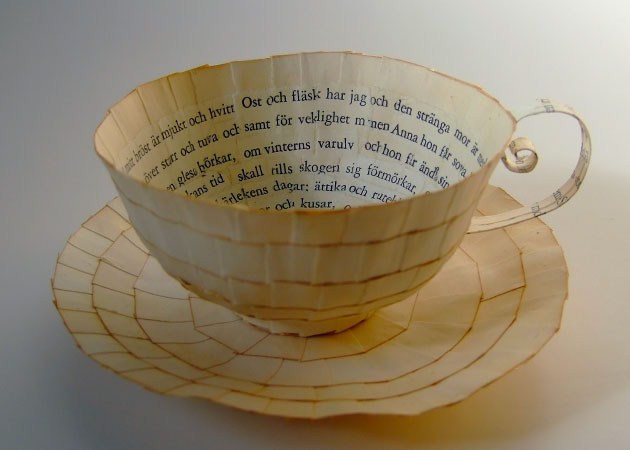
Before proceeding, I have to provide the source of the amazing illustration on this page. It is a graphic example of the creative recycling of literature. This teacup comes from the artistic vision of a Swedish artist, Cecilia Levy. You can view other examples of her artistry at her website here, and if you wish to reproduce them elsewhere, be sure to request permission (just as I did).

Returning to the concept of environmentalism, I wish to avoid political implications here. In general terms, however, I think it is fair to say the Scriptures teach that humanity is a “steward” of creation, which belongs not to us, but to its Maker. As stewards, we have been entrusted to be responsible in our management (use) of nature’s abundance. Wanton destruction should be called what it is—sin.

Now, this general principle manifests itself in a wide spectrum of responses, and attitudes are always subject to change. I vividly recall the very first Earth Day celebrated in the United States. I’m sure that being a high school student in a huge southern California school reinforced the indelible nature of the memory.

My wife and I have been diligent recyclers for many years . . . and that extends far beyond newspapers and aluminum cans. We have used countless items until their usefulness has ended. (Long past when they should have been replaced, in the opinion of our children.) I attribute much of our thriftiness to growing up in low income families where luxuries were few. But it arises not from that background alone. We also have a sense of responsibility to others, and dispatching items that are still usable to landfills just seems wrong.

I imagine Lewis possessed somewhat similar sentiments. He didn’t manifest much of a flair for extravagance. I don’t think he devoted that much thought to material possessions. I once read (but can’t find the source) that his brother and roommate Warnie was a bit frustrated by Lewis’ lack of concern for maintaining articles that were still in decent condition. Major Lewis, being a military man, focused on utilitarian considerations. The specific items of concern in the incident were some dishes or “crockery” that Warnie deemed to still be fit for service.

Both men were seasoned veterans of rationing, of course. Their skills at stretching things to go as far as possible were conditioned by years of deprivation. Americans are typically shocked to learn that rationing persisted in Europe after the end of the war. In an era characterized by excess and waste it’s difficult for us to put ourselves in their mindset.

Ironically, my hunt for a Lewisian passage on ecological concerns had nothing to do with rationing. It was rewarded when I looked at his essay “Willing Slaves of the Welfare State.” (The work is included in the delightful collection, God in the Dock.)

In this essay, Lewis is describing scientific advances as morally neutral. It is the application we choose to put our knowledge to, that determines its rightness. One of his illustrations alludes to care of the world in which we live.

The first is the advance, and increasing application, of science. As a means to the ends I care for, this is neutral. We shall grow able to cure, and to produce, more diseases—bacterial war, not bombs, might ring down the curtain—to alleviate, and to inflict, more pains, to husband, or to waste, the resources of the planet more extensively. We can become either more beneficent or more mischievous. My guess is we shall do both; mending one thing and marring another, removing old miseries and producing new ones, safeguarding ourselves here and endangering ourselves there.

Brilliant. And utterly true.

I also want to pass on an interesting observation made several years ago in another blog. The author references Lewis’ mention of the related concept of “plentitude.” You can read Tim Hagen’s full post here.

Since I’ve been reading a lot of C.S. Lewis lately, I figured I could use (and abuse?) a couple quotes from him in suggesting a philosophy of responsible waste management.  The Discarded Image is a piece that brings to light our modern misconceptions about the “Dark Ages.”  A testimony of medieval literature, for example, is how systematized their view of the universe was.  This organization grew out of classical authors such as Apuleius of Numidia, from whom Lewis draws two principles: the Triad (the idea that two entities – such as soul and body – can only meet each other through a third medium – in this case, the spirit) and Plentitude.  Lewis summarizes Plentitude in stating: “The universe must be fully exploited.  Nothing must go to waste.”  In other words, if something had the capacity to be useful, the medieval mind found a use for it.

The concept of plentitude as described here reminds me of the way people living in harsh environments cannot afford to waste anything. Eskimos, for example, are said to use every part of the seals they harvest . . . meat, blubber, bone, sinew. None of it is cast aside.

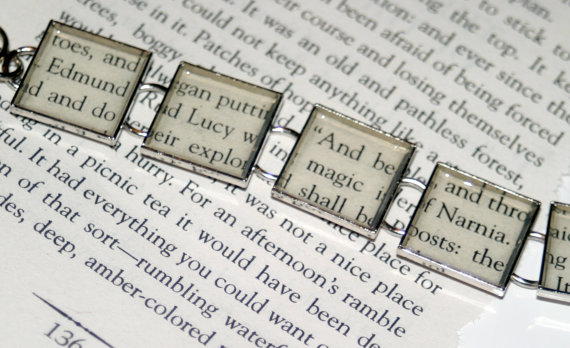
Let’s end these thoughts with another example of artistic creativity. This image shows how pages of a recycled copy of the Chronicles of Narnia can be recycled into jewelry. It comes from this commercial website which offers “one of a kind” items for sale. I don’t know whether this particular piece remains available, but I bet they would be willing to make you one of your very own if you’re interested. Then the cash from your wallet can be recycled into theirs. In exchange you’ll own a unique treasure that may become a wonderful conversation starter for many years to come.

narnia bracelet

Recycling Literature

recycled pageMany subscribers to Mere Inkling share a common trait with C.S. Lewis. Like your humble blogger, you are lovers of books. We don’t need to apologize for it; it’s in our DNA.

We carry that astonishing gene that manifests itself in a passion for the written word. (It’s frequently inherited from a parent who possessed the same ardor.)

If you’re one of this corpus of literary addicts, you just nod your head in agreement whenever you hear Lewis’ oft-quoted, “You can never get a cup of tea large enough or a book long enough to suit me.”

If you love books, if you don’t mind owning copies that others before you have enjoyed, and if you are on a tight budget, you might want to join me in becoming a customer of Better World Books.

[I have no interest in this nonprofit organization other than genuinely commending them to you as a wonderful source of inexpensive books. Most books have been officially removed from library collections . . . and require new homes. The “profits” are directed towards libraries and literacy programs.]

Many of us have enjoyed walking through rows of books on sale in local settings. This is a little like that, except that you can do digital searches and they have tons more titles available. (Literally.)

One of my recent purchases was Latin for the Illiterati. I purchased it the same day I bought The Anchor Book of Latin Quotations (for a secret project I’m working on).

Latin for the Illiterati includes “common phrases and familiar sayings,” that the reader is now able to decipher when encountered in classical literature. References do not have to be ancient to be included. For example, “salus populi suprema lex esto,” which means “the welfare of the people is the supreme law.” (But I didn’t need to translate that for you residents of Missouri, since it’s your own state motto.)

Quick test, which state has this as its motto? “Vox audita perit, litera scripta manet,” which means “the voice that is heard perishes, the letter that is written remains.” Actually, I cheated a bit, I don’t think it is any government’s motto, but it certainly is a truism that will resonate with readers!

C.S. Lewis valued rereading good books. In a 1915 letter, he wrote, “There is something awfully nice about reading a book again, with all the half-unconscious memories it brings back.”

In that same spirit, the following year he wrote to the same friend, “You really lose a lot by never reading books again.”

As I said, he was explicitly referring to revisiting a work already read. Nevertheless, I believe he would agree with the broader sense of his words . . . that it is a sad thing to see a book destined never to be read again.

Whether or not I am correct is irrelevant. The fact is that there are hundreds of thousands of books awaiting new homes. I don’t doubt that many of them “deserve” to be recycled for their raw materials. However, I also believe that the majority of them remain capable of teaching and inspiring. After all, litera scripta manet, right?