Nature’s Hazards

tumbleweedsNo matter where in the world you live, you are vulnerable to dangers uniquely associated with that locale. Some of us have moved around and weathered a variety of these threats.

My own family has survived earthquakes in our home state of Washington, ice storms in Oklahoma, nearby tornadoes in Texas, record-setting freezes in Minnesota, both droughts and failed levees in two different California cities along with a Super Typhoon in Guam. (Sometimes we’ve even been assailed by disasters that had no place occurring where they did, like a hurricane that knocked out our power for a full month in England, of all places!)

It’s quite possible that you too have experienced near misses when it comes to suffering Nature’s wrath. (I’d much rather attribute these things to fallen Nature than refer to them as “acts of God.”)

C.S. Lewis offers a wonderful description of Nature in Miracles.

You must have tasted, however briefly, the pure water from beyond the world before you can be distinctly conscious of the hot, salty tang of Nature’s current. To treat her as God, or as Everything, is to lose the whole pith and pleasure of her. Come out, look back, and then you will see . . . this astonishing cataract of bears, babies, and bananas: this immoderate deluge of atoms, orchids, oranges, cancers, canaries, fleas, gases, tornadoes and toads. How could you ever have thought that this was the ultimate reality? How could you ever have thought that it was merely a stage-set for the moral drama of men and women? She is herself.

Offer her neither worship nor contempt. Meet her and know her. If we are immortal, and if she is doomed (as the scientists tell us) to run down and die, we shall miss this half-shy and half-flamboyant creature, this ogress, this hoyden, this incorrigible fairy, this dumb witch. But the theologians tell us that she, like ourselves, is to be redeemed. The “vanity” to which she was subjected was her disease, not her essence. She will be cured, but cured in character: not tamed (Heaven forbid) nor sterilised. We shall still be able to recognise our old enemy, friend, play-fellow and foster-mother, so perfected as to be not less, but more, herself. And that will be a merry meeting.

But, until that glorious day when Nature has been reborn in the culmination of the event that took place on Calvary . . . until that day, Nature remains a capricious neighbor. It’s best to know what she is likely to throw at you based on where you reside—and be prepared. Disaster preparedness is something that the wise will concern themselves before catastrophe strikes.

There are some dangers, however, for which one cannot adequately prepare. The prospects of mega-tsunamis terrify me (and I don’t even live by the sea). Then there are zombie outbreaks, which are apparently taking place on a frequent basis, if the plethora of media on that ghoulish subject is any indication.

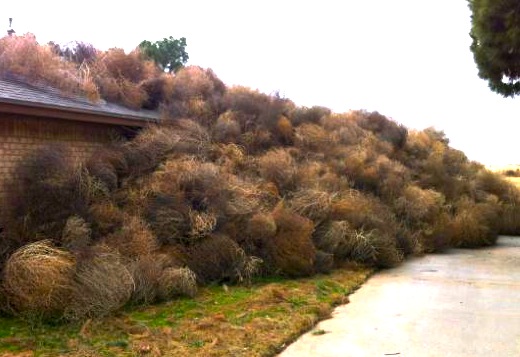
The photograph at the top of this page reveals a grim threat to life on the American plains. There may be a few other places where these merciless creatures wreak havoc (the arid portions of Australia, perhaps), but I hope most of those reading this have been spared the visage of plagues of tumbleweeds racing across the horizon in search of victims to overrun, scar, and bury. As the picture shows, sometimes it is not even safe to shelter in a home during a particularly virulent attack.

I’ve seen many a wayward tumbleweed, while I’ve driven across barren desert terrains. Occasionally you’ll see them alone, scouting ahead of the mass for weak prey. If you see an entire horde, well . . . it’s probably already to late to flee.

This picture makes me shiver. It’s one reason I’m so happy to have moved home to Puget Sound, where the incessant rain* keeps everything green. I can put up with an occasional tectonic jiggle, if it means I don’t have to worry about being buried alive beneath a mountain of desiccated thorns.

_____

* The rainfall in western Washington is highly exaggerated. It’s true that for half of the year it receives more rain than the national average, but the other six months it receives less than average of the rest of the nation.

Also, I don’t believe it is an accident that one of the most commonly encountered tumbleweeds in the United States is Salsola tragus, an utterly humorless thistle that invaded from Russia at the end of the nineteenth century. Despite occasional eruptions, it seems to be lying in wait, for the most part, growing in strength for the final conflagration between humanity and noxious weeds and their allies, the triffids.

To Tweet or Not to Tweet

platypusI have a twitter account I’ve never used. I had attended a ministry conference where the featured speaker encouraged all of the pastors to harness the power of this cutting edge technology.

I dutifully returned home, established an account, and realized there were very few things I wanted to say in 140 characters or less. One hundred and forty words . . . now you’re talking. But a mere seven score letters . . . I don’t think so.

I know there are many positive things about brevity. In our hectic world, it’s become an absolute necessity. Still, some things—to be expressed more clearly and (dare I say it, “entertainingly”)—demand more than two and a half sentences.

I was recently reading an article entitled “Tweets Before Twitter,” and it gave me cause to reconsider the prospect of using twitter to share worthwhile ideas. It described “ingenious brevity inspired 150 years ago by telegrams. . . . when people had to pay as much as $1 per Morse-coded word to dispatch a cable overseas, only a robber baron could afford to be loquacious.”

Now, that’s a sobering thought, especially since one of the dollars of that era would likely translate into about $214.17 today (by rough estimate). With that incentive, many telegraphs employed cryptic shorthand similar to the increasingly familiar terminology of the tweetworld.

However, one example they cited was different. It did not rely on learning a new language of contemporary abbreviations. Instead, it appealed to a much older language, Latin. Here’s the example they reported.

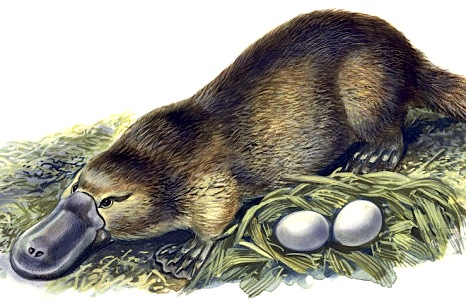
Monotremes oviparous, ovum meroblastic.

Translation: In the 19th century one of the greatest scientific debates was whether the platypus laid eggs, a fact that zoologist William Hay Caldwell was finally able to confirm in 1884. Here he uses Latin to cable his discovery from Australia to the British Association for the Advancement of Science. Since Latin had words for high-level scientific concepts, Caldwell could condense an entire paper into one brief sentence, letting colleagues know that platypus embryos develop like birds instead of mammals.

If I could remember the Latin I studied back in high school . . . And, if the people I was tweeting could read what I was saying . . . I just might reconsider my decision not to tweet. But I regard that event highly unlikely.

For now I’ll remain more than content to post a couple of times a week to Mere Inkling, in the hopes that a few of my words prove helpful or entertaining.

Finally, although the great unknown of platypus parenting was discovered in 1884, I’ve been pondering another mystery of the Ornithorhynchus anatinus. Why was it, that C.S. Lewis failed to include these wondrous creatures in Narnia? Perhaps it was because their semi-aquatic nature meant they would be of little value in the battles that marked the events recorded in the Chronicles? I have little doubt that despite the absence of their mention, Narnia’s waters teemed with their frolicking duck bills, otter feet and beaver tails.

Beware of Beavers

beaverIt’s rather ironic that after my last post on the peaceful harmony of wildlife I would choose to post on the subject of increasing violence among once peaceful forest mammals.

Beavers—of all the unlikely creatures—have apparently been growing more aggressive.

That’s a far cry from the gentle domestic rodents C.S. Lewis introduced us to in The Lion, the Witch and the Wardrobe. Just consider the politeness of Mr. and Mrs. Beaver when the Pevensie children are meeting Aslan for the first time:

“Go on,” whispered Mr. Beaver.

“No,” whispered Peter, “you first.”

“No, Sons of Adam before animals,” whispered Mr. Beaver back again.

As if we needed another reminder that we’re not in Narnia, reports out of Belarus indicate that beaver attacks are on the rise. In the most serious attack, a sixty year old man was actually slain by one of the web-footed amphibians. Accounts said a major artery in his leg was sliced by its “razor-sharp teeth.”

A frightening picture indeed.

Well, worrisome certainly . . . until we hear the rest of the story.

It turns out the fisherman was assaulting the poor little animal. While we must remain considerate of the grief of the sportsman’s family, it appears he was driving past the beaver—which was presumably minding its own woodland business—when he decided it would be fun to grab it and force it to pose for a picture with him.

Apparently—make note of this lest you inadvertently arouse a beaver’s ire—since they are predominantly nocturnal, beavers become disoriented and irritable when forced to pose for portraits during the daytime.

It’s one thing to enjoy nature’s wildness from a distance. Quite another to interpose ourselves and expect undomesticated beasts to behave with good manners. After all, as we learned when Aslan created Narnia, he didn’t civilize all of the furry beavers:

He was going to and fro among the animals. And every now and then he would go up to two of them (always two at a time) and touch their noses with his. He would touch two beavers among all the beavers, two leopards among all the leopards, one stag and one deer among all the deer, and leave the rest. (The Magician’s Nephew).

Military Helmets

War is deadly business. And, if a kingdom or nation hopes to emerge victorious, they are wise to equip their soldiers properly. That’s why this fact, included in today’s Ripley’s Believe It or Not comic, is so shocking.

It’s inconceivable that as the world marched to war in 1914, not a single one of the world powers equipped their troops with steel helmets. Elegant helms that looked superb on the parade ground . . . yes. Elaborate crests that exaggerated height to intimidate the foe . . . of course. Comfortable fabrics that kept the scorching sun off of the scalp . . . certainly.

But steel helmets that might actually spare men from bullet and shrapnel wounds . . . not those.

It’s not like the danger of ballistic wounds caught the Europeans off guard. Muskets had given way to deadly rifles long before. Artillery had advanced to the point where the Germans actually built not one, but two unique weapons: (1) Big Bertha, a huge howitzer that lobbed an eighteen hundred pound shell nearly eight miles, and (2) the Paris Gun, a siege cannon able to fire its shell eighty miles!

As soldiers like C.S. Lewis and J.R.R. Tolkien rallied to the flag and fought the Huns, they would eventually be issued more protective equipment. But it didn’t exist at the war’s outset. And even with it, Lewis was severely wounded in combat. in 1939 he wrote, “My memories of the last war haunted my dreams for years.”

The irony about metal helmets is that even ancient peoples recognized the importance of protecting the skulls of their warriors with the strongest materials available. In my office I have a replica Roman legionary helmet. Trust me, it was capable of saving lives.

Today’s combat helmets are highly advanced, and great effort is made to protect military members from head trauma. Sending them into battle with anything less than the best equipment available should be a crime.

Educational Headaches

Doing a bit of research about Chinese poetry, I came across a fascinating sentiment that has been reverberated across the centuries since it was first penned by Du Fu in the eighth century.

Du Fu was a prominent poet and a dedicated civil servant who believed in making his kingdom a better place for all. He lived during a tumultuous era and survived several major revolts. (Such turmoil is often said to provide fertile fodder for the poet’s heart.)

At one point he earned the displeasure of the emperor and was demoted to a position as Commissioner of Education. He served diligently but found the duties onerous. Foremost among his complaints was the timeless curse of administrators and teachers:

I am about to scream madly in the office.

Especially when they bring more papers to pile higher on my desk.

It’s true that most of us get buried under greater mounds of paperwork as we advance in our careers . . . but it is a particular shame when teachers (people who are there in the trenches because they love kids) suffocate under stifling piles of trivial record-keeping debris.

If you’re interested in reading a couple of verses composed by Du Fu, you can find them on the internet. Or, you could wait a couple weeks for the release of Curtana 2.2 (the free journal I edit), and read them there.

The Inklings (especially C.S. Lewis and J.R.R. Tolkien) are exemplars of the tradition of dedicated patriots and poets who devoted their energies to improving our world. And, I doubt you’d need to search very hard to find in their writings an echo of this disaffection for the piles of meaningless work each of them had to wade through during their prolific lives.

Stained Glass Fiasco

It’s shocking, what you come across on the internet. You see many things that were never meant to be. I place this stained glass window of Mr. T in that category.

Yes, I recognize that he is a Christian, and his gold (24 carat) cross is prominently displayed. But still . . .

I was surfing in search of a good portrayal of Saint Martin of Tours. Not quite sure how the most distinctive member of the A-Team appeared in the list.

At least it provides an excellent reminder that a person should be prepared for the unexpected whenever they enter the worldwide web. (It’s not likened to a spider’s domain without reason.)

Addendum:

I realize that you are not comparing Mr. Tureaud to an arachnid, but you really should be much more careful in how you jump from thought to thought.

Sharing Surnames

“‘It isn’t Narnia, you know,’ sobbed Lucy. ‘It’s you. We shan’t meet you there [again]. And how can we live, never meeting you?’

‘But you shall meet me, dear one,’ said Aslan.

‘Are—are you there too, Sir?’ said Edmund.

‘I am,’ said Aslan. ‘But there I have another name. You must learn to know me by that name. This was the very reason why you were brought to Narnia, that by knowing me here for a little, you may know me better there.’”

C.S. Lewis, The Voyage of the Dawn Treader

 Names are precious, and the way that others who share your name bring to it honor or dishonor is important. As Ecclesiastes says, “A good name is better than precious ointment . . .”

I may be more sensitive to this truth than most people, because I grew up with a modestly (in)famous name. Fewer people recognize the link today, since the Burt Lancaster film that publicized the Birdman of Alcatraz is rarely aired. When I was a kid, it seemed to be run annually, like the Wizard of Oz, and I invariably could count on someone making the name connection every time it ran.

Actually, it wasn’t all that bad. Lancaster’s portrayal of the compassionate inmate was extremely sympathetic. The connection didn’t bother me much. Well, not until I read about the genuine Robert Stroud. Not quite as appealing a human being. Enough said.

Anya Stroud, WarriorIf you conduct some web searches on variations of your family name, you’ll be surprised what you find. I recently came across a fictional “relative” named Anya Stroud. She looks like someone you’d like to have at your side in an apocalyptic battle, doesn’t she? I understand she is a resident of just such a violent world, in the game system she inhabits.

Returning though to the real world . . . what we do with our name means a great deal to others who share it, especially to our family. Perhaps most of all, to our descendants. Much better for them to look back upon an honorable and godly ancestor rather than a vile example of unredeemed humanity.

And there is another aspect to guarding our name. One of the names followers of Jesus are known by is “Christian.” This is the most precious name we can hold. It is because of this name we can approach our Creator and call him “Father.”

This is a name we should strive to protect and make praiseworthy. We should not however try to earn it, since that’s impossible. It’s a name given simply as a gift, to all who believe Jesus is the Christ, the Messiah promised to be our Redeemer.

Addendum:

Parents are blessed when their children bring honor to their name. So too our Father in heaven. In a world where many hypocrites appeal to his name to defraud and mislead others, it is good to be reminded that our calling as disciples is to live in a manner that conforms to God’s command: “You shall therefore be holy, for I am holy.”

Soldiering for Nine Decades?

Ninety Years in the French Army

Today’s edition of “Ripley’s Believe It or Not” included the peculiar remark about a French soldier who served ninety years in their army–all without a single promotion! Having served nearly a quarter of a century in uniform myself, I found it daunting to imagine nearly a century in the ranks.

A little research verified the fact. Jean Theurel (1699-1807) was a fusilier with the unbelievable record. And his service was uninterrupted, despite being severely wounded in battle twice. As for finishing his career as a private, it turns out that he had turned down many opportunities for promotion. Although he was lauded as the “oldest soldier in Europe,” it’s hard to imagine anyone else serving longer on a different continent. (Or wanting to, for that matter…)

Addendum: 

The Dashing Octogenarian This painting reveals a much more dignified portrayal of the veteran than does your illustrated version (which does not at all befit the proper decorum of a scriptorium).

Serving one’s country with integrity is an honorary thing. But better by far is following the Lord of Hosts and the Prince of Peace.