Stephen King Echoes C.S. Lewis

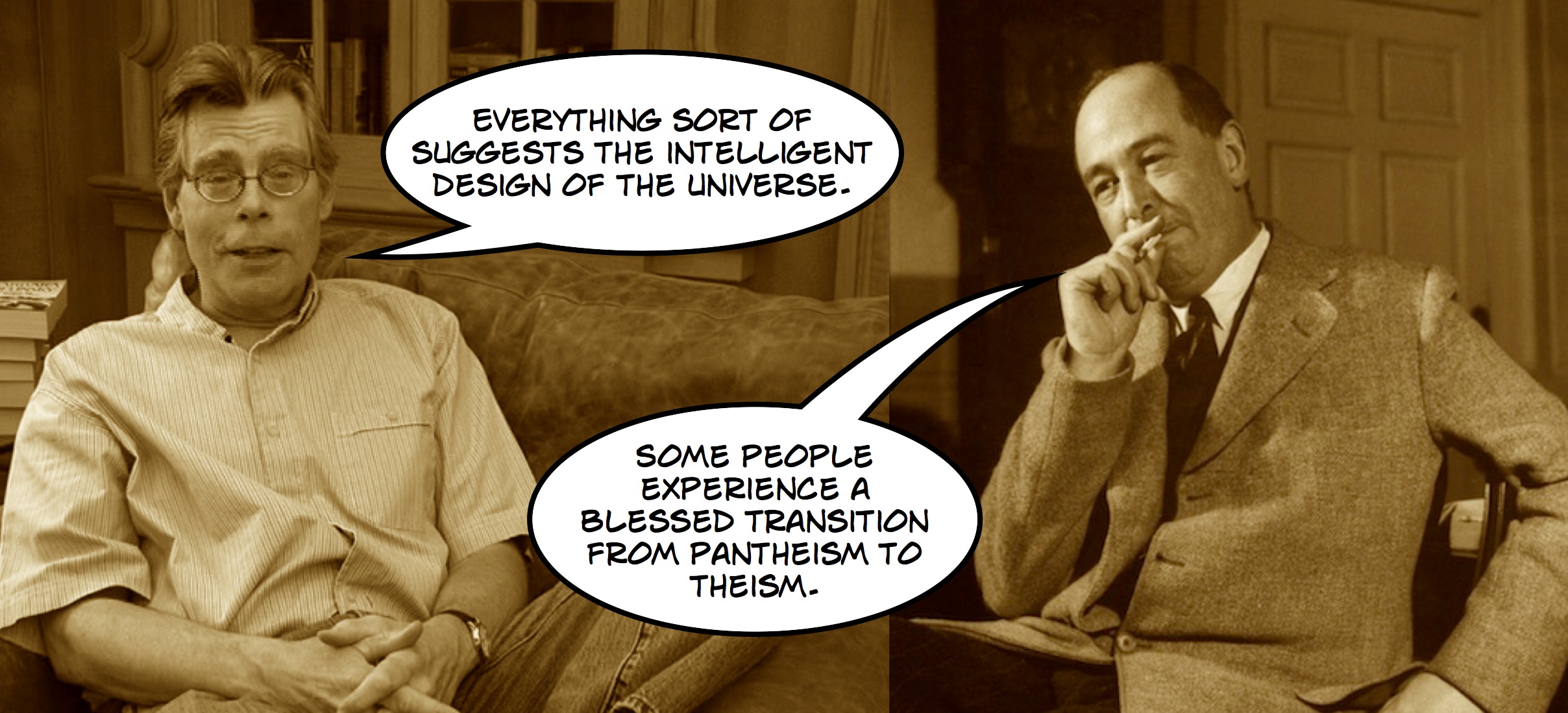
csl and kingAuthor Stephen King surprised quite a few fans during a recent PBS interview when he expressed his belief in the universe’s intelligent design. In nature and the cosmos, like theist C.S. Lewis before him, he views a creation so complex and wondrous that he thinks it makes more sense to believe in a divine power than to dismiss faith.

During the interview, King said,

I choose to believe it, yeah. I think that . . . there’s no downside to that, and the downside—if you say, well, OK, I don’t believe in God, there’s no evidence of God—then you’re missing the stars in the sky, and you’re missing the sunrises and sunsets, and you’re missing the fact that bees pollinate all these crops and keep us alive and the way that everything seems to work together at the same time.

In an essay, “Christianity and Culture,” C.S. Lewis alludes to the “Theist” phase of his own life. He points out how limiting a faith that recognizes God only abstractly, in his handiwork, can be.

There is an easy transition from Theism to Pantheism; but there is also a blessed transition in the other direction. For some souls I believe, for my own I remember, Wordsworthian contemplation can be the first and lowest form of recognition that there is something outside ourselves which demands reverence.

To return to Pantheistic errors about the nature of this something would, for a Christian, be very bad. But once again, for “the man coming up from below” the Wordsworthian experience is an advance. Even if he goes no further he has escaped the worst arrogance of materialism: if he goes on he will be converted.

King is, of course, far from what one would properly call a “person of faith.”** Still, it may be that he is presently moving in a positive direction. The following words reveal his yearning for hope, criticism of institutional religion, and his as yet unanswered questions about why God allows suffering in our world.

It’s certainly a subject that’s interested me, and I think it interests me more the older that I get. And I think we’d all like to believe that after we shuffle off this mortal coil, that there’s going to be something on the other side because for most of us, I know for me, life is so rich, so colorful and sensual and full of good things, things to read, things to eat, things to watch, places to go, new experiences, that I don’t want to think that you just go to darkness. . . .

But as far as God and church and religion and . . . that sort of thing, I kind of always felt that organized religion was just basically a theological insurance scam where they’re saying if you spend time with us, guess what, you’re going to live forever, you’re going to go to some other plain where you’re going to be so happy, you’ll just be happy all the time, which is also kind of a scary idea to me. . . .

Everything is sort of built in a way that to me suggests intelligent design. But at the same time there’s a lot of things in life where you say to yourself, well, if this is God’s plan, it’s very peculiar. And you have to wonder about that guy’s personality, the big guy’s personality. . . . What I’m saying now is I choose to believe in God, but I have serious doubts.

For many intelligent people, like C.S. Lewis and Stephen King, coming to faith cannot be severed from their reason. They desire to make sense of the world. Some, sadly, determine that human beings perish forever with their final breath. With that worldview, using King’s words, “you just go to darkness.”

Fortunately many others—brilliant and simple people alike, for God shows no partiality—possess true wisdom and heed the words of Jesus, that he is the way, the truth and the life. Both of these writers experienced an ineffective exposure to the church when they were young. Unfortunately, it served as more of an inoculation than a foundation.

Eventually C.S. Lewis followed that path from theism to Christianity. It’s not impossible that Stephen King may, as well.

_____

* A full transcript of the PBS interview is available here.

** In the interview, King “commends” the entertainment value of enthusiastic, emotionally-charged preaching, while disparaging his own mainline upbringing.

I went to a Methodist church for years as a kid, and Methodist youth fellowship on Thursday nights, and it was all pretty – you know, think of a bottle of soda with the cap off for 24 hours. There weren’t very many bubbles left in that stuff by then. It was pretty – it was Yankee religion, Terry, and there’s really not much in the world that’s any more boring than that. They tell you that you’re going to go to hell, and you’re half-asleep.
Not to be Missed

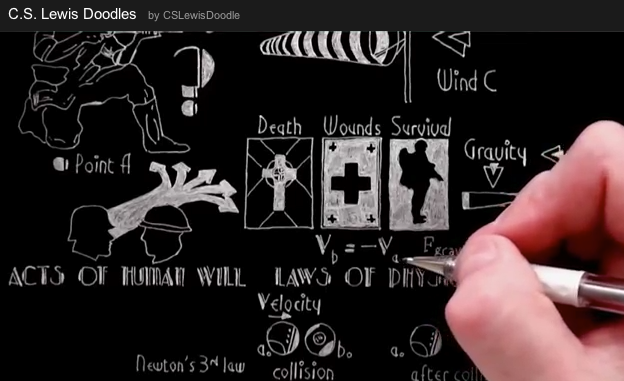
csl doodlesA recent post at the wonderful C.S. Lewis Minute blog introduced me to an amazing new way to experience the brilliance of the great author. I want to pass on the information so that you too can enjoy it.

The site is called “C.S. Lewis Doodles,” and it is the creation of a Kiwi (New Zealander) named Kalman Kingsley.

Kingsley uses a skillful artistic presentation of the clearly read original essays, to give Lewis’ words a particularly engaging and comprehensible air. It is, in a sense, C.S. Lewis “updated” to contemporary media.

Lewis himself alluded to the value of different types of media in communicating. In “Studies in Words” he says, “Language exists to communicate . . . Some things it communicates so badly that we never attempt to communicate them by words if any other medium is available.” Of course, in this case Lewis’ words are profound—in and of themselves. However, the addition of the illustrations serves to highlight and amplify his message.

Lewis, after all, passed away nearly sixty years ago, when most homes still owned black and white televisions. Technology has advanced light years since then, and transposing Lewis’ timeless wisdom to new formats such as this is an important work worthy of the talents of innovative men and women.

C.S. Lewis Doodles is available here, but don’t head there until you finish reading this Mere Inkling post.

The YouTube “Channel” offers three essays:

“The Grand Miracle” (from a sermon about the Incarnation preached in 1945)

“The Laws of Nature” (a 1945 consideration of the interplay between Nature and prayer)

“On ‘Sexual’ Morality” (a 1963 essay entitled “We have No ‘Right to Happiness’”)

All three of these essays are found in the collection published as God in the Dock. (For Americans the last word in that title refers not to a marina, but to a courtroom.)

Because each presentation covers an entire essay, they range in length from eight to ten minutes. Nevertheless, they are so well presented that they will certainly hold your interest.

I believe Lewis would have enjoyed this presentation of his work. Had he been an artist and had access to this technology, he may have experimented with it himself. As he wrote to Arthur Greeves in 1933, his book Pilgrim’s Regress is “going to be decorated by a map on the end leaf which I had great fun in drawing the sketch for.”

You can hear (and view) Lewis’ thoughts on “the Laws of Nature,” by clicking on the image below.

_____

C.S. Lewis Minute is a website every true Lewis fan should be following. You can read the column I referred to—and subscribe to the blog—here.

Why War?

bulletsI recently read a profound statement penned by G.K. Chesterton. Although he was not a military veteran himself, he was absolutely on target when he wrote: “The true soldier fights not because he hates what is in front of him, but because he loves what is behind him.”

Terrible things are happening today in Syria. Yesterday, over lunch, I “debated” one of my sons regarding the merits (and drawbacks) of American intervention in that Levantine cauldron.

He believes we can’t “stand by” while the world watches as a civil war rages around another of the world’s mad dictators. I argued the United States isn’t morally responsible to serve as the world’s guardian of peace. And, even if we as a single, fallible, divided people were accountable . . . what about the violence and injustice in so very many other places. Sudan, Myanmar (Burma), the Congo, and scores of other lands cry out for intervention on behalf of the oppressed.

There is an almost unlimited amount of injustice around the globe today. And, looking in the mirror, it’s evident we have problems to resolve right here.

Sending American troops to intervene in foreign civil wars is ugly business. Taking sides against dictators does not always provide a safer and more just world—we need look no further than the so-called Arab Spring to reveal that.

I was proud to serve my nation—and causes I believed in—during the liberation of Kuwait and the retaliation for the September 11 attacks on the United States a decade later.

I am now retired from active duty, and I’ve lived long enough to witness how little positive fruit seems to follow war.

Like C.S. Lewis, I remain persuaded that some evils are so malevolent (Hitler, for example, comes to mind) . . . that they must be confronted. As he wrote in “The Conditions for a Just War,”

If war is ever lawful, then peace is sometimes sinful.

At the same time, however, war is something into which we should never rush. It demands our conscious consideration of the cost and an accurate determination that the blood spilled—include that of noncombatants inevitably caught up in the horror—is a price worth paying.

It is that question which moral men and women must debate and ponder.

“Learning in War-Time” is a brilliant essay included in the collection which goes by the name of Lewis’ speech, “The Weight of Glory.” In the essay, Lewis discusses the seriousness of war. As a combat casualty during the First World War, he vividly understood its nature.

However, as a Christian, Lewis recognized that warfare is not the worst thing that can befall a human being.

What does war do to death? It certainly does not make it more frequent: 100 percent of us die, and the percentage cannot be increased. It puts several deaths earlier, but I hardly suppose that that is what we fear. Certainly when the moment comes, it will make little difference how many years we have behind us.

Does it increase our chances of painful death? I doubt it. As far as I can find out, what we call natural death is usually preceded by suffering, and a battlefield is one of the very few places where one has a reasonable prospect of dying with no pain at all.

Does it decrease our chances of dying at peace with God? I cannot believe it. If active service does not persuade a man to prepare for death, what conceivable concatenation of circumstances would? Yet war does do something to death. It forces us to remember it.

True. To die at enmity with God is a fearful thing. Still, even better than coming to faith during war (Lewis would surely agree), is recognizing God’s love and living a life of peace.

Books C.S. Lewis Loved

csl booksThose of us who admire C.S. Lewis respect his words on many subjects, not least of which would include literary matters. He was, after all, both a gifted writer and a professor teaching related subjects at two of the world’s most prestigious universities.

In 1962 The Christian Century asked him to list the ten titles most influential in his professional and philosophical life. (Most of these are available as free downloads on the internet.)

1. Phantastes by George MacDonald

2. The Everlasting Man by G. K. Chesterton.

3. The Aeneid by Virgil

4. The Temple by George Herbert

5. The Prelude by William Wordsworth

6. The Idea of the Holy by Rudolf Otto

7. The Consolation of Philosophy by Boethius

8. Life of Samuel Johnson by James Boswell

9. Descent into Hell by Charles Williams

10. Theism and Humanism by Arthur James Balfour

The following year Lewis was interviewed by Sherwood Wirt, longtime editor of Decision magazine. (Decision is published by the Billy Graham Evangelistic Association, and you can learn more about the publication here.)

During his interview, Wirt focused on spiritual rather than professional benefits from books Lewis had found beneficial.

Sherwood Wirt: What Christian writers have helped you?

C.S. Lewis: The contemporary book that has helped me the most is Chesterton’s The Everlasting Man. Others are Edwyn Bevan’s book, Symbolism and Belief, and Rudolf Otto’s The Idea of the Holy, and the plays of Dorothy Sayers.

Fortunately all of these titles are readily available for those who would like to explore works that influenced Lewis’ conversion and Christian growth. Let’s briefly consider them in the order Lewis cited them.

Gilbert Keith Chesterton (1874-1936) was a prolific English writer. Just how prolific, one might ask. Well, he wrote approximately eighty books, hundreds of poems, hundreds of short stories and about 4,000 essays. His works continue to inspire many today, and merit contemporary reading.

Chesterton shared many of the same values as Lewis, and preferred calling himself an “orthodox” Christian rather than adhering to denominational labels. (In this he foreshadows Lewis’ invaluable emphasis on “mere” Christianity.)

The Everlasting Man was published in 1925 and ponders the universal significance of Jesus Christ. It was composed in reaction to The Outline of History, in which H.G. Wells paints Jesus as just one more political agitator in a political backwater of the Roman empire. Honestly, he does describe him as being remarkable, but mostly in terms of having a charismatic persona.

Lewis said that Chesterton’s Everlasting Man “baptised” his intellect, which is no small expression of praise.

You can purchase The Everlasting Man through normal channels or download a free text format version at this site. If you enjoy listening to audiobooks, you can obtain a free audio copy of the volume here.

Edwyn Robert Bevan (1870-1943) was an English philosopher and historian who specialized in the Hellenistic world.

In Symbolism and Belief, based on a series of lectures presented in 1933-34, Bevan discusses major religious symbols and metaphors. He illustrates how figurative language is best capable of describing spiritual truth. He argues that the greater precision offered by philosophical terminology is actually counterproductive in this quest.

The volume offers insight into the rationality of religious faith, although it concludes with his conviction that it ultimately boils down to a genuine encounter with God—“what actually causes anyone to believe in God is direct perception of the Divine.”

Symbolism and Belief is available for free download in a variety of formats at this site.

Rudolf Otto (1869-1937) was a German Lutheran theologian. He spent most of his ministry teaching at one of the most prominent seminaries in the world, the University of Marburg Divinity School.

In The Idea of the Holy Otto espoused the concept that the things of God were “numinous.” He defined this as a “non-rational, non-sensory experience or feeling whose primary and immediate object is outside the self.” The word itself was derived from the Latin numen which refers to divine power.

Otto explains how the numinous is a mystery (mysterium) that is simultaneously terrifying (tremendum) and fascinating (fascinans). C.S. Lewis found the notion of the numinous particularly useful in his book, The Problem of Pain.

The Idea of the Holy: an Inquiry into the Non-rational Factor in the Idea of the Divine and Its Relation to the Rational is available in multiple formats here.

Dorothy Leigh Sayers (1893-1957) was a personal friend of C.S. Lewis. In a 1963 letter he wrote: “She was the first person of importance whoever wrote me a fan letter. I liked her, originally, because she liked me; later, for the extraordinary zest and edge of her conversation—as I like a high wind. She was a friend, not an ally.”

Sayers was an extremely successful English writer. Her versatility allowed her renown to grow as a poet, playwright, essayist and as a writer of popular detective mysteries. She was also a classicist, and regarded her translation of Dante’s Divine Comedy as her finest work.

Fortunately, four of her plays are available in a collection available here. They include “The Zeal of Thy House,” “The Devil to Pay,” “He That Should Come,” and “The Just Vengeance.” And, although you can’t download the file, if you would like to stream the recording, an audio version of her famous “The Man Born to be King” is available here.

Orwellian Advice

cls orwellThe title of this post is slightly misleading. In truth, it does contains advice from Eric Arthur Blair (1903-1950) whose pen name was George Orwell. However, because of the impact of his two dystopian classics, Nineteen Eighty-Four and Animal Farm, the author’s name has actually become a true English adjective . . . one that might suggest I’m alluding to futuristic or totalitarian matters.

Or·well·i·an [awr-wel-ee-uhn] means something that resembles his literary work, especially as described in the aforementioned novel and novella. (Within the Christian literary community, “Lewisian” is common shorthand for referring to C.S. Lewis . . . but that word is unlikely to ever find its way into standard dictionaries.)

Despite the enormous (and eternal) differences between Orwell and Lewis, they did have something significant in common. More about that in a moment.

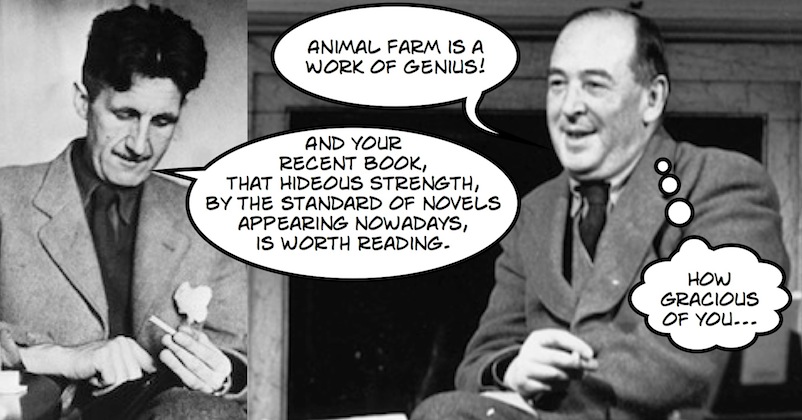
As the graphic I created above reveals (from actual quotations), Lewis had a better opinion of Orwell’s work than vice versa. Orwell disliked Lewis and resented the fact that he was popular among many common people. He particularly disliked Lewis’ traditional (evangelical) Christianity. In his review of That Hideous Strength, Orwell dismissed the biblically based supernatural as a version of “magic.”

Much is made of the fact that the scientists are actually in touch with evil spirits, although this fact is known only to the inmost circle. Mr. Lewis appears to believe in the existence of such spirits, and of benevolent ones as well. He is entitled to his beliefs, but they weaken his story . . .

Orwell was one of those “professing” Christians who is accurately labeled a hypocrite. He was a communing member of the Church of England, and advocated a Judeo-Christian moral code, but did not believe in an afterlife. The following letter, written to Eleanor Jaques in 1932, reveals his hypocrisy.

It seems rather mean to go to HC [Holy Communion] when one doesn’t believe, but I have passed myself off for pious & there is nothing for it but to keep up with the deception.

In a comment to my last post, a good friend of Mere Inkling, Brenton Dickieson at A Pilgrim in Narnia, reminded me of a thought-provoking essay on English written by Orwell. His essay, “Politics and the English Language,” addresses a number of problems with the language. He considers dying metaphors, verbal false limbs, pretentious diction, and meaningless words.

A Similarity in the Two Writers’ Advice

Orwell’s goal is “the scrapping of every word or idiom which has outworn its usefulness. It has nothing to do with correct grammar and syntax, which are of no importance so long as one makes one’s meaning clear, or with the avoidance of Americanisms, or with having what is called a ‘good prose style.’”  [As irritating as I imagine most Europeans find Americanisms!] Writers of fiction will enjoy the way Orwell explains the challenge of “showing, not telling.”

What is above all needed is to let the meaning choose the word, and not the other way around. In prose, the worst thing one can do with words is surrender to them. When you think of a concrete object, you think wordlessly, and then, if you want to describe the thing you have been visualizing you probably hunt about until you find the exact words that seem to fit it.

When you think of something abstract you are more inclined to use words from the start, and unless you make a conscious effort to prevent it, the existing dialect will come rushing in and do the job for you, at the expense of blurring or even changing your meaning. Probably it is better to put off using words as long as possible and get one’s meaning as clear as one can through pictures and sensations. Afterward one can choose—not simply accept—the phrases that will best cover the meaning, and then switch round and decide what impressions one’s words are likely to make on another person.

This last effort of the mind cuts out all stale or mixed images, all prefabricated phrases, needless repetitions, and humbug and vagueness generally. But one can often be in doubt about the effect of a word or a phrase, and one needs rules that one can rely on when instinct fails. I think the following rules will cover most cases:

1. Never use a metaphor, simile, or other figure of speech which you are used to seeing in print.

2. Never use a long word where a short one will do.

3. If it is possible to cut a word out, always cut it out.

4. Never use the passive where you can use the active.

5. Never use a foreign phrase, a scientific word, or a jargon word if you can think of an everyday English equivalent.

6. Break any of these rules sooner than say anything outright barbarous.

These rules sound elementary, and so they are, but they demand a deep change of attitude in anyone who has grown used to writing in the style now fashionable.

Students of Lewis will note in the final passage the parallel with advice he provided to a correspondent in 1956. Although the context is different—Orwell’s is a formal essay and Lewis’ a casual correspondence written to a child, the similarities are significant. Lewis would have been familiar with Orwell’s essay, composed a decade before his letter, but the resemblance between their words is better attributed to shared literary philosophies and the self-evident nature of the principles. Lewis identified five important considerations when writing.

1. Always try to use language so as to make quite clear what you mean and make sure [your] sentence couldn’t mean anything else.

2. Always prefer the plain, direct word to the long, vague one. Don’t implement promises, but keep them.

3. Never use abstract nouns when concrete ones will do. If you mean “More people died” don’t say “Mortality rose.”

4. Don’t use adjectives which merely tell us how you want us to feel about the things you are describing. I mean, instead of telling us a thing was “terrible,” describe it so that we’ll be terrified. Don’t say it was “delightful;” make us say “delightful” when we’ve read the description. You see, all those words (horrifying, wonderful, hideous, exquisite) are only like saying to your readers, “Please, will you do my job for me?”

5. Don’t use words too big for the subject. Don’t say “infinitely” when you mean “very;” otherwise you’ll have no word left when you want to talk about something really infinite.

Whatever the two authors thought about the other, they certainly shared some similar views on the subject of effective writing. And, I think we can assume with confidence that Lewis would concur with Orwell’s final rule. Under no circumstances should we resort to barbarity! For, as Lewis wrote in The Four Loves, “Who does not prefer civility to barbarism?”

____

If you are interested in reading Orwell’s “Politics and the English Language” in its entirety, you can find it here.

Seeking the Living

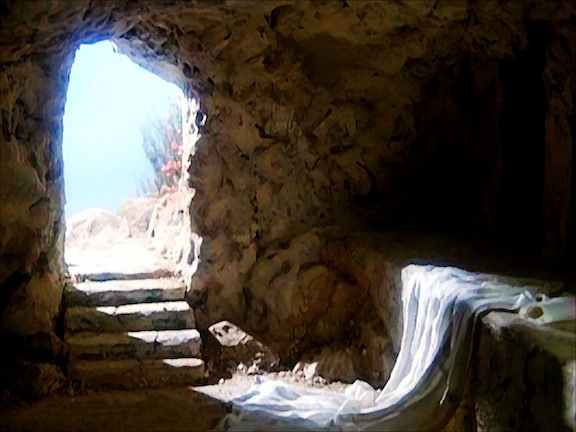
tombOne of the readings at our celebration of the Resurrection, this Easter morning, came from the Gospel according to Saint Luke. It included the powerful words of the angels waiting beside the empty tomb. To Mary Magdalene and the other women who had arrived to complete the ceremonial preparations for Jesus’ burial, they said: “Why do you seek the living among the dead?”

That’s precisely what separates Christianity from every other religious faith; for two millennia, Jesus’ disciples have followed a resurrected and living Lord.

This is what non-Christians are ultimately unable to fathom. Christianity is far more than the adoption of a particular lifestyle. It is infinitely more than a cognitive acquiescence a set of doctrines. It is nothing less than a dynamic, living relationship with our Creator through his only begotten Son.

Many regard Jesus as a great teacher from an ancient epoch—whose words are worthy of preserving. This is a good thing . . . but it’s not Christianity.

Many consider Jesus the model of a noble life—and strive to emulate his compassion and humility. This too is a good thing . . . but it’s not Christianity.

Many regard Jesus as an object of superstition—and they spout religious jargon while living hypocritical lives utterly devoted to their carnal appetites. This is not a good thing . . . and it’s most certainly not Christianity.

C.S. Lewis refers to this inherent inability to “persuade” an unbeliever to see beyond Christianity as a creedal profession or even a simple lifestyle and comprehend it as a relationship.

Our opponents, then, have a perfect right to dispute with us about the grounds of our original assent. But they must not accuse us of sheer insanity if, after the assent has been given, our adherence to it is no longer proportioned to every fluctuation of the apparent evidence. They cannot of course be expected to know on what assurance feeds, and how it revives and is always rising from its ashes.

They cannot be expected to see how the quality of the object which we think we are beginning to know by acquaintance drives us to the view that if this were a delusion then we should have to say that the universe had produced no real thing of comparable value and that all explanations of the delusion seemed somehow less important than the thing explained.

That is knowledge we cannot communicate. But they can see how the assent, of necessity, moves us from the logic of speculative thought into what might perhaps be called the logic of personal relations. What would, up till then, have been variations simply of opinion become variations of conduct by a person to a Person. Credere Deum esse turns into Credere in Deum. And Deum here is this God, the increasingly knowable Lord. (C.S. Lewis, “On Obstinacy in Belief”).

Ultimately, inviting others to share the joy and peace that we disciples of Jesus know—undeserving as all of us are—is not about persuasion. It is about introducing them to Jesus.

It’s about echoing the words of the angels in that Judean cemetery. “Don’t seek Jesus among the dead. He is risen and living, and he offers eternal life to all who call upon his name.”

Grasping for Immortality

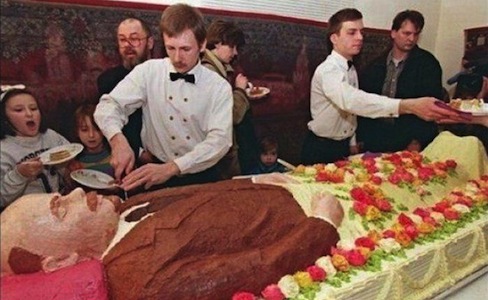
memorial cakeToday’s news carried a truly bizarre story. Yesterday, Venezuela’s dictator died after a lengthy illness. Today we learned that his body is due to be preserved for future generations to venerate. Like his forebear Lenin, he’ll be on call in a glass casket in case someone needs to gaze at him to have their socialist energies reinvigorated.

And that was only half of the surprising news report about Chavez’s demise.

The head of the presidential guard, a general close to the leader, related his final words. He was at his bedside and reported that he was too weak to verbalize the words, but clearly mouthed the plea “I don’t want to die; please don’t let me die.”

It’s shocking that General Ornella would divulge this fact about Chavez, particularly during the actual process of his divinization. The general attributes Chavez’s reluctance to receive his “eternal reward” to his love of country and desire to remain here to lead his nation for ever.

I, on the other hand, would attribute his reluctance to die to other sentiments.

The article that related the morbid plans for the display of Chavez’s body cited the familiar example of Lenin, which I mentioned above. It also noted two other former rulers whose bodies have also been preserved for an adoring posterity: Mao Zedong and Ho Chi Minh. Preparing this post I found that Kim Il-sun and his son Kim Jong-Il share a mausoleum. Likewise, Lenin’s successor Stalin would still be on display, had it not been for eventually falling out of political favor.

Now, there’s something obvious that all of these men have in common. They were leaders of oppressive communist regimes—which oppressed their own citizens because of their atheistic worldview.

Having rejected God and knowing no hope of resurrection or eternal life, they feebly grasped for immortality the only way they knew. They sought to leave a monumental mark on history, in order to be long remembered. And, considering a monument and a statue insufficient mnemonic devices . . . well, enough about that.

A Far Better Way

We who know the Creator of all life have much to be grateful for. Not least of which, his gracious gift of eternal life. Christians believe we will trade in this weak and worn body for a new one. So, while we treat the bodies of those who have died with dignity, we feel absolutely no impulse to venerate them. On the contrary, “ashes to ashes and dust to dust.”

C.S. Lewis wrote something in Mere Christianity which relates directly to this sharp contrast in worldviews.

Immortality makes this other difference between totalitarianism and democracy. If individuals live only seventy years, then a state, or a nation, or a civilisation, which may last for a thousand years, is more important than an individual. But if Christianity is true, then the individual is not only more important but incomparably more important, for he is everlasting and the life of a state or a civilisation, compared with his, is only a moment.

That, dear friends, is quite a paradigm shift. To regard each human life as more precious than any abstract government or institution created by humanity’s hand. Having that perspective is akin to seeing with God’s own eyes.

I hope the people of Venezuela soon recognize the futility of the shrine that is being built. Infinitely better to seek “immortality” (eternal life) in the one place where it may truly be found.

Beware of Zoolatry

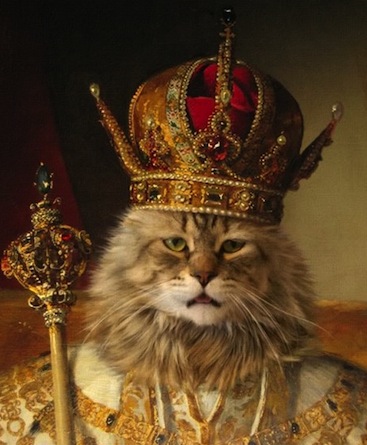
royal catWhen my wife and I dated, I praised her beautiful cat when I visited her home. The cat maintained that imperial posture and attitude that is common in virtually all felines. And that came as no surprise, since she was an Egyptian Mau, one of the most ancient of breeds. She passed on long decades ago, but her haughty, regal bearing is etched in my memory.

I thought of her today when I read the following in the December issue of First Things, in the executive editor’s column.

Wandering around the American Kennel Club’s big “Meet the Breeds” event with my two youngest children recently, I saw a big banner in the cat section proclaiming that a particular breed had been considered a god by an ancient civilization. Of course, our understanding of the genuine religious impulses of ancient religions has increased, but still, one of the gifts the Jewish people have brought the world is that no one who knows about the God of Abraham, Isaac, and Jacob is the least bit tempted to worship cats.

I mean, would you want to worship a murderous narcissistic psychopath? This is not an image of God to make anyone happy. If you’re going to worship an animal, why not the Border Collie, frantically eager to please, or the loving, soulful-eyed Lab? Or the alert and protective German Shepherd? Or the indomitable Saint Bernard? Or the classic loyal and even-tempered mutt?

I don’t intend to offend any cat lovers by repeating this observation—my son has an affectionate tabby he rescued as a kitten while a senior in high school, that’s welcome in our home anytime. Still, as an unrepentant dog person, and “papa” to a rescued border collie, the words above brought a smile to me.

C.S. Lewis painted a graphic image of one animal-headed deity. It was Tash, the god of the Calormenes. In The Last Battle, we see that in Narnia, the reality behind the lifeless image can be most terribly revealed.

In the shadow of the trees on the far side of the clearing something was moving. It was gliding very slowly Northward. At a first glance you might have mistaken it for smoke, for it was grey and you could see things through it. But the deathly smell was not the smell of smoke. Also, this thing kept its shape instead of billowing and curling as smoke would have done. It was roughly the shape of a man but it had the head of a bird; some bird of prey with a cruel, curved beak. It had four arms which it held high above its head, stretching them out Northward as if it wanted to snatch all Narnia in its grip; and its fingers—all twenty of them—were curved like its beak and had long, pointed, bird-like claws instead of nails. It floated on the grass instead of walking, and the grass seemed to wither beneath it. . . .

The others watched it for perhaps a minute, until it streamed away into the thicker trees on their right and disappeared. Then the sun came out again, and the birds once more began to sing. Everyone started breathing properly again and moved. They had all been still as statues while it was in sight. “What was it?” said Eustace in a whisper. “I have seen it once before,” said Tirian. “But that time it was carved in stone and overlaid with gold and had solid diamonds for eyes. It was when I was no older than thou, and had gone as a guest to The Tisroc’s court in Tashbaan. He took me into the great temple of Tash. There I saw it, carved above the altar.”

“Then that—that thing—was Tash?” said Eustace.

In our world, idolatry has certainly evolved since it’s pantheistic and zoolatrous beginnings. Today we are tempted by material indulgences and corruptions aplenty. While few of us impute divinity to animals or objects of stone or wood, we don’t have to look far to find something we deem worthy of adoration.

Our favorite idol is neither beast nor mammon. It is ourselves. As C.S. Lewis wrote in The Problem of Pain:

This act of self-will on the part of the creature, which constitutes an utter falseness to its true creaturely position, is the only sin that can be conceived as the Fall. For the difficulty about the first sin is that it must be very heinous, or its consequences would not be so terrible, and yet it must be something which a being free from the temptations of fallen man could conceivably have committed. The turning from God to self fulfils both conditions. It is a sin possible even to Paradisal man, because the mere existence of a self—the mere fact that we call it “me”—includes, from the first, the danger of self-idolatry. Since I am I, I must make an act of self-surrender, however small or however easy, in living to God rather than to myself. This is, if you like, the “weak spot” in the very nature of creation, the risk which God apparently thinks worth taking.

Now, this is a sin to which I frequently find myself succumbing. I far too often think first about my own desires and appetites . . . only later (if ever) becoming concerned with the needs of my neighbor.

No, it’s neither cat nor dog that needs to be evicted from the throne in my soul reserved for my Creator—it’s me.

Knowing Our ABCs

Most readers are familiar with the amazing story of Jeanne D’ Arc (Joan of Arc). She was a French peasant who received visions which proved accurate. She foresaw victory for a humbled nation which had not experienced a major military victory for an entire generation.

Jeanne led the army of the Dauphin (the heir to France’s throne who would reign as Charles VII) to unimaginable victories. She was seriously wounded but inspired her troops with her swift return to battle. She counseled, and prayed for mercy, but recognized England could only be repulsed from French shores by force.

Tragically, she was captured and the English, following a sham trial, judged her guilty of heresy. Jeanne was only nineteen when she perished in flames in an English blaze. Just twenty-five years later, a special court convened by the Pope found her “not guilty” of the crime, and proceeded to declare her a martyr. She was canonized in 1920, nearly five centuries after her brief but brilliant life.

Recently, while reading more about her life I was reminded of something startling she said during her first “inquisition.” When she originally presented herself to the Dauphin, no one could believe a modest young farm girl could be France’s rescuer. A commission of inquiry, comprised of a number of senior clergy, offered the Dauphin a “favorable presumption” that she might, indeed, have divine sanction.

During that “trial,” she was vigorously questioned. The following account comes from Medieval History by Israel Smith Clare.

It is very interesting to see how she evaded the difficulties, overcame the objections, and quietly set aside the learned cavils of the doctors by the simplicity and directness of her replies. They first asked her what signs she could show them to prove her mission. She answered: “I have not come to Poitiers to show a sign. Give me some men-at-arms and lead me to Orleans, and I will then show you signs. The sign I am to give is to raise the siege of Orleans.” One of the [theological] doctors responded thus: “But if God wished to deliver the city he could do it without soldiers.” Jeanne replied: “The soldiers will fight, and God will give them the victory.” Brother Seguin of Limousin asked her, in his provincial dialect, in what idiom her angels spoke. She answered: “In a better idiom than yours.” Said he, somewhat angrily: “Do you believe in God?” Jeanne replied: “I have more faith in God than you have.” The sharp man was thus silenced.

Still the doctors proceeded with their examinations, asking repeated questions and suggesting many learned difficulties. Said Jeanne: “Why do you ask me all these things? I do not know even my A, B, C; but I have come, by God’s command, to raise the siege of Orleans and crown the king.” Having nothing more to say, the doctors finally decided in the maiden’s favor, to which they were somewhat influenced by the great reverence which she inspired among the people of Poitiers by her holiness and piety . . .

Jeanne’s final comment which stands out. The fact that she was illiterate was, to her, no disgrace. She was confident God had chosen her to accomplish the historic events which surely followed.

We live in an era where nearly all adults in the industrialized world are literate. Even in less privileged lands, literacy rates hover around fifty percent.

We—especially those of us who love words and write—tend to look down on those who are not as eloquent as we consider ourselves to be. A woman like Jeanne reminds us that one need not be educated to be truly eloquent. She put the ecclesiastical patricians in their proper place. And rubbed their proverbial noses in it, when she emphasized her illiteracy. Devout, courageous, humble . . . and sarcastic toward condescending clerics—I’m eager to one day meet her!

While knowing one’s ABCs bears little correlation to personal virtue or merit, literacy is essentially a good thing. How impoverished our lives would be if books were sealed to us and we could not be transported to novel places and new epiphanies in their pages.

C.S. Lewis shared this awareness that illiteracy was something that could bar some from experiencing life’s most important treasures. In The Pilgrim’s Regress, he draws a wonderful picture of the relationship between the image and the word. In this allegory, the Landlord represents God.

“. . . The Landlord has circulated other things besides the Rules. What use are Rules to people who cannot read?”

“But nearly everyone can.”

“No one is born able to read: so that the starting point for all of us must be a picture and not the Rules. And there are more than you suppose who are illiterate all their lives, or who, at the best, never learn to read well.”

“And for those people the pictures are the right thing?”

“I would not quite say that. The pictures alone are dangerous, and the Rules alone are dangerous. That is why the best thing of all is to find Mother Kirk at the beginning, and to live from infancy with a third thing which is neither the Rules nor the pictures and which was brought into the country by the Landlord’s Son. That, I say, is the best: never to have known the quarrel between the Rules and the pictures. But it very rarely happens. The Enemy’s agents are everywhere at work, spreading illiteracy in one district and blinding men to the pictures in another. . . . As often as men become Pagans again, the Landlord again sends them pictures and stirs up sweet desire and so leads them back to Mother Kirk even as he led the actual Pagans long ago. There is, indeed, no other way.”

“. . . The Landlord succeeded in getting a lot of
messages through.”

“. . . These pictures woke desire.”

“. . . And then the Pagans made mistakes. They would keep on trying to get the same picture again: and if it didn’t come, they would make copies of it for themselves. Or even if it did come they would try to get out of it not desire but satisfaction.”

Elsewhere, in the essay “Some Thoughts” in God in the Dock, Lewis expressly (and correctly) declares literacy itself as one of the things for which Europe should be grateful to the Church.

[One looking at] Christian activities which are, in a sense directed toward this present world . . . would find that this religion had, as a mere matter of historical fact, been the agent which preserved such secular civilisation as survived the fall of the Roman Empire; that to it Europe owes the salvation, in those perilous ages, of civilised agriculture, architecture, laws, and literacy itself. He would find that this same religion has always been healing the sick and caring for the poor; that it has, more than any other, blessed marriage; and that arts and philosophy tend to flourish in its neighbourhood.

Theological Training

I’m proud I graduated from a well-respected seminary. And I’m proud of following that Master of Divinity degree with an advanced Master of Theology degree in Patristics. And that’s precisely the problem . . . I’m proud.

As a Christian, I recognize that pride is one of the most destructive and insidious sins. As a pastor and chaplain, I have seen all too frequently how pride expressly targets members of the clergy. Our vulnerability to the temptation to be proud is one of the common chinks in the armor of the ordained.

C.S. Lewis recognized this fact. In A Severe Mercy, he wrote:

I think there is a great deal to be said for having one’s deepest spiritual interest distinct from one’s ordinary duty as a student or professional man. St. Paul’s job was tent-making. When the two coincide I shd. have thought there was a danger lest the natural interest in one’s job and the pleasures of gratified ambition might be mistaken for spiritual progress and spiritual consolation; and I think clergymen sometimes fall into this trap. . . .

In fact, the change [to a Christian ministry] might do good or harm. I’ve always been glad myself that Theology is not the thing I earn my living by. On the whole, I’d advise you to get on with your tent-making. The performance of a duty will probably teach you quite as much about God as academic Theology wd. do. Mind, I’m not certain: but that is the view I incline to.

Lewis understood that “advancement” in ecclesiastical contexts can mask the inner heart and be mistaken as a form of holiness when it is in actuality vanity. I was reminded of this weakness in clerical armor recently, when I read a tribute to a Chinese Christian whose name is little known beyond his homeland. Dr. Sun Yi-yin, known in America as “Freddie Sun,” died in August at the age of 76. A professor of Geology, he lost his faculty position for failing to deny Christ.

Like thousands of other Christians living under the atheist regime, he was imprisoned for his work in establishing churches and Bible schools. He raised the funds to start no fewer than 154 of these training centers, and was key to the equipping of approximately 60,000 underground pastors and teachers. The “underground” Church in China is distinguished from the government-controlled “Three-Self Patriotic Movement.”

For his labors, Sun endured a decade in a Chinese labor camp. (His wife, Dorothy Chang, was also imprisoned. Rather than reducing his faith, during his sojourn in the harshest of conditions, Sun experienced a personal revival and his zeal increased.

His story is amazing, but here is the aspect that hit the mark in the center of my conscience. In his autobiography, The Man in the Fiery Furnace, Sun described his imprisonment as his “seminary” experience: “Instead of learning homiletics, hermeneutics, Greek, and Hebrew, I was being taught the greater lessons of obedience, submission, forgiveness, love, endurance, and patience.”

Now, I am grateful that God has preserved me from the “fiery furnace,” but I do long to experience the fruit of the spirit that Sun so richly harvested in prison. While not dismissing the importance of the classical subjects of homiletics and hermeneutics, as the Apostle says, “If I speak in the tongues of men and of angels, but have not love, I am a noisy gong or a clanging cymbal. And if I have prophetic powers, and understand all mysteries and all knowledge, and if I have all faith, so as to remove mountains, but have not love, I am nothing. If I give away all I have, and if I deliver up my body to be burned, but have not love, I gain nothing.” (I Corinthians 13:1-3, ESV).

In The Problem of Pain, Lewis’ treatise on suffering, he addresses how God can redeem terrible things such as unjust punishments. For those desiring to understand how an omnipotent God can allow evil to occur, Lewis’ presentation is quite helpful. And, the life example of Dr. Sun provides a superb example of its validity.

I advance six propositions necessary to complete our account of human suffering which do not arise out of one another and must therefore be given in an arbitrary order. 1. There is a paradox about tribulation in Christianity. Blessed are the poor, but by ‘judgement’ (i.e., social justice) and alms we are to remove poverty wherever possible. Blessed are we when persecuted, but we may avoid persecution by flying from city to city, and may pray to be spared it, as Our Lord prayed in Gethsemane.

But if suffering is good, ought it not to be pursued rather than avoided? I answer that suffering is not good in itself. What is good in any painful experience is, for the sufferer, his submission to the will of God, and, for the spectators, the compassion aroused and the acts of mercy to which it leads. In the fallen and partially redeemed universe we may distinguish (1) the simple good descending from God, (2) the simple evil produced by rebellious creatures, and (3) the exploitation of that evil by God for His redemptive purpose, which produces (4) the complex good to which accepted suffering and repented sin contribute.

Now the fact that God can make complex good out of simple evil does not excuse—though by mercy it may save—those who do the simple evil. And this distinction is central. Offences must come, but woe to those by whom they come; sins do cause grace to abound, but we must not make that an excuse for continuing to sin. The crucifixion itself is the best, as well as the worst, of all historical events, but the role of Judas remains simply evil.

I thank God for the life and testimony of Sun. I pray God will reap an abundance of believers in China, and elsewhere, due to his faithfulness. And I thank God for using Sun’s words to cause me to stop in the midst of my busy activities and take the time to examine my own heart and motives.