Compassionate Care

In my last column I shared how I had been drafted into service as my wife’s nurse.

The duties are not onerous, in part because she’s become quite ambulatory with her crutches . . . but even more, due to the fact that I truly love her. To care for those you love is a natural thing, and it would be the opposite path—to ignore the suffering of those about whom you care—that would be contrary to human nature.

This is why we are also so deeply stunned when we see spouses doing harm to one another, or (far worse) injuring children in their care. These are inhuman acts contrary even to that universal Natural Law which governs even those who take no notice of religious codes.

But, returning to my nursing experience . . . I am not a total stranger to such matters. My first assignment as an Air Force chaplain was in a “Contingency Hospital” which was part of the Reserve. As part of my active duty tours I frequently included hospital visitation and service.

In fact, years ago during a five week Joint military exercise in Thailand, I served for a season as the chaplain of a Mobile Army Surgical Hospital. (Yes, I was an honest to goodness M*A*S*H chaplain!)

Returning to my initial point, caring for my wife is not burdensome. I readily confess I would hardly bring the same enthusiasm and selflessness to caring for a stranger.

But that’s not the man, the disciple of Jesus, I desire to be. And so, I pray for greater compassion, exercise and “stretch” my concern for others, seek forgiveness for my failings . . . and repeat the cycle.

C.S. Lewis writes brilliantly about the great significance of each and every human life. In The Weight of Glory he reminds us that we have the potential to influence their lives either positively or negatively, and assisting them to follow the path to “glory” is central to our reason for being.

It is hardly possible for [us] to think too often or too deeply about [the future destiny] of [our] neighbor. The load, or weight, or burden of my neighbour’s glory should be laid on my back, a load so heavy that only humility can carry it, and the backs of the proud will be broken. . . .

All day long we are, in some degree, helping each other to one or the other of these destinations [glorified resurrection in the presence of our Creator or eternal corruption apart from God].  It is in the light of these overwhelming possibilities, it is with the awe and the circumspection proper to them, that we should conduct all our dealings with one another, all friendships, all loves, all play, all politics. There are no ordinary people. You have never met a mere mortal. Nations, cultures, arts, civilizations—these are mortal, and their life is to ours as the life of a gnat.  But it is immortals whom we joke with, work with, marry, snub, and exploit—immortal horrors or everlasting splendours.

One of my favorite books was written by Calvin Miller. He’s the author of numerous classics, and I most recently enjoyed his The Path of Celtic Prayer. However, because of my interest in the early church, and my affection for keenly wielded wit, it is The Philippian Fragment which ranks in my personal “top ten.” (And, great news, despite being out of print for some time, it’s now available in a Kindle edition!)

The following quotation is from one of the epistles gathered in pseudepigraphical Philippian Fragment. The letters are written by a pastor named Eusebius of Philippi to another shepherd, “Clement, pastor of Coos.” It illustrates precisely the spirit we should have within us. If we were all like Eusebius, this world would be a far more wonderful place.

I am not sure that I can survive the new hostility I have engendered by missing church merely to pray for a dying man. I was foolish to assume that the church would see the glory of my ministry to Publius and excuse the absence of my sermon. Through pain I have learned that it is still wrong to heal on the sabbath—at least during the eleventh hour. . . . Is the yet-paralyzed Publius worth the cancellation of my morning sermon? I have betrayed a tradition to furnish forth a single act of compassion. Oh, the institutional cankers that do fester when traditions are unserved! . . . It is time for the evening vigil now, and I have just received word that one of the lepers is at death’s door and has called for me to come. Shall I go to tend the dying, or shall I go to church and keep my place?

I had planned to talk tonight about how we must minister to our world before we seek each other’s consolations. I am still unforgiven by most for healing the paralytic. Now I must go to the leper and seal my fate. 26. Grief is seldom convenient to our scheduled worship.

I had a dear mentor, Constantinus, who was shepherd of the congregation in Antioch. His church’s meeting house was near a busy road. One day, five minutes before his well-packed service was to begin, a Roman chariot ran over a beggar and left him dying before the church house. How grieved was the pastor that most of his members stepped over the bleeding man to carry their prayer scrolls on into the sanctuary. Constantinus was a gentle pastor and full of the love of Christ. He scooped up the emaciated old man and carried him to his grieving widow.

In the process of his ministry to this victim of Roman traffic, his hands and togas were fouled with blood. There was no time to go home and change clothes, so he entered his pulpit besmirched by the gore of his own compassion. 31. Clement, many in that congregation never forgave Constantinus his bloody toga. Ministry must ever be willing to face tradition. Somewhere a leper is dying. Tonight I shall act out a sermon. I can preach next week when human suffering is more remote. (Calvin Miller, The Philippian Fragment).

Nursing Those We Love

This week I became a nurse. No, I didn’t complete a degreed or certificated program, I simply assumed the duties of being my wife’s post-surgical caregiver.

She had very serious knee surgery, which will require her to place no weight at all on her right leg for at least a month and a half. This first week she’s required an escort and assistance for virtually everything. And I’ve offered this service gladly, and lovingly . . . even when it’s interrupted my sleep apnea crippled rest.

Obviously, over three and a half decades of marriage, she has needed modest nursing in the past. But this is more serious. It is sustained. She has seen me through a number of serious illnesses and surgeries, but then she (like so many other women I’ve been privileged to know) is a natural nurse and caregiver.

C.S. Lewis was a man not vastly different from me. He was not terribly comfortable when placed in such a role . . . yet he too discovered great meaning in caring for the needs of his wife during her illness. His precious Joy was dying, so the intensity of his labors, and their corresponding emotional investment dwarf my own. And yet the “framework” of our circumstances bears a marked similarity.

In his wonderful book Lenten Lands, Lewis’ son Douglas Gresham relates how Lewis and his brother Warnie provided exceptional care to his mother during her illness. He writes:

[Lewis] spent most of each day with [Joy] at the hospital, but they both agreed Mother should be brought home to The Kilns to die—in Jack’s home—her husband’s home—with him at her side. The “common room” was converted to a hospital ward, complete with a system of bells by which Mother would summon a nurse, or later Jack, if she needed help, as she often did.

I’ll make a confession. Although most men can adequately perform familial nursing duties when there is no alternative caregiver, most of us are quite content to step aside and let our wives or sisters attend to whatever nursing procedures are called for. Actually, I was quite gifted at removing slivers, but when it comes to bodily discharges, I’m no sexist to admit I and most of my gender display a serious weakness.

And yet, even in these cases, when changing the soiled diaper of an infant (or someone old enough to feel shame for having such needs) . . . even such unpleasant acts are possible for us to do for those we love. So the key to being able to care for others is not to pinch our nose and do it as quickly as humanly possible. The key, instead, is to learn to love those placed in our care.

In our grandparents day, it wasn’t uncommon for an elderly great-grandparent to reside with the family of one of their children. My father, for example, grew up with his blind grandfather as a member of their household. Similarly, my mother enjoyed the daily presence of her grandmother in her own home throughout her life. Not only was it expected that children would “take in” their elderly parents, it was natural. After all, they were family.

But, how does one transfer this familial affection to the stranger? After all, as Jesus said, “If you love those who love you, what benefit is that to you? For even sinners love those who love them. And if you do good to those who do good to you, what benefit is that to you? For even sinners do the same” (John 6).

Mother Teresa and the many thousands of saints throughout history who have cared for the leper, the outcasts, and the dying know this truth. They do everything as though they were caring for the Lord himself, just as he asked his disciples to do. Medicines are not their only balms—nor their most important. Their compassionate touch and tender encouragements are often far more healing.

When I compare myself to these caregivers, I realize just how inadequate a nurse I am. As a pastor, a core aspect of my vocation has been to bind the injuries of the sheep entrusted to my care. But I do this in a “spiritual” manner, and it has been rare to ever help one of them replace a bloodied bandage. Spiritual, emotional and social wounds are those that most pastors feel comfortable treating. Providing for the “baser” physical needs of the diseased is quite another matter.

And this brings us to the end of today’s reflection. When next I write, I’ll carry this final thought a bit farther forward.

Lewis’ Appreciation of Architecture

I don’t have much of a gift for drawing, but I often find the simplest artwork quite engaging. Nor do I understand the mathematics necessary to become an accomplished architect—yet I definitely appreciate the majesty of finely designed buildings.

This, I recently learned, is another thing that I have in common with Jack Lewis.

We lunched at Wells after seeing the Cathedral. . . . I am no architect and not much more of an antiquarian. Strange to say it was Uncle H. with his engineering more than our father with his churchmanship that helped me to appreciate it; he taught me to look at the single endless line of the aisle, with every pillar showing at once the strain and the meeting of the strain (like a ship’s framework inverted); it is certainly wonderfully satisfying to look at. The pleasure one gets is like that from rhyme—a need, and the answer of it following so quickly that they make a single sensation. So now I understand the old law in architecture, “no weight without a support, and no support without an adequate weight.” (Letters of C.S. Lewis, 7 August 1921).

Lewis aptly describes how large cathedrals are built. Many “regular” churches display similar construction, albeit in more modest proportion. Like admiring the stained glass common to many houses of worship, gazing at their structural beauty can cause us to “lose ourselves” for a moment. Sometimes massive columns or graceful arches can even spark within us a sense of awe.

Awe inspiring architecture takes varied forms. It can be conveyed by simple scale. I have yet to visit Hagia Sophia (a dream I hold), but I have visited the Cathedral of Notre Dame. With the souvenir shops tastefully hidden away, it’s probably their age that most touches me.

The awareness that my brothers and sisters in Christ have offered prayers in each for nearly a millennia or more is sobering. And, I believe our wonderful friend C.S. Lewis was equally impressed by that fact.

Yes, huge sanctuaries are impressive, but a church does not need to be massive to impress. There is a modest church in Cambridge, England which my wife and I visited several times. It is the Church of the Holy Sepulchre, and it was inspired by the original Church of the Holy Sepulchre in Jerusalem. Crusaders who had worshipped in Jerusalem carried home the vision of the simple edifice, and it was built in Cambridge around 1130.

When we lived in England, the congregation there was vibrant and reaching out to those without hope. Apparently shortly after we departed, it “outgrew” the facilities there and had to relocate to a larger building.

I don’t recall Lewis specifically mentioning this parish, although I can’t imagine him teaching at the University there and not at least visiting the Church of the Holy Sepulchre. And when he entered the holy place, I can easily picture him joining me in admiration of the artistic symmetry of the arches and columns, “with every pillar showing at once the strain and the meeting of the strain.”

Your Writing Style

Each of us writes in a unique manner.

You can study writing patterns in various ways, by considering vocabulary, changes in sentence lengths, repeated phrases, and various other measurable elements.

Then there are more subjective aspects of our writing, but these too are recognizable. They would include tone and more abstract things like pacing.

When you add them all together, you arrive at an amorphous quality called the writer’s “voice.” And, as I said above, each of our “voices” are different.

It may be that we dabble in a variety of forms and genres. For example, in addition to these casual blog posts, I also write about theology and military ministry from a much more “professional” perspective. And, shockingly (to my own writing identity) I’ve recently received encouragement related to poetry with which I’ve been experimenting.

Even when we write in various literary forms, and they clearly differ from one another in their voice, the truth is that for each of these documents we develop a personal, inimitable voice.

Now, after emphasizing our literary uniqueness, I want to switch perspectives and consider that our various styles and voice resemble those of others. Occasionally, when reading someone’s work it strikes you as familiar. You may even recall the author that the work reminds you of. (I’m not referring to plagiarism, of course, although the internet has apparently made that particular plague even more common now than in the past.)

It would be vanity to claim that our own writing voice resembles that of no one else. Yes, some voices are so peculiar that they are clearly “rarities,” but others have shared even those odd personalities in the past. I suspect that’s even true for the senseless ramblings with which some self-styled “artists” assail the public. (Even insanities can resemble one another.)

In any case, if you ponder this subject it’s natural to wonder: who do I write like?

Today, through the amazing processing abilities of the computer, you may be able to get an answer to that very question. It’s not a definitive answer, because as I said above, our writing voice possesses both material (words and syntax) and spiritual (ephemeral and aesthetic) dimensions. And, while a computer may be without peer in comparing the former, I believe it to be quite deficient in discerning the latter.

Nevertheless, a rudimentary program is available online to compare your writing with that of a number of writers of varying reputation. The program has a number of limitations, but I think there may be something to it. It requires an extensive section of your writing (several paragraphs, at least). I assume more would be better, in terms of promoting accuracy.

As I just mentioned, it includes a limited number of authors currently entered into the database, and I suspect that the gifted C.S. Lewis is not among them. (I say this not because I expected to be aligned with him, but because of some of the included authors I am aware of. In addition, the program’s creator is actually Russian, so I would be curious to learn how the represented English authors were selected.)

It would limit the program’s value, for example, if I only input data on three writers and you were matched with the one you resembled most closely. Would you prefer, for example, to be told you write like Edward Bulwer-Lytton, Georgette Heyer, or Fabius Planciades Fulgentius?

Even with a significant number of writers included, the program’s accuracy will be affected by the quantity (and specific choice) of what is included to represent each. For example, the programmer properly included Stephen King. How valuable would that be, however, if he had only used King’s poetry and excluded his prose works? (Yes, the horror master has also penned poetry—now, that’s a scary thought!)

Well, despite the limitations of the “I Write Like” program, it is fun to try out. And it sounds impressive, in that it relies upon a naive Bayesian classifier. (Well, the “naive” part doesn’t sound especially remarkable, but the formula looks pretty imposing to someone who never took calculus.

You can use take the “test” at this site.

Make sure you include lengthy selections from your work. Also, testing the program with different genres (assuming you write in different styles) will actually give you new matches. (That is, of course, as it should be.)

If you do decide to experiment with it, a comment below about your results would be interesting for others. And now, for the moment that you have been awaiting . . . with whose writing did the program match mine?

I tried a number of times (no—not fishing for results I wanted, but using a variety of types of my writing) and here were the repeated results:

For my blog posts: H.P. Lovecraft or J.R.R. Tolkien

For my more formal essays: J.R.R. Tolkien or Jonathan Swift

(It’s Swift’s picture, you’ll note, that begins this post.) Actually, the majority of the results linked to Swift, whose work I don’t recall ever reading in full, not even Gulliver’s Travels. However, our shared emphasis on wit, advocacy and satire account for what I deem a genuinely accurate assessment. And it does not hurt that Swift was Anglo-Irish, like my favorite author!

So, until Dmitry Chestnykh adds C.S. Lewis to the writers included in the “classifier,” I’m quite content to rest on my matches. Because even if I don’t share Lovecraft’s worldview, I can still respect his literary skill. And being identified with the other gentlemen, is a grand compliment.

[Special thanks to Julie Catherine who introduced me to the site via her post on the subject.]

Nature’s Melodies

Recently we were walking our five year old granddaughter home after a visit to our house, and she said something remarkable. (Our son’s family lives on a forested parcel adjacent to our own near Puget Sound.)

This precious little girl gazed to the top of the tall pine and fir lining the path and said, “I love the music the woods make.” She went on to describe various elements of nature’s orchestra, including the whistling wind in the treetops, the croaking of innumerable frogs drumming down by the pond, and, of course, the varied melodies of the birds who also call this glorious place “home.”

It was a wonderful moment.

When we pause to appreciate nature, it reminds us of the beneficent God who created it. Nature, especially when it is pristine and untouched by human hand, is truly wondrous. There are, I recognize, some “natural” settings that might actually be improved by human intervention . . . but these are few.

Unspoiled nature is beautiful. And that is a crucial distinction to make—because nature too has been corrupted by humanity’s fall from grace. Its capricious temperament is manifested in storms and other disasters.

So we, as Sons of Adam and Daughters of Eve must be content to savor this blurred image of God’s original creation. For, even this corrupted world, is surely magnificent.

C.S. Lewis appreciated this truth. He and his close friends enjoyed many a long walk across the English countryside.

Nature is an awe-inspiring thing, but she is incapable of communicating ultimate joy. To find that, we must look beyond the forest to see who wrote the music it so eloquently sings.

In The Four Loves, Lewis emphasizes this truth:

Nature cannot satisfy the desires she arouses nor answer theological questions nor sanctify us. Our real journey to God involves constantly turning our backs on her; passing from the dawn-lit fields into some pokey little church, or (it might be) going to work in an East End parish. But the love of her has been a valuable and, for some people, indispensable initiation.

May our Creator grant us the opportunity to enjoy his unfathomable creation—even as we recognize that it is only by his boundless grace we are capable of doing so.

Mastering the Anacoluthon

Allow me to once again display my grammatical ignorance. I was reading an online book review and the author used lots of multisyllabic words. (That’s something I actually enjoy.) But then he went and threw in one of those words I had to rush to dictionary.com to define. (That’s another thing I love—learning new words.)

Naturally, I could partially decipher the definition from the context. However, whenever I have a dictionary within reach, that shortcut doesn’t satisfy me.

In this case, the word was anacolutha, the plural form of anacoluthon. It is defined as “a construction involving a break in grammatical sequence, as ‘It makes me so—I just get angry.’” Well, we can all agree that is not a good sentence; it’s a fine example of what a writer should avoid.

Not all grammar rules make sense. Take for example the notion that one cannot end a sentence with a preposition. Some of us literally had our knuckles rapped for scribbling such grammatical “obscenities.” While it’s true that you can avoid using prepositions in this manner, it’s not the great sin we were taught it was. In his Letters to an American Lady, C.S. Lewis writes:

[Regarding] a sentence ending with a preposition. The silly “rule” against it was invented by Dryden. I think he disliked it only because you can’t do it in either French or Latin which he thought more “polite” languages than English.

Well, isn’t that an interesting historical note to become aware of?

But, back to anacolutha . . . let’s see if it’s difficult for a trained pen to sever the ties of logic, and compose this sort of literary construction.

Reepicheep was a great swordsman who, “a tail is the honor and glory of a Mouse” was his creed.

Frodo pondered his options while—the Nazgûl loathed bathing more than once each fortnight.

Wow, that’s a lot harder than it looks. If you can think of better examples (not difficult, I’m sure), feel free to share them in a comment! But only write them here, and don’t allow any anacolutha to slip into your real writing!

Screwtape Goes to War

I edit a free online journal for military chaplains. Articles have been contributed by clergy from most of the world’s continents, sharing their experiences and opinions. Much of the material will be of interest to anyone interested in the nature of ministry within the armed forces.

The current issue was “published” at the end of June, and includes one article that may be of particular interest to the readers of Mere Inkling.

On page fifty-seven you’ll find the preface to a series of six letters. They are collected under the same title as this post, “Screwtape Goes to War.” It is available via this link: Curtana: Sword of Mercy.

Those familiar with C.S. Lewis’ masterpiece of diabolical correspondence will require no introduction. Here’s an excerpt from one of the six epistles gathered in this modest collection. Remember, it is from the pen of a senior demon advising a junior Tempter on how to corrupt his “patient” (in this case a chaplain).

While preaching can in theory be used by the Enemy to draw his servants closer to himself, it’s equally possible to use the pulpit to drive a wedge between the Enemy and those ordained to serve him. In fact, there is something uniquely satisfying about using a chaplain’s own preaching to immunize him to the disgusting message of hope and forgiveness.

There are so many tactics to undermining the effectiveness of your chaplain’s sermons . . . where to begin? I have found the following methods to be most useful.

1. Encourage him to subscribe to all sorts of periodicals and keep him as far away from the Enemy’s book as possible. Tell him that by this means he “will remain in touch with the culture” to which he is preaching. We do not want him opening the Scriptures. It’s not too challenging persuading many clergy today that they’ll bore and alienate their audience by citing passages from that archaic text. Let him explore all sorts of publications so he discovers ones he honestly enjoys. That will make the choice easier when he looks on his desk at a tempting contemporary publication lying next to that black book.

Not all journals are created equal, of course. Some actually contribute to the knowledge and comprehension of the Enemy’s book. Avoid these. Secular publications are usually safe, the more so when they celebrate selfishness, man’s favorite religion. The most precious, however, are those published by “religious” presses. You know those to which I refer. The ones penned by our allies who where wear the garb of the Enemy but live with either themselves or some other idol on the throne of their souls. Those who may praise him with their lips but deny him access to their hearts. Mind you, these documents need to be chosen with great care. But if you can find some which appeal to him, it will aid you immeasurably in bringing about his demise. . . .

Curtana discusses both historical matters and contemporary issues. It is interfaith and international in scope. The website includes a “subscription” form for those who wish to be notified whenever a new issue of the journal is published.

Don’t be confused when you see the date on the current issue. Like many minimally-staffed, free publications, we’ve fallen slightly “behind schedule.” Thus, the current issue is dated Fall & Winter 2011. (I promise this is due not merely to procrastination, but also to the editor’s chronic propensity for terribly over-extending himself.) At any rate, Curtana 3.1 is indeed the issue which includes the afore-described article.

C.S. Lewis the Poet

Many of us desire to write. And yet, we often consider ourselves “failed” writers because the novel buried within us is never published. Print on Demand technology has addressed this to a degree . . . but the fact remains that few of us are destined to receive accolades for our work.

And that, simply, is life. We cannot all be “successful,” especially as the world defines the concept.

It is good to have family and friends who remind us of what does truly make us precious, especially if we are enslaved by our passion to write, and discouraged by the meager fruits of our efforts.

In the writers group in which I participate, we enjoy that sort of supportive “family.” While we encourage everyone to refine their skills, expand their horizons and pursue their dreams . . . we are also realistic in our expectations. One of the most important things we can do for novice writers, in my humble opinion, is to help them discover the particular fields in which their literary labors will be most effective.

For example, many writers compose memoirs that prove invaluable to family members. When these stories capture the flavor of a bypast locale, their value extends to others who are interested in that beloved community. Likewise, I’ve known people whose gift for writing was most radiant in terms of letters. Their personal correspondence was glorious. Like radiant gems carved to perfection for each of the individual persons to whom they were addressed. In past eras, such correspondence was highly esteemed. Gifted writers such as these owe no apology for not writing best-selling fiction.

Still, we often judge ourselves by our failures, rather than our successes.

C.S. Lewis was no different. He was quite successful as a writer, and was certainly in high demand as a professor and adviser at Oxford and Cambridge. He received international praise for his work, and yet he was despondent about at least one aspect of his writing.

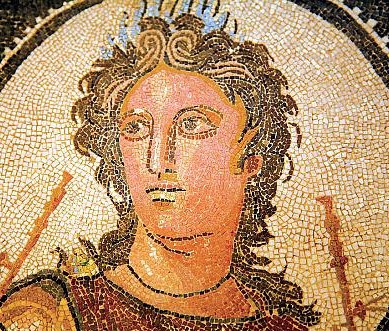
Lewis had longed from his adolescence to become a respected poet. This was partly due to the age in which he was reared. Poetry was viewed as the most cultured and elegant form of writing. Much more so than is true today. (Although I assume today’s poets still regard Euterpe, pictured above, as the most wondrous of Greece’s Muses. Her domain was Music and Poetry.)

Lewis’ poetry did not receive much critical praise. We’ll consider the subject more in the future, but for now suffice it to say that this fact caused him much grief. Walter Hooper, Lewis’ secretary writes in his C.S. Lewis: Companion & Guide: “The most noticeable effect of Lewis’ conversion [to Christianity] was the death of his old ambition as a poet and the emergence of a man never thereafter at a loss for the right words.”

Lewis still wrote poetry, of course, but he no longer sought his identity in it. The following love poem, inspired by his deep affection for his wife Joy, is quite powerful. As they faced her illnesses and death, I believe his words reach heights rarely attained by many a poet laureate.

As the Ruin Falls by C. S. Lewis

All this is flashy rhetoric about loving you.

I never had a selfless thought since I was born.

I am mercenary and self-seeking through and through:

I want God, you, all friends, merely to serve my turn.

Peace, re-assurance, pleasure, are the goals I seek,

I cannot crawl one inch outside my proper skin:

I talk of love—a scholar’s parrot may talk Greek—

But, self-imprisoned, always end where I begin.

Only that now you have taught me (but how late) my lack.

I see the chasm. And everything you are was making

My heart into a bridge by which I might get back

From exile, and grow man. And now the bridge is breaking.

For this I bless you as the ruin falls. The pains

You give me are more precious than all other gains.

If you find this poem moving, it is well worth taking a moment to listen to Phil Keaggy’s musical treatment of Lewis’ lyrics.

Charting Our Life Course

In our last conversation we considered the fact that life is a journey. And during this journey which encompasses our very existence, we follow a variety of paths.

Not all of the paths lead to “happy endings.” I almost wrote “fairy tale endings,” but then I recalled that some old folk tales conclude in a rather grim fashion.

Signposts stand as sentinels at the junctions. “Take this path to self-fulfillment.” “Follow this lane to explore forbidden pleasures.” “This way leads to power.” They offer promises aplenty, but their veracity is not guaranteed. In fact, the more outlandish the claims, the more suspect they become to the wise.

Speaking of wisdom, some of the most powerful words in the Book of Proverbs relate to this notion of choosing paths cautiously. Wisdom and Folly are personified as two women. One offers life-enriching knowledge and insight. The other proffers more carnal and transitory wares.

My son, keep my words


    and treasure up my commandments with you . . .

Say to wisdom, “You are my sister,”


    and call insight your intimate friend,

to keep you from the forbidden woman,


    from the adulteress with her smooth words.

. . . and I have seen among the simple,


    I have perceived among the youths,


    a young man lacking sense,

passing along the street near her corner,


    taking the road to her house . . .

And behold, the woman meets him,


     dressed as a prostitute, wily of heart.

She is loud and wayward;


     her feet do not stay at home;

now in the street, now in the market,


    and at every corner she lies in wait. . . .

I have spread my couch with coverings,


    colored linens from Egyptian linen;

I have perfumed my bed with myrrh,


    aloes, and cinnamon.

Come, let us take our fill of love till morning;


    let us delight ourselves with love.

For my husband is not at home;


    he has gone on a long journey . . .

With much seductive speech she persuades him;


    with her smooth talk she compels him.

All at once he follows her,


    as an ox goes to the slaughter,

or as a stag is caught fast

    till an arrow pierces its liver;

as a bird rushes into a snare;


    he does not know that it will cost him his life.

And now, O sons, listen to me,


    and be attentive to the words of my mouth.

Let not your heart turn aside to her ways;


    do not stray into her paths,

for many a victim has she laid low,


    and all her slain are a mighty throng.

Her house is the way to Sheol,


    going down to the chambers of death.

The power of this proverb is in its truth. I have actually known the seductresses (and seducers) described in these verses. Well, I’ve been acquainted with emanations of both female and male versions of Folly, since they are legion.

Despite the Lies, There is Still Hope

The key to journeying through life with the fewest deadly detours is to rely on a trustworthy guide. A compass, so to speak. A map or handbook that soundly advises which paths to take, and what precipices to avoid.

Of course, if we would rather take the risk, we can rely on human ignorance (is West to my right or my left?) . . . or worldly counsel (let us take our fill . . .).

The Bible lays out the safe and proven path. What’s more, our Savior—who calls himself “The Way,”—promises to accompany us on the journey itself.

One of C.S. Lewis’ least read books is entitled The Pilgrim’s Regress. It is modeled on the classic Pilgrim’s Progress, written by John Bunyan in 1678. The Pilgrim’s Regress was Lewis’ first published work of prose fiction. His protagonist goes through a period of disbelief, mirroring Lewis’ own. It is well worth the read, although, perhaps, it is best preceded by a reading of Bunyan’s original work.

Toward the end of his allegory, Lewis brilliantly describes the course of travel for many who sojourn for a season in foreign (unbelieving) realms. The traveler learns that all who earnestly seek the Truth ultimately find it in a single Source. I offer the following passage not as a “spoiler,” but to illustrate the importance of following the right path—and to entice you to consider reading The Pilgrim’s Regress.

“What do you see?” said the Guide.

“They are the very same shape as that summit of the Eastern Mountain which we called the Landlord’s castle when we saw it from Puritania.”

“They are not only the same shape. They are the same.”

“How can that be?” said John with a sinking heart, “for those mountains were in the extreme East, and we have been travelling West ever since we left home.”

“But the world is round,” said the Guide, “and you have come nearly round it. The Island is the Mountains: or, if you will, the Island is the other side of the Mountains, and not, in truth, an Island at all.”

“And how do we go on from here?”

The Guide looked at him as a merciful man looks on an animal he must hurt.

“The way to go on,” he said at last, “is to go back. There are no ships. The only way is to go East again and cross the brook.”

“What must be must be,” said John. “I deserve no better. You meant that I have been wasting my labour all my life, and I have gone half-round the world to reach what Uncle George reached in a mile or so.”

“Who knows what your uncle has reached, except the Landlord? Who knows what you would have reached if you had crossed the brook without ever leaving home? You may be sure the Landlord has brought you the shortest way: though I confess it would look an odd journey on a map.”

The Road Taken

They are both important. Where we are going, and how we get there.

It’s quite common for analogies about our lives to assume the form of journeys. The journey, in fact, is a fitting metaphor for all human life.

Aging is a journey. Maturing is a journey that should run parallel to aging (though it seldom seems to do so). Learning is a journey. And the image of the “lifelong learner” is something that appeals to most readers and to all who hunger for daily intellectual growth.

Our spiritual lives are journeys of a sort. They follow “paths,” with branches that invite us to travel in myriad directions. Yet all roads are not “equal.” David, the anointed Psalmist prayed, “Make me to know your ways, O Lord;
 teach me your paths” (Psalm 25:4, ESV).

Even secular poets have recognized the power of this concept. One of the most memorable lines ever penned in English is: “Two roads diverged in a wood and I . . . I took the one less traveled by, and that has made all the difference” (“The Road Not Taken,” Robert Frost).

The Inklings expertly used the metaphor of journey to frame their works. Tolkien’s The Hobbit and Lord of the Rings are both propelled, in fact, by vivid journeys. Likewise, Narnia’s Chronicles contain a number of momentous journeys, which ultimately culminate in the final journey which just begins with the close of The Last Battle.

These journeys are, of course, literal trips. Physical traveling from one place to another. Of course, these physical passages occur simultaneously with far more meaningful changes.

The typical contemporary journey of life may take us to varying locales—but it’s possible to savor a rich life journey without ever traveling far from the home of our youth. Indeed, one could be bedridden from birth, and travel the world in terms of experiencing Life. Thanks to God’s gifts of imagination, dream, wonder and faith.

C.S. Lewis also employs this journeying metaphor in his nonfiction works. In The Problem of Pain, he paints a fascinating panorama of our life in this world. He reveals that suffering is actually a blessing, in that it prevents us from growing too attached to this world. Although God graces us with pleasing moments in this life, they are interrupted by moments of insecurity . . . lest we mistakenly believe this finite world is our true home.

Christian doctrine of suffering explains, I believe, a very curious fact about the world we live in. The settled happiness and security which we all desire, God withholds from us by the very nature of the world: but joy, pleasure, and merriment, He has scattered broadcast. We are never safe, but we have plenty of fun, and some ecstasy. It is not hard to see why. The security we crave would teach us to rest our hearts in this world and pose an obstacle to our return to God: a few moments of happy love, a landscape, a symphony, a merry meeting with our friends, a bathe or a football match, have no such tendency. Our Father refreshes us on the journey with some pleasant inns, but will not encourage us to mistake them for home.

May the roads we choose to follow bring us safely to the wonderful home our heavenly Father has prepared for each of us.

___

The beautiful, copyrighted photograph above appears compliments of Craig Sterken Photography at craigsterken.com. Check out his exceptional gallery!